
How to Apply Clear Coat to a Car: Panel Edge or Blend?
This post contains affiliate links. As an Amazon Associate, we earn from qualifying purchases.
To apply clear coat to a car, spray two medium wet coats over fully flashed basecoat, then carry the clear to the nearest panel edge or break-off point and build at least 2.0 mils of dry film. That thickness is PPG’s stated floor for its Limited Lifetime Guarantee and for OEM warranty coverage.
That 2.0 mil figure decides the whole how to apply clear coat to a car question, because clear film thins wherever a coat fades out. A blended edge looks perfect on the day you spray it. Months later it stops looking perfect, and the carmakers who warranty this work have written down exactly what happens and why.
What follows is the version of this job the OEM documents actually support: the film thickness numbers from four different spec sheets, the blending rule Tesla and VW both refuse to sign off on, and the mixing, gun, and flash specs you need sorted before the first pass.
Key Takeaways
- 2.0 mils of dry film is the floor PPG ties to its Limited Lifetime Guarantee and OEM warranty. Glasurit 923-55 specs 40-50 µm and the VW Tiguan manual specs 50-70 µm, so the numbers don’t line up.
- Tesla and VW both reject clear coat blending. Tesla says blended edges lift and discolor over time. VW says solvent blending causes delamination and visible paint lines.
- First coat to the repair area, final coat to the panel end. That’s VW’s sequence. Tesla wants clear coat edge to edge on the entire panel from the start.
- Pot life runs 3 hours for SelectClear 497-00 at 70°F and 4 hours for Glasurit 923-55 at 20°C. Mix only what you can spray inside that window.
- Matte OEM finishes need their own procedure. Volvo’s technical journal states plainly that standard glossy-clear steps don’t transfer.
How Thick Does Clear Coat Need to Be? The 2.0 Mil Floor
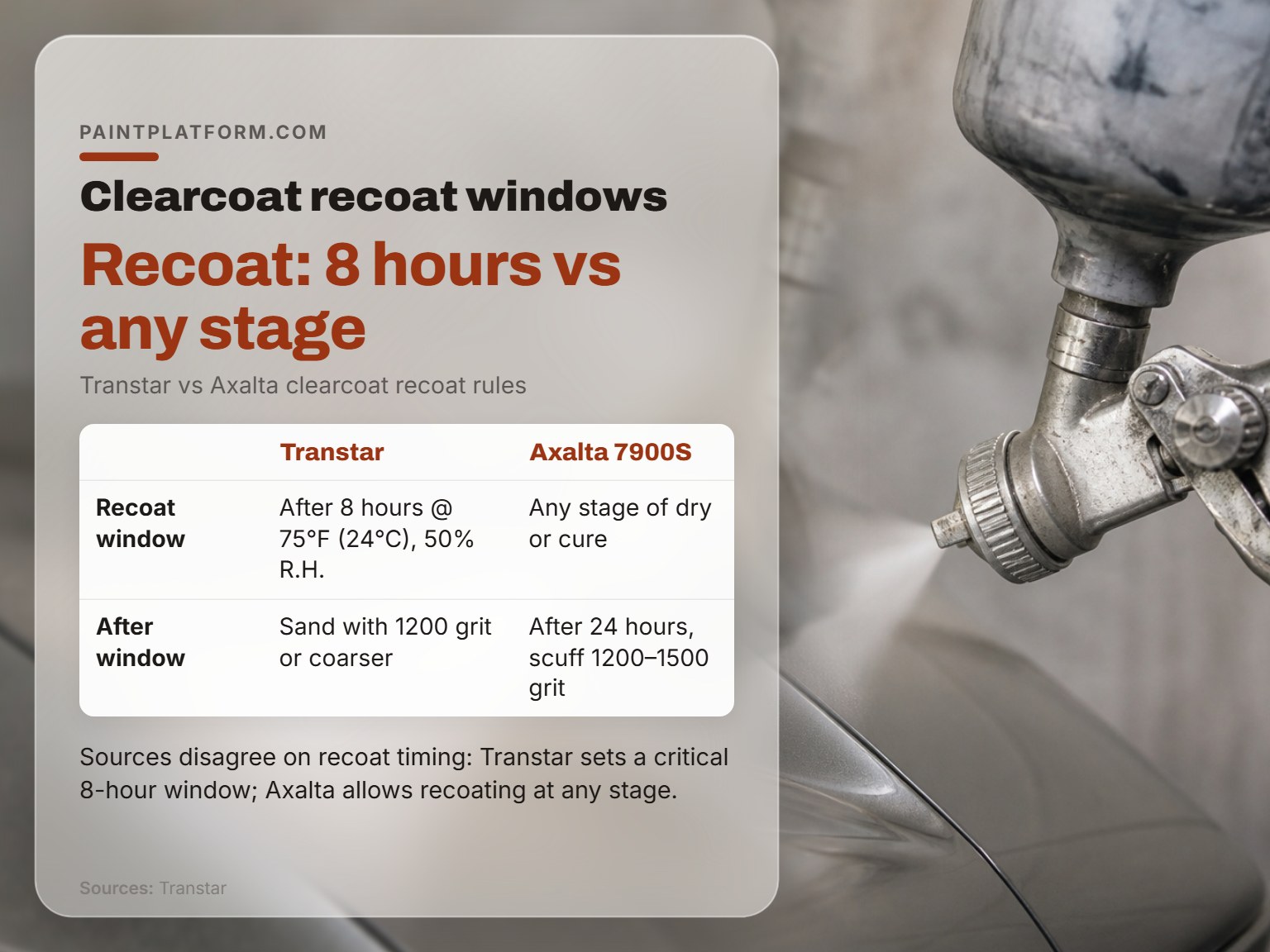
Two mils of dry film is the number PPG ties to its warranty. Miss it and the guarantee language stops applying, however good the panel looks in the booth.
A mil is one thousandth of an inch, and clear coat film thickness is measured after the solvents flash away, not while the panel is still wet. PPG’s PD-0730 procedure requires the clear to cover basecoat color by a minimum of 2.0 mils and to extend to the nearest panel edge or break-off point.
Four documents give four targets, and they don’t agree.
| Source | Dry Film Spec | What It Covers |
|---|---|---|
| PPG PD-0730 | Minimum 2.0 mils | Warranty and OEM approval |
| SelectClear 497-00 | 2.0 mils in 2 coats | Multi-panel and overall repairs |
| Glasurit 923-55 | 40-50 µm (about 1.6-2.0 mils) | Matte OEM finishes |
| VW Tiguan manual | 50-70 µm (about 2.0-2.8 mils) | Two-Part HS Brilliant Plus Clear |
The conflict is worth sitting with. Glasurit 923-55 tops out at 50 µm, which is roughly 2.0 mils. That’s exactly where PPG’s minimum starts. VW’s Tiguan manual wants 50-70 µm, about 2.0 to 2.8 mils.
So a shop spraying Glasurit to the top of its own spec sheet lands right on PPG’s floor and calls it finished. Neither number is wrong. They’re different products with different chemistry, and the data sheet is the only thing that tells you which one you’re holding.
Thickness matters because the film itself blocks UV. More film between the sun and the basecoat gives you more UV protection for auto paint. Less film and the color fades first, then the clear chalks over.
Which number do you aim for? Start at 2.0 mils and treat anything under it as a redo. If you’re spraying a multi-panel repair, SelectClear 497-00 is built for that exact scope, and its own data sheet calls for 2.0 mils in two coats.
If you’re matching a matte OEM finish instead, Glasurit 923-55 is the product formulated for it, and its spec is 40-50 µm. Every clear coat paint system carries its own thickness target, and that target is what you measure against at the end.
Easy to miss: Film thickness is measured after the solvents leave, not while the panel is wet. A wet-looking coat reads thick and then dries thinner than you thought you sprayed.
Why Tesla and VW Both Refuse to Blend Clear Coat
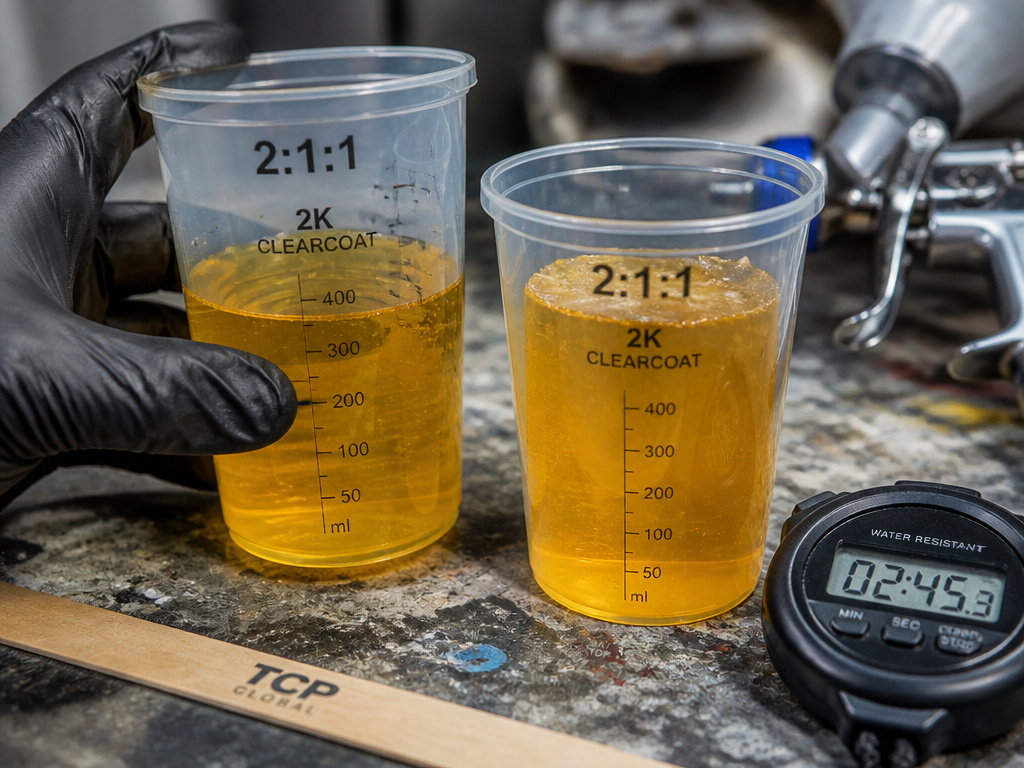
Blending clear coat is common practice in plenty of shops. Tesla and Volkswagen both say not to do it, in writing, in documents you can pull up right now.
Tesla’s Model 3 body repair procedure states that Tesla does not approve of, condone, or recommend clear coat blending in any collision repair. It permits the technique only on interior structures that stay minimally exposed to the elements.
VW’s position statement is just as blunt. Solvent blending isn’t an acceptable method of repair on any Volkswagen vehicle, and the company points to lack of adhesion, delamination of the OEM finish and the refinish coating, and visible paint lines from polishing thin blended areas.
Delamination means the finish lifts away from the panel in layers. That’s the failure VW is describing.
VW also notes that solvent blending products aren’t recommended or guaranteed by the paint companies that make them. The products sit on shelves. Their own manufacturers won’t back them.
| Position | Who Holds It | Stated Reason |
|---|---|---|
| No blending, ever | Tesla | Edges lift and discolor over time |
| No solvent blending | Volkswagen | Delamination and visible paint lines |
| Spot repair is supported | VW Tiguan manual | Clever repair procedure for minimal damage |
| Clear to the panel edge | PPG PD-0730 | Required for the lifetime guarantee |
VW’s own Tiguan service manual complicates that picture. For minimal damage repairs, it documents a clever repair procedure where the 5% Clear Coat Additive gets swapped for 5% HS Spot Thinner. So the company rejects solvent blending while still publishing a spot repair path.
The mechanism behind all of it is thickness. Clear coat thins as it fades out at the edge of a repair, so the film at that boundary is the thinnest part of the job. Tesla’s procedure says the thinning is what makes the repair boundary visible over time.
The same shallow-film problem drives most clear coat scratches on a daily driver. Shallow film fails first.
How to Apply Clear Coat to a Car: Whole Panel or Repair Area?
The two OEM procedures run in opposite directions, and both of them work.
Tesla wants clear coat applied to the entire panel, from edge to edge, or to a break point that allows proper adhesion and material flow. Its preferred process blends the base coat color for a seamless transition, then clears the whole panel.
VW splits it. The first clearcoat goes to the repair area only. Only the second coat in a two-coat system, or the final coat in a three-coat system, gets extended to the panel end.
Before you start: Sanding, cutting, brazing, or welding dry clear coat without a NIOSH-approved air-purifying respirator with particulate filters, or proper ventilation, puts that dust straight into your lungs. Wear gloves for the same operations. And check your state’s rules before buying a solvent-blending product, because many states prohibit VOC-containing ones outright.
VW’s Two-Coat and Three-Coat Sequences
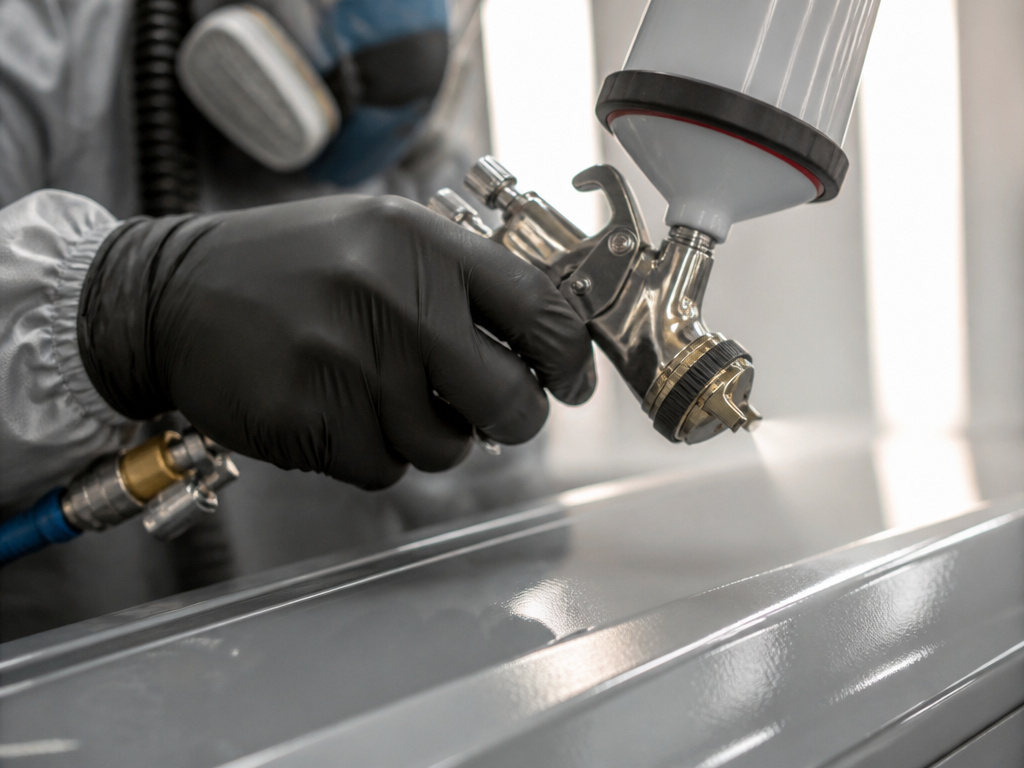
- Spray the first clearcoat to the repair area only. Clear the whole panel first and you add material you’ll have to level back down.
- Extend the second coat to the panel end in a two-coat system. Stop short and you’ve built the thin edge VW warns about.
- In a three-coat system, extend only the final coat to the panel end. The middle coat stays on the repair area.
- Keep the base coat blend underneath. The clear follows the color, not the other way around.
PPG’s PD-0730 sits between the two approaches. It requires the clear to reach the nearest panel edge or break-off point, which is shorter than a full panel but further than the repair area.
Spray the first coat to the repair area and the last coat to the panel end. That one rule covers VW’s sequence and keeps the visible edge off the repair boundary.
Neither sequence survives bad prep underneath. Clear coat follows the base coat, and the base coat follows whatever you left on the panel, so surface prep decides more of the outcome than the brand on the can.
The VW numbers come from the Tiguan service and repair manual.
Mixing, Pot Life, and the Clock You Can’t Stop
Pot life is the deadline nobody respects until the first cup goes solid.
Neither clock pauses. A 2K clear is two components that start reacting the moment they meet, and that reaction is what cures the film. Leave it in the cup while you take a call and you’re spending pot life on nothing.
The Three Activators and When to Use Each
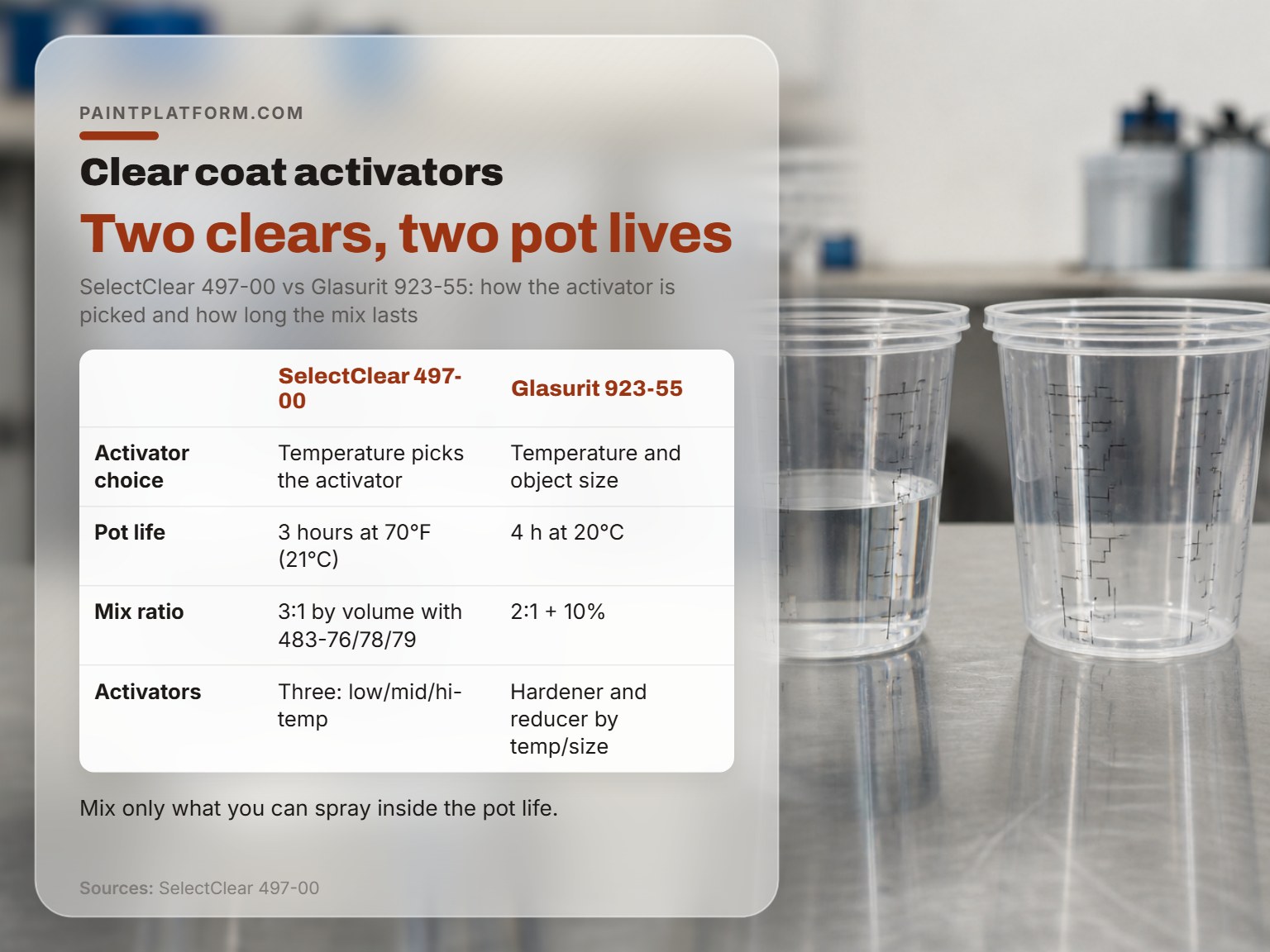
SelectClear 497-00 ships three activators (low/mid/hi-temp) and is mixed 3:1 by volume with 483-76/78/79 activator.
- Temperature picks the activator on SelectClear.
- Temperature and object size both drive the choice on Glasurit, which is one more variable than most people plan for.
- Pot life is 3 hours for SelectClear 497-00 at 70°F.
- Pot life is 4 hours for Glasurit 923-55 at 20°C.
Mix only what you can spray inside the pot life. I’d rather mix a second cup than watch a full one turn to jelly in the gun.
That’s a product instruction, not a suggestion.
Gun Setup: Tip Size, Pressure, and Viscosity
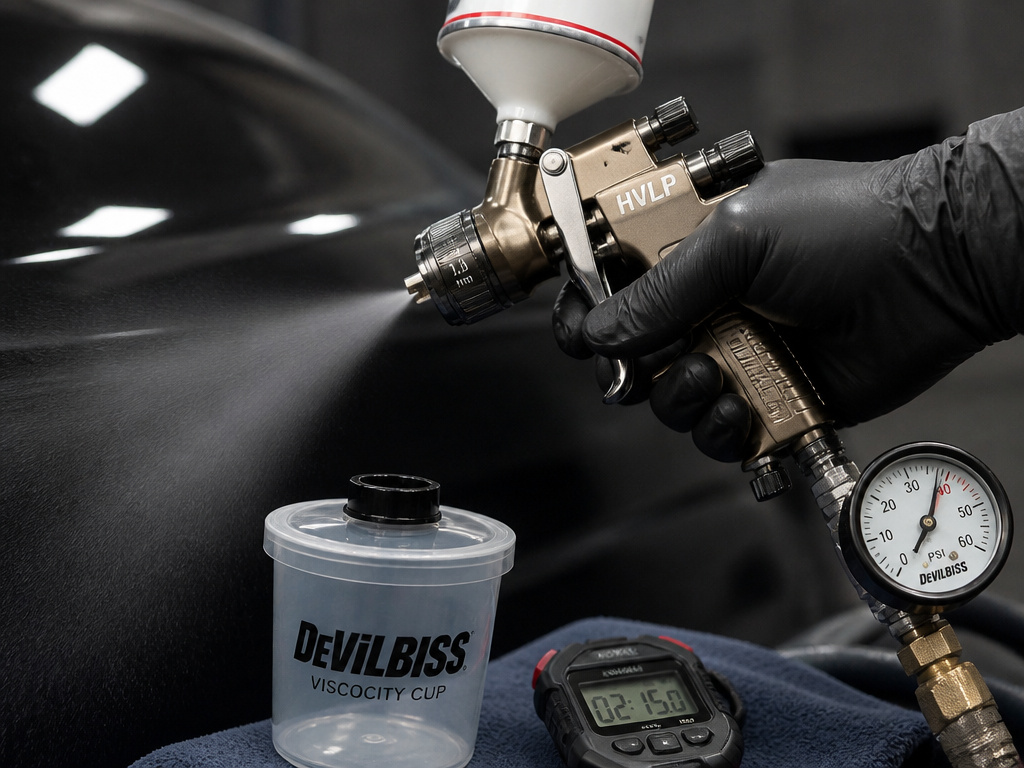
Glasurit 923-55 lists a spray viscosity of approximately 16 s DIN 4 at 20°C.
- SelectClear 497-00: 1.3-1.6 mm tip, 30-40 PSI at the gun, 8-10 PSI at the cap.
- Glasurit 923-55: spray viscosity approximately 16 s DIN 4 at 20°C.
- VW Tiguan manual: 1.2-1.3 mm at 2.0-2.5 bar, HVLP atomizing at 0.7 bar.
Dry spray is easy to spot once you know the look. The film lands chalky and pale with a sandy texture, and it feels rough under a fingertip instead of slick.
Where this goes sideways: Turning the pressure up to fix a dry-spray look. More pressure pushes more solvent out before the film lands, so the texture gets worse instead of better.
If you’re working from clear coat spray paint cans instead of a gun, none of these numbers apply. Aerosol cans carry their own pressure and their own tip, and you can’t adjust either one.
Good spray gun technique matters as much as the numbers. Keep the gun parallel to the panel and overlap your passes.
Flash Windows: 5 Minutes or 20?
You spray the second coat, step back, and the panel already looks finished and glossy. The clock on the wall says four minutes. The data sheet says five to seven.
Those numbers come from different chemistry, different solvent loads, and different windows. They aren’t interchangeable between products.
Never flash off for more than 25 minutes after a Glasurit spraycoat. Past that window the film skins over, and the next coat lands on a surface it can’t bite into.
Tack-free at 1-2 hours doesn’t mean cured. The panel looks dry and feels dry long before it’s safe to tape, which is why the sheet says overnight.
Force Dry and Infrared Times
Matte and Satin Finishes Break the Standard Procedure
Matte panels need their own playbook.
Volvo’s technical journal states that matte painted vehicles require extra care during body repairs and that standard glossy-clear procedures aren’t transferable. That’s a carmaker telling you the normal routine doesn’t apply.
The journal is available via the NHTSA technical service bulletin archive.
Glasurit 923-55 is the product built for this work. It’s a two-pack clear for mat basecoat and clearcoat finishes, suitable for repairing extremely mat OEM finishes and for finishing bumpers.
Tuning Gloss and the Clever-Repair Mixture
That’s how you walk a finish toward the sheen the car came with.
VW’s Tiguan manual documents a clever repair procedure for minimal damage.
- The additive lengthens the drying period when mixed 3:1 with two-part VHS hardeners.
- The spot thinner replaces it for minimal damage repairs.
- Neither belongs on a reclined surface. The manual says so directly.
Skip this if: You’re planning a spot repair on a matte panel. Volvo states that standard glossy-clear procedures aren’t transferable, and VW’s manual warns the clever-repair mixture off reclined surfaces entirely.
VOC Rules and the Respirator You Actually Need
The paperwork matters as much as the gun on this job.
SelectClear 497-00 is rated 4.3 lb/gal (520 g/l) VOC compliant, and the data sheet notes it needs lacquer thinner or a low-VOC cleaner in regulated markets. That’s a product-level instruction.
A product that’s fine in one state can be a violation in the next one over.
Then there’s the dust.
- Respirator or ventilation for any sanding, cutting, brazing, or welding of dry coating.
- Gloves for the same operations.
- Local VOC rules before you buy a solvent-blending product.
The warning covers sanding on a cured film of any kind. Wet sanding cuts the airborne dust down, but it doesn’t replace the respirator.
One more number worth knowing.
Frequently Asked Questions
How thick should clear coat be?
Start at 2.0 mils of dry film. PPG’s PD-0730 sets that as the minimum for its Limited Lifetime Guarantee and OEM warranty. Glasurit 923-55 specs 40-50 µm and the VW Tiguan manual specs 50-70 µm, so confirm the target on your own product’s data sheet before you spray.
Is clear coat blending acceptable?
Tesla and Volkswagen both say no. Tesla states it doesn’t approve of, condone, or recommend clear coat blending in any collision repair, and permits it only on interior structures minimally exposed to the elements. VW says solvent blending isn’t an acceptable method of repair on any Volkswagen vehicle.
How long is the pot life of mixed clear coat?
SelectClear 497-00 gives you 3 hours at 70°F (21°C). Glasurit 923-55 gives you 4 hours at 20°C. The clock starts when the two components meet, and it doesn’t pause, so mix only what you can spray inside the window.
What gun tip size do you need for clear coat?
SelectClear 497-00 calls for 1.3-1.6 mm. Glasurit 923-55 lists 1.3 mm on HVLP gravity feed or 1.3-1.4 mm on a compliant gun. VW’s Tiguan manual calls for 1.2-1.3 mm. Match the tip to the product sheet, not to the last job you sprayed.
Can you spray clear coat on just the repair area?
VW’s procedure does exactly that for the first coat, then extends the second or final coat to the panel end. Tesla’s procedure clears the entire panel from edge to edge from the start. PPG requires the clear to reach the nearest panel edge or break-off point.
Do matte cars need a different clear coat?
Yes. Volvo’s technical journal states that matte painted vehicles require extra care and that standard glossy-clear procedures aren’t transferable. Glasurit 923-55 is formulated for extremely mat OEM finishes and can be mixed with Glasurit 923-57 to tune the gloss level.
The Bottom Line
Measure before you spray, not after. A wet film gauge tells you what you actually built while there’s still time to add a coat.
Here’s the threshold that decides the job: if the repair can’t carry clear coat all the way to a panel edge or a break-off point, you’re doing a blend, and both Tesla and VW have said in writing that they won’t stand behind it. On a car you plan to keep, that’s the whole decision.
One concession, though. If the repair sits on an interior structure that barely sees weather, Tesla’s own procedure allows blending there. The rules track exposure.
So that’s how to apply clear coat to a car in a way that holds up. Your first step this week: find the data sheet for whatever clear you’re actually spraying and write its film thickness target on the lid of the can. Every other number in this job gets measured against that one.
