
Car Paint Types Explained: What Each Layer Does
This post contains affiliate links. As an Amazon Associate, we earn from qualifying purchases.
Car paint types explained: a modern factory finish stacks five layers (phosphate, electrocoat, primer, basecoat, clearcoat) totaling 105 to 115 microns on a Ford body, and the type of each layer decides how the paint ages, repairs, and fails.
The layer count is the easy part. What each layer is actually made of is where the real differences live, because a lacquer topcoat and a urethane topcoat sit on the same five-layer stack and cure by completely different chemistry.
What follows is the full stack as Ford documents it, then the topcoat chemistries that actually differ, then the exceptions that break the standard model, and finally what it all means for a touch-up on a daily driver.
Key Takeaways
- Five layers, not three: phosphate (5 microns), electrocoat (20), primer (25), basecoat (10 to 20), clearcoat (45) on a Ford body.
- Lacquer and enamel aren’t the same product: EPA AP-42 lists lacquer at 12 to 18 volume percent solids and enamel at 24 to 33.
- Chromatic colors age faster: Ford rates core colors (white, black, silver) at 5+ years and chromatic colors (red, blue, green) at 2 to 3 years.
- Matte finishes can’t be buffed: GM 23-NA-016 says buffing polishes the flat finish, and panel repaint is the only correction.
- Mixing brands is forbidden for warranty work: GM GMW15406 and Honda TSB 16-055 both require a single complete system from one manufacturer.
The Five Layers in a Modern Factory Finish
A Ford body panel leaves the plant with five separate coats on it, and each one has a job the others can’t do.
The phosphate layer at 5 microns sits directly on the steel. Electrocoat at 20 microns provides corrosion protection. Primer at 25 microns smooths the electrocoat and blocks light. Basecoat at 10 to 20 microns carries the color and metallic flake. Clearcoat at 45 microns provides gloss and UV protection.
| Layer | Thickness (microns) | Job |
|---|---|---|
| Phosphate | 5 | Corrosion protection, adhesion |
| Electrocoat | 20 | Corrosion protection |
| Primer | 25 | Smooths electrocoat, blocks light |
| Basecoat | 10 to 20 | Color and metallic flake |
| Clearcoat | 45 | Gloss, UV protection |
Many explanations of car paint types stop at basecoat and clearcoat. Ford’s own documentation lists five layers, and the extra three do real work. Run a fingernail across a rocker panel and the extra PVC anti-chip layer feels slightly soft, almost rubbery, compared to the hard clearcoat above it.
The Trim System Is a Different Stack
Bumper covers and plastic trim don’t get electrocoat, because you can’t run current through plastic. Ford’s trim system substitutes a 25-micron conductive primer over TPO, the thermoplastic olefin most fascia panels are molded from. That primer provides adhesion to the plastic, and the rest of the stack (basecoat and clearcoat) sits on top of it.
The practical consequence: a bumper cover and a steel fender on the same car have different underlayers, so a chip in each one exposes different material. Matching color is the easy part. Matching the substrate underneath is where touch-up gets complicated.
Some commercial vehicles skip clearcoat entirely and use a monocoat system for solid colors. That changes UV protection and repair strategy both. If you’re buying automotive primer for a DIY repair, know which substrate you’re spraying before you open the can.
The automotive OEM paint process perspective walks through the full stack, and it’s worth reading the primary document rather than a summary.
The clear coat is the layer most people think of as “the paint.” It’s also the layer that fails first in UV-heavy climates, which is why a chalky, oxidized finish usually means the clear is gone and the basecoat is next.
Why Does Lacquer Spray Differently Than Enamel?
The two finishes cure by completely different mechanisms, and that difference decides how many coats you need and how the finish behaves after a decade in the sun.
EPA AP-42 lists lacquer at 12 to 18 volume percent solids and enamel at 24 to 33 volume percent solids. That’s a rough measure of how much actual paint is left on the panel after the solvent flashes off. Lower solids means more coats to build the same film thickness.
Transfer efficiency is the other half of the story. Air-atomized spraying lands 30 to 50 percent of the coating solids on the part. Electrostatic spraying lands 60 to 95 percent, because the charged droplets are pulled toward the grounded panel instead of drifting past it.
Lacquer dries by solvent evaporation alone. Enamel and urethane cure by evaporation plus chemical cross-linking, which is why a lacquer finish needs buffing for full gloss and a urethane finish doesn’t.
A lacquer coat flashes off quickly. An enamel coat stays tacky noticeably longer. That’s the cross-linking working, and it’s why enamel rewards patience and punishes impatience.
If you’re spraying a single color and want the simplest possible path, single-stage paint skips the clearcoat step entirely. It’s also the finish most classic-car restorers reach for, because it’s period-correct for a lot of older vehicles.
The EPA’s surface coating operations chapter is where those solids and transfer-efficiency numbers come from, and it’s the document to cite if you ever need to defend a spray-booth decision.
Car Paint Types Explained: How Ford and VW Split Their Microns
Ford’s clearcoat alone is 45 microns. VW’s factory manual documents the Golf’s uni waterborne finish and its metallic or pearlescent waterborne finish as separate structures.
| OEM | Total thickness | Documented |
|---|---|---|
| Ford body | 105 to 115 microns | Per-layer breakdown, clearcoat 45 |
| VW Golf uni | Not specified | Waterborne solid color |
| VW Golf metallic | Not specified | Waterborne metallic or pearl |
Ford puts nearly half its total film thickness into clearcoat, while VW documents its uni and metallic/pearlescent waterborne finishes as separate structures. Neither approach is wrong.
The Volkswagen factory finish paint structure manual documents the uni (solid color) waterborne finish and the metallic or pearlescent waterborne finish as separate structures. It also notes that individual vehicles repainted once or several times may exceed the spec, and that this need not be communicated. So a used car with a repaint may not match the factory numbers at all.
When you’re comparing car paint types for a repair, the OEM allocation matters less than the total. What matters is whether your repair adds thickness without exceeding the surrounding panel, because a fat repair shows as a ridge at the blend line under direct sun.
Matte, Tri-Coat, and Tinted Clearcoat: The Exceptions
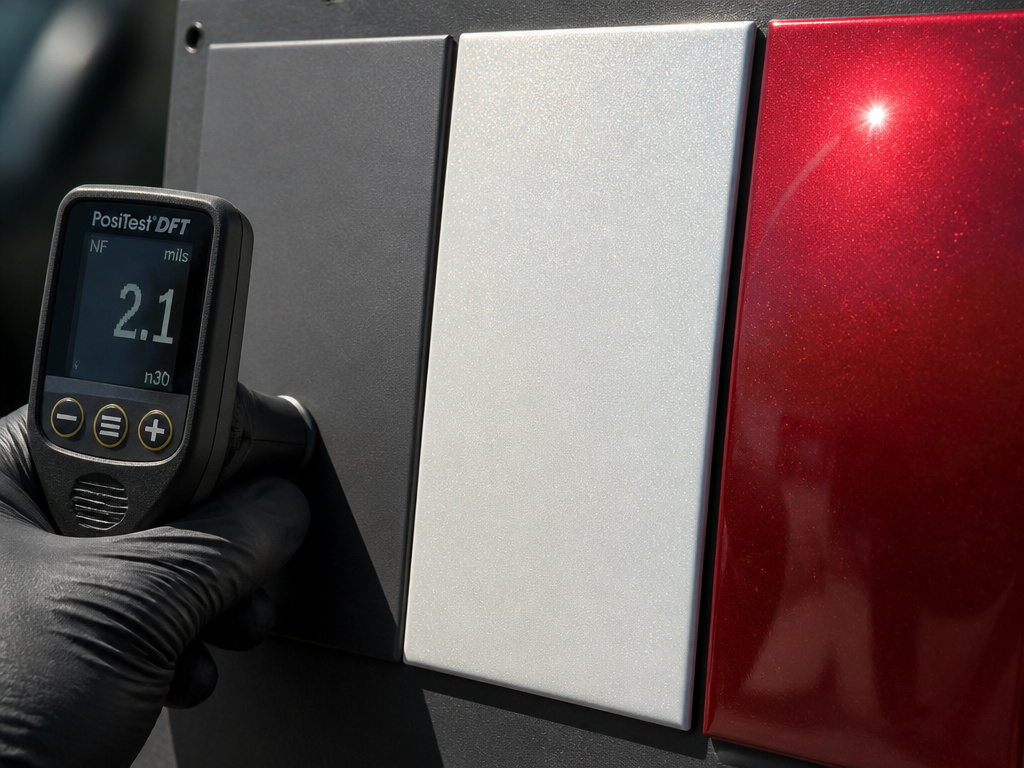
Every rule above has an exception, and the exceptions are where most DIY paint advice falls apart.
- Matte finish (GM 23-NA-016, starting with the 2024 HUMMER EV SUV Edition 1): same clearcoat chemistry as gloss, but the coating diffuses and absorbs light instead of reflecting it.
- Tri-coat (Ford): the basecoat splits into a groundcoat (pigment) and an effect-flake layer (mica), used for pearlescent whites and neutrals.
- Tinted clearcoat (Ford): mostly on reds, some blue or yellow, where the clear itself carries pigment.
- Monocoat (Ford): solid colors on some commercial vehicles, no clearcoat at all.
A matte panel under direct sun looks flat and slightly chalky, with none of the wet sheen a gloss clearcoat throws back at you. That visual difference is the whole point of the finish, and it’s also why standard repair advice breaks.
Before you start: Spray paint only in a well ventilated area, wear an approved respirator, gloves, and eye protection, and keep containers away from sparks, flames, or cigarettes. Isuzu’s body repair manual treats every one of those as a hard rule, not a suggestion.
Why Tri-Coat Breaks the Base/Clear Model
A tri-coat adds a third layer between primer and clear, and that layer changes what a color match actually requires. If you spray a tri-coat repair with a standard basecoat and clearcoat, the color will read wrong from certain angles because the effect-flake layer isn’t there to bounce light the way the factory intended.
The practical rule: if the door-jamb sticker or the build sheet calls out a tri-coat code, don’t try to match it with a two-stage product. Order the actual three-stage system or hand the panel to someone who has it.
Where this goes sideways: Buffing a matte panel. GM 23-NA-016 says buffing polishes the flat finish, and the only correction is a full panel repaint. There’s no touch-up path back to flat.
The automotive paint types that handle these exceptions are a specialized category. Many off-the-shelf sprays assume a gloss basecoat-clearcoat job.
Repair Rules Depend on the Paint Type You’re Matching
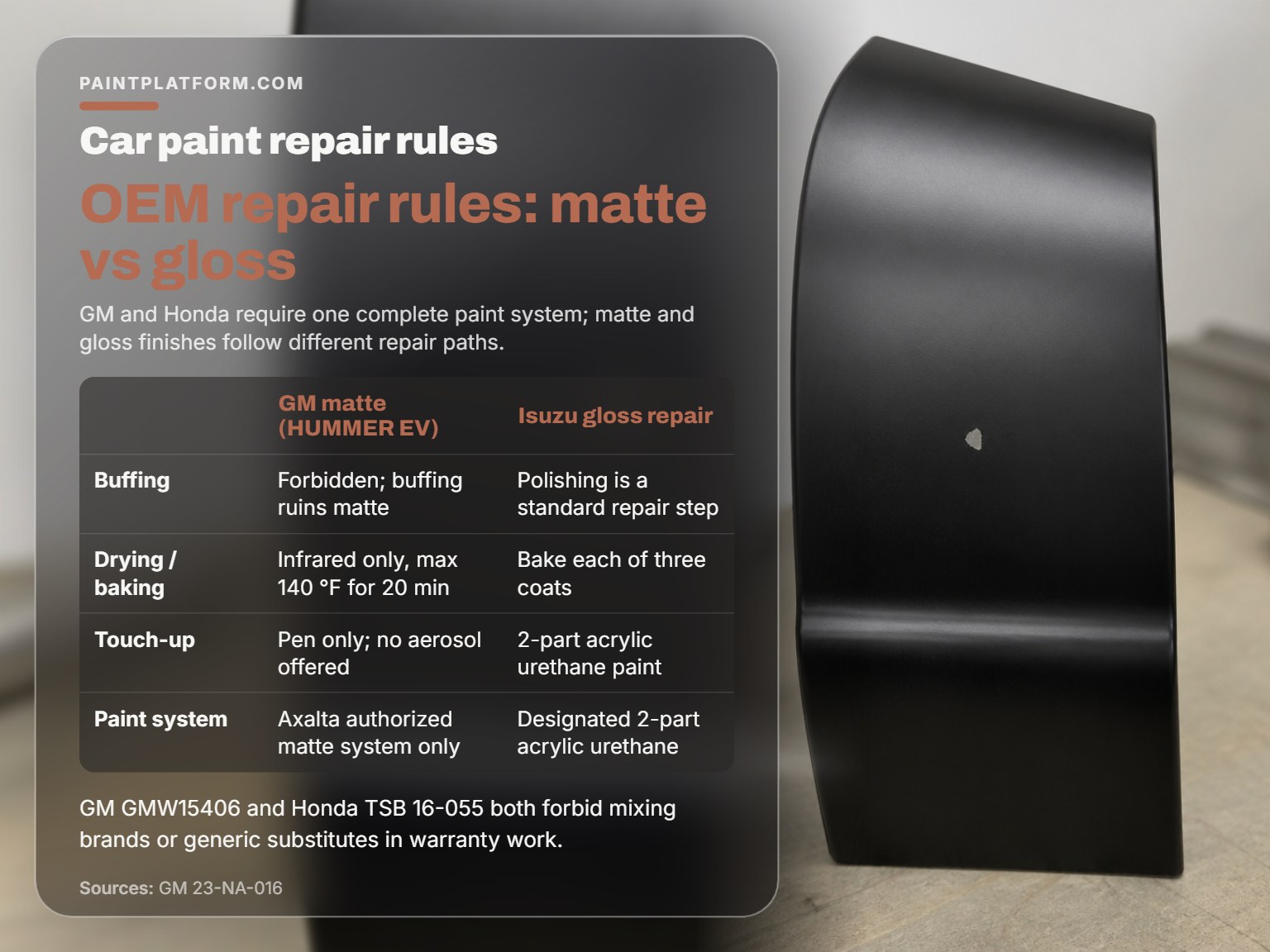
Warranty paint repair is a dealer topic, and that’s exactly why it’s worth reading. The rules that govern it tell you what the OEMs actually trust, and those rules are stricter than most people expect.
GM GMW15406 requires dealers to use only materials and methods meeting the spec, and it says approved primers, surfacers, sealers, basecoats, and clearcoats form a complete system that isn’t interchangeable. Honda’s TSB 16-055 goes further: only listed products, the entire system from one manufacturer, a hardener or activator added to the basecoat, and no generic substitutes. Honda also requires a copy of the repair order listing the paint manufacturer and products used, and it warns that missing documentation can trigger warranty chargebacks.
Here’s where the OEMs actually disagree. GM 23-NA-016 forbids buffing matte paint and says GM won’t offer aerosol touch-up for the HUMMER EV, requiring the pen or a panel repaint. Isuzu’s body repair manual treats polishing and spraying as standard repair steps. Both are OEM documents. The difference is the finish: a matte surface can’t be polished back to flat, so the repair path changes.
Cure temperature is another split. GM 23-NA-016 caps matte repair drying at 140 degrees Fahrenheit for 20 minutes using infrared only. Ford’s factory body topcoat cures at 140 degrees Celsius, which is a completely different process in a completely different context. The numbers look contradictory if you read them side by side without the context.
What most people get wrong: Mixing brands. GM GMW15406 says approved products form a complete system and aren’t interchangeable. Honda TSB 16-055 adds that generic substitutes aren’t allowed and can trigger warranty chargebacks.
Isuzu’s factory process is worth knowing because it explains why the repair rules are so rigid. The body is degreased, cleaned, and zinc-phosphate coated by dipping, then placed in a cationic electrodeposition primer bath, then chipping primer goes on the most susceptible areas. A repair that skips any of those steps approximates the original finish.
The NHTSA warranty and goodwill paint bulletin is the Honda document in full.
If you’re working on a classic car paint job, the warranty rules may not apply, but the system logic still does. Pick one manufacturer’s primer, basecoat, and clearcoat and stay inside that line.
What Should You Buy for a Small Touch-Up?
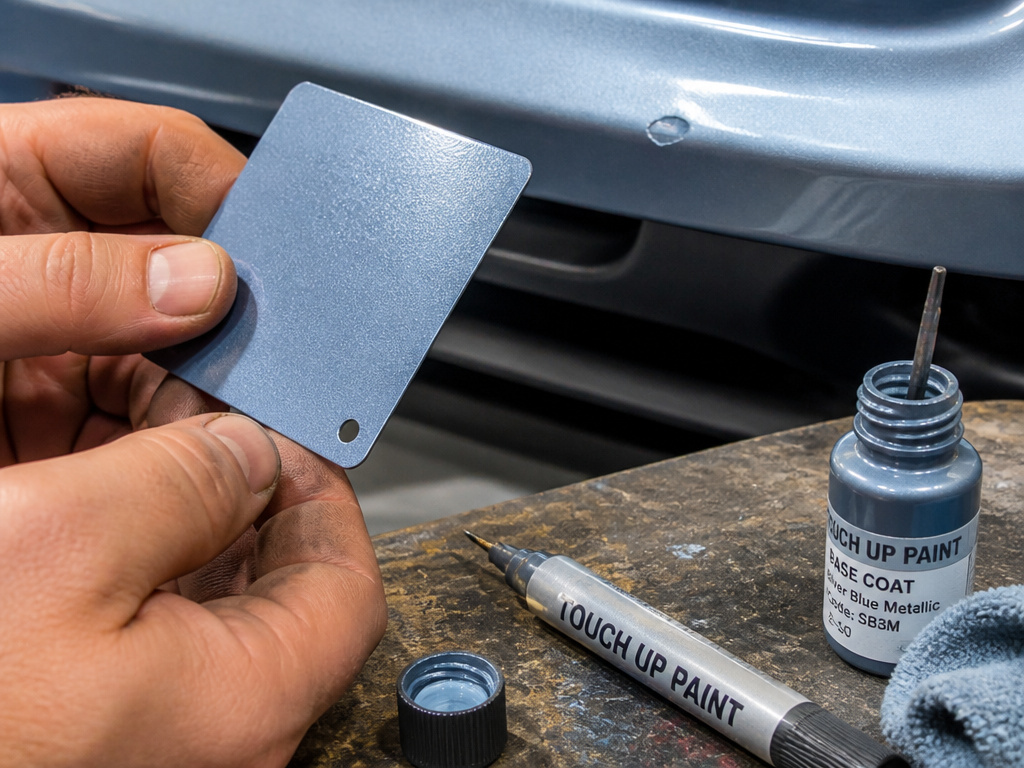
A rock chip on a daily driver doesn’t need a spray booth, and it doesn’t need a custom-mixed aerosol from a paint shop.
The car paint types explained above all assume you’re matching a factory finish. A touch-up doesn’t need to match perfectly, just closely, and the difference between a touch-up that holds up and one that doesn’t is almost always technique, not product.
Here’s what I keep on the shelf: a color-matched touch-up product for factory codes, a pen-and-brush product for small chips, and an enamel when I’m spraying a larger panel that doesn’t need a perfect color match. None of those are show-car products. They’re daily-driver products, and that’s the point.
The Scrap Panel Test
Before any of that touches a car, it touches a scrap panel. I keep one next to my workbench and shoot every color on it first. That habit has saved more bumpers than any product I’ve bought.
I used to think a pricier can would fix a bad blend. Testing on scrap panels taught me the hand matters more than the label.
- Clean the chip with alcohol and let it dry completely, because solvent trapped under fresh paint can blister the repair.
- Test the color on a scrap panel first, because a factory code can read a shade off on a sun-faded panel.
- Build thin coats, several light passes instead of one heavy one, because thick coats run and trap solvent.
- Let each coat flash before the next, because spraying wet-on-wet lifts the layer underneath.
- Top with clear if the chip went through the clearcoat, because a basecoat-only repair has no UV protection.
I keep a scrap panel next to my workbench and shoot every color on it before it touches a car. That habit has saved more bumpers than any product I’ve bought.
Common mistake: Spraying one heavy coat to cover the chip fast. Thick coats run, sag, and trap solvent under the skin, and the touch-up looks worse than the chip did.
A run in fresh spray paint catches the light as a glossy teardrop, and by the time you notice it the skin underneath may have already skinned over. Overworking a touch-up can make it worse. Stop while it still looks a little underdone.
Trust the process, then trust your eye.
If you’re buying your first can of automotive spray paint, start with a paint for beginners kit and a scrap panel. The lesson lives in the hand.
Frequently Asked Questions
What are the five layers of car paint?
Phosphate, electrocoat, primer, basecoat, and clearcoat. Ford documents them at 5, 20, 25, 10 to 20, and 45 microns respectively, for a total of 105 to 115 microns on a body panel. Bumper covers substitute a 25-micron conductive primer for the electrocoat because plastic can’t take an electrical charge.
Is lacquer still used on new cars?
Rarely. Modern factory finishes are almost all basecoat-clearcoat systems built on waterborne or high-solids chemistry, and the clearcoat is an acrylic copolymer. Lacquer still shows up in restoration work and some specialty applications, but it isn’t what comes on a new car from any major OEM.
Can you buff a matte car finish?
No. GM 23-NA-016 is explicit: buffing polishes the matte paint, reducing or eliminating the flat appearance, and the only correction is a full panel repaint. Touch-up is limited to the matte paint pen from the parts department. Aerosol touch-up isn’t offered for the HUMMER EV matte finish.
Why do red cars fade faster than white ones?
Ford rates core colors (white, pearl white, black, grey silver) as stable for 5+ years and chromatic colors (blue, red, green, orange, yellow) at a 2 to 3 year life. Tinted clearcoats, which are mostly used on reds, fall into the chromatic group. The pigment chemistry, not the clearcoat, is what ages.
Do I need to use the same brand of primer and clearcoat?
For warranty work, yes. GM GMW15406 and Honda TSB 16-055 both require a complete system from one manufacturer, and both forbid mixing brands or generic substitutes. For a DIY touch-up, the same logic still applies: a primer designed for one clearcoat may not bond properly to another.
The Bottom Line
Everything in this car paint types explained walkthrough comes down to one practical question: how much of the finish do you actually need to match?
My rule: if the chip is small and the car is older, a touch-up pen and a scrap panel get you most of the way there. If the chip went through to bare metal, or the panel is matte, consider professional repair. The math changes fast once you’re past the clearcoat.
The one thing I’d change about how most people approach this: practice on a junk panel before you touch your own car. The lesson lives in the hand, and a junk hood costs less than a mistake on a daily driver.
And a concession. None of this applies if you’re chasing a showroom finish on a classic. For a daily driver, protection matters more than perfection.
