
How to Dispose of Spray Paint Cans: Empty vs Non-Empty
This post contains affiliate links. As an Amazon Associate, we earn from qualifying purchases.
To dispose of spray paint cans, first settle one question: is the can empty? Under California’s rule, a can that sprays nothing through a clear nozzle can go in the trash or to a scrap metal recycler, while Washington requires residue not exceed 3 percent by weight or 1 inch and pressure be at or near atmospheric. A can with paint still inside, or a clogged or damaged nozzle, goes to household hazardous waste.
The how to dispose of spray paint cans clogged-nozzle clause is where most people get caught, because a can that hisses and then quits looks empty from the outside. Under California’s rule, a defective spray mechanism keeps the can non-empty even after the propellant is gone, though California also says a can you push the nozzle on with nothing coming out and a nozzle that isn’t clogged can go in the trash or to a scrap metal recycler.
Here’s what follows: the two competing definitions of empty, the nozzle test that settles it in about three seconds, where non-empty cans actually go, and the storage habits that keep a half-full can from turning into a problem before drop-off day.
Key Takeaways
- Empty is a legal term, not a feeling. Under California’s rule, a can with a working nozzle that sprays nothing qualifies, while a clogged can does not, and Washington adds a 3 percent residue cap and an atmospheric-pressure check.
- California and Washington define empty differently. California uses “maximum extent practical,” while Washington adds a 3 percent residue cap and an atmospheric-pressure check.
- Non-empty cans are banned from trash and blue bins in California, and LA County applies the same rule to homeowners and small generators, though LA County also says anyone may dispose of empty aerosol cans as solid waste or recycle empty cans as scrap metal.
- Pesticide cans are the trap. Washington flags cans with a “Danger” or “Warning” label as the most common aerosol products that become extremely hazardous waste, while LA County says anyone may dispose of empty aerosol cans as solid waste or recycle empty cans as scrap metal.
- Store cans upright, away from flames, acids, and anything that can dent them until you reach a collection site.
What Counts as Empty When You Dispose of Spray Paint Cans?
Two regulators answer this differently, and the gap between them decides where your can ends up.
An aerosol can qualifies as empty when the contents and propellant have been discharged to the maximum extent practical under normal use, meaning the spray mechanism was not defective and allowed discharge. A can with a damaged or clogged valve remains non-empty even after the propellant is exhausted.
That paragraph is the whole rule in miniature, and both halves matter. Read the DTSC non-empty aerosol can rule and you’ll see the state leaning hard on one word: defective. A can that worked normally and ran dry is empty. A can that failed is not, no matter how light it feels.
The California Definition
California’s rule, Cal. Code Regs. Tit. 22 §66261.7(m), sets the bar at “maximum extent practical under normal use.” There’s no residue weight, no pressure gauge, no shake test. The test is whether the spray mechanism was working when the can ran out.
Here’s the practical version, straight from the same page: if you push the nozzle and nothing comes out and the nozzle isn’t clogged, you can throw the can in the trash or take it to a scrap metal recycler. That’s the whole procedure.
The Washington Definition
Washington’s Department of Ecology adds numbers California doesn’t use. For common 6-ounce to 16-ounce spray cans, the can is empty when residue doesn’t exceed 3 percent by weight or more than 1 inch, and the pressure inside is equal or nearly equal to atmospheric pressure. A shake test may be enough to check the residue.
| Question | California (DTSC) | Washington (Ecology) |
|---|---|---|
| Empty means | Discharged to maximum extent practical | Completely sprayed out, minimal residue |
| Residue limit | None stated | 3 percent by weight or 1 inch |
| Pressure check | Not mentioned | At or near atmospheric |
| Clogged valve | Non-empty | No separate rule |
Neither state is wrong. They’re answering the same question with different levels of precision: California uses ‘maximum extent practical,’ while Washington adds a 3 percent residue cap and an atmospheric-pressure check.
The 3-Second Nozzle Test That Decides Everything
You’re standing in the garage holding a can of spray paint that last worked in October. Point it at a scrap of cardboard and press the button.
The sound tells you most of it. A live can gives you a flat hiss with the mixing ball rattling underneath. A dead one gives you a hollow click and then nothing, and that silence is the thing you’re listening for.
Before you start: Most aerosol cans run on propane, butane, or liquefied petroleum gas, which is why California treats most non-empty cans as ignitable hazardous waste. Test outdoors or with the garage door open, away from pilot lights and water heaters. Don’t puncture or crush a can at home unless your local program specifically asks you to.
- Point the nozzle at scrap cardboard, outdoors or with the door open. Skipping the cardboard means you find out on the driveway instead, and a fresh paint blob on concrete is a much longer afternoon.
- Press for two full seconds. If product or propellant comes out, the can is non-empty and goes to hazardous waste. No further testing needed.
- If nothing comes out, look at the nozzle itself. A visible plug of dried paint means the mechanism is defective, which makes the can non-empty under California’s rule even though it feels weightless.
- If nothing comes out and the tip is clear, California treats it as empty. Trash it or take it to a scrap metal recycler, though Washington requires residue not exceed 3 percent by weight or 1 inch and pressure be at or near atmospheric, and a shake test may help check the residue.
Where this goes sideways: A half-full can left in a hot garage is still pressurized, and heat pushes that pressure higher. Store it upright, out of direct sun, and check the base for bulging before you pick it up.
Notice what the test does not involve: spraying the can until it’s dry. Washington’s guidance says not to spray out contents just to empty a can and to use remaining product for its intended purpose, while California’s empty definition hinges on the spray mechanism working normally to discharge contents. If there’s product left, use it for the job it was bought for.
Where Do Non-Empty Spray Paint Cans Actually Go?
The trash is out for non-empty cans. California prohibits non-empty aerosol cans in trash carts and household recycling bins, and it’s a legal prohibition, not a suggestion, though LA County says anyone may dispose of empty aerosol cans as solid waste or recycle empty cans as scrap metal.
What you’re looking for is a household hazardous waste program. Most counties run one, and the entry cost is usually nothing.
Household Hazardous Waste Drop-Off
LA County Public Works runs mobile collection events and permanent centers where residents can recycle spray paint cans free of charge. Homeowners and small generators of non-empty cans aren’t allowed to put them in the trash at all, so the county event is the intended route. You can read the LA County spray can disposal FAQ for the current schedule.
Calgary takes a similar approach with tighter logistics. Spray paint goes to household hazardous waste drop-offs at designated fire halls and City Eco Centres, capped at 20 litres per visit with a 20-litre maximum container size. Bring the original can if you have it, or a strong container that won’t leak, closed tightly and labelled with what’s inside.
Retail and Municipal Collection Events
PaintCare sites accept waste paint from consumers in containers of five gallons or less, but there’s a catch worth knowing before you load the car. Spray paint can only be managed as universal waste aerosol cans until it’s drained. Once drained, the paint inside can be handled as universal waste paint, and that drained paint is not covered under PaintCare.
So the retail drop-off that takes your latex cans may turn away the aerosol. Call first. It’s a two-minute phone call that saves a wasted trip.
Rule of thumb: If you can’t remember whether the can still has paint in it, treat it as non-empty. A wasted trip to a collection site costs you an hour. A pressurized can in a trash truck costs somebody a lot more.
| What’s in the can | Where it goes | Why |
|---|---|---|
| Empty, clear nozzle | Trash or scrap metal recycler | Meets the empty definition |
| Paint left, working nozzle | Household hazardous waste | Ignitable propellant still inside |
| Clogged or damaged valve | Household hazardous waste | Defective mechanism means non-empty |
| Pesticide labeled Danger or Warning | Permitted hazardous waste facility | Most common source of extremely hazardous waste |
If you’re also clearing out latex cans this month, the paint recycling options are broader and easier, and the two waste streams don’t have to be handled on the same trip.
Why the Rules Depend on Which State You’re In
In 2002, California’s SB 1158 made aerosol cans a universal waste, and that one bill is why the state’s rules look different from everyone else’s.
Before SB 1158, anyone generating hazardous waste aerosol cans was subject to the full set of hazardous waste generator requirements. Puncturing, draining, and crushing a can counted as treatment and needed authorization from DTSC. The bill moved that work into universal waste handler territory, which means notified handlers can now process cans on site without a facility permit.
That’s a meaningful difference from New York. The NYS universal waste paint fact sheet states plainly that universal waste handlers are not allowed to treat, dilute, or dispose of universal waste at their facility, while California allows notified handlers to process cans on site and Washington allows generators to puncture cans on site.
Washington sits in the middle. Ecology allows generators to puncture cans on site to remove and consolidate liquid residues and capture volatile organic compounds, while New York’s fact sheet says universal waste handlers are not allowed to treat, dilute, or dispose of universal waste at their facility. Washington does not plan to allow pesticide-containing aerosol cans as universal waste.
Quotable: There is no national rule for a spray paint can. There are fifty state rules and a federal floor, and the can in your hand follows whichever one covers your address.
County-level technical guidance fills in the rest, and it varies just as much. The Pima County hazardous waste technical guide is one example of how far the local detail goes. If you want to know how to dispose of paint in your own county, the county waste department’s page beats any national summary, including this one.
What to Do With a Clogged or Dead Nozzle
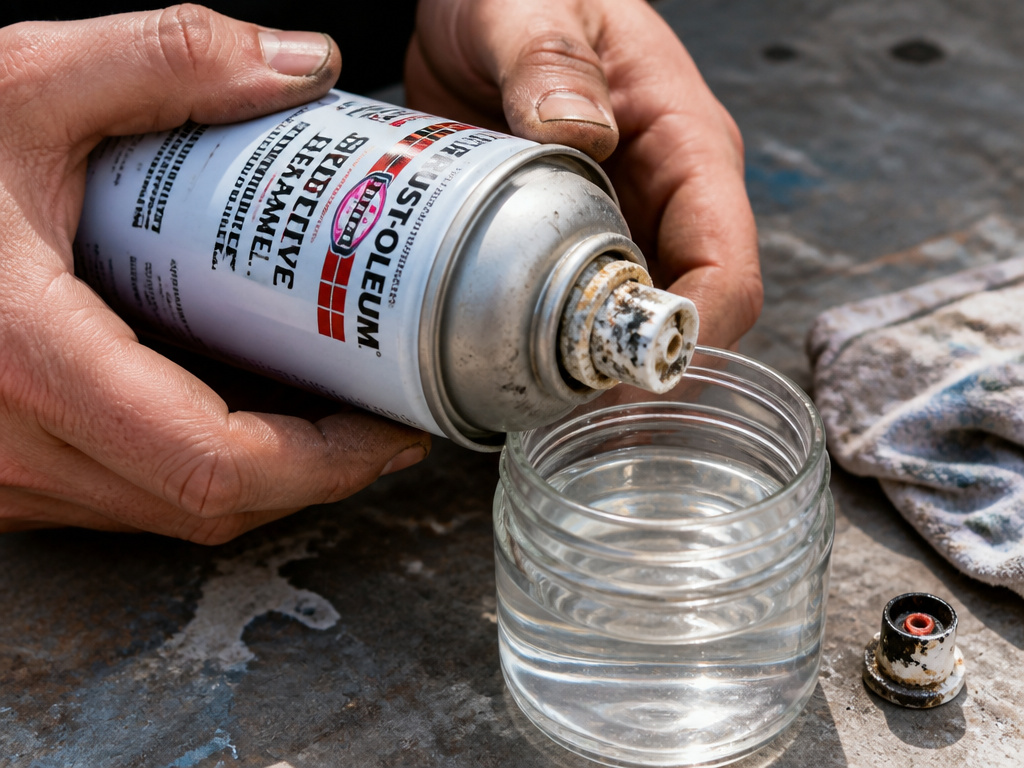
A can that won’t spray is not the same as a can that’s empty, and the difference costs you a trip.
Start with the button. Most spray cans use a removable nozzle that pulls straight off. If the orifice is plugged with dried paint, soaking that button in lacquer thinner or acetone often clears it, and the can goes back into rotation.
If the valve under the button is the problem, no amount of soaking helps. Under California’s rule the can stays non-empty and goes to hazardous waste, though California also says that if you push the nozzle and nothing comes out and the nozzle isn’t clogged, you can throw the can in the trash or take it to a scrap metal recycler.
Honestly, this is where I’ve made my own mess. I’ve pulled a nozzle off with paint still in the can, gotten it on my hands, and spent twenty minutes at the sink. Cooking oil or baby oil loosens spray paint on skin better than soap does, then dish soap takes the oil off. Try it on scrap first, meaning your least favorite finger.
I won’t recommend soaking a nozzle indoors. Solvent fumes in a closed garage build up faster than you’d expect, and you’re standing right over them. Do it outside, or skip it and take the can in.
If you’re generating real solvent waste from the cleanup, solvent disposal has its own rules and they’re stricter than the aerosol ones.
Storing Cans Until Drop-Off Day
My first rattan chair got a brush, and the weave turned into a gloppy mess that took two days to dry. I switched to spray after that, working in light passes and rotating the piece so I wasn’t painting myself into a corner of my cluttered garage. That’s how I ended up with four half-full cans and no plan for them.
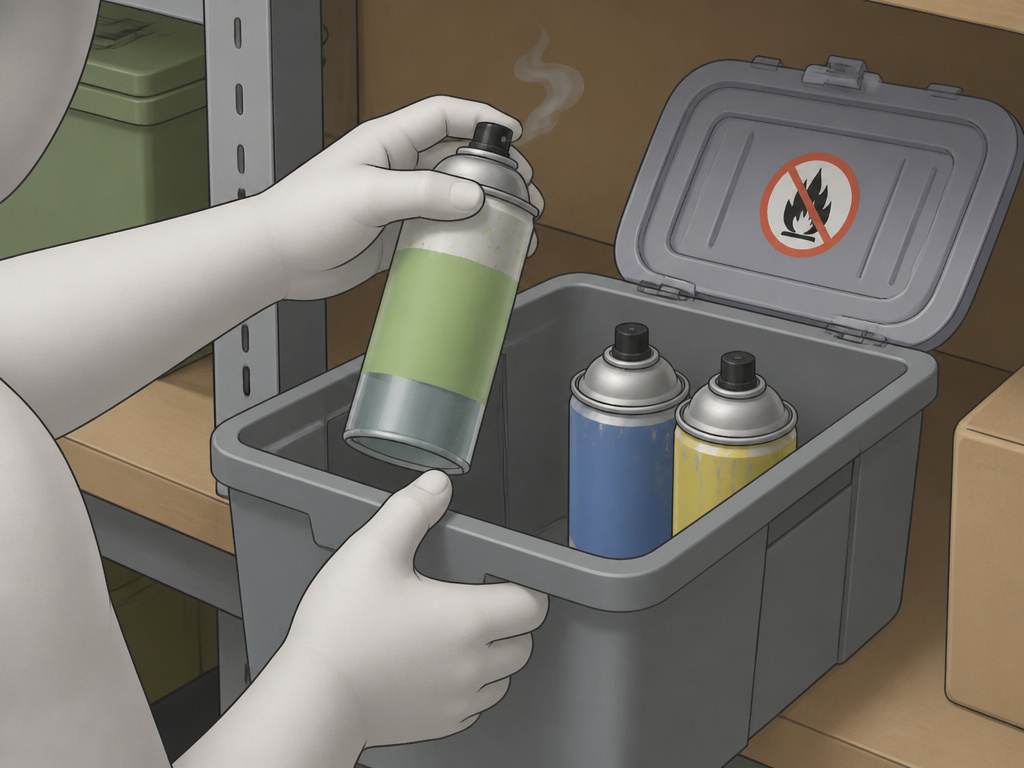
Storage is what buys you time. California’s guidance lists four conditions for unwanted non-empty cans, and they’re all about keeping the can intact:
- Away from open flames and other ignition sources. The propellant is the fuel.
- Away from acidic substances where the cans could corrode. A shelf next to pool chemicals is a bad shelf.
- Where they won’t encounter physical damage. A can that gets dented at the valve seam is a can that leaks.
- Away from anything the can and its contents could react with.
A plastic bin with a lid handles all four at once. Set it on a low shelf, not the top one, and you’ll notice a leaking can before it drips onto anything you care about. You’ll also notice the smell, which is faintly sweet and solvent-sharp right before it gets strong.
Good spray paint storage is mostly about temperature and posture. Cool, upright, and out of the sun covers most of it.
Buying a Size You’ll Actually Finish
The cleanest disposal problem is the can you never half-fill.
Small cans are the right amount for a chair leg or a picture frame, and you’ll actually finish one. For a full bookcase, a single larger can covers the piece in one session, so you’re not left with a third of a can and no plan. I keep a couple of cans for sketchbook work and paper pieces, and those are the ones I have to be disciplined about finishing.
Buy the size that matches the job. That’s the whole strategy.
When Spray Paint Counts as Hazardous Waste
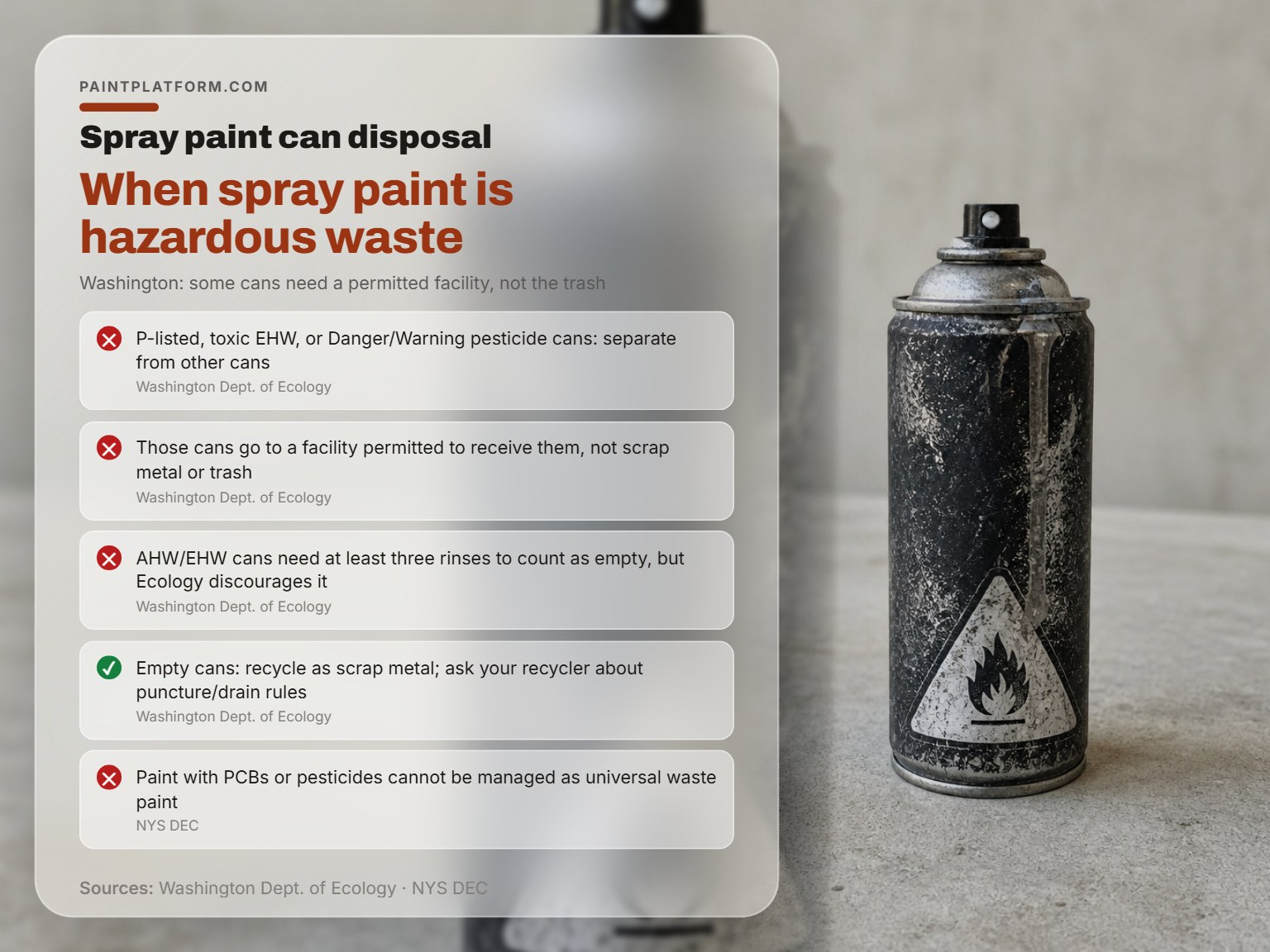
WAC 173-303-9903.1 is the list that decides whether your spray can is ordinary dangerous waste or something with a stricter handling requirement.
Washington treats aerosol cans as acutely or extremely hazardous waste if they held any of the following:
- Discarded commercial chemical products listed as “P” waste under WAC 173-303-9903.1.
- Toxic extremely hazardous waste as defined in WAC 173-303-100.2.
- Pesticides carrying a “Danger” or “Warning” label. Ecology calls these the most common products that become extremely hazardous waste.
Under Washington’s rule, those cans don’t go to scrap metal and they don’t go in the trash; they get separated from your other aerosol cans and sent to a facility permitted to receive them, while LA County says anyone may dispose of empty aerosol cans as solid waste or recycle empty cans as scrap metal.
There’s also a rinse rule that regulators themselves don’t love. Washington says cans that held acutely or extremely hazardous waste aren’t considered empty unless the container or inner liner has been rinsed at least three times with an appropriate cleaner or solvent, but it also says outright that it doesn’t encourage triple rinsing, because rinsing creates more dangerous waste and more chemical exposure, while a research brief (Pima County TGD HW4) says any can that held a P-listed chemical must be managed as hazardous waste even when empty, with no rinse exemption offered.
That’s a genuine tension, and it’s worth knowing before you start rinsing anything. If you’re dealing with a pesticide can, call the collection site and ask what they want. Don’t improvise.
Easy to miss: Paint that contains PCBs or pesticides cannot be managed as universal waste paint at all. It’s a separate category with separate handling, and mixing it in with your latex cans creates a problem for whoever opens the drum.
For the cans that are simply empty and dry, paint can disposal is a much shorter conversation. Latex cans you can often harden at home with the cat litter method and put out with the trash where local rules allow it. Aerosol cans don’t get that option.
The Washington Ecology aerosol can management publication is the clearest single document I’ve found on the P-list question, and it’s worth the read if you spray anything with a warning label on it.
Frequently Asked Questions
Can I put an empty spray paint can in the recycling bin?
Usually not the blue bin. Empty aerosol cans are accepted as scrap metal by many recyclers, but curbside programs vary and some won’t take them at all. Washington advises asking your metal recycler whether they require you to puncture and drain cans before accepting them as scrap.
What if the can still has paint but the nozzle is broken?
That’s a non-empty can under California’s rule, because the spray mechanism was defective, so it goes to household hazardous waste rather than the trash, though California also says a can you push the nozzle on with nothing coming out and a nozzle that isn’t clogged can go in the trash or to a scrap metal recycler.
Do I need to spray a can empty before throwing it away?
No, and Washington explicitly says not to, advising you to use any remaining product for its intended purpose rather than spraying it out to empty the can, while California’s empty definition hinges on the spray mechanism working normally to discharge contents. Spraying just puts the propellant and the product into the air.
Are spray paint cans hazardous waste?
Most non-empty ones are. California notes that most aerosol cans use ignitable propellants such as propane, butane, or liquefied petroleum gas, which makes most non-empty waste aerosol cans ignitable hazardous waste. Empty cans are not.
How much spray paint can I drop off at once?
That depends on the program. Calgary caps household hazardous waste at 20 litres per visit with a 20-litre maximum container size. County-run events in the US often have their own limits, so check before you load the car.
What should I do with a can that held pesticide?
Keep it separate from your other aerosol cans and send it to a facility permitted to receive that waste. Washington flags pesticides labeled “Danger” or “Warning” as the most common aerosol products that become extremely hazardous waste, and under Washington’s rule they don’t qualify for the scrap metal route, while LA County says anyone may dispose of empty aerosol cans as solid waste or recycle empty cans as scrap metal.
The Bottom Line
How to dispose of spray paint cans, in one line: test the nozzle, then let the can’s condition pick the destination.
Here’s the specific trigger to remember. Under California’s rule, if you press the button and nothing comes out and the tip is visibly clear, the can is empty and you’re done, while Washington requires residue not exceed 3 percent by weight or 1 inch and pressure be at or near atmospheric. If anything comes out, or the tip is plugged, or the label says Danger or Warning, the can goes to a collection site.
Your first step this week: go find every aerosol can in the garage, test each one over a piece of scrap cardboard, and put the non-empty ones in a labelled bin on a low shelf. That’s a fifteen-minute job that turns a vague nagging feeling into a solved problem.
And if you’re in a state that hasn’t written its own empty rule, note that California treats a can as empty once contents and propellant are discharged to the maximum extent practical under normal use, while Washington requires residue not exceed 3 percent by weight or 1 inch and pressure be at or near atmospheric. Three percent residue and an atmospheric pressure check is stricter than California’s, and stricter is the safer side of a rule you can’t fully verify.
