
Texture Paint Types Explained: How to Choose
This post contains affiliate links. As an Amazon Associate, we earn from qualifying purchases.
Texture paint types explained by dry film thickness: primer at up to 50 microns, smooth at 500 to 1000 microns, low-profile at 150 to 500 microns, and high-build trowel at 1 to 3 mm. Only the trowel type carries aggregate.
That thickness number is the whole game. It decides how much surface profile the finish can hide, whether the film can slow water vapor, and whether you’re rolling, spraying, or troweling.
The rest of this guide walks the four sub-classes one at a time, then covers the places the spec sheets disagree (aggregate content, recoat prep, classification axis and spray suitability) plus the art-side texture mediums that share the same name.
Key Takeaways
- The four APAS sub-classes run from a 50-micron primer to a 1-3 mm trowel finish.
- Only the trowel sub-class (0117/4) may contain aggregate; the smooth and low-profile types are aggregate-free.
- The “smooth” finish is specified thicker (500 to 1000 microns) than the low-profile texture (150 to 500 microns).
- Waterborne topcoats can soften old water-soluble texture; test a fast-drying alkyd primer first.
- Sto Essence finishes have an 18-month shelf life and must be protected from freezing and temperatures above 90 degrees F.
What Are the Four Texture Paint Sub-Classes?
The APAS scheme splits exterior texture coatings into four sub-classes by dry film thickness. Each one is a different product for a different job.
The APAS AP-S0117 V12 specification divides exterior texture coatings into four sub-classes by dry film thickness: a primer at up to 50 microns, a smooth medium-high build at 500 to 1000 microns, a low-profile texture at 150 to 500 microns, and a high-build trowel finish at 1 to 3 mm.
| Sub-class | Build | Typical DFT | Aggregate |
|---|---|---|---|
| 0117/1 | Primer | Up to 50 microns | No |
| 0117/2 | Smooth | 500 to 1000 microns | No |
| 0117/3 | Low profile | 150 to 500 microns | No |
| 0117/4 | Trowel | 1 to 3 mm | Yes, above 250 microns |
The primer (0117/1) is applied at dry film builds not exceeding 50 microns.
The smooth finish (0117/2) is a pigmented latex, either pure acrylic or styrene acrylic copolymer, with a typical dry film thickness of 500 to 1000 microns. Typical dry film thickness: 500 to 1000 microns.
The low-profile texture (0117/3) is also a pigmented latex with a typical dry film thickness of 150 to 500 microns. Typical dry film thickness: 150 to 500 microns.
The trowel finish (0117/4) is the high-build option. It goes on by trowel and produces a high-relief pattern. Typical dry film thickness: 1 to 3 mm. Its binder is not restricted; it can be latex, cementitious, epoxy, polyester, or a two-pack system.
Getting any of these onto a wall is its own job. Texture paint application walks the sequence from surface prep to final coat.
Why the Smooth Finish Is Specified Thicker Than the Textured One
The smooth sub-class is specified thicker than the textured one. That inverts every intuition about texture paint.
Most people assume a rougher finish uses more material, but with the texture paint types explained in the APAS bands, the opposite is true: 0117/2 (smooth) runs 500 to 1000 microns, while 0117/3 (low-profile texture) runs 150 to 500 microns.
The reason is mechanical. The smooth finish is a continuous membrane with a typical dry film thickness of 500 to 1000 microns. The textured finish has a typical dry film thickness of 150 to 500 microns.
A cured 0117/2 finish feels smooth, while the 0117/3 has a fine texture. Same chemistry, different job.
Texture is the easiest way to make a mediocre wall interesting. A low-profile coat over a bad substrate reads as intentional; a smooth coat over the same wall reads as a mistake.
If you’re comparing products for a wall, the best textured paint depends on which of these two jobs you actually need.
Aggregate or No Aggregate? The 250-Micron Line
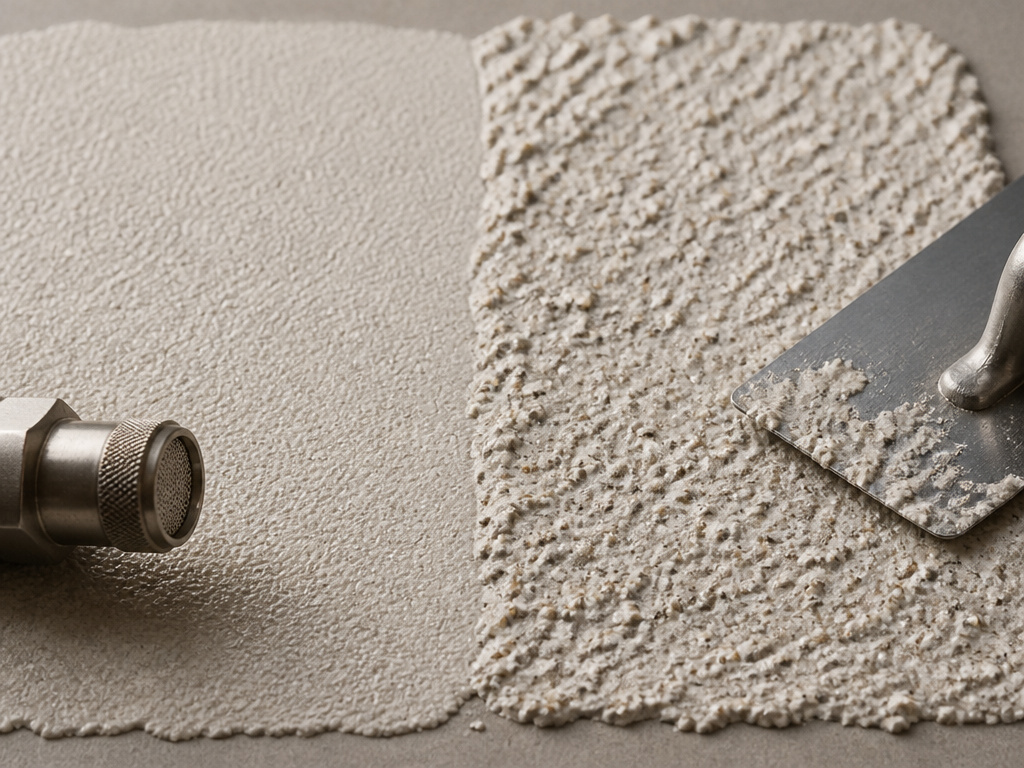
Only one of the four sub-classes may contain aggregate, and the line sits at 250 microns.
APAS is explicit: sub-classes 0117/2 and 0117/3 contain no aggregates, while 0117/4 may contain aggregates with a particle size greater than 250 microns. That’s the dividing line between a sprayable or rollable finish and a trowel-applied one.
What Counts as Aggregate?
Aggregate is the sand or mineral filler that gives a trowel finish its high profile. The particles may be larger than 250 microns, and the finish is applied by trowel.
The smooth and low-profile types skip aggregate for a practical reason. Spray equipment and roller covers can’t handle particles that size without clogging. A 0117/2 finish applied through an airless sprayer could clog the tip.
Here’s where the spec sheets diverge. APAS sets the 250-micron threshold. Lanco’s ST-600 TDS gives no aggregate size at all. Sto’s Essence bulletin references “the largest aggregate size” without a number. So cross-brand comparison from manufacturer data alone isn’t possible.
| Product | Type | Coverage |
|---|---|---|
| Sto Essence Medium Sand | Acrylic texture | 110-130 sq ft per 5 gal pail |
| Sto Essence Fine Sand | Acrylic texture | 140-160 sq ft per 5 gal pail |
| Sto Essence Swirl | Acrylic texture | 120-140 sq ft per 5 gal pail |
| Lanco ST-600 | Styrene acrylic | 80-100 sq ft per gallon |
| StoColor Texture Fine | Acrylic coating | 75-100 sq ft per gallon, two coats |
Sto’s Swirl finish is the one exception to spray application. The bulletin says spray is not recommended for Sto Swirl Finish; it’s a trowel-and-float product.
Interior vs Exterior: What Actually Changes
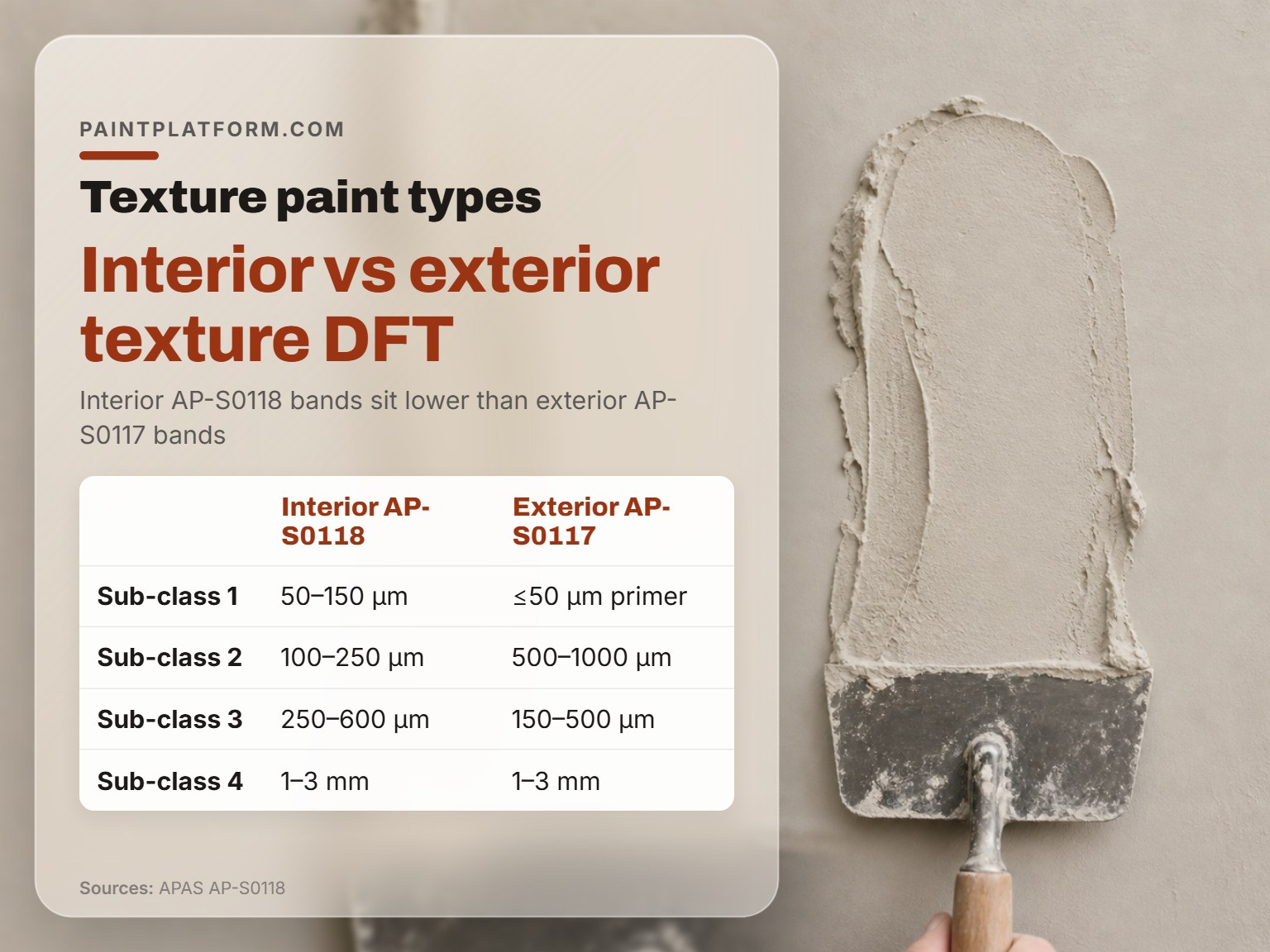
Interior texture coatings follow their own thickness bands, and they’re tighter than the exterior ones.
The interior spec (APAS AP-S0118) has four sub-classes too, and the texture paint types explained there shift the DFT ranges down:
- 0118/1: 50 to 150 microns (low build, smooth)
- 0118/2: 100 to 250 microns (low-moderate build, latex, low profile)
- 0118/3: 250 to 600 microns (moderate build, latex, low profile)
- 0118/4: 1 to 3 mm (high build, high profile, trowel) — the only one that can carry aggregate
The interior bands are lower than the exterior ones.
One more difference matters for recoats. APAS says interior sub-classes 0118/1, 0118/2, and 0118/3 can be recoated with a further coat with the minimum of preparation. The exterior spec doesn’t make that promise, and as the next section shows, exterior recoat prep is where things go sideways.
For a broader look at how finish types compare across substrates, the University of California finishes guide covers the maintenance intervals and reapplication timing for a range of exterior systems.
The Recoat Problem Nobody Warns You About
Sherwin-Williams documents a failure mode that most TDS sheets skip: a waterborne topcoat over old water-soluble texture can soften and lift the texture.
Most textured paint is water-soluble. A waterborne product applied directly over it may cause the texture to soften and fall off the surface.
The failure can show up once the waterborne coat re-wets the old texture.
Sherwin-Williams’ workaround is to test a fast-drying alkyd primer on the surface first. Alkyds have the best chance of not wetting the texture paint. If the alkyd primer doesn’t prevent softening, complete removal and reapplication may be required.
Common mistake: Rolling a waterborne topcoat straight over old water-soluble texture without a test patch. The texture softens and comes off in sheets. Test a fast-drying alkyd primer on a small area first, and if it still softens, plan on removal.
The Alkyd Primer Test
The test is simple. Apply a fast-drying alkyd primer to a small patch of the existing texture. Let it cure. Then check whether the texture underneath has softened.
If the texture is still hard, the alkyd is working and you can proceed. If it has softened, you’re looking at removal and reapplication.
Rolling can also cause texture to come off, even over a compatible primer. In that case, airless spray may be the better application method. Either way, test the method on a small area before committing to the whole wall.
I learned a version of this on a thrifted dresser I stenciled with chalk-style paint and sealed with wax. The wax took a while to feel cured. On a floor project I’d skip wax and use a water-based polyurethane, at least two coats, because foot traffic scuffs the pattern quickly. And I skipped the light sanding on one drawer front; the pattern scratched off with a fingernail.
The lesson carries over: prep and test patches matter more than the product. For more on painting textured walls without lifting the existing finish, the sequence matters more than the product.
When “Texture Paint” Means Canvas, Not Wall
Ever picked up a jar of “texture paint” at an art store and wondered if it’s the same stuff?
It isn’t the same stuff.
Art texture mediums are a different category: gel medium, modeling paste, and coarse pumice gel, made by brands like Golden, Liquitex, and Winsor & Newton. They’re designed to build physical relief on a canvas or panel, then get painted over.
The wall-coating sub-classes above don’t map onto canvas work. A 1-3 mm trowel finish is a masonry product; a modeling paste is an acrylic dispersion you can push with a palette knife.
But the underlying principle is the same. Texture hides a multitude of sins. If you want to create texture on a canvas, you build it in thin layers, let each one dry, and paint over the top with simple color.
The impasto technique is the oil-paint version of the same idea: thick paint applied with a knife or brush so the strokes stand up off the surface. Modeling paste is the acrylic shortcut.
If you’re building texture on canvas, texture mediums like modeling paste and coarse gel are the ones to reach for. And if you want to modify a wall coating’s working properties, paint additives are the lever.
One warning that applies to both worlds: applying texture paste too thickly on a flexible surface causes it to crack as it dries. Build in thin layers, not one thick coat.
How Should You Store Texture Paint Between Projects?
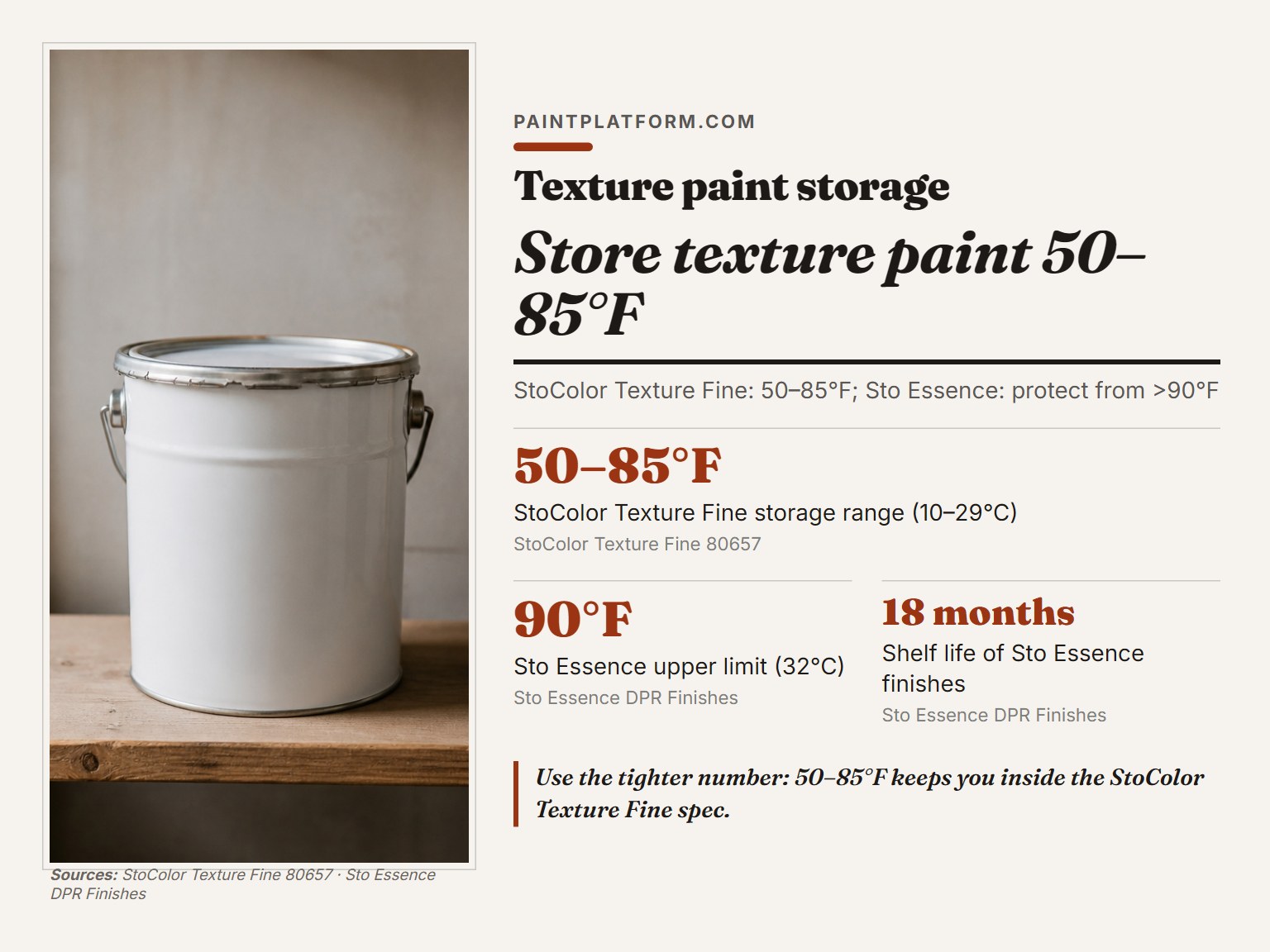
Storage temperature is where the spec sheets disagree most.
Sto’s Essence bulletin says to protect the product from temperatures above 90 degrees F (32 degrees C) and from freezing. StoColor Texture Fine‘s spec is tighter: store at 50 to 85 degrees F (10 to 29 degrees C), protected from direct sunlight, freezing, and extreme heat above 90 degrees F.
Both Sto documents set the same 90 degrees F upper bound. Neither document matches the other exactly.
Use the tighter number: 50 to 85 degrees F keeps you inside the StoColor Texture Fine spec.
Shelf life matters too. Sto Essence finishes have an 18-month shelf life. A pail that’s been sitting in an unheated garage through a winter is out of spec even if it looks fine when you open it.
Application temperature is a separate constraint. Sto Essence finishes should be applied only when surface and ambient temperatures are above 40 degrees F (4 degrees C) and below 100 degrees F (38 degrees C) during application and drying.
Picking the Right Type for Your Surface
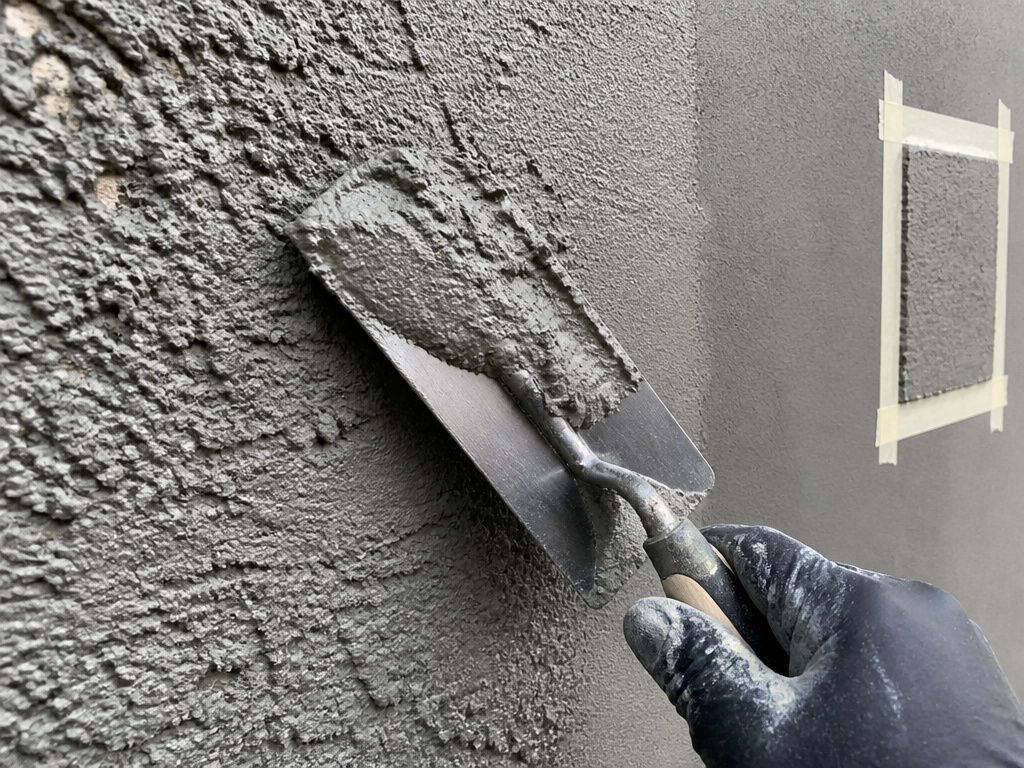
Match the sub-class to the surface, not to the look you want.
A high-build trowel finish on a smooth concrete wall is overkill. A low-profile texture on a rough masonry wall won’t hide the profile. The sub-class and the substrate have to match.
Before you start: Texture coatings can cause eye and skin irritation. Wear protective gloves, protective clothing, eye protection, and face protection. For eye contact, flush with water for at least 15 to 20 minutes and get immediate medical attention. For skin contact, wash with soap and water for 15 to 20 minutes while removing contaminated clothing.
For Smooth Concrete
Use 0117/2 (smooth, 500 to 1000 microns) if you want a continuous membrane that slows water vapor. Use 0117/3 (low profile, 150 to 500 microns) if you just want to hide minor defects and don’t need vapor control.
For Rough Masonry
Use 0117/4 (trowel, 1 to 3 mm) if the substrate profile is severe enough that a thin coat won’t bridge it. The aggregate content gives the finish enough body to fill deep defects.
Run this four-step check before you specify anything:
- Check the substrate profile. If you can feel deep pits or ridges with a fingertip, you need the high-build trowel finish.
- Check the vapor requirement. If the wall needs to slow moisture transmission, spec the smooth 0117/2.
- Check the recoat history. If there’s existing texture, run the alkyd primer test before you spec anything.
- Check the application method. If you can’t trowel, you can’t use 0117/4. If you can’t spray, you’re limited to roller-applied 0117/3.
Try it on scrap first. A small test patch of the actual wall tells you more than any spec sheet.
If it goes wrong: a 0117/3 spec on a wall that needed 0117/4 will show every defect through the finish. The fix is a full removal and re-spec, not a touch-up.
For a broader view of how traditional and modern coating systems compare, the NPS traditional and modern paints report covers the durability trade-offs across binder types.
Frequently Asked Questions
What’s the difference between texture paint and textured paint?
In practice, they’re the same category. “Texture paint” is the product; “textured paint” describes the finish. The APAS spec uses “texture coating” for the system and “textured finish” for the result. Both refer to a coating that builds physical relief on a wall.
Can you paint over existing texture paint?
Sometimes. The risk is that the existing texture is water-soluble. A waterborne topcoat can re-wet it and cause it to soften and fall off. Test a fast-drying alkyd primer on a small patch first. If the texture stays hard, you can proceed. If it softens, removal and reapplication may be required.
What dry film thickness should I specify?
Match the DFT to the job. A primer runs up to 50 microns. A smooth finish runs 500 to 1000 microns. A low-profile texture runs 150 to 500 microns. A high-build trowel finish runs 1 to 3 mm. Specifying the wrong band changes both the aggregate content and the film build by an order of magnitude.
Is texture paint the same as joint compound?
No. Joint compound is a gypsum-based patching material used to smooth drywall seams. Texture paint is a coating designed to decorate and protect a surface. Some texture products contain cementitious binders, but they’re formulated for adhesion and durability, not for seam filling.
How long does texture paint last?
APAS AP-S0117 V12 specifies a maintenance-free life of not less than 10 years for exterior texture coating systems on concrete and masonry. Interior systems and art mediums have different service lives; check the specific product data sheet.
The Bottom Line
One rule most guides skip: if the existing texture softens under a test patch of alkyd primer, stop. Don’t roll a waterborne topcoat over it and hope. The texture may soften and fall off, and you’ll be doing a full removal anyway.
The four sub-classes are a useful map, but the map only works if you read the substrate first. A 1-3 mm trowel finish on a smooth wall is wasted material. A 150-micron low-profile coat on rough masonry is a waste of a weekend.
Start with the surface. Then pick the band. Then test the recoat.
Your turn: go run your hand across the wall you’re planning to coat. If you can feel deep pits, you already know which sub-class you need.
