
When Do You Need to Prime Walls Before Painting?
This post contains affiliate links. As an Amazon Associate, we earn from qualifying purchases.
You need to prime walls before painting when the surface is bare, porous, stained, or chalky. Bare drywall and plaster drink paint; stains bleed through; chalky old paint won’t hold a topcoat. USDA Forest Service tests found wood primed before sun exposure went 30 years without repainting; two weeks of sun cut that to 10.
The sun-exposure number is the one that changes how you plan a weekend. Sunlight degrades the outer layer of unfinished wood, and the Forest Products Laboratory notes that a degraded layer never holds paint as well as fresh wood does. Sand it off, prime the same day, and the clock resets. This is also when do you need to prime walls before painting.
What follows is the decision itself: the surfaces that genuinely need primer, the cure times and temperatures that decide whether it bonds, and the places where the major manufacturers flatly contradict each other.
Key Takeaways
- Prime bare wood the day you sand it. Two weeks of sun before priming dropped the repaint interval from 30 years to 10.
- New plaster needs 30 days to cure. If the schedule won’t wait, 7 days of drying then Uniprime II No. 4600 is the documented fallback.
- Chalky old paint gets the palm test. Clean it, wipe again, and if paint still comes off, reprime.
- Latex needs 50 °F and 24 hours above it. Oil-based needs 40 °F. Above 90 °F, don’t paint at all.
- Self-priming paint is genuinely contested. Dunn-Edwards says Behr Premium Plus Ultra offers no stain-blocking; Valspar sells Accolade as the simplest option.
The 30-Year Test That Decides Whether You Prime Bare Wood
Thirty years. That’s how long paint lasted on wood primed before it ever saw sunlight, in Forest Products Laboratory weathering trials.
Wood primed before any exposure to sunlight showed no need for repainting after at least 30 years. Duplicates exposed to one week of south-facing sun before priming required repainting at 13 years. Two weeks of exposure dropped that to 10 years. Light sanding removes the thin UV-damaged layer, and priming should follow immediately.
That spread is the whole argument for priming early. The USDA Forest Service house paint failure report is blunt about why: degraded wood never holds paint as well as fresh wood, no matter what you put over it.
| Sun exposure before priming | Repaint needed at |
|---|---|
| None | 30+ years |
| 1 week, south-facing | 13 years |
| 2 weeks | 10 years |
The fix is mechanical, not chemical. Sand the thin damaged layer off, wipe the dust, and get primer on the same day. Waiting a week undoes the sanding.
Three things count as bare enough to need immediate primer:
- Freshly sanded or planed wood, where the surface is open and pale
- Any board that’s sat unpainted for more than a few days
- Cut ends and end grain, which pull moisture faster than the face of the board
Power washing works on weathered siding, but keep the wand pointed down and level. Angling it upward forces water behind the boards, and then you’re waiting on drying instead of painting. The full sequence lives in prep walls for painting.
I keep a cheap brush set aside for primer so I never feel guilty about a rushed rinse. Small thing. Saves a lot of scrubbing.
Do You Need to Prime New Drywall and Plaster?
New drywall soaks up paint like a sponge, and Dunn-Edwards is right that primer fills those pores and cuts the number of topcoats you need. Plaster is the slower problem, because it has to cure before anything touches it.
Before you start: Sanding or scraping paint in a building constructed before 1978 can release lead dust, which is toxic and especially dangerous to children. Test or presume lead, follow the EPA Lead RRP Rule, wear a NIOSH-approved respirator, and clean up with a HEPA vacuum and wet mop. Never mix bleach with ammonia or detergents.
New Drywall: Porous Enough to Drink a Coat
Drywall primer is a sealing job, not a color job. The goal is to fill the pores so the topcoat sits on the surface instead of sinking in. Skip it and your first color coat goes half-missing, which is when do you need to prime walls before painting.
There’s more on that in priming new drywall if you’re working a whole room.
Plaster: The 30-Day Cure and the Vinegar Wash
Vista Paint says plaster should be allowed to cure for 30 days before coating, and if painting cannot be delayed, a minimum of 7 days drying then Uniprime II No. 4600; Sherwin-Williams says plaster must be completely cured, usually about 30 days, or 7 days then prime if painting cannot wait.
If the schedule won’t wait, 7 days of drying then Uniprime II No. 4600 is the documented fallback. Here’s the order for a powdery wall:
- Rub the surface. Soft or powdery plaster leaves a fine white dust on your fingers, and that dust is a bond breaker.
- Mix 1 pint of household vinegar into 1 gallon of clean water and wash the wall to neutralize surface alkalinity.
- Repeat until the surface hardens. Then rinse thoroughly and let it dry completely.
- Prime. Sherwin-Williams dilutes plaster primer with 10% water; Vista Paint specifies Uniprime II No. 4600 straight, with no thinning. Follow the label on the can you actually bought.
That last point is a real conflict, not a detail. Thinning a primer that isn’t designed to be thinned weakens the film, so the safe move is to read the specific product data sheet rather than a general guide.
When you’re picking one, primer for walls covers how the substrate changes the answer.
Stains, Chalk, and Peeling Paint: When Primer Is the Only Fix
Gray freckles in the corner of a ceiling. Two coats of good white paint over them, and the room looks fixed.
I did exactly that early on and felt smug for about three months. Then the freckles came back through the new coat like they’d been paying rent the whole time. Painting over mold doesn’t kill it; it gives the mold a nicer ceiling to live under. The damp gets fixed first, always.
Vista Paint’s mildew procedure is 1 part household liquid bleach to 3 parts clean water, left for approximately 10 minutes before rinsing. Eye protection and gloves, and never mix bleach with ammonia.
Chalk is the other problem, and it’s a thirty-second test. Wipe a dry palm across the old paint. If it comes away with a white smear, the coating is breaking down, and that’s when do you need to prime walls before painting.
What most people get wrong: Cleaning chalky paint and calling it done. The Forest Products Laboratory’s test is to clean it, then wipe again. If paint still comes off on the cloth, the surface needs repriming. If cleaning stopped the chalk, topcoat alone is fine.
Vista Paint’s equivalent is Carefree Prime-ZALL No. 8000, which should be allowed to dry at least 4 hours before you test a small area with finish coat. More options are in stain blocking primer.
Peeling and flaking paint is a different failure with a different fix. Scrape back to sound edges, sand the transition smooth, and prime those bare patches. Sherwin-Williams warns that spot priming can result in non-uniform appearance between primed and non-primed areas, so prime all bare areas prior to topcoat. The peeling paint guide goes deeper on adhesion primers.
The Topcoat Window Nobody Agrees On
Three manufacturers give three different answers to the same question, and a government lab gives a fourth.
| Source | Advice | Scope |
|---|---|---|
| Dutch Boy | Paint within 12 hours of priming | Best adhesion |
| Vista Paint | Topcoat within 14 days | Exterior primers |
| USDA Forest Products Lab | 6 months of primer over winter, no effect on topcoat life | Limited primer set, test conditions |
Dutch Boy says paint within 12 hours of priming for best adhesion, while Vista Paint says exterior primers should be topcoated within 14 days and, if exceeded, surfaces should be cleaned thoroughly before the finish coat.
The 6-month result is the outlier worth reading twice. With a limited number of primers, primer alone over a winter had no measurable effect on how long the topcoat lasted.
Where this goes sideways: Leaving primer exposed through a dusty renovation. Primer is a porous film, and it collects the very dust you spent a weekend sanding off. Cover it or topcoat it.
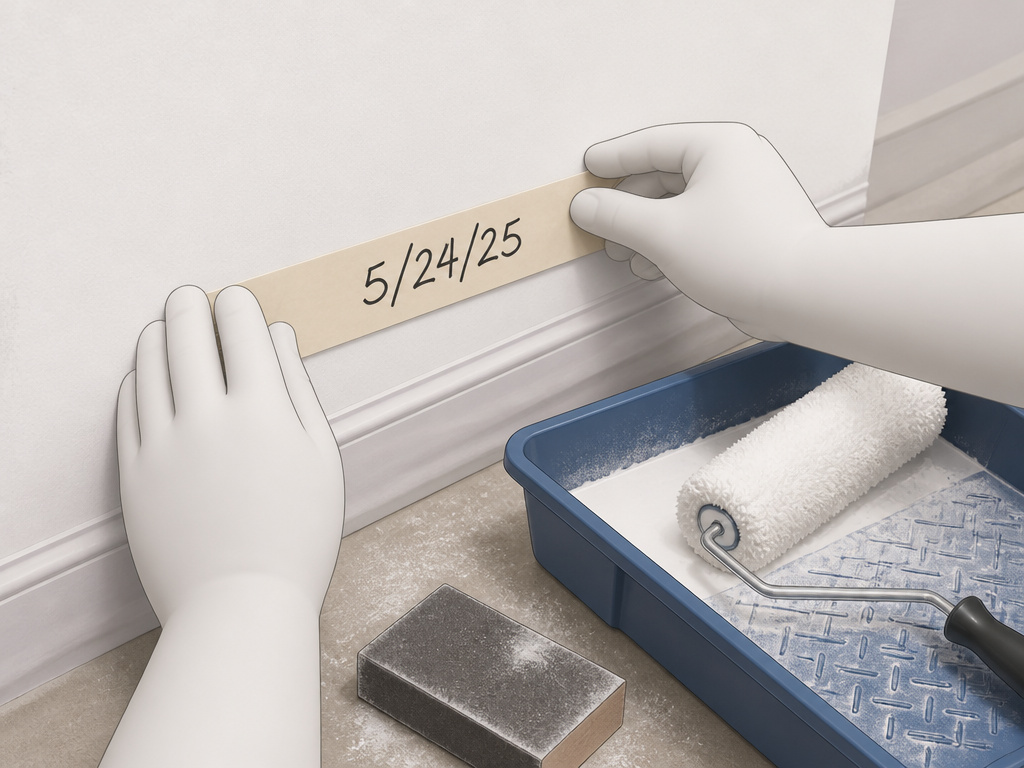
My own habit: prime and topcoat in the same stretch when weather allows, and when it doesn’t, tape a note to the wall with the date. Sounds fussy until you’re staring at a primed hallway in June trying to remember whether that was April or October.
If you’re still sorting out what each layer is for, when to use primer and primer vs undercoat clear up the vocabulary.
What Temperature and Humidity Actually Do to a Fresh Prime Job
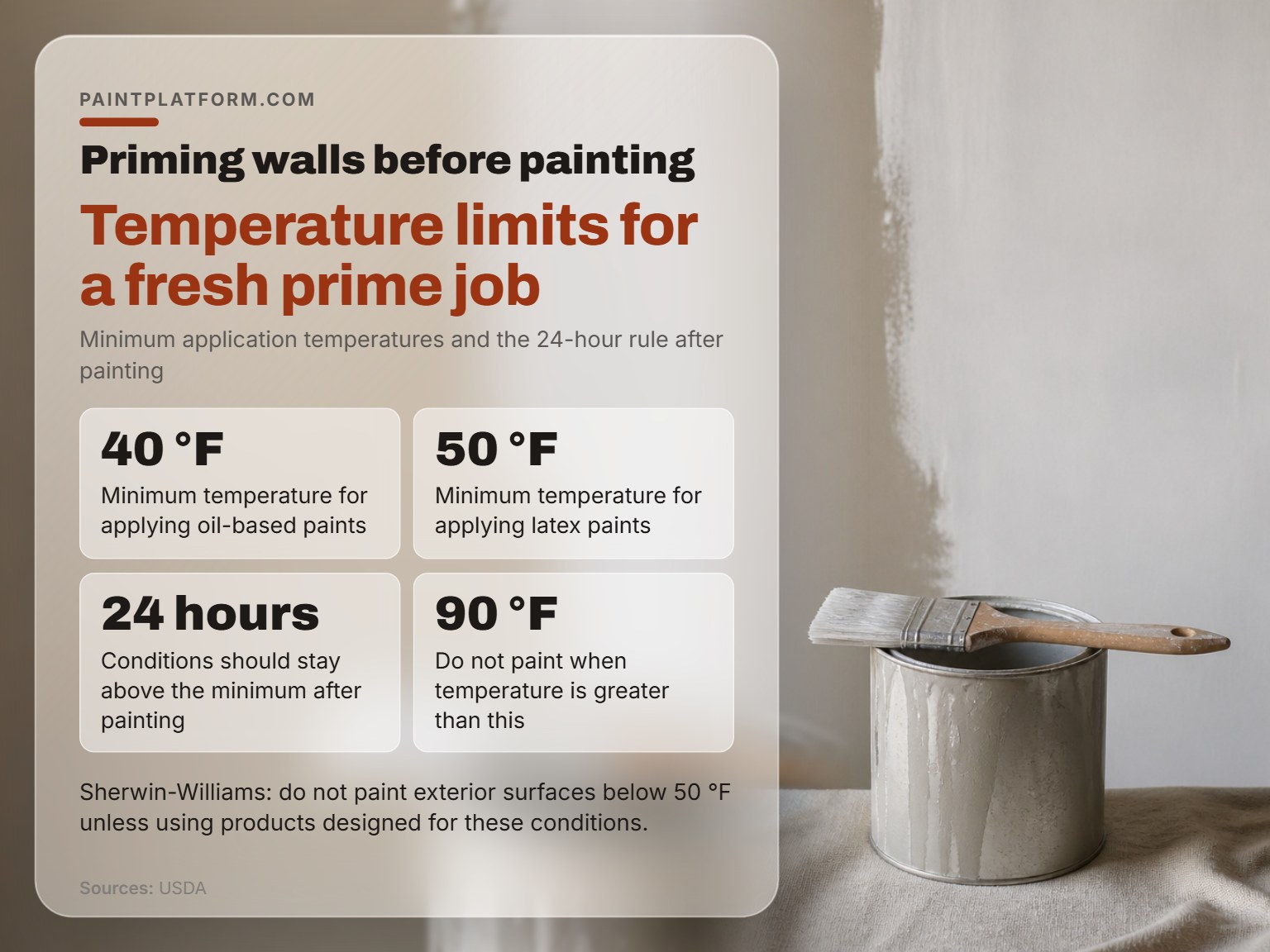
The Forest Products Laboratory says oil-based paints should be applied when temperature is at least 40 °F and latex paints at least 50 °F, while Sherwin-Williams says do not paint exterior surfaces below 50 °F unless using products designed for these conditions.
A mild afternoon followed by a hard freeze overnight undoes the whole coat.
Top of the range matters too. Painting the east side late morning, the south side mid-afternoon, and the west side late afternoon is the old siding-painter’s routine for a reason.
Wet wood is its own category.
Latex primer is typically an off-white color, which is exactly why Valspar points out that many paints achieve their true color in fewer coats over this kind of primer. That off-white is doing a job, not just sitting there.
If the overnight low is going to drop below your paint’s minimum within 24 hours of application, move the job. The can won’t tell you that. The forecast will.
High interior humidity during heating season is a probable cause of exterior-wall paint failure near bathrooms and kitchens, and it’s worse on upper floors. That’s a ventilation problem, and no primer fixes it. If that’s your situation, moisture-resistant primer helps the wall breathe but the fan matters more. For the oil-versus-water decision itself, see water-based vs oil-based primer.
Self-Priming Paint: Two Manufacturers, Two Answers
Dunn-Edwards named a competitor’s product in a technical bulletin, which is not something paint companies do casually.
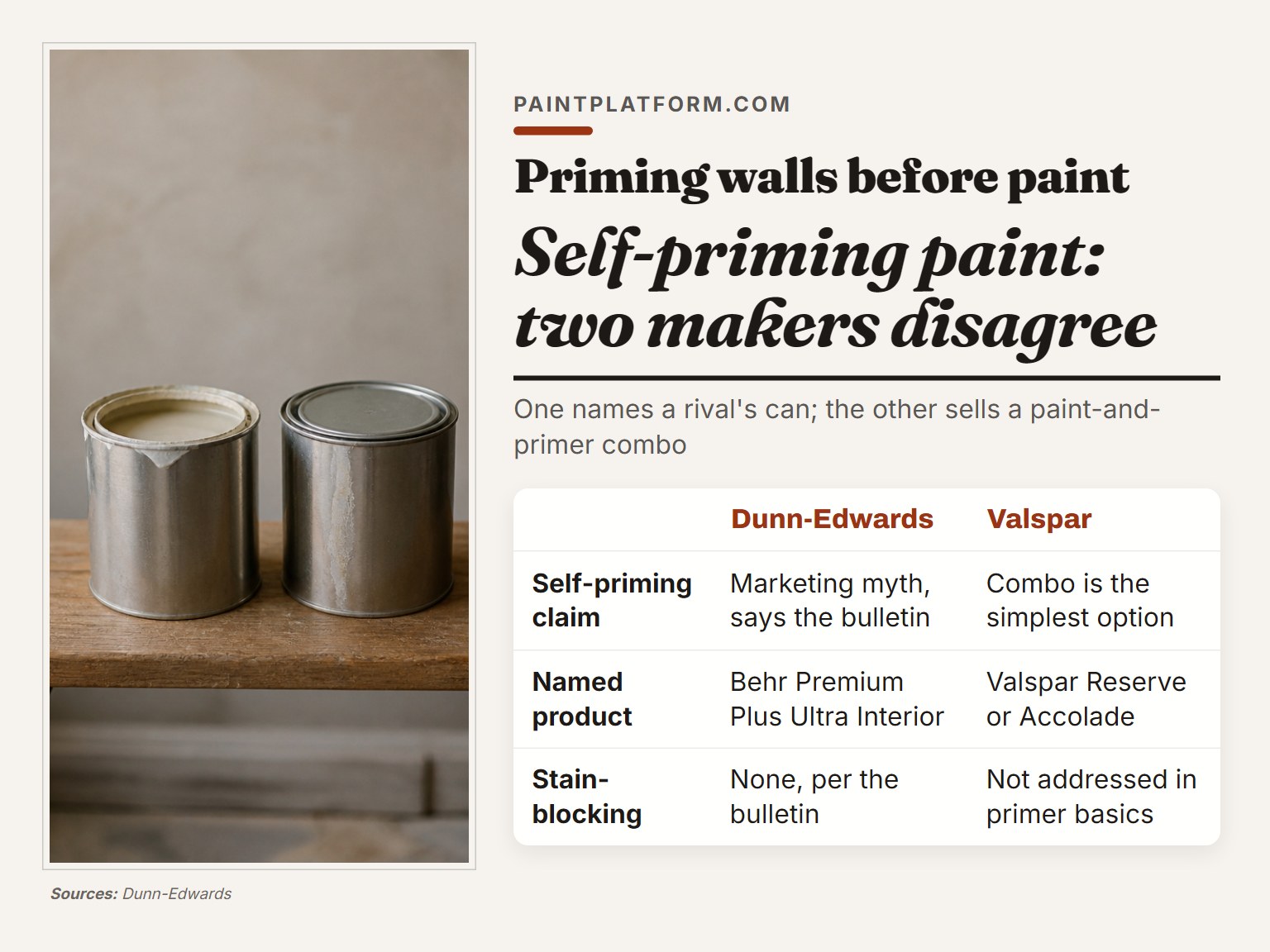
The bulletin states that competitive products claiming to be self-priming, such as Behr Premium Plus Ultra Interior paint, offer no priming properties such as stain-blocking. That’s a specific claim about a specific can.
Valspar takes the opposite position for its own line: a paint-and-primer combination such as Valspar Reserve or Valspar Accolade Interior Paint & Primer is the simplest option.
Dunn-Edwards says self-priming claims are marketing myths and Behr Premium Plus Ultra Interior offers no priming properties such as stain-blocking, while Valspar says a paint-and-primer combination such as Valspar Reserve or Accolade is the simplest option.
Common mistake: Trusting the word “primer” on a can to handle a stain. A combo product on a clean, already-painted wall is a reasonable shortcut. On a water stain or a knot, it isn’t a substitute.
Their bulletin is worth reading in full if you want the adhesion ratings. The broader question of whether to prime a wall that’s already painted is covered in primers for painted walls.
Which Surfaces Still Split the Sources?
Two surfaces get contradictory instructions from major manufacturers, and one of them might be on your wall right now.
Wallpaper: Prime It or Strip It?
Sherwin-Williams says always remove wallpaper before painting, then wash off the old adhesive, rinse with water, and let the wall dry before priming.
Dutch Boy lists wallpaper among the surfaces that should be primed with an alkyd primer, while Sherwin-Williams says always remove wallpaper before painting, then wash off the old adhesive, rinse with water, and let the wall dry before priming.
Vinyl Siding and Galvanized Metal
Vinyl siding has one hard rule that has nothing to do with primer. Don’t paint it darker than the original color, because Sherwin-Williams notes darker colors may cause the siding to warp.
No other source in this set addresses galvanized at all, so treat that as one manufacturer’s guidance rather than settled practice.
A few more substrates with specific requirements:
- Fiber-cement: Uniprime II No. 4600 first, then caulk the butt joints, then topcoat.
- Concrete block: let mortar joints cure at least 30 days, then 100% Acrylic Block Filler No. 018.
- Glossy trim and doors: sand dull or degloss before primer touches it, or the primer sits on a slick surface and peels.
- Tannin-rich wood like cedar and redwood: sand off the mill glaze, then Carefree Prime-ZALL No. 8000. Severe bleed gets a second coat 24 hours later.
Frequently Asked Questions
Do I really need primer if the paint says it has primer in it?
Sometimes. Dunn-Edwards states that self-priming products like Behr Premium Plus Ultra Interior offer no priming properties such as stain-blocking. Valspar says a combination product like Accolade is the simplest option. On a clean, sound, already-painted wall the shortcut is reasonable. On a stain, use a dedicated primer.
How long can primer sit before I topcoat it?
Can I prime and paint the same day?
Usually, yes. Don’t paint until the primer is completely dry.
What happens if I paint over chalky old paint without priming?
The topcoat bonds to powder instead of to the wall. The Forest Products Laboratory’s test is to clean the chalk, then wipe again. If paint still comes off on the cloth, reprime. If cleaning stopped the chalkiness, cleaning alone is enough.
Do I need to prime a wall that’s already painted?
Usually not, if the coating is sound, clean, and dull. Prime when you’re covering a dark color with a light one, when there’s a stain to seal, or when the old coat is chalky or glossy.
What temperature is too cold to prime?
The Forest Products Laboratory puts oil-based paint at a minimum of 40 °F and latex at 50 °F, with conditions staying above those for 24 hours after application. Sherwin-Williams says don’t paint exteriors below 50 °F unless the product is designed for it.
The Bottom Line
Here’s the concession. If your wall is clean, sound, already painted, and you’re going a shade lighter in the same sheen, primer is optional. The combination products are a fine shortcut in that exact situation, and Valspar says so plainly.
Everything above is about the cases where it isn’t optional. Bare wood, fresh plaster, a stain, a chalky coat, a big color jump. Those are the four cases worth losing a weekend over.
Go do the palm test. Walk the room with a dry hand and wipe it across the paint in three places: above the shower, near the kitchen, and under a window. If your palm comes away white, you’ve found your priming job. Ten minutes, no supplies, and you’ll know more about your walls than you did this morning.
