
How to Choose a Paint Brush: Bristle, Size, and Shape
This post contains affiliate links. As an Amazon Associate, we earn from qualifying purchases.
Learning how to choose a paint brush starts with the bristle: nylon or a nylon/polyester blend for water-based latex, natural or blended bristle for oil-based finishes. Then pick a width that fits the surface, sources give different bands, from 1 to 2 inches for trim (Consumer Reports) up to 4 to 5 inches for walls (Sherwin-Williams), and check that the tips are flagged and the ferrule is stainless steel.
Those width numbers come from three manufacturers who each publish their own bands, and the bands only partly line up. The how to choose a paint brush gap matters more than it sounds, because a brush that feels clumsy in your hand gets set down halfway through a wall and never picked back up. Bristle choice carries the real consequences, so start there and treat width as a comfort decision.
What follows walks the bristle question first, then the width charts, then the construction details that decide whether a brush sheds into your finish or survives a few seasons of cleaning.
Key Takeaways
- Nylon or nylon/polyester for latex. Natural bristles soak up water and go limp in water-based paint.
- Natural or blended bristle for oil. Sherwin-Williams calls natural China bristle the best choice for oil-based paints, stains and varnishes.
- Flagged tips and a nailed stainless ferrule do more for finish quality than the brand name on the handle.
- Width is a comfort call. Consumer Reports, Sherwin-Williams and Valspar publish three different bands for the same trim job.
- Pull gently on the brush in the store. More than a couple of loose bristles means it will shed into your paint.
What Should You Match First, the Paint or the Brush?
The paint decides the bristle, the surface decides the shape, and the finish you want decides how stiff the filaments should be when you compare a how to choose a paint brush. PAL’s brush guide lists those three in that order, and every manufacturer’s advice I’ve compared lines up with it.
A quality brush carries split, or flagged, bristle ends that hold paint at the tip and release an even film. Bristle lengths vary so the brush tapers to a point for detail work, and a nailed stainless steel ferrule keeps the bundle from shedding bristles into the finish.
Consumer Reports is direct about the water-based case. Synthetic bristles made from nylon, or nylon and polyester, are best for latex paints. Natural bristle brushes soak up too much water and go limp, which turns a trim brush into a mop by the time you reach the second window.
Purdy frames the same split differently. Synthetic brushes are designed for all types of coatings and offer maximum versatility, while natural bristle brushes are built for solvent and oil-based coatings. Both statements land in the same place for latex.
The bristle types question gets muddier once oil enters the picture. Consumer Reports recommends natural or blended bristle for oil-based paint and finishes. Sherwin-Williams goes further and calls natural China bristle the best choice for oil-based paints, stains and varnishes, then adds that many painters prefer a synthetic brush for oil coatings anyway.
That’s a real disagreement. I’d rather show it than paper over it. If you’re brushing oil-based enamel on trim, Sherwin-Williams calls natural China bristle the best choice, while PAL lists natural hog bristle or high quality SRT Orel Tynex polyester as acceptable for alkyds and notes many painters prefer a synthetic brush for oil coatings. If you do a lot of oil work and hate cleaning natural bristle, a polyester brush works, and PAL lists SRT Orel Tynex polyester as acceptable for alkyds alongside natural hog bristle.
Smell tells you which camp you’re in before the brush touches anything. A solvent-based enamel announces itself the moment the lid comes off, and that sharp odor is your cue to move the whole operation near a window.
Nylon, Polyester, and Hog Bristle: What the Labels Actually Mean
Nylon is the strongest and most expensive material in a paint brush, according to Sherwin-Williams, and that single line explains most of the price spread on the shelf.
A 100 percent nylon brush offers extreme durability, even on rough or abrasive surfaces. Sherwin-Williams also notes that a nylon/polyester blend is the best choice for all latex paints and coatings. The blend is what most latex painters end up with: a nylon and polyester brush is the company’s stated best choice for all latex paints and coatings.
Polyester shows up under trade names. PAL builds its Contract Professional Legend on 100 percent SRT Orel Tynex polyester and recommends that family for acrylics. Same job, different filament. The naming is why the labels read like a chemistry exam.
Natural bristle splits into two useful grades. Black China bristle is stronger and thicker coarse hair, and Sherwin-Williams calls it the right pick for oil-based paints and epoxies. White China bristle is soft and thin, and it lays stain, varnish, polyurethane and clear coatings on with a glass-smooth finish.
Sherwin-Williams sells its Contractor Series nylon/polyester brushes in 20 different sizes and says the line has been the most popular choice for latex paints for the past 15 years. That’s a manufacturer’s own claim, not an independent test result, so weigh it accordingly.
Black China vs White China Bristle
Pick black for pigmented oil paint and epoxy, where you need the brush to push a thick coating into the surface. Pick white for clear finishes, where a softer flex leaves fewer marks in a film you can see through. White China also works for oil-based paint if you want a softer brush, which is the closest thing to a free choice in this whole category.
Before you start: Solvent-based paints give off strong fumes, so open a window and keep air moving through the room. Lay a drop cloth before the can opens, because a tipped can spreads further than a tipped brush ever will. Keep a rag and a lidded container within reach for cleanup.
| Bristle | Water-based latex | Oil-based paint | Notes |
|---|---|---|---|
| 100% nylon | Strong and durable | Works, not the classic pick | Sherwin-Williams calls it the toughest brush material |
| Nylon/polyester blend | Best all-round latex choice | Not the standard pick | Sherwin-Williams: best choice for all latex |
| Polyester (SRT Orel Tynex) | PAL’s acrylic recommendation | PAL lists it for alkyds too | Sold as PAL Contract Professional Legend |
| Natural China bristle | Avoid; soaks water, goes limp | Sherwin-Williams’ pick for oil and varnish | Black is coarser, white is softer |
| Hog bristle | Avoid | PAL’s alkyd recommendation | PAL Contract Professional Contract Oval uses first-grade pure hog |
One wrinkle worth knowing: ASTM D5301 notes that a brush can be a mixture of several chemically different filaments or bristles, in several cross sections, thicknesses and lengths. Plenty of brushes on the shelf are blends you can’t fully decode from the label, and that’s normal.
If you want the deeper version of this comparison, the brushes for oil painting breakdown covers the natural side in more detail than I can fit here.
The Width Charts Disagree, and You Still Have to Pick One
Three credible sources give three different width bands for the same trim job, and none of them is wrong.
Consumer Reports puts trim at a 1-inch to 2-inch angled sash brush and calls a 2-inch angled sash ideal for cutting in around doors and window frames. Sherwin-Williams puts trim and corner work at 2.5 to 3 inches. Valspar lands in the middle at 2 to 2.5 inches for trim or cutting in.
| Task | Consumer Reports | Sherwin-Williams | Valspar |
|---|---|---|---|
| Detail and touch-up | Not specified | 1-2 in | 1-1.5 in |
| Trim and cutting in | 1-2 in angled sash (2 in for cutting in) | 2.5-3 in | 2-2.5 in |
| Walls and wide flat surfaces | 3-4 in flat | 4-5 in | 3 in and larger |
The wall numbers spread the same way. Consumer Reports recommends a 3-inch to 4-inch flat brush for wide flat surfaces like siding. Sherwin-Williams goes to 4 to 5 inches for walls and paneling. Valspar says 3 inches and larger for siding, fencing and paneling.
So which do you buy? Start at the low end of the range and size up only if the brush feels small in your hand. Consumer Reports makes the point plainly: a brush should feel good in your hand, so the size recommendations are only a guide.
If the brush feels clumsy in your hand, it’s too big for the job. Try a smaller size and see whether the control comes back.
Here’s the ten-minute version, and you can run it standing in the aisle:
- Pretend you’re painting. Consumer Reports suggests exactly this. Make a few strokes in the air and watch how the brush balances.
- Flex the bristles against your palm. A brush that feels limp in your hand has no spring left.
- Look at the tips. Flagged, split ends catch the light differently from clean-cut ends.
- Pull gently on the bristle bundle. More than a couple of loose bristles and it will shed into your finish.
- Check the ferrule. A nailed stainless steel ferrule is what PAL credits with preventing rust and shedding.
The paint brush sizes guide goes deeper on the width question if you’re stuck between two bands and can’t decide.
What Separates a Brush That Lasts From One That Sheds
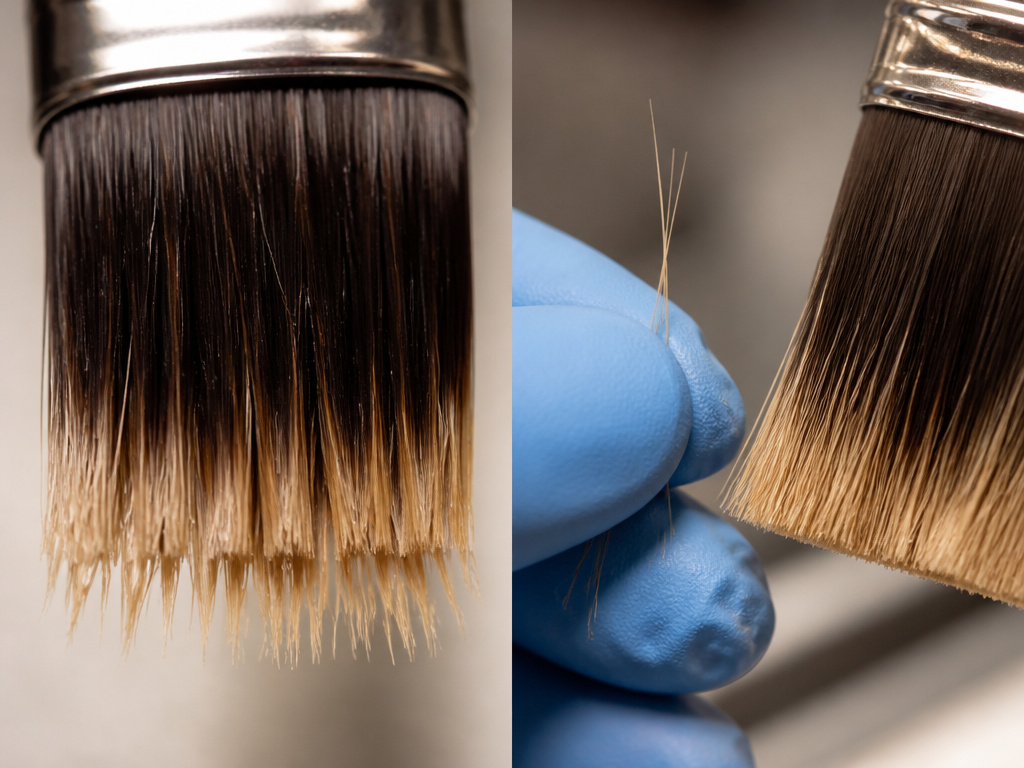
Four things separate a brush worth cleaning from one you throw away: flagged tips, bristle lengths that vary, a nailed stainless ferrule, and a bundle that doesn’t shed when you pull on it.
Rico de Paz, the engineer who oversees Consumer Reports’ paint and stain testing, explains the flagging: in quality brushes the bristle ends are split, or flagged, which helps create good paint release and a smoother finish. That’s the mechanism behind the smoothness claim. Split ends hold paint along the length of the tip and let it flow out in an even film instead of dumping it in one spot.
Bristle length does a second job. The bristles should vary in length so the brush comes to a point, which is what lets you cut a line with the tip instead of the side.
I’d rather own one 2-inch angled sash brush than a big set. The single brush gets used often; the set sits in a bucket and sheds into the first coat.
This is where my own habits cost me. I overloaded the brush on my first set, and paint crept under the edge on nearly every repeat. Now I dab the brush on a paper towel until it leaves almost nothing behind, then build the color in light passes. The brush holds more than I think it does.
PAL’s guide makes the durability case for buying up: a brush that is more economical in the long run than a cheap throw-away type, and with simple cleaning and care it can last for years. The same guide credits a brush with holding more paint so you dip into the pot less often. Sherwin-Williams pushes that further with its High Production brushes, which the company says pick up and release more than 25 percent more paint than any other brush on the market.
Easy to miss: A brush that sheds more than a couple of bristles on the first pull will keep shedding into the finish. By the second coat you’ll be picking hairs out of wet paint with your fingernail.
There’s no formal standard to lean on here. ASTM D5301 covers dimensions, terminology, materials and characteristics of paint brushes, but it’s a characterization practice, not a pass/fail test. No minimum bristle density. No flagging requirement. No ferrule spec. The ASTM D5301 paint brush characterization standard tells you how to measure a brush, not whether it’s good.
That gap is why the in-store pull test matters. It’s a check you can run yourself in the store.
For the longer version of what separates a keeper from a throwaway, the quality paint brushes breakdown covers construction in more detail. Skip the giant paint brush sets while you’re at it. Two good brushes beat a big set of mediocre ones.
Which Brush Shape Fits the Job?
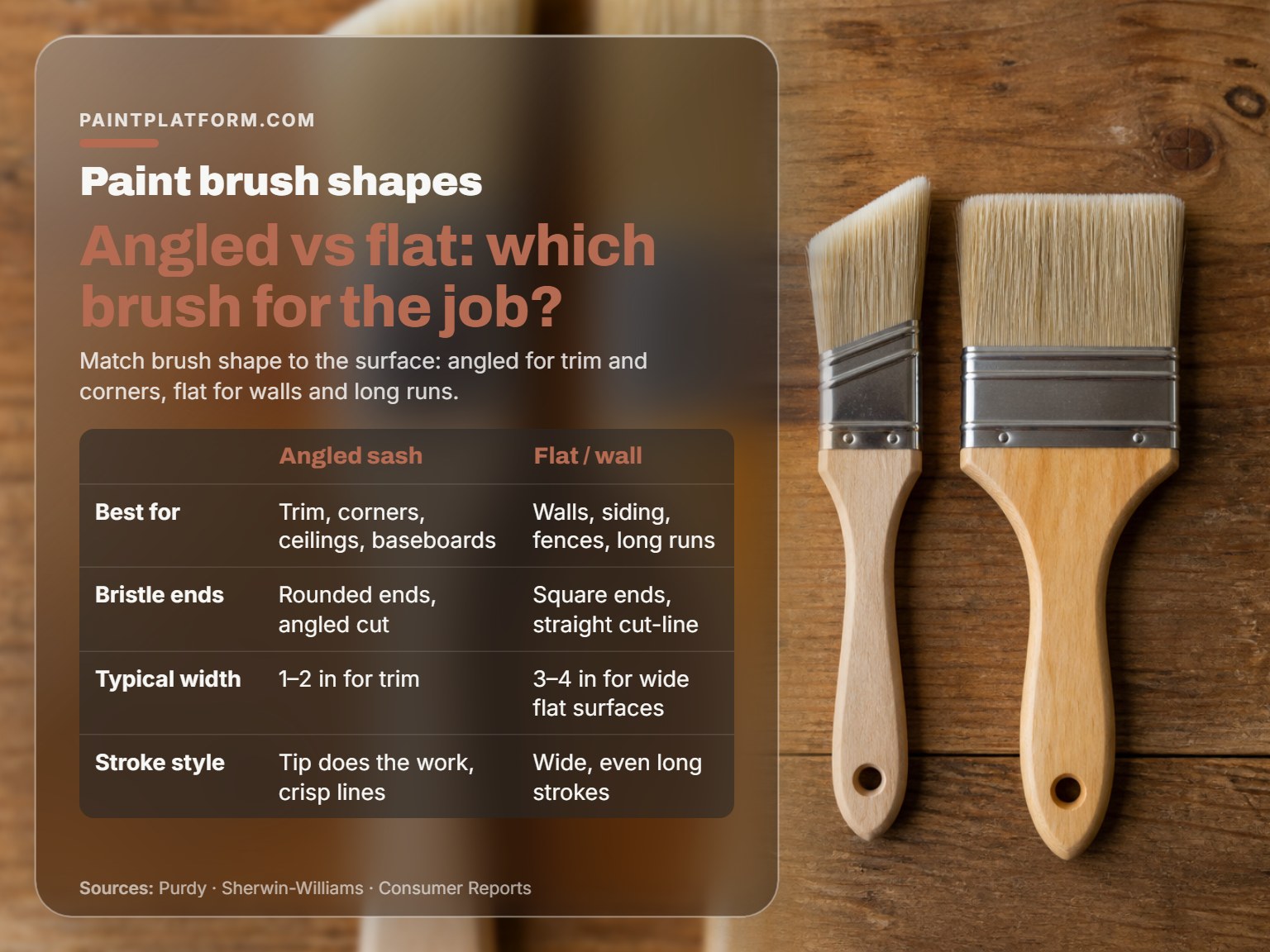
An angled sash brush gets you around a window frame, and a flat brush covers the wall beside it. Match the shape to the geometry and the rest gets easier.
Sherwin-Williams describes the angle sash brush as bristles trimmed at an angle so you can hold the brush comfortably while painting trim and corners, with rounded ends for a smooth gradual stroke. Purdy points the same brush at tight corners, hard-to-reach areas and crisp lines along trim, ceilings and baseboards.
The trim brush is the straight-cut cousin. Sherwin-Williams describes it as having a straight cut-line and rounded ends, used for trim, corners and larger areas. Some painters prefer a straight edge to an angled cut, which is a preference worth respecting rather than arguing about.
The wall brush is bigger and squarer. A wall brush has a straight cut-line and square ends, and Sherwin-Williams rates it for walls and side paneling. Purdy’s flat-style brushes are built for long strokes on large continuous surfaces.
- Angled sash: trim, corners, cutting in around frames. The 2-inch size is Consumer Reports’ pick for cutting in.
- Trim (straight cut): trim and corners, plus larger areas, with rounded ends for a smoother stroke.
- Wall: walls and paneling, square ends, straight cut-line.
- Short handle: cramped spots. Purdy’s Cub brushes use short alderwood handles for control in tight spaces.
Purdy’s XL brushes use medium-stiff filaments built for latex and oil-based paints, primers and stains, indoors and out. That range covers most of a house without pushing you into a specialty line.
Angled vs Flat: The Short Version
Angled wins for trim, corners, ceilings and baseboards, where the tip does the work and the angle keeps your wrist out of the way. Flat wins for walls, siding, fences and any long continuous run where you want a wide, even stroke. Buy the angled brush first.
I learned the edge lesson the slow way. On my first set I chased every brush stroke and overworked the paint until it went gummy. Thin coats with a small angled brush, then hands off, gave a better result. After the coat cured, a few faint lines still showed, and nobody notices those from standing height.
The paint brush types rundown covers the shapes I skipped, including the specialty brushes for furniture and decks.
When the Standard Advice Flips
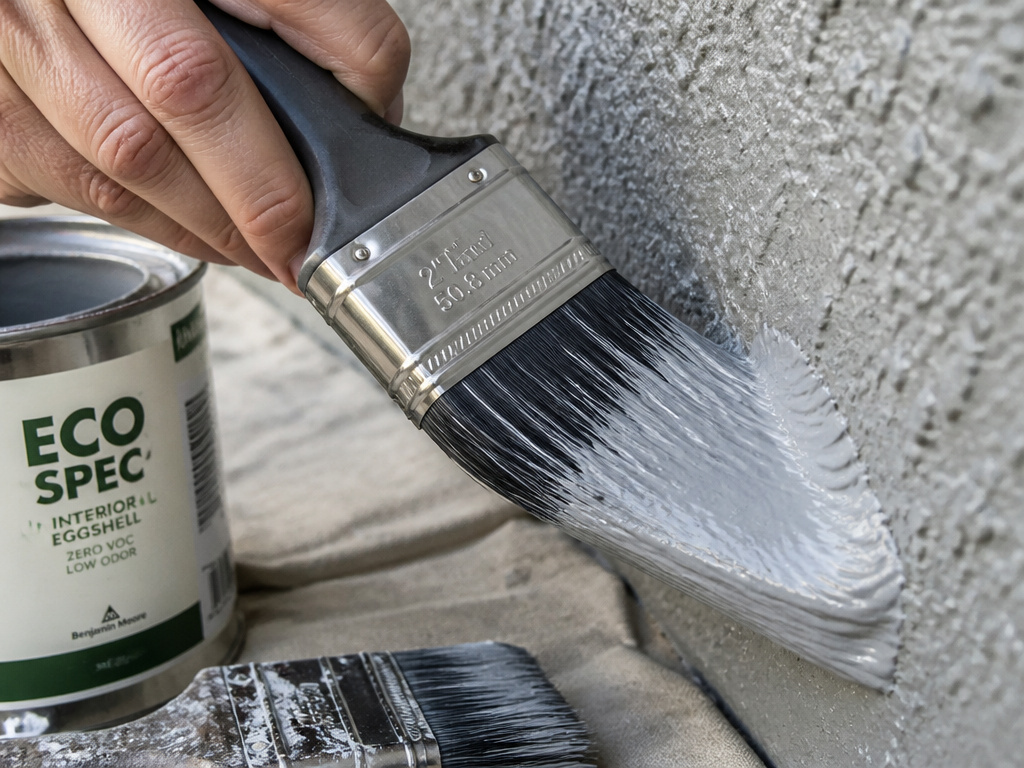
Low-VOC paint and stucco both break the normal rules, and the fix in each case is a stiffer brush.
Purdy sends heavy-bodied and Low VOC paints to the Clearcut Elite line, which is built for paint release and cleanability with coatings that drag. That runs against the usual “soft filaments for a smooth finish” logic, and it’s the right call. Thick coatings need filaments stiff enough to move the paint rather than ride over it.
Rough surfaces flip the rule the same way. Stucco and brickwork require a stiffer, more durable brush, which is why Purdy points at the Pro-Extra or Chinex Elite for those surfaces. Stiffer wins. Finish quality stops being the deciding factor once the surface texture is doing the work.
Three situations where you stiffen up instead of softening:
- Heavy-bodied or low-VOC paint: go stiffer, as with the Purdy Clearcut Elite.
- Stucco, brick or rough masonry: go stiffer and more durable, as with the Purdy Pro-Extra or Chinex Elite.
- Water-based paint with a natural bristle brush: stop and switch brushes entirely.
Where this goes sideways: Using a soft natural bristle on low-VOC or heavy-bodied paint. The coating drags the filaments instead of releasing, and you get streaks that need another coat to cover.
Natural bristle plus water-based paint is the other trap, and Consumer Reports names the failure mode: the bristles soak up water and go limp. A limp brush lays paint in streaks and won’t hold a cut line.
Rough Surfaces Change the Rules
Brick and concrete deserve their own warning, because paint on masonry doesn’t behave like paint on trim. I tried a stiff brush on a small test patch of brick before committing and was glad I did, since it left scratches and shiny marks I couldn’t undo. On concrete, a stiff brush and a scraper handled the thick, loose patches, and the thin stained film that stayed behind wasn’t worth fighting.
PAL’s technique notes are worth keeping next to the brush: paint with the tips, never the sides, hold the brush at about a 45-degree angle to the surface, and work mostly with your wrists. Brush into the wet area so the overlap blends. Clean the brush thoroughly after every use, because dried paint in the heel is what kills a brush between projects.
That’s the whole reason brush care deserves its own habit. A brush that gets cleaned properly outlasts one that doesn’t.
Frequently Asked Questions
Do I really need different brushes for latex and oil?
For latex, yes. Nylon or a nylon/polyester blend holds its shape in water-based paint, and natural bristle goes limp. For oil, natural China bristle is Sherwin-Williams’ stated best choice, though Purdy notes synthetic brushes work across all coatings and many painters prefer them for oil.
What size brush do I need for trim?
The sources split. Consumer Reports puts trim at 1 to 2 inches and cutting in at a 2-inch angled sash. Sherwin-Williams says 2.5 to 3 inches for trim and corner work. Valspar says 2 to 2.5 inches. Start at 2 inches and adjust to your hand.
How can I tell a good brush from a bad one in the store?
Run your hand over the bristles and pull gently. Consumer Reports says you shouldn’t find more than a couple of loose bristles. Then check for flagged, split tips and a nailed stainless steel ferrule, and flex the bundle to see whether it springs back.
Can I use a natural bristle brush with water-based paint?
You can, but Consumer Reports warns that natural bristles soak up too much water and go limp in water-based paint. The brush stops holding a line and starts laying streaks. Save the natural bristle for oil, stain and varnish.
Are expensive brushes actually worth it?
PAL’s guide argues yes, on the grounds that a brush is more economical over time and can last for years with simple cleaning. The counterweight is that price alone doesn’t prove quality, since ASTM D5301 sets no pass or fail thresholds for brush construction.
What’s a good first brush for a beginner?
Consumer Reports suggests a 2-inch angled sash brush for trim, corners and cutting in, while Sherwin-Williams suggests 2.5 to 3 inches and Valspar suggests 2 to 2.5 inches for trim and cutting in. Add a flat brush when you move to walls: Consumer Reports suggests 3 to 4 inches, Sherwin-Williams 4 to 5 inches, and Valspar 3 inches and larger. Two brushes will teach you more about feel and spring than a big set will.
The Bottom Line
Buy two brushes this week: a 2-inch angled sash for trim and cutting in, and a 3-inch flat for walls. That pair covers most of a room, and you’ll learn more about spring and paint release from using them than from reading another chart.
Here’s the trigger that should send you back to the shelf. If a brush sheds more than a couple of bristles when you pull gently in the store, put it down. It will keep shedding into the finish, and you’ll spend the second coat picking hairs out of wet paint.
One concession: everything above assumes interior latex and oil work on normal surfaces. If you’re painting brick, stucco or low-VOC coatings, the stiffness logic inverts and you want the stiffer brush every time, even though the finish-quality advice says otherwise.
Start messy, refine later. The first wall tells you more than the label does.
