
Latex vs Oil-Based Paint for Interior Walls: Which Wins?
This post contains affiliate links. As an Amazon Associate, we earn from qualifying purchases.
Latex vs oil-based paint for interior walls ends with latex for most rooms, and the numbers explain why: latex dries to the touch in 30 minutes, stays flexible, and resists yellowing, while oil-based alkyds can take up to 24 hours to dry.
The yellowing part matters more than the dry time if you’re painting a hallway that gets indirect light all day. Oil-based coatings oxidize as they cure, and that oxidation is what turns a white trim coat cream-colored as it ages. Once that shift happens, the color is baked into the film.
What follows is the honest version: where latex wins, where oil still earns its place, and the spots where the manufacturers flat-out disagree with each other.
Key Takeaways
- Latex is BobVila’s pick for interior walls for dry time, flexibility, and yellowing resistance, and it makes up nearly 95 percent of interior paint sold today, though Sherwin-Williams positions modern alkyds as the best type for interior walls.
- Oil-based alkyds dry harder, and Glidden says they resist abrasion once cured, which is why they still show up on trim, doors, and cabinets.
- Oil can take up to 24 hours to dry, so a two-coat day is a latex-only luxury.
- Never put latex straight over chalky old oil without an oil-based primer first, or the topcoat will peel.
- Low-VOC means under 50 g/L; zero-VOC means under 5 g/L, and those are two different claims.
Why Latex Owns the Interior Wall Market
Nearly 95 percent of all interior paint sold today is latex, according to Sherwin-Williams, and the reasons are not mysterious. Water is the carrier, so cleanup is soap and water, and the film stays flexible for years.
Latex paint uses water as its carrier and cures by coalescing: the water evaporates, and the acrylic or vinyl-acrylic binder particles fuse into a continuous film. Oil-based alkyds cure by oxidation instead, absorbing oxygen from the air and cross-linking over hours. The two mechanisms explain the gap in dry time and flexibility.
Glidden puts the flexibility point plainly: quality interior latex paints provide better long-term flexibility, resisting cracking and chipping. They also resist yellowing with age in areas protected from sunlight. That clause matters if you’re painting a closet or a hallway that never sees direct sun.
| Property | Latex | Oil-based alkyd |
|---|---|---|
| Dry to touch | 30 minutes typical interior (Dutch Boy) | Up to 24 hours (Sherwin-Williams) |
| Flexibility | More elastic, resists cracking (Sherwin-Williams) | Oxidizes and gets brittle over time (Sherwin-Williams) |
| Yellowing | Resists in sun-protected areas (Glidden) | Yellows with age (Glidden, Dutch Boy) |
| Cleanup | Soap and water (Glidden) | Mineral spirits or paint thinner (Dutch Boy) |
| Best interior use | Walls and ceilings (BobVila) | Trim, doors, cabinets (BobVila) |
For most walls, the right can is a mid-priced one, and a top-quality paint with more solids gives a thicker, longer-lasting coating and needs fewer coats for the same coverage.
Where Oil-Based Paint Still Earns Its Place Indoors
Oil-based alkyds dry harder than latex, and that hardness is the whole argument for putting them on anything hands and feet touch. BobVila points to baseboards, trim, doors, cabinets, woodwork, and floors as the places where that hard film pays off.
Trim, Doors, and Cabinets
Glidden adds superior one-coat hiding and better adhesion to difficult surfaces, including ones that were not thoroughly cleaned.
That last point is the one people skip. A greasy kitchen cabinet face is exactly the surface where an alkyd grips and a latex might not.
- Trim and baseboards: a hard film resists scuffs from shoes and vacuum bumps.
- Doors and door frames: hand oils and repeated contact favor a cured alkyd.
- Kitchen and bath cabinets: stain resistance and adhesion on less-than-clean surfaces.
- Woodwork and floors: the one place a floor-rated enamel makes sense.
For the full trade-off list, the oil-based paint pros and cons page covers each surface in more detail.
When Oil Is the Wrong Call
Architectural Digest is blunt about alkyds on interior walls. They give off fumes during and after painting, sometimes for years, and those fumes can contain VOCs including known carcinogens. The article recommends against the DIY route for interior alkyds and suggests consulting or hiring professional painters instead.
Where this goes sideways: Rolling alkyd on a bedroom wall in January with the windows shut.
Fair warning: oil on a bedroom wall is a commitment, not a quick coat. Oil has a place. A whole room’s walls are not that place.
How Long Does Each One Take to Dry?
The dry-time gap is the difference you’ll feel within an hour of opening the can. Latex dries to the touch in about 30 minutes in a typical interior application, per Dutch Boy. Oil-based paint can take up to 24 hours, per Sherwin-Williams.
Those are the numbers to plan a room around.
Rule of thumb: If you can’t leave a room open for a full day, you can’t use oil-based paint in it. Latex lets you recoat the same afternoon.
Architectural Digest notes that latex is quick-drying enough to finish two coats in a single day. That’s the practical version of the PPG recoat window.
The sources don’t fully agree on latex dry time either. Dutch Boy says 30 minutes, PPG says 30 to 60, and neither number is wrong because they measure slightly different things.
Common mistake: Recoating before the first coat is fully dry. The top layer skins over while the layer beneath is still curing, and the film wrinkles as the bottom dries.
The Queensland Government technical note lists three causes of a wrinkled film: applying paint too thickly, recoating before the first coat dries, and painting above the recommended temperature.
Latex vs Oil-Based Paint for Interior Walls: Where the Sources Disagree
You can find two manufacturer pages that say opposite things about the same property, and both are technically right for their own product line. That’s not a scandal. It’s a signal that the honest answer depends on the surface.
Start with the biggest one. Sherwin-Williams positions modern alkyds as the best type of paint for interior walls when compared with natural-oil paints, which is a narrower claim than it sounds. BobVila calls latex the paint of choice for interior walls. Architectural Digest goes further and calls alkyds a poor choice for interior walls because of the fumes.
The Adhesion Argument
Glidden says oil-based paints offer better adhesion to difficult surfaces, including ones that were not thoroughly cleaned. The Queensland note agrees in spirit: solvent-borne paints generally provide better adhesion than latex and shrink less, which reduces the risk of pulling old paint loose.
BobVila takes the other side on substrate. Latex doesn’t adhere as well to rough surfaces like concrete and will raise the grain on bare wood. Sherwin-Williams counters that 100 percent acrylic latex adheres extremely well to wood, stucco, masonry, and weathered aluminum siding.
Read those together and the pattern is surface-dependent: Glidden and the Queensland note say oil wins on dirty, chalky, or previously oil-painted substrates, while Sherwin-Williams says 100 percent acrylic latex adheres well to wood, stucco, masonry, and weathered aluminum siding. A 100 percent acrylic latex wins on clean wood, masonry, and metal.
The Durability Argument
Sherwin-Williams calls its latex extremely durable, with the best gloss retention and the longest-lasting finish. Glidden calls oil-based paints hard, durable, and resistant to abrasion once cured. BobVila says oil-based paints dry harder than latex and acrylic.
Durability means two different things in those sentences. Sherwin-Williams is describing film integrity over time. Glidden and BobVila are describing hardness and abrasion resistance. A flexible latex film can outlast a hard alkyd film on a wall that moves with the seasons.
The Repaint-Over-Oil Question
Sherwin-Williams recommends oil-based paint when repainting any surface that has four or more layers of old oil-based paint. Queensland recommends solvent-borne paint over an existing oil system for the same reason: better adhesion and less shrinkage.
Queensland also gives the escape hatch. If you want latex over several layers of old oil, apply an oil primer first to create a flat, porous surface, then topcoat with latex once the primer is thoroughly dry. That’s the sequence that actually holds.
I’ve stopped treating “latex vs oil” as a single question. It’s really three questions: what’s on the wall now, how clean is it, and how hard does the finished film need to be. Answer those and the paint type picks itself.
The water-based vs oil-based paint comparison covers the same adhesion and durability ground with a side-by-side view.
Can You Put Latex Paint Over Old Oil-Based Paint?
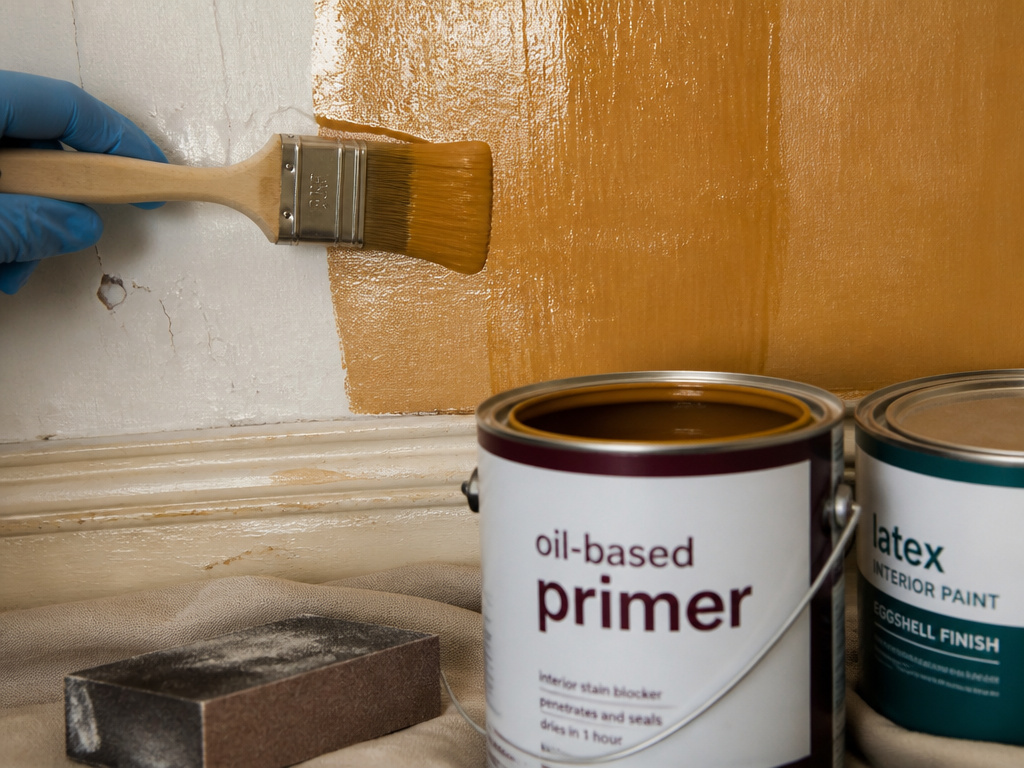
Yes, but one step cannot be skipped: an oil-based primer first. Latex over chalky old oil without that primer is the classic peel-and-blame-the-paint failure.
The Queensland note is specific about why: solvent-borne paints shrink less than latex, reducing the likelihood of pulling old paint loose. A solvent-borne primer shrinks less and grips the chalky residue better than latex can.
1.
-
Apply an oil-based primer and let it dry fully. Don’t shortcut this with a latex primer. 3.
-
Wait the full recoat window between coats. PPG lists 2 to 4 hours for its flat latex.
The painting latex over oil walkthrough covers the same sequence with more detail on sanding grit and dry times. If you’re still deciding on the primer itself, the water-based vs oil-based primer comparison breaks down which one to reach for on chalky versus clean substrates.
One more curing number to file away. PPG says new concrete and masonry should cure at least 30 days, preferably 90, before priming. Benjamin Moore’s spec for Eco Spec F374 says 30 days for new plaster or masonry, with a maximum pH of 10.
Before you start: Scraping or sanding old paint can release lead dust, and lead exposure can cause serious illness, especially in children. Wear a NIOSH-approved respirator, clean up with a HEPA vacuum and a wet mop, and keep pregnant women and children out of the room until the dust is gone.
VOCs, Odor, and What Low-VOC Actually Means
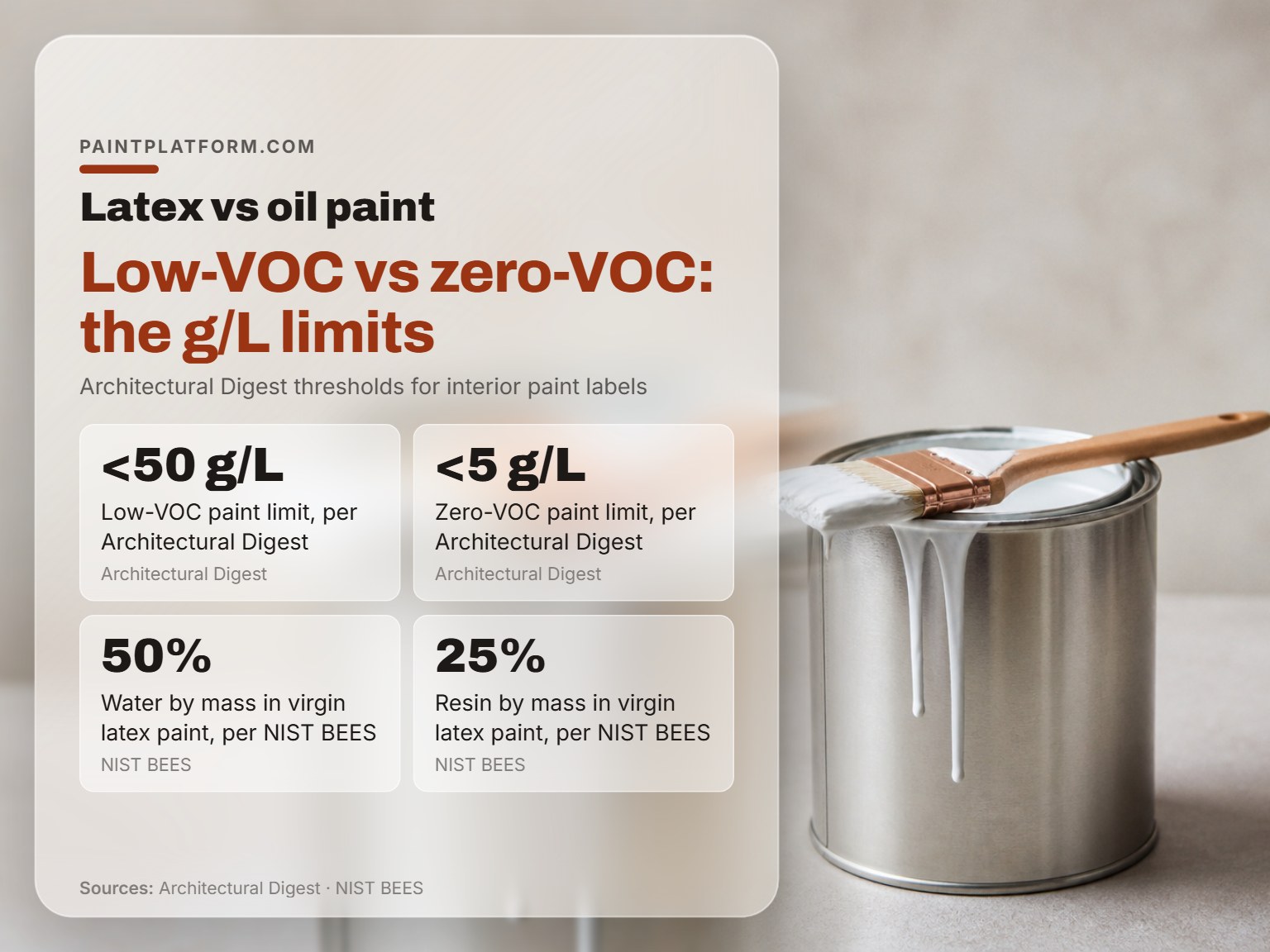
Architectural Digest defines the thresholds: low-VOC paint has less than 50 grams of VOCs per liter, and zero-VOC paint has under five grams per liter. Those are different claims, and a can that says “low-VOC” is not making the zero-VOC promise.
- Low-VOC: under 50 g/L, per Architectural Digest and PPG’s Hi-Hide 689-10 sheet.
- Zero-VOC: under 5 g/L, per Architectural Digest.
- Oil-based carrier: a solvent of volatile organic compounds, per NIST BEES.
- Water-based carrier: water plus a coalescing agent, far fewer VOCs on application, per NIST BEES.
The carrier is where the difference lives. NIST’s BEES product file explains that oil-based paints use a solvent carrier and emit far more VOCs on application, while latex skips the solvent cleanup entirely. Benjamin Moore’s Eco Spec F374 goes further as a zero-VOC, 100 percent acrylic, minimal-odor interior latex.
If you want the fuller chemistry, the oil paint vs acrylic paint for walls piece goes deeper on binder types.
For the raw material breakdown, the NIST generic latex paint products file lists virgin latex at 25 percent resin, 12.5 percent titanium dioxide, 12.5 percent limestone, and 50 percent water by mass.
Which Paint Goes on Which Surface?
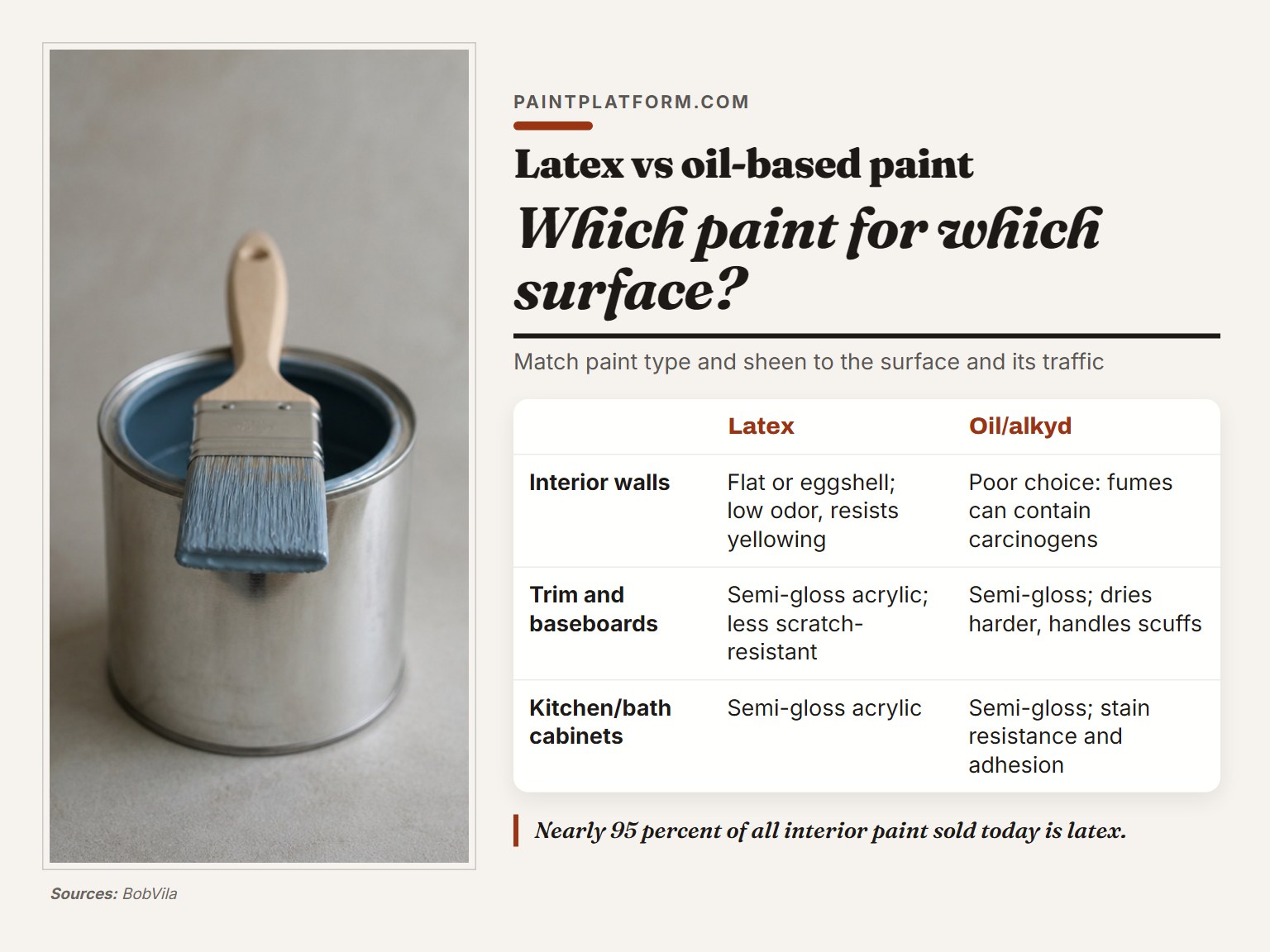
Match the paint to the surface and the sheen to the traffic, and most of the latex vs oil-based paint for interior walls debate resolves itself. BobVila’s sheen guide is a starting point, and the paint type follows from what the surface does all day.
| Surface | Paint type | Sheen | Why |
|---|---|---|---|
| Interior walls | Latex | Flat or eggshell | Low odor, flexible, resists yellowing |
| Ceilings | Latex | Flat | Hides imperfections, spatter-resistant |
| Trim and baseboards | Oil/alkyd or acrylic | Semi-gloss | Hard film handles scuffs and cleaning |
| Kitchen and bath cabinets | Oil/alkyd | Semi-gloss | Stain resistance and adhesion |
| Doors | Oil/alkyd or acrylic | Semi-gloss or gloss | Hand contact and repeated cleaning |
For a wider look at the categories, the interior paint types guide covers the full menu beyond latex and alkyd. The Queensland Government’s Queensland painting maintenance technical note is also worth a read if you’re repainting an older home with unknown layers underneath.
Outside that window, the film won’t form properly, no matter how good the paint is.
Frequently Asked Questions
Is latex or oil-based paint better for interior walls?
BobVila calls latex the paint of choice for interior walls, while Sherwin-Williams positions modern alkyds as the best type for interior walls. It dries to the touch in about 30 minutes, stays flexible, and resists yellowing in areas protected from sunlight. Oil-based alkyds dry harder and resist abrasion, which is why they still make sense on trim, doors, and cabinets.
Can I use oil-based paint on interior walls?
You can, but the case is thin. Oil-based paints can take up to 24 hours to dry and give off more odor and higher VOCs than latex. Architectural Digest recommends against DIY interior alkyd use and suggests consulting a professional painter instead.
Why does oil-based paint turn yellow?
Oil-based coatings oxidize as they cure, and that oxidation is what causes yellowing and chipping in interior applications. Glidden and Dutch Boy both list yellowing with age as a known drawback of oil and alkyd paints.
Do I need a primer before painting over oil-based paint with latex?
Yes. Apply an oil-based primer first to create a flat, porous surface, then topcoat with latex once the primer is fully dry. Skipping that step is how latex topcoats peel off old oil.
How long before I can recoat latex paint?
PPG lists a 2 to 4 hour recoat window for its Hi-Hide 689-10 flat interior latex at 77F and 50 percent relative humidity. Dutch Boy notes latex dries to the touch in about 30 minutes, but dry to touch and ready to recoat are not the same thing.
The Bottom Line
The latex vs oil-based paint for interior walls question has a boring answer for most rooms, and the answer is latex.
Where it changes is trim, doors, and cabinets in a kitchen or bathroom. There, an alkyd’s hard film still earns the extra dry time.
Here’s the part I’d underline: prep decides more than the can.
