
Mold Resistant Paint vs Mold Killer: Which Should You Use?
This post contains affiliate links. As an Amazon Associate, we earn from qualifying purchases.
Mold resistant paint vs mold killer are two different products with two different jobs. A mold killer cleans and disinfects a contaminated surface first. Mold-resistant paint protects the dried paint film afterward. Skip the cleaner and paint applied over moldy surfaces is likely to peel; skip the paint and the surface stays bare.
That peeling timeline is where failed jobs start. EPA guidance says paint applied over moldy surfaces is likely to peel, and the agency frames removal, not killing, as the goal. The legal category on the label matters more than the front of the can.
What follows walks the difference between a registered kill claim and a treated-article film protection, then the sequence that actually holds up: clean, dry, prime, topcoat.
Key Takeaways
- Clean first, always. EPA says do not paint moldy surfaces and that paint over mold peels, though Rust-Oleum’s product page says you can paint directly over existing mold without extensive pre-cleaning.
- Only one product here carries a product registration. Zinsser Mold Killing Primer (EPA Reg. No. 87469-1-69587); the rest are treated articles that protect the film.
- ASTM D3273 and D5590 are film tests, not kill tests. A “passes” claim with no score means little.
- Two coats beat one. Zinsser Perma-White requires two coats for proper performance, while Family Handyman recommends a two-step process combining a fungicidal primer layer with an antimicrobial topcoat.
- Fix the moisture or nothing works. EPA: control moisture to control mold.
Mold Resistant Paint vs Mold Killer: What Actually Separates Them
A mold killer is a cleaning step. A mold-resistant paint is a protective step. The mold resistant paint vs mold killer question isn’t a competition, and treating them as alternatives is how people end up repainting the same wall twice.
A mold-resistant coating protects the dried paint film from future growth on the surface. Mold killers clean and disinfect the substrate before any coating goes on. EPA Pesticide Registration Notice 2000-1 classifies mildew inhibition on a dried paint film as a non-public health claim, distinct from a kill claim on a living organism.
The two categories sit in different legal buckets. A treated article is ordinary paint with a preservative that protects the film. A registered pesticide coating carries an EPA registration number and can claim to kill the organisms listed on its label. Four of the five products compared here are the first kind.
| Category | Registration | What it can claim | Example |
|---|---|---|---|
| Treated article | No product registration | Film resists mold on the dried surface | Zinsser Perma-White Interior |
| Registered pesticide | EPA Reg. No. On label | Kills organisms listed on the label | Zinsser Mold Killing Primer |
| Additive | EPA-registered for film | Inhibits growth on the dried film | M-1 Advanced Mildew Treatment |
I’ve stopped treating these as competing products. The mold-resistant paint pros and cons come down to which job you’re hiring it for, not which can is better.
In short: a mold killer cleans, a mold-resistant paint protects, and neither replaces the other.
The Legal Category Most Labels Bury in Small Print
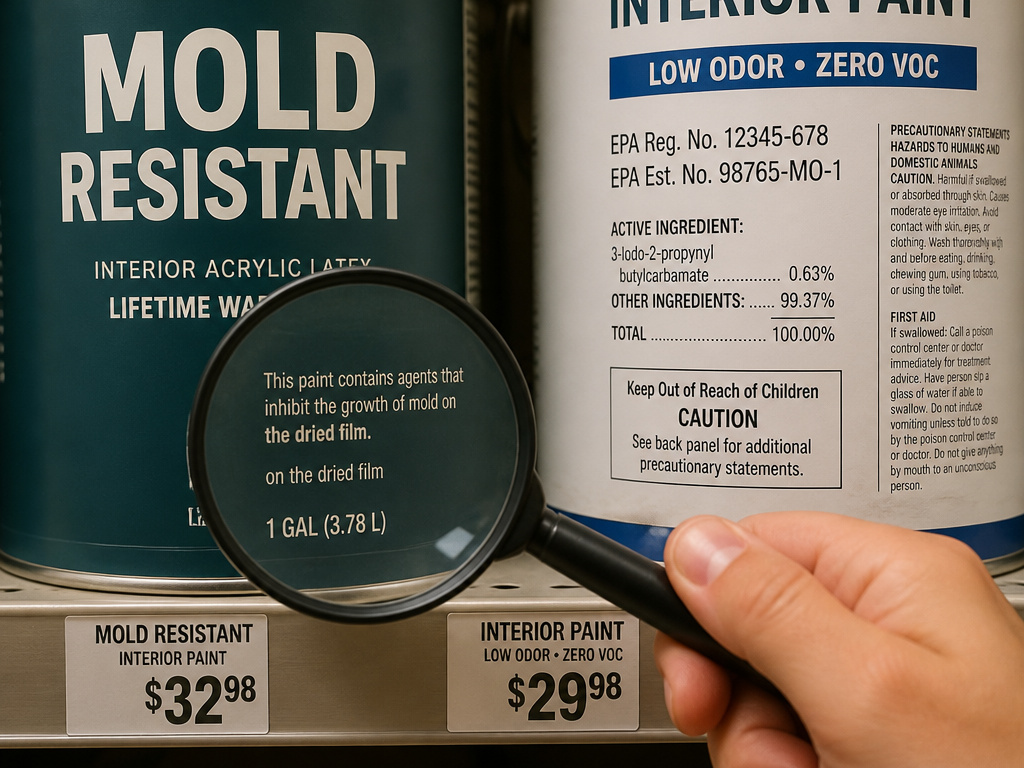
Zinsser Mold Killing Primer carries EPA Reg. No. 87469-1-69587 on the label. That number changes what the product is allowed to claim.
Treated Article: Protects the Film, Not the Wall
Under 40 CFR 152.25(a), a paint treated to protect the coating itself is exempt from registration as a pesticide. The exemption covers the paint film, not the wall underneath. That distinction matters when a can says “mold resistant” in large letters and “on the dried film” in small ones.
Here’s what a treated article can and cannot say:
- Can claim: the dried paint film resists mold growth on its surface.
- Cannot claim: that the product kills mold, mildew, or any organism on the wall.
- Cannot claim: indoor air quality improvement through microorganism reduction, per PRN 2000-1.
- Requires: a qualifier with equal prominence, such as “resists mold on the dried film.”
Easy to miss: A “mold resistant” label on a treated article means the dried film resists growth. It says nothing about what happens to the wall behind it.
Registered Pesticide: A Kill Claim With Strings
A registered coating carries an EPA registration number and can make a kill claim for the organisms and surfaces on its label. The EPA-registered mold proofer paint label shows the format: registration number, active ingredient, listed surfaces, and required pre-cleaning. Zinsser’s label says “paint over and kill all existing mold, mildew” but also requires pre-cleaning for “wet, slimy, heavy soiled, gross filth, overgrowth or loose material.” The label narrows the marketing.
That’s the pattern to look for on any mold-killing primer: a registration number plus a pre-cleaning step. Without both, you’re looking at a treated article.
What Does ‘Passes ASTM D3273’ Actually Mean?
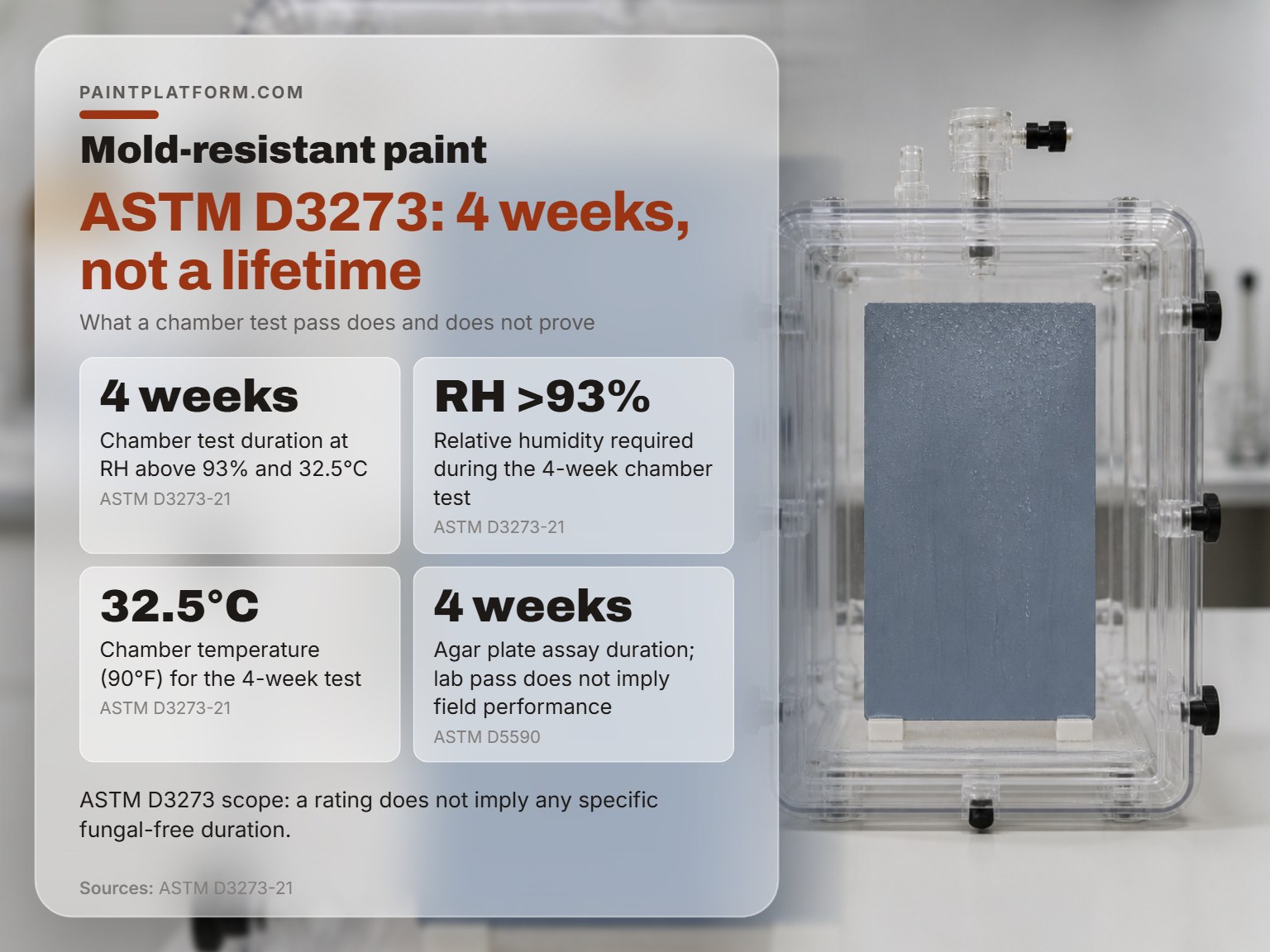
Four weeks in a chamber at 32.5°C and RH above 93% is what ASTM D3273-21 actually measures. A coating that scores well in that chamber resisted growth under those conditions for four weeks.
That’s it.
The standard’s own scope says performance at a certain rating “does not imply any specific period of time for a fungal free coating.” ASTM D5590, a 4-week agar plate assay, says a coating that resists growth in the lab “will not necessarily resist growth in the actual application.”
| Standard | What it measures | What a pass does not prove |
|---|---|---|
| ASTM D3273 | 4-week chamber, RH above 93%, 32.5°C | A specific mold-free duration |
| ASTM D5590 | 4-week agar plate assay | Field performance |
| ASTM E-84 | Flame spread | Anything about mold |
Benjamin Moore Aura Bath & Spa cites only ASTM E-84 for its mold claim, and E-84 is a flame-spread test. No fungal test appears on the sheet. A “passes ASTM” line without a printed score tells you very little about how the product will hold up in a steamy bathroom.
The mold-killing paint category leans on these test names heavily. Read the scope language before you trust the badge.
The Clean-Dry-Prime-Coat Sequence That Holds Up
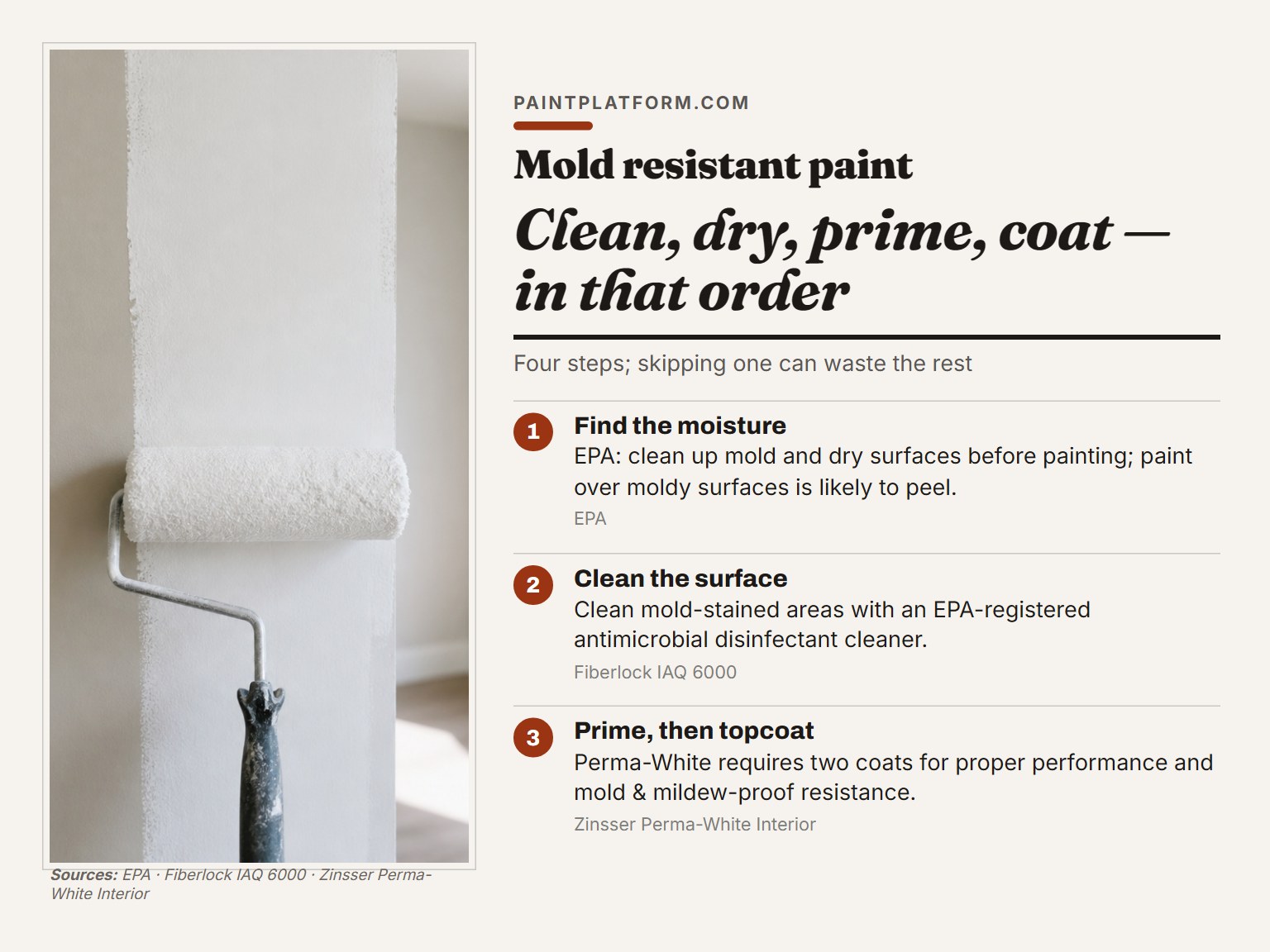
Four steps, in this order: find the moisture, clean the surface, let it dry fully, then prime and coat.
Before you start: Scraping or sanding old paint can release lead dust, so wear a NIOSH approved respirator and clean up with a HEPA vacuum and wet mop. Fiberlock IAQ 6000 and AfterShock must not be applied below 50°F (10°C), and Perma-White only between 50-90°F (10-32°C), so a cold snap mid-project can leave a film that never fully sets. And if you’re spraying AfterShock, the label requires a NIOSH respirator with an R, P, N, or HE filter.
- Find the moisture. EPA’s line is blunt: control moisture to control mold. EPA says the best way to control mold growth is to control moisture. Skip this and the rest is cosmetic.
- Clean the surface. Use an EPA-registered antimicrobial cleaner on mold-stained areas. Fiberlock’s IAQ 6000 data sheet says mold-stained surfaces should be cleaned with an EPA-registered antimicrobial disinfectant cleaner. A mold remover for painted walls works too, as long as the label lists the surface.
- Let it dry completely. Let the surface dry completely before priming and coating. Let it dry completely before priming and coating. If mold returns after cleaning, the moisture source is still active.
- Prime, then topcoat. A fungicidal primer layer plus an antimicrobial topcoat is the two-step sequence Family Handyman recommends after severe water damage. Perma-White requires two coats of the topcoat itself.
Find the leak. That’s the whole game.
So: find the moisture, clean, dry, prime, coat. Skip any one and the rest is wasted effort.
Where the Marketing and the Label Disagree
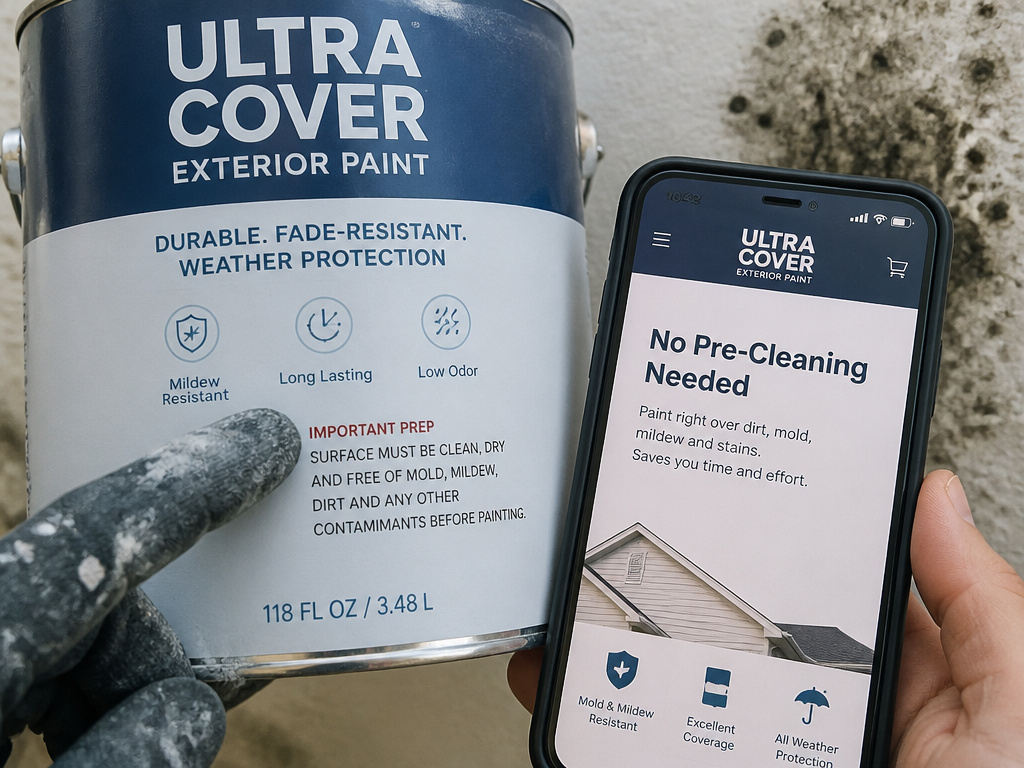
The can says one thing. The label says another. Rust-Oleum’s product page for Zinsser Mold Killing Primer says you can “Paint directly over existing mold and mildew without extensive pre-cleaning.” The label on the same can requires pre-cleaning for “wet, slimy, heavy soiled, gross filth, overgrowth or loose material.” The marketing claim exceeds the label.
“Do not paint or caulk moldy surfaces. Clean up the mold and dry the surfaces before painting. Paint applied over moldy surfaces is likely to peel.” That’s EPA’s Brief Guide to Mold, Moisture and Your Home, and it’s the direct counter to the paint-over-mold pitch.
That’s a direct conflict, and the label plus EPA win. If you want the full step-by-step on paint over mold, the sequence above is the one that matches the regulator’s guidance.
Guarantees vary as much as the labels. Zinsser backs Perma-White with a five-year mold- and mildew-proof paint film guarantee, per brand manager Angela Cunningham. The EPA PERMA-GUARD mold coating label offers optional 5-year and 10-year guarantee language, but also says application of other paints over PERMA-GUARD nullifies the warranty. And Zinsser’s own Frank Glowacki told PaintPro that none of the fungicide additives are designed to protect long term.
Where this goes sideways: Buying a warranty-backed coating and then topcoating it with a different brand. The PERMA-GUARD label voids the guarantee the moment another paint goes over it, and you lose the protection you paid for.
Which Product Fits Which Job?
I tested a mold-resistant paint on a scrap board next to a plain one in a damp corner. Both looked fine initially. The real difference came from moisture control, not the label.
For Bathrooms and Damp Rooms
Zinsser Perma-White Interior is the pick for bathrooms, basements, kitchens, and laundry rooms. It requires two coats for the mold-proof film, and it’s tintable up to 4 ounces of universal colorant per gallon. The bathroom mold-resistant paint category is broader, but Perma-White is the one with a written film guarantee.
For Wall Cavities and Framing
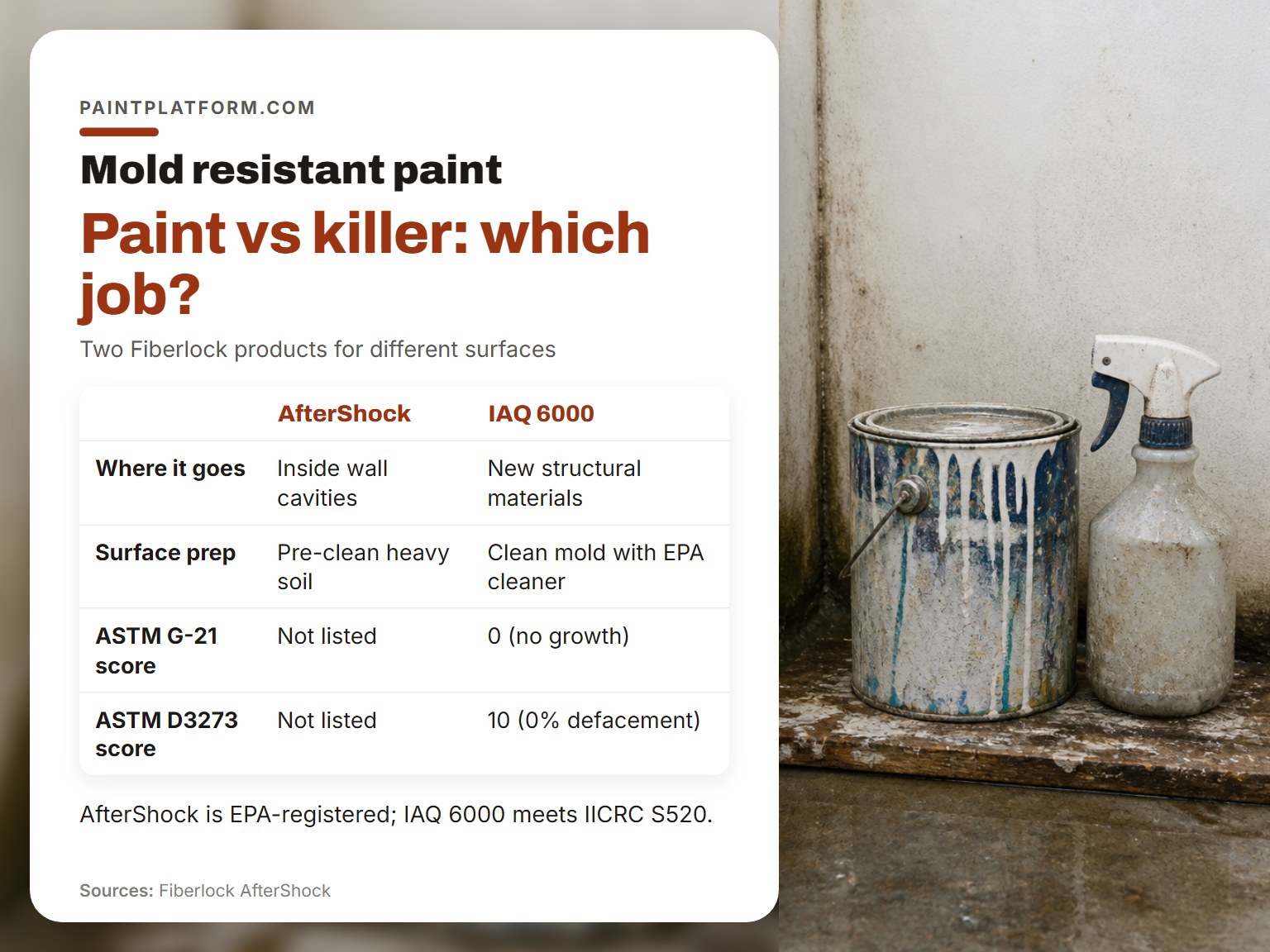
Fiberlock AfterShock is the one product here with an explicit cavity application statement. It’s labeled for interior wood framing, primed metal, concrete, and wallboard inside the wall cavity. It is not for HVAC applications.
For New Construction and Structural Materials
Fiberlock IAQ 6000 is labeled for new structural materials during building construction and meets IICRC S520 criteria. It passed ASTM G-21 with a score of 0 (no growth) and ASTM D3273 with a score of 10 (0% defacement). Coverage is 250-400 square feet per gallon on smooth surfaces, 150-300 on porous. For the wider field of mold-proof paint, those scores are among the few printed on a data sheet.
For cleaning mold-stained surfaces before any coating, Moldex Mold Killer (EPA Reg. No. 6836-193-82480) is bleach-free and labeled for hard nonporous surfaces. Its label says to repeat the application every 7 days, or when growth returns, which tells you the product is a maintenance step, not a one-time fix.
When to Skip the Paint Entirely
Some walls shouldn’t be painted at all. A damp exterior surface is a different problem from a damp interior wall. On exterior trim, surface mildew can often be cleaned off. Soft, crumbly wood underneath is a different story. Poke it with a screwdriver before deciding.
I’ve watched north-facing spots grow mildew fastest. Trimming back a bush did more than repainting.
If the wood is soft, don’t paint. If the leak is active, don’t paint. If the moisture source is unresolved, don’t paint.
- Active leak. Perma-White may be applied over damp masonry but is not designed to stop active water leaks. Fix the leak first.
- Soft, crumbly wood. Paint over rot fails. Replace the board.
- HVAC surfaces. AfterShock and Perma-White both say no to HVAC applications. Use a specialist product.
- Wet, moldy porous materials. EPA says these may need to be discarded, not coated.
If you’ve already painted and the growth is back, the fix is upstream. The steps to stop mold returning start with moisture control, not another coat.
Frequently Asked Questions
Can mold-resistant paint kill mold?
Fiberlock AfterShock and Zinsser Mold Killing Primer carry registered kill claims, though Pratt & Lambert’s Andy Rzicznek says he knows of no paint that kills mildew and mold spores. Zinsser Mold Killing Primer carries EPA Reg. No. 87469-1-69587. Treated articles like Perma-White protect the dried film and cannot claim to kill organisms on the wall.
Do I need a mold killer if I’m using mold-resistant paint?
Yes. EPA guidance says to clean up mold before painting, and paint over moldy surfaces is likely to peel. A mold killer or antimicrobial cleaner is the cleaning step. The paint is the protective step.
What does “passes ASTM D3273” actually mean?
It means the coating resisted growth in a 4-week chamber at RH above 93% and 32.5°C. The standard’s own scope says a rating does not imply any specific mold-free duration. A pass without a printed score tells you very little.
Can I tint a mold-resistant paint?
It depends on the product. Zinsser Perma-White accepts up to 4 ounces of universal colorant per gallon. Fiberlock IAQ 6000 accepts up to 2 ounces. Zinsser’s Frank Glowacki told PaintPro that EPA-registered mold/mildew products must be white or clear by law, while Fiberlock IAQ 6000 may be tinted with up to 2 ounces of universal colorant per gallon.
Is one coat enough?
No. Zinsser Perma-White requires two coats for proper performance and mold & mildew-proof resistance. Fiberlock AfterShock requires pre-cleaning for heavily soiled areas and removal of gross filth or heavy soil before application.
The Bottom Line
Nothing here replaces fixing the moisture. EPA’s own framing says it: control moisture to control mold. A mold killer cleans the surface. A mold-resistant primer or coating protects the film. The paint on top is the last step. Cleaning and priming come first.
One rule worth taping to the can: if the wall is still damp, stop. Perma-White may go over damp masonry, but it is not designed to stop an active leak. Neither is anything else on this list.
Try this today: buy a cheap humidity meter and put it in the room you’re about to paint. If the reading stays high, you have a moisture problem, not a paint problem.
