
How to Remove Latex Paint From Carpet: Wet and Dried
This post contains affiliate links. As an Amazon Associate, we earn from qualifying purchases.
That window is where the how to remove latex paint from carpet question gets decided. Latex paint is a water-borne emulsion, and once the water leaves the film, the resin particles fuse into a skin that grips fiber instead of sitting on it.
What follows covers the wet-side rescue, the dried-side protocol, the four authorities who contradict each other on detergent and water temperature, and the point where you should stop and call someone.
Key Takeaways
- Blot, never wipe. Pressing a damp rag down and lifting moves paint out; rubbing drives it deeper and widens the stain.
- The 6-to-8-hour mark is the cutoff Iowa State Extension names, after which latex removal becomes very difficult.
- CRI caps the detergent at 1/4 teaspoon per cup of lukewarm water and says no stronger concentration, ever.
- Laundry detergent is a genuine split. Iowa State says use it; CRI says never, because optical brighteners can dye the fiber.
- A whole gallon is a pad replacement, not a spot treatment.
Why the First Five Minutes Decide Everything
Fresh latex comes up almost embarrassingly easily. I rubbed a blob into a beige carpet once, working it in circles like I was buffing a car. A quarter-sized dot became a smear the size of a dinner plate. The paint didn’t fight me. I gave it somewhere to go.
Now the routine is press, lift, move to a clean patch of rag, repeat. That’s the whole thing.
A water-borne latex emulsion skins over as the water evaporates, and the change is visible. The film goes from glossy-wet to a dull matte skin. Once that skin forms, the resin binds to carpet fiber rather than sitting on the surface, and mechanical action spreads pigment through the pile instead of lifting it clear.
Watch for that matte shift when you compare a how to remove latex paint from carpet timeline. It shows up on the surface of the blob before the middle has set, and it tells you the clock just started.
The carpet paint removal sequence below works the same on a stair tread or a landing.
- Press a white cloth straight down and lift. Rubbing widens the footprint, which is how a quarter-sized dot becomes a dinner plate.
- Work from the outside edge inward. Paint pushed outward at the rim stains fresh fiber you didn’t have to touch.
- Switch to a clean section of cloth every few presses. A loaded rag just redistributes paint back into the pile.
- Flush with cool water once the bulk is up. The Iowa State Extension AnswerLine stain tips call for soaking in cold water or washing in cool water with detergent while the paint is still wet.
- Blot dry and stay off it. Walking on damp fiber pushes residual pigment deeper before you’ve had a chance to check.
The rag comes up with a grey-pink smear on the first few presses, then fades to almost nothing. When the cloth stops picking up color, you’re done.
Common mistake: Rubbing a fresh blob in circles. Pigment drives into the pile within seconds, and the smear ends up several times the size of the original dot.
How Do You Treat Latex Paint That Has Already Dried?
Start with the Carpet and Rug Institute’s dilution and nothing stronger: 1/4 teaspoon of liquid dish washing detergent in 1 cup of lukewarm water.
Before you start: Ammonia and solvent-based spot removers both put fumes in a closed room, so open a window and keep children and pets away until the area is dry. Test any solvent on a hidden corner first, because a lightened patch of carpet is permanent.
The CRI dilution, step by step
The Carpet and Rug Institute latex paint guide caps the mix at 1/4 teaspoon of liquid dish washing detergent per 1 cup of lukewarm water, and it adds an explicit warning never to use a stronger concentration.
- Pretest the solution on an inconspicuous patch of carpet first.
- Apply the detergent solution and work it in gently. CRI says do not rub.
- Blot the loosened paint with a white cloth.
- Rinse with cold water, then blot until the fiber is dry.
- Repeat the rinse with lukewarm tap water several times. A mist sprayer keeps you from overwetting the backing.
That last step matters more than it sounds. Detergent residue left in the pile attracts soil, and a spot that looks clean on day one can look grimy again later.
Why the rinse matters more than the wash
The latex paint removal method CRI publishes is deliberately weak. It’s built around the idea that a mild solution applied repeatedly beats a strong solution applied once.
If the spot is stubborn, CRI’s own advice is to call a professional cleaner, who has the equipment to use more aggressive solutions.
| Source | Mix | Dwell |
|---|---|---|
| CRI | 1/4 tsp liquid dish detergent per 1 cup lukewarm water | Work in gently, rinse cold |
| UGA Extension (step 1) | 1 quart warm water, 1/2 tsp liquid hand dish detergent, 1 tbsp ammonia | 30 minutes |
| UGA Extension (step 2) | 1 quart warm water, 1 tbsp vinegar | 1 hour |
| Iowa State Extension | Dry cleaning solvent, then liquid laundry detergent | 10 to 15 minutes |
Where this goes sideways: Using the stain-resist solution from a spot removal kit before the spill is fully out can set a permanent stain. CRI flags that sequencing hazard directly, and no other source does.
Where the Four Authorities Actually Disagree
Four credible sources, and they split on detergent, water temperature, and how hard to scrub.
| Question | One position | The other position |
|---|---|---|
| Laundry detergent | Iowa State: rub in liquid laundry detergent | CRI: never, optical brighteners can dye the fiber |
| Water temperature | Iowa State: scrub with hot water after the dwell | CRI: rinse cold, mix the solution lukewarm |
| Scrubbing | UGA: stiff-bristled or wire brush for tough spots | CRI: work in gently, do not rub |
| Ammonia and vinegar | UGA: 30-minute ammonia soak, then 1-hour vinegar soak | CRI: no such protocol, dilution cap only |
| Whole-gallon spill | Bane Clene: replace the pad and section the carpet | CRI: call a professional cleaner |
None of these are sloppy sources. They’re answering slightly different questions, and the disagreement is worth reading carefully rather than averaging.
The laundry detergent split
This one is the sharpest. Iowa State tells you to rub in liquid laundry detergent after a dry cleaning solvent. CRI says never use a laundry detergent of any type, because optical brighteners are fluorescent dyes that can tint the fiber.
Iowa State recommends rubbing in liquid laundry detergent, while CRI says never use a laundry detergent of any type because optical brighteners can dye the fiber.
Hot water or cold?
The UGA Extension paint stain removal page leans warm, with a 30-minute ammonia soak followed by a 1-hour vinegar soak. CRI leans cold for the rinse. Bane Clene, the trade supplier, extracts with hot water or detergent.
The ammonia soak smells exactly like you’d expect, which is why the window matters more than the temperature debate.
One thing I’d add from my own floor: this is not the oil paint playbook. I dabbed a cadmium red smudge with a wet rag once and got a pink halo for my trouble. Water does almost nothing to oil paint, and oil paint on carpet is a completely different job.
The Pretest Rule That Saves You From a Worse Stain
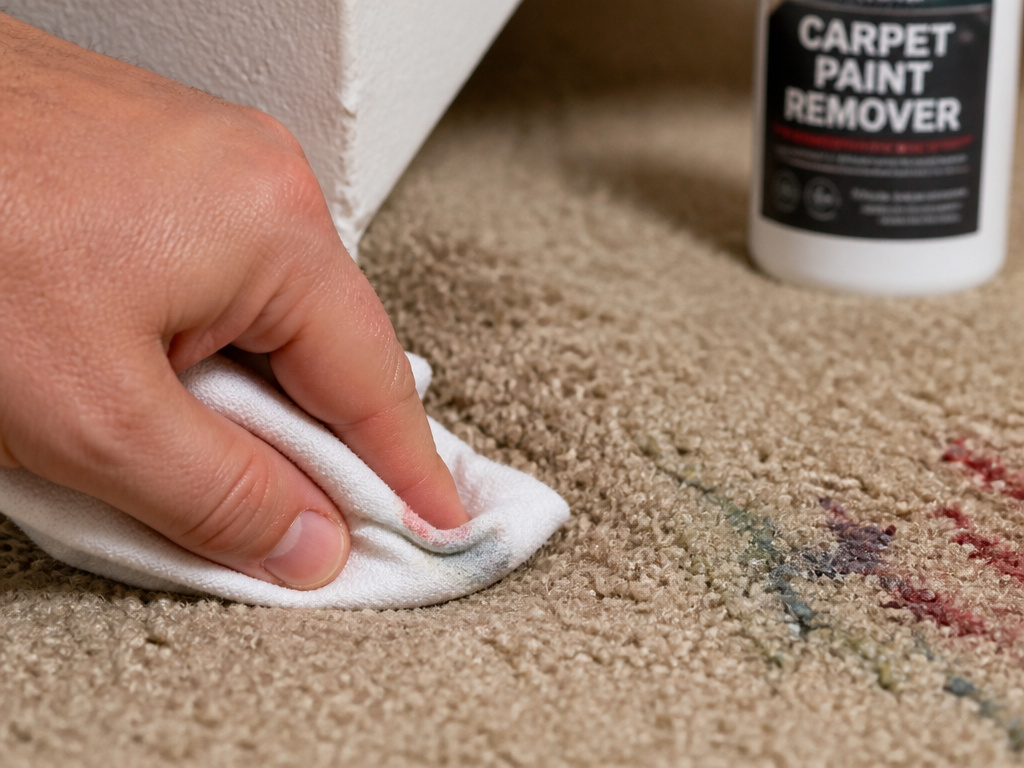
Pretesting is the step everyone skips, and it’s the only one that protects you from making things worse.
CRI’s instruction is specific: apply the solution to an inconspicuous area, check for color transfer to the cloth or damage to the carpet, and if a change occurs, select another solution. Bane Clene applies its Pro-Solve Gel liberally with no fiber caveats at all.
That gap is the whole argument for testing. A trade procedure written for pros who know their fibers does not transfer cleanly to a stranger’s carpet.
I skipped the pretest exactly once, on a rental carpet, and I now own a patch that looks cleaner than the rest of the room. A minute on a hidden corner would have told me. Try it on scrap first.
If the pretest changes the fiber at all, switch products before you touch the spot. The paint removers for carpet options that pass a pretest on wool and nylon are a short list.
What Changes When the Spill Is a Whole Gallon?
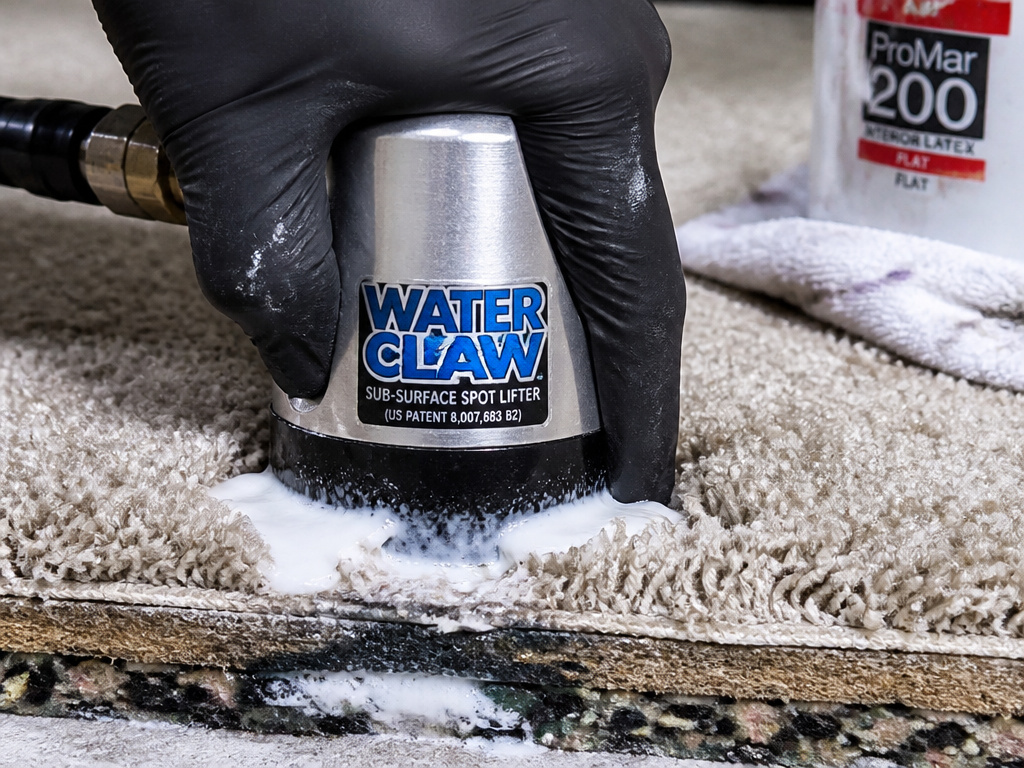
A gallon spill changes three things at once: the pad, the backing, and who should be doing the work.
Bane Clene’s guidance for an entire gallon spilled on one small carpeted area is blunt. Replace the carpet pad in the affected area and section the affected carpet area. The spot treatment procedure stops applying.
A spot you can cover with a dinner plate is a cleaning job. A spill you can see the pad through is a flooring job, and no amount of dish soap changes that.
For heavy but sub-gallon spills, Bane Clene reaches for the Water Claw Spotter Sub-Surface Spot Lifter to flush paint out from below the pile. That’s the tool that separates a surface fix from a real one.
The 5 Things Worth Keeping Under the Sink

The kit is short and cheap. You probably own half of it.
- Liquid dish washing detergent. CRI’s dilution is 1/4 teaspoon per cup of lukewarm water.
- A stack of white cotton rags. Colored cloth can bleed dye, and you want a fresh face for every press.
- Bane Clene Pro-Solve Gel Thickened Solvent-Based Spot & Stain Remover. A thickened solvent that stays where you put it instead of wicking sideways through the pile.
- Bane Clene Water Claw Spotter Sub-Surface Spot Lifter. The tool for paint that has already run below the surface.
- Paper towels. CRI’s rinse-and-blot sequence goes through a lot of them.
For most household spots, a bottle of liquid dish washing detergent and a stack of white rags handle the whole job. Save the Pro-Solve Gel for paint that has already started to skin over, where a detergent solution just slides off the film.
The same dish soap dilution works on paint from upholstery if the cushion cover is a washable fiber. Chemical latex paint removers earn their place only on paint that has fully cured.
Frequently Asked Questions
Does dried latex paint ever come out of carpet completely?
Often yes, but the odds drop fast after the first day. Iowa State Extension describes removal as very difficult once the paint has dried 6 to 8 hours. Past that point you’re working on the surface of the film rather than lifting paint out of the pile.
Can I use laundry detergent on latex paint in carpet?
Two credible sources say opposite things. Iowa State Extension recommends rubbing in liquid laundry detergent as part of the treatment. The Carpet and Rug Institute says never use a laundry detergent of any type, because optical brighteners can dye the fiber. Pretest, and lean toward CRI on pale carpet.
Is hot water or cold water better for latex paint?
It depends which authority you follow. CRI rinses with cold water and mixes its detergent solution lukewarm. Iowa State scrubs with hot water after a solvent dwell. Bane Clene extracts with hot water or detergent. CRI rinses with cold water and mixes its detergent solution lukewarm, while Iowa State scrubs with hot water after a solvent dwell and Bane Clene extracts with hot water or detergent.
What if the paint already soaked into the carpet pad?
Then it’s a pad problem. Bane Clene’s guidance for a whole-gallon spill is to replace the carpet pad in the affected area and section the carpet. CRI’s parallel advice is to call a professional cleaner, who has the equipment to handle it.
Will vinegar remove latex paint from carpet?
UGA Extension uses vinegar as a second-stage soak, not a standalone remover: 1 quart warm water and 1 tablespoon vinegar for 1 hour, after an ammonia soak. CRI publishes no vinegar protocol at all, so treat it as an escalation step rather than a first move.
The Bottom Line
Here’s the trigger to remember: if the paint has been down longer than 6 to 8 hours, stop treating it as a spot and start treating it as a fiber problem. That’s the line Iowa State Extension draws, and it matches what I’ve watched happen on my own floor.
The second thing worth saying out loud is that the sources genuinely disagree, and that’s fine. CRI rinses with cold water and mixes its detergent solution lukewarm, while Iowa State scrubs with hot water after a solvent dwell and Bane Clene extracts with hot water or detergent. CRI says never use laundry detergent of any type because optical brighteners can dye the fiber, while Iowa State recommends rubbing in liquid laundry detergent as part of the treatment.
None of this helps if the spill soaked the pad. At that point you’re pulling carpet, and the honest advice is to call someone who owns a Water Claw and a truck.
Go buy the cheap dish soap. Keep the rags where you can reach them. The mess is survivable.
