
Heat Gun vs Chemical Stripper: Which Should You Use?
This post contains affiliate links. As an Amazon Associate, we earn from qualifying purchases.
Heat gun vs chemical stripper comes down to three things: the surface, the paint type, and the lead risk. A heat gun softens thick oil-based gloss on timber in seconds per section. A chemical stripper wins on intricate carvings, uPVC, and any surface where heat could warp, crack, or vaporize lead.
The line between those two methods is thermal. Calling it tribal misses the point. A heat gun relaxes the polymer chains in oil-based paint so the film lifts in leathery strips. A chemical stripper breaks the cross-links at a molecular level and turns paint into a wrinkled gel you scrape away.
What follows is the temperature math, the surfaces where each method fails, the lead-paint rules that actually matter, and the hybrid workflow most pros run on real jobs.
Key Takeaways
- Match the tool to the substrate first. Heat guns scorch veneer and warp uPVC. Chemical strippers are safer on both.
- Lead paint changes the whole calculation. UK HSE guidance (via blog) puts the fume threshold at 590C, but sources disagree on the safe ceiling (500C, 590C, or JourneymanHQ’s 1,100F).
- A 2000W heat gun clears a standard door panel in under 20 minutes once you have the rhythm.
- Chemical stripper dwell time runs 15 minutes to several hours, so budget for the wait or work in sections.
- Test on scrap first. A patch test beats a ruined antique every time.
What Temperature Actually Softens Paint?
Most thick paint layers on timber begin to soften and blister between 200C and 300C. That range is the working sweet spot for standard oil-based gloss, and it is where a variable-temperature heat gun earns its keep.
A heat gun softens paint through forced convection. A resistance element heats incoming air, and a fan drives it through a nozzle at controlled velocity. Temperature and airflow rate together determine how fast heat penetrates successive paint layers to the wood interface beneath the film.
The exact figure depends on paint type, layer count, and wood species. But that 200-300C window is the target. Below it, the film stays rubbery. Above it, the paint chars before it releases.
Published operating ranges for heat guns disagree with each other. One source lists 300F to 1,400F (150C-750C). Another lists 100C to 550C. A third puts the airflow at 400-650C. Treat any single number as a rough guide, not a spec sheet.
I scorched a table leg once chasing a stubborn topcoat. The paint went gummy and smeared instead of lifting, and I ended up scraping and sanding anyway.
If the paint starts to bubble and smoke before it softens, you are already too hot. Back the nozzle off and keep it moving.
Where a Heat Gun Wins (and Where It Scorches)
On flat timber with thick oil-based gloss, a heat gun is fast. A 2000W model can clear a standard door panel in under 20 minutes once you are experienced. There is no liquid waste to dispose of and no grain-raising from moisture.
Here is where sources split. One blog calls a heat gun a poor choice for wide flat expanses because the element only covers a few square inches at a time. Another says it is faster than chemical stripper on most flat wood. Both are describing real jobs with different paint layers and different operator skill.
Where the Heat Gun Earns Its Keep
- Thick oil-based gloss on raw timber. Softens in seconds per section.
- Shellac-based finishes. Respond rapidly around 250C.
- Window sashes and trim. The targeted air stream lets you work one small area without touching adjacent panels.
- Cold-weather work above 40F. Below that, efficiency drops noticeably.
Where It Scorches
Veneer is the classic heat gun trap. The adhesive beneath softens at relatively low temperatures, and the veneer can delaminate before you notice. Set the tool below 250C, keep it moving, and test on an inconspicuous area first.
I keep a scrap of veneered ply in the shop just to test heat settings on. It has saved me twice.
Two-pack epoxy and polyurethane coatings are cross-linked polymers. They do not soften with heat. They char. For those, a methylene chloride-free stripper such as Dumond Smart Strip Pro is more effective, with heat used only to assist the final scrape.
Where a Chemical Stripper Wins (and Where It Makes a Mess)
Chemical strippers break the polymer cross-links inside the paint itself. The result is a wrinkled gel that lifts from the substrate and scrapes away cleanly. Where heat struggles, this mechanism shines.
Where the Gel Wins
- Intricate mouldings and carved details. Gel conforms to the shape where a heat gun cannot maintain even contact.
- Large flat panels. Paste stripper goes on in sections and works unattended.
- uPVC frames. Heat warps them. A chemical paint stripper rated for plastics does not.
- Confirmed lead paint. Sources disagree: some say cold chemical methods avoid aerosolizing lead the way heat does, while others permit a heat gun below 500C–590C with FFP3 respirator and containment.
Chemical strippers made a bigger mess than I expected the first time I used one. Between the sticky residue, the wait of 15 minutes to several hours, and the cleanup rags, a scraper and sander would have been done before the stripper even bubbled.
Worth knowing before you start: Solvent-based strippers containing dichloromethane are unavailable to UK consumers under UK REACH restrictions. If you are following an old tutorial that names DCM, that product no longer exists on the shelf.
The Mess Nobody Warns You About
- Test on scrap first. A patch test tells you whether the stripper attacks the finish or the wood.
- Apply a thick, even coat. Thin coats skin over before they penetrate.
- Wait the full dwell time. 15 minutes to several hours depending on product and paint thickness.
- Scrape in one direction. Back-and-forth smears the residue.
- Neutralize before heat. Never put a heat gun on a surface that still has wet stripper on it. Most strippers are highly flammable, and the combination can flash fire.
If you are weighing best paint strippers for a furniture job, gel formulas beat liquid ones on vertical surfaces every time.
How Do You Handle Lead Paint Safely?
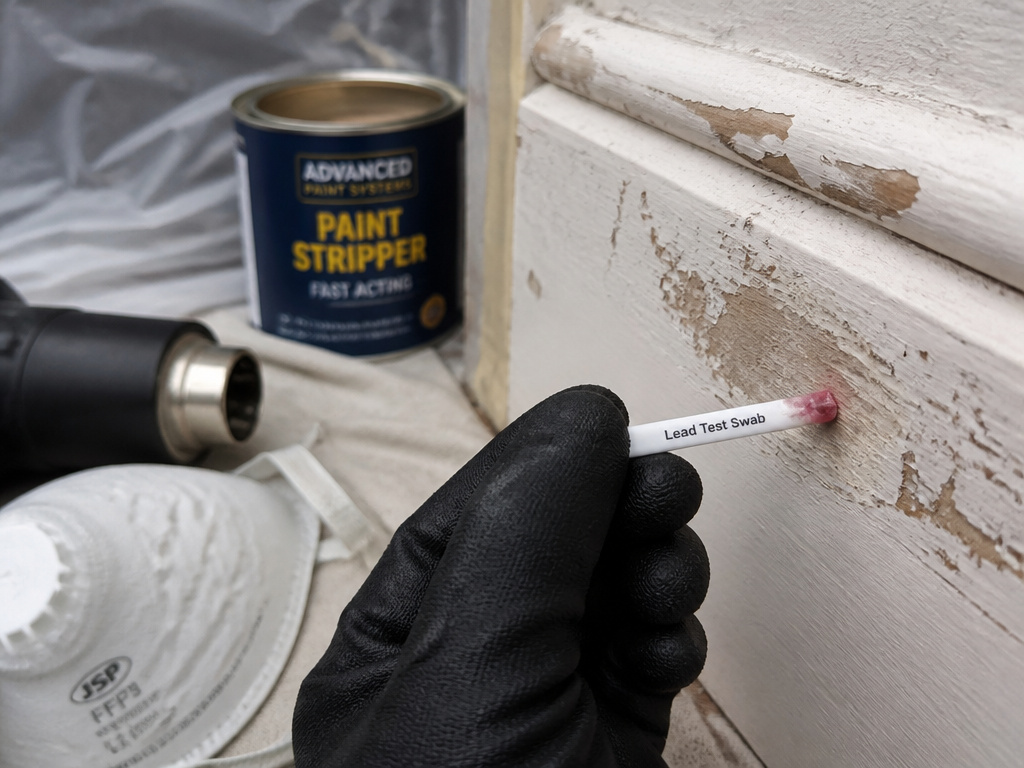
Lead paint is the one place where the heat gun vs chemical stripper choice stops being about speed. Every source agrees on that. They disagree, sharply, on the numbers.
| Source | Stated ceiling | Stance on heat guns |
|---|---|---|
| JourneymanHQ | Below 1,100F (~593C) | Permitted with P100 respirator |
| mofa.world (citing UK HSE) | Below 590C | Permitted with FFP3 and containment |
| mofa.world (how-to guide) | Below 500C if lead confirmed | Never without EPA RRP containment |
| BuildWiz UK | Below 500C | “Marginal” – infrared preferred |
Notice what is missing from that table: a single regulator-set number. The Control of Lead at Work Regulations 2002 set no temperature at all. The 500C and 590C figures come from blog interpretations of HSE guidance, not from the regulation itself.
On when lead paint becomes hazardous, sources split wider. One attributes to UK HSE a fume threshold of 590C. Another says lead fumes and fine particulate dust appear above 200C, well within the range of most domestic heat guns. The conservative reading is the one to plan around: if the surface is pre-1980 and could carry lead, test before you heat.
I test every pre-1980 piece before I touch it with heat. The swab is cheap and the answer is fast.
Before you start: Lead swab kits are sold in multi-packs at Screwfix and Toolstation. A UKAS-accredited lab chip test takes two to five working days for a proper result. If lead is confirmed, seal the room with polythene sheeting, wear an FFP3 respirator, and bag all waste as hazardous material.
Sources disagree on whether a heat gun may be used on lead paint at all: one mofa.world guide says never without respiratory protection and EPA RRP containment, while another says do not use a heat gun if lead is detected and use cold chemical or professional abatement instead. An infrared paint remover is the middle option: it keeps surface temperature well below 500C, so lead stays in the paint matrix as solid strips you can bag rather than breathe.
uPVC, Veneer, and the Surfaces That Punish Both Methods
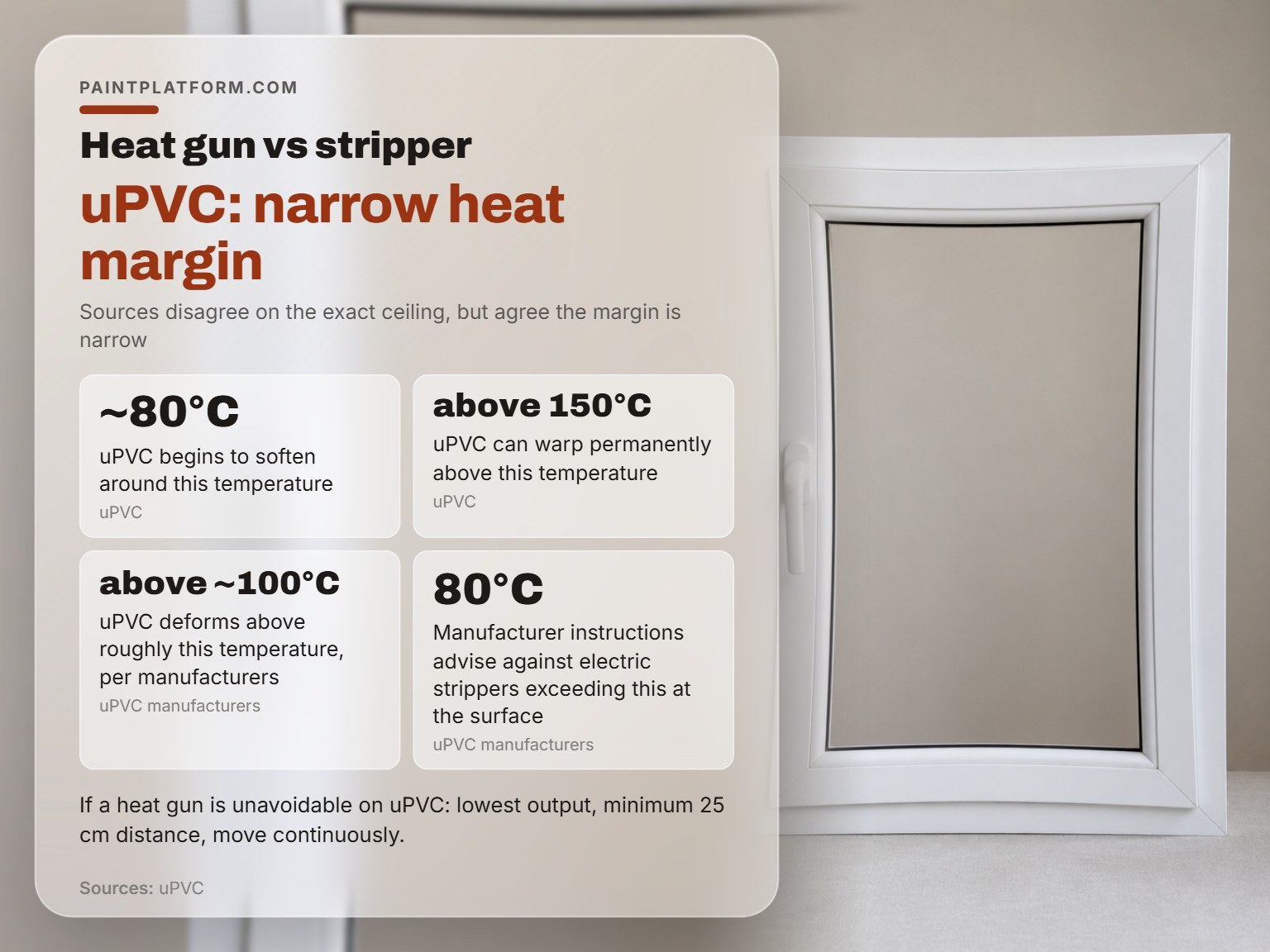
UPVC is the most unforgiving substrate in this whole comparison. Sources disagree on the exact ceiling, but they agree the margin is narrow.
| Surface | Heat gun risk | Better method |
|---|---|---|
| uPVC frames | Softens ~80C; warps above 150C | Chemical stripper rated for plastics |
| Veneered furniture | Adhesive softens; veneer delaminates | Cold bio-based paste stripper |
| Masonry and plaster | Residual moisture flashes to steam; plaster cracks | Chemical paste or wide-paddle scraper |
| Metal radiators | Heat disperses into the mass; slow softening | 2000W+ heat gun in 150mm sections |
On uPVC, one source says the material begins to soften around 80C and can warp permanently above 150C. Another, citing uPVC manufacturers, says it deforms above roughly 100C and that manufacturer instructions advise against any electric stripper exceeding 80C at the surface. The gap between those two numbers is the safety margin you do not want to gamble.
If you must use a heat gun on uPVC, keep it at lowest output, hold a minimum 25 cm from the surface, and move continuously. Honestly, chemical stripper rated for plastics is the better call. I have watched a friend warp a uPVC sill in under a minute.
Masonry and plasterwork are their own trap. Residual moisture can flash to steam under heat gun temperatures and crack the plaster surface. A paint remover for wood and masonry is usually a chemical paste or a wide scraper, not a heat gun.
Heat Gun vs Chemical Stripper: The Head-to-Head Table
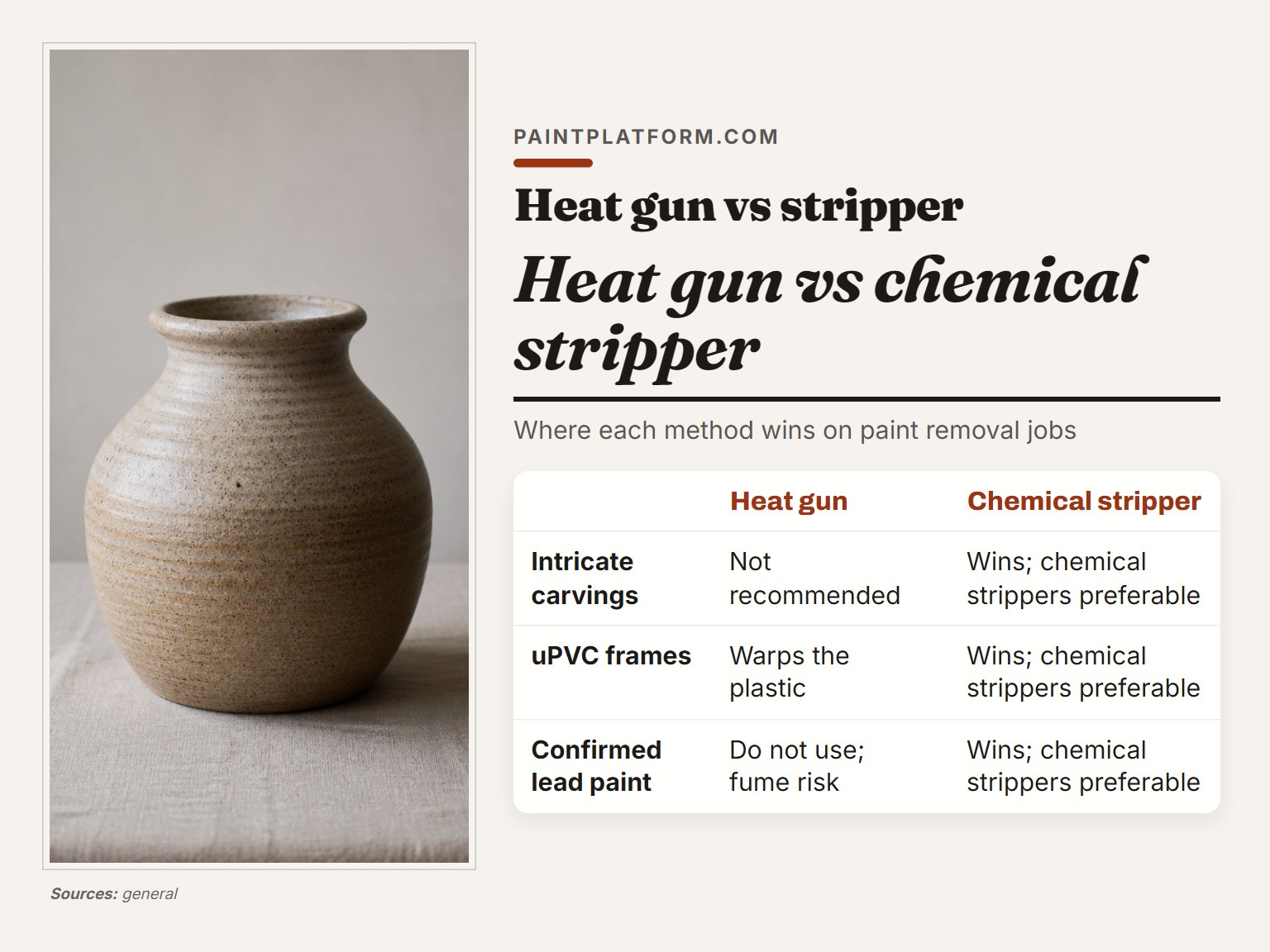
| Job | Heat gun | Chemical stripper |
|---|---|---|
| Thick oil-based gloss on flat timber | Fast; seconds per section | Slow; 15 min to several hours dwell |
| Intricate carvings and mouldings | Risky; burns raised edges | Wins; gel conforms to shape |
| uPVC frames | Warps the plastic | Wins; cold method only |
| Confirmed lead paint | Marginal; fume risk | Wins; no thermal hazard |
| Wide flat door panel | Split verdict; operator-dependent | Split verdict; unattended dwell |
| Veneered antique | Delaminates the veneer | Wins; cold paste is safer |
The table hides a real disagreement. On wide flat expanses, JourneymanHQ calls a heat gun a poor choice because the element only covers a few square inches at a time. Mofa.world says a heat gun is faster and less messy on most flat wood surfaces. Both are describing real jobs. The variable is how many paint layers you are dealing with and how patient you are with the gun.
Heat gun vs chemical stripper on a standard interior door: if the door has three or four coats of oil-based gloss and no lead risk, the heat gun wins on time and cleanup. If it has ten coats and you are not sure what is underneath, the chemical stripper wins on safety and consistency. I would take the chemical stripper on anything with more than four coats.
What Gear Do You Actually Need?
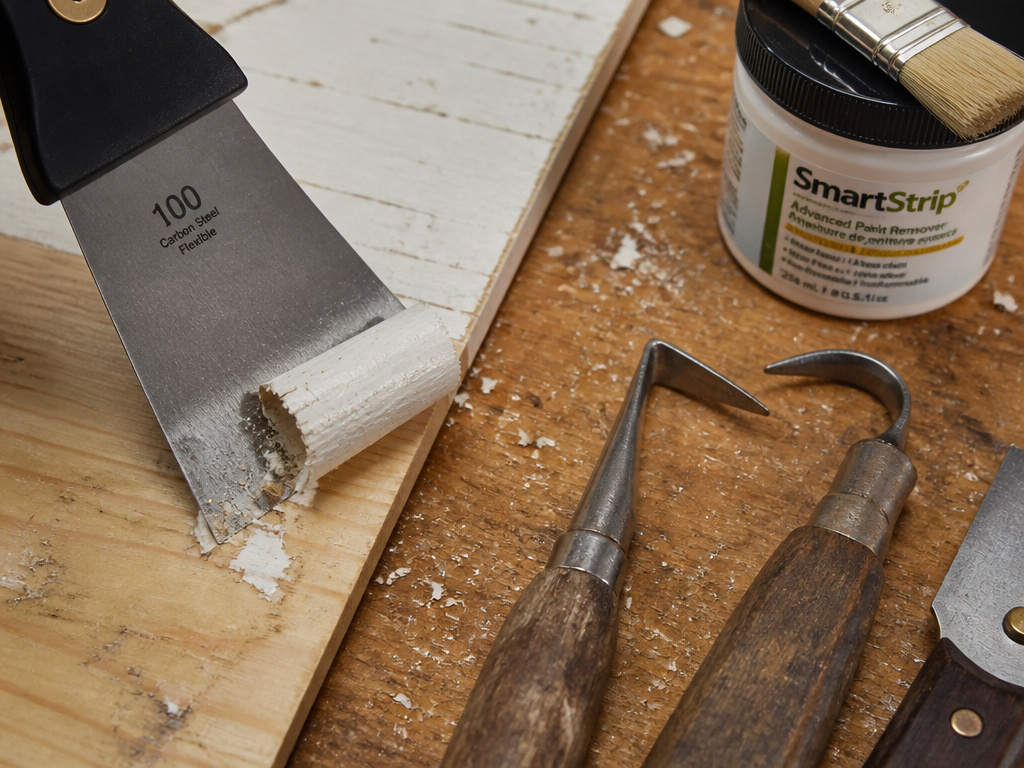
Gear matters less than technique, but the wrong scraper will ruin the strip. Here is what I actually reach for.
- A 100mm carbon steel flexible scraper. The workhorse for flat softwood. Buy two, keep one sharp.
- A shavehook set. Triangular, pear-shaped, and combination heads for profiles a flat blade cannot reach.
- A variable-temperature heat gun. A variable model that holds a setting well is worth it. Fixed-temperature models are a false economy.
- A chemical stripper. A methylene chloride-free gel is the one I keep on the shelf for carvings and veneer.
- A carbide scraper. Underrated. It holds an edge through a whole door and does not flex under pressure.
Named products matter less than people think. A cheap scraper from Screwfix strips paint as cleanly as an expensive one if the edge is sharp. The tool that changes outcomes is the one you actually keep sharp.
I spent a whole afternoon once trying to strip a moulded chair back with a flat scraper. A cheap shavehook would have done it in twenty minutes. That is the kind of mistake that teaches you to buy the right profile before you buy the bigger heat gun.
If you are building out a kit, paint scraper types matter more than brand. A paint scraping tool set with three profiles covers most jobs.
One more number worth knowing: a long extension cord sags the voltage and can kill the element early. Use 12-gauge minimum for runs over 25 feet.
The Hybrid Workflow Pros Actually Use
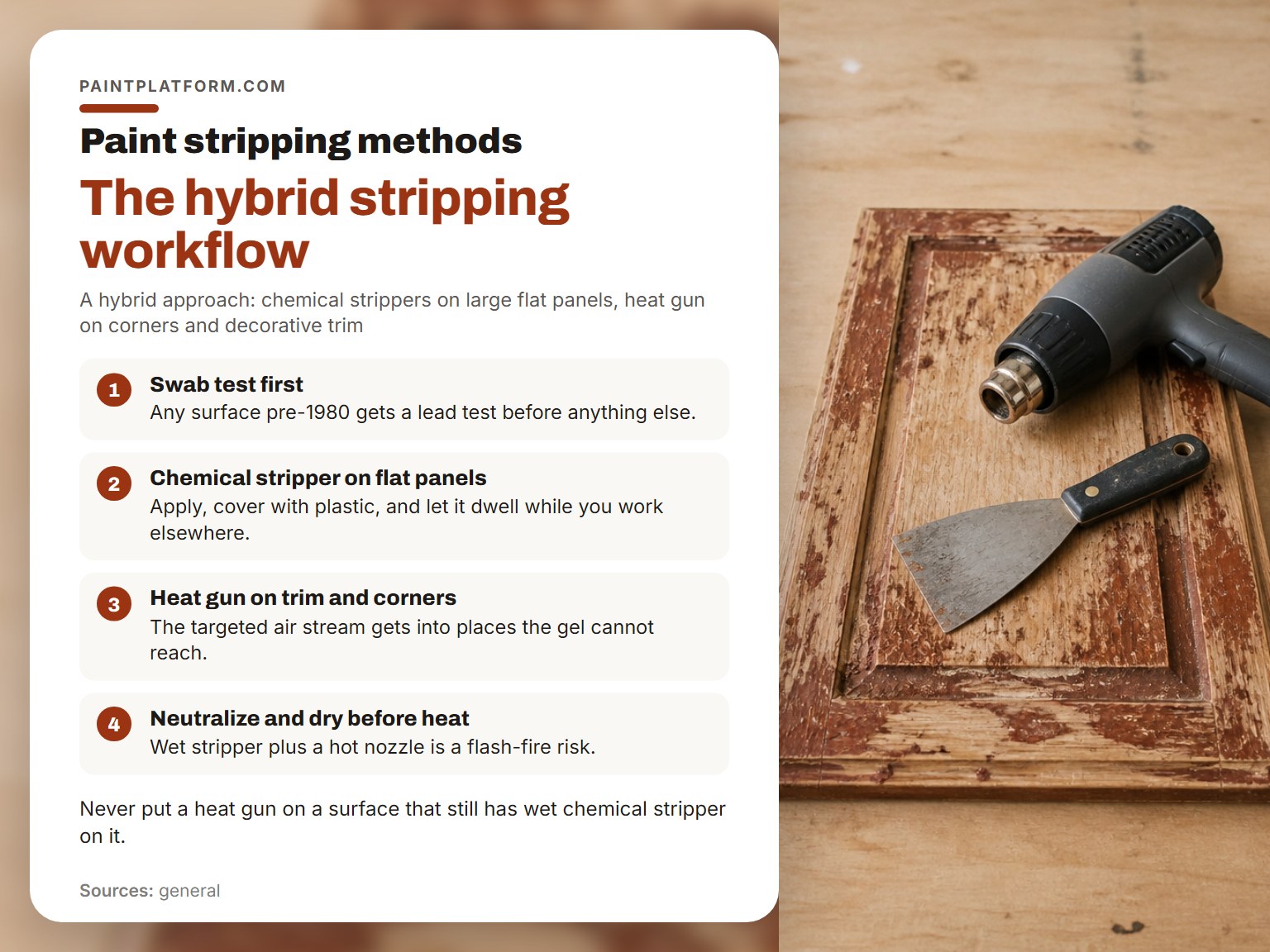
Most pros do not pick one method. They run both on the same piece.
- Swab test first. Any surface pre-1980 gets a lead test before anything else.
- Chemical stripper on the flat panels. Apply, cover with plastic, and let it dwell while you work elsewhere.
- Heat gun on the trim and corners. The targeted air stream gets into places the gel cannot reach.
- Shavehook on the profiles. A flat blade rounds off crisp edges. A shavehook preserves them.
- Neutralize and dry before switching back to heat. Wet stripper plus a hot nozzle is a flash-fire risk.
The order matters. Never put a heat gun on a surface that still has wet chemical stripper on it. Most strippers are highly flammable, and the combination can cause an immediate flash fire. Ensure the wood is completely dry and neutralized before you switch from chemicals to heat.
I will not run a heat gun on a veneered piece, full stop. The adhesive under the veneer softens before the paint does, and by the time you see the corner lift, it is already too late to save. A cold paste stripper is slower and boring and it works.
If you are stripping a whole house worth of joinery, the furniture stripping workflow is the same. Flats with gel, profiles with heat, trim with a shavehook.
Frequently Asked Questions
Is a heat gun faster than chemical stripper?
For most flat timber with thick oil-based gloss, yes. A 2000W heat gun can clear a standard door panel in under 20 minutes. Chemical stripper dwell time runs 15 minutes to several hours depending on the product and the paint thickness. On wide flat expanses, the answer flips depending on how many layers you are dealing with.
Can I use a heat gun on lead paint?
Only with full precautions, and the sources disagree on the ceiling. JourneymanHQ says below 1,100F. UK HSE guidance cited by mofa.world says below 590C. Another mofa.world guide says below 500C if lead is confirmed. The safest route is a cold chemical stripper rated for lead paint or professional abatement. If you proceed with heat, wear an FFP3 respirator and seal the room.
What temperature softens paint on wood?
Most thick paint layers on timber begin to soften and blister between 200C and 300C. Below that range, the film stays rubbery. Above it, the paint chars before it releases. Two-pack epoxy and polyurethane are cross-linked polymers and do not soften at all, no matter the temperature.
Will a heat gun warp uPVC window frames?
Yes. UPVC begins to soften around 80C and can warp permanently above 150C. One source citing uPVC manufacturers says it deforms above roughly 100C and that manufacturer instructions advise against any electric stripper exceeding 80C at the surface. Use a chemical stripper rated for plastics instead.
Which is cheaper, a heat gun or chemical stripper?
For a single project, chemical stripper is marginally cheaper upfront. For anyone stripping more than one or two pieces, the heat gun wins over time because it is a one-time purchase and chemical stripper is a recurring consumable. The break-even point sits around the second project.
Do I need a variable-temperature heat gun?
For paint removal, yes. Fixed-temperature models give you two settings: too hot and off. A variable model lets you dial in the 200-300C window where oil-based gloss softens without charring.
The Bottom Line
Here is the rule I would tape to the bench: if the surface is pre-1980, swab it before you touch it with anything. A lead swab kit settles the question in a minute, and the result decides the method for you.
The heat gun vs chemical stripper debate gets a lot of airtime online, but most real jobs end up hybrid. Chemical stripper on the flats, heat gun on the trim, shavehook on the profiles. The method you pick matters less than the order you run them in.
If I had to hand a beginner one tool for their first strip job, it would be a chemical stripper and a carbide scraper, plus a reminder to be patient. The heat gun is faster once you know what you are doing. It is also the tool that turns a table leg into a paint-sample board in seconds.
