
Portrait Painting for Beginners: Where to Actually Start
This post contains affiliate links. As an Amazon Associate, we earn from qualifying purchases.
Portrait painting for beginners starts with four colors, one brush bigger than feels comfortable, and a panel you are willing to ruin. Art Academy recommends titanium or zinc white, yellow ochre, indian red, and vine or ivory black. NIST CS98-42 gives oil paint three to twenty-one days to dry.
That drying window sets the rhythm of portrait painting for beginners. It explains why a face painted in one sitting looks different three days later, and why oiling out between passes matters more than the brush you bought.
What follows walks the table setup, the palette argument, the drying clock, and the two places a beginner face slides sideways first.
Key Takeaways
- Four colors cover the first few months: titanium or zinc white, yellow ochre, indian red, and vine or ivory black, per Art Academy.
- Oil paint needs 3 to 21 days to pass the NIST sand and pressure tests.
- Print the reference at canvas size and square the panel on the easel with a small level before the first mark goes down.
- Reach for a brush slightly larger than feels right. Small brushes turn painting back into drawing.
- Two-hour studies beat one long haul. New Masters Academy runs nine two-hour poses before a four-hour final.
Portrait Painting for Beginners: What Goes on the Table First
The table setup decides more of the outcome than the paint does. Art Academy’s beginner module uses an 8 3/4 by 11 3/4 inch panel toned with an imprimatura of yellow ochre and a touch of vine black, and it notes that 9 by 12 or 11 by 14 inch panels work just as well.
Commercial Standard CS98-42 measures artists’ oil paint consistency on a standard 2-kg Paste Paint Consistometer. Paint must brush out smoothly, evenly and easily, leave a normal brush mark, retain its form under a palette knife, contain no free or excess oil, and show no skin.
Before you start: Rectified turpentine is on Art Academy’s supply list and it fumes, so open a window and keep a lidded jar for the dirty solvent. If solvents bother you, the same source gives a painter’s mayonnaise of equal parts white vinegar, egg yolk, and 3 to 5 parts linseed oil, shaken hard, stored in the refrigerator, and good for about a week.
Here is the short version of the list:
- Panel or canvas, 8 3/4 by 11 3/4 inches, toned and dry before you start.
- A wood palette well seasoned with cheap linseed oil, plus two palette knives.
- Bristle brushes, round or filbert.
- A knitting needle as a measuring stick, cotton rags, and a small level for squaring the panel on the easel.
- The reference image printed at the same size as the canvas.
Art Academy is blunt about paint grade. Professional oil colors are strongly recommended, with Old Holland, Rublev, and Williamsburg named as excellent brands, and student-grade pigments called a false economy with a guaranteed color collapse. NIST CS98-42 adds a useful footnote to that argument: paints meeting the standard are not identical nor of uniform excellence, so compliance is a floor rather than a ranking.
Oil is the medium Art Academy builds its beginner module around. The oil painting basics matter more than the brand on the tube for the first month: how much medium, how much solvent, how thin the first pass.
If oil feels like a commitment, acrylic painting finishes a study in one sitting. London Art College recommends a white clean-off palette for acrylic because it dries very hard, and mentions that a Rowney Stay-Wet palette keeps colors workable for a few days.
The National Gallery of Art lesson on community portraits allows acrylic, low-grade or water-soluble oil, and watercolor as beginner media, with one hard rule attached: never mix oil with acrylic or watercolor. It also asks painters to mark the oil-only palette knife with tape on the handle so the two never swap.
Match by feel, not by number. Every maker numbers brushes differently, so the handle is the worst place to compare.
You can spend a lot on beginner art supplies and still paint badly. The five items above are the ones that change the painting.
How Many Colors Do You Really Need for Skin Tones?
Four is where Art Academy starts beginners, and it is not the only answer on the shelf. New Masters Academy teaches the Anders Zorn palette as its working set for painting people. The Artists Network course with Joy Thomas builds a limited portrait palette from the three primaries plus black and white.
The National Portrait Gallery in the UK pushes back on all three. Its guidance says mixing skin tones is more complicated than mixing two colors together, and that it takes several colors and some experimentation.
| Source | Colors in the set | What it claims |
|---|---|---|
| Art Academy | White, yellow ochre, indian red, vine or ivory black | Four colors are enough to begin mastering flesh tones |
| New Masters Academy | Anders Zorn palette | A useful working palette for painting people |
| Artists Network (Joy Thomas) | Three primaries plus black and white | A limited palette that still reaches full color |
| National Portrait Gallery | Several colors, plus experimentation | Skin tones take more than two colors to mix |
I mix by instinct and trial, which makes me a poor guide to why a palette works on paper. What I can tell you is which set I would hand a beginner: the four-color one, because a smaller palette forces you to see temperature instead of reaching for a new tube.
What the Four-Color Set Actually Covers
White, yellow ochre, indian red, and black reach a surprising range of flesh. Yellow ochre carries the warm mid-tone, indian red handles the flush in cheeks and ears, black does the cooling and the deepest shadow, and white lifts everything.
The limit shows up in the greens and violets around a jawline in shadow. Yale’s conservation write-up describes the standard cool shadow mix as white, a bright red like cadmium, a red lake or alizarin, and yellow ocher, with dark brown ocher and raw umber added for the warm version. That recipe is the backbone of skin tone mixing without a dozen tubes on the palette.
Where the Zorn Palette Fits
The Zorn set trades range for speed. It is a working palette, not a training wheel, and New Masters Academy teaches it as a practical way to paint people rather than a color-theory exercise.
Whichever set you pick, the skill underneath is the same. Realistic skin tones come from adjusting warm and cool against each other, not from owning more pigment.
Four is a start.
The Drying Clock That Sets Your Whole Schedule
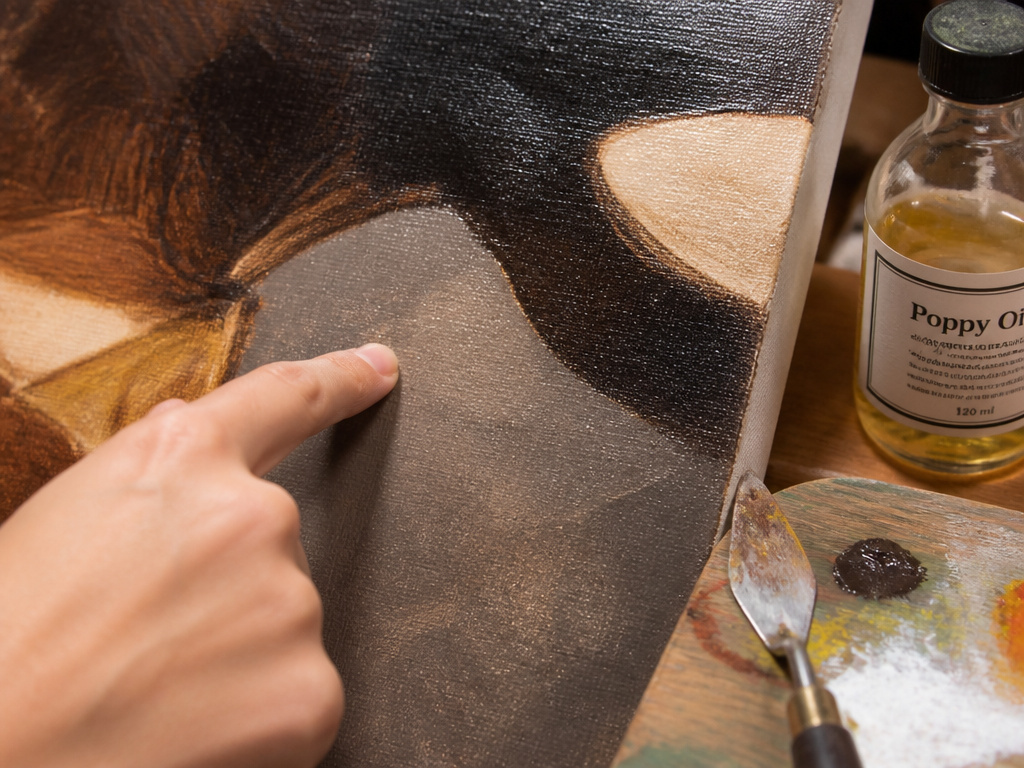
The NIST artists’ oil paints report puts the drying window at three to twenty-one days, tested by sand and pressure. That is a wide window, and it decides whether you can glaze on Thursday or wait until next week.
The same standard splits lightfastness into two groups. Group I paints must resist fading at southern exposure under glass at a 45 degree angle for two months, including at least 600 hours of sunlight. Group II gets one month and at least 300 hours.
Beginners ask me about speeding that clock up with a hair dryer on a thick passage. I have watched it end in cracks and bubbles, and the crack shows up two days later when the surface settles. I wait, or I work thinner.
Three things the standard actually tells you:
- The three to twenty-one day window is the tested envelope, so a cold studio sits outside it entirely.
- Group I paints hold two months of southern exposure, at least 600 hours of sun.
- Group II paints hold one month, at least 300 hours.
- Compliant paints are not identical, and the standard says so outright.
Here is where the schedule bites. The Yale oil painting case study, following Thomas Bardwell’s 1756 manual, oils out between phases with poppy oil to saturate the dry surface before new paint goes on. Cool shadows containing raw umber sink in particular and need oiling out before the next stage so the tonal balance reads accurately.
A dried-in passage goes matte and sunken, and the gloss difference alone tells you where the paint has drunk the oil out of itself. That dull patch is your cue, not a calendar.
Wait it out.
Why Your Brush Is Probably Too Small
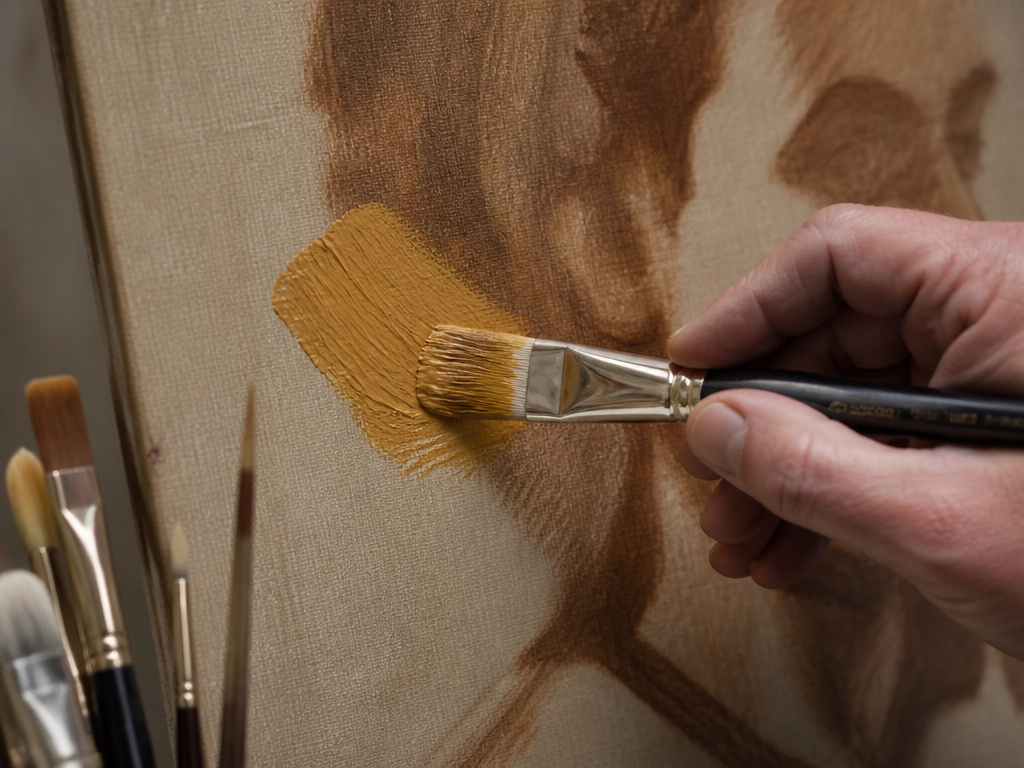
Your brush is too small. Art Academy says it plainly: do not paint with overly small brushes, and better to work with one slightly larger than your comfort zone. Small brushes invite drawing, and drawing is the thing you are trying to move past.
I keep one filbert that is genuinely too big for the panel and reach for it the moment I catch myself outlining. It forces shapes instead of edges. My control is worse for about ten minutes and better for the next two hours.
A dry bristle dragged across a toned panel makes a soft scratch, and that sound tells you more about how much paint is on the brush than looking at it does. Loaded bristles go quiet. Starved ones rasp.
Bristle rounds and filberts cover most of a beginner head. Brush shapes start mattering once you understand why a filbert lays a softer edge than a round does on the same stroke.
Do not glaze over a passage before it passes the pressure test. New paint sinks into the soft layer underneath, and the surface goes uneven by the next session in a way you cannot sand out.
The Block-In Order That Saves the Whole Painting
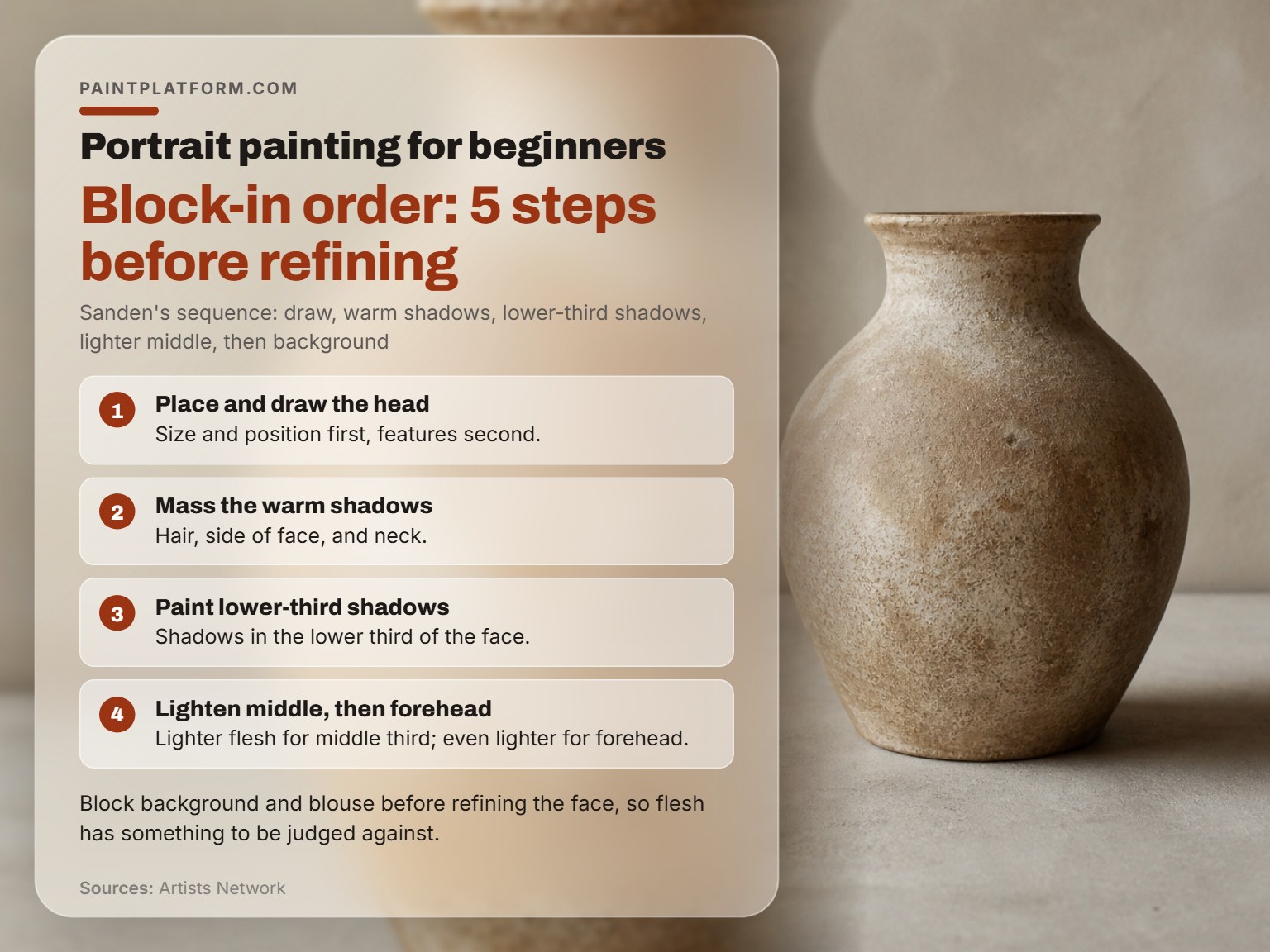
Order matters more than color in the first hour. John Howard Sanden’s oil portrait procedure, as Artists Network lays it out, runs in a fixed sequence, and the sequence is the whole method.
- Place and draw the head. Size and position first, features second.
- Mass the warm shadows in the hair, the side of the face, and the neck.
- Paint the lower-third shadows of the face.
- Lighten the flesh value for the middle third, then go lighter again for the forehead.
- Block the background and blouse before refining the face, so the flesh has something to be judged against.
The Bardwell Three-Stage Version
Yale’s demonstration builds on Bardwell’s 1756 system of three major stages, each of which may take up to two paint applications. Stage one is a monochrome tonal underpainting called Claro Obscuro or Mezzotino, which seals the loose drawing material before any color arrives.
That first stage is where a portrait is won or lost. A tonal map that reads correctly in gray will read correctly in color. A map that does not will not be rescued by better pigment.
If the background is not blocked in by the time you start refining the face, you are judging flesh tones against bare canvas. Bare canvas is the brightest thing in the room and it lies to you.
Solid drawing basics carry more weight here than color does. The ART 0052 course outline from Sierra College spends its lab time on optical gray drawing of the head with a Sharpie pen, layering small marks to build a full range of values, before paint enters the room at all.
London Art College gives proportions to check the drawing against: the average female figure runs about seven and a half head-lengths, the average male about eight.
Order first.
Where Beginner Portraits Fall Apart First
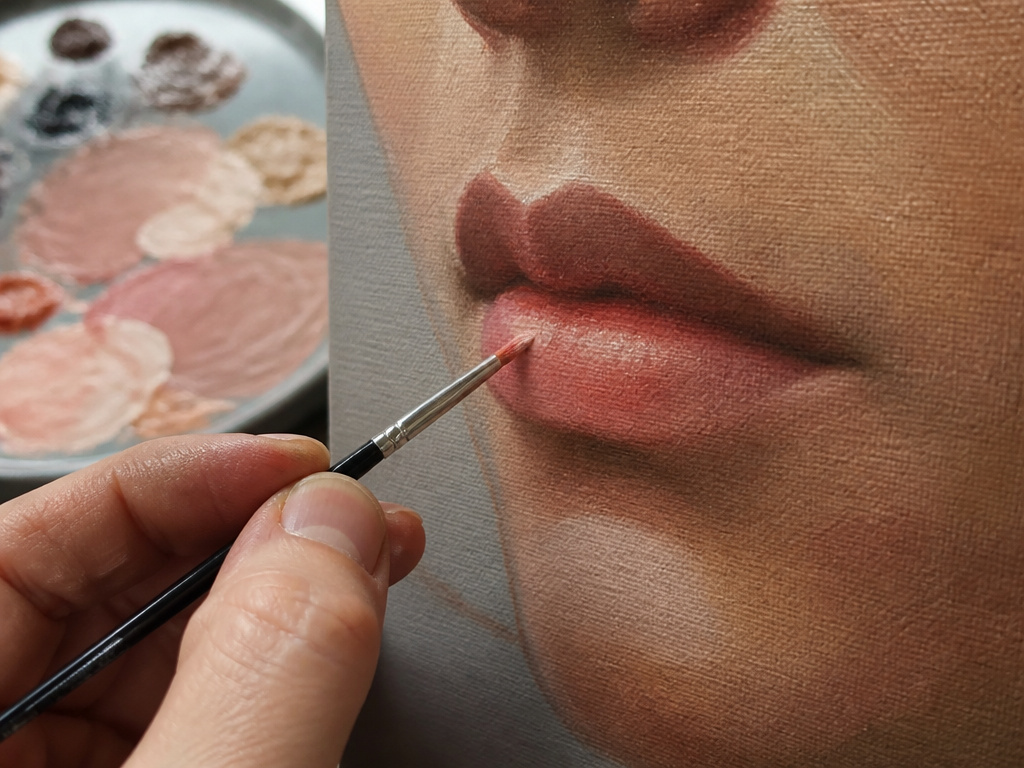
Painting a mouth with an outline is the fastest way to make a face look like a drawing. London Art College names that linear approach as the most common mistake in painting mouths, and the fix is a change of method rather than more practice.
Modeling the Mouth in Light and Dark
A mouth has volume, and the lips plus the face around them have distinct form. Model it with light and dark and hard and soft edges, beginning with the dark tones and adding highlights last.
Two specifics from the same source do most of the work. The lower lip is always fuller and catches more light than the upper. And lips painted too red read as lipstick, so use the same mixture as the skin with a touch of red added.
| What you see | Why it happens | Fix |
|---|---|---|
| Lips look pasted on | Painted with an outline instead of modeled | Build in light and dark, highlights last |
| Mouth reads too red | Straight red used instead of the skin mix | Skin mixture plus a touch of red |
| Upper lip looks heavier than the lower | Values reversed | Lower lip is fuller and catches more light |
| Face reads flat overall | Outline kept hard all the way around | Keep the outline soft for roundness and depth |
Common mistake: Outlining the lips and filling them in. The line goes flat the moment the light shifts across the face, and you end up repainting the entire lower third two sessions later.
I have repainted a lower lip three times in one sitting because I outlined it first. The fourth attempt, built from dark to light with no line at all, finally worked.
Volume, not outline.
How Long Should a Beginner Portrait Study Take?
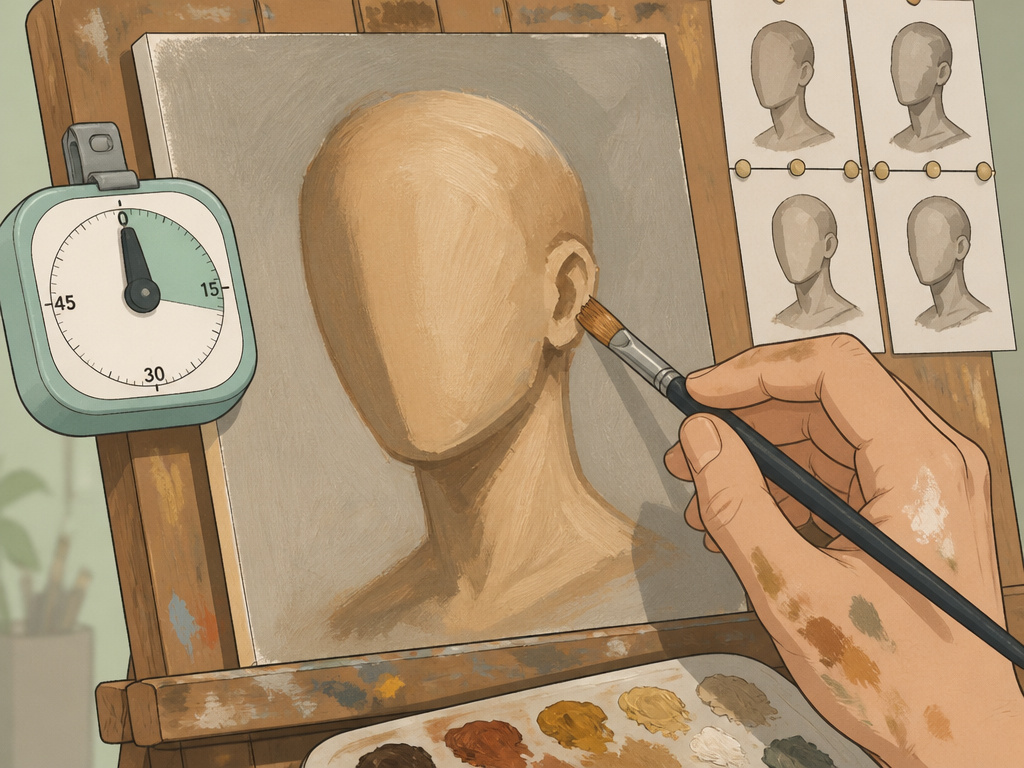
The timer goes off at two hours and the ear is still wrong. That is the point of the exercise.
New Masters Academy structures its beginner portrait course around timed work: a run of two-hour oil paintings from life, each with a new model, followed by a final four-hour portrait after nine poses capped at two hours. The grisaille lesson adds a 4-up thumbnail assignment, four small versions of the same head before committing to a larger one.
Sierra College’s ART 0052 takes a different route to the same place. Students sketch ten people from life and submit a semester portfolio with an artist’s statement and a written self-evaluation. The portfolio is the assignment, and no single painting carries the grade.
What the timer buys you:
- Two hours: block-in done, one feature resolved, background suggested.
- Four hours: the same head carried to a finish, edges softened, highlights last.
- A semester: ten heads minimum, judged as a set rather than one at a time.
Two hours is enough to get a head blocked in and one feature resolved. Four hours lets you finish. Anything past that on a beginner study is polishing, and polishing a weak block-in makes it weaker.
Set the timer. Stop when it rings.
Frequently Asked Questions
Do I need oil paint to start portrait painting?
No. The National Gallery of Art lesson on community portraits accepts acrylic, low-grade or water-soluble oil, and watercolor as beginner media. The one rule it attaches is that oil must never be mixed with acrylic or watercolor, which is why it asks painters to tape-mark the oil-only palette knife.
How many colors do I need for skin tones?
Art Academy starts beginners on four: titanium or zinc white, yellow ochre, indian red, and vine or ivory black. New Masters Academy teaches the Anders Zorn palette instead, and the Artists Network course builds a limited set from three primaries plus black and white. The National Portrait Gallery argues that skin tones take several colors and some experimentation.
How long does oil paint take to dry?
NIST Commercial Standard CS98-42 sets the window at three to twenty-one days, tested by sand and pressure. A cold or damp studio sits outside that tested envelope, so the window stretches.
What size panel should a beginner use?
Art Academy works on an 8 3/4 by 11 3/4 inch panel toned with yellow ochre and a touch of vine black, and notes that 9 by 12 or 11 by 14 inches are equally acceptable. Print the reference at the same size as the panel so the drawing transfers at scale.
Should I draw the face before I paint it?
Yes. Sanden’s procedure establishes head size and placement and draws the features before any shadow goes down. Yale’s demonstration goes further, transferring the drawing in white chalk or black charcoal and then reinforcing the lines with a medium-rich brown ocher thinned with oil.
The Bottom Line
Here is the trigger worth taping to your easel: if a passage is still tacky on day three, do not paint over it. Three days is the floor in NIST CS98-42, and a cold studio pushes you past it.
The first thing to do this week is not buy paint. Cut a rectangle out of paper, hold it up, and frame a face through it. London Art College recommends exactly that for composition studies, and it costs you nothing but the paper and the two minutes.
One concession on the four-color advice. The National Portrait Gallery disagrees with it outright, and if four colors feel too tight after a month, that is a signal to expand rather than evidence you failed at the exercise.
I would rather see ten ugly two-hour heads than one careful portrait you nursed for a month. The tenth head teaches you something the first nine could not, and nobody has to see any of them.
