
How to Choose a Watercolor Brush: Sizes, Hair, Shapes
This post contains affiliate links. As an Amazon Associate, we earn from qualifying purchases.
How to choose a watercolor brush starts with three matches: the shape, which decides what marks the brush can make; the hair or fiber, which decides how much water it holds; and the size, which is not standardized between brands. Buy a few good brushes rather than a big set.
That last point in how to choose a watercolor brush trips up more buyers than the other two combined. Canson states plainly that each manufacturer runs its own numbering, so a brush stamped 8 by one maker can be thicker and longer than a brush stamped 8 by another. The number on the handle is a label the factory chose.
What follows covers the specs that do travel between brands, the shape families worth owning, the hair types and where the sources disagree about them, and the care habit that ends more brushes than any manufacturing defect.
Key Takeaways
- Shape first, size second. Canson calls the round brush indispensable, and Escoda says one medium round can finish a whole painting.
- Numbers don’t travel between brands. Canson quotes N°0 to N°24, Escoda quotes #3/0 to #30 or more, and Canson says each maker numbers its own way.
- Natural hair holds more water; synthetic holds its point. Canson says synthetics absorb less water, Isabey says they are less retentive, and Dick Blick notes synthetics resist solvents and clean up easier.
- Kolinsky earns its reputation on strength, spring, and snap. Dick Blick calls it professional-grade hair that lasts years with proper care.
- Standing a brush in water ruins it. JetPens warns the handle swells, the glue softens, and the bristles can drop out.
Why the Number on the Handle Tells You Almost Nothing
The number stamped on a watercolor brush is a label the factory chose.
Watercolor brush sizes run on each manufacturer’s own scale. Canson numbers its brushes from N°0 to N°24, while Escoda quotes a range from #3/0 to #30 or more. Because those scales are proprietary, two brushes stamped with the same number can differ in bristle thickness and length.
Canson says it outright: each manufacturer has its own numbering, so thicknesses and lengths with the same number tend to vary. That one sentence explains most of the confusion in a brush aisle.
Here’s how the two published ranges compare.
| Source | Range quoted | What it means for you |
|---|---|---|
| Canson | N°0 to N°24 | Large wash sizes sit at the top of the scale |
| Escoda | #3/0 to #30 or more | Goes finer below zero and larger past 24 |
| Both | Proprietary numbering | The same number is not the same brush |
Escoda quotes a range from #3/0 to #30 or more, spanning fine detail work up to large wash sizes.
Then Escoda adds something more useful than any of those numbers. Size matters less than hair diameter and length out, meaning how far the bristles extend past the ferrule. Those two specs travel between brands. The printed number doesn’t.
Which Brush Shape Should You Actually Buy?
Ever notice that a beginner set has six shapes and you only ever reach for one?
Both Canson and Escoda point at the same answer. The round brush is the all-purpose workhorse, and it’s the one to buy first.
Round, Flat, and Filbert: The Workhorses
Canson calls the round brush an all-purpose tool for applying washes and drawing narrow lines, and uses the word indispensable. Escoda describes the same brush as the essential all-purpose brush, with a conical belly that holds water and pigment and a tip that makes details and fine lines. Escoda goes further and says one medium-sized round can carry a complete painting.
The square flat is the second shape most painters keep. Canson notes its flexibility lets it draw precise lines and lay washes, which makes it a partner to a round.
The filbert is where the sources part company. Canson describes it as flat and tapered to a point, suited to precision techniques and glazing. Escoda ties the same shape mainly to floral work. Same brush, two different jobs, and both descriptions come from manufacturers who make them.
Here’s the shape reference I’d tape inside a sketchbook cover.
| Shape | Main job | Best for |
|---|---|---|
| Round | Washes plus fine detail | The one brush most painters need |
| Square flat | Precise lines and broad washes | Blocking in shapes |
| Filbert | Soft tapered edge | Glazing, floral work |
| Rigger | Long controlled stroke | Branches, wire, hair |
| Round mop | High absorption | Large wet areas, experienced hands |
| Fan | Shading and blending | Dry brush texture |
The Specialists: Rigger, Mop, Fan, Dagger, Script Liner
Escoda recommends the rigger for details that need a long yet controlled stroke, and names marine watercolor, branches, wiring, and hair as its territory. Canson’s script liner covers similar ground from the other direction: it holds a lot of paint and draws fine lines.
Those two overlap enough that a buyer following one guide can end up with the wrong tool. If your subject is a mast and its rigging, the rigger’s long bristle is the whole point. If it’s a signature line, the liner’s reservoir does the work.
The round mop is a bigger round with more body and a fuller belly, which gives it more absorption and retention. Escoda flags it for artists who have already mastered the technique, which is a polite way of saying it floods paper in unpracticed hands.
The art brush shapes explained page covers each one with stroke examples.
Common mistake: Buying the full shape range before painting with any of them. Escoda notes the round mop suits artists who’ve already mastered the technique, so a beginner who buys one gets a brush that floods the paper and teaches nothing about control.
Natural Hair or Synthetic: Where the Sources Split
Every brush aisle sorts hair into good and cheap. The sources don’t agree on which is which.
What Kolinsky Actually Is
Dick Blick’s brush hair guide settles the naming first. Kolinsky is not really sable at all. It comes from the tail of a species of mink in the weasel family, found in Siberia and northeastern China. Dick Blick calls it generally conceded to be the best material for oil and watercolor brushes, because of its strength, spring, and ability to hold its shape. It’s professional-grade hair that lasts many years with proper care.
Canson is just as warm about it, describing Kolinsky red sable as very fine, particularly flexible, long-lasting, and able to hold large amounts of diluted paint.
Red sable is a separate label. Dick Blick notes it comes from any weasel-family member with red hair, not from the animal called a sable. A pure red sable is a solid alternative to Kolinsky with similar performance and durability. Blending weasel with ox hair makes a more economical brush, but the fine point goes.
The Cheaper Hairs, and What They Do Well
- Squirrel points as well as Kolinsky but lacks its strength, stiffness, and snap. It also has the best water-holding capacity of any natural hair, which is why it suits watercolor and inks.
- Ox has strong body, a silken texture, and good snap, but no fine tip. It works best in medium-grade wash or flat brushes.
- Pony is the least strong natural hair and won’t return to a point after a stroke.
- Camel doesn’t come from camels. It’s usually pony, goat, ox, or a blend, and it lacks snap.
- Hog bristle forms a V-shaped flag at the tip and suits oils and acrylics more than watercolor.
Synthetic filaments are nylon or polyester, and Dick Blick notes they can be tapered, tipped, abraded, or etched to raise color carrying. JetPens adds that synthetics have defined points, hold their shape well, and run a little stiffer than natural hair.
Now the disagreement. Canson says synthetics are as fine and long-lasting as animal bristles, generally firmer, and absorb less water. Isabey says synthetic hairs are more resistant to use but less retentive. Dick Blick points out that synthetics resist damage from solvents, insects, and paints, and clean up easier because the filaments lack the scale structures that trap paint.
Canson says synthetics absorb less water, and Isabey says they are less retentive, while Dick Blick focuses on their resistance to damage and easier cleaning. They split on how to describe the trade. Canson frames it as parity on quality. Isabey frames it as a durability gain. Dick Blick frames it as easier maintenance. For a beginner, all three readings point the same way.
I keep a jar of cheap synthetics on the desk and reach for them more than anything else. They hold a point through a whole session, they survive a rinse in the sink, and when one finally splays I don’t mourn it. The expensive brush lives in the roll case.
The natural vs synthetic comparison goes deeper on retention and spring if you’re weighing a specific purchase.
How Much Paint Should the Brush Hold?
Halfway through a wet wash, the brush runs dry. The color stops moving, the edge sets where you didn’t plan it, and you’re back at the palette loading up again.
Isabey explains where that capacity lives. The tip is the first absorption point, and the extremity of the bristle or hair dictates how much paint gets picked up. The belly, also called the reserve, holds the color and releases it in a progressive, uniform way as the brush touches paper. A larger brush absorbs more material.
Escoda frames the trade-off in plain terms. Brushes with higher absorption are better for washes or for working with a lot of water. Brushes with lower retention suit control and detailed illustration. Escoda also flags the upper limit: too much spring makes strokes less fluid.
You can feel it before you see it. A brush with a real reserve releases color in a steady ribbon. A thin one dumps its load quickly and then scratches.
My early paintings went muddy because I loaded the brush like a mop. Thick paint, thick strokes, and every layer turned to sludge. What fixed it was picking up less paint and building color in thin passes. The brush was fine. I was the problem.
Match the belly to the job, not to the price tag. A brush that can’t hold enough water for the wash you’re painting will make you reload constantly, and reloading is where the puddle forms.
The water control guide covers how much water to leave in the brush for different techniques.
How to Choose a Watercolor Brush You Can’t Test First
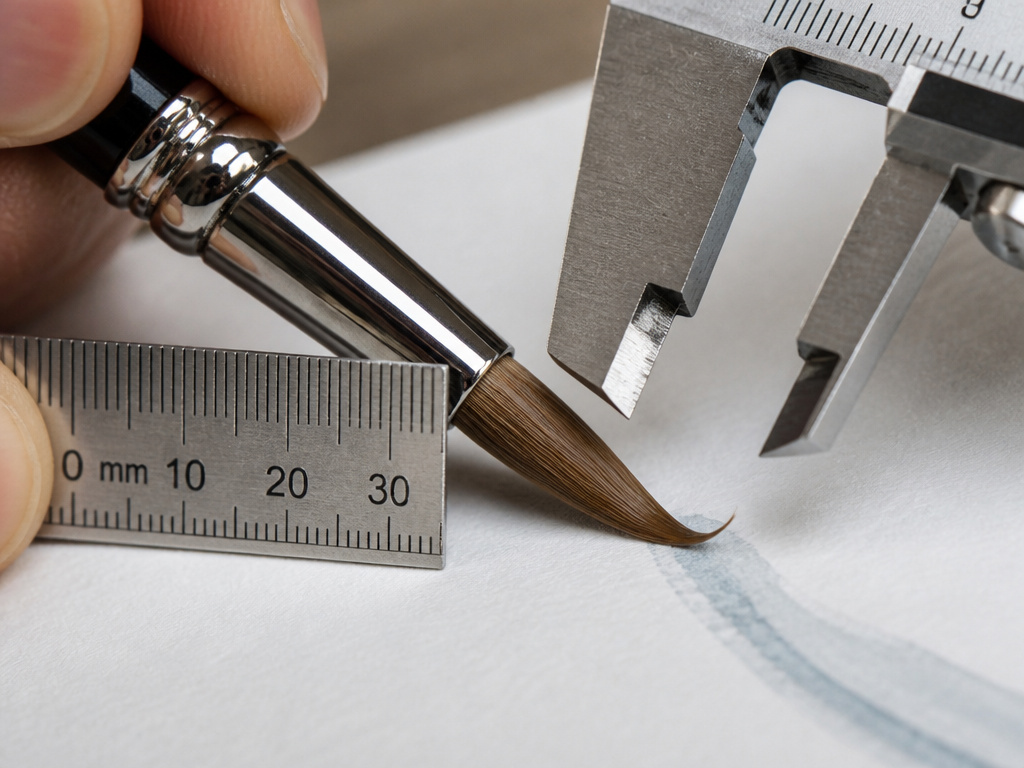
Escoda points at two specs the printed number hides: hair diameter at the ferrule, and length out.
Length out is how far the bristles extend past the metal. Neither is better, and neither shows up in the size number.
JetPens adds a third check: tip elasticity, meaning how much a brush can deform and bounce back. A tip that returns to a point after a stroke is sound. A tired one stays bent. A tired one stays bent.
- Hair diameter decides how much the brush carries.
- Length out decides how long a line the point can draw before it needs reloading.
- Tip elasticity decides whether the point comes back after a stroke.
When you’re buying online, the published size range tells you how far a maker’s scale runs. JetPens lists the Winsor & Newton Series 7 Kolinsky in rounds 000, 00, 0, 1, and 2. It lists the Royal & Langnickel Zen in rounds 2, 4, 6, 8, and 14 plus flats from 1/2 inch to 1 inch. Both are real brushes with real followings. The numbers describe different scales.
A few more ranges worth knowing, all from the same listing. The Escoda Reserva Series 1212 is Kolinsky in rounds 0, 2, 4, and 6. The Escoda Prado Series 1462 is synthetic in rounds 2, 4, 6, 8, and 10. The Princeton Elite 4850R is synthetic in rounds 0, 1, 2, 3, 4, 6, and 8. The Raphaël Precision Imitation Sable runs 00, 0, 2, 4, and 6. The Silver Brush Black Velvet Voyage is a squirrel-synthetic hybrid in rounds 2, 4, 6, and 8.
Notice the pattern. A synthetic line and a Kolinsky line from the same maker don’t cover the same numbers. That’s the numbering problem showing up in a shopping cart.
The best watercolor brushes roundup sorts these by purpose and material.
How Many Brushes Do You Actually Need?
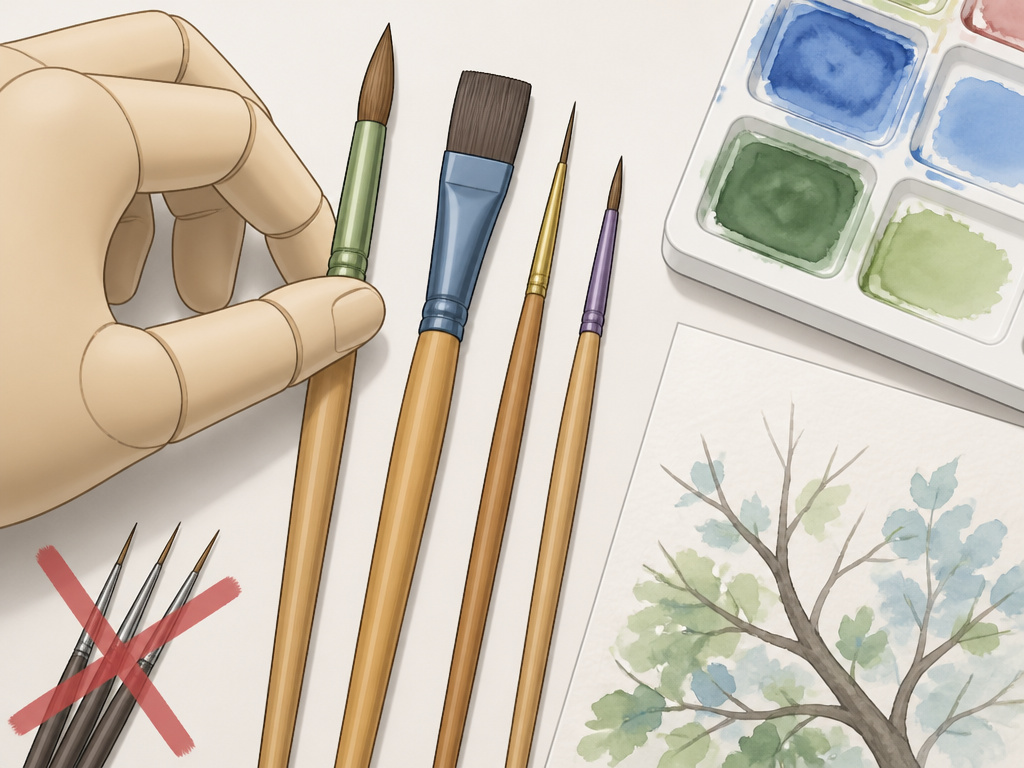
Three credible sources give three different answers, and all three are worth hearing.
Escoda claims a single medium-sized round brush can create a complete work. Canson advises starting with a small number of brushes in different sizes, focusing on quality, and adding as experience grows. JetPens pushes back on the small-brush instinct entirely, noting you’ll rarely need a truly tiny brush and that size should follow the painting surface rather than detail ambition.
Those aren’t really contradictions. Escoda is describing what a skilled hand can do with one brush. Canson is describing how to build a set over time. JetPens is telling you to stop buying 000 rounds for detail you’ll never paint.
A Starter Set That Covers Most of It
- One medium round, in the middle of the size range Escoda quotes.
- One flat for washes and edges.
- One rigger or liner if you paint branches, wire, or hair.
- Nothing truly tiny until a specific subject demands it.
That’s four brushes, and the brush sets page lists options if you’d rather buy a group.
Where this goes sideways: Buying a big set to save money per brush. You end up with shapes you can’t name, brushes that splay quickly, and one round you actually reach for. Canson’s advice to start small and add later holds up better than the bulk discount.
Handle, Ferrule, and the Care Rules That Decide Lifespan
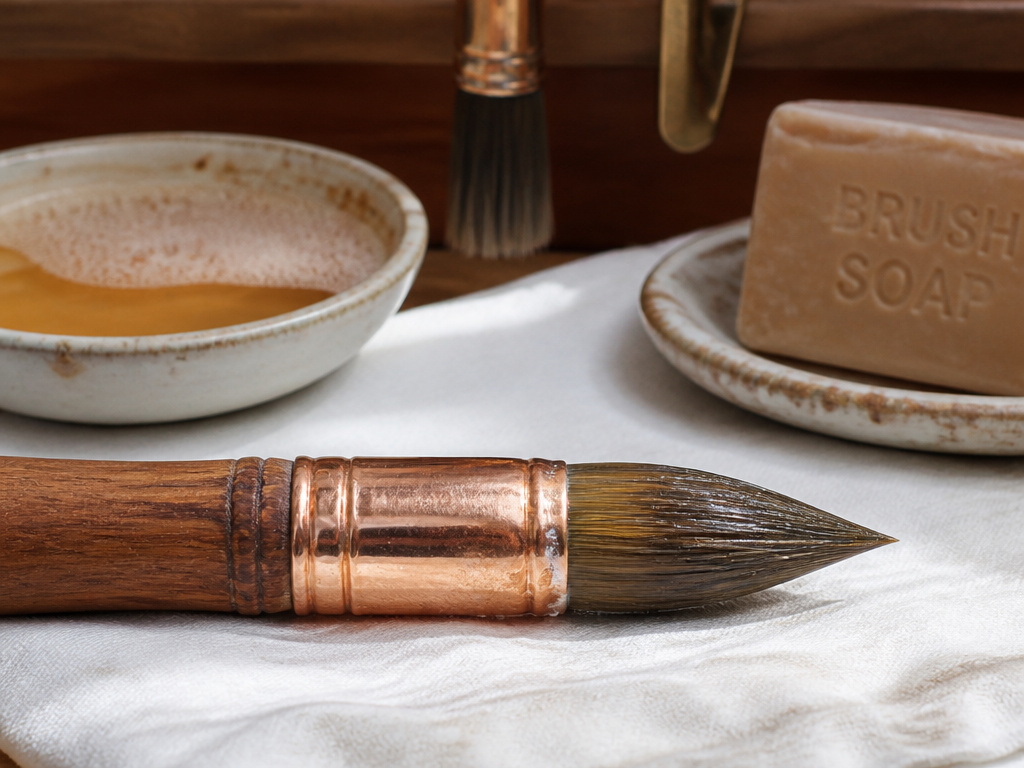
Most brushes die young, and water is usually the reason.
Isabey recommends a short handle for watercolor, both for precision work and for painting flat on a table. Long-handled brushes are mainly for easel work, where you stand back from the painting. If you paint at a desk, a long handle puts your hand further from the paper than you want.
The ferrule is the metal band that holds the bristles and connects them to the handle. Isabey notes it’s usually copper or brass, and that for some color-wash production a quill replaces it entirely. Isabey also shapes its brushes during assembly without any subsequent cutting, which preserves the natural tip.
Fair warning: the first thing to do with a new brush isn’t painting. Dick Blick notes most brushes ship with a water-soluble sizing for hair protection, and it has to come off with brush soap and water before use.
Then there’s the habit that ends more brushes than anything else. JetPens is blunt about it: don’t leave watercolor brushes to soak. Water swells a wooden handle, chips the paint, and damages the glue. Bristles fall out, or the handle separates from the ferrule. Soaking also means the brush rests point-down, which deforms the tip.
Here’s the order that keeps a brush alive.
- Wash the sizing out before the first session. Warm water, brush soap, until the water runs clear.
- Rinse after every session until no color comes out. Isabey recommends warm water and soap for watercolor and gouache.
- Dry horizontally or hang the brush bristles-down. Never stand it tip-up in a jar.
- For acrylic, get the brush into water the moment you stop painting. Isabey notes acrylic dries and hardens fast, so rinse under running water and wash until the lather runs clean.
Leave a brush standing tip-down in a water jar and the handle swells. The finish chips, the glue at the ferrule softens, and the bristles can come out in your hand.
The brush care and storage guide covers long-term storage, and the brush cleaning walkthrough handles the stubborn cases like dried acrylic in the ferrule.
Frequently Asked Questions
Do I need a Kolinsky brush to paint well?
No. Dick Blick calls Kolinsky professional-grade hair that lasts years with proper care, and Canson calls it the watercolorist’s brush par excellence. Both descriptions are about the material, not about what a beginner can do with it. A synthetic or a red sable will teach you the same lessons for far less commitment.
What size watercolor brush should a beginner buy first?
Start with a medium round. Escoda says one medium round can carry a complete painting, and Canson advises starting with a small number of brushes in different sizes. Canson’s advice to start with a small number of brushes and add later fits the same plan.
Can I use one brush for a whole painting?
Escoda says a single medium-sized round can create a complete work. That’s a statement about what’s possible. Comfort is a different question. Most painters keep a flat nearby for washes and edges, and JetPens notes a versatile brush means carrying fewer in a travel kit.
Why do my brush tips bend and stay bent?
Almost always soaking. JetPens explains that a brush left resting point-down in water deforms its tip, and the same water swells the handle and softens the glue at the ferrule. Rinse, then dry horizontally or hang bristles-down.
Is synthetic hair worse than natural hair?
The sources split on how to describe it. Canson says synthetics are as fine and long-lasting as animal bristles, firmer, and less absorbent. Isabey says they’re more resistant to use but less retentive. Dick Blick notes they resist solvents and clean up easier. Canson says synthetics absorb less water, and Isabey says they are less retentive, while Dick Blick focuses on their resistance to damage and easier cleaning.
Before You Go
Here’s the part I’d underline. The number on the handle is the least reliable thing you’ll read in a brush aisle, and it’s the thing most buyers check first. Flip that around. Check hair diameter, length out, and tip elasticity, then look at the number last.
None of this changes if you paint big wet landscapes. There, absorption beats control every time, and a squirrel mop earns its place on day one. Dick Blick notes squirrel has the best water-holding capacity of any natural hair, which is exactly what a two-foot wash needs.
So here’s your first move. Buy one medium round in a hair you can afford to ruin, take it home, and paint a page of nothing but strokes. Try it on scrap first, then take it to the good paper. The brush will tell you what it wants faster than any guide can.
