
Airbrush vs Spray Paint: Which Should You Use?
This post contains affiliate links. As an Amazon Associate, we earn from qualifying purchases.
In the airbrush vs spray paint decision, an airbrush gives you thin, controllable coats and fine detail, while a spray can covers large areas fast and needs no setup. Most hobby painters end up with both: a can for primer and flat basecoats, an airbrush for everything after.
That split exists for a reason. A can pushes paint through a fixed nozzle at whatever pressure the propellant has left, so the coat is wide, fast, and uneven by design. An airbrush lets you dial air and paint separately, so the same tool that fogs a whole breastplate can also draw a two-inch scratch line.
What follows walks the money, the paint consistency, the needle sizes, and the places where the sources flatly contradict each other. By the end you’ll know which tool to buy first for the work you actually do.
Key Takeaways
- Big porous surfaces belong to the can. MDF and dense foam drink thin airbrush paint, so a hardware-store primer seals them in seconds.
- Thin coats belong to the airbrush. Zenithal priming only works through a brush, because the soft top-down transition is the entire point.
- Mix to about the consistency of semi-skimmed milk. Thick craft acrylic spits and clogs and mimics a broken airbrush almost perfectly.
- A tank beats a fancier needle. Pulsing from a tankless compressor shows up as banding on any large flat piece.
- Neither tool is breathable. A respirator and real ventilation are required for both, indoors included.
Where the Airbrush vs Spray Paint Split Actually Falls
Control over the paint leaving the nozzle is the whole difference. A can releases a fixed cone and you place it with your wrist. An airbrush lets you change air and paint separately, mid-stroke, so fades and fine weathering live there.
Airbrush atomization relies on the Venturi effect: compressed air rushes through a narrow nozzle, creating a vacuum behind it that pulls paint from the cup. The paint shatters into microscopic droplets and leaves as a fine mist. A double-action trigger separates the two controls: pressing down releases air, pulling back releases paint.
That sounds academic until you watch a can run dry. As the propellant drops, the spray turns from a mist into spitting globs, and it always happens on the last pass over a finished surface. An airbrush has no propellant to run out of, so the hundredth pass behaves like the first.
Here is the same comparison laid out by job rather than by feature:
| Job | Spray can | Airbrush |
|---|---|---|
| Primer on MDF or dense foam terrain | Fast and cheap; seals the surface in seconds | Wastes a bottle; MDF drinks thin paint |
| Zenithal priming | Cannot produce the soft top-down transition | The only practical way to do it |
| Fades, weathering, edge highlights | Too coarse; blotchy at close range | Fine control, thin layers, clean edges |
| A whole squad of rank-and-file models | Faster for a whole unit at once | Slower, but wastes far less paint |
| Cold, humid, or hot weather | Paint clumps in the air, lands rough | Runs indoors at low pressure |
Read that table as a workflow, not a verdict. A can is a delivery system. An airbrush is an instrument.
Is an Airbrush Cheaper Than Spray Paint in the Long Run?
Only if you paint enough to amortize the hardware, and the sources genuinely split on where that line sits. That disagreement is worth understanding before you spend anything.
Airbrushdoc runs the math from the can side: ten cans of hobby spray paint burned over a few months lands you in the same territory as a complete beginner airbrush setup, and an entry-level rig pays for itself after a few dozen projects. Propaintersguide pushes back, arguing the equipment only makes sense if you’ll use it regularly, and that anyone painting a single project a year should stay with spray paint.
Paintingsboss takes a third position, noting that an airbrush needs a compressor and accessories on top of the brush, so the upfront figure is higher. Imagotribe counters that a bottle of airbrush paint is many times cheaper over the long haul. Airbrushdoc’s own caveat is the honest one: airbrush paint is expensive hobby paint, and you’d waste an entire bottle priming one large MDF building.
So the decision comes down to frequency, not price tags:
- Painting once or twice a year. Stay with cans. The setup time alone will kill your enthusiasm.
- Painting most weekends. Buy the airbrush. The per-project cost drops fast once the hardware is paid off.
- Painting one big terrain set and nothing else. Cans, plus a cheap hardware-store primer. Thin hobby paint on MDF is money into the wind.
- Painting miniatures year round. Airbrush, no argument.
I’d add one thing the cost arguments all skip. Setting up an airbrush for a single small piece is like heating the whole oven for one cookie.
The Thick Paint That Looked Like a Broken Airbrush
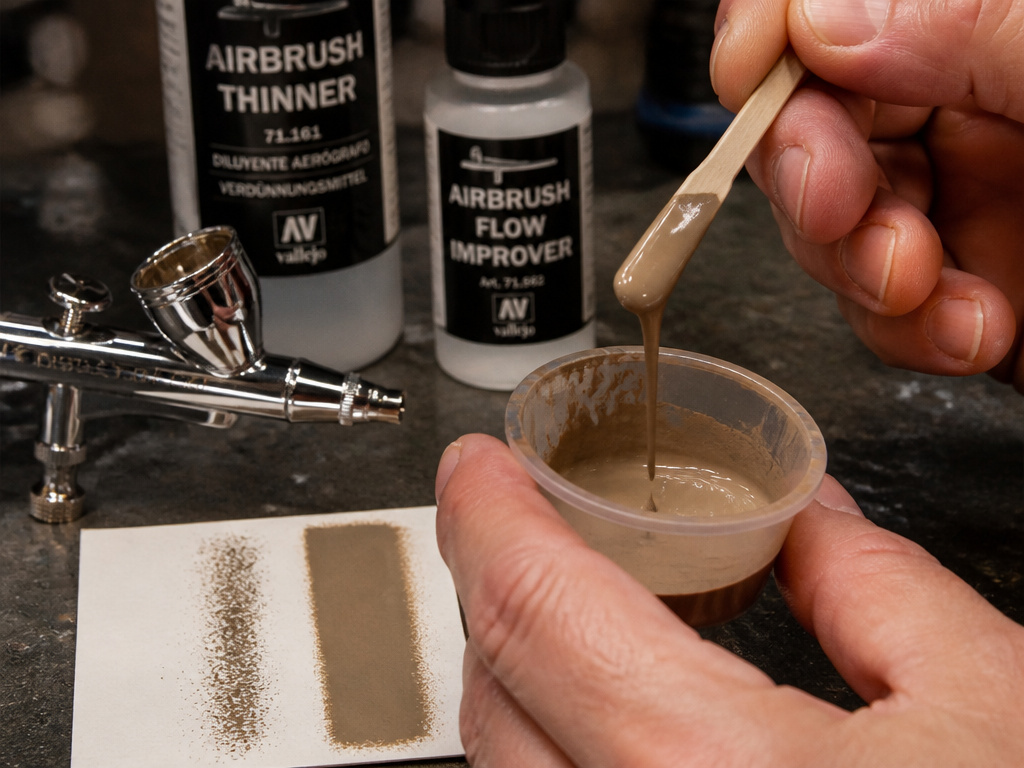
The airbrush spat, coughed, and laid down a grainy stripe across the test card. I had the box in my hand, ready to send it back, absolutely certain I’d bought a lemon.
It wasn’t the airbrush. My craft acrylic was straight-from-the-bottle thick, and thinning it to roughly the consistency of semi-skimmed milk fixed the whole thing in about four minutes. That was the entire repair.
Fair warning: this is the most common false alarm in the hobby. Paint that’s too thick sputters and clogs and looks exactly like a mechanical failure, so people return perfectly good tools.
Before you start: Thinned acrylic atomizes into fine particulates that hang in the air for a while, so a respirator and real ventilation are required even indoors. Primer left sitting in the nozzle dries harder than paint and can cost you an hour of soaking. Keep a scrap card beside you and test every mix on it before it touches the model.
The Drip Test I Use Now
- Mix in a cup, not in the reservoir. Stir the paint and thinner together outside the brush first, because a half-mixed cup sprays unevenly and you’ll blame the needle.
- Add thinner a few drops at a time. Overshooting gives you watery coverage that runs into every recess, and you cannot take thinner back out.
- Add flow improver alongside the thinner. Regular acrylic miniature paints need both, and the flow improver is what stops paint drying on the needle tip mid-session.
- Dip a stir stick and watch the drip. If the paint clings and globs, it’s too thick. If it runs off in a thin stream, you’re close.
- Test on scrap before the model. Every airbrush setup behaves slightly differently, so the same mix can spray clean on one rig and sputter on another.
Thinning is like seasoning a soup. You add a little, taste, and add again, because dumping the whole jar in is a one-way trip.
Reading the Spray
Once the mix is right, most remaining problems are diagnosable in seconds. This table covers the ones I hit most:
| Symptom | Likely cause | Fix |
|---|---|---|
| Spitting and grainy spray | Paint too thick or pressure too high | Thin a few drops at a time, then drop the pressure |
| Runs and spiderwebbing | Too much thinner, too close, or too much pressure | Back off the thinner, pull back, lower the PSI |
| Clogging mid-session | Primer or a thick white drying on the needle | Flush immediately, add flow improver |
| Rough, pebbled texture from a can | Cold, humid, or hot air clumping the paint | Wait for better weather or move indoors with a brush |
| Faint banding on a large flat panel | Tankless compressor pulsing | Switch to a tank compressor |
The airbrush paint you start with matters far less than how thin you get it. A mid-range bottle thinned correctly beats a premium bottle straight from the jar.
What Spray Cans Still Do Better
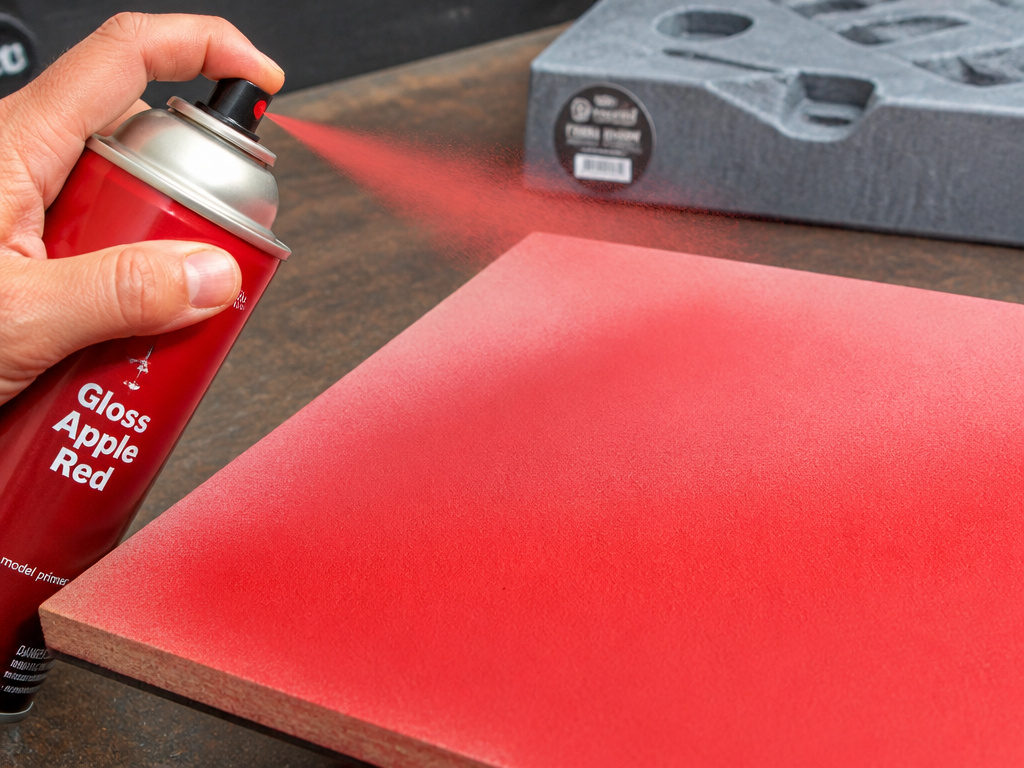
A can beats an airbrush on a big porous surface, every time. Airbrushdoc is direct about it: MDF absorbs thin airbrush paint rapidly, and you’d waste an entire bottle priming a single large building when a cheap hardware-store primer will seal that wood in seconds.
Dense foam terrain has the same problem. It drinks paint, and the coat cracks wherever the foam flexes unless you seal it first with something flexible like Plasti Dip or a coat of PVA glue, let it cure fully, then prime.
Batch work is the other can territory. A batch of plastic figures sealed outdoors before a tournament is a can job, and Imagotribe concedes that for basic priming a spray can is often enough, partly because you don’t have to set up the entire airbrush rig for it.
Miniaturepaintscompare argues the opposite for small indoor work: a rattle can needs ventilation, warmth, and dry air, which makes it hopeless in a small flat in February, and it puts down far more primer than a miniature actually needs, while airbrushdoc and imagotribe hold that a spray can is often enough for basic priming and large pieces.
Where this goes sideways: Spraying a can in cold, humid, or hot air. The paint clumps in the air and lands as a rough, pebbled texture across the whole piece. You won’t see it until the coat dries, and by then sanding it back means losing surface detail.
Distance and speed are the whole spray painting technique with a can. Too close and you get drips, too far and the paint arrives half dry and gritty. Shake the can properly first, because a lazy shake gives you an uneven color across the piece.
A clean aerosol spray paint primer does one job well: sealing a large, dumb, porous surface fast. Rust-Oleum 249124 Painter’s Touch 2X Ultra Cover is sold in a 12 oz can in Gloss Apple Red.
And when you finish, clear the nozzle by spraying upside down for two seconds. That single habit is why some people’s cans last a season and other people’s die in a month.
Which Airbrush and Compressor Setup Makes Sense for a Beginner?
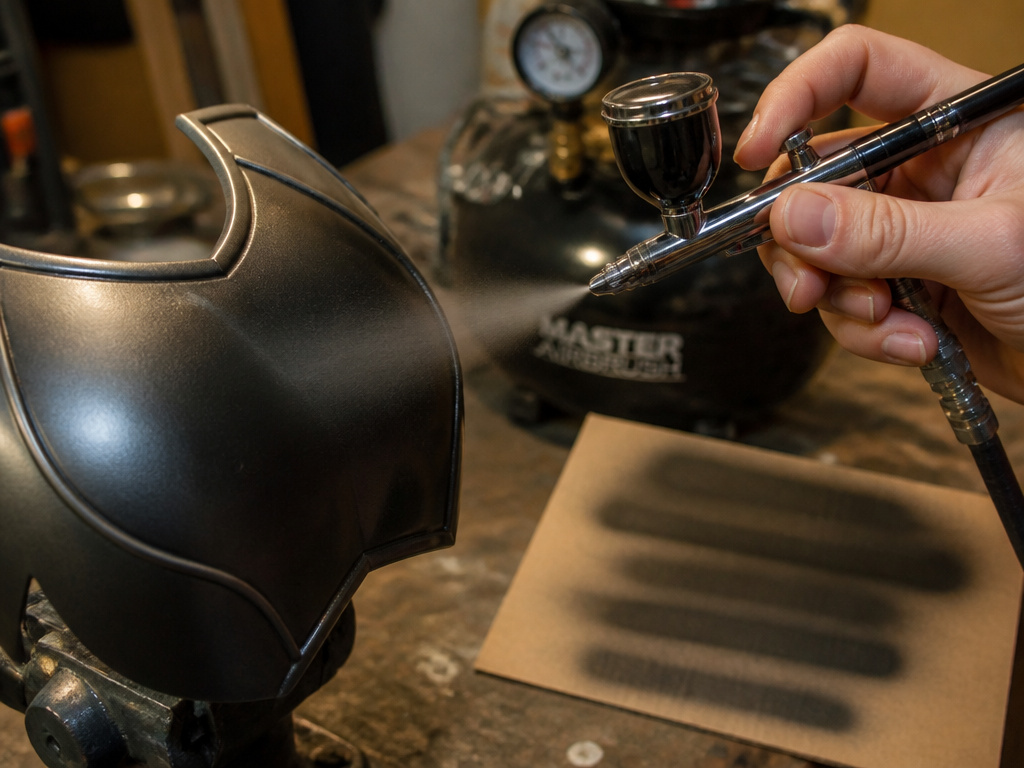
Start with the work, not the catalog. A 0.5 mm needle sprays more paint per pass than a 0.3 to 0.35 mm needle, and on a helmet or breastplate that’s the difference between an even coat and visible banding.
Needle Size: 0.5 mm vs 0.35 mm
The Badger Patriot 105 ships with a 0.5 mm needle and gravity feed, and it’s the practical choice for large armor pieces. Owners report it runs too coarse for fine weathering straight out of the box, which is why many builders later add a finer brush or buy the optional 0.3 mm needle set.
The Iwata Eclipse HP-CS runs a 0.35 mm needle with gravity feed. It handles detail and edge highlights beautifully and needs more passes than a 0.5 mm on anything large.
If you want one airbrush to start with, pick the needle that matches the biggest thing you plan to paint. Add the fine brush later, once you know you’ll keep going.
The Compressor Matters More Than the Brush
A compressor with a tank evens out the pulsing you get from a tankless unit, and that pulsing shows up as uneven coverage across any large flat surface. This is the part beginners skip, and it’s the part that ruins the coat.
The California Air Tools CAT-1P1060S is a tank compressor commonly paired with a 0.5 mm brush for large cosplay pieces.
A tank air compressor sprayer setup is the single biggest quality upgrade you can make, bigger than moving up a tier on the brush itself.
Pressure is where the sources disagree, and you should know both positions. Airbrushdoc puts most thinned acrylics at roughly 15 to 30 PSI. Imagotribe works fine detail on miniatures at up to one bar, which is far lower. Start low, test on cardboard, and raise it only if the paint spits.
When You Should Skip Both and Grab a Different Sprayer
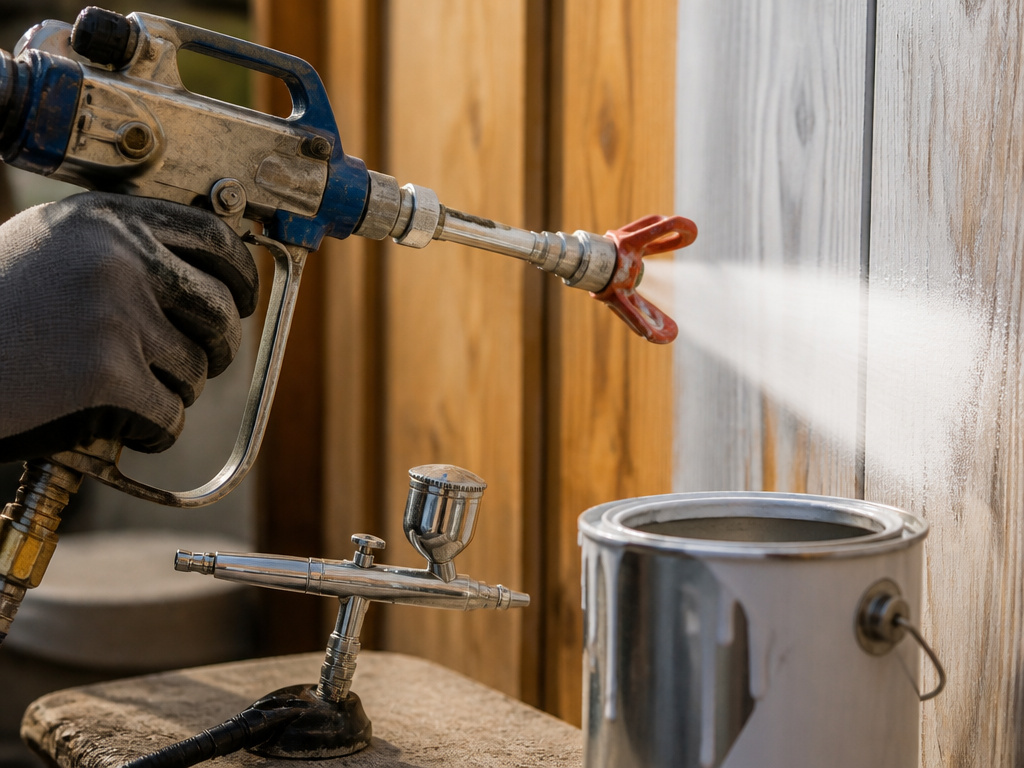
An airbrush is the wrong tool for a wall, a fence, or a car panel, and pretending otherwise wastes a weekend. Propaintersguide is blunt that airbrushing is much slower than spray painting and unsuitable for larger areas, while painterscare claims airbrushes cover a larger area in less time.
Painterscare claims the reverse, that airbrushes cover a larger area in less time, while propaintersguide holds that airbrushing is much slower than spray painting and unsuitable for larger areas.
The broader world of types of paint sprayers exists for exactly this gap. Once you’re painting furniture, doors, or walls, the airless vs HVLP question is the one to settle before you spend anything. Neither answer involves an airbrush.
Durability is another disagreement worth flagging. Propaintersguide holds that spray painting is more durable than airbrushing and better suited to outdoor work. Paintingsboss points to airbrush acrylics described as having a durable finish, so don’t pick a tool on durability claims alone.
The Cleaning Habit That Decides Whether You Keep Airbrushing
Dried acrylic turns into something close to plastic, and a clogged nozzle turns a five-minute job into an hour of soaking and swearing. This is the part that decides whether the airbrush stays on your bench or goes in a drawer.
Primer is the worst offender. It’s more heavily pigmented than paint, so it clogs a fine needle more readily, and primer left to dry inside the brush is considerably harder to remove than paint. Flush immediately, every time, before you do anything else.
The part nobody mentions: A bent needle tip from a single drop onto a hard floor. The brush still sprays, just slightly off-center, and you’ll chase the resulting uneven pattern for weeks before you think to look at the tip.
The cleaning sequence that works:
- Dump the cup. Leftover paint in the reservoir dries into a plug you’ll fight later.
- Flush with cleaner and water. Specialized airbrush cleaner plus water clears acrylic residue that plain water leaves behind.
- Pull the needle and wipe it. Do this while the paint is still wet, because a dry needle drags grit back through the nozzle.
- Reassemble without over-tightening. The brass threads on small nozzles are soft, and a heavy hand snaps them.
Store your paint in airtight containers too. Airbrush paint dries quickly and will clog the brush if it’s been sitting open.
Frequently Asked Questions
Can I use spray paint in an airbrush?
Sources disagree. Loonycraft states that spray paint cannot be used with an airbrush because they have different consistencies and application methods, while the same source also says the same paint can be used with both as long as consistency is suitable. Buy paint made for the tool.
Do I need a compressor with a tank for props?
It’s strongly recommended. A tank evens out the pulsing of a tankless compressor, which shows up as uneven coverage across a large flat surface. A small tankless unit handles detail work fine but struggles through long sessions on big pieces.
Is an airbrush safer than a spray can?
Not automatically. Loonycraft calls an airbrush safer to use with proper ventilation, while paintsgeek argues airbrushes spray at higher pressure than cans and need better protection, not less. Airbrushdoc is clear that indoor airbrushing still requires a respirator and proper ventilation, because you’re aerosolizing fine particulates either way.
How thin should airbrush paint be?
Roughly the consistency of semi-skimmed milk. It’s better to err thin and apply more layers than to spray thick and fight clogs. Test the mix on a scrap card before it goes anywhere near a finished piece.
Which is better for miniatures, airbrush or spray can?
Both, for different steps. Spray cans are often enough for basic priming, and they’re faster for a whole unit at once. The airbrush wins for zenithal priming, thin coats, and anything where the softness of a transition matters.
The Bottom Line
Here’s the trigger I’d use. If you’re painting only a single project per year, stay with cans and put the difference into better paint. Above that, buy the compressor first and the airbrush second, because the tank is what stops the pulsing that ruins large flat coats.
Fair warning: this shifts if you paint miniatures rather than props. At miniature scale the surface area is tiny, a 0.35 mm needle covers nearly everything, and a can’s overspray becomes the bigger problem.
One concession worth stating plainly. I can’t give you an exact break-even point for your own bench, because it depends on how much paint you waste and how often you spray. The sources don’t agree on it either, and anyone who quotes you a firm number is guessing.
What I can tell you is that the airbrush vs spray paint question stops feeling like a choice after a month of doing both. You reach for whichever one the job wants, and you stop thinking about it.
