
Types of Ladders for Painting: Which One Fits the Job?
This post contains affiliate links. As an Amazon Associate, we earn from qualifying purchases.
The types of ladders for painting come down to four: a stepladder for interior walls and ceilings, a platform ladder for long indoor jobs, an extension ladder for exterior walls and roofs, and a twin front ladder when two people share a wall. Match the duty rating to your weight plus tools, not your weight alone.
The number on that sticker is a ceiling for everything on the ladder at once: you, your clothes, the tools on your belt, and the gallon you set on the shelf. A 200-pound painter carrying a gallon and a tray is already past a Type III’s 200-pound rating before the first coat goes on.
What follows walks through the types of ladders for painting that earn their keep, the reach numbers that decide which size you actually buy, and the two places where the safety sources flatly disagree, so you can see both positions instead of one.
Key Takeaways
- Type I (250 lb) is a sensible floor for painting. Type III’s 200 lb is household light duty, and the National Safety Council warns a 200-lb worker shouldn’t be on one, though RIDGID lists Type III for light cleaning and painting.
- Reach decides the size, not the ladder’s label. A 6-ft stepladder puts your feet near 3 ft 9 in and your hands around 10 ft 4 in, per RIDGID’s selection guide.
- Overlap is the number the sources fight about. Cal/OSHA and the Painting and Decorating Contractors of California publish different tables, and both are below.
- A ladder shelf or hook is the cheapest upgrade you can make, because it keeps a hand free for the rail.
The Four Types of Ladders That Actually Get Used for Painting
Four shapes cover nearly every painting job a homeowner or a working painter runs into, and the types of ladders for painting are variations on them.
A stepladder is self-supporting and needs level ground under all four feet. An extension ladder is non-self-supporting and leans on a top support, so it needs only two level points plus a secure top. Duty ratings apply to both, and the rating covers the user, clothing, tools and materials together.
Stepladder: The One You’ll Use Most
An A-frame stepladder is what you want for cutting in a ceiling line, rolling a bedroom, or reaching a cabinet top. It stands on its own, so you can set it down and step away without it tipping.
Cal/OSHA caps step ladders at 20 ft, and painter’s step ladders at 12 ft. Most interior work never goes past 8 ft.
The top cap is not a step. The American Ladder Institute is explicit on that, and so is every bruised shin in the trade.
Platform Ladder: For Long, Flat, Indoor Runs
A platform ladder trades a top rung for a small standing deck. On a job where you’ll be up and down for three hours, that deck is the difference between a comfortable back and a sore one.
National Safety Council Data Sheet 665 addresses platform ladders, but check the label on the specific ladder for its platform dimensions. Painter’s stepladders max out at 12 ft under Cal/OSHA, while Benjamin Moore’s guide lists platform stepladders up to 14 ft. Check the label on the specific ladder rather than trusting either number.
Extension Ladder: Exteriors and Roof Access
Extension ladders are the two- or three-section ladders that lean. Cal/OSHA caps two-section wood at 60 ft, two-section metal at 48 ft, three-section metal at 60 ft, and two-section reinforced plastic at 72 ft.
The American Ladder Institute publishes a different cut by duty rating: three-section extension ladders reach up to 72 ft for Type IA and Type I and up to 60 ft for Type II.
For a one-story ranch, a 16-ft extension ladder extends to 13 ft and reaches 16 ft 1 in, with a working range to the top support of 7 1/2 ft to 12 1/2 ft. A 24-ft model extends to 21 ft and reaches 23 ft 10 in.
Twin Front Ladder: Two Painters, One Wall
A twin front ladder is two stepladders sharing a hinge. Benjamin Moore’s guide lists them up to 20 ft, rated to carry a person on both sides, with a platform for standing.
For a two-person exterior crew this is the piece of kit that ends the arguing about who gets the ladder next. It is also heavy, and it needs a flat surface under all four feet.
| Job | Ladder | Why it fits |
|---|---|---|
| Interior walls and ceilings, one room | 6-ft stepladder | Feet land near 3 ft 9 in, hands reach 10 ft 4 in |
| Long indoor run, hours on your feet | Platform ladder | A standing deck instead of a rung |
| Two-story exterior wall | Extension ladder | Leans on the wall; 24-ft model reaches 23 ft 10 in |
| Two painters, same wall | Twin front ladder | Both sides rated to carry a person |
| Anything above two stories | Scaffolding or planks | Ladder work stops paying off |
What Do the Duty Ratings Actually Mean?
Ever read the sticker on a ladder and assumed the number was how much you personally could weigh? That reading is the single most common mistake I see, and it goes wrong quietly.
| Type | Duty rating | Typical use |
|---|---|---|
| IAA | 375 lb | Extra heavy duty, industrial |
| IA | 300 lb | Extra heavy duty, professional |
| I | 250 lb | Heavy duty, general contracting |
| II | 225 lb | Medium duty, light commercial |
| III | 200 lb | Light duty, household cleaning and painting |
RIDGID’s selection guide spells out what the number covers: the combined weight of the user, clothing, tools, and any materials on the ladder. The American Ladder Institute Ladders 101 page says the same thing and adds a warning worth taping to your toolbox. A longer ladder does not carry more weight. There is no relationship between length and capacity, so a 28-ft ladder can be rated lighter than a 6-ft one.
ANSI requires a duty rating sticker on the side of every ladder, per the Painting and Decorating Contractors of California. It’s usually a small decal near the middle of a side rail, and it’s the first thing to fade on a ladder that lives in a truck.
Common mistake: Treating the duty rating as your body weight. The National Safety Council is blunt about this: a 200-lb worker should not use a Type III 200-lb ladder, because body weight plus tools induces overload. The label capacity is not the safe working capacity for a person of that weight.
Where the sources split is on job sites. The Painting and Decorating Contractors of California states that on construction jobsites only Type IA and Type I are acceptable. OSHA lists all five categories and says to select by expected load and type of work. RIDGID assigns Type II to light commercial work and general repair, painting and cleaning, and Type III to light cleaning and painting. A union crew and a homeowner painting a shed are working to different rules.
How to Choose a Ladder Height by Reach, Not by Length
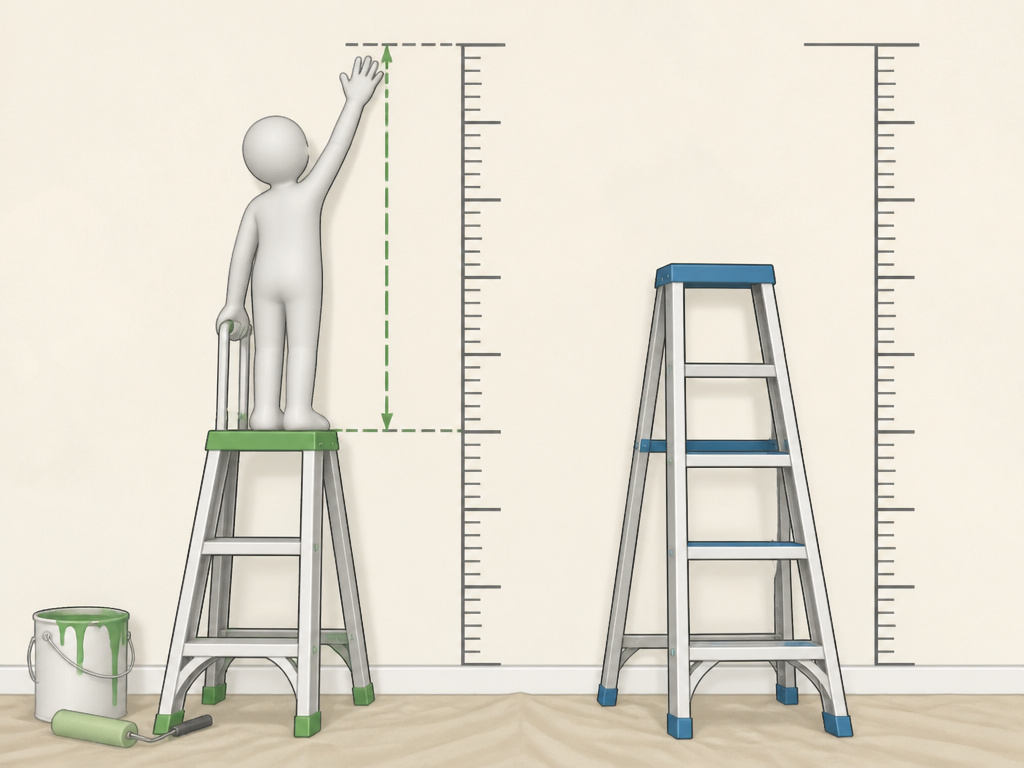
A 6-ft stepladder puts your feet at roughly 3 ft 9 in and your hands at 10 ft 4 in, according to RIDGID’s selection guide. That gap between the ladder’s label and your actual reach is where most buying decisions go wrong.
The numbers scale predictably. A 4-ft stepladder gives a standing level of 1 ft 11 in and a maximum reach of 8 ft 6 in. A 6-ft gives 3 ft 9 in and 10 ft 4 in. Extension ladders work the same way, and the extended length is always shorter than the nominal size.
Buying a 40-ft extension ladder for a one-story ranch is like buying a stand mixer before you’ve made toast. It’s more ladder than the wall needs, and it’s heavier to carry, harder to store, and no safer.
The American Ladder Institute notes that the top of an extension ladder must extend one to three feet above the roof eave when the climber intends to access the roof. That’s a real failure mode, and it shows up on the first climb, not the tenth.
Rule of thumb: Measure the highest point you’ll actually paint, add your own reach, then buy one size below the number you land on. Overbuying a ladder makes every setup harder.
For interior work above a normal ceiling line, painting high ceilings has the reach options laid out. The short version is that a taller ladder is rarely the answer.
Setting Up: Angle, Overlap, and Where the Sources Split
The setup rules are where the citations stop agreeing, and a painter who only reads one source will believe a number that another agency contradicts.
Before you start: Keep the ladder and every tool at least 10 feet from overhead power lines. Face the ladder and hold three points of contact (two hands and a foot, or two feet and a hand) whenever you climb. Pull any ladder with a bent rail, a bent rung, or a damaged foot out of service and tag it. A self-employed Massachusetts painter fell 14 feet from an extension ladder that was found with bent rungs, bent side rails and damaged feet.
- Check the ground under both feet. Soft turf or a slope lets a foot sink, and the ladder shifts as soon as you put weight on it.
- Set the base out one-quarter of the working length. That’s the 4:1 rule from the Painting and Decorating Contractors of California, and it lands you close to the 75 1/2-degree pitch the American Ladder Institute recommends.
- Extend the top three feet past the landing if you’re stepping onto a roof. OSHA requires 3 ft above the landing; the American Ladder Institute says one to three feet above the roof eave.
- Seat the rung locks and look at them. Put your weight down on the second rung before going higher, because an unseated lock drops the fly section without warning.
- Tie the top off to the structure before you step onto or off the ladder at the upper level.
- Block or lock any door the ladder stands in front of: the PDCC says never set up in front of a door unless it’s locked, while OSHA says always block the door off.
- Keep the whole setup 10 feet clear of power lines, including the ladder itself.
Overlap is the other contested number. Both tables are below, and they do not match.
| Two-section length | Cal/OSHA minimum overlap | PDCC minimum overlap |
|---|---|---|
| Up to 32 ft | 36 in | 3 ft (stated as up to 36 ft) |
| 32 to 36 ft | 46 in | 4 ft (stated as over 26 to 48 ft) |
| 36 to 48 ft | 58 in | 4 ft |
| 48 to 60 ft | 70 in | 5 ft |
The gap is real. At 34 ft, Cal/OSHA wants 46 in of overlap while the PDCC table asks for 3 ft. When two published sources disagree, use the larger number. The OSHA extension ladder safety fact sheet covers the rest of the setup requirements in two pages.
Aluminum, Fiberglass, or Wood: Which One Belongs Near a Live Wire?
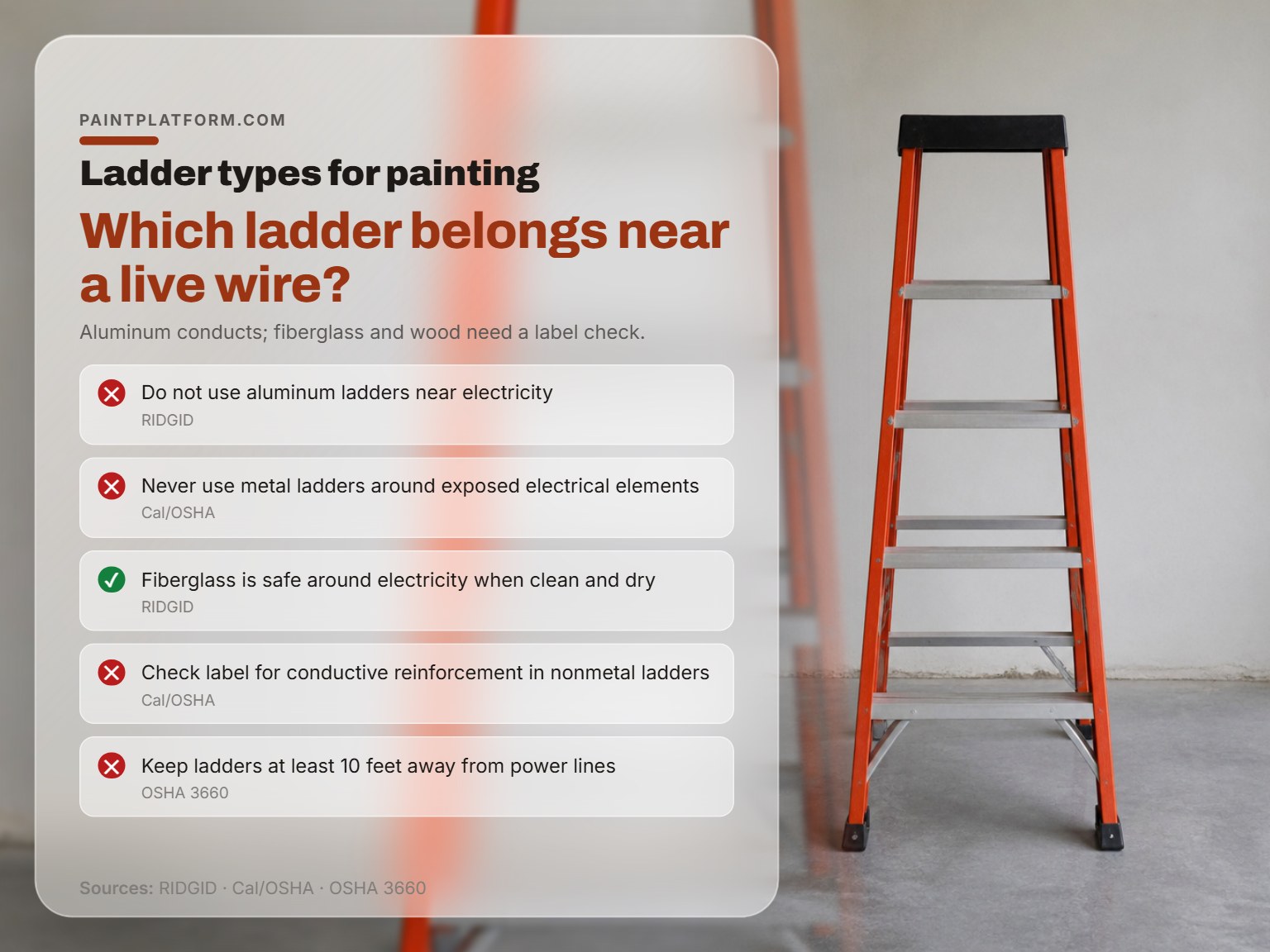
Aluminum is the lightest ladder on the rack and the wrong one beside a live wire. Every source in this stack agrees on that point.
The American Ladder Institute explains the mechanism: aluminum conducts, and your body can complete a circuit between the power source, the ladder and the ground. RIDGID’s guide says plainly not to use aluminum ladders near electricity. Benjamin Moore’s contractor guide says the same. Cal/OSHA goes further and says metal ladders should never be used for work on or around exposed electrical elements.
Fiberglass is where the agreement breaks.
- RIDGID states that fiberglass ladders are safe for working around electricity when clean and dry.
- Cal/OSHA warns that some nonmetal ladders, including fiberglass and wood, are reinforced with steel or other conductive materials, and says to check the warning label or manufacturer’s directions before assuming a ladder is non-conductive.
- Benjamin Moore notes that fiberglass can suffer long-term sun damage if stored outside, which matters because a chalky, sun-bleached rail is a rail that may no longer be clean and dry in the way RIDGID’s wording assumes.
Wood is heavy, and Benjamin Moore’s guide notes it can run into expansion problems in the rain. The PDCC recommends treating wood ladders used outside to prevent weather damage, while MU Extension says wood ladders should be sealed with varnish, shellac, linseed oil or preservative and should not be painted because paint hides defects.
Before you trust any ladder near wiring, check three things: the material listed on the label, whether the label warns of conductive reinforcement, and whether the ladder is clean and dry. Damp fiberglass with a film of paint dust is not the ladder RIDGID’s sentence describes.
The Mistakes That Put Painters on the Ground
You’re one rung from the top, the roller is a foot past comfortable, and you lean. That lean is where a lot of ladder injuries start.
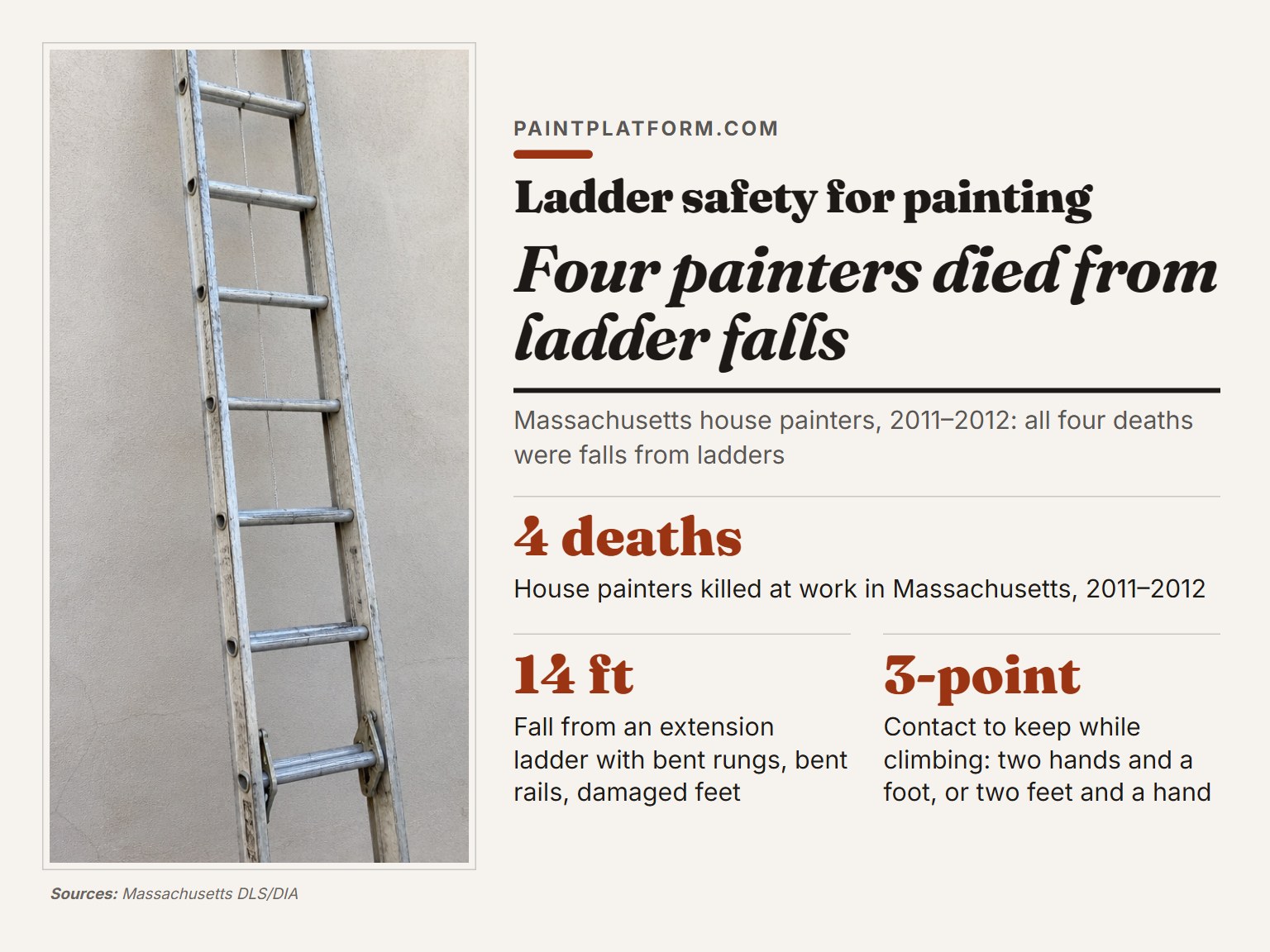
Massachusetts documented the outcome. From 2011 through 2012, four house painters died at work in the state, and all four fell to their deaths from ladders. The 14-ft fall described earlier involved an extension ladder with bent rungs, bent side rails and damaged feet.
Run a thumb down each rail before you climb. A bent rail feels like a kink under the pad of your thumb long before your eye catches it, and that ten-second check is the whole inspection.
The recurring mistakes are boring and consistent:
- Standing on the top cap or the paint shelf of a stepladder, which the American Ladder Institute prohibits outright.
- Carrying tools in your hands while climbing. OSHA says use a tool belt or raise tools with a hand line.
- Hoisting a full gallon by the handle. The PDCC says use a rope pull for heavy or bulky loads.
- Tying two ladders together to gain height. OSHA and the PDCC both prohibit it.
- Using an extension ladder horizontally as a platform, which OSHA lists under do-not.
- Setting a step ladder up partially closed and treating it as a single ladder, which the PDCC prohibits.
- Moving the ladder while you’re on it, by rocking or jumping it along the wall.
Which Rungs Are Off-Limits Depends Who You Ask
The PDCC says never stand on the top two rungs of any ladder. The American Ladder Institute says the top three rungs of an extension ladder are not for climbing, and that on a step ladder you may not stand on the top cap or the step below it.
The practical answer is the stricter one. The PDCC says never stand on the top two rungs of any ladder, while the American Ladder Institute says the top three rungs of an extension ladder are not for climbing; stay off the top three rungs of an extension ladder and off the top cap and the step beneath it on a step ladder. The full set of ladder safety for painting rules is worth reading once a season, because the ones you forget are the ones that bite.
Where this goes sideways: Setting a ladder in front of a door and calling it handled. The PDCC says never set up in front of a door unless it’s locked; OSHA says always block the door off. A locked door still opens from the other side, so block it.
Three Jobs Where a Ladder Is the Wrong Tool
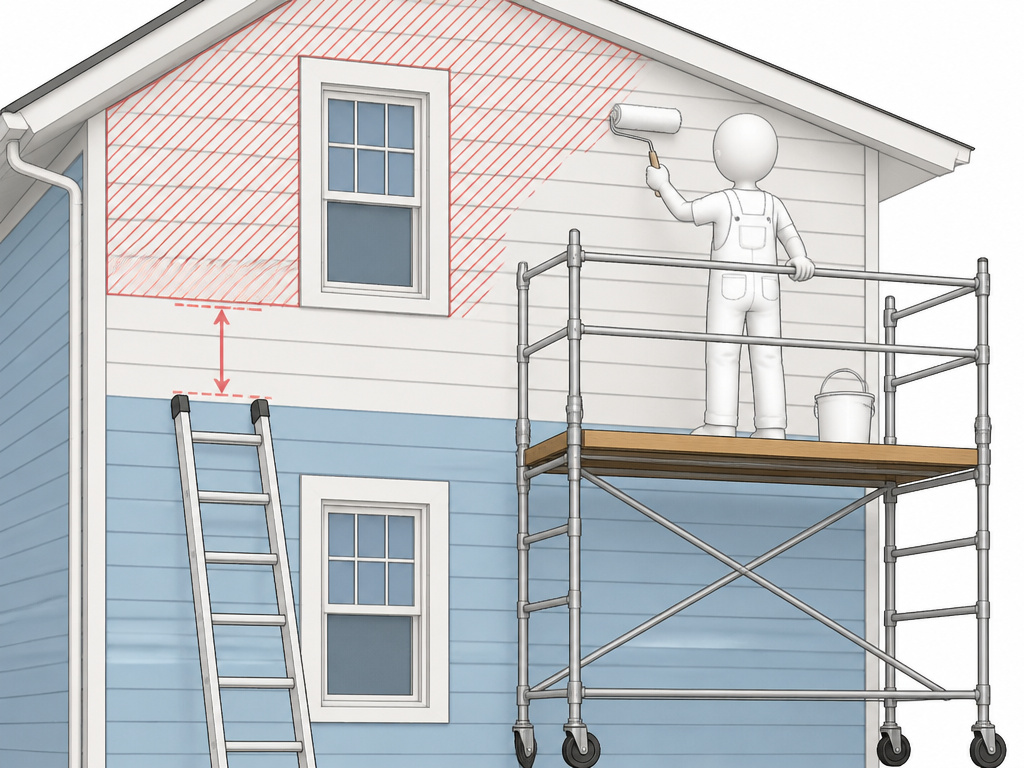
Three situations where a ladder stops being the answer: a wall above two stories, a ceiling you can’t reach from the top permitted rung, and a job that needs two people on the same wall for hours.
Benjamin Moore’s contractor guide recommends planks or scaffolding for multi-level exterior painting that needs a lot of tools or reaches above two stories. That’s the honest cutoff. Above that height, the setup time for scaffolding pays itself back in a single afternoon.
Renting also makes sense when your projects are inconsistent in height or you don’t have storage for a ladder, per the same guide. A 40-ft extension ladder you use twice a decade is a storage problem with a duty rating, though Benjamin Moore lists extension ladders up to 40 ft while Cal/OSHA permits two-section metal ladders up to 48 ft.
For ceilings and high interior walls, an extension pole guide for painting will often solve the problem without any ladder at all. And if the wall is tall but the reach is awkward, painting without a ladder covers the pole-and-platform combinations that work.
If you’re weighing a rented scaffold against a taller ladder for an exterior, this scaffold vs ladder for exterior painting breakdown is the decision in one page.
Skip this if: You’re painting a single-story exterior with clear access. A 24-ft extension ladder covers most of that wall, and renting scaffolding for one wall is money and a Saturday you won’t get back.
Care and Storage: What Quietly Ruins a Good Ladder
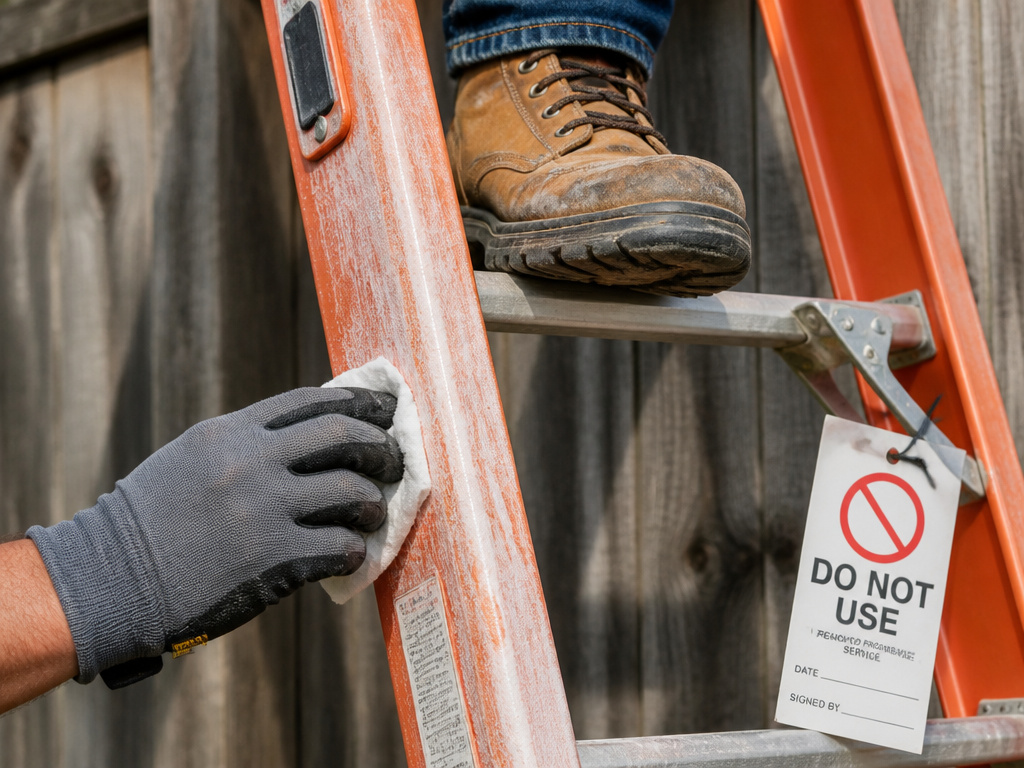
A ladder that lives outside is a ladder quietly losing its grip. The damage doesn’t announce itself; it shows up as a slick rail on the day you need the traction.
Fiberglass that has spent a summer against a fence goes chalky and pale on the sunny side. The surface that used to grip starts feeling slick under a work boot. Benjamin Moore’s guide notes that fiberglass ladders can experience long-term sun damage if stored outside, which is the mechanism behind that chalky finish.
The PDCC’s storage rules are short. Store ladders out of sunlight on a rack or where they’re supported. Keep them clean and free of grease, oil, wet paint and other slippery hazards. Don’t store materials on the ladder. The OSHA stairways and ladders guide covers the fixed-ladder side of the same subject if your setup includes a permanent ladder.
Anything with a defect comes out of service immediately and gets tagged “Do not use,” per Massachusetts DLS. That includes bent rails, bent rungs and damaged feet. A ladder with a defective side rail should not be repaired at all.
There’s also an age question. Cal/OSHA requires ladders placed in service after January 7, 2011 to meet ANSI A14.1-2007 for wood or ANSI A14.5-2007 for reinforced plastic. Earlier ladders are grandfathered to whatever standard was in effect when they went into service, which means a legally compliant ladder can still predate the current standard. Portable job-made cleat ladders built to Construction Safety Orders Section 1676 are exempt from the A14.1 requirement.
Wood care has its own set of opinions, and the University of Missouri ladder guide is a reasonable place to read further if you own a wooden stepladder.
Frequently Asked Questions
What is the best ladder for painting a room?
6-ft fiberglass stepladder covers most interior rooms. It puts your feet near 3 ft 9 in and your hands around 10 ft 4 in, which handles standard 8-ft walls and most ceiling lines. Step up to an 8-ft model only if your ceilings run higher than that.
Can I paint from an extension ladder?
You can, but it’s uncomfortable for long stretches because you’re standing on a rung rather than a platform. Extension ladders earn their place on exterior walls and roof access. For interior work, a stepladder or platform ladder is the better tool.
How much weight can a painting ladder hold?
It depends on the duty rating: Type III is 200 lb, Type II is 225 lb, Type I is 250 lb, Type IA is 300 lb, and Type IAA is 375 lb. That figure covers you, your clothing, your tools, and any materials on the ladder. The National Safety Council warns that a 200-lb worker should not use a 200-lb Type III ladder.
Is a fiberglass ladder safe around electricity?
Usually, with a caveat. RIDGID states that fiberglass ladders are safe for working around electricity when clean and dry. Cal/OSHA warns that some nonmetal ladders are reinforced with steel or other conductive materials, so check the warning label before you assume. Never use an aluminum ladder near live wiring.
How much should an extension ladder overlap?
Cal/OSHA requires 36 in of overlap up to 32 ft, 46 in from 32 to 36 ft, 58 in from 36 to 48 ft, and 70 in from 48 to 60 ft. The Painting and Decorating Contractors of California publishes 3 ft up to 36 ft, 4 ft from 26 to 48 ft, and 5 ft from 48 to 60 ft. Where the two tables disagree, use the larger figure.
The Bottom Line
Go look at the sticker on your ladder tonight. If it says Type III and you weigh anywhere near 200 lb, that ladder is a cleaning ladder, not a painting ladder, and the tools on your belt are already eating into the margin.
If you own exactly one ladder and you paint interiors, make it a 6-ft fiberglass stepladder. Choose a model whose duty rating covers your weight plus tools and materials. For a second ladder, a 24-ft extension covers most one-and-a-half-story exteriors.
One threshold worth remembering: if your ladder went into service before January 7, 2011 and you can’t find the ANSI label, treat it as a ladder you don’t know rather than a ladder you trust. The standard it was built to may be two revisions old.
And if you take nothing else from this, take the ten-second rail check. Thumb down each side, eyes on the feet, then climb. Let it be messy first; the ladder doesn’t care how the wall looks, only how you got up there.
