
How Much Paint for Kitchen Cabinets: By Door Count
This post contains affiliate links. As an Amazon Associate, we earn from qualifying purchases.
For how much paint for kitchen cabinets, plan on 2 to 3 quarts of finish paint plus 1 quart of primer for a 20 to 30 piece kitchen. A 30-piece kitchen measures 100 to 130 square feet of paintable surface once you count both faces of every door and the visible boxes.
The both-faces part is where estimates go wrong. A standard 30 by 15 inch door is 450 square inches, which is about 3.1 square feet on one side and 6.2 on both. Count doors once and you buy half the paint you need.
What follows is the door-count math, the primer volume, and the one number on the can that beats every rule of thumb. Ten minutes with a tape measure and you shop once.
Key Takeaways
- 2 to 3 quarts of finish paint plus 1 quart of primer covers an average 20 to 30 piece kitchen.
- Both faces of every door count toward your total, and skipping the back is the most common undercount.
- Coverage claims run from about 90 square feet per quart to 571 square feet per coat, so read your own can.
- A light color over dark wood needs three finish coats, which two-coat math never budgets for.
- Spraying wastes 30 to 40 percent of the paint you load, so add a quart if you spray.
How Much Paint for Kitchen Cabinets? Start With Door Count
Twenty-five doors and ten drawers is the average kitchen. Count both faces of those doors and add the visible boxes, and you land between 100 and 130 square feet of paintable surface.
Cabinet paint coverage is measured on flat, primed surfaces at a stated film thickness. Door profiles, edges, and frame returns add surface area without adding flat square footage, so a calculated total understates what a real kitchen consumes. The gap widens on raised panels and open grain. Two doors of identical width can consume different amounts once profiles are counted.
Door count is the shortcut worth memorizing, because it converts straight into cans.
| Kitchen size | Doors + drawers | Primer | Finish paint (2 coats) |
|---|---|---|---|
| Small galley, one wall | 10 to 15 | 1 quart | 1 to 2 quarts |
| Average L-shape | 20 to 30 | 1 quart | 2 to 3 quarts |
| Large, U-shape with island | 30 to 45 | 2 quarts | 1 to 1.5 gallons |
| Open plan | 45+ | 2 to 3 quarts | 1.5 to 2 gallons |
A compact apartment kitchen runs 8 to 12 doors and drawers. A standard suburban kitchen runs 20 to 30. A large kitchen with a pantry and an island reaches 30 to 45, and an open plan with a butler’s pantry passes 50.
Walk your kitchen and tally every one, including the island and any glass-front uppers. You paint cabinet doors on both faces whether or not anyone sees the back.
If you’re repainting the room’s trim and doors as well, keep that total separate. Different product, different coverage, separate shopping trip.
Why the Coverage Line on the Can Beats Every Rule of Thumb
Martha Stewart and Frank Vega plan on 1 gallon per 350 square feet, while other sources publish different coverage figures and no two cans agree.
| Product | Stated coverage | What the figure leaves out |
|---|---|---|
| Giani Nuvo kit | 100 sq ft per kit (about 40 running feet) | Cabinet interiors |
| BEHR No. 7520 | Up to 400 sq ft per gallon | Paint lost to spraying |
| Amy Howard Miracle Cabinet Paint | About 571 sq ft per coat | Not itemized in the spec |
| Martha Stewart / Frank Vega | 1 gallon per 350 sq ft | Nothing; it’s a planning rule |
That’s a wide spread between the low and high claims, and both ends are defensible. Amy Howard publishes a per-coat figure for a thin, self-leveling product. BEHR’s 400 square feet assumes a flat, primed surface and explicitly excludes what a sprayer loses.
Read the coverage per gallon figure on your own can before you do any arithmetic. It’s printed for a reason.
Why the Numbers Spread So Far
Coverage depends on film thickness, surface texture, and how much paint stays behind in the tray or the gun. A thin coat over a sealed cabinet covers more area than a thin coat over open oak grain, and both get called “one coat” on the label.
Easy to miss: BEHR’s 400 square feet per gallon excludes paint lost to spraying. Load a sprayer and that number stops describing your job.
Measure Your Cabinets in Ten Minutes Flat
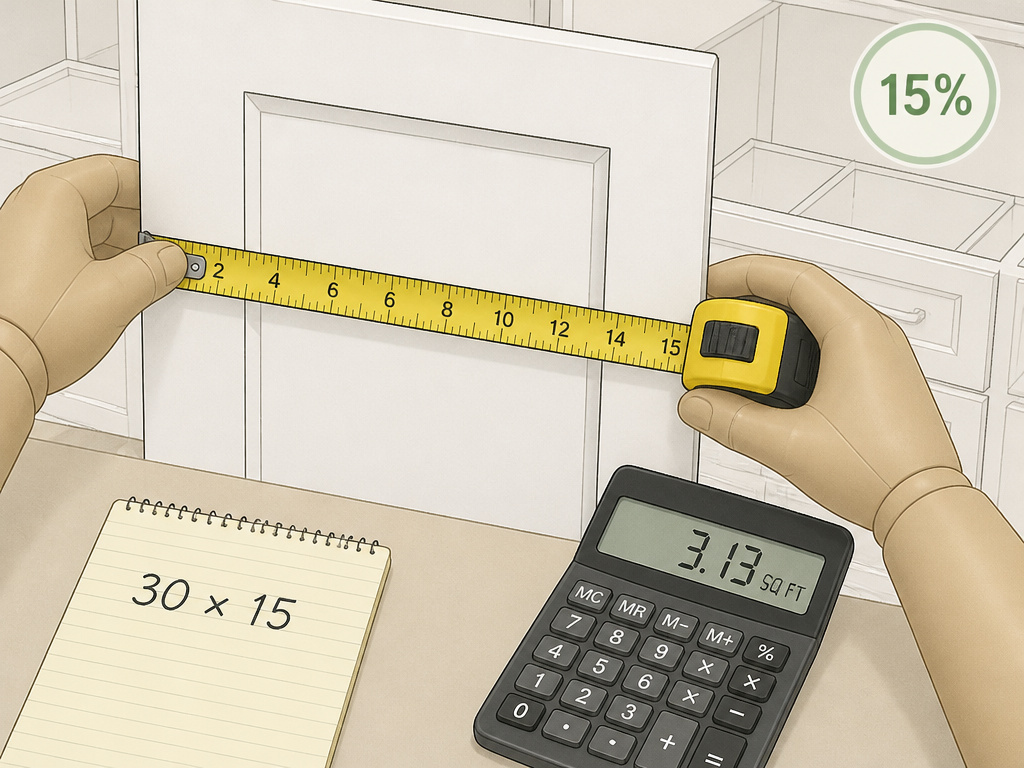
Four steps, one tape measure, and a calculator you already own.
- Measure every door and drawer front, height times width. A standard 30 by 15 inch door is 450 square inches, or about 3.1 square feet. Skipping the drawer fronts is how one quart turns into a second trip.
- Double the door figure for the back face. That same door comes to about 6.2 square feet both sides, and forgetting the back is the most common undercount in the job.
- Add the boxes. Face frames and visible cabinet sides run 20 to 30 percent of total surface in a standard kitchen.
- Add 15 percent. Cabinet work wastes more than wall work because you’re brushing small pieces and edges, so the allowance is 15 percent rather than the 5 percent used on walls.
Rust-Oleum’s own worksheet shortens step one: length times height divided by 144 gives square feet. Base cabinets stand 34-1/2 inches tall, and wall cabinets run 12 to 18 inches or 30 to 42 inches.
A paint calculator will do the arithmetic, but it can’t count your drawer fronts for you.
Does Primer Count Toward Your Paint Total?

It depends on the product: paintpricing.com says a bonding primer is required on cabinets, while Giani Nuvo says no primer is needed on most conventional wood and laminate cabinets. Budget it before you budget color.
- Factory finish, oak grain, or old oil paint: one full coat of bonding primer. New paint won’t grip without it.
- Raw wood or a heavy color change: a second primer coat often saves a third finish coat later.
- Paper-covered cabinet ends: one coat of Zinsser oil-based Cover Stain.
- Raw plywood and exposed knots: Zinsser Bull’s Eye 1-2-3, because tannins bleed through a water-based topcoat.
- Acrylic caulk: let it cure 72 hours. Silicone caulk resists paint completely, so don’t paint over it.
The sources don’t agree on how much primer that is. Frank Vega, quoted by Martha Stewart, plans about half the topcoat volume for a single primer coat. Fine Homebuilding treats primer as a full separate coat at the same coverage rate. Split the difference and buy the quart.
If your cabinets are oak with open grain, priming kitchen cabinets deserves its own afternoon.
The Prep Step That Decides How Much Paint You Waste
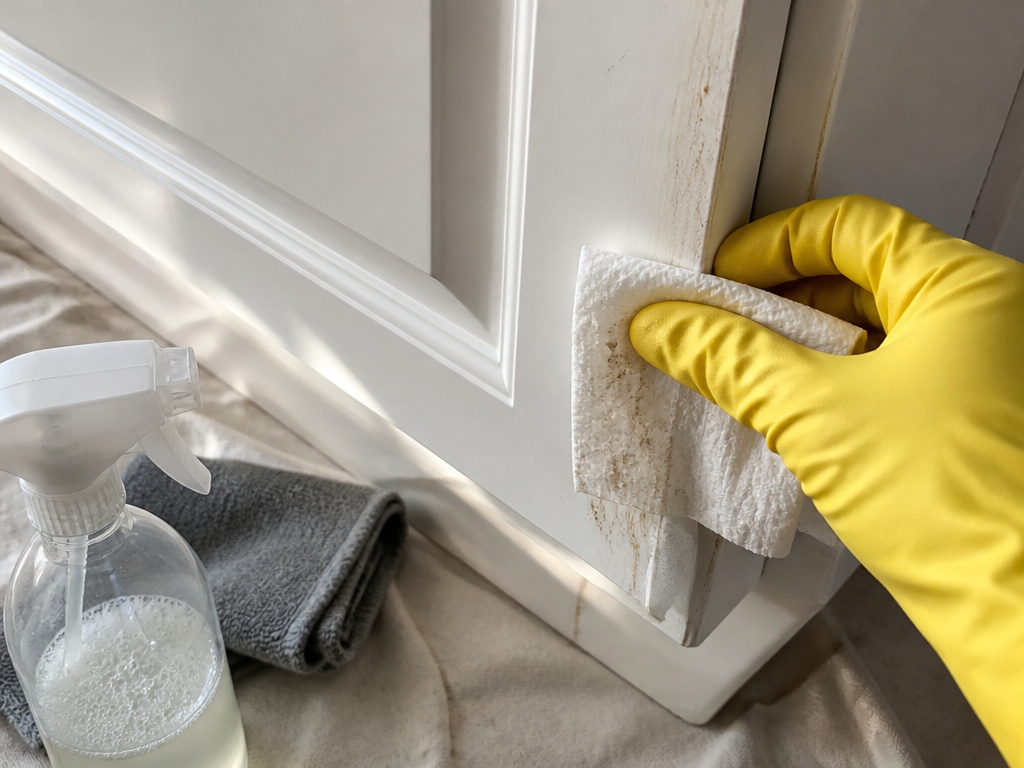
A paper towel can come back yellow-brown on a door that looked perfectly clean.
That’s the whole lesson. I skipped a warm water and TSP substitute wash on one door once, and the paint peeled off around the handle. Now I do a warm water and TSP substitute wash, a plain water rinse, and a full drying period before anything else happens.
Before you start: TSP is strongly alkaline and needs skin and eye protection. Denatured alcohol dissolves latex paint, so wear a respirator rated for organic solvents and test a hidden spot first. Keep the room between 50 and 90°F, the application window BEHR and Rust-Oleum both specify.
- Degrease, then rinse. Warm water and a few drops of dish soap handle most of the film near the stove. Save the heavy degreaser for last resort.
- Scuff the shine. Giani says #600 grit on glossy finishes, BEHR says 150 to 220, and Fine Homebuilding starts at 100 and works up to 220.
- Spot-prime knots with an oil-based primer, following the grain.
- Fill dings first, so the patch dries while you clean.
None of this changes your can count on paper. It changes whether you repaint in two years, which is the real paint budget.
An hour on the wash beats an afternoon fixing a peel. It’s the boring step, and it does more than any primer I’ve bought.
If this is your first run at it, the painting kitchen cabinets walkthrough covers the order of work.
Coats Are Where Cabinet Estimates Fall Apart
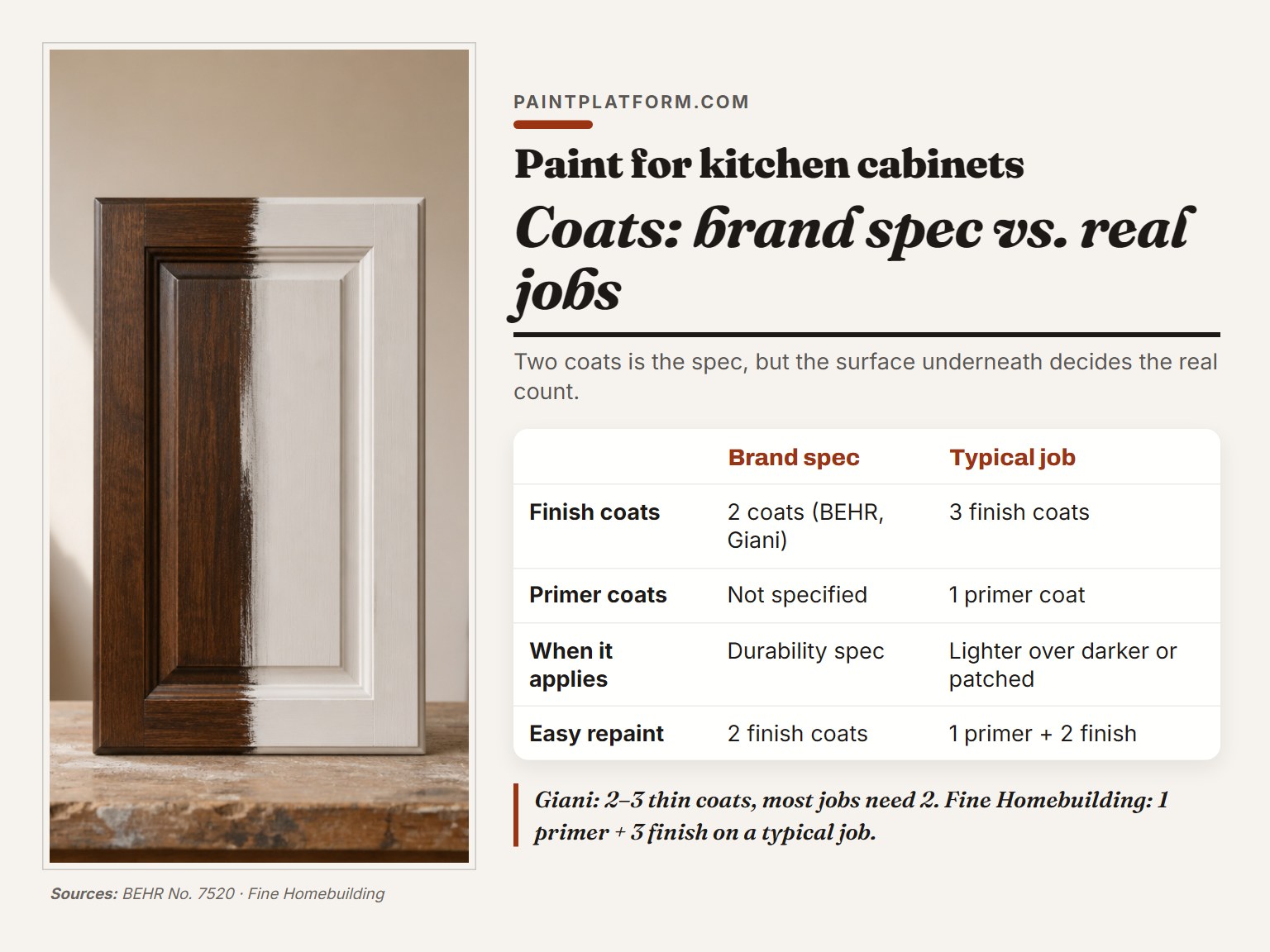
Two coats is what BEHR and Giani specify, but the real number depends on what’s underneath.
Giani designs Nuvo for 2 to 3 thin coats and says most jobs need 2. BEHR requires 2 coats of No. 7520 for durability. Fine Homebuilding, writing for people who do this daily, budgets one primer coat and three finish coats on a typical job. Same cabinets, different arithmetic.
What changes is the job underneath the paint. Repainting well-maintained cabinets in a similar color takes one primer coat and two finish coats. Painting a light color over dark stain, or patching dents, takes three finish coats.
I learned to mix more than I think I need the hard way. Running out mid-piece and trying to rematch the color left a visible patch I could never blend away. Now I mix extra and keep it.
Buy for the third coat even if you plan on two. A quart you never open beats a color you can’t rematch a year from now.
Where this goes sideways: Applying Nuvo in one thick coat to save a pass. It’s built for two thin coats, and a heavy coat sags, runs, and stays soft for weeks.
If you’re still choosing between products, the best paint for cabinets comparison covers sheen and hardness.
Spraying vs Brushing: The 30 to 40 Percent Nobody Budgets
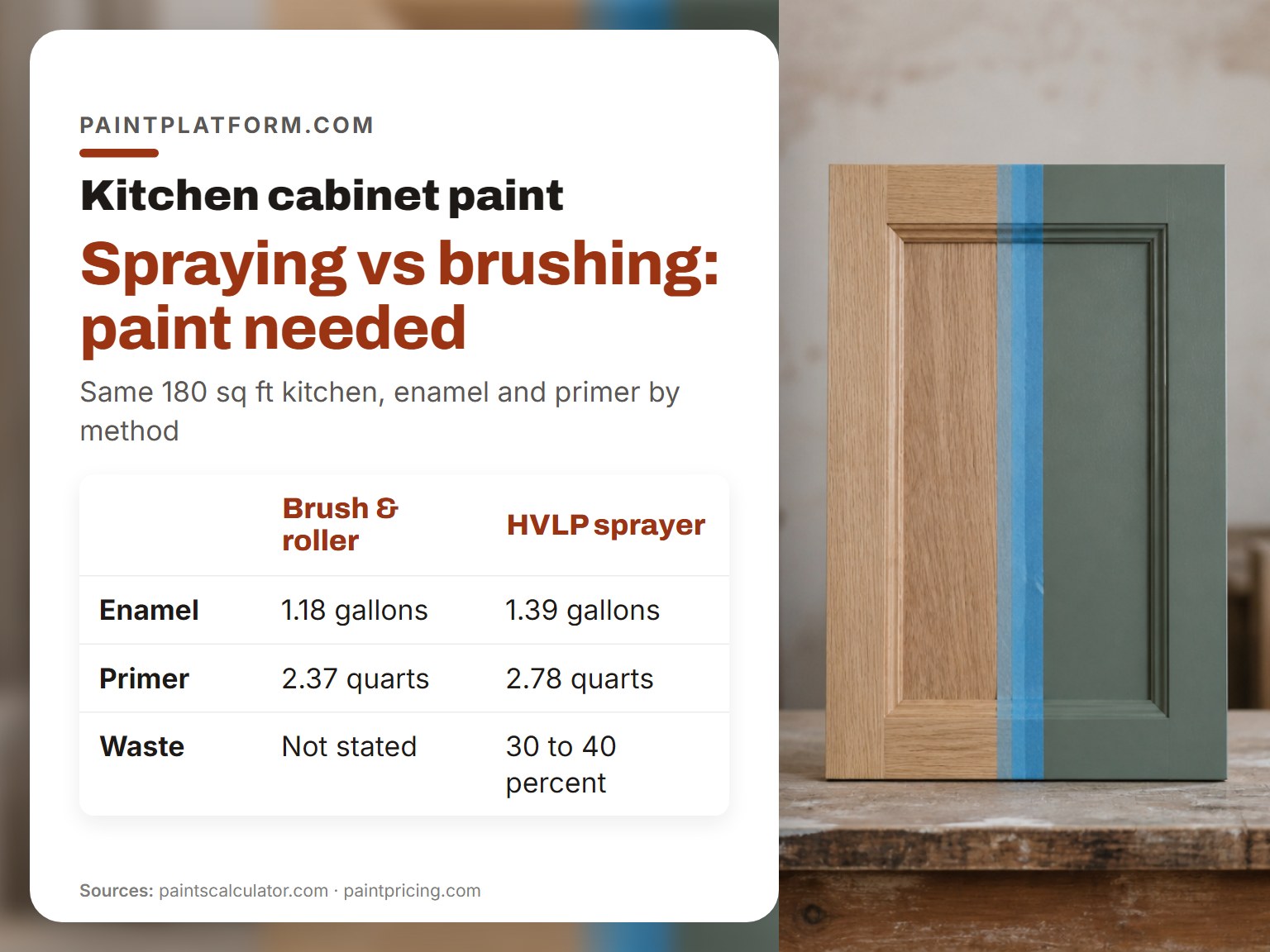
An HVLP sprayer puts about a gallon of paint through four coats on 25 cabinet doors, per Fine Homebuilding. That’s the finish-quality end of the range, not the frugal one.
Brushing and Rolling
Brushing and foam rolling wastes almost nothing, which is why the door-count tables assume it. A 180 square foot kitchen takes 1.18 gallons of enamel by brush and roller, and 2.37 quarts of primer.
Spraying
The same 180 square foot kitchen takes 1.39 gallons sprayed, plus 2.78 quarts of primer. Waste estimates run from 30 to 40 percent at the high end down to a 10 percent margin in Fine Homebuilding’s own numbers. Add a quart over your brush figure and you’re covered either way.
If you’re buying tight on quantity, brush and roll. If the finish matters more than the can count, spray, mask properly, and buy the extra quart without arguing with yourself.
Sheen matters as much as method, and cabinet paint finishes explains why gloss outlasts flat.
Keep the Leftover Quart, Labeled
A custom cabinet color is nearly impossible to match a year later. Keep a labeled jar of the exact paint and you turn a weekend repaint into a five-minute touch-up.
Cure times are the other thing people rush. Giani says wait 7 days before cleaning and 14 days for full cure. Amy Howard lists 7 to 14 days. One estimating guide puts full cure at two to three weeks, and another says latex isn’t fully hard for about three weeks.
Treat the first two weeks as gentle. Water-based paint sitting wet puts the film in a weakened state, and you’ll see the dull patch before you understand where it came from.
Frequently Asked Questions
Is one gallon enough for kitchen cabinets?
Yes for most small and average kitchens. One gallon covers a typical 30-piece kitchen at the coverage rate on your can. Very large kitchens with an island may need additional paint.
Do I need to paint the inside of the cabinets?
No. Every kit and every guide counts the doors, drawer fronts, both door faces, and the visible frame and boxes. Interiors stay as they are, which is a big part of why the total stays low.
How long should I wait between coats?
It depends on the product, and the sources genuinely disagree. Giani, BEHR, and Amy Howard all allow a recoat at about 2 hours, while Martha Stewart’s expert says at least 24 hours in a well-ventilated area. Follow your own can first.
How much extra paint should I buy?
Fifteen percent over your measured area for brush and roll, and a quart more than that if you spray. Cabinet work wastes more than walls because of all the small pieces and edges.
Can I use wall paint on cabinets?
No. Wall paint stays soft on a door that opens dozens of times a day, sticks to itself where the door meets the frame, and chips at the edges. Use a cabinet and trim enamel.
The Bottom Line
If your tally passes 30 doors and drawers, stop shopping in quarts. Buy by the gallon, add the extra quart if you’re spraying, and keep whatever is left in a labeled jar.
The how much paint for kitchen cabinets question has a short answer: measure your doors, add the boxes, add 15 percent, then buy one coat more than you planned.
One concession. None of this math helps if your cabinets are PVC vinyl thermofoil. Those need a specialty product and a different plan, and the door-count table won’t save you.
If you want one answer and an average kitchen, BEHR Premium Cabinet, Door & Trim Enamel No. 7520 in satin, brushed and rolled over a bonding primer, two coats. It’s the least fussy path. And measure your own doors anyway. Ten minutes with a tape measure beats any table on the internet, including this one.
