
How Much Paint for Exterior Siding: Measure and Estimate
This post contains affiliate links. As an Amazon Associate, we earn from qualifying purchases.
For exterior siding, budget one gallon per 250 to 450 square feet per coat, then double it for bare wood. The how much paint for exterior siding question has no single answer because coverage varies by product: Benjamin Moore Aura F632 spreads 350 to 450 square feet per gallon, Regal Select N401 covers 250 to 350, and C2 C5000 reaches 450 on a smooth face.
Two things drive that gap: how much solid material stays in the film after the water leaves, and how rough the board underneath is.
What follows is the five-minute version I actually use. Measure the wall, pull a coverage number off the can, plan the second coat, and write the total on the lid. Then the parts that trip people up, like wet wood, cold mornings, and rough-sawn cedar that drinks a gallon before you’ve finished one wall.
Key Takeaways
- Measure each wall separately and write the numbers down, because the second trip to the paint store is always the expensive one.
- Take the low end of the spread rate on rough-sawn or weathered boards. C2 C5000’s 450 square feet per gallon applies to the smooth face only.
- Bare wood takes two coats on the Benjamin Moore sheets, while C2 C5000 allows one or two finish coats directly on bare wood and Valspar Defense sells a one-coat paint and primer.
- Minimum application temperature runs from 35°F to 50°F across these products, and Valspar Defense raises its minimum to 50°F on large expanses of metal siding, so read the data sheet before you commit a Saturday.
- Wait until the wood is dry, and check with a plastic square before the first brush stroke.
How Much Paint for Exterior Siding Do You Actually Need?
Four hundred and fifty square feet per gallon. That’s the top of the range, and it belongs to C2 Paint C5000, which is a siding stain more than a paint.
At the bottom sits Benjamin Moore Regal Select N401 at 250 to 350 square feet per gallon. Same job, same kind of wood, and a spread of nearly double. I check the sheet every time and the number still surprises me.
Spreading rate is measured on a smooth, properly prepared surface at the manufacturer’s stated film thickness. Benjamin Moore Aura F632 covers 350 to 450 square feet per gallon at 3.5 to 4.5 mils wet film, while Regal Select N401 covers 250 to 350 square feet per gallon.
| Product | Spread rate per gallon | Coats on bare wood |
|---|---|---|
| Benjamin Moore Regal Select N401 | 250 to 350 sq ft | 2 finish coats, no primer |
| Benjamin Moore Aura F632 | 350 to 450 sq ft | 2 finish coats, self-priming |
| Benjamin Moore Element Guard K763 | 300 to 400 sq ft | Fully primed first |
| C2 Paint C5000 | 450 sq ft (smooth face) | 1 to 2 finish coats |
| Valspar Defense | 250 to 400 sq ft | Marketed as one coat |
Volume solids explain part of the spread. Aura F632 is 40.1 percent solids and C2 C5000 is 37 percent, so the two cans leave different amounts of film behind once the water leaves.
Then there’s the older data. The 1945 NBS Letter Circular 810 lists 500 square feet per gallon for a priming coat and 700 for a finish coat, using white-lead paint mixed on the job. Those figures belong to a different chemistry. The same document still says rough or weather-beaten wood takes much more paint than planed wood, and that part hasn’t aged at all.
The only number worth trusting is the one printed for the product in your hand. Start with paint coverage figures from that data sheet and treat everything else as a sanity check.
How Do You Measure Siding Without Climbing the Ladder Twice?
Do you need to walk the whole house with a tape measure? Once, yes. Then never again if you keep the numbers somewhere you’ll find them.
The Two-Minute Wall Measurement
- Sketch each elevation on one sheet and label it north, south, east, west. Skip the labels and you’ll re-measure the same wall twice without knowing which number belongs where.
- Measure height from the foundation line to the soffit. Gable peaks are triangles, and a rectangle measurement overshoots them badly.
- Measure length at the top and at the bottom. Old houses are rarely square, and the wider number is the one that buys paint.
- Multiply height by length for each rectangle, then add each gable at half base times height.
- Subtract doors and big windows. Small windows barely move the total, and the trim around them eats paint anyway.
What to Subtract
Subtracting is where estimates turn optimistic. A window opening is real square footage, but the casing, sill, and drip cap around it are all surfaces you’ll paint. I subtract the glass and add back nothing.
Online calculators will hand you four decimal places on a number built from a guess. Using a paint calculator is a fine double-check, and I do run one, but I run it after my own total exists so I can see where it disagrees.
Where this goes sideways: Measuring one wall and multiplying by four. A ranch with a garage bump-out and a recessed porch has four different wall lengths, and the average is wrong in both directions.
The Second Coat Is Where Most Estimates Fall Apart
One coat is a guess wearing a paint shirt.
Benjamin Moore Aura F632 requires two coats on bare substrate, Regal Select N401 is self-priming with two finish coats, and Element Guard K763 requires new surfaces to be fully primed. On previously painted surfaces you can stop at one or go to two, which is a decision about color and film thickness rather than coverage.
- Bare wood, fiber cement, or hardboard: two finish coats, no debate.
- Sound, previously painted siding: one or two, and the second is cheap insurance under a dark color.
- Redwood and cedar: BEHR DYNASTY wants two primer coats with 12 to 16 hours of dry time between them.
- A drastic color change: the second coat does most of the hiding, so budget for it.
Then there’s the film thickness question, which nobody settles. Letter Circular 810 targets 4.5 to 5.5 mils of total dry film across all coats. Aura F632 lays down 1.4 to 1.8 mils per coat, so two coats land at 2.8 to 3.6 mils, under the 1945 target. Regal Select N401 runs 2.3 mils per coat and gets closer.
The two documents don’t reconcile. I’d rather say that out loud than pretend the numbers agree.
Letter Circular 810 also notes that the old standard was three coats, and that a two-coat system only works when the topcoat is built for a special primer and the total film matches what three coats used to deliver, while Benjamin Moore sheets specify two coats on bare substrates and Valspar Defense is marketed as a one-coat paint and primer. Modern one-coat products are sold on a different promise. The best exterior paint for a two-coat job is the one whose data sheet actually says two coats.
The same over-buy logic applies to trim paint. Small area, heavy coat count.
Wet Wood Will Blister, and I Have the Cedar to Prove It
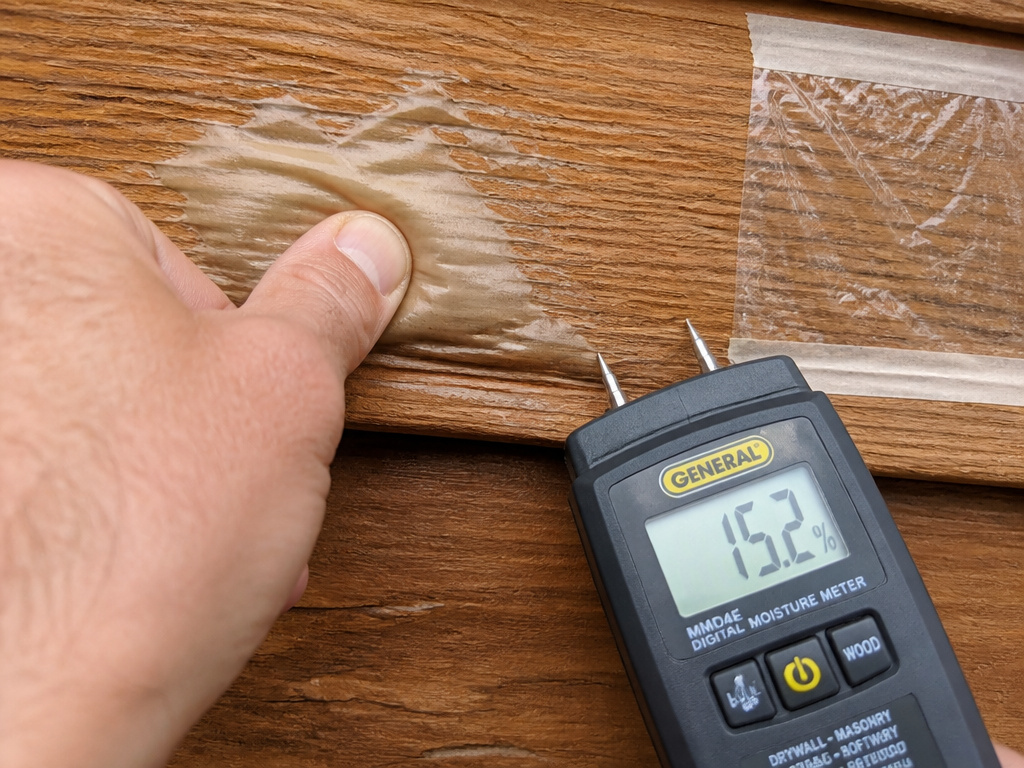
The blisters came up in a line along the second board after the brush went down.
I had washed that cedar section, given it only a short time to dry, and painted it. Later the film had lifted into soft bubbles you could push with a thumb, and the wood underneath was damp. Now I wait until the wood is dry and tape a square of plastic wrap to the board overnight. If there’s fog under the plastic in the morning, the paint stays in the can.
A cheap pin moisture meter reads the wood before I open a can. Not fancy. It has saved me from my own optimism more than once.
Mildew is the other thing that gets misread. On a painted fence and some shady trim, the green-gray film turned out to be surface growth that scrubbed off with a stiff brush and soapy water. Soft, crumbly wood under that same film is a different problem, so I poke it with a screwdriver before deciding.
Shady spots grew it fastest, and cutting back a bush did more than repainting did.
Before you start: Scraping, sanding, or stripping old paint can release lead dust, which is toxic and especially dangerous to children and pregnant women. Wear a NIOSH approved respirator, clean up with a HEPA vacuum and a wet mop, and keep the work area closed to anyone not in protective gear.
I won’t paint exterior wood until it has dried thoroughly after washing. One sunny afternoon fools me every time, and the failure shows up after the ladder has already moved.
If you want the full sequence for boards rather than just the gallon count, painting exterior wood siding walks through prep, priming, and the order of operations. The USDA refinishing wood siding report is the lab-side version of the same subject.
Why the Temperature Rules Don’t Agree With Each Other
Several exterior products, the same wood siding, and a 15-degree gap in the lowest temperature they’ll tolerate. Fifteen degrees is a lot.
| Product | Minimum application temperature | Rain-ready |
|---|---|---|
| C2 Paint C5000 | 50°F (10°C) | Not stated |
| Benjamin Moore Aura N634 | 35°F | Not stated |
| Benjamin Moore Element Guard K763 | 35°F (1.7°C) | 60 minutes |
| Valspar Defense | Above 35°F, 5°F above dew point | 1 hour |
| BEHR DYNASTY | 35°F to 90°F, held 4 hours | 60 minutes |
C2 Paint C5000 draws a hard line at 50°F for product, air, and surface. Benjamin Moore Aura N634 and Element Guard K763 both go down to 35°F. Valspar Defense also allows 35°F, with two conditions: the air must sit at least 5°F above the dew point, and the temperature must not drop below 35°F within 48 hours; on large expanses of metal siding Valspar requires 50°F or higher.
BEHR DYNASTY runs 35°F to 90°F and wants that range held for at least four hours after application.
The 48-hour lookahead is the rule I’d borrow no matter whose can is in the truck. A morning that starts above the minimum and falls below freezing overnight will wreck a coat that looked fine at lunch.
Aura F632’s recoat time is 4 hours at 77°F/50% RH, and touch dry in 1 hour.
Skip this if: You’re painting a large expanse of metal siding in shoulder season. Valspar Defense raises its minimum to 50°F on metal even though the same can says 35°F.
Latex finishes don’t coalesce properly in cold weather, which is why an oil-alkyd primer holds up better as an end-grain sealer when the mercury drops. That’s a real difference, and choosing exterior paint by the calendar matters as much as choosing it by the color card.
Primer, Bare Wood, and the Coats the Label Actually Asks For
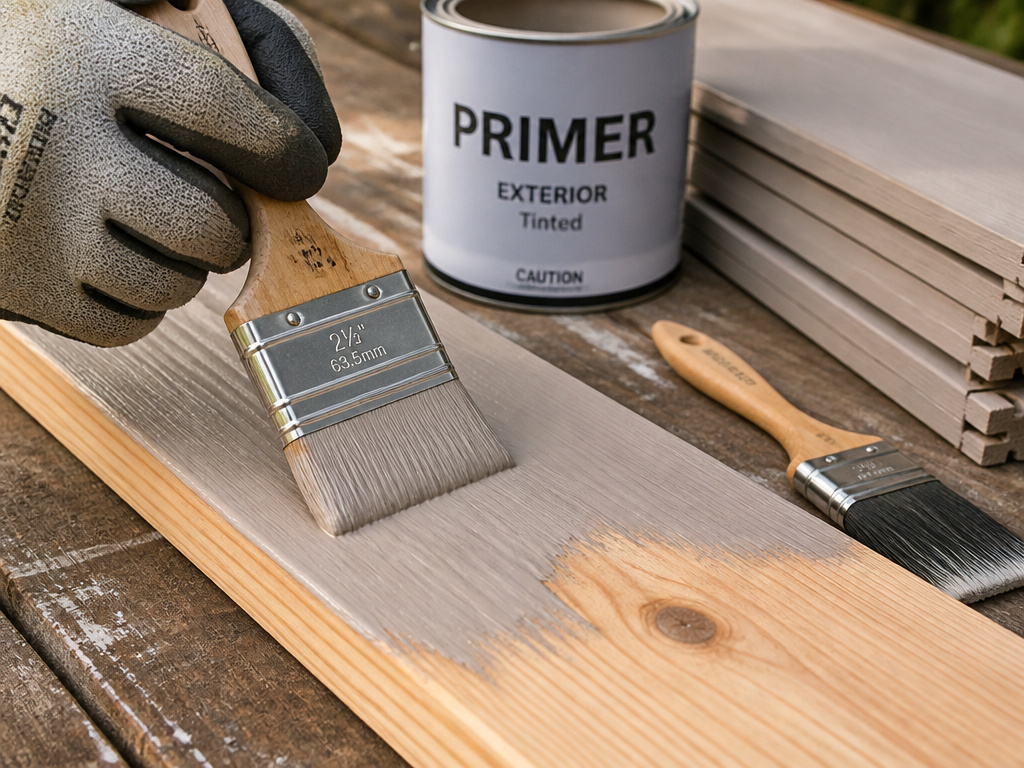
Three manufacturers answer the primer question three different ways, and each answer is correct for its own product.
When You Actually Need a Primer
Regal Select N401 says no primer is needed on wood, then asks for two finish coats. Element Guard K763 says new surfaces should be fully primed. C2 C5000 goes on as one or two finish coats directly over bare wood and reserves a stain-blocking primer for severely staining species like T1-11 plywood, redwood, and cedar.
BEHR DYNASTY sits further out again, with two primer coats required on redwood and cedar and 12 to 16 hours of dry time between them.
The primer question depends on the product: Regal Select N401 says no primer on wood, Element Guard K763 says new surfaces should be fully primed, and C2 C5000 reserves primer for severely staining woods.
Tint the primer toward the finish color when you’re making a big change. A tinted primer under a dark color does more for coverage than a third finish coat will.
Masonry follows different rules. New masonry has to cure 30 days before primer or paint touches it, per the Benjamin Moore Regal Select N401 sheet. Painting a fresh stucco patch on a Saturday is a mistake you only make once.
If you’re working out the whole house rather than one elevation, exterior house painting starts with the same wall measurements and adds the trim, soffits, and doors.
Rough Faces, End Grain, and Other Places Gallons Disappear
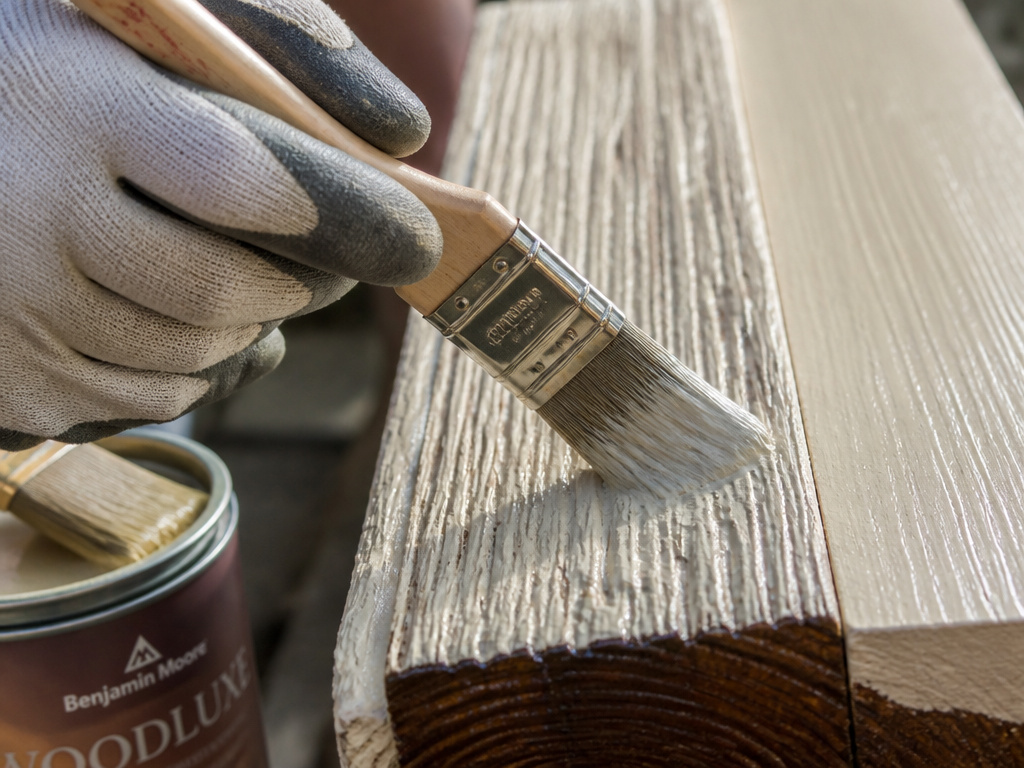
The rough side of a cedar board drinks paint, and C2 says so right on the sheet: 450 square feet per gallon applies to the smooth face, and the rough face takes more.
Letter Circular 810 makes the same point from 1945. Rough surfaces and weather-beaten wood need much more paint than smoothly planed wood, and no calculator accounts for it.
- End grain: paint peels at board ends when the end grain isn’t sealed, so seal each cut as you fit the piece.
- Back priming: the back of siding gets wet from wind-driven rain, splash, capillary rise at the laps, and condensation, and back priming limits all of it.
- Grain angle: flat-grain siding changes width almost twice as much as vertical grain for the same moisture swing.
- Fasteners: about one inch (25 mm) up from the bottom edge and well away from board ends, with a pilot hole and a 45-degree bevel where boards butt together.
The paint industry wood siding findings go further than film thickness. Sealing end grain and managing extractive bleed matter as much as adding another coat, and oil-alkyd stain-blocking primers were the most effective end-grain sealer of the options tested.
Which brings the count back up. Rough faces, end grain, back priming, and a second coat on bare wood all add gallons, and fence paint math works the same way on a smaller scale.
Frequently Asked Questions
Does one gallon of exterior paint cover 400 square feet?
Sometimes. The printed spread rate runs from 250 to 350 square feet per gallon for Regal Select N401 up to 450 for C2 C5000 on a smooth face. Four hundred is a fair middle guess for a modern acrylic on prepared wood, and a bad guess on rough-sawn cedar.
How much extra paint should I buy for siding?
Enough for a full second coat on bare or weathered wood, which means doubling the first-coat number rather than adding a splash. On sound, previously painted siding, one extra gallon covers touch-ups and the spots you find at the end.
Can I paint exterior siding at 40°F?
Depends on the product. Benjamin Moore Aura N634 and Element Guard K763, Valspar Defense, and BEHR DYNASTY all allow application at 35°F. C2 Paint C5000 stops at 50°F. Valspar adds a 48-hour lookahead and a dew point margin.
Do I need a primer on bare wood siding?
Check the specific sheet. Regal Select N401 says no primer on wood and two finish coats. Element Guard K763 says new surfaces should be fully primed. BEHR DYNASTY requires two primer coats on redwood and cedar.
How soon can rain hit fresh exterior paint?
Element Guard K763 resists rain 60 minutes after application over wood or primed surfaces at 77°F and 50 percent humidity. Valspar Defense is rain-ready in 1 hour. BEHR DYNASTY wants 60 minutes of dry time at 60°F to 70°F and 60 to 70 percent humidity, and longer in cool or humid conditions.
Why did my exterior paint blister?
Moisture under the film, almost every time. Wood that was painted damp, or a wall with a vapor problem, pushes water through the coat and lifts it. Check for fog under a plastic square before painting, and fix the water source before the paint.
The Bottom Line
If your wall total lands close to what you planned to buy, buy the extra gallon. Running short mid-wall means a color match at the counter and a lap line you’ll see every time you pull into the driveway.
The how much paint for exterior siding math stays the same no matter whose can you carry: measure the walls, take the spread rate off the data sheet, and double it for bare wood. What changes is the fine print, and the fine print is where the failures live.
This week, walk the house with a notebook and write four numbers per elevation. Height, length, gable, openings. That’s the whole job, and it takes less time than reading this did.
One concession before you go: none of this helps if the wood is wet or the temperature is wrong. A perfect estimate on a bad day still buys you blisters. I know, because I’ve bought them.
