
How Much Paint Do I Need for a Room? Read the Can First
This post contains affiliate links. As an Amazon Associate, we earn from qualifying purchases.
You need roughly one gallon of paint for a room with 350 to 400 square feet of wall area, and most bedrooms land at one to two gallons once a second coat goes on. Trust the can label over any rule of thumb, since coverage runs from 250 to 400 square feet per gallon by brand.
Coverage is a range because paint forms a film rather than pouring out in even amounts. A porous surface pulls resin and pigment into itself. A sealed surface holds the paint on top.
A deep color needs another pass before the wall stops showing through. That’s why the same gallon behaves differently in two rooms of identical size.
What follows is the wall math, the places where the major sources flatly disagree about coverage, and an honest answer to the how much paint do i need for a room question.
Key Takeaways
- Check the can before you trust any rule of thumb. Coverage runs from 250 to 400 square feet per gallon depending on the brand and product line.
- Two coats is the working assumption on walls and one on the ceiling, unless you’re repainting the same color over itself.
- This Old House and PaintCare say to subtract 10 square feet per window and 20 per door for a precise estimate, while BEHR treats the deduction as optional to build in a cushion.
- Textured walls can drink up to 50 percent more paint than smooth walls.
- A quart covers about 100 square feet, which is enough to learn how a color behaves.
How Much Paint Do I Need for a Room? Start With the Can Label
Sherwin-Williams publishes 350 to 400 square feet per gallon. BEHR publishes 250 to 400 for BEHR ULTRA Interior Paint and Primer. Both are accurate descriptions of their own products, and neither one is a universal constant.
A gallon of interior paint covers between 250 and 400 square feet in a single coat, depending on the manufacturer and the product line. Primer covers less, at 200 to 300 square feet per gallon. Coverage figures are printed on the can label and take precedence over any published average.
That label is the only number that belongs to your actual can. A paint calculator gets you close, but it can only work with the rate you feed it, so read the can first and calculate second.
Farrow & Ball is unusually candid about this. Their own calculator, per their site, only works out paint for walls and does not account for windows, doors, or alcoves. If a manufacturer is willing to flag the limits of its own tool, treat every calculator with the same suspicion.
When the label is worn off or you’re working from a color card, 350 square feet per gallon is the fallback number. PaintCare and Re-Paints both recommend it for a rough estimate.
Why One Gallon Covers 250 Square Feet in One Room and 400 in Another
BEHR’s spec sheet starts at 250 square feet per gallon. That’s the low end of a real range.
New drywall, plaster, and bare wood absorb paint the way a paper towel absorbs water. The first coat partly seals the surface instead of sitting on top of it, so less of what you roll on ends up as visible color. PaintCare notes that unprimed surfaces need more coats for exactly this reason, and a tinted primer cuts the number of top coats by getting the substrate closer to the final color first.
Texture works the same way at a larger scale. A rough wall has more actual surface than a smooth one with the same footprint, and PaintCare puts the penalty at up to 50 percent more paint. BEHR frames the mirror image: a smooth, primed, or sealed wall needs less, and so does a subtle color change.
Then there’s sheen. PaintCare states that coverage increases as sheen decreases, and that a job taking two coats of flat paint takes three or more in semi-gloss or gloss. No other source in this set corroborates that, so treat it as one organization’s position rather than settled fact.
The practical upshot: a paint coverage calculation is only as good as the surface you’re applying it to. Two rooms with identical dimensions can differ by a gallon.
The Wall Math, Minus the Parts You Should Skip
The math starts with perimeter times height.
Before you start: Oil-based paint and its solvents need real ventilation and a respirator rated for organic vapor, not a dust mask. Never pour leftover paint down a storm drain; those drains carry untreated water straight to local waterways. Store cans somewhere dry that won’t freeze, with the lid sealed tight.
Here’s the sequence, in order:
- Measure the perimeter and multiply by ceiling height. Measuring floor area instead of wall area is a common error that undershoots the wall total.
- Subtract 10 square feet per window and 20 per door. This Old House credits that convention to Lowe’s. Skipping it builds a cushion into your estimate instead of removing one.
- Multiply by the number of coats. Two is the standard assumption on walls. Get this wrong and every downstream number is wrong with it.
- Divide by the rate on the can. If the label is gone, use 350. Rounding down here can leave you short.
- Add 10 to 15 percent for waste. Angi recommends that allowance, and it covers roller loss, touch-ups, and the odd drip you didn’t plan for.
PaintCare runs a 10-foot-by-10-foot room with 10-foot ceilings at about 400 square feet, and notes that after windows and doors come out you’d probably need one gallon. PaintCare puts a 20-foot-by-20-foot room at the same ceiling height near two gallons.
Sherwin-Williams describes a gallon as enough for a 10-foot-by-10-foot room, which they put at 100 square feet. Different route, same destination.
For anything bigger, the scaling gets steep fast. Re-Paints works a 25-foot-by-25-foot room at six and a half gallons, which is worth checking against your own numbers.
Where the Sources Disagree on Coverage
Every coverage number you’ve read online is somebody’s product spec dressed up as a universal rule.
| Source | Paint per gallon | Primer per gallon |
|---|---|---|
| Sherwin-Williams | 350-400 sq ft | 200-300 sq ft |
| BEHR (ULTRA, PREMIUM PLUS) | 250-400 sq ft | Not stated |
| PaintCare | 300-400 sq ft | Not stated |
| This Old House (citing Lowe’s) | 350-400 sq ft | 200-300 sq ft |
| Angi | About 400 sq ft | 200-300 sq ft |
| Re-Paints | 300-400 sq ft | Not stated |
The spread matters. Someone applying the generic 350 rule to BEHR ULTRA could under-buy against that product’s own 250 floor.
Harris County’s Household Paint Planner has a documented arithmetic problem worth knowing about. The brochure states 300 to 400 square feet per gallon in its text, then adds a note that “400 ft. Is approximately 4 gallons,” which implies 100 square feet per gallon. Those two statements can’t both be right. Check the can, as the brochure itself advises.
The window-and-door question splits sources too. This Old House and PaintCare both say to measure openings and subtract them. BEHR treats the same deduction as optional, noting that stopping at the wall area builds a little extra into your estimate. Both approaches work; they just land on opposite sides of the same cushion.
Primer is more consistent. Sherwin-Williams, This Old House, and Angi all put it at 200 to 300 square feet per gallon, which means you need more primer than paint for the same wall.
One product sits outside every table. BEHR PREMIUM Chalk Decorative Paint uses what BEHR calls unique application techniques and may need a different amount entirely, so the back of that label is the only figure worth using.
For a deeper look at the arithmetic, gallons per square foot is the ratio that ties all of these figures together.
How Many Coats Will This Room Actually Take?
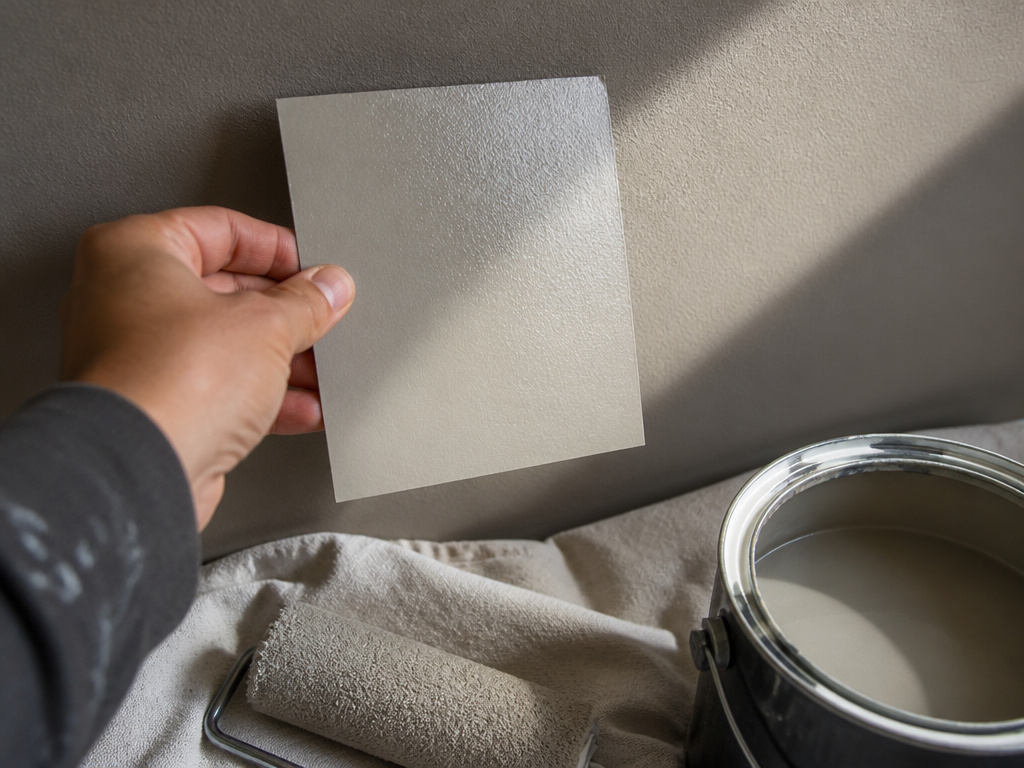
The chip looked soft and pretty under the store lights. On a wall with a window across from it, that same satin finish turned into a mirror for every roller mark.
That’s the lesson I keep relearning about estimates: the number on the can tells you how far the paint spreads, not how the finish will behave once it’s up. I tape a sample board to the wall now and walk past it for a couple of days before committing. Sheen shows up at angles, never head-on, and a small chip can’t show you that.
I won’t pick a finish off a paper chip again. Tape a real sample board to the wall, look at it in the morning and again at night, then decide. A chip shows color. Sheen needs a bigger surface.
On quantity, the sources line up more than they do on coverage. This Old House calls two coats on walls and one on the ceiling the rule of thumb. Angi plans for two coats to get even color and no streaks.
The exceptions are where the estimate breaks:
- Dramatic color changes. PaintCare says moving from very dark to very light, or the reverse, can take three or even four coats. That’s more coats than a standard two-coat estimate.
- Vibrant and dark colors. PaintCare singles out red, orange, and purple as needing extra coats for an even finish.
- Same color over same color. This Old House notes that repainting white over clean white might need just one coat.
- Higher sheens. PaintCare’s claim that semi-gloss and gloss need more coats than flat stands alone in this source set, so weigh it accordingly.
If you’re still working out whether your room needs the second pass, how many coats of paint for interior walls walks through the conditions that decide it.
Textured Walls, Deep Colors, and Other Paint Hogs
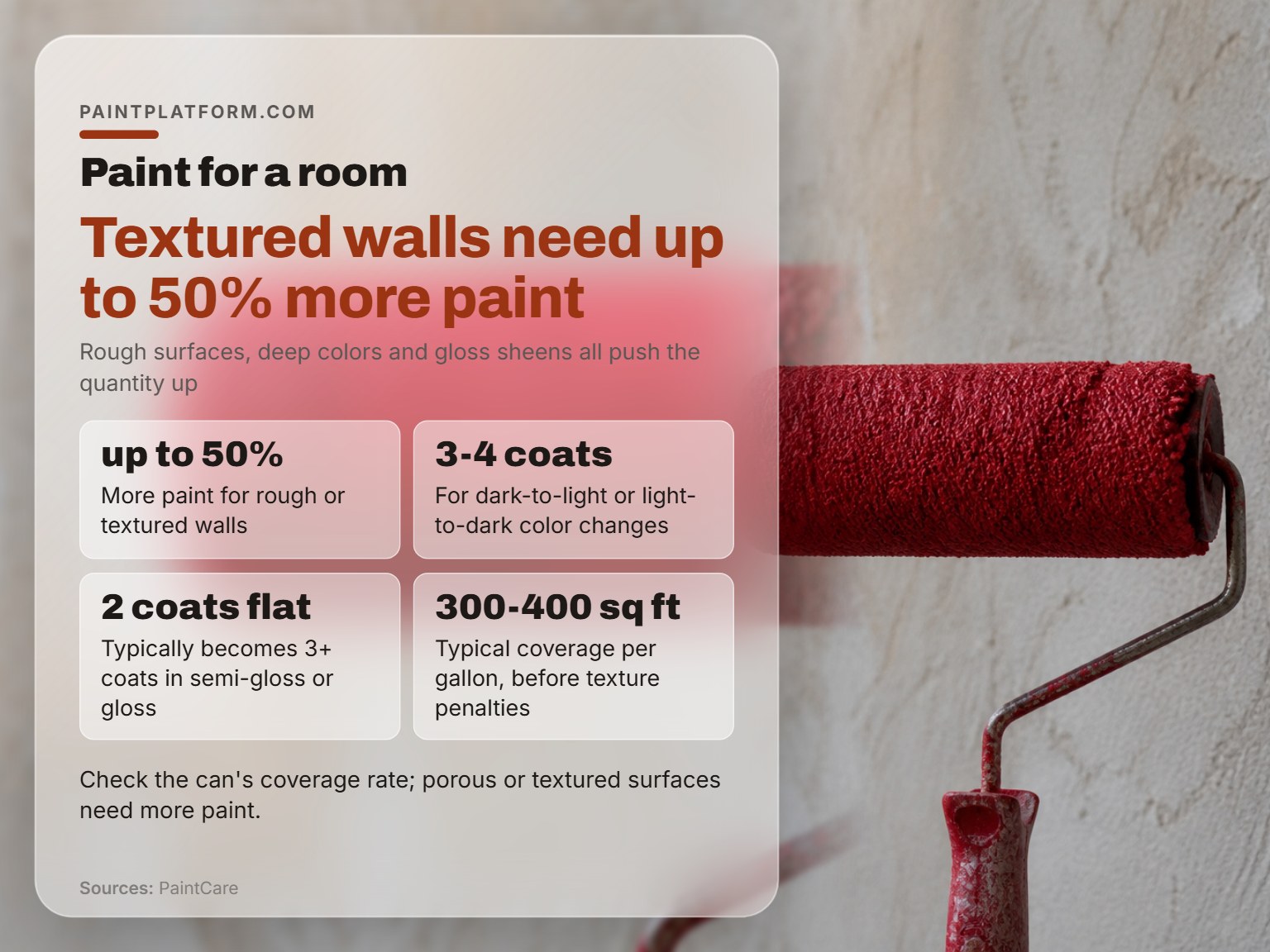
Texture is the quiet budget killer.
PaintCare puts the penalty at up to 50 percent more paint for rough surfaces, and the number scales with how rough you’re talking about. BEHR’s guidance runs the other direction: smooth, primed, or sealed walls need less, and a subtle color change needs less again.
| Surface or change | Effect on quantity | What to do |
|---|---|---|
| Rough or textured wall | Up to 50 percent more | Budget the extra before you shop |
| Unprimed drywall or bare wood | More coats | Prime first, tinted if the color is deep |
| Dark to light, or light to dark | Three to four coats | Buy for the worst case |
| Red, orange, or purple | Extra coats for even finish | Gray primer underneath |
| Smooth, primed, subtle change | Less paint | Trust the low end of the range |
| Semi-gloss or gloss | More coats than flat | Add a coat to your estimate |
Re-Paints offers one specific pairing that saves a coat: use a gray primer whenever the topcoat is going to be red. PaintCare makes the general version of the same point, noting that tinted primer reduces the number of top coats, though there are limits to how much pigment a primer will take.
Where this goes sideways: Buying for the smooth-wall number and then rolling onto knockdown texture. You’ll run out before you finish, and a second batch mixed at the store may not match the first under daylight.
The City of Seattle’s green remodeling guide makes the same point in a single line: coverage is listed on the can, and porous or textured surfaces need more. That’s the whole rule, and it’s worth more than most calculators.
Ceilings, Trim, and Doors Need Their Own Math
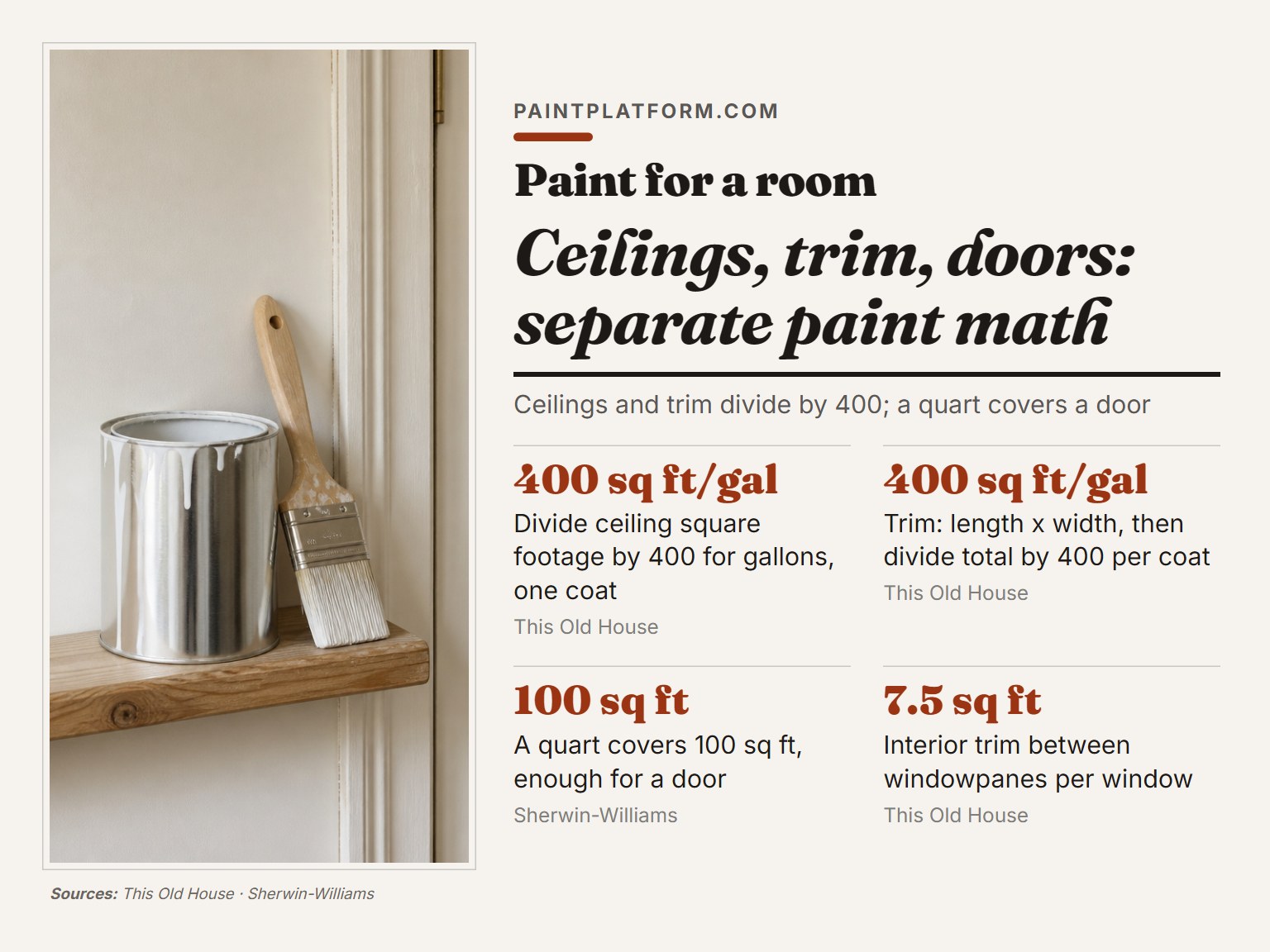
Three surfaces usually get left out of the wall estimate: the ceiling, the trim, and the doors.
Ceilings
This Old House divides ceiling square footage by 400 to get gallons, and one coat is standard. A 20-foot-by-10-foot ceiling is 200 square feet; divide by 400 to get gallons. Want a second coat? Double it. More detail lives in how much paint for a ceiling if you’re doing the whole house.
Trim
Trim is where estimates quietly fall apart. Add up the length of every piece, multiply by its width, and divide the total by 400 for gallons per coat. A 60-foot run of trim at 6 inches wide works out to 30 square feet. Interior trim between windowpanes adds roughly 7.5 square feet per window.
Easy to miss: The trim and ceiling are usually a different product from the wall paint. Counting them in the wall total inflates the estimate and leaves you with the wrong finish in the wrong can.
Doors
Doors are simpler than people expect. Sherwin-Williams puts a quart at 100 square feet, which is enough for a door with paint to spare. That’s also why a quart is the right size for a single trim and doors touch-up rather than a full gallon.
The trim total for a standard room usually lands under a gallon, so buy it in quarts. A quart covers about 100 square feet, so buy trim paint in quarts.
Buying Less and Buying Right
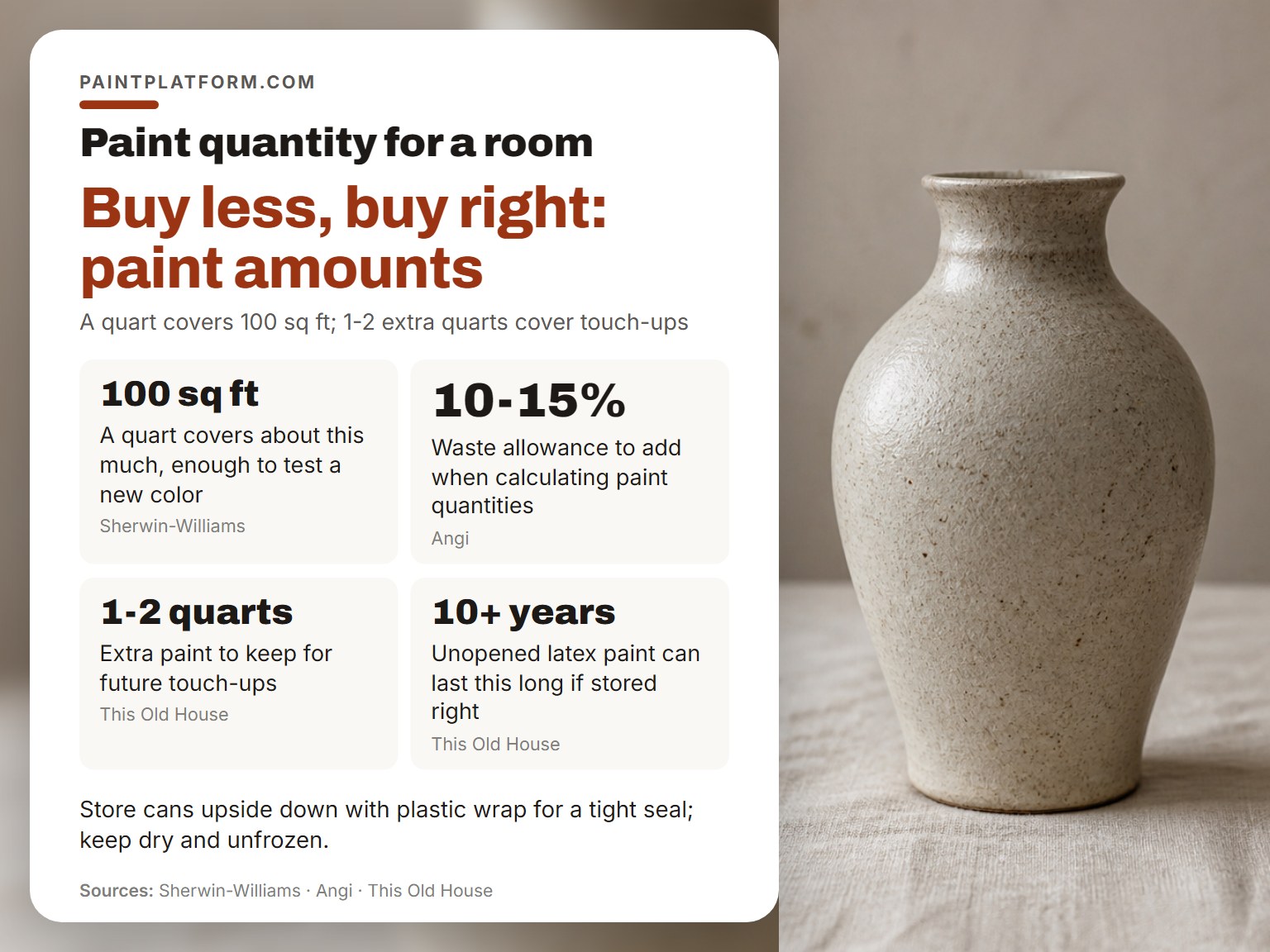
The cheapest mistake is the one you can return unopened.
Overbuying comes from fear, and fear is expensive in a way that’s easy to avoid. Angi’s 10 to 15 percent waste allowance is a reasonable buffer. A whole extra gallon on top of that is more than you need.
A few habits keep the number honest:
- Buy a quart first when the color is new to you. A quart covers about 100 square feet, enough to see how it reads in your light before you commit to gallons.
- Keep 1 to 2 extra quarts for touch-ups. This Old House recommends it, and matching a custom color later is harder than storing it now.
- Check the can’s rate before you trust any calculator. Farrow & Ball’s own tool ignores windows and doors, and the Harris County worksheet contradicts itself.
- Skip the five-gallon pail unless the math says otherwise. BEHR sells quarts and five-gallon pails alongside the standard gallon.
A quart is the cheapest experiment in painting. It covers about 100 square feet, which is enough to learn whether a color works before you commit to gallons.
Leftover latex paint in a tightly closed can lasts anywhere from a few months to 10 years, per This Old House, and unopened cans run 10 years or more. You’ll know it’s gone bad if the lid or can is bulging, there’s a film on top, or the paint won’t stay mixed after stirring.
Harris County’s brochure adds a storage trick worth stealing: cover the opening with plastic wrap, fit the lid securely, and store the can upside down so the paint forms its own seal. Keep it dry and somewhere that won’t freeze.
Disposal has rules too. With an inch or less left, open the can and let it evaporate. With more, mix in kitty litter and stir until absorbed. Oil-based paint goes to a household hazardous waste collection event, not the trash.
If you’re still narrowing down the product itself, how to choose interior paint for a room covers the sheen and finish decisions that drive your coverage number in the first place.
Frequently Asked Questions
How much paint do I need for a 10×10 room?
PaintCare runs a 10-foot-by-10-foot room with 10-foot ceilings at about 400 square feet of wall, and notes that after subtracting windows and doors you’d probably need one gallon. With two coats, plan on two gallons. Sherwin-Williams also describes a gallon as enough for a 10-by-10 room, though they put that room at 100 square feet.
Does primer count toward my paint total?
No. Primer covers less per gallon than paint, at 200 to 300 square feet according to Sherwin-Williams, This Old House, and Angi. Calculate primer and paint separately, and expect to buy more primer than paint for the same wall.
Should I buy extra paint for touch-ups?
This Old House recommends 1 to 2 extra quarts. Custom colors are hard to rematch later, so the quart you keep works out cheaper than the gallon you have to re-tint.
How long does leftover paint last?
This Old House puts tightly closed latex at anywhere from a few months to 10 years, with unopened cans running 10 years or more. Bulging lids, surface film, or paint that won’t stay mixed are the signs it’s done.
Do I need to subtract windows and doors?
This Old House and PaintCare both say yes, at 10 square feet per window and 20 per door. BEHR treats the deduction as optional and notes that skipping it builds a little extra into your estimate. Either approach works, as long as you know which one you’re using.
The Bottom Line
Here’s the trigger that decides it: if your wall area divided by the can’s coverage rate lands within a quart of a whole gallon, buy the next size up. If your wall area divided by the can’s coverage rate lands within a quart of a whole gallon, buy the next size up.
“How much paint do I need for a room” has a boring answer and a useful one. The boring answer is the formula. The useful answer is that the can in your hand outranks every average published on the internet.
Start with the label on the paint you’re actually buying. If it’s gone, use 350 square feet per gallon, add your second coat, and round up. That’s the whole method, and it beats any calculator that ignores what your wall is made of.
One thing worth doing this week: buy a single quart of the color you’re considering and paint a sample board. Tape it to the wall. Look at it tomorrow morning and again at night. You’ll learn more about how the room will read than any estimate can tell you.
