
How Much Paint for a Ceiling: Coverage Math Made Simple
This post contains affiliate links. As an Amazon Associate, we earn from qualifying purchases.
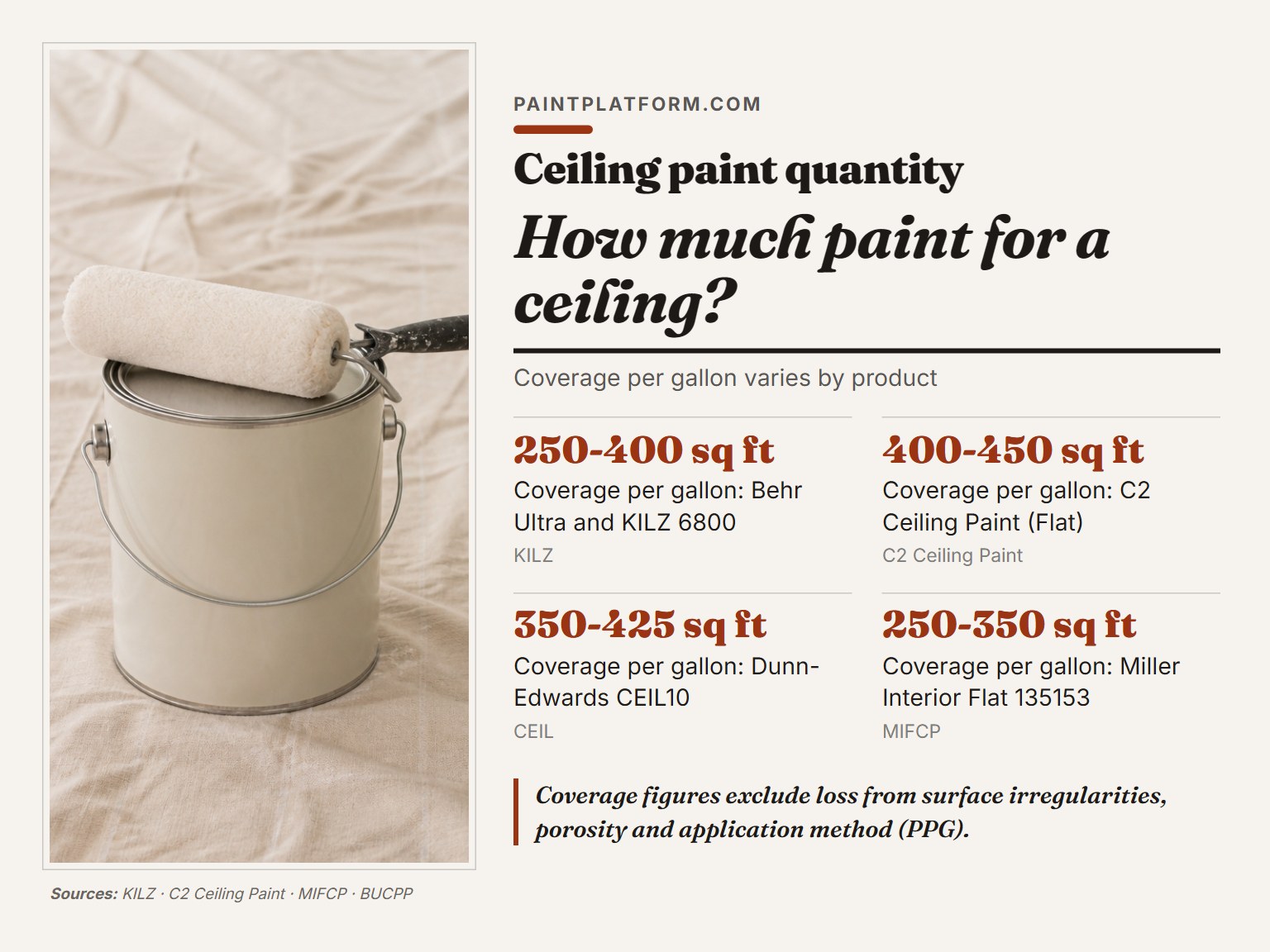
Manufacturer coverage figures run from 250 square feet per gallon (Miller Interior Flat 135153) to 450 (C2 Ceiling Paint), so buy toward the low end and let the leftover sit in the can.
The gap between the stingiest can and the most generous one is the whole story. Coverage depends on how much wet paint you leave behind, and each maker builds its number on a different dry film thickness. PPG Bright Ceiling Paint 17-45 reaches its 400 square feet at 1.2 mils dry. Dunn-Edwards CEIL10 reaches approximately 350 to 425 at 1.5 mils.
What follows: how to measure the ceiling you actually have, why the label range is wider than you’d expect, and the buying habit that keeps you from ending up with three spare gallons in the garage.
Key Takeaways
- The label range across brands runs 250 to 450 square feet per gallon, so buy toward the low end for a smooth, primed ceiling.
- Dry film thickness drives coverage, not the marketing name. PPG specifies 1.2 mils and KILZ Stainblocking 6800 varies from 1.5 to 2.4 mils depending on the rate.
- Recoat windows split three ways: Behr and KILZ say 2 hours, C2 and Miller say 4, and Dunn-Edwards and PPG say 2 to 4.
- Spraying loses paint that never appears in the label figure. KILZ and PPG both exclude application loss from their coverage numbers.
- Popcorn ceilings eat coverage and need a 1/2 to 3/4 inch nap roller, per Behr’s own instructions.
Why One Can Promises 250 Square Feet and Another Promises 450
Six ceiling paints, six coverage claims, and the widest gap between them is substantial. C2 Ceiling Paint (Flat) says 400 to 450 square feet per gallon. Miller Interior Flat 135153 says 250 to 350.
Ceiling paint coverage per gallon depends on the dry film thickness the maker specifies. PPG Bright Ceiling Paint 17-45 lists 1.2 mils dry and up to 400 square feet per gallon. Dunn-Edwards CEIL10 lists 1.5 mils dry and 350 to 425 square feet. KILZ Stainblocking Ceiling Paint 6800 varies its film from 1.5 to 2.4 mils with the coverage rate.
Solids and film are part of the picture. A thicker specified dry film means fewer square feet per gallon. C2 lists 40% volume solids. PPG lists 31% volume solids and up to 400 square feet per gallon.
| Ceiling paint | Coverage per gallon | Recoat time |
|---|---|---|
| C2 Ceiling Paint (Flat) | 400 to 450 sq ft | 4 hours |
| Dunn-Edwards CEIL10 | 350 to 425 sq ft | 2 to 4 hours |
| PPG Bright Ceiling Paint 17-45 | up to 400 sq ft | 2 to 4 hours |
| Behr Ultra Ceiling Paint & Primer | 250 to 400 sq ft | 2 hours |
| KILZ Stainblocking 6800 | 250 to 400 sq ft | 2 hours (4 for max stainblocking) |
| Miller Interior Flat 135153 | 250 to 350 sq ft | 4 hours |
Read that table as a range, not a promise. PPG states outright that its numbers exclude loss from surface irregularities, porosity, and application method.
If you want the arithmetic behind those claims run side by side, this walkthrough of how to calculate paint coverage does exactly that.
Buy toward the bottom of the range when you work out how much paint for a ceiling. A spare quart on a shelf beats a second trip up a ladder.
How Do You Measure a Ceiling That Isn’t a Perfect Rectangle?
Start at the floor, not the ceiling. Rooms are far more rectangular down there than they are overhead, and you can measure a floor without a ladder.
- Measure wall to wall in both directions at floor level. Eyeballing from the doorway is how a 12 by 14 foot room gets misjudged and you come up a gallon short.
- Multiply length by width. Twelve feet by fourteen feet gives you 168 square feet of ceiling, and that’s the number you divide by later.
- Add every alcove, closet, and soffit the ceiling runs over. Skip a reach-in closet and you’ve under-counted enough that the roller runs dry before the far corner.
- Divide by the coverage figure you’re actually budgeting for, not the best one on the shelf. Using 450 when your can is a 250-to-350 product is a common way people buy short.
- Round up to a whole gallon, then ask whether a quart covers the gap. A quart is a quarter of a gallon, and it can be the difference between finishing tonight and driving out again.
Measuring an L-Shaped or Sloped Ceiling
An L-shaped room is two rectangles. Measure each leg to the corner where they meet, work out both, and add them.
Sloped ceilings need the length of the slope itself, measured along the angle rather than the floor projection underneath. Measure the floor under a vaulted ceiling and you’ll under-buy every time.
A paint calculator will handle the multiplication, but it can’t see your ceiling’s texture.
Write the how much paint for a ceiling total on the paint lid in pencil. Future you will not remember.
What the Coverage Number Assumes, and What Breaks It
The label figure is the best case, printed without apology. Four things quietly eat into it.
| Label claim | What it assumes | What breaks it |
|---|---|---|
| Up to 400 sq ft/gal (PPG 17-45) | Smooth, nonporous surface | Porosity, texture, spray loss |
| 250 to 400 sq ft/gal (Behr Ultra) | A 3/8 to 1/2 inch nap roller | Popcorn ceilings needing 1/2 to 3/4 inch nap |
| 250 to 400 sq ft/gal (KILZ 6800) | Brush or roller application | Airless spraying, which the figure excludes |
| 350 to 425 sq ft/gal (Dunn-Edwards CEIL10) | 1.5 mils dry film per coat | A thinner coat than the spec calls for |
- Texture. A popcorn ceiling needs a thicker roller nap than a smooth ceiling. Behr calls for a 1/2 to 3/4 inch nap acoustic cover on those ceilings instead of the standard 3/8 to 1/2 inch.
- Porosity. Bare drywall and fresh patching drink the first coat. PPG names porosity as one of the reasons its number is a ceiling rather than a promise.
- Application loss. An airless sprayer throws a fine mist past the edges of the ceiling, and that mist lands on drop cloths instead of drywall. KILZ and PPG both exclude it from their figures.
- Film thickness. A thin, hurried coat covers more square feet and hides less. That’s the trade the high-coverage numbers are quietly making.
A coat rolled too thin covers more square feet and hides less.
Where this goes sideways: Chasing the highest number on the shelf. C2 lists 400 to 450 square feet per gallon and 40% volume solids. Stretch it thin to make it reach and you’ll be buying that second gallon anyway.
If you’re still choosing between products, this breakdown of ceiling paint types covers what the flat, dead-flat, and stain-blocking formulas are each built to do.
How Many Coats of Paint for a Ceiling Do You Actually Need?
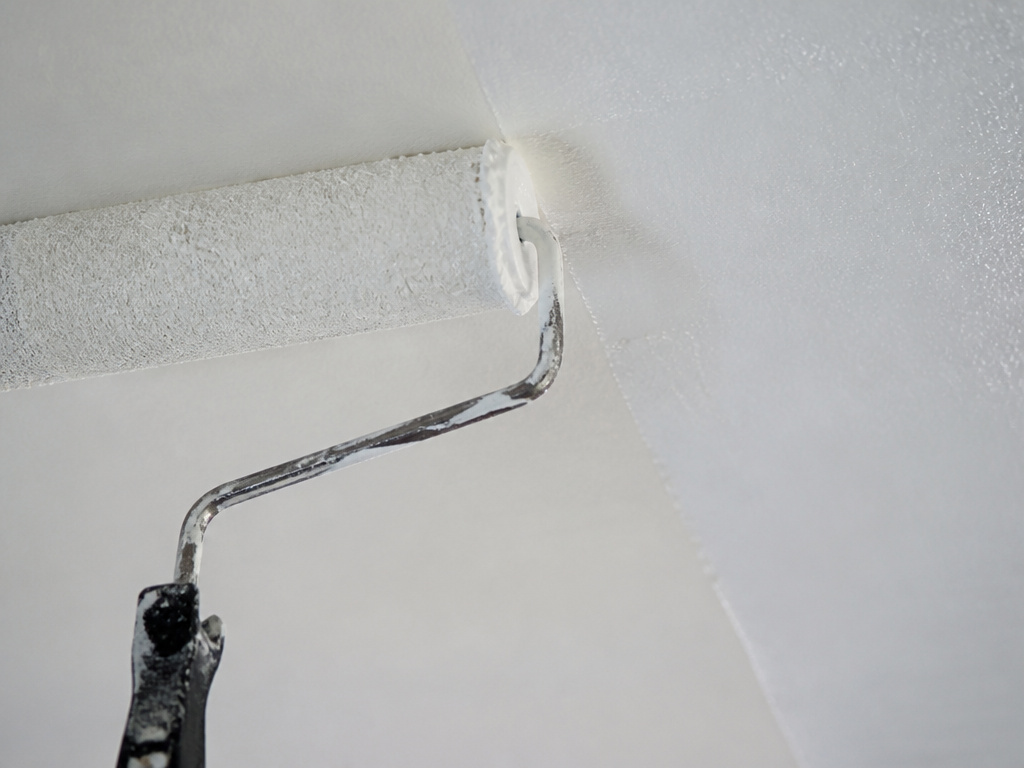
One coat is a real claim on some cans and a stretch on others. The manufacturers don’t agree, and they’re each describing a different ceiling.
Valspar Signature Ceiling Paint + Primer says it cleanly covers ceilings in a single coat. Behr Ultra says multiple coats may be required to complete hide. C2 says finish with one or two coats after priming. PPG says some colors, drastic color changes, or porous substrates may need more than one.
Read those as four different rooms, each describing a different ceiling.
When One Coat Really Is Enough
Same color, already painted, no patches, no water stains.
Add any of the following and consider a second coat: bare drywall, fresh joint compound, a color change, or a stain that bled through once already. The full reasoning on how many coats of paint for a ceiling is worth ten minutes before you commit to a number.
I’d rather roll two thin coats than one heavy one. A heavy coat can sag at the roller edge and show lap marks once the light hits it sideways.
Recoat timing is where people get impatient. Behr and KILZ both list 2 hours at 77°F and 50% relative humidity. Dunn-Edwards and PPG list 2 to 4. C2 and Miller list 4.
Follow the can in your hand, and add time in a cool room.
Full cure runs longer than most people expect. C2 lists 14 days. PPG lists 30, and adds that you should wait the full 30 before cleaning the ceiling with a non-abrasive mild cleanser.
Roller, Sprayer, or Brush: Which One Costs You the Most Paint
Everyone reaches for the thickest roller cover in the shop. On a smooth ceiling, that’s the wrong move.
Before you start: An extension pole plus a ceiling means overhead reach on a ladder, so move the ladder instead of leaning.
Roller Nap and Spray Tip Settings That Match the Surface
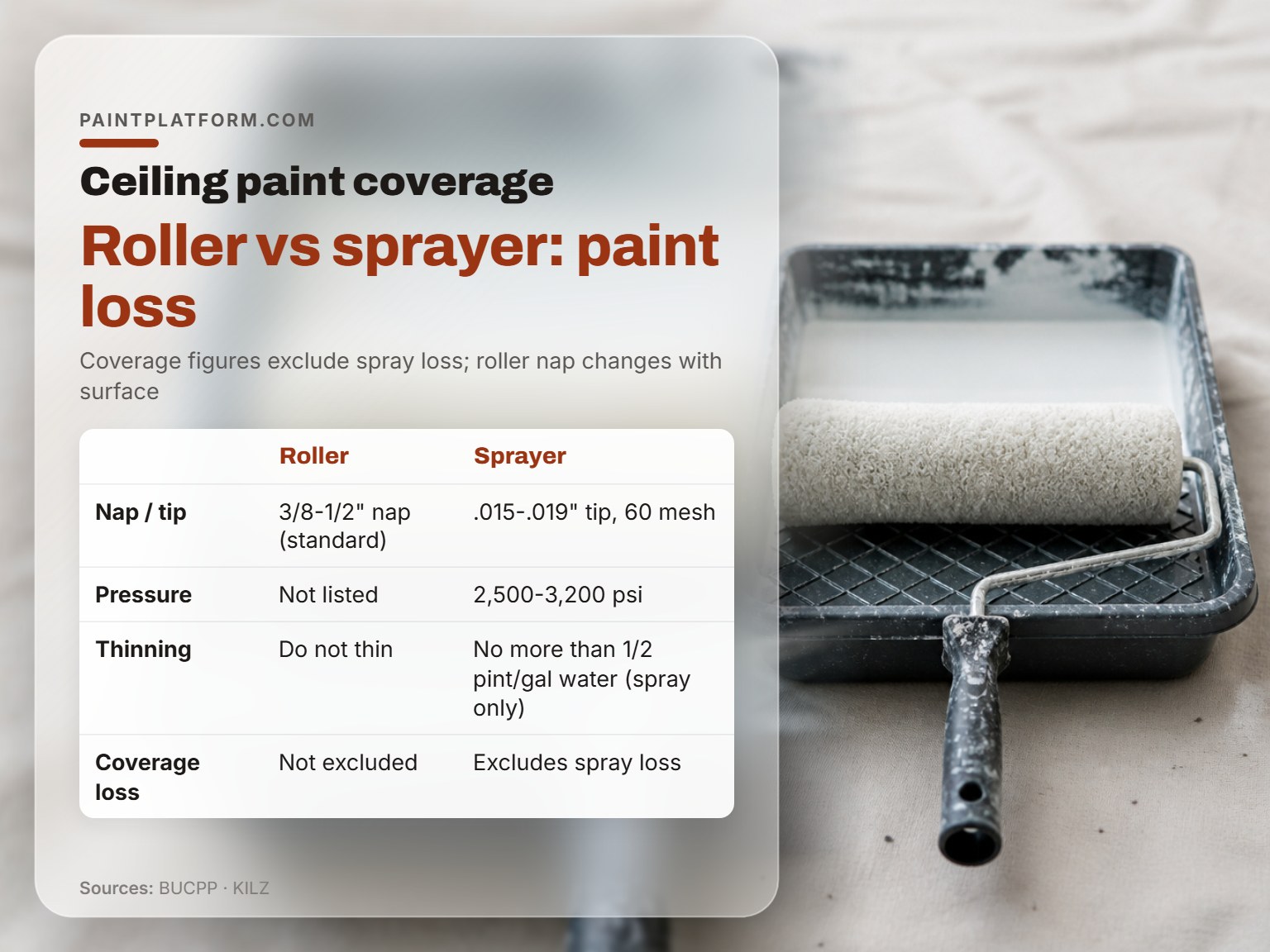
Nap recommendations genuinely conflict, and the surface is the tiebreaker. Behr says 3/8 to 1/2 inch for standard ceilings. Dunn-Edwards splits it finer: 1/4 to 3/8 inch on smooth surfaces, 3/8 to 1/2 inch on semi-smooth. Miller says 3/8 to 3/4 inch. KILZ says 1/2 to 3/4 inch.
For spraying, Behr and KILZ both list a .015 to .019 inch tip with a 60 mesh filter. KILZ adds 2,500 to 3,200 psi. Dunn-Edwards runs lighter at 1,800 to 2,500 psi with a .013 to .017 inch tip. Miller specifies .017 to .021 inch.
A roller with the right load applies an even coat; a dry one leaves a stipple pattern.
Thinning is the other disagreement. Behr says don’t thin for roller or brush, but allows up to 1/2 pint of water per gallon if you’re spraying. Dunn-Edwards caps it at 1/4 pint per gallon. C2 says do not thin at all. Follow whichever can you bought, because those limits are not interchangeable.
For one residential ceiling, roll it. The ceiling roller setup is simpler than a sprayer, which needs a mask, a drop cloth wall, and cleanup.
How Much Paint for a Ceiling Should You Buy?
Three rules cover almost every ceiling purchase: measure, divide, round up one quart.
- Budget the low end of the range. If the can says 250 to 400, plan on the lower end. You’ll finish with paint left over instead of a wet roller and an empty can.
- Buy a quart first when the ceiling is unusual. A quart shows you how the paint behaves on your texture before you commit to gallons.
- Skip the calculator that only multiplies length by width. It can’t see texture, and texture is the variable that moves coverage most.
- Match the product to the problem. A stained ceiling wants KILZ Stainblocking 6800, and note that KILZ says tinting is not recommended for stainblocking applications.
If you want one answer for a normal white ceiling in a normal room: Behr Ultra Ceiling Paint & Primer, one gallon per 350 to 400 square feet, on a 3/8 to 1/2 inch nap roller. That covers the large majority of bedrooms and hallways.
The same logic scales sideways. If you’re pricing a whole room rather than just the lid, this guide to how much paint for a room adds the walls without double-counting the ceiling.
Fair warning: coverage math gets you close, and the can gets you the rest of the way. If you’re weighing brands on hiding power rather than square footage, the best ceiling paint comparison is the better starting point.
Frequently Asked Questions
Does a gallon of ceiling paint really cover 400 square feet?
Sometimes, on a smooth, nonporous, properly primed surface. PPG lists up to 400 square feet and C2 lists 400 to 450. Miller lists 250 to 350 for the same category of product. The surface decides which end of that spread you land on.
How much paint do I need for a standard bedroom ceiling?
12 by 14 foot ceiling is 168 square feet, which one gallon covers at every listed rate. Buy one gallon and keep the receipt. If the ceiling is popcorn or bare drywall, add a quart.
Can I use wall paint on a ceiling instead of ceiling paint?
You can, and plenty of people do. What you give up is the dead-flat finish. PPG lists its ceiling paint at a flat 0 to 3 on an 85 degree meter, and KILZ lists under 5.0. A wall paint with any sheen will show every imperfection overhead.
How long should I wait before the second coat?
Check the can. Behr and KILZ say 2 hours, C2 and Miller say 4, and Dunn-Edwards and PPG say 2 to 4 at 77°F. Cooler rooms and higher humidity stretch all of those.
Why did my ceiling take more paint than the label said?
Texture, porosity, or application method. Behr ties its coverage to surface texture and porosity. PPG excludes loss from irregularities and application method. KILZ excludes spray loss. Any of those pushes you toward the bottom of the range.
The Bottom Line
One number decides this job: your ceiling’s square footage divided by 300. That figure sits inside every manufacturer range listed here, from Miller’s 250 to 350 up to C2’s 400 to 450, so it works whichever can you carry home.
If your ceiling is textured, or you plan to spray it, drop to 250 and add a quart. That’s the honest floor, and it’s the number the labels are quietly working around.
Here’s my concession: none of this matters much on a hall ceiling under 100 square feet. Buy the gallon, paint it, move on.
On anything larger, buy one gallon and a spare quart rather than two gallons and a shelf of leftovers. The quart costs less than the gallon, and the leftover gallon will sit in your garage until it skins over.
