
How Many Gallons of Paint Per Square Foot? Do the Math
This post contains affiliate links. As an Amazon Associate, we earn from qualifying purchases.
Roughly 0.0025 to 0.0033 gallons of paint per square foot. That’s how many gallons of paint per square foot the common label rates produce, since most wall paint covers 300 to 400 square feet per gallon, which works out to 1 divided by that rate. Flip the label number for your own multiplier: divide 1 by the square-foot rate printed on the can.
That reciprocal is the whole trick behind the how many gallons of paint per square foot question, and it’s also where estimates fall apart. A rate printed on a can describes a smooth, primed, previously painted wall. Change any of those three conditions and the same square footage drinks more paint than the math promised.
What follows is the arithmetic, the rates the major brands actually publish, and the surface conditions that push a job from one gallon to two.
Key Takeaways
- Divide 1 by the square-foot rate on the can to get gallons per square foot. The exact figure is 1 divided by whatever square-foot rate is printed on your can.
- Primer covers less than paint. Sherwin-Williams lists primer at 200 to 300 square feet per gallon against 350 to 400 for wall paint.
- Textured walls cut coverage, down to 200 square feet per gallon in Houzz Pro’s calculator.
- A dramatic color change adds coats, not area. PaintCare puts it at three or four coats, and red, orange, or purple can take more.
- Buy 1 to 2 extra quarts, not an extra gallon, and buy them in the same batch so the shade matches.
Why the Label Number Is a Rate, Not a Promise
The number on the can is a rate, and it describes a surface you probably don’t have.
Theoretical coverage is computed. One US gallon occupies 231 cubic inches. Applied at one mil dry film thickness with 100 percent solids, that gallon covers 1,604 square feet. A 45 percent solids coating covers 722 square feet at one mil, or 361 square feet at two mils. Wet film is the dry target divided by the solids fraction.
That 1,604 constant comes straight from Dampney’s technical page, and it explains why coverage isn’t a fixed number at all. It’s a function of two variables: how much solid material is in the can, and how thick you spread it.
Work the math on a real product and the lightbulb clicks. Dunn-Edwards SPARTASHIELD 10 carries 41 percent volume solids. Sherwin-Williams A-100 Flat carries 34 percent. At one mil, that’s 657.64 square feet per gallon versus 545.36, roughly 17 percent more coverage from the same volume of liquid.
If you’re covering a dark wall with a light color and want fewer coats, Dunn-Edwards SPARTASHIELD 10 is the one to price against Sherwin-Williams A-100 Flat. Higher solids means more pigment film per pass, and more film per pass means fewer passes.
This is the part that separates a real estimate from a guess. Your can’s label rate already folds the solids content in. The paint coverage number is the manufacturer’s own answer to the solids question, which is why it beats any generic rule of thumb.
Two thin coats beat one heavy coat every time, and that’s not a slogan. A heavy coat skins over on the surface while the layer beneath stays soft, and the film fails from the bottom up.
How Many Gallons of Paint per Square Foot Do the Brands Assume?
Six published sources, six different numbers, and every one of them is defensible.
| Source | Coverage per gallon | What it assumes |
|---|---|---|
| Sherwin-Williams | 350 to 400 sq ft | Smooth interior wall, one coat |
| BEHR (exterior) | 250 to 400 sq ft | Wide spread for texture and porosity |
| PaintCare | 300 to 400 sq ft | Label rate; 350 default if unknown |
| Houzz Pro | 350 sq ft standard | Drops to 200 sq ft on textured walls |
| Harris County Engineering | 400 sq ft | Flat worksheet default |
| Dampney (industrial) | 1,604 sq ft at 1 mil | 100 percent solids, zero application loss |
Notice the spread. BEHR’s low end sits 150 square feet below its high end on the same gallon. That’s not sloppiness on BEHR’s part. Exterior siding genuinely varies that much, and BEHR says so directly: porous, rough, textured, or previously unpainted surfaces need more paint, and so does a dramatic color change.
So which number do you use? Start with the can. PaintCare says most label rates land between 300 and 400 square feet per gallon and suggests 350 as a default if you can’t find one, while This Old House and Harris County Engineering divide by about 400 square feet per gallon instead.
The paint calculator on a retailer site will do the division for you, but check what it’s dividing by. Most ask four questions and hand you a number without ever asking about texture. Houzz Pro is the exception I’ve found that actually offers a 200 square feet per gallon textured rate as a menu option.
Easy to miss: A calculator that defaults to 400 square feet per gallon is quietly assuming a smooth, sealed, light-colored wall. On a rough exterior that’s a significant undercount, and you’ll discover it with a brush in your hand.
For a fuller walkthrough of buying quantities without over-ordering, PaintCare publishes a solid how much paint to buy guide that covers color change, sheen, and primer in one place.
What Moves the Coverage Rate Most: Texture, Color, and Sheen
Texture does more to your gallon count than any brand choice you’ll make in the aisle.
Texture Is the Biggest Single Swing
Houzz Pro cuts coverage to 200 square feet per gallon on textured walls. PaintCare frames the same effect differently, saying rough textures may need up to 50 percent more paint. Both point at the same physical fact: texture multiplies surface area without changing the footprint.
Stucco and heavy orange-peel drywall feel like coarse sandpaper under a flat palm, and they hold paint exactly the way sandpaper would. Every pit and ridge is extra wall you didn’t measure.
Color Change Adds Coats, Not Area
Coverage per gallon doesn’t change when you switch from cream to charcoal. The number of passes does.
- Same color over same color: one coat may be enough, per This Old House.
- Light to light, or a subtle shift: two coats, the standard wall schedule.
- Very dark to very light, or the reverse: three or four coats, per PaintCare.
- Red, orange, or purple: PaintCare warns these can take even more to look even.
The coats of paint you plan is a multiplier sitting on top of your area figure, and skipping it is the single most common estimating error I see.
Sheen Quietly Changes the Count
PaintCare states the rule cleanly: as sheen decreases, coverage increases. A job that takes two coats of flat typically takes three or more in semi-gloss or gloss.
Glossier paint reflects more, so every thin patch and lap mark shows. You end up recoating to hide what flat would have swallowed.
If you’re fighting an old color and want the fewest passes, that’s the case for a best paint to cover with high hiding power rather than a third coat of something thin.
Where this goes sideways: Buying gallons based on a smooth-wall rate and then discovering the wall is textured. You’ll run out partway through the second coat, and a fresh batch mixed later may not match the first exactly.
How Do You Turn Square Footage Into Gallons?
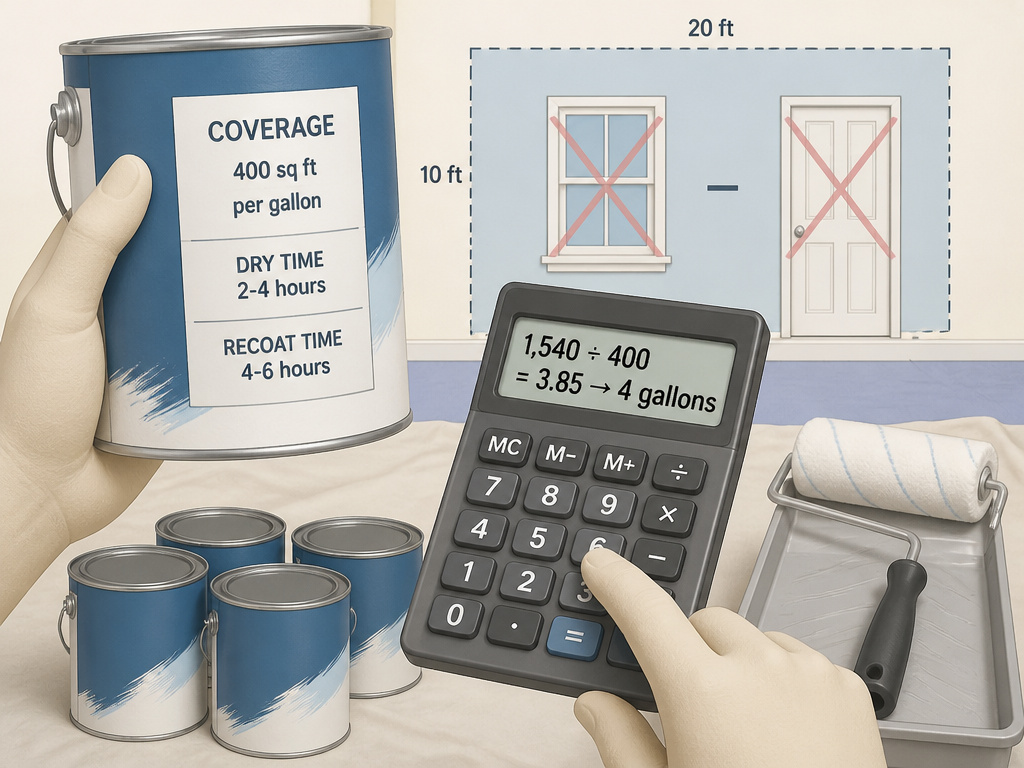
You have 1,200 square feet of wall. Now what?
Before you start: Solvent-based paint gives off vapors that pool low, so ventilate wherever you’re storing it. Keep cans between 4 and 35 degrees C (40 and 95 degrees F), the storage range in the UFGS paint specification. And never pour leftovers down a storm drain; Harris County notes those run untreated into Galveston Bay.
- Measure each wall separately. Width times height, then add them up. Estimate from floor area instead and a room with 10-foot ceilings comes up short.
- Subtract the openings. This Old House deducts 10 square feet per window and 20 per door, while BEHR says measure the actual opening, noting an average window runs 15 square feet. Either works; pick one and stay consistent across the whole job.
- Multiply by your coat count. Two on walls is the standard schedule. One on the ceiling.
- Divide by the coverage rate. Use the can’s number. If there isn’t one, PaintCare recommends 350 square feet per gallon as a default, while This Old House and Harris County Engineering use about 400 square feet per gallon.
- Round up to a whole gallon, then add a quart. Rounding down is how you end up with three walls finished and a fourth one short.
Run a worked example and it stops feeling abstract. Harris County’s own planner takes 1,540 square feet of paintable surface, divides by 400, gets 3.85, and rounds to 4 gallons.
Here’s the honest part. If you’re unsure between two gallon counts, buy the smaller one plus a quart. A second trip is annoying. Storing a half gallon you’ll never open is worse, and paint doesn’t keep forever. For a room-by-room breakdown that accounts for trim and doors, this guide on how much paint for a room walks the same arithmetic with more detail.
Primer, Ceiling, and Trim Run on Different Rates
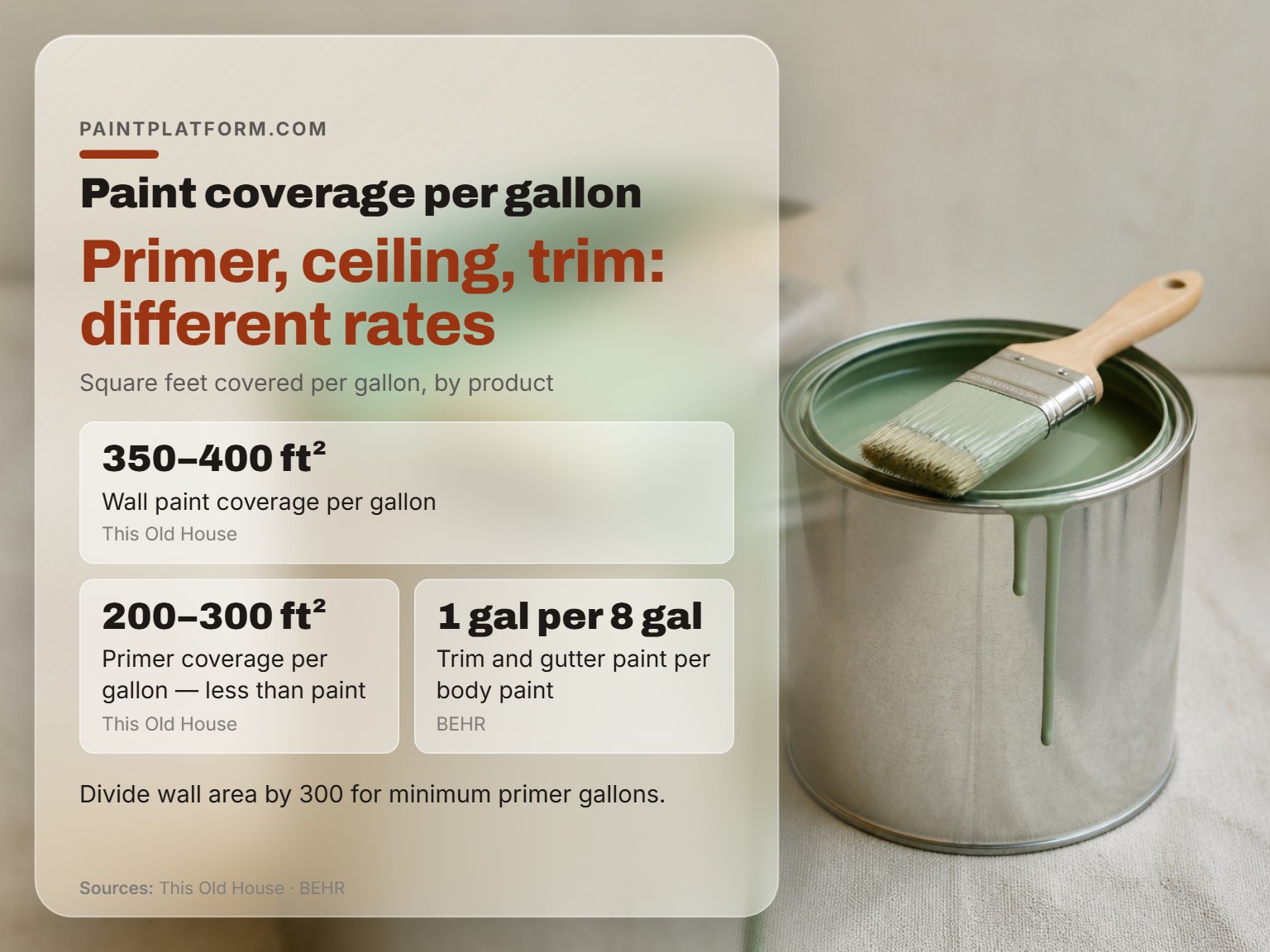
Primer, ceiling paint, and trim paint each carry their own spread rate, and mixing them up is how a one-gallon job turns into three.
| Product | Planning rate | Source |
|---|---|---|
| Wall paint | 350 to 400 sq ft/gal | Sherwin-Williams |
| Primer | 200 to 300 sq ft/gal | Sherwin-Williams; This Old House |
| Ceiling paint | 400 sq ft/gal | Houzz Pro |
| Textured wall | 200 sq ft/gal | Houzz Pro |
| Trim and gutters | 1 gal per 8 gal body paint | BEHR |
| Spray can, 16 oz | about 30 sq ft | Sherwin-Williams |
The primer line is the one people get wrong. Primer covers less than paint, so a wall that needs two gallons of topcoat needs more primer. This Old House recommends dividing wall area by 300 to get your minimum primer gallons.
For trim, BEHR’s rule of thumb is one gallon of trim and gutter paint per eight gallons of body paint. That’s a ratio worth writing on the back of your hand, because trim paint is usually a different product in a different sheen.
Ceiling paint is the opposite case. At 400 square feet per gallon it goes further than wall paint, and a standard ceiling usually eats less than a gallon per coat. If you’re sizing one, this ceiling paint breakdown covers the flat-versus-eggshell question too.
If your wall area divided by 300 comes out to a fraction of a gallon of primer, round up to the next whole gallon. You can’t buy four-tenths of a gallon, and a partial can of primer is the least useful object in your garage.
Exterior work runs on its own logic because siding has lap lines, shadow gaps, and often a rough factory texture. BEHR’s 250 to 400 square feet per gallon range exists for exactly that reason, and a paint for exterior siding estimate should start at the low end.
Where the Math Goes Wrong: Overbuying, Waste, and Storage
You get to the counter with four gallons for a room that needed two, and the reason is almost always the same.
Fear. Buying extra feels like insurance, and the sources can’t agree on whether to build a buffer in. Houzz Pro’s calculator adds a 10 percent waste allowance to its gallons estimate. Dampney mandates a flat 10 percent deduction for can losses, windage, and overspray, which is the same idea from the other direction. This Old House skips the waste factor entirely and just rounds up to the nearest whole gallon.
Three different methods, all reasonable. What none of them say is “buy double.”
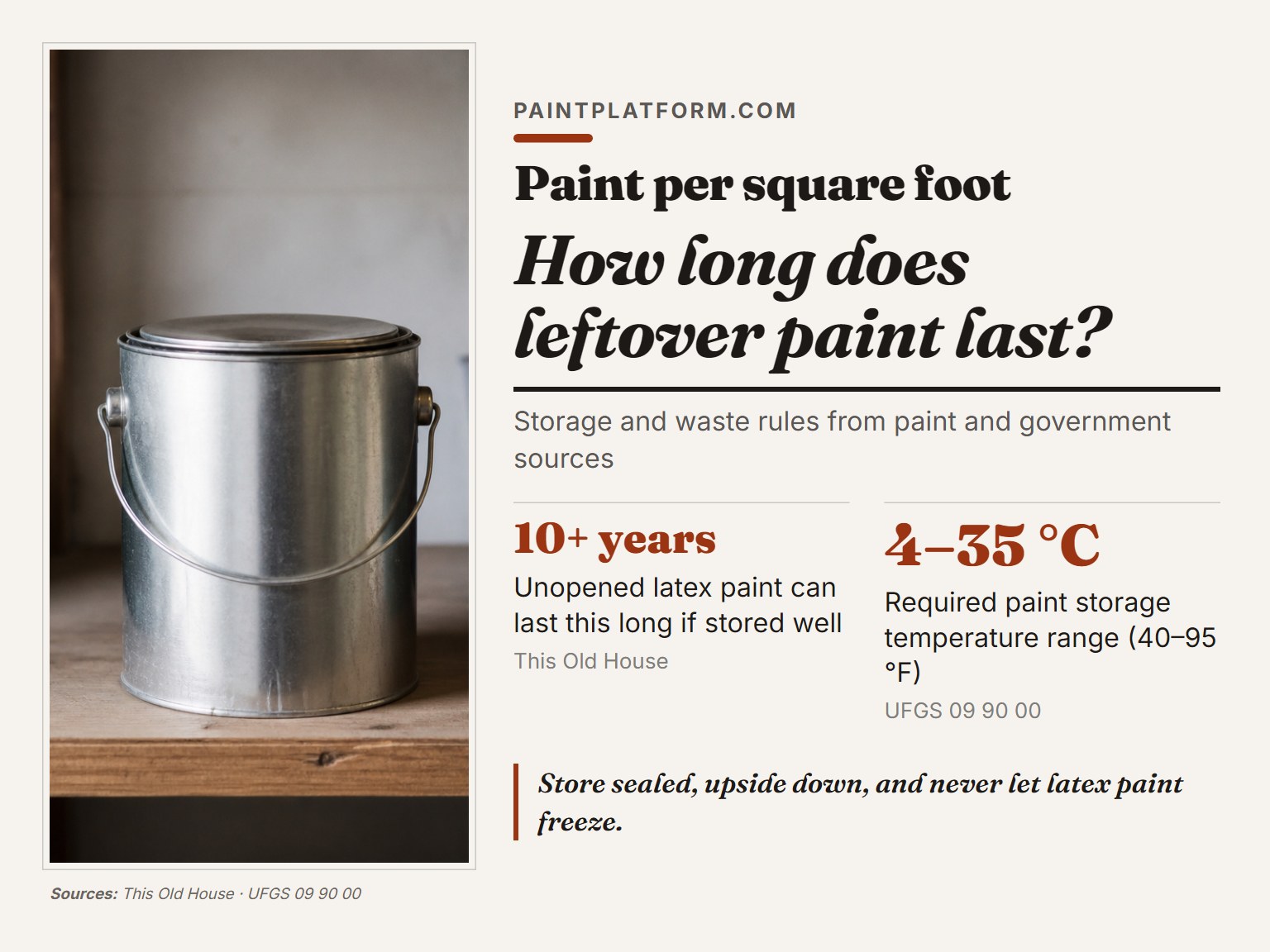
The part nobody mentions: Latex paint in a tightly closed can lasts anywhere from a few months to 10 years, and unopened cans can go 10 years or more. But that’s a best case. A can stored in a garage that freezes and thaws will fail long before the label date.
You know a can has turned when the lid bulges, when a rubbery film sits on the surface like cold gravy, or when it won’t stay mixed after you stir it. Test it on a scrap of cardboard before it touches a wall.
Storage practice matters more than most people think:
- Seal it properly. Harris County recommends plastic wrap over the opening, lid hammered down over a folded cloth, then store the can upside down so paint seals the rim.
- Keep it from freezing. Both Harris County and the City of Dallas flag freezing as the thing that kills latex paint.
- Mind the temperature band. The UFGS architectural paints specification puts storage at 4 to 35 degrees C (40 to 95 degrees F), which rules out most unheated sheds in February.
- Dry it before trashing it. Under an inch of paint left? Open it and let it evaporate. More than that, stir in kitty litter until absorbed, then break it up once dry.
Small jobs follow the same discipline. A fence paint estimate on rough cedar can run double a smooth-board figure, and the fence will tell you which one you’ve got the moment the first coat soaks in and disappears.
Frequently Asked Questions
How many square feet does one gallon of paint cover?
Most wall paint covers 300 to 400 square feet per gallon, and Sherwin-Williams puts the typical figure at 350 to 400. Primer covers less, at 200 to 300 square feet per gallon. Textured walls can drop to 200 square feet per gallon.
How do I convert square footage to gallons of paint?
Divide your paintable area by the coverage rate on the can, then multiply by your coat count. If the label is missing, PaintCare recommends 350 square feet per gallon as a default, while This Old House and Harris County Engineering use about 400 square feet per gallon. Round up to the nearest whole gallon.
Does primer cover the same area as paint?
No. Sherwin-Williams lists primer at 200 to 300 square feet per gallon against 350 to 400 for paint. That means a wall needing two gallons of topcoat typically needs closer to three gallons of primer for one coat.
How much extra paint should I buy for touch-ups?
This Old House recommends 1 to 2 extra quarts, bought at the same time as the main order so the shades match. Buying a spare gallon instead usually means storing paint you’ll never open.
Why did my paint run out before the calculator said it would?
Texture, a dramatic color change, or a lower-sheen finish all increase consumption without changing your square footage. Houzz Pro’s calculator cuts coverage to 200 square feet per gallon on textured walls, and PaintCare notes rough textures may need up to 50 percent more paint.
The Bottom Line
One trigger is worth memorizing. If your wall area divided by 350 lands close to a whole number, buy the next gallon up. That boundary is exactly where texture, a color change, or a thirsty first coat tips you over, and half a gallon of headroom costs less than a mismatched second batch.
The other habit worth building: buy a sample quart before you commit to gallons. It’s the most underrated move in estimating, because a quart tells you how the paint actually behaves on your wall, not how it behaves on a spec sheet. You’ll learn quickly whether your surface drinks paint or wears it thin.
And if you’re painting something rough, dark, or previously unpainted, assume the label rate is optimistic. Trust the number on the can, then trust your wall a little less.
