
Drop Cloth Types Explained: How to Choose
This post contains affiliate links. As an Amazon Associate, we earn from qualifying purchases.
Drop cloth types explained in one line: canvas absorbs splatter and takes repeat washing, polyethylene blocks liquid but slides underfoot, paper covers small jobs, and backed canvas does both at a weight cost. Lowe’s grades poly from 2.0 mil Light Duty up to 6.0 mil Super Duty.
Those Lowe’s bands sit in a single table, and the same 6.0 mil sheet appears there twice. Once as a Super Duty drop cloth, once as a vapor barrier under a concrete slab. Same film, two jobs, and the second one carries a spec that has nothing to do with painting.
What follows walks the four materials, the mil and ounce numbers that decide which one you grab, and the surface-by-surface picks that hold up on stairs and finished hardwood.
Key Takeaways
- Plain canvas catches splatter but passes a spill. A pint of latex on 10 oz canvas reaches the floor in about thirty seconds, so a backing decides more than weight does.
- Poly is a liquid barrier. It offers little grip underfoot, and Trimaco rates plastic and vinyl lowest on both slip resistance and leak protection.
- 2.0 mil is Lowe’s Light Duty floor, while Warp’s sells Jiffy-Cover down to 0.4 mil, so “drop cloth” spans a wide thickness range.
- Backed canvas wins stairs and hardwood. Whether the backing is a full rubber sheet or a dot pattern changes where it holds.
- Wash cold, skip softener, air dry. High heat cracks butyl backing and shrinks cotton.
Drop Cloth Types Explained: What Each Material Does Under a Spill
Four materials cover nearly every job: woven canvas, polyethylene film, treated paper, and canvas bonded to a rubber or poly backing. Each one fails in a different way, and that failure mode is the part worth knowing.
Canvas drop cloths are woven cotton, graded by weight in ounces. Polyethylene sheets are graded by thickness in mil, one thousandth of an inch. Paper cloths are treated for dust and light drips. Backed canvas bonds an absorbent top layer to a rubber or poly bottom layer.
| Type | Catches splatter | Holds a spill | Reusable |
|---|---|---|---|
| Canvas | Yes, until the weave saturates | No, liquid wicks through | Washable, long life |
| Polyethylene | No, drips roll off | Yes, while the film stays intact | Rarely, usually discarded |
| Paper | Light dust and small drips | Limited | No |
| Backed canvas | Yes | Yes, the backing blocks it | Depends on the backing |
Trimaco describes canvas as the tried-and-true option, reusable and washable, and notes that heavier canvas is more durable and more protective. The same guide ranks plastic and vinyl as offering the least amount of slip resistance and leak protection, and recommends them under a heavier cloth or over furniture and shrubbery.
Warp’s takes the opposite commercial view and leads its drop cloth line with transparent polyethylene Jiffy-Cover. Both companies are describing real products. They just rank the same four materials in a different order, and that split runs through everything below.
The Mil Number on Poly Is a Thickness, Not a Grade
Mil measures film thickness at one thousandth of an inch, and it tells you very little about how a sheet behaves in a room with a ladder in it.
| Lowe’s duty class | Poly thickness |
|---|---|
| Light Duty | 2.0 mil |
| Medium Duty | 3.0 mil |
| Heavy Duty | 4.0 mil |
| Super Duty | 6.0 mil |
Lowe’s publishes those four bands in its own application matrix, and the same document lists 6.0 mil poly a second time as a concrete-slab vapor barrier. A vapor barrier has to hold moisture back from below for years, which is a construction spec with different demands than a Saturday repaint.
Easy to miss: A 6 mil sheet sold as a vapor barrier and a 6 mil painting drop cloth can be the same film with two different jobs attached. Read the application line, not just the number.
Where the Sources Split on Minimum Thickness
Warp’s sells Jiffy-Cover in 9′ x 12′ and 10′ x 20′ sizes, in thicknesses from 0.4 mil to 4 mil. Frost King’s P112R is a 9 ft by 12 ft polyethylene sheet at 0.5 mil, per the AIH catalog. Both ship as drop cloths.
Lowe’s lowest named band starts at 2.0 mil. So a 0.5 mil sheet sits four times thinner than the thinnest thing Lowe’s will call Light Duty. It will still keep paint off a floor nobody walks on. It will not survive grit, a ladder foot, or a shoe.
The two retailers aren’t measuring the same thing. Warp’s is selling a disposable sheet. Lowe’s is grading a duty class. For anything with foot traffic, start at Lowe’s Heavy Duty 4.0 mil band and work up. A 6 mil reinforced clear poly roll, like the one AIH catalogs, is the version that survives a weekend.
Heavy Duty Has No Agreed Definition in Canvas
Trimaco sells heavy duty canvas in 6 oz, 8 oz, 10 oz, and 12 oz, and states plainly that heavier canvas is more durable and more protective. What Trimaco doesn’t publish is the ounce count where “heavy duty” begins.
Sherwin-Williams fills that gap on its own shelf. Its Contractor Series 10 oz canvas is marketed as heavyweight, super absorbent, washable, and reusable, with finished seams and hems.
So 10 oz is heavy duty at one retailer and simply the fourth entry in a range at the manufacturer. Neither is wrong. No standard defines the threshold.
That matters when you compare two cloths by label rather than by number. A “heavy duty” tag on a poly sheet and a “heavy duty” tag on a 10 oz canvas describe two different properties: puncture resistance in one case, absorbency and drape in the other.
Weight is easy to feel once you’ve handled a few.
Nour’s cotton drop cloth comes in 3’x20′, 4’x12′, 5’x6′, 8’x12′, and 14’x12′, described as washable, reusable, canvas weave, fold-and-stitch on all sides, and shed resistant. Trimaco’s 58901 Premium Canvas is 8 oz at 12 ft by 9 ft, and the 58908 is 8 oz at 15 ft by 4 ft, a runner shape built for hallways.
Plain Canvas Passes a Spill in About Thirty Seconds
Thirty seconds is how long a pint of latex takes to reach the floor through a 10 oz canvas, according to a six-week test run by CompositePaint. A quart gets there in under a minute.
The weave is doing exactly what it was designed to do. Splatter lands, gets caught in the fibers, and dries in place, which is why a small flick of paint never reaches the floor. A spill is a different event. Once the cotton saturates, the liquid has nowhere left to sit and wicks straight through.
That puts two sources at odds. Trimaco frames canvas as the dependable default and says heavier canvas is more protective. CompositePaint’s test says weight buys you time, not a barrier. Both hold up: a heavier canvas holds more paint before it saturates, and it still saturates.
Where this goes sideways: Buying a heavy canvas and calling the floor protected. A 12 oz cloth buys time, not a barrier. For a large spill on finished oak, you need a non-absorbent backing.
The fix is a backing. Butyl rubber on Trimaco’s Butyl II, or plastic film on a poly sheet.
When the floor underneath is finished oak, the entire job is protecting floors when painting, and that changes which cloth you reach for.
For most finished floors I’d take Trimaco Butyl II. It’s a two-layer cloth with an absorbent canvas top and a poly backing, listed as Heavy Duty in 4 ft by 15 ft and 9 ft by 12 ft, and Sherwin-Williams describes it as super absorbent, leak resistant, dustproof, and draping well over furniture.
The Butyl II 9×12 costs about $40, roughly three times a plain canvas, and it is heavy. On stairs that weight works against you.
Which Drop Cloth Goes on Stairs, Hardwood, and Carpet?
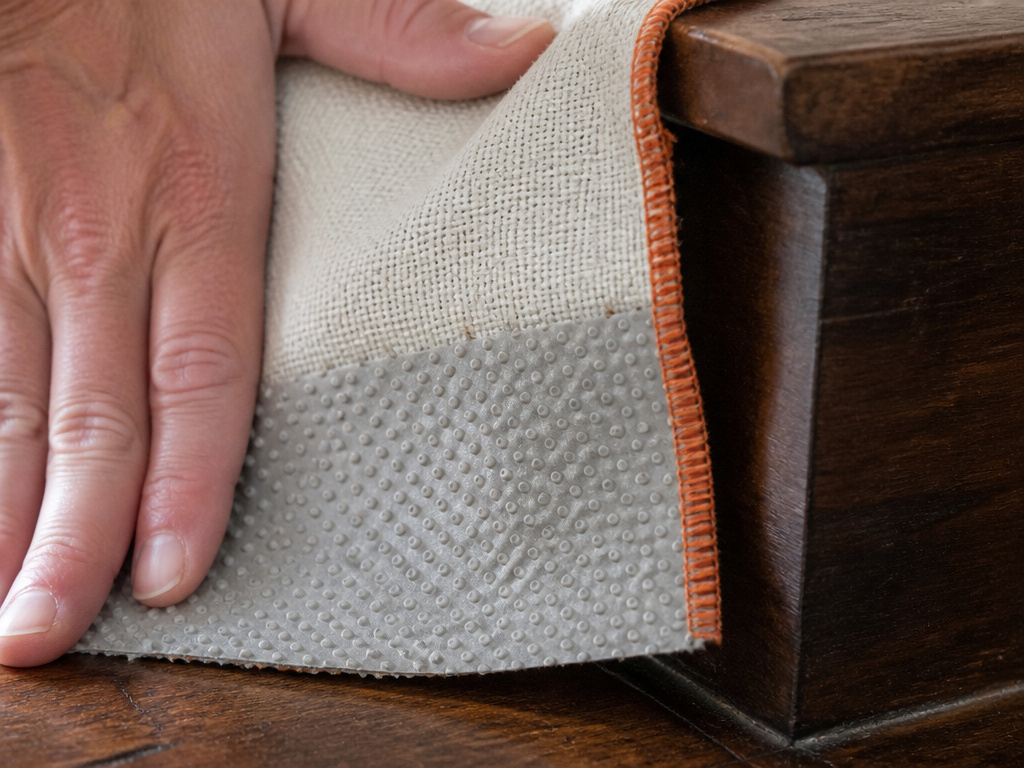
Two manufacturers solve the stair problem differently, and both claim the job.
Stairs and Landings
Trimaco’s Stay Put Canvas Plus is lined with a full non-slip rubber backing, the way a rug pad is, with an absorbent canvas top and a plastic middle layer for leak resistance, while Sherwin-Williams describes CoverGrip’s backing as a rubberized dot pattern rather than a full sheet. Trimaco states its slip-resistant cloths are up to 300% more slip-resistant than traditional canvas, and stitches the borders in orange thread so you can spot one across a room.
Trimaco’s CoverGrip Safety Drop Cloth takes the other route: 8 oz canvas with a rubberized dot backing rather than a full sheet, in 8 ft by 10 ft and 5 ft by 8 ft. Sherwin-Williams says the dotted backing holds position even on stairs or in corners.
CompositePaint’s stair test sided with Stay Put Canvas Plus, while Sherwin-Williams says CoverGrip’s dotted backing holds position even on stairs. Its reasoning: a heavy 10 oz canvas won’t drape over a tread without weighting, and a cloth that doesn’t drape leaves the riser exposed.
Before you start: Plastic on a stair tread is a fall risk, and a loose canvas edge catches a heel on the way down. Tape or weight every edge before you carry a can up the stairs.
Finished Hardwood
Trimaco’s guidance is blunt here: if you’re protecting hardwood, tile, laminate, or anything else slippery, a slip-resistant cloth is essential, though CompositePaint’s pick for a floor walked on with a wet roller is the Trimaco Eliminator on the strength of its slip-resistant backing. CompositePaint’s pick for a floor you’ll walk on with a wet roller is the Trimaco Eliminator, on the strength of its slip-resistant backing.
Carpet and Concrete
For carpet, concrete, and subfloor, Trimaco recommends traditional canvas. Those surfaces already grip, so a rubber backing buys you nothing and costs you washability.
Backed Cloths and the Washing Argument
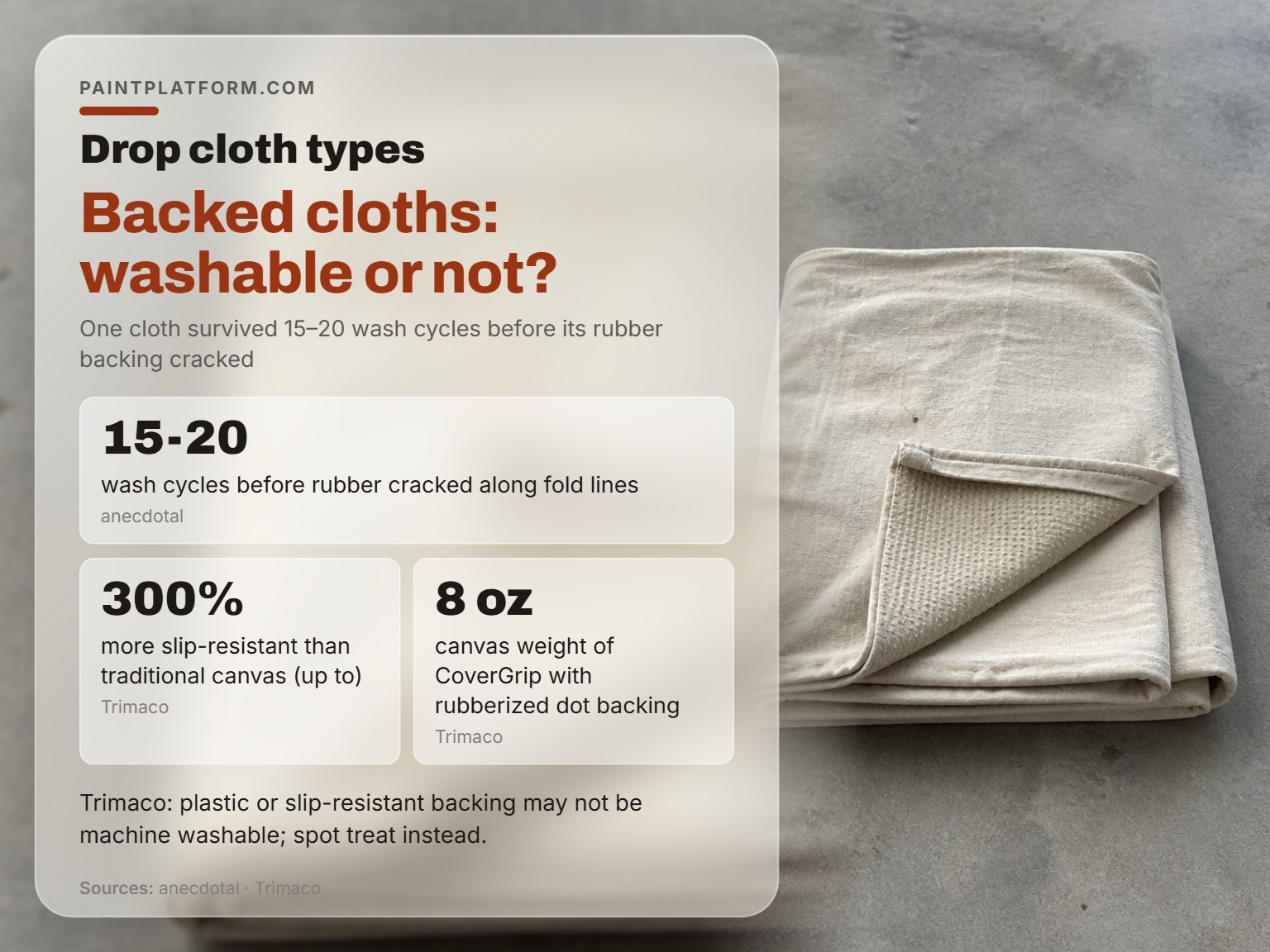
Trimaco’s guide says plastic and slip-resistant-backed cloths may not be machine washable and can be spot treated. CompositePaint’s test found the Butyl II surviving 15 to 20 cold-water wash cycles before the rubber cracked along the fold lines.
Those statements sit closer together than they first look. Trimaco is writing a care instruction for a whole category. CompositePaint is reporting one cloth’s observed lifespan. A backed cloth can survive a wash cycle and still be a poor candidate for the machine.
If you do wash a canvas, the order matters:
- Shake it outside first. Dried splatter that goes into the drum turns into grit that abrades the backing on every cycle.
- Wash cold, no fabric softener. Softener coats the cotton fibers and cuts absorbency on the next job.
- Air dry, never machine dry. High heat cracks butyl backing and shrinks cotton, and a shrunken canvas no longer covers the room it was bought for.
- Spot treat the backing instead of scrubbing it. Abrasion on a rubber sheet is what starts the cracking that ends the cloth’s life.
Washability is the reason canvas stays in the rotation and poly doesn’t.
Dust control is the other half of prep, and painting coveralls matter as much as the floor covering once you start sanding between coats.
Sizes, Overlap, and How Far Splatter Actually Travels
Now everything in the splatter zone gets covered, and the dog still ends up speckled.
Splatter travels further than the drop zone. Trimaco recommends full coverage for overhead work, sanding drywall, and popcorn ceiling removal, where dust is as much of a threat as drips.
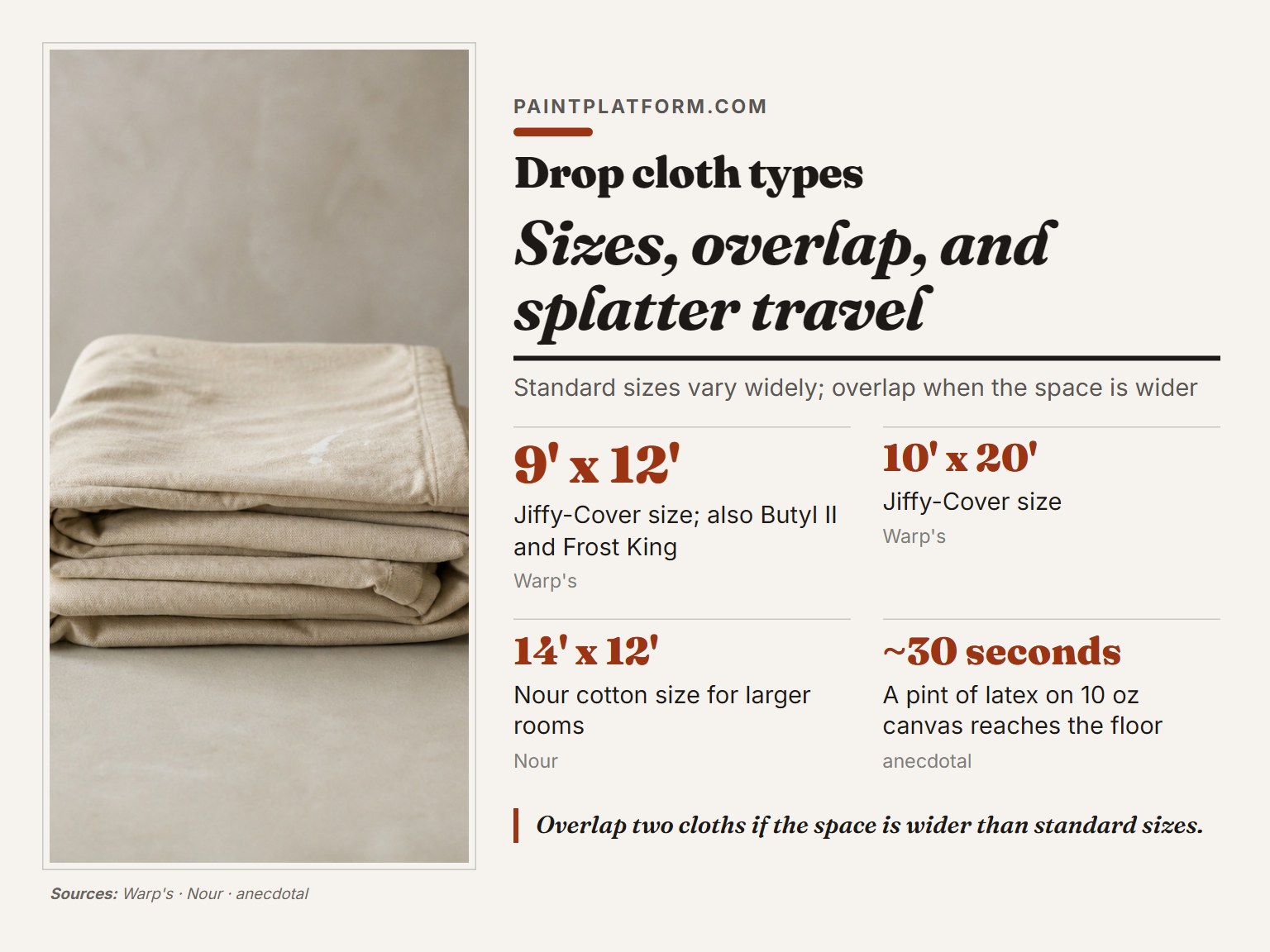
Sizes vary more than most buyers expect. Warp’s Jiffy-Cover comes in 9′ x 12′ and 10′ x 20′. Nour’s cotton cloth runs 3’x20′, 4’x12′, 5’x6′, 8’x12′, and 14’x12′. CoverGrip is 8 ft by 10 ft and 5 ft by 8 ft. Butyl II is 4 ft by 15 ft and 9 ft by 12 ft.
If the space is wider than any standard size, overlap two cloths. A single 9×12 covers many bedrooms, and a 10×20 or a 14×12 handles larger rooms without a seam down the middle.
For light work, Trimaco’s One Tuff 90019 is 12 ft by 9 ft at 0.011 in thick, DuPont Sontara coated, a blue fabric cloth the company calls economical and disposable after a few uses. It’s an economical, disposable option for touch-ups and trim.
Dust is the other half of the job, and a tack cloth picks up the fine film a drop cloth never touches.
Frequently Asked Questions
Do I need a drop cloth if I’m using a roller?
Yes, because roller spatter is airborne. Roller covers throw fine droplets well past the wall line, and those land on furniture and trim as readily as on the floor. A canvas cloth catches them in the weave and dries in place.
What thickness of poly do I need for painting?
Lowe’s lowest named band is 2.0 mil Light Duty, and its Super Duty band is 6.0 mil. For a floor with foot traffic, 4.0 mil and up is the practical starting point. Sub-1-mil sheets like Frost King’s 0.5 mil P112R are disposable covers, not floor protection.
Can you wash a canvas drop cloth?
Trimaco lists canvas as washable and reusable. CompositePaint’s tested routine is a cold wash with no fabric softener, then air drying. Machine drying is the step that ruins them, because high heat cracks butyl backing and shrinks cotton.
Is plastic or canvas better on stairs?
Backed canvas, by a wide margin. Plastic on a stair tread is a fall risk, and a heavy 10 oz canvas won’t drape over a tread without weighting. Trimaco’s Stay Put Canvas Plus and CoverGrip both use rubber backing to hold position on stairs.
How big a drop cloth should I buy for a bedroom?
9 ft by 12 ft cloth covers many bedrooms. If the room is wider than that, overlap two cloths rather than stretching one. Nour’s range tops out at 14’x12′, and Warp’s Jiffy-Cover goes to 10′ x 20′.
The Bottom Line
Here’s the threshold I’d use. If the floor under the job is something you’d have to refinish after a spill, buy a backed cloth: Trimaco Butyl II for rooms, Stay Put Canvas Plus for stairs. If the floor is concrete, subfloor, or carpet you don’t care about, a 10 oz canvas is enough and it will outlast the paint job.
That flips entirely for stain and epoxy. A one-time-use plastic like Trimaco Leakproof Plastic is the right call there, because you don’t want a contaminated cloth living in your garage afterward.
Drop cloth types explained in one sentence: match the cloth to what’s underneath it. The label on the bag tells you almost nothing.
The thing I’d skip is the 0.5 mil sheet. It’s cheap and it’s thin.
