
Lacquer Paint Pros and Cons: Fast Dry, Hard Trade-Offs
This post contains affiliate links. As an Amazon Associate, we earn from qualifying purchases.
Lacquer paint pros and cons trade speed for durability. Lacquer dries by solvent evaporation alone, so it’s touch-dry in 20 minutes and fully dry in 24 hours, but the EPA calls it less durable than enamel and urethane, and it needs buffing labor to look its best.
Solvent evaporation alone is the whole mechanism, which is central to the lacquer paint pros and cons. There’s no chemical cross-linking happening in the film, unlike enamel and urethane.
The rest walks the trade-off in order: what lacquer actually is per ASTM, where the durability claims disagree, what it’s genuinely good for, and the exact application window that decides whether the finish works or fails.
Key Takeaways
- Touch-dry in 20 minutes, handle in 1 hour, fully dry in 24 hours at 70°F and 50% relative humidity, per Rust-Oleum’s data sheet.
- The EPA calls lacquer less durable than enamel and urethane. Rust-Oleum’s marketing says otherwise, and both are technically correct about different things.
- Apply between 50-90°F and below 85% humidity.
- Never lay lacquer over air-dried enamel. Rust-Oleum explicitly forbids it, and the new coat will lift.
- Wait 24 hours before buffing or sanding.
What Lacquer Paint Actually Is
ASTM D333-01 is the standard that settles the definition, and it’s narrower than the word suggests. A lacquer is a coating based on synthetic thermoplastic film-forming material dissolved in organic solvents, drying primarily by solvent evaporation.
ASTM D333-01 defines lacquer as a coating based on synthetic thermoplastic film-forming material dissolved in organic solvents, drying primarily by solvent evaporation. Typical lacquers include nitrocellulose, other cellulose derivatives, vinyl resins, and acrylic resins. The definition separates true lacquer from materials that share the word but cure by chemical cross-linking.
That last point matters more than it sounds. The word “lacquer” gets used for Japanese urushi, for nitrocellulose wood finishes, and for acrylic automotive sprays, and those are three different materials with three different cure mechanisms. The ASTM D333 lacquer standard guide is the one that actually pins down the thermoplastic, solvent-evaporation version.
The other two share the name. Natural urushi lacquer cures by a different chemistry entirely, which is why you’ll see natural lacquer durability research discussing a material that has almost nothing in common with what’s in a spray can.
Why Does Lacquer Dry So Fast?
Twenty minutes to touch-dry is the number that defines lacquer, and it comes directly from the cure mechanism. Rust-Oleum’s data sheet lists touch-dry at 20 minutes, handle at 1 hour, and full dry at 24 hours at 70°F and 50% relative humidity.
I used to mix a full palette of paint at the start of every session and watch half of it skin over before I got to it. Lacquer explained why: without cross-linking, the only thing setting the film is solvent leaving, and solvent leaves fast. Now I mix small and often, and I waste a lot less paint.
The EPA’s refinishing guide makes the same point in technical terms. Lacquer cures “by solvent evaporation only,” while enamel and urethane cure by “solvent evaporation and chemical cross-linking reactions.” That single difference drives everything else about how lacquer behaves.
The upside is real. The EPA notes that lacquer’s rapid dry minimizes dirt entrapment, which is why shops without a spray booth still reach for it. Lacquer’s rapid dry minimizes dirt entrapment.
The downside is also real, and it’s the same mechanism. A film that sets by solvent leaving can be re-dissolved by solvent later. That’s why a fresh coat of lacquer melts into the previous one instead of sitting on top of it, and it’s why the finish stays vulnerable to the same solvents that applied it.
The Durability Question Sources Don’t Agree On
Two credible sources describe the same product class in opposite terms, and neither one is lying. The EPA’s refinishing document says lacquer is “not as durable as enamel and urethane finishes.” Rust-Oleum’s technical data sheet for its acrylic lacquer calls it “a premium automotive coating designed to provide a lustrous, durable finish.”
| Source | What It Says | What It’s Based On |
|---|---|---|
| EPA refinishing guide | Lacquer is “not as durable as enamel and urethane finishes” | Cure mechanism: solvent evaporation only, no cross-linking |
| Rust-Oleum TDS ATO-14 | “Premium automotive coating… Lustrous, durable finish” | Product positioning for the acrylic lacquer line |
| NIST BSS 172 | Outdoor exposure results “typically take five years to obtain” | Service-life methodology, not a lacquer-specific test |
Why the Disagreement Exists
The EPA is making a comparative claim about cure chemistry, which is the heart of the lacquer paint pros and cons. Rust-Oleum is making a claim about its specific acrylic formulation. Both can be true at once: an acrylic lacquer can be durable for a lacquer and still less durable than a cross-linked urethane.
The third row is the one most articles skip. The NIST coating service life prediction methodology notes that outdoor exposure results typically take five years to obtain. Any claim about how a finish holds up over a decade is, at best, an extrapolation from shorter tests. The coating durability literature review covers the same ground for appearance-related failure modes.
Where this goes sideways: Trusting a durability claim that doesn’t name its test method. “Durable” without a number, a standard, or an exposure period is marketing, not data.
What Lacquer Is Actually Good For
Furniture. That’s the honest answer.
Lacquer earns its keep in a short list of places:
- Furniture and cabinetry, where the fast recoat window keeps a project moving.
- Small automotive touch-ups, where the 1.0-2.0 mil DFT per coat builds film quickly.
- Anything you’re spraying in a garage without a booth, because the rapid dry minimizes dirt entrapment.
Furniture and Wood
Lacquer’s fast dry makes it a natural fit for furniture, especially pieces you’re spraying in a garage or a small shop. The 20-minute recoat window keeps a project moving.
The best lacquer paint for furniture is usually an acrylic lacquer in a spray can. The SKUs are 253364 Gloss White (12 oz), 253365 Gloss Black (12 oz), and 253366 Clear (11 oz).
For a broader look at how lacquer stacks up against other furniture coatings, the best paint finishes for furniture comparison covers the alternatives.
Automotive Touch-Ups
Lacquer still has a role in small touch-ups. DuPont developed nitrocellulose lacquer systems in 1923, and those early systems required 3-4 coats and showed relatively poor resistance to chemical solvents like hydrochloric acid, per a 2016 Coatings review.
Modern acrylic lacquer is a different animal. Rust-Oleum’s version has a recommended dry film thickness of 1.0-2.0 mils (25-50 µm) per coat and practical coverage of 8-10 square feet per can.
If you’re weighing lacquer against the older alkyd finishes, the lacquer vs enamel paint comparison lays out the trade-offs. The enamel paint pros and cons piece covers the other side of that choice.
How to Apply Lacquer Without Ruining It
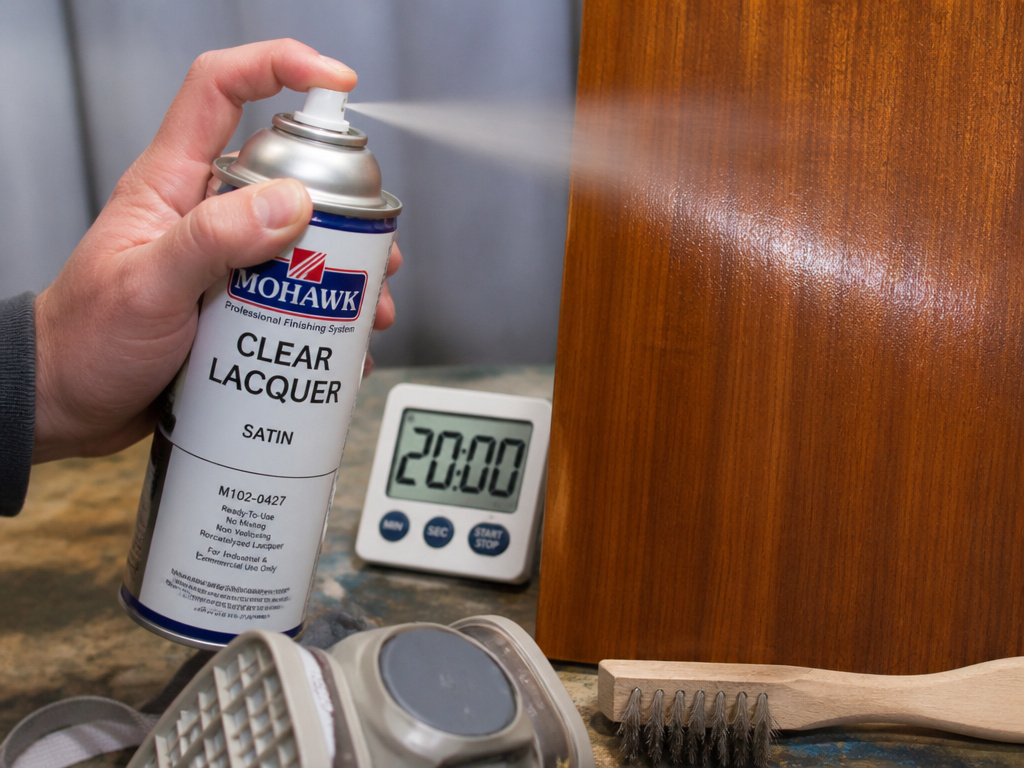
The recoat window is 20 minutes, and it’s the one most people miss. Rust-Oleum’s data sheet says to apply the second coat when the first is dry to touch, which at 70°F and 50% relative humidity is about 20 minutes.
Before you start: Lacquer’s flash point is -156°F (-104°C), and the solvents are acetone and aromatic hydrocarbons. Spray outdoors or in a well-ventilated garage, never near an open flame, and wear a NIOSH-approved respirator if you’re sanding old paint that might contain lead. The flash point is -156°F (-104°C), so keep it away from open flame.
The solvents are acetone and aromatic hydrocarbons, so ventilation matters. That’s your cue that ventilation matters.
Here’s the sequence that actually works:
- Clean the surface with soap and water, then rinse and let it dry. Skip this and the lacquer may not adhere properly.
- Remove loose paint and rust with a wire brush or sandpaper, and lightly sand glossy surfaces. Lightly sanding glossy surfaces prepares them for the lacquer.
- Shake the can vigorously for one minute after the mixing ball begins to rattle. If the mixing ball doesn’t rattle, do not strike the can; contact Rust-Oleum.
- Hold the can upright 10-16 inches from the surface and spray in a steady back-and-forth motion, slightly overlapping each stroke. Keep the can moving while spraying.
- Apply one light coat followed by one heavy coat for best appearance. For best appearance, apply one light coat followed by one heavy coat.
- Wait 24 hours before buffing or sanding. Buffing early smears the film instead of polishing it.
The application window is 50-90°F (10-32°C) with humidity below 85%. Outside that range, Rust-Oleum does not recommend application.
If you want the deepest gloss the finish can give, the high gloss paint breakdown covers what buffing actually does to a lacquer film. And if you’re comparing solvent-based options, the oil-based paint piece is the relevant read.
Common mistake: Spraying lacquer over an existing air-dried enamel coat. Rust-Oleum explicitly forbids it, and the solvents in the lacquer will lift the enamel underneath.
When Is Lacquer the Wrong Choice?
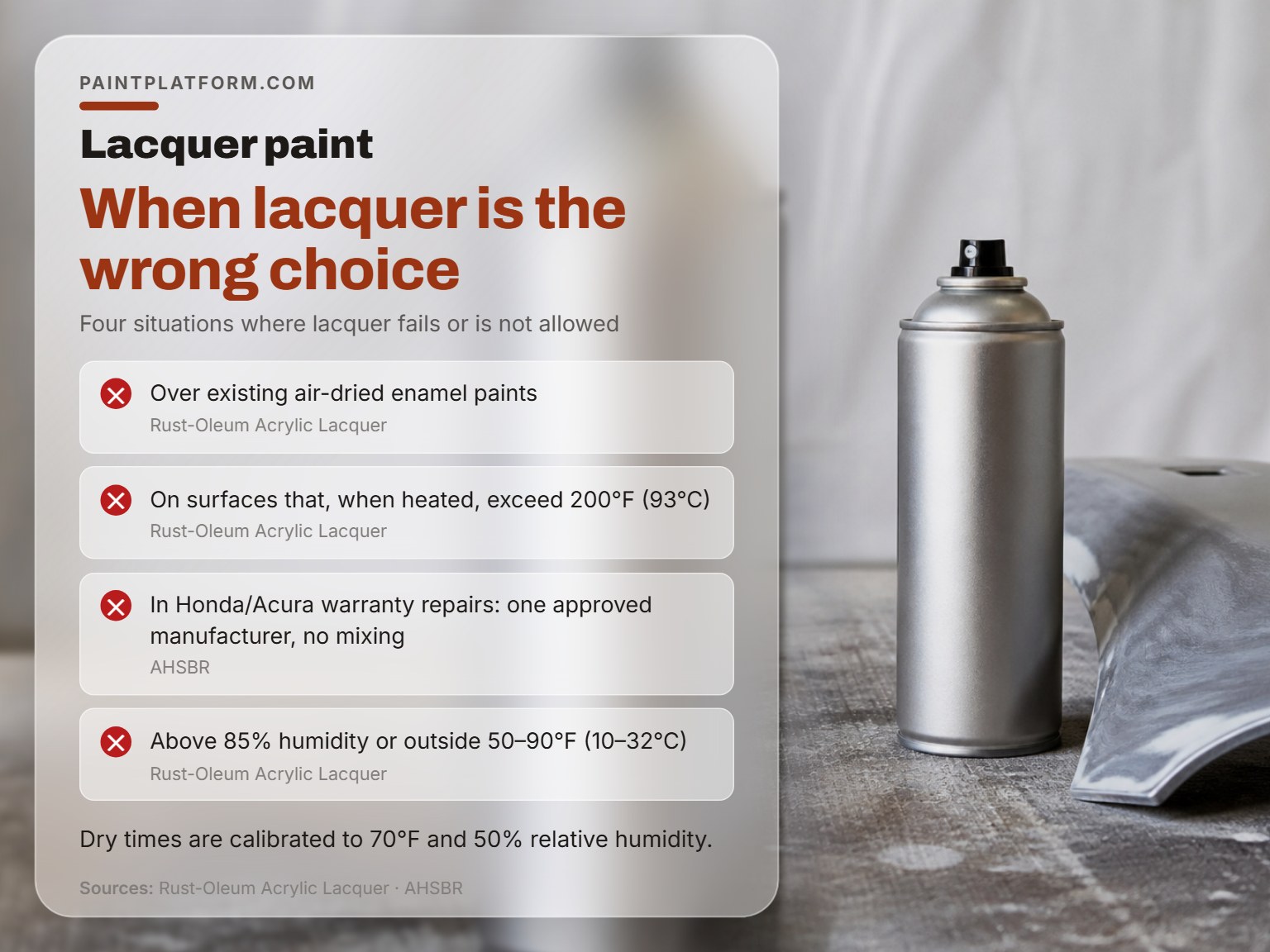
Fair warning: this is where lacquer loses.
Here’s where lacquer stops being the right answer:
- Over air-dried enamel. Rust-Oleum explicitly forbids it, and the solvents in the lacquer will lift the enamel underneath.
- On surfaces that exceed 200°F (93°C) when heated. Rust-Oleum’s data sheet says do not apply to surfaces that, when heated, exceed 200°F (93°C).
- In warranty paint repairs on Honda or Acura vehicles. Service Bulletin 16-055 requires the entire refinish system from one approved manufacturer, with no cross-brand mixing or generic substitutes. Approved manufacturers are BASF, PPG, AkzoNobel Coatings, Axalta Coating Systems, Sherwin-Williams, and Valspar Products.
- Above 85% humidity or outside 50-90°F. The dry times are calibrated to 70°F and 50% relative humidity, and the film will blush outside that window.
The Honda bulletin is worth reading in full if you do any automotive work. It requires a hardener or activator added to the basecoat, and it threatens warranty repair chargebacks for unapproved materials. The automotive OEM paint materials paper gives the OEM-side view of why the film stack matters: clearcoat 45 µm, basecoat 10-20 µm, primer 25 µm, electrocoat 20 µm, phosphate 5 µm.
If you’re working in a humid climate or a space you can’t ventilate well, a water-based acrylic paint is the better choice. It won’t give you the same re-soluble film, but it avoids lacquer’s solvent hazards.
Skip this if: You’re spraying in a garage that hits 88°F in July with 90% humidity. Rust-Oleum’s dry times are calibrated to 70°F and 50% relative humidity, and the data sheet specifies humidity below 85%.
Frequently Asked Questions
Is lacquer paint more durable than enamel?
No, per the EPA. The agency’s refinishing guide says lacquer is “not as durable as enamel and urethane finishes,” because lacquer cures by solvent evaporation alone while enamel and urethane cure by solvent evaporation plus chemical cross-linking. Rust-Oleum markets its acrylic lacquer as durable, but that’s a claim about its specific formulation, not a claim that lacquer beats enamel across the board.
How long does lacquer paint take to dry?
Rust-Oleum’s data sheet lists touch-dry at 20 minutes, handle at 1 hour, and full dry at 24 hours, at 70°F and 50% relative humidity. Those times are specified at 70°F and 50% relative humidity.
Can you spray lacquer over old paint?
Not over air-dried enamel. Rust-Oleum explicitly forbids it, and the solvents in the lacquer will lift the enamel underneath. Rust-Oleum explicitly forbids application over air-dried enamel.
What temperature should you apply lacquer paint?
Between 50°F (10°C) and 90°F (32°C), with humidity below 85%. Rust-Oleum’s dry times are calibrated to 70°F and 50% relative humidity, and the data sheet specifies application between 50°F and 90°F with humidity below 85%.
Is lacquer paint safe to use indoors?
No. Rust-Oleum says to use it outdoors or in a well-ventilated area such as an open garage, and the solvents are acetone and aromatic hydrocarbons. The flash point is -156°F (-104°C), and the data sheet says not to use it near an open flame.
What’s the difference between lacquer and acrylic paint?
Acrylic paint is a broad category that includes water-based acrylics and acrylic lacquers. Lacquer, per ASTM D333, is specifically a thermoplastic film that dries by solvent evaporation. The two overlap when you’re talking about acrylic lacquer, which is an acrylic resin dissolved in solvent and sold as a lacquer.
The Bottom Line
If you’re spraying in a garage that hits 88°F in July with 90% humidity, wait. Rust-Oleum’s published dry times are calibrated to 70°F and 50% relative humidity, and the data sheet specifies humidity below 85%. That’s the one condition where I’d tell a beginner to skip lacquer entirely.
For everything else, lacquer has a clear personality: fast, re-soluble, and honest about its limits. Learn it on a piece of furniture you can afford to sand back. Start before you feel ready, and take notes on how the film behaves.
