
Chalk Paint vs Regular Paint: Which Should You Use?
This post contains affiliate links. As an Amazon Associate, we earn from qualifying purchases.
Chalk paint vs regular paint splits on three things: prep, finish, and cure. Chalk paint is a thick, water-based decorative paint that grips most surfaces after a clean and a light scuff, dries ultra-matte, and needs a sealer. Regular latex or enamel needs sanding and primer, but lays down a smoother, harder film.
The light scuff is where projects quietly fail, because “no prep” gets read as “no cleaning” and grease or furniture polish kills adhesion on any paint, chalk included. Granny B’s says the same thing in its own instructions: clean first, scuff the glossy bits, then paint.
What follows is the honest version: what each paint actually needs, how long the stages really take, where the sources contradict each other, and which tin I’d put on a thrift-store chair tomorrow.
Key Takeaways
- Prep is the real dividing line. Chalk paint wants a clean, degreased surface plus a light scuff on gloss; regular paint wants sanding, dust removal and primer.
- One coat is a claim, not a promise. Making Manzanita and Home Stratosphere both report single-coat coverage, while Granny B’s describes two coats in a day and Renovated Faith’s painters wait 24 hours between them.
- Chalk paint cure time is disputed. The Owl Box puts full cure at 2-3 weeks depending on brand, while Renovated Faith puts it at 30 days.
- The sealer is where sources split on durability. Kaitlin Madden and Home Stratosphere say chalk paint needs a sealant, while Making Manzanita calls it durable and water-resistant with a protective topcoat.
- Regular enamel is often favoured on wet, high-wear surfaces. The Owl Box and A Little Delightful point to regular paint for bathrooms, kitchen cabinets and high-traffic pieces, while Making Manzanita calls sealed chalk paint durable and water-resistant.
What Actually Separates Chalk Paint From Regular Paint
Chalk paint is a water-based decorative paint built for furniture and craft projects, with a thick, creamy body and an ultra-matte finish.
Chalk paint is a water-based decorative coating built on a mineral aggregate and pigment, formulated to sit on a surface rather than melt into it. Regular latex and enamel paints are designed to flow out, level, and form a hard continuous film over a sanded, primed substrate. One film stays porous; the other seals itself.
That porosity is the whole story. It’s why chalk paint grabs a glossy surface that latex would slide off, and it’s also why an unsealed chalk finish soaks up a spilled coffee.
The name itself is worth clearing up. The Lived In Look reports that “chalk paint” is a registered trademark of Annie Sloan Paints, and that most competing brands sell “chalk finish” instead. Same idea, different label on the tin.
Regular paint is a broad tent. For furniture it means acrylic or PVA wall paint, water-based enamel, or oil-based enamel, all built to form a hard film over a properly prepared surface.
| Decision point | Chalk paint | Regular latex or enamel |
|---|---|---|
| Prep | Clean, degrease, light scuff on gloss | Sand, dust off, prime |
| Coats | Often one; sources split on two | Two or more |
| Finish | Ultra-matte only | Flat, eggshell, semi-gloss, gloss |
| Dry and recoat | Touch-dry within an hour | Longer, especially oil-based |
| Best for | Furniture, decor, low-wear pieces | Walls, cabinets, high-wear surfaces |
If you’re weighing the chalk paint vs regular paint question across a house full of pieces, that table is the short version. The rest of this page is the long one.
Does Chalk Paint Really Skip the Sanding and Priming?
Two sources say sanding and primer are optional. Two others say the best results come from doing both anyway.
In My Own Style is the most absolute: the chalky formula adheres to any surface without sanding or a primer coat, and latex needs both. Kaitlin Madden agrees you can technically skip them, as long as the surface is clean and dry, then adds the caveat that her best results come from sanding and priming even with chalk paint. Some pieces need a bonding primer no matter what.
Making Manzanita lands in the middle: light sanding recommended, priming optional. Granny B’s is the most practical of the lot, saying a thorough clean plus a light scuff on very glossy areas is enough on many pieces.
The Stained Dresser That Failed Twice
Renovated Faith published a reader case that’s worth knowing before you trust the no-prep promise on an old piece. A stained dresser failed with chalk paint plus sealer. It failed again with primer, chalk paint and sealer. It only worked with an oil-based blocker primer and latex on top.
That’s one dresser, not a lab result. But it’s the clearest illustration of where the no-prep claim breaks: stain and tannins bleeding up through a porous film.
Here’s what “clean” actually has to mean before any of this works:
- Degrease properly. A damp cloth won’t lift furniture polish or the aerosolised cooking grease that settles on kitchen cabinets.
- Scuff the gloss. Varnished, laminated and high-shine surfaces get a light pass with fine sandpaper.
- Dust off. Loose grit trapped under the first coat shows up in the film later.
Common mistake: Wiping a piece down with a damp rag and calling it clean. Polish residue and kitchen grease stay put, and Granny B’s is blunt that residue affects adhesion with any paint, chalk included.
There’s a physical tell on a can that’s been sitting a while. Chalk paint settles fast and leaves a thick ring of sediment at the bottom, which is why The Lived In Look turns the tin upside down for roughly 30 minutes before opening it.
If skipping prep entirely is the goal, there are paints formulated for furniture without sanding that handle it better than a standard latex. And if you’d rather mix your own, note that DIY chalk paint usually uses plaster of paris, baking soda or unsanded grout as the aggregate, per Renovated Faith, so it behaves differently from a commercial tin.
The Coat Count and Cure Time Sources Can’t Agree On
The chalk paint vs regular paint coat count is where the advice splits, and nobody’s wrong.
Making Manzanita says chalk paint often needs a single coat where regular paint needs more. Home Stratosphere says the same, putting latex at two or more coats. Granny B’s describes two coats going on in a single day in warm conditions. Renovated Faith’s painters wait 24 hours between coats, which puts two coats at 48 hours of dry time.
Cure time is just as split. The Owl Box says 2-3 weeks depending on brand. Renovated Faith puts full hardness at 30 days and recommends light use for the first month. The same source notes a month or longer in dry conditions for chalk, against about two weeks for Behr latex.
VOC content is the third disagreement, and it’s the one people repeat most confidently. Kaitlin Madden states chalk paint contains no VOCs. Renovated Faith describes chalk paint as low-VOC and reserves “no VOCs” for milk paint. Granny B’s describes its own chalk paint as lead-free and low in VOCs.
Three sources, three answers. If indoor air quality is the deciding factor for you, treat “no VOCs” as a brand-specific claim to check on the tin rather than a property of the category.
Never judge a chalk-painted piece by how it feels on day two. Full hardness lands somewhere between two weeks and a month depending on the brand, and until it does, the film is still soft enough to mark.
If you want the fuller list of trade-offs in one place, there’s a rundown of chalk paint pros and cons worth reading before you commit a weekend to it.
How Long Does Chalk Paint Take From First Coat to Finished Piece?
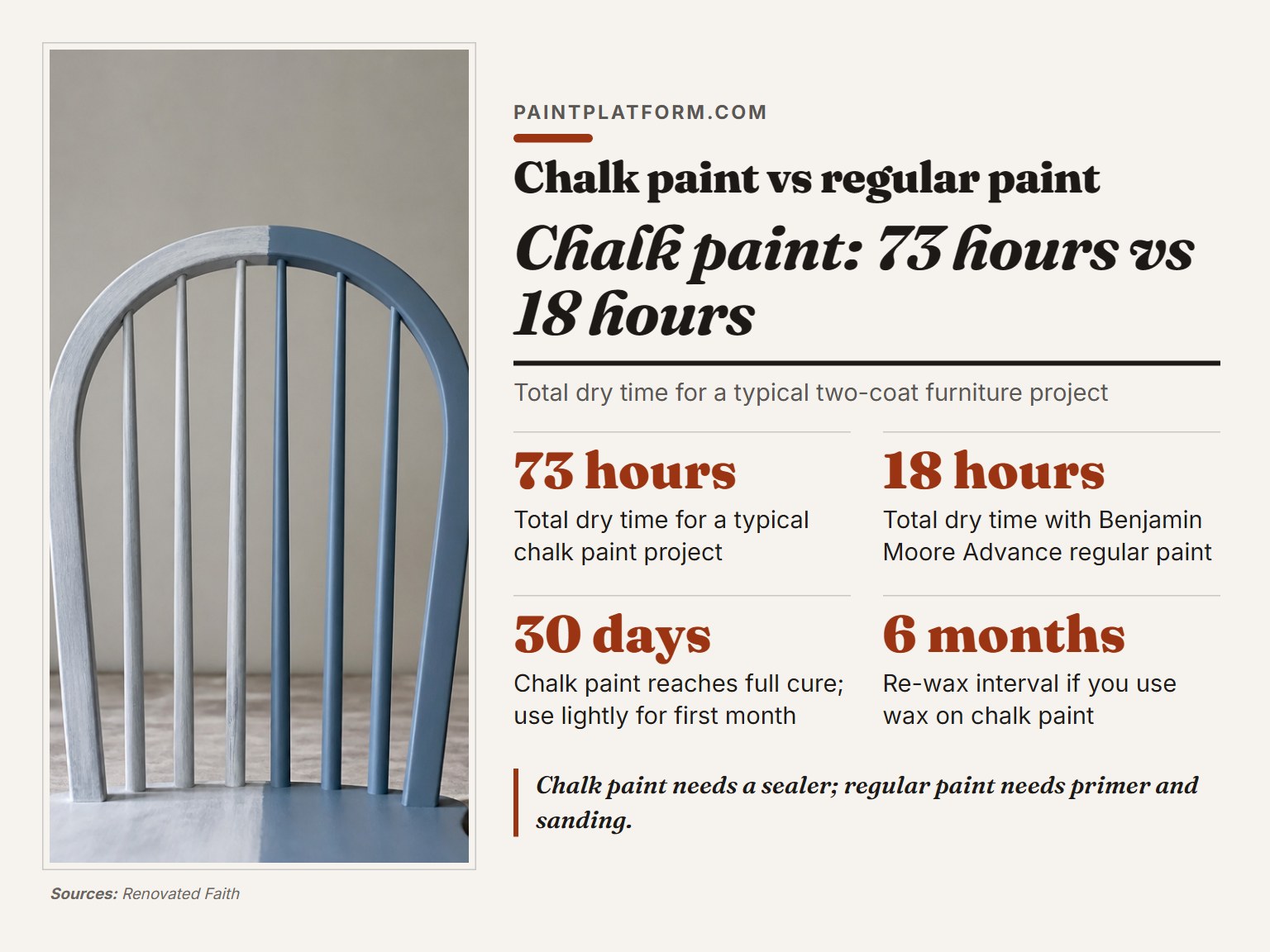
Renovated Faith clocked a typical Annie Sloan project at 73 hours from first coat to finished piece.
That number surprises people, because the paint itself feels dry fast. Granny B’s says chalk paint dries to the touch often within an hour. Making Manzanita says chalk dries within hours while regular paint needs a full 24 before a topcoat or another coat.
The gap between “dry to the touch” and “ready for the next step” is where schedules fall apart.
| Stage | Chalk paint | Regular paint |
|---|---|---|
| Touch dry | Often within an hour | Longer, especially oil-based |
| Recoat window | 24 hours, or same day in warm conditions | 4 hours (Benjamin Moore Advance) |
| Final dry | 24 hours after the last clear coat | 7 hours (Advance) |
| Full cure | 2-3 weeks, up to 30 days | About 2 weeks (Behr latex) |
| Total project | 73 hours for a typical piece | 18 hours of dry time (Advance) |
The 73-Hour Version
- Coat one. Brush or roll it on in long even strokes, working in short sections. Chalk paint dries fast, and going back over a wet patch leaves visible brush marks.
- Day two, coat two. Waiting 24 hours between coats is the common recommendation, which puts two coats at 48 hours. Skipping the wait traps solvent under a skin and the finish stays soft.
- Clear coat one. Roughly an hour between the two clear coats, per Renovated Faith.
- Clear coat two. Then 24 hours before the piece gets handled. The Lived In Look recommends at least 24 hours of dry and cure before waxing.
- Cure. Two to four weeks before full hardness. Use the piece lightly until then.
A high-quality angled brush sized to the piece is the one supply worth thinking about, and there are notes on chalk paint brushes if you’re choosing. The Lived In Look’s advice is refreshingly plain: any hardware store brush suitable for latex works, and a foam roller speeds up large flat panels.
Where Chalk Paint Loses: Water, Wear, and High-Traffic Pieces
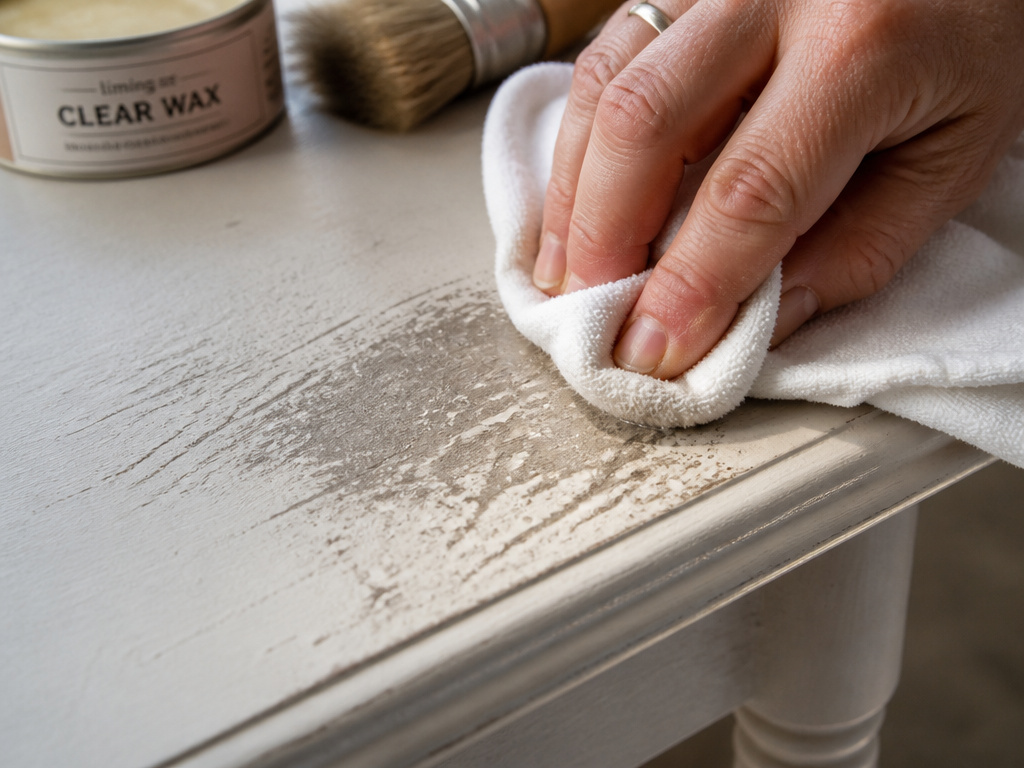
Water is where chalk paint gives up ground, and the people who’ve lived with it say so plainly.
Renovated Faith calls chalk paint porous and soft, doing a poor job of holding up to water and scratching unless it’s sealed. The Owl Box notes regular paint is considered better performing in humid conditions like bathrooms and kitchens. A Little Delightful frames the trade the same way: chalk paint prioritises character, regular paint is built to withstand wear and tear.
Granny B’s makes the counter-case for regular enamel, which is tough straight from the tin because it forms its own protective film, and for some very heavy-wear situations needs no additional topcoat at all.
Fair warning: the durability argument usually turns on whether the piece is sealed, and the sources don’t even agree on the sealer.
Where this goes sideways: A thin wax coat on a kitchen table. Wax suits a dresser, but Granny B’s points heavy-wear pieces toward a harder topcoat, and Home Stratosphere says flatly that unsealed chalk paint isn’t durable for outdoor or high-traffic use.
The re-wax interval is another split. Renovated Faith says waxed chalk furniture needs re-waxing every 6 months in one post and every 3 years in another, with more frequent work on heavy-use pieces. If you’re picking a chalk paint wax, check the re-wax interval, since sources disagree between 6 months and 3 years.
Which Finish Do You Actually Get?
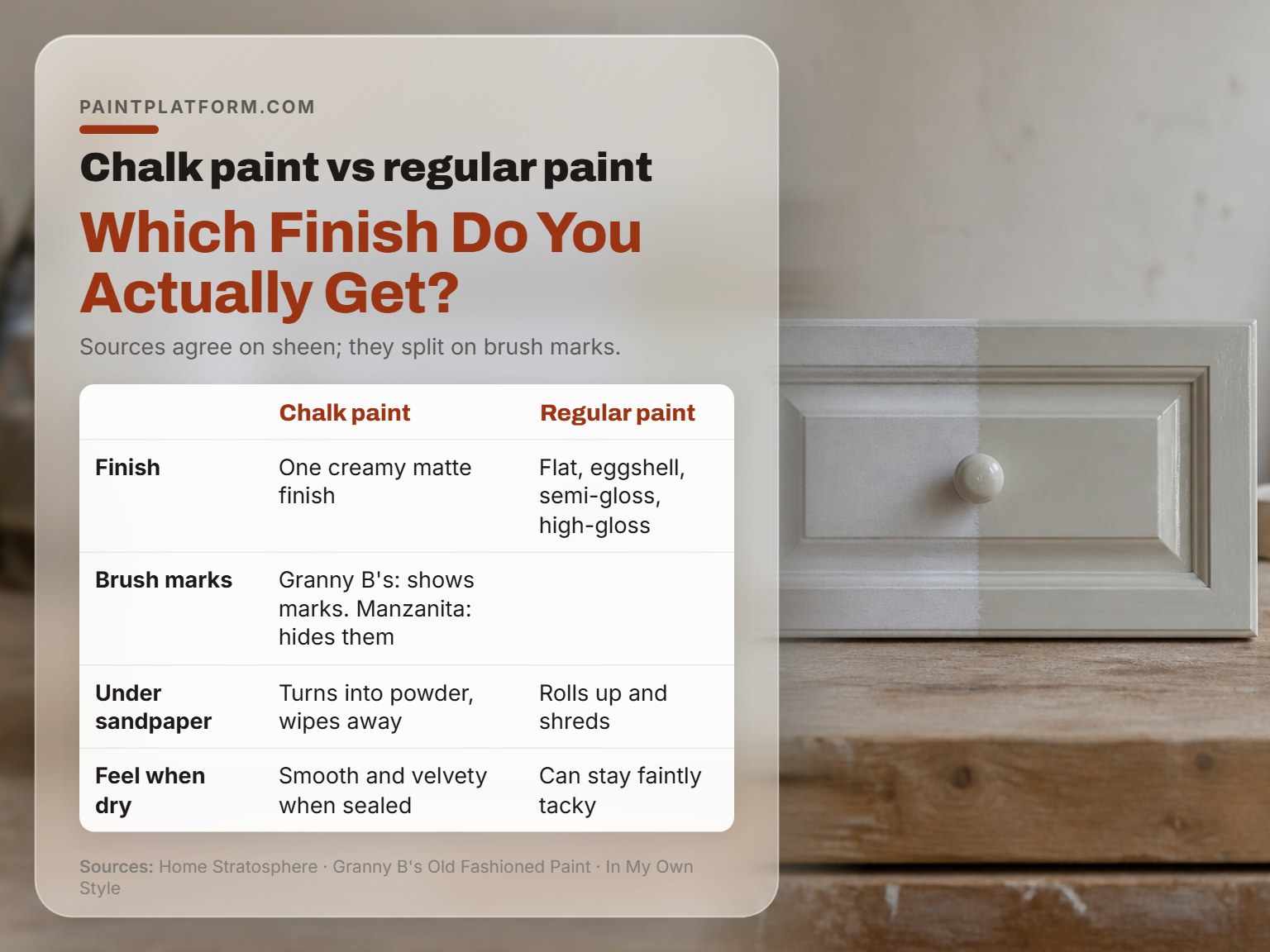
Home Stratosphere and Kaitlin Madden describe chalk paint as coming in one creamy matte finish, though other sources describe it more broadly.
Home Stratosphere puts it clearly, saying chalk paint comes in a single creamy matte finish while latex is available in flat, eggshell, semi-gloss and high-gloss sheens. Kaitlin Madden draws the same line.
Brush marks are where the sources openly contradict each other. Granny B’s says chalk paint shows brush marks and that regular paint levels out more smoothly for a factory-like finish. Making Manzanita says the opposite, that chalk paint hides brushstrokes and grain.
Both can be true depending on the brand, the brush and how thick the coat went on. That’s the least satisfying answer here and I’m leaving it in, because pretending one source is right would be worse.
Brush Marks: Two Sources, Two Answers
What the sources do agree on is how the two paints behave under sandpaper. In My Own Style describes latex rolling up and shredding when you sand it, while dried chalk paint turns into powder that wipes away and leaves a smooth surface.
That powder is the reason chalk paint distresses so easily. Renovated Faith notes it sands off in tiny particles that create a worn, aged look.
The feel is different too. Sealed chalk paint is smooth and velvety under the hand, while a latex-painted surface can stay faintly tacky even when dry, enough that things set on it stick a little.
Two Thrift Chairs, One Month, No Visible Difference
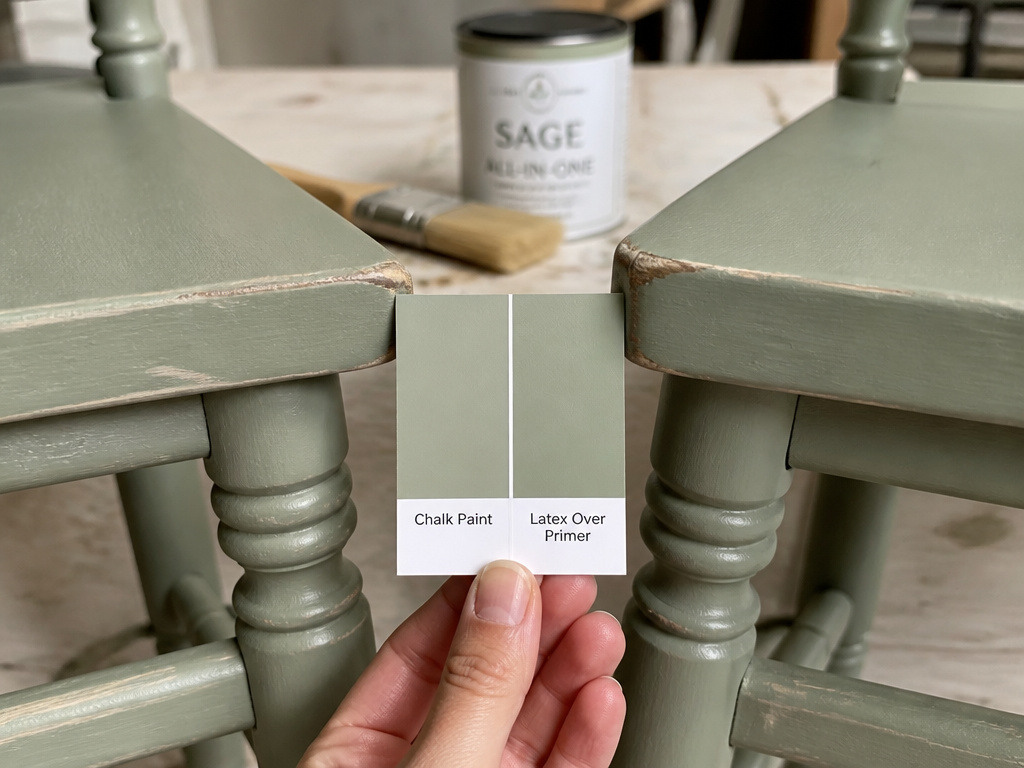
Two matching thrift chairs sat in my studio for a month, one in a branded chalk paint and one in basic latex wall paint over a coat of bonded primer.
After a month of normal use I couldn’t tell them apart. Same sheen, same wear at the corners, same everything.
That result tracks with what the sources say about prep mattering more than the tin. Both chairs got a clean surface and both got sealed.
The chalk tin cost more per quart, and I’d rather put that difference into more thrift pieces to mess up. That’s my honest position after running the test, and it’s a stance about my own budget, not a claim about how the paints perform.
One chair is not a benchmark. But it cured me of assuming the expensive tin is automatically the better tin.
I’ll say the quiet part: on a clean, prepped piece, an expensive chalk paint and a basic latex over primer can look identical a month later.
If you do want to spend on chalk paint, spend it on a brand with a colour you actually want. There’s a shortlist of the best chalk paint for furniture that covers the names below in more detail.
What to Buy and What to Skip
Pick the paint by the piece, not by the label.
What I’d Buy
Annie Sloan Chalk Paint was developed in 1990 and is built on water, calcium carbonate and colour pigment per The Owl Box.
Amy Howard at Home One Step Paint is a one-step chalk-finish option with no separate primer stage.
Granny B’s Old Fashioned Paint comes in over 65 colours and four tin sizes from 50ml to 1 litre, and is lead-free and low in VOCs.
Benjamin Moore Advance is a regular-paint option. Renovated Faith measured 18 hours of total dry time across primer, recoat and final coat, against 73 hours for a typical chalk project.
Rust-Oleum Chalked is a chalk-finish option for anyone who wants the matte look without the premium.
What I’d Skip
- Specialty chalk-only brushes. The Lived In Look says any latex-suitable brush works, and a basic furniture wax is fine unless you’re going for a glazed finish.
- Chalk paint on a bathroom vanity. The Owl Box points toward regular paint in humid conditions like bathrooms and kitchens, and A Little Delightful favours regular paint for high-traffic areas.
- A wax topcoat on a kitchen table. Granny B’s pushes heavy-wear pieces toward a harder topcoat, and wax needs redoing.
If you’re torn between matte categories rather than paint types, the milk paint vs chalk paint comparison is the next decision down, and milk paint behaves differently again on raw wood.
Frequently Asked Questions
Is chalk paint more durable than regular paint?
Only when it’s sealed, and even then the sources disagree. Making Manzanita calls sealed chalk paint durable and water-resistant. Renovated Faith calls it soft, scratch-prone and poor at holding up to water. Granny B’s says regular enamel is tough straight from the tin and sometimes needs no topcoat at all.
Do you have to seal chalk paint?
It depends on the source. Kaitlin Madden and Home Stratosphere say chalk paint needs a sealant, while Making Manzanita calls it durable and water-resistant with a protective topcoat.
Can you use chalk paint on kitchen cabinets?
You can, and a lot of people do. The Owl Box and A Little Delightful both point toward regular paint where humidity and daily handling are the main stress. If you go chalk anyway, plan on a hard topcoat rather than wax.
How long before you can use chalk-painted furniture?
Lightly, after the last clear coat has had about 24 hours. Properly, after full cure, which The Owl Box puts at 2-3 weeks and Renovated Faith puts at 30 days. Renovated Faith recommends only light use during that first month.
Is chalk paint the same as milk paint?
No. Renovated Faith describes chalk paint as low in VOCs and milk paint as having none, and milk paint is sold as a powder you mix yourself. Chalk paint is thicker and covers more, which is why the two land at a similar cost per project.
Does chalk paint really need no prep?
It needs less prep, not none. In My Own Style and Kaitlin Madden both say sanding and priming can be skipped on a clean, dry surface. Granny B’s still requires a thorough clean and a light scuff on glossy areas, and a stained piece may need a bonding primer regardless.
The Bottom Line
If the piece gets wet or gets used hard, use regular paint. That’s the whole test. A bathroom vanity, a kitchen cabinet, a dining table that takes daily elbows: regular enamel, prepped properly, sealed by its own film.
Everything above assumes a piece you can actually clean and scuff. If it’s laminate, or an old stained antique with tannins that bleed, none of that applies and you’re into a bonding primer before either paint gets a look.
Here’s the first thing to do this week, and it costs you one scrap board: paint half with your chalk paint and half with the latex you already own, seal both, and leave them on the floor where you’ll kick them. A week of that tells you more than any comparison table, mine included.
Go make a mess. That’s the part that teaches you something.
