
Limewash vs Whitewash: Which Should You Choose?
This post contains affiliate links. As an Amazon Associate, we earn from qualifying purchases.
In the limewash vs whitewash choice, limewash is a mineral coating made from CL90 quicklime that soaks into porous masonry and hardens through carbonation, while whitewash is a broader term usually meaning thinned latex paint that sits on the surface as a film. Bare brick takes limewash; painted brick needs whitewash.
Carbonation is the slow part. Limewash doesn’t dry into a coating the way paint does; it cures by pulling carbon dioxide out of the air and turning back into limestone over days, not hours. That timeline is why the application rules look so fussy, and why so many first attempts fail early on.
What follows covers the chemistry, the lifespan numbers that disagree by a factor of four, the quick water test that tells you which finish your wall can even take, and the application window where most jobs quietly fail.
Key Takeaways
- Limewash needs bare, porous masonry. It won’t bond to painted or sealed brick, and no primer fixes that.
- Whitewash is a looser term than the label suggests. Some sources mean lime and chalk; most modern usage means thinned latex paint.
- Apply limewash between 5 C and 30 C. Outside that window, carbonation stalls and the finish stays soft or powders.
- Lifespan estimates range from 5 to 30 years. Contractor and aggregator figures disagree by a factor of four.
- The water test decides it quickly. If water beads and rolls off, limewash is off the table.
What Is the Real Difference Between Limewash and Whitewash?
What actually separates these two finishes? The answer starts with what each one is made of, not what it looks like on a sample board.
Limewash is a mineral coating of slaked lime (calcium hydroxide) suspended in water, sometimes with mineral pigment. Applied to damp, porous masonry, it penetrates the surface and hardens through carbonation, reacting with atmospheric carbon dioxide to form calcium carbonate. Whitewash is a broader category: traditional lime-and-chalk mixtures or, in modern usage, thinned latex paint.
Cornish Lime sells its limewash as a pure, non-hydraulic product made from high-calcium CL90 quicklime, in 10 L containers, with a stated coverage of roughly 4 to 6 square metres per litre depending on surface suction and application method. That is the only true OEM spec sheet in this comparison, and it matters because the other sources in this space are contractor blogs and aggregators, not manufacturers.
The whitewash side is messier. Angi describes whitewash as lime, water, and white chalk or other additives, or watered-down white paint. Limewash Pros and NYC Painters both say that in modern usage whitewash usually means latex paint thinned with water. Rhino Shield treats whitewash as a broader name for several different materials and lightening techniques. All three are describing something real, which is why the advice online contradicts itself.
| Property | Limewash | Whitewash |
|---|---|---|
| Binder | Slaked lime (CL90 quicklime) | Lime plus chalk, or thinned latex |
| Bond to brick | Soaks in and carbonates | Sits on the surface as a film |
| Breathability | High, mineral | Low if latex-based |
| Coats | Multiple thin coats | Often a single coat |
| Reversibility | Distressable while curing | Paint film hard to remove |
The mineral chemistry behind limewash
Slaked lime is calcium hydroxide. As a limewash cures, the lime reacts with carbon dioxide in the air through carbonation and turns back into calcium carbonate, which is limestone. That is why limewash doesn’t peel the way paint does when it fails; it either bonds and hardens, or it powders off the wall as a weak chalky layer. The chemistry is also why limewash needs damp conditions to cure properly. Dry it too fast and the carbonation never finishes.
What modern whitewash actually is
A paint-based whitewash keeps its paint binder even when you thin it with water. Rhino Shield makes this point plainly: diluting paint does not turn it into a lime-based mineral finish. That distinction is the whole argument. A thinned latex wash sits on the surface as a thin film, and films peel, especially on a wall that heats and cools. Traditional lime whitewash behaves more like unrefined limewash, which is why the two terms overlap at the historic end and diverge sharply at the modern end.
If you want to mix your own, the limewash paint ratio matters more than the brand on the tub.
20 to 30 Years vs 5 to 7: Why Lifespan Numbers Disagree
Ask three sources how long limewash lasts and the answers span a factor of four. Angi puts both limewash and whitewash at 20 to 30 years on brick exteriors, and 30 to 50 years on interiors. Ranger Painting puts limewash at 5 to 7 years before a refresh coat, and paint-based whitewash at 20 to 30 years. Groovy Hues splits the difference: 20 to 30 years in mild climates, with retouching every five to seven years.
| Source | Limewash lifespan | Whitewash lifespan | Basis |
|---|---|---|---|
| Angi | 20-30 yrs exterior, 30-50 interior | Same | Aggregator estimate |
| Ranger Painting | 5-7 yrs before refresh | 20-30 yrs (paint-based) | Contractor estimate |
| Groovy Hues | 20-30 yrs, retouch every 5-7 | 20-30 yrs | Contractor estimate |
| Cornish Lime | No figure published | No figure published | OEM datasheet silent |
Cornish Lime’s own datasheet does not publish a lifespan figure at all. That silence is the most useful fact in the table. When the manufacturer won’t commit to a number, every other figure is somebody’s field estimate, and the honest range is somewhere between five and thirty years depending on exposure, coats, and substrate.
Limewash can dry lighter than it looks wet, and I was judging wet colour against a dry standard. Wait until it’s fully dry before you decide whether to add another coat. The limewash pros and cons list is worth a read before you commit a whole wall.
Common mistake: Treating a wet limewash coat as the final colour. It can dry lighter, and the panic-recoat that follows is how people end up with a patchy wall they can’t fix without sanding back to bare brick.
Will Limewash Even Stick to Your Brick?
Will limewash bond to your wall? The answer takes a cup of water and a moment. NYC Painters describes the test plainly: splash a little water on the brick. If it soaks in and the brick turns dark, the surface is porous and limewash is possible. If the water beads and rolls off, the brick is sealed or painted, and limewash is off the table unless you strip it.
That test is worth more than any sample board. A client who was set on limewash for a sealed fireplace ended up with a whitewash instead, because the alternative was stripping in a building with strict dust rules. The test settles more arguments than any product page.
What disqualifies a wall from limewash:
- Painted brick of any kind, latex, oil, or acrylic.
- Sealed brick. A clear sealer counts as a coating and blocks absorption.
- Damp or actively leaking walls. Fix the moisture first, whatever finish you pick.
- Heavily exposed facades. Cornish Lime explicitly does not recommend limewash for external facades in areas heavily exposed to the elements.
Where this goes sideways: Applying limewash over a sealed or painted surface. The coating blocks absorption, so the limewash sits on top as a weak film instead of carbonating into the masonry. It flakes off instead of carbonating into the masonry.
If your wall passes the water test, whitewash brick is the other option worth testing on a hidden corner before you commit.
Application Fails at the Temperature Window, Not the Brush
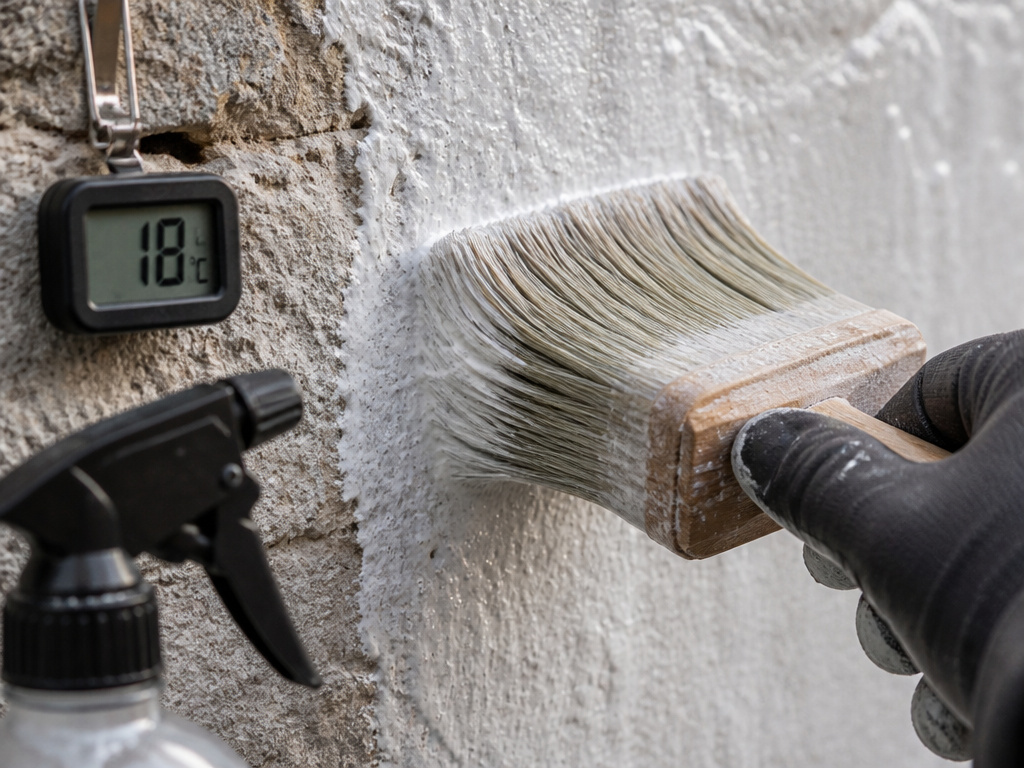
Application is where most limewash jobs quietly fail, and the culprit is usually the thermometer. Cornish Lime specifies a working window of 5 C to 30 C. Below 5 C, carbonation slows to a crawl. Above 30 C, the coat dries too fast and never finishes curing.
Before you start: Hydrated lime is caustic and will burn skin on contact. Wear nitrile gloves and eye protection, and keep clean water within arm’s reach for splashes. Lime dust also irritates airways, so mix in a ventilated space.
The application sequence, with what happens if you skip a step:
- Dampen the wall first. Skipping this lets a thirsty surface pull water out of the mix before carbonation starts, and the coat powders instead of hardening.
- Apply between 5 C and 30 C. Outside that window, carbonation stalls and the finish stays soft for days.
- Keep the coat damp for the first day. Mist lightly; don’t saturate. Dry too fast and the lime never finishes curing.
- Protect from frost, rain, direct sun, and drying wind. Any of those four pulls moisture out too quickly and leaves a chalky, dusty surface.
- Build thin coats, not thick ones. More coats give more uniform colour and a more durable finish, and several coats are recommended on absorbent surfaces.
A well-mixed limewash should have a milky, creamy texture thin enough to work with but thick enough to cover well. If it looks like water, it’s too thin. If it’s too thick to work with, it’s too thick.
I got a little hydrated lime on my wrist once and it itched, a very low-tech way to learn what “caustic” means. Gloves are not optional.
The 5 C to 30 C window
The temperature limit is not a suggestion. Limewash cures by carbonation, and carbonation is a chemical reaction that needs moderate humidity and moderate temperature to complete. Cornish Lime’s 5 C to 30 C range is the manufacturer’s own number, and it exists because outside that window the reaction either stalls or runs too fast for the finish to hold together.
Keeping it damp for carbonation
Cornish Lime says limewash should be kept damp after application to promote carbonation, and that protection from frost, rain, direct sunlight, and drying winds is required. Mist lightly with water if the coat looks dry, but do not saturate. Saturation washes the lime back off the wall.
The limewash interior walls guide covers the interior version of this sequence, where wind and rain are less of a problem but dry radiator heat is a bigger one.
A Whitewash Recipe Is a Ratio, Not a Product
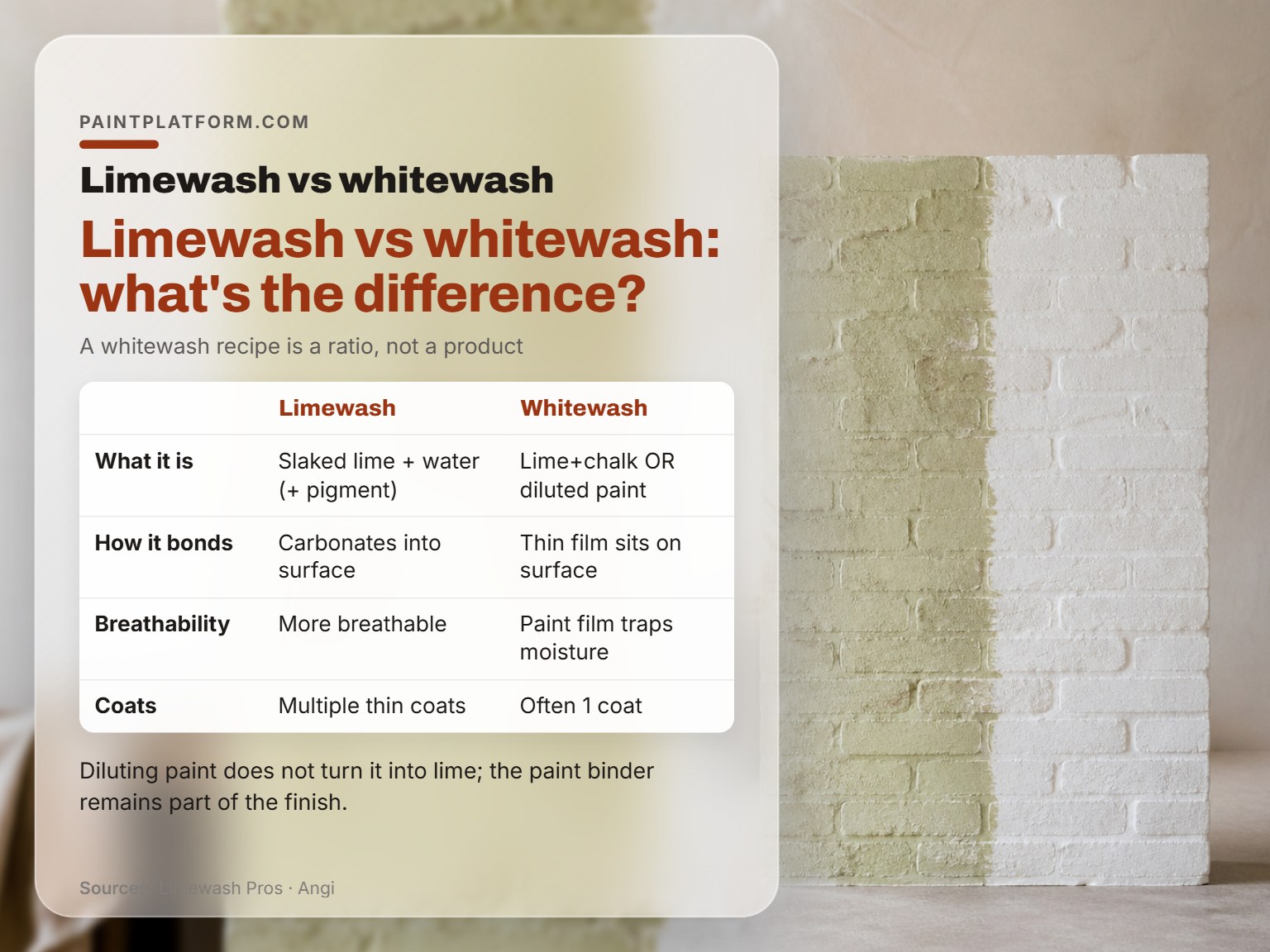
A whitewash recipe is a ratio, not a product, which is why two people can follow the same instructions and get two different finishes. Traditional whitewash was hydrated lime, salt, and water, sometimes with alum or molasses, used on barns and fences. Modern whitewash is usually latex paint thinned with water, brushed on and wiped back so some brick shows through.
The ratios that actually work:
- Traditional lime whitewash. Hydrated lime, salt, and water, mixed to a brushable consistency.
I tested a 1:1 mix on a scrap corner first. It soaked in fast and looked chalky, so I adjusted the mix for more coverage. Dab and wipe with a damp rag to control it. The whitewash recipe page has the full breakdown if you want to start from scratch.
The why-layer here matters: diluting paint does not turn it into lime. The paint binder remains part of the finish even when you add water, which is why a thinned latex whitewash behaves like a thin paint film and a lime whitewash behaves like a mineral coating. They look similar when new and behave completely differently after a year.
Limewash vs Whitewash on Brick: Ten Years Later
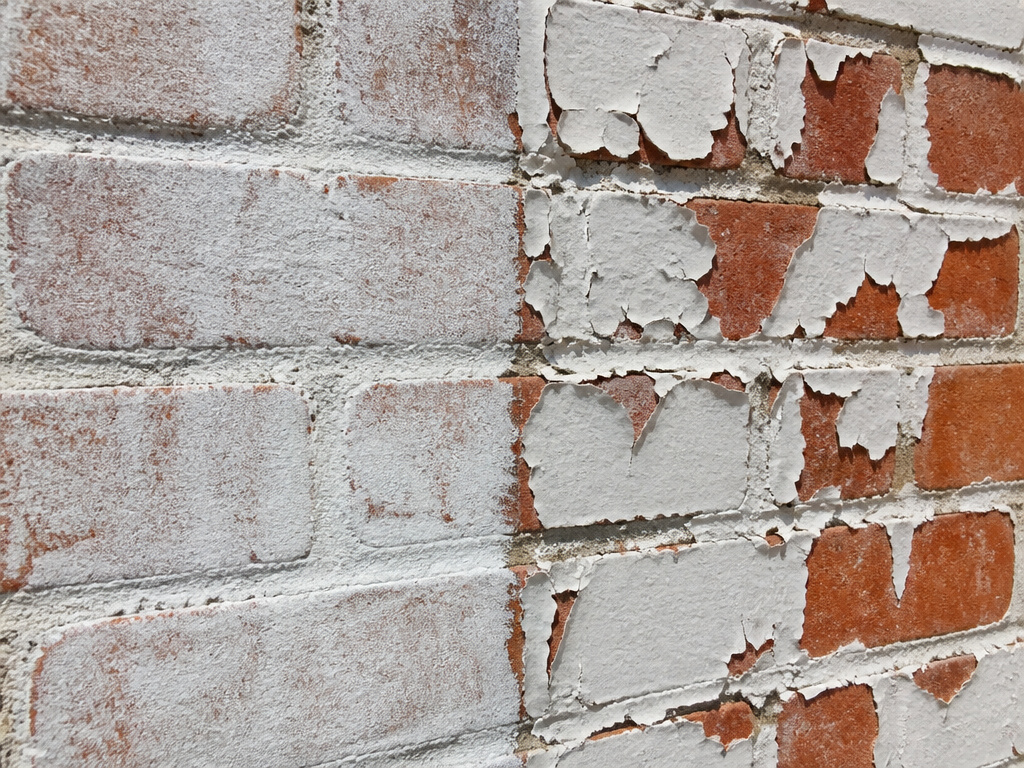
Ten years on the same brick wall is where the two finishes actually separate, and the winner depends on what you wanted in the first place. Limewash is the most forgiving of the finishes and weathers gracefully, which is why it’s the more forgiving finish for a wall you might change your mind about. Paint-based whitewash holds its colour longer but fails by peeling, which is harder to patch invisibly.
The brand question is real. Cornish Lime’s limewash comes in 24 traditional colours on a CL90 base, and the swatches are based on four coats applied to a fine lime plaster, so the colour you see on the card assumes four coats on a smooth mineral surface. If you want the full range, the best limewash paint list covers the options by substrate.
If you want the finish to stay removable, test a patch first and keep the rest of the wall bare until you’ve lived with it for a while. Limewash is forgiving while it cures; ten years later it’s part of the wall.
Reversibility is one of the sharpest disagreements in this space. Ranger Painting says limewash can often be power-washed off, while paint-based whitewash is difficult to remove once cured. Rhino Shield warns the opposite: don’t choose limewash solely expecting an easy pressure-wash reversal, because removal methods can affect the masonry as well as the finish. Both are describing real outcomes. Ranger Painting says limewash can often be power-washed off while paint-based whitewash is difficult to remove once cured, whereas Rhino Shield warns that removal methods can affect the masonry as well as the finish, so limewash is not reliably reversible without risk to the brick.
If you’re chasing the look without the mineral chemistry, limewash effect paint is the compromise route, and it behaves more like a paint than a limewash.
Some Walls Should Never Get Limewash
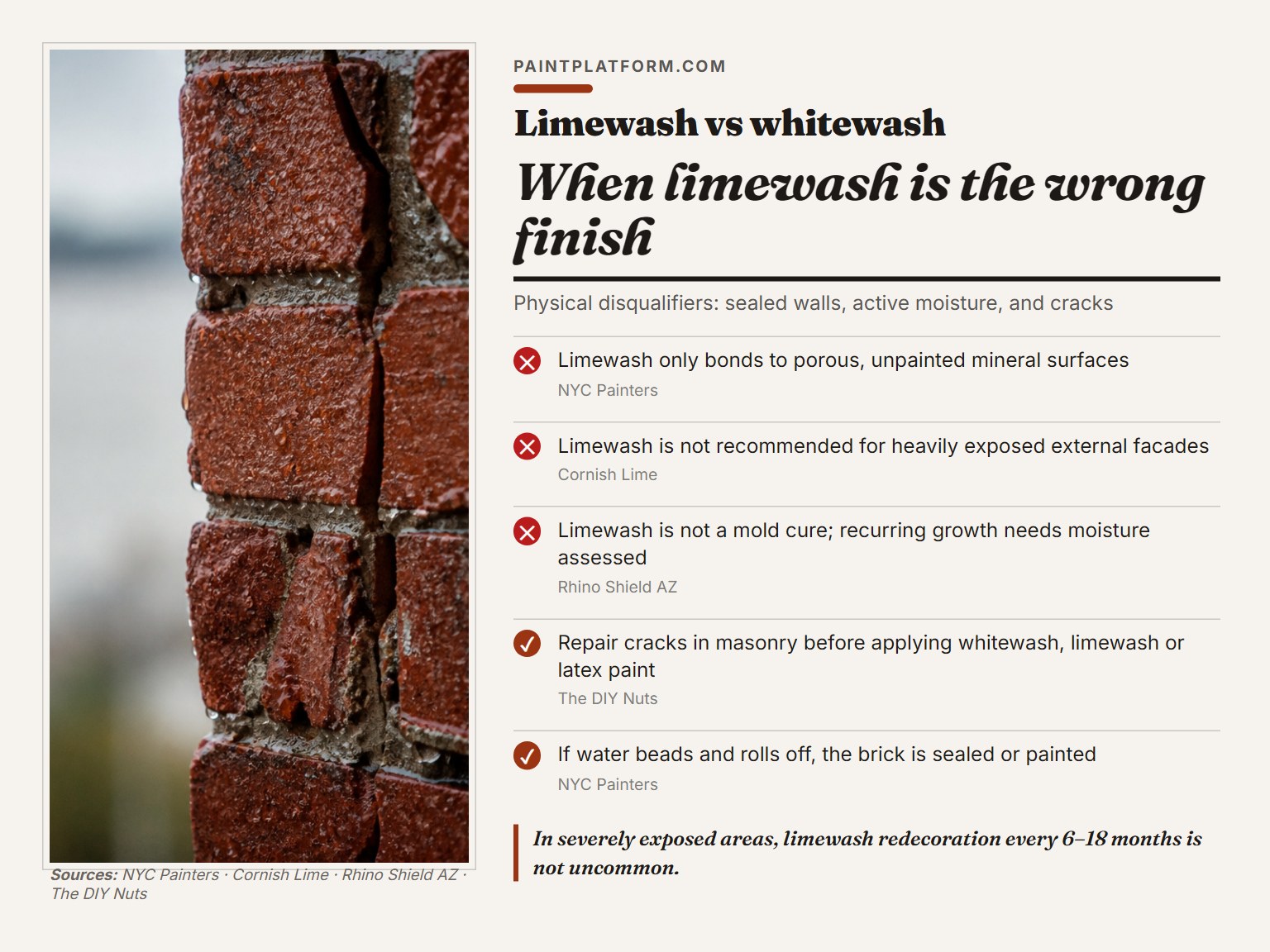
Some walls should never get limewash, and the reasons are physical, not aesthetic. A wall that can’t absorb water can’t absorb limewash, and a wall with an active moisture problem will keep that problem no matter what you paint over it.
Common mistake: Treating limewash as a mold cure. It resists mold because of its high pH while it’s intact, but if the wall has an active moisture problem, the growth comes back through the finish. Fix the water first.
The other disqualifier is exposure. Cornish Lime says limewash is not recommended for external facades in areas heavily exposed to the elements, and notes that redecoration every six to eighteen months is not uncommon in severely exposed areas. If your wall takes driving rain from the prevailing wind, limewash is the wrong finish and a paint-based whitewash is the more practical choice.
Cracks are the third disqualifier. The DIY Nuts is blunt about it: cracks in the masonry must be repaired before applying any whitewash, limewash, or white latex paint. Skip that step and the finish cracks along the same lines.
Frequently Asked Questions
Is limewash the same as whitewash?
Cornish Lime says the terms are often used interchangeably and can mean the same thing. Rhino Shield treats whitewash as a broader category that includes both traditional lime whitewash and thinned-paint versions. The practical answer: they overlap at the traditional end and diverge sharply at the modern end, where whitewash usually means thinned latex.
Can I put limewash over painted brick?
No. Cornish Lime states that pure limewash can only go over an absorbent mineral background such as lime render, lime plaster, or stone. NYC Painters adds that limewash won’t stick to painted or sealed brick unless every bit of old paint is stripped first. Rhino Shield warns the same: a coating that blocks absorption prevents the limewash from behaving as intended.
How long does limewash last on exterior brick?
The numbers disagree. Angi puts both finishes at 20 to 30 years on brick exteriors. Ranger Painting puts limewash at 5 to 7 years before a refresh coat and paint-based whitewash at 20 to 30 years. Cornish Lime does not publish a lifespan figure at all. The honest range is somewhere between, and it depends on exposure, number of coats, and substrate.
What temperature should I apply limewash?
Cornish Lime specifies 5 C to 30 C. Outside that window, carbonation stalls and the finish stays soft or powders. Protect the fresh coat from frost, rain, direct sun, and drying winds for the first day, and mist lightly if the coat looks dry.
Is whitewash just thinned paint?
Not always. Angi describes whitewash as lime, water, and white chalk or other additives, or watered-down white paint. NYC Painters describes traditional whitewash as hydrated lime, salt, and water. Limewash Pros and NYC Painters both note that modern whitewash is usually latex paint thinned with water. The label covers both, which is why the advice online contradicts itself.
The Bottom Line
If your brick is already painted or sealed, the limewash vs whitewash comparison is moot. Whitewash is your only option short of stripping the wall, and stripping a fireplace surround in a furnished room is a dusty job nobody volunteers for.
The trigger to walk away from limewash is simple: if water beads on the brick, stop. No primer fixes a sealed wall, and no amount of extra coats will make limewash bond to a surface that can’t absorb it.
One concession worth stating plainly. The lifespan numbers in this piece disagree by a factor of four, and I can’t resolve that disagreement from the sources. If you need a hard number for a project timeline, use the conservative end, five to seven years before a refresh, and treat anything longer as a mild-climate bonus rather than a guarantee.
Start with a test patch and let it dry fully before you judge the result. Limewash is the more forgiving finish while it cures, but only if you find out what your wall does before you commit the whole facade.
