
Garage Floor Paint Guide: Read the Label First
This post contains affiliate links. As an Amazon Associate, we earn from qualifying purchases.
A garage floor paint guide worth following starts with the label, because application windows and cure times change by brand. Rust-Oleum RockSolid allows 40-90 degrees F air; EpoxyShield wants 60-85 degrees F. Match the product to your slab’s moisture before you open the can.
The RockSolid can and the EpoxyShield can sat side by side on my bench last fall, both labeled epoxy, both wanting a different kind of Saturday. RockSolid will go down at 40 degrees F. EpoxyShield wants 60. That gap decides whether an October afternoon works or waits until spring.
What follows is the order I actually run it in: the plastic sheet, the etch, the temperature check, and the cure clock that tells you when the car goes back in.
Key Takeaways
- Test the slab before you buy anything. Tape a 2′ x 2′ plastic square down for 24 hours; fog or dark damp patches mean the coating waits.
- Application windows are brand-specific. RockSolid allows 40-90 degrees F air, EpoxyShield wants 60-85 degrees F, and Benjamin Moore caps humidity at 70 percent.
- New concrete needs 28 to 30 days before any of these coatings go down.
- Vehicle traffic waits 3 to 10 days depending on the product, so line up parking elsewhere.
- Anti-skid additive is optional on Rust-Oleum products and worth adding on any floor that sees rain off a car.
What Does the Label Require Before You Open the Can?
Have you read the back of the can, or just the front? The front tells you the color. The back tells you whether today is even a paint day.
Manufacturers publish application windows that differ by product line. Rust-Oleum RockSolid accepts air temperatures from 40 to 90 degrees F and relative humidity below 80 percent. Rust-Oleum EpoxyShield requires 60 to 85 degrees F air and a 55 degree F floor minimum. Benjamin Moore caps humidity at 70 percent and recommends priming first.
That’s a wide spread between two cans from the same company. Here’s how the published windows stack up:
| Product | Air temperature | Max humidity |
|---|---|---|
| Rust-Oleum RockSolid | 40-90 degrees F | Below 80% |
| Rust-Oleum EpoxyShield | 60-85 degrees F | Below 80% |
| Rust-Oleum Concrete & Garage Floor Paint | 50-90 degrees F | Below 85% |
| Gorilla Garage Floor Coating Kit | 50-90 degrees F | Not specified |
| System Three ShowRoom | 50-85 degrees F | Not specified |
| Benjamin Moore guidance | No lower than 50 degrees F | Below 70% |
Air temperature and floor temperature are two different numbers, and only one of them shows up on your weather app. EpoxyShield wants the concrete itself at 55 degrees F or warmer. A slab can stay colder than the garage air after the air warms up.
The RockSolid instruction sheet also says not to coat if temperatures will drop below 40 degrees F for 48 hours afterward. EpoxyShield goes further and wants nothing below 65 degrees F for 24 to 48 hours after application. That second number is the one people ignore.
If you’re still narrowing down products, a garage floor paint guide comes down to matching those windows to your calendar, not to the color card.
Common mistake: Reading the daytime high and ignoring the overnight low. A warm afternoon that drops well below the product’s minimum overnight will leave you with a coating that never fully crosslinks.
The Plastic Sheet Test That Decides Everything
Tape a two-foot square of clear plastic to the slab on a Friday, walk away, and come back Saturday morning. If there’s fog on the underside or a dark damp patch on the concrete, you’ve just saved yourself a repaint.
I skipped that test once in a basement. The slab looked bone dry in the morning light. After coating, I had bubbles walking across the floor in a line.
Basements are the sneakiest slabs because they look dry on a cool morning and sweat through a humid July. Now I test in the worst weather I can find, not the nicest.
Here’s the full sequence before a single drop of paint a garage floor project starts:
- Sweep, then degrease. Oil spots left in place stop the coating from bonding, and you’ll see them as fisheyes within a day of rolling.
- Tape down the plastic square for 24 hours. Droplets inside or a darker patch underneath means moisture is trapped; the floor waits until that’s resolved.
- Test old paint with the X-and-tape pull. Cut an X through the coating to the concrete, press duct tape over it, pull fast. More than a quarter coming off means the old paint has to go completely.
- Drip water on bare concrete. If it beads, a sealer is present and needs sanding or stripping before anything else happens.
- Let it dry all the way through. Trapped water under epoxy turns into a blister, and blisters don’t heal.
Reading the Plastic Sheet Results
Fog on the inside of the plastic is the clear signal. So is a concrete patch that reads visibly darker than the surrounding slab when the sheet comes up.
Small beads of condensation are common and don’t automatically kill the project. Standing water, or a dark patch that stays dark after you pull the tape, does.
The Etch Step Nobody Enjoys and Everybody Rushes
Etching is the step that decides whether the coating bonds to the concrete or sits on top like a decal.
Rust-Oleum’s etch is a mild citric acid, and the instruction sheet is explicit: do not substitute muriatic acid. Spread the etch over the concrete with a plastic watering can and scrub with a stiff bristle brush while the section stays wet.
Muriatic acid scared me, so I went the citric route. Scrubbing with a stiff brush got the surface where it needed to be.
You’ll know it worked by touch and by smell. A properly etched slab feels rough under your palm, and there’s a faint vinegar sharpness in the air while the solution is working. Rinse and squeegee twice, then rub your fingers across the dry floor. Dust on your fingertips means another round.
If water beads on the slab, stop. A beaded drop means sealer or polish is still there, and no coating bonds to a surface it can’t wet.
One more wrinkle worth knowing: EpoxyShield says to skip the etch entirely on basement floors and prepare with a TSP solution or TSP substitute instead. Basement slabs are often finished differently, and the acid etch can do more harm than good down there.
28 Days Is the Floor, Not a Suggestion
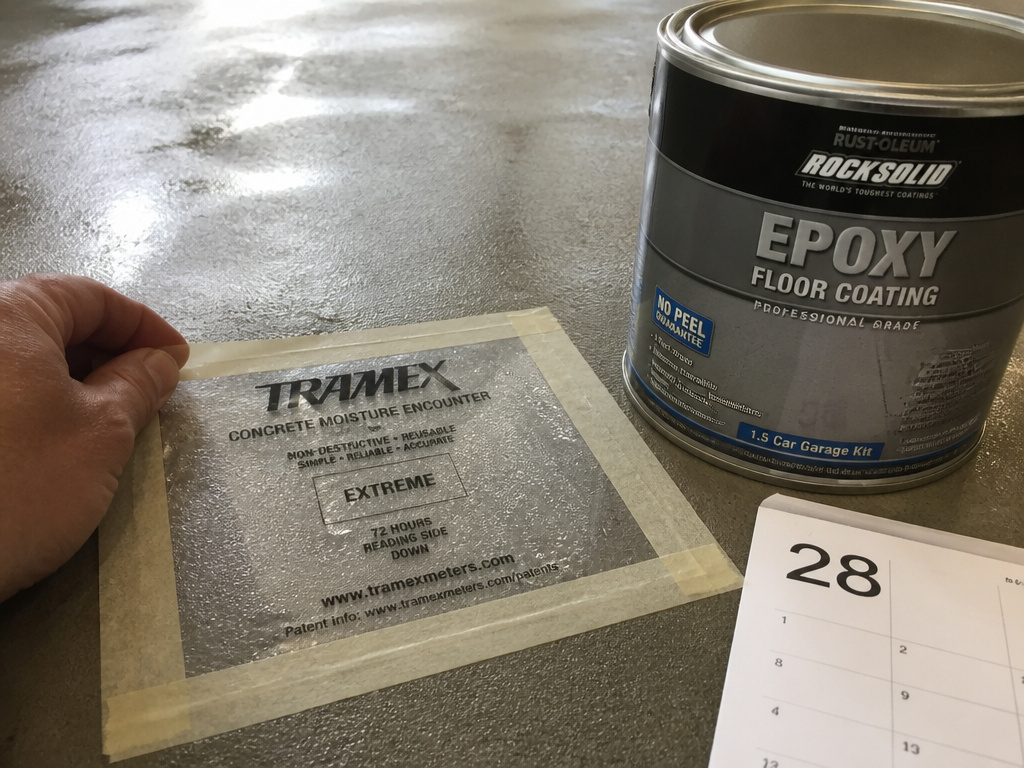
Twenty-eight days is the minimum cure for newly poured concrete before RockSolid or EpoxyShield goes on. Gorilla’s kit instructions ask for at least 30.
The reason is moisture, not hardness. Fresh concrete is still releasing water vapor from the mix, and a coating applied over an active slab traps that vapor underneath. It finds the weakest point in the film and pushes through as a blister or a cloudy patch.
If your slab was poured this month, put the cans away and come back in 28 to 30 days. There’s no additive that shortcuts this.
Does a Garage Floor Need a Primer Coat?
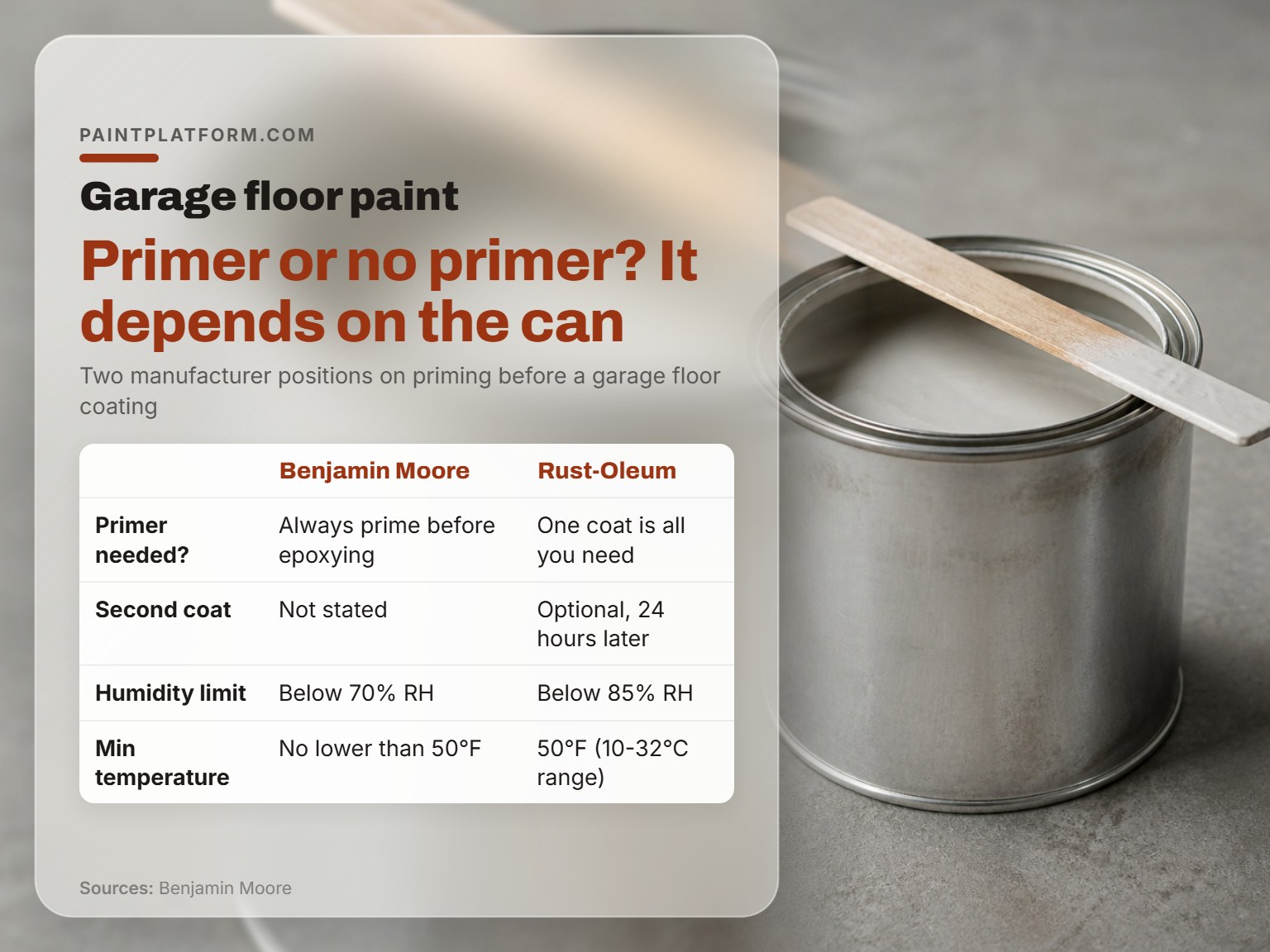
Benjamin Moore says yes, always. Rust-Oleum’s Concrete & Garage Floor Paint and Primer says one coat is all you need, and a second coat is optional, applied 24 hours later in a perpendicular direction.
Both positions are manufacturer positions, and they’re describing different products. A can that already carries primer in the formula doesn’t need a separate primer step. A topcoat-only epoxy does.
Three brands, three different assumptions about what’s in your hand when you start.
I won’t argue with Benjamin Moore on this one, but I’ll say the primer decision follows the product, not the floor. Buy a can that carries the primer and skip a day. Buy a topcoat-only epoxy and budget the extra day honestly.
The Benjamin Moore garage floor guide is also the source of the tightest humidity number in this whole article: below 70 percent. If your garage runs damp, that’s the figure to plan around when you’re choosing epoxy garage floor paint.
Three Days, Five Days, or Ten: The Cure Clock by Brand
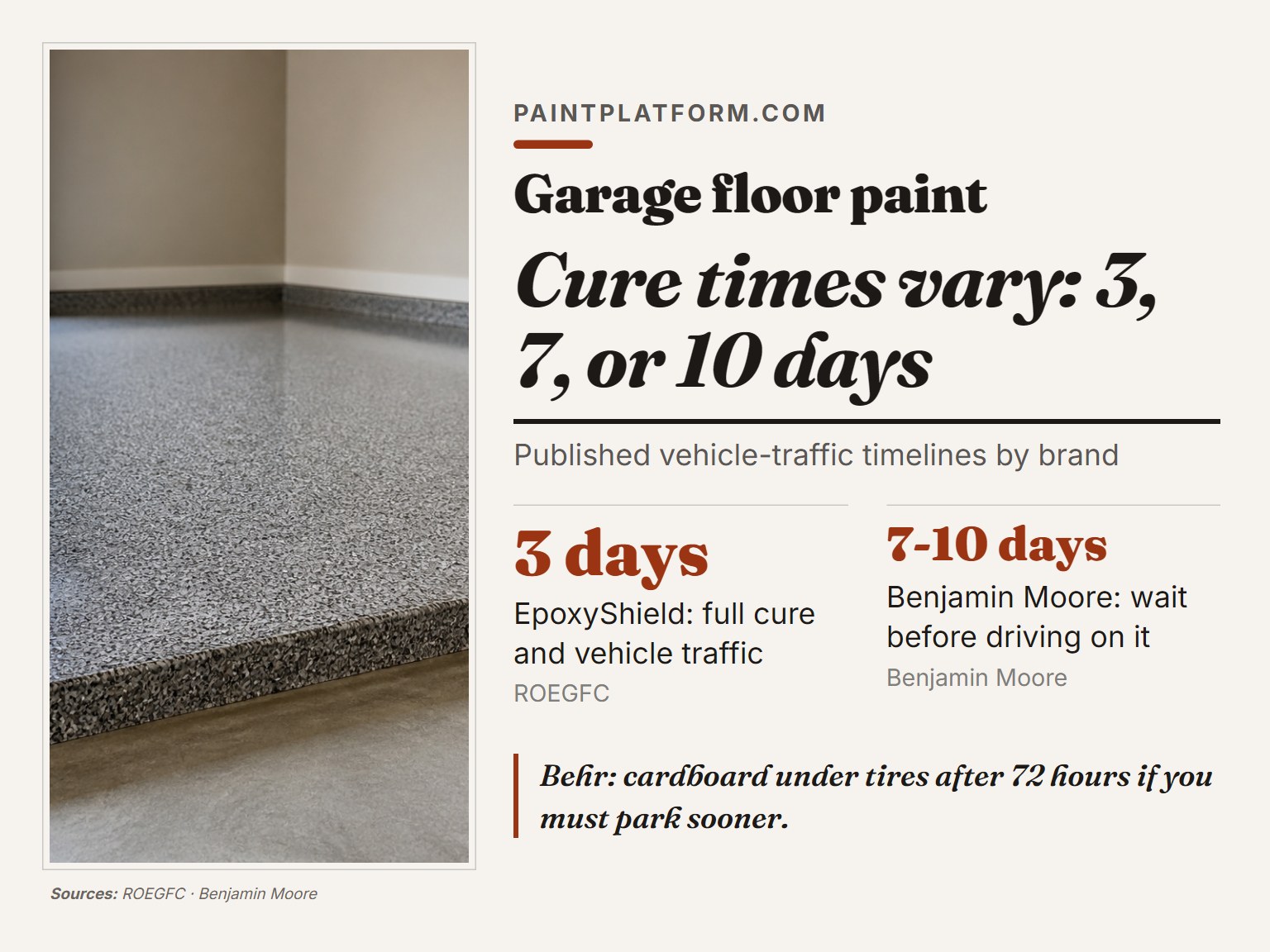
EpoxyShield says full cure and vehicle traffic at 3 days. System Three says 72 hours without a topcoat, and 7 days with one. Benjamin Moore says 7 to 10 days before you drive on it.
That’s a wide spread on the same basic question. The published timelines:
- Rust-Oleum EpoxyShield: light foot traffic at 12-16 hours, heavy items and normal foot traffic at 24-48 hours, vehicle traffic at 3 days.
- System Three ShowRoom: light foot traffic at 24 hours, moving items back at 48 hours, vehicle traffic at 72 hours. With a topcoat, 7 days.
- Benjamin Moore: 24-48 hours before returning items (and don’t drag them), 7-10 days before driving on it.
- Behr Premium 1-Part Epoxy: corrugated cardboard under tires after 72 hours if you must park sooner.
Small confession: I rolled one corner of a floor too thick to save time, and it stayed tacky for days. Thin coats are the answer, annoyingly.
Why the Numbers Vary So Much
Full cure depends on film thickness, ambient temperature, and whether a topcoat is involved. A thin coat at a warmer temperature cures faster than a thick coat at a cooler one, and the manufacturer can only publish one number for the label.
System Three’s own guide puts the whole project at 3 to 5 days for a typical two-car garage, including prep, primer, basecoat, and an optional clear topcoat. That’s the honest schedule.
If you want the longer version of that trade-off, a garage floor paint guide on epoxy pros and cons is worth reading before you commit a week of evenings.
Which Can Fits Your Garage?
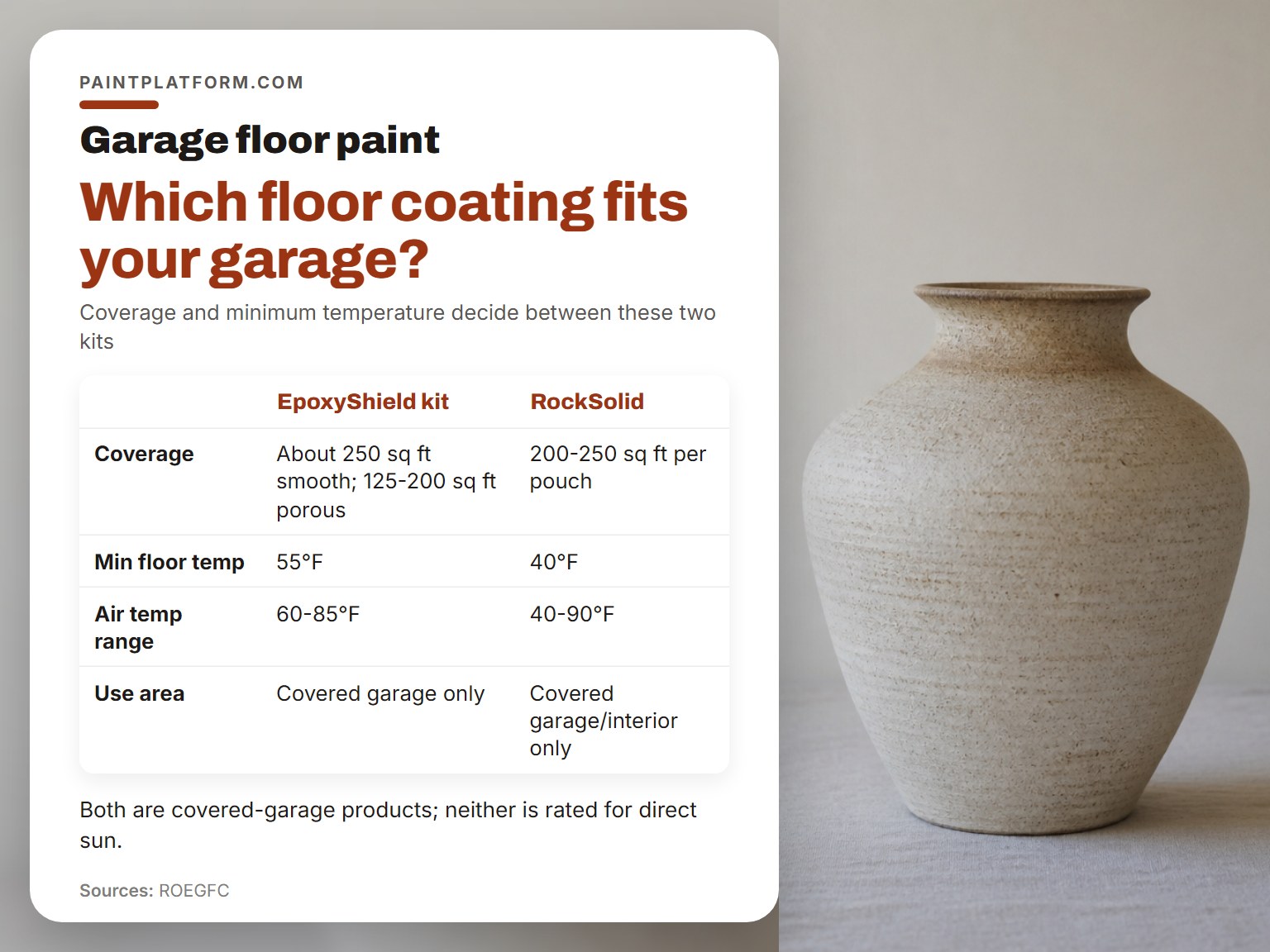
Match the product to the slab and the calendar, and the decision mostly makes itself. Here’s how I’d sort the common cases:
| Your situation | Product that fits | Why |
|---|---|---|
| Bare 2-car slab, covered garage | Rust-Oleum EpoxyShield kit | About 250 sq ft per kit on smooth concrete |
| Cold garage you can’t keep above 55 degrees F | Rust-Oleum RockSolid | 40 degree F floor minimum |
| Basement floor | EpoxyShield with TSP prep | Etch is off the table on basement slabs |
| Carport or driveway | None of these | All are interior or covered-garage only |
For a straightforward garage, EpoxyShield is the default pick. It covers roughly 250 square feet on smooth bare concrete, dropping to 125-200 square feet on rough or porous slabs, and the pot life of 1-2 hours forces you to work in a straight line.
RockSolid earns its place when temperature is the constraint. Its Polycuramine pouch covers 200-250 square feet, and the 40 degree F floor minimum buys you weeks of extra working season at either end of the year.
Both are covered-garage products. Neither is rated for direct sun, and Gorilla’s instructions say the same thing: epoxy fades under constant exposure.
Where this goes sideways: Coating a floor that gets wet. Painted concrete turns slick fast, and Rust-Oleum, EpoxyShield, and the SSPC flooring report all point the same direction. Add the anti-skid additive to the mixed coating, or plan on an anti-slip epoxy topcoat.
Epoxy or Polyurethane for a Garage Slab?
Epoxy is a common choice for bare concrete garage slabs.
For a floor that sees daylight through an open door all afternoon, the epoxy vs polyurethane comparison is worth ten minutes before you buy.
If you’re still comparing brands across the whole category, the rundown of the best garage floor paint covers the field, and the concrete floor paint options include the one-part acrylics that skip the mixing entirely.
Frequently Asked Questions
How long after painting a garage floor can I park on it?
It depends on the product, and the spread is real. Rust-Oleum EpoxyShield says 3 days for full cure and vehicle traffic. System Three says 72 hours without a topcoat and 7 days with one. Benjamin Moore says 7 to 10 days. Check your specific can before you move the car back in.
Do I have to etch concrete before painting it?
Not always. Rust-Oleum’s citric-based etch is the standard prep for garage slabs, but EpoxyShield’s instructions say to skip the etch on basement floors and use a TSP solution or substitute instead. The test is water: if it beads, the surface isn’t ready regardless of which prep you chose.
Can I paint a garage floor in cold weather?
Only within the product’s published window. RockSolid allows air down to 40 degrees F with a 40 degree F floor minimum. EpoxyShield needs 60 degrees F air and 55 degrees F at the slab, and it doesn’t want overnight temperatures below 65 degrees F for 24 to 48 hours afterward.
Why did my garage floor paint peel?
Almost always moisture or surface contamination. A slab that fails the 24-hour plastic sheet test traps vapor under the film, and the coating lifts.
Is one coat of garage floor paint enough?
Rust-Oleum’s own instructions say one coat is necessary and a second is optional. If you do add one, wait 24 hours and roll perpendicular to the first coat. Behr’s guidance is a thin, even layer, which is the same advice in different words.
How do I know if my slab has moisture problems?
Tape a 2′ x 2′ sheet of clear plastic down for 24 hours. Water droplets on the underside, or concrete that reads darker than the surrounding slab, means moisture is trapped. Resolve it before coating, or the coating becomes the thing that fails.
The Bottom Line
Here’s the trigger I’d hand you: pour a cup of water on the slab. If it soaks in, and the plastic sheet came up dry, you’re ready to buy a can. If either test fails, no product on the shelf fixes it, and you’ve saved yourself a week of evenings.
One concession worth stating plainly. If you’re sanding or scraping old paint off that slab, the lead question overrides everything else here. Rust-Oleum’s instructions call for a NIOSH-approved respirator, a HEPA vacuum, and a wet mop for cleanup, and that’s not a step to shortcut with a shop vac and a dust mask.
Everything above assumes a clean, dry, sound slab and a weekend you’re willing to give to prep. Start small and stay curious. The floor will tell you what it needs if you test it first.
