
Epoxy vs Polyurethane Paint: Which Should You Buy?
This post contains affiliate links. As an Amazon Associate, we earn from qualifying purchases.
Epoxy vs polyurethane paint splits on what the surface faces: epoxy bonds hard and resists chemicals and water, while polyurethane holds color and gloss in sunlight. Use epoxy for floors, tanks, and below the waterline. Use polyurethane for exterior topcoats, vehicles, and anything that must stay glossy.
Below the waterline is where that split gets physical. Epoxy cures into a hard, impermeable film that water cannot creep through, which is why boat restorers reach for it on wooden hulls and why chemical tanks get novolac epoxy. Polyurethane stays flexible and holds its color under UV, so it sits on top and takes the sun.
What follows walks the choice surface by surface: the head-to-head specs, the places where the sources flatly contradict each other, and the cure-time math that decides whether your project takes a weekend or a week.
Key Takeaways
- Epoxy wins floors and chemical tanks. Trade trainer Akis Apostolopoulos rates epoxy harder and higher in compression strength than polyurethane, and much more resistant to sulfuric acid.
- Polyurethane wins outdoors. Aliphatic PU holds color and gloss for 5-10 years in sun, while exterior epoxy yellows and degrades in 12-18 months, per Magamal Pinturas.
- Cure time splits them. Epoxy usually needs about 7 days to fully cure. PU can be modified so a multicoat job starts Friday and hands over Monday.
- Cost claims contradict each other. Magamal says PU costs more than conventional epoxy. Eresboya says PU is generally more affordable. The trainer refuses to rank them at all.
- Thin coats or nothing. A thick epoxy coat skins over on top while the layer underneath stays soft.
What Each Coating Is Actually For
Epoxy and polyurethane solve different problems, so treat them as two tools rather than two brands of the same thing. One builds the barrier. The other wears the weather.
Epoxy forms a hard, impermeable film with high compression strength and strong adhesion. Polyurethane forms a flexible, UV-stable film that holds color and gloss under sunlight. The two are combined: epoxy as primer and intermediate coat, aliphatic polyurethane as the topcoat. That layering is the standard for offshore steel under ISO 12944 C5-M and CX.
That system matters more than the epoxy vs polyurethane paint either-or question most people ask. Magamal Pinturas, a Brazilian coatings manufacturer, lays out the same stack for offshore superstructures: zinc-rich epoxy primer, epoxy intermediate, polyurethane topcoat. The epoxy does the bonding and waterproofing. The PU does the color and the sun protection.
Epoxy’s Job
Epoxy is a two-component system, resin plus hardener, and it needs careful mixing before it goes down. Eresboya notes it gives a matte, smooth surface with strong adhesion, chemical resistance, and abrasion resistance. That combination is why it shows up on floor coatings, factory areas, chemical tanks, and parking garages.
For aggressive chemical immersion, Magamal specifies novolac epoxy. That is a different resin from standard epoxy, built for continuous contact with harsh chemicals rather than occasional splashes.
Polyurethane’s Job
Polyurethane is the finish coat. Eresboya lists it for exterior surfaces, vehicle coatings, metal, and furniture, and credits it with resistance to UV, weather, and impacts. RESINPRO makes the same point for boats: PU is the topcoat above the waterline, with a high-gloss finish and UV protection.
Here is the practical list I keep coming back to:
- Epoxy: concrete floors, chemical tanks, below the waterline, structural reinforcement on wooden hulls, garage slabs under forklift traffic.
- Polyurethane: exterior metal, vehicle panels, decks and topsides above the waterline, furniture, anything that has to hold a gloss.
- Both, in layers: epoxy primer and intermediate coat, then an aliphatic PU topcoat.
How Do the Two Compare Head to Head?
Which one wins? It depends on the surface, and the table below shows where each one pulls ahead.
| Property | Epoxy | Polyurethane |
|---|---|---|
| Hardness | Hard, but without elasticity | Hard plus flexible |
| UV and sunlight | Yellows in 12-18 months outdoors | Holds color 5-10 years (aliphatic) |
| Chemical resistance | Strong; novolac for immersion | Weaker than epoxy |
| Cure time | About 7 days to fully cure | Modifiable; Friday-to-Monday possible, but humidity-sensitive |
| Best surface | Floors, tanks, below waterline | Exterior topcoats, vehicles, decks |
The compression-strength row is where epoxy earns its keep. Apostolopoulos says epoxy floors are harder, more durable, and have much higher compression strength than polyurethanes. That is why warehouses and logistics centers with heavy forklift traffic run epoxy.
The sunlight row is where epoxy loses. Magamal puts exterior epoxy yellowing and degrading at 12 to 18 months. Aliphatic polyurethane topcoat, by the same source, retains color and gloss for 5 to 10 years outdoors.
Where the Sources Disagree on Epoxy vs Polyurethane Paint
Three of the sources contradict each other outright, and pretending otherwise would be dishonest. Here is who says what.
| Question | One position | The other |
|---|---|---|
| Cost | Magamal: PU costs more than conventional epoxy | eresboya: PU is generally more affordable |
| Abrasion | Magamal: PU wins, because it stays flexible | eresboya and LearnCoatings: epoxy wins on abrasion resistance |
| Durability | eresboya: epoxy lasts longer | Magamal: PU lasts longer outdoors |
| Humidity | Magamal: PU is more restrictive to apply, though epoxy is also moisture-sensitive with far more limited damage | LearnCoatings: PU needs trained, experienced staff |
On cost, Magamal rates epoxy “moderado” and PU “mais caro,” meaning PU costs more. Eresboya says polyurethane paints are generally more affordable. Apostolopoulos declines to rank them at all, calling the comparison “apples to oranges” because there are so many product tiers.
My read: both are right about different products. Aromatic PU floor resin and aliphatic PU topcoat are not the same purchase, and the price gap swings with the grade.
On abrasion, Magamal’s table gives PU the edge because it combines hardness with flexibility, while epoxy is hard but without elasticity. Eresboya credits epoxy with abrasion resistance, and LearnCoatings rates epoxy floors harder and more durable for heavy traffic. Those two claims can both be true if you are measuring different things, which is why “harder” and “more abrasion-resistant” are not the same sentence.
I won’t pretend the cost question has a clean answer. After one bad weekend with a cheap epoxy kit, I stopped trusting the price tag and started trusting the spec sheet. A product that fails in year two costs more than one that lasts ten.
Friday Afternoon, One Gallon, and a Monday Deadline
That one-weekend epoxy kit idea lost me. Between degreasing, etching, and rinsing, prep alone ate most of a Saturday, and the coating needed about 7 days before anything could go back on it.
Then I rolled it on too thick in one corner to save time. The surface skinned over, the roller started dragging with a tacky pull I could feel through the handle, and that corner stayed soft. Thin coats, annoyingly, are the answer.
This is exactly where PU earns its reputation for speed. Apostolopoulos says polyurethane floors can be modified for pot life, re-coat time, and total cure time, which allows a contractor to start a multicoat project on Friday and hand it over on Monday, though PU is humidity-sensitive and more restrictive to apply. Epoxy, by contrast, usually needs 7 days to fully cure.
Here is how I plan a coating job now:
- Read the cure time before you buy. If the surface has to be back in service Monday, epoxy is the wrong product unless you have a full week.
- Block out prep as its own day. Degreasing and etching are not optional, and they take longer than the label suggests.
- Apply thin coats. A thick coat skins over and traps solvent underneath, which is how you get a tacky floor.
- Check humidity before you open the can. Magamal flags PU as humidity-sensitive and more restrictive to apply, though epoxy is also moisture-sensitive with far more limited damage. LearnCoatings goes further: its narrator refuses to supply inexperienced teams with PU floor resins because too many things can go wrong.
Before you start: Epoxy hardeners can sensitize skin on repeated contact, so wear nitrile gloves and long sleeves. Polyurethane hardeners are respiratory sensitizers, so brush or roll with ventilation and a proper respirator, not a dust mask. Solvent-based products are flammable, so keep ignition sources out of the room until the film is dry.
Where this goes sideways: A thick epoxy pour traps its own exotherm. The top skins over and the layer underneath stays soft. Two thin coats beat one thick one every time.
Which One Survives Sunlight, Chemicals, and Forklifts?
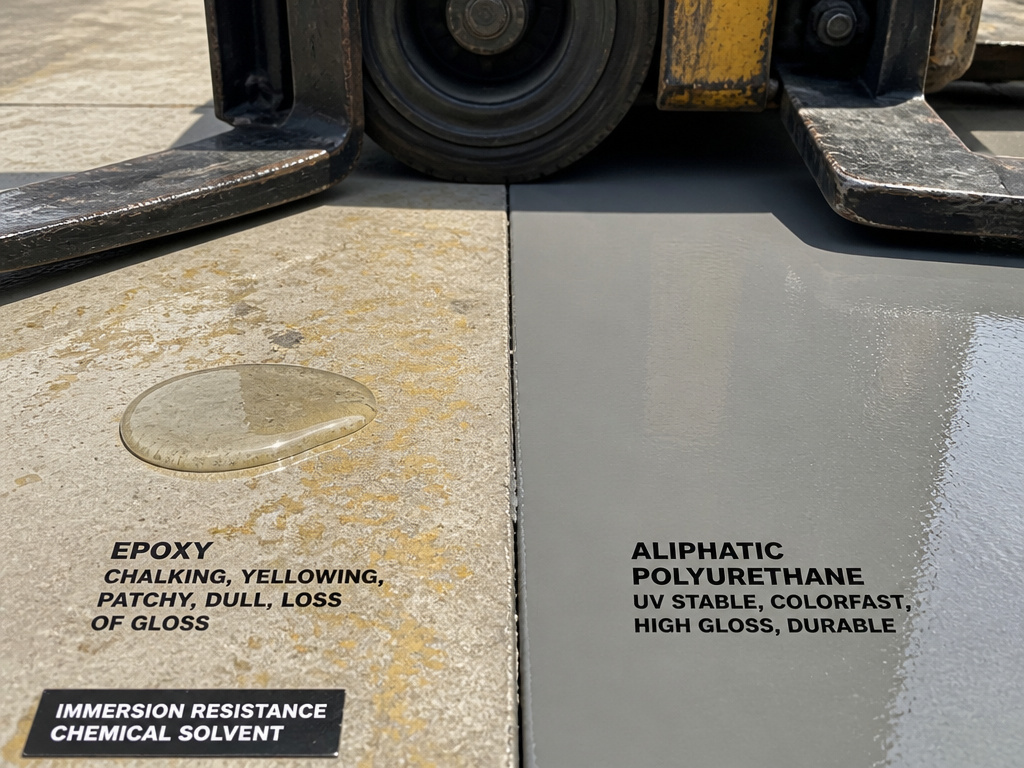
Sunlight, acid, and forklift traffic each pick a different winner, and the coating that wins one test can lose the next.
Sunlight and Yellowing
Magamal’s numbers are the clearest in the set. Exterior epoxy yellows and degrades in 12 to 18 months under sun exposure. Aliphatic polyurethane topcoat retains color and gloss for 5 to 10 years outdoors.
Creative Resins says the same thing in different words: epoxy lacks UV stability and may degrade faster in sunlight, while polyurethane excels in UV resistance and maintains color and finish longer.
The visual cue is easy to spot once you know it. A yellowing epoxy film goes chalky and slightly opaque at the surface, and the gloss drops away in patches rather than evenly.
Chemicals and Immersion
Epoxy takes this one. Apostolopoulos says that in sulfuric-acid industries such as battery manufacturing, epoxy floors are much more resistant than polyurethanes. Magamal specifies novolac epoxy for aggressive chemical immersion. Eresboya credits epoxy with strong chemical resistance for chemical production areas.
Creative Resins sums it up: epoxy typically lasts longer in highly corrosive environments because of superior chemical resistance, but it lacks UV stability.
Apostolopoulos notes that epoxies under heavy forklift conditions may experience corrosion and yellowing. In facilities with heavy chemical exposure, he recommends checking with the manufacturer to see which product suits the actual spill profile.
Forklifts and Abrasion
Compression strength goes to epoxy. Apostolopoulos rates epoxy floors harder, more durable, and much higher in compression strength than polyurethanes, which is why they are preferred for warehouses and logistics centers with heavy forklift traffic. Magamal’s verdict row awards epoxy the win for forklift floors on greater film hardness and compression resistance.
Abrasion resistance is murkier. Magamal’s table gives PU the edge because it combines hardness with flexibility. Eresboya credits epoxy with abrasion resistance, and LearnCoatings rates epoxy floors harder and more durable for heavy traffic. Both can be right depending on whether the wear is impact or sliding.
How to Choose Without Wasting a Weekend
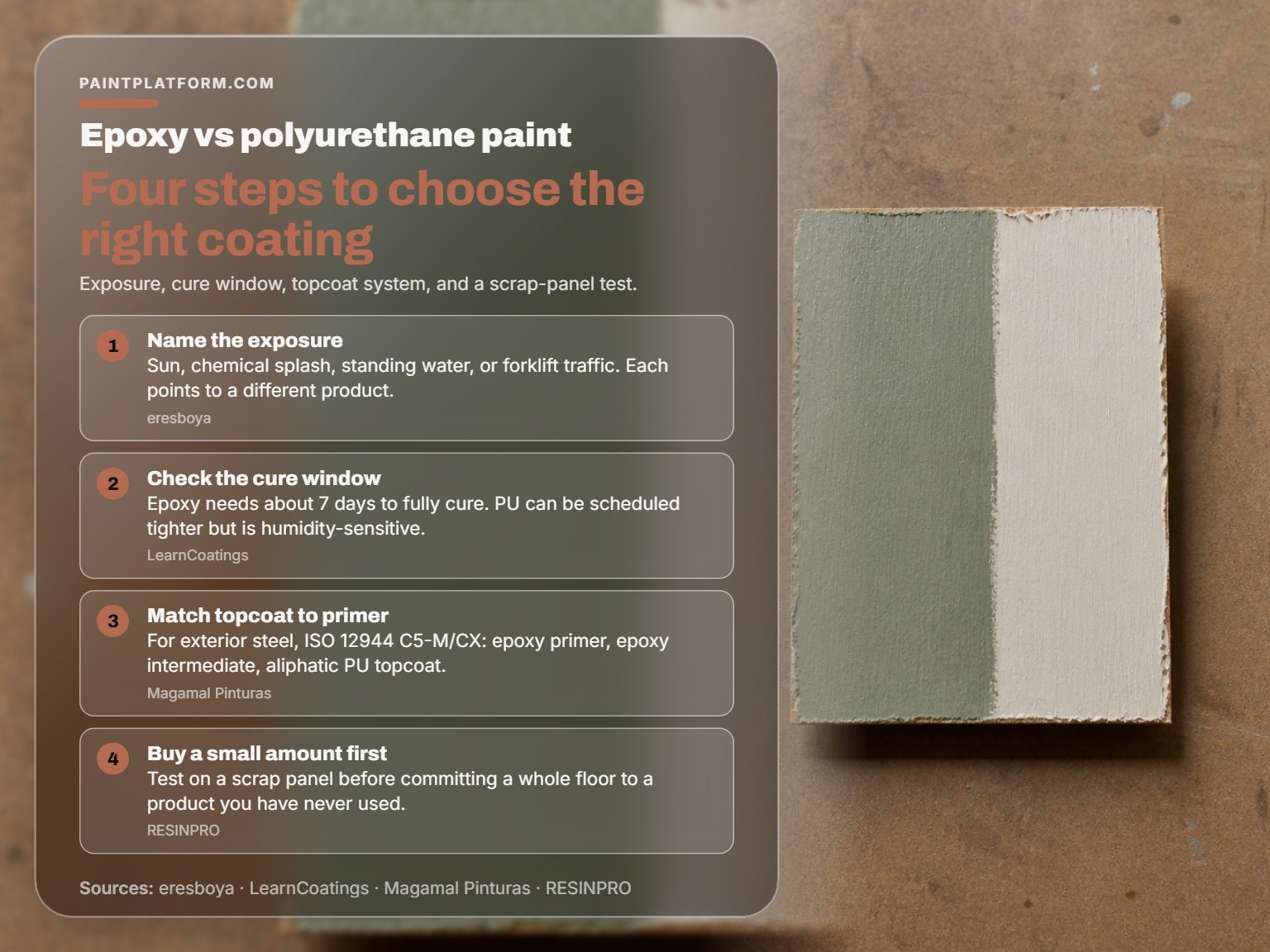
Four steps, in this order.
- Name the exposure. Sun, chemical splash, standing water, or forklift traffic. Each one points to a different product.
- Check the cure window. Epoxy needs about 7 days to fully cure. PU can be scheduled tighter, though it is humidity-sensitive and more restrictive to apply. If the surface has to be back in service fast, that decides it.
- Match the topcoat to the primer. For exterior steel, the ISO 12944 C5-M and CX system is epoxy primer, epoxy intermediate, and aliphatic PU topcoat. Do not skip the PU layer and expect the epoxy to hold color.
- Buy a small amount first. Test on a scrap panel before you commit a whole floor to a product you have never used.
That last step is the one most people skip, and it is the one that saves the most money. Reviews describe someone else’s surface, someone else’s humidity, and someone else’s prep. A scrap panel describes yours.
The Small Test That Beats Any Review
Coat a scrap of the same substrate with each product, let both cure, and leave them outside for a month. You will learn more from that panel than from any comparison table, including this one.
Thin coats, more of them, and a full cure window. That is the whole game with two-component coatings.
Frequently Asked Questions
Is polyurethane better than epoxy for outdoor metal?
For color and gloss retention, yes. Magamal puts aliphatic polyurethane at 5-10 years outdoors versus 12-18 months for exterior epoxy. For chemical exposure or immersion, epoxy is the stronger choice.
Can you put polyurethane over epoxy?
Yes, and it is the standard system. RESINPRO recommends epoxy undercoats for bonding and waterproofing, with a PU topcoat for weatherproofing and color. The PU layer also protects the epoxy underneath from sunlight and yellowing.
Why did my epoxy floor stay tacky?
Most likely the coat went on too thick. A thick film skins over on top while solvent stays trapped underneath, and the floor can still be tacky. Cool temperatures and short mixing times make it worse.
Which is cheaper, epoxy or polyurethane paint?
The sources disagree. Magamal rates PU as more expensive than conventional epoxy. Eresboya says PU is generally more affordable. Apostolopoulos refuses to rank them, calling it “apples to oranges” because product tiers vary so widely.
How long before I can walk on an epoxy floor?
Epoxy usually needs about 7 days to fully cure, per Apostolopoulos. Light foot traffic may be possible sooner depending on the product, so follow the manufacturer’s recoat and cure schedule rather than a general rule.
The Bottom Line
If your surface faces sun, buy the polyurethane topcoat. If it faces chemicals, water, or forklift traffic, buy the epoxy. If it faces both, buy both and stack them in the order the sources agree on: epoxy primer, epoxy intermediate, aliphatic PU topcoat.
Here is the threshold that decides most home projects. If the coating has to be back in service quickly, epoxy is the wrong product. Pick a PU system you can schedule tightly, or wait for a week when you have the time.
And do the scrap-panel test first. One afternoon and two small cans will tell you more about how a product handles on your surface than any review, including mine.
Start messy, refine later.
