
Limewash Paint Pros and Cons: What Actually Lasts
This post contains affiliate links. As an Amazon Associate, we earn from qualifying purchases.
Limewash paint pros and cons split cleanly: limewash lets an old wall dry out, but it streaks, and needs recoating far more often than modern paint. SPAB’s guidance puts renewal at every five years, while heritage bodies following older practice reapply annually.
Five years assumes a wall that can dry. Seal that wall with a water repellent and the moisture has nowhere to go, which is the first failure NSW Environment and Heritage warns about.
What follows is the honest ledger: where limewash wins, where it fails on real stone, what two peer-reviewed studies actually measured, and how to tell a genuine limewash from an acrylic product wearing the label.
Key Takeaways
- Breathability is the entire point. Limewash transmits moisture and salts; acrylic “limewash” does not, according to NSW Environment and Heritage.
- Plan on recoating. SPAB says every five years. Babergh District Council and the National Park Service both describe annual reapplication on exposed walls.
- At least three or four coats on a first application, each one dried and the wall dampened before the next.
- Sandstone is a no for first-time limewashing, per SPAB. The Lime Association’s own brief is notably less cautious.
- Skip the “improved version” tins. NSW says that phrase usually signals modern binders hiding inside.
Limewash Paint Pros and Cons Begin With Calcium Hydroxide
Calcium hydroxide is the whole trick. Slaked lime mixed with water goes on thin and milky, then sets by pulling carbon dioxide out of the air and turning back into calcium carbonate, the mineral limestone is made of.
Limewash consists of slaked lime, calcium hydroxide, mixed with water and applied thin. It sets by absorbing carbon dioxide and converting to calcium carbonate, the mineral in limestone. The coating sits as a sacrificial layer, eroding before the masonry beneath it does, and transmitting moisture vapor rather than blocking it.
That carbonation cycle is why the coating stays vapour-open. It also explains the soft, uneven colour that people chase. Pigment is often added to the final layers only, and regional shades grew out of local earths.
I came to limewash through paint rather than through restoration, and the first thing that struck me is how little it behaves like paint. It doesn’t sit on top of the wall. It soaks in and becomes part of the surface.
Three things follow from that chemistry:
- It erodes instead of peeling. Limewash acts as a sacrificial coating, destroyed more rapidly than the material below it. That is a completely different maintenance rhythm.
- It is reversible. Limewash often comes off with water unless water-shedding additives are in the mix.
- It is genuinely thin. Brushing on a visible, thick layer is likely to craze and crack on drying; apply several thin applications. Brush it on visibly thick and it crazes into a web of cracks.
That last point catches people. More product feels like more protection. Here it just means more cracking.
How Long Does Limewash Last Before It Needs Redoing?
This is where the sources stop agreeing, and the spread is wide enough that it changes how you plan the job.
| Source | Stated interval | What it describes |
|---|---|---|
| SPAB | Every five years | Typical renewal on a suitable wall |
| Babergh District Council | Annually | Traditional practice on unprotected walls |
| National Park Service | Annually | Reapplication to counter weathering |
| Keim Mineral Paints | Distress in months; redecoration in a few years | Manufacturer comparing limewash to its own product |
Read that table before you commit to a schedule. Five years and one year are not the same promise, and both come from credible conservation bodies.
The NPS findings sit on the pessimistic end and they are worth naming properly. Its NPS durability study of limewashes recommended three or more applications for the initial coat and annual reapplication to counter weathering from exposure. Successive limewashings needed fewer layers, which is at least some consolation.
Babergh’s Babergh District Council limewash guidance explains why the annual figure existed at all. Limewash can be impermanent and rubbed off unprotected parts of a building, so traditionally walls were limewashed every year.
Judge the interval by the wall, not by the tin. A sheltered courtyard and a wind-battered gable on the same house are two different schedules.
Why the Numbers Diverge
Exposure does most of the work. An unprotected elevation takes driven rain and acid rainfall, and Keim points out that in high-acid-rain areas the limewash actually dissolves and streaks.
Keim is also a mineral paint manufacturer, so treat its “distress within a few months” line as an interested party’s position rather than neutral research.
Breathability, Measured Instead of Repeated
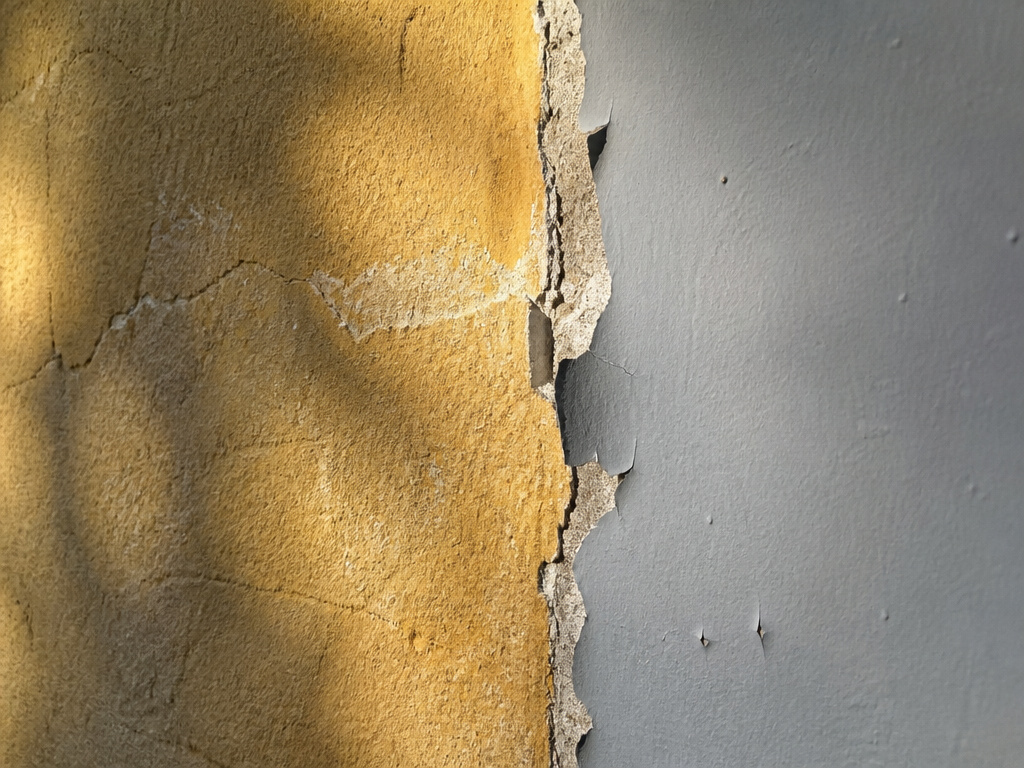
Two peer-reviewed studies put numbers on the breathability claim.
The MDPI 2024 facade study ranked water-vapour permeability across coating types. Silicate and lime paints came out highest. Acrylic and PVA came out lowest. That is the whole argument in one sentence, and it is measured rather than asserted.
The same study found something less flattering. Lime paint showed the greatest colour variation under accelerated ageing and lost its pigmentation considerably. If you chose limewash for a specific shade, expect it to drift.
There is one finding in that paper I keep coming back to. Except for lime paint, detachment often occurred at the substrate. Lime paint failed within its own film rather than at the bond line.
That sounds like a defect. It is closer to a feature.
Where Limewash Fails: Stone, Salt, and Fast Drying
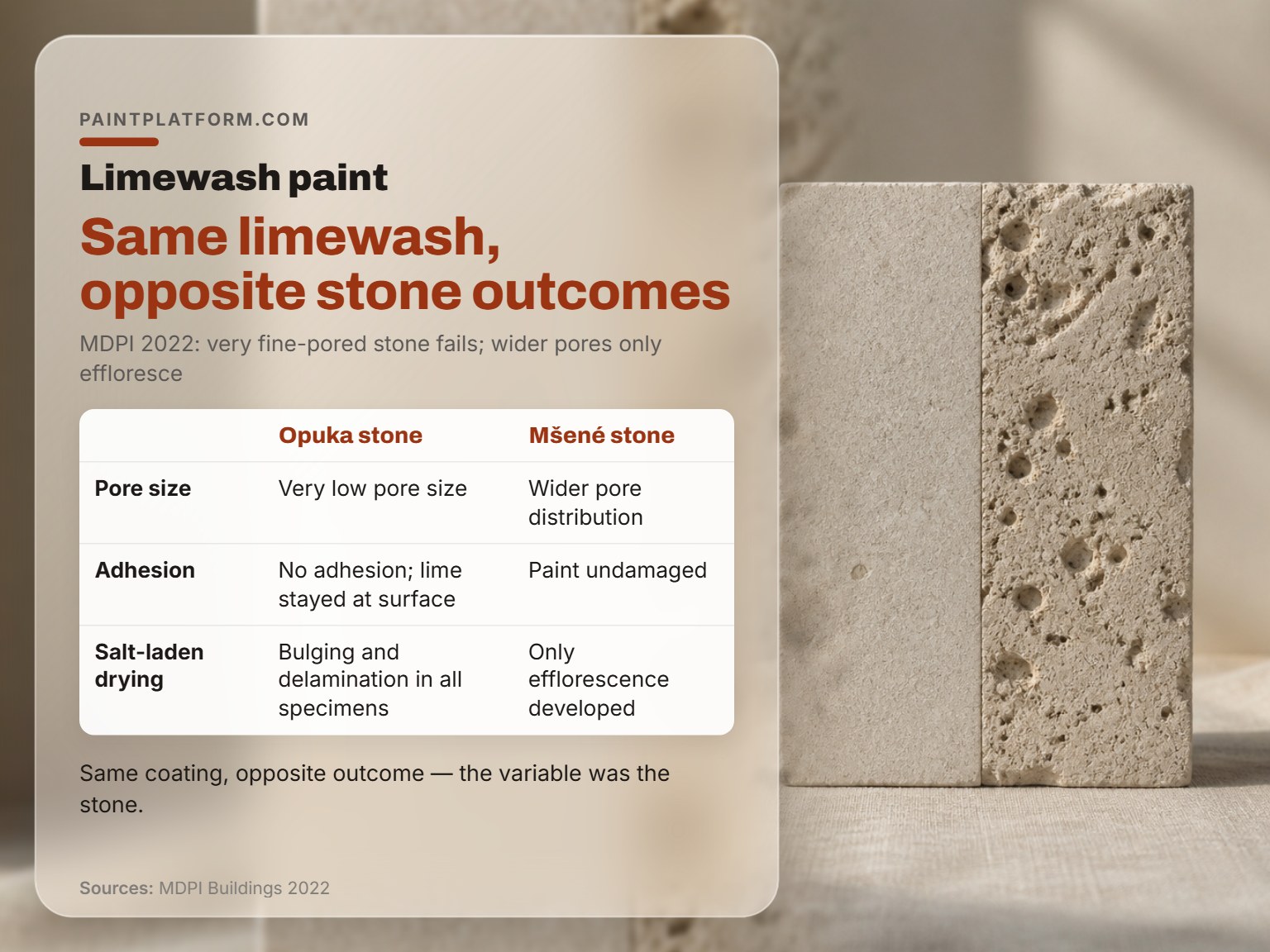
On very fine-pored stone, limewash can fail. That is not a scare story, it is a lab result.
The MDPI 2022 study tested two stones. On Opuka, a stone with very low pore size, the lime stayed at the surface with no adhesion at all. Bulging of the paint and delamination of the stone surface occurred in every Opuka specimen under salt-laden drying.
On Msené stone, which has a wider pore distribution, only efflorescence developed. The paint itself was undamaged. Same coating, opposite outcome, and the variable was the stone.
| Substrate | Verdict | Reason |
|---|---|---|
| Lime plaster or render | Good | Similar porosity and movement to the coat |
| Limestone | Good | Porous, breathable, accepts the lime |
| Sandstone, first time | Avoid | SPAB calls first-time limewashing inadvisable |
| Flint and hard brick | Avoid | Impervious; the coat cannot grip or dry |
| Cement render, plasterboard | Poor | Takes less well; may need modification |
| Very fine-pored stone | Fails | No adhesion; delamination under salt load |
The Salt Problem
Salt-laden masonry is the second trap. Oil-modified limewash can suppress salt transit rather than let the salt pass, and the MDPI 2022 work found that oil alters drying kinetics when the dose is wrong.
NSW is blunter about the general principle. Old walls should never be coated with water repellents or sealing products, because the coating traps moisture and causes damage.
Fast Drying and Hot Sun
SPAB notes that limewashing is less successful in very fast-drying conditions. Limewash needs time to carbonate, and limewashing is less successful in very fast-drying conditions.
That is a scheduling problem, not a product problem. Dampen the wall first.
Are Linseed Oil and Other Additives Worth It?
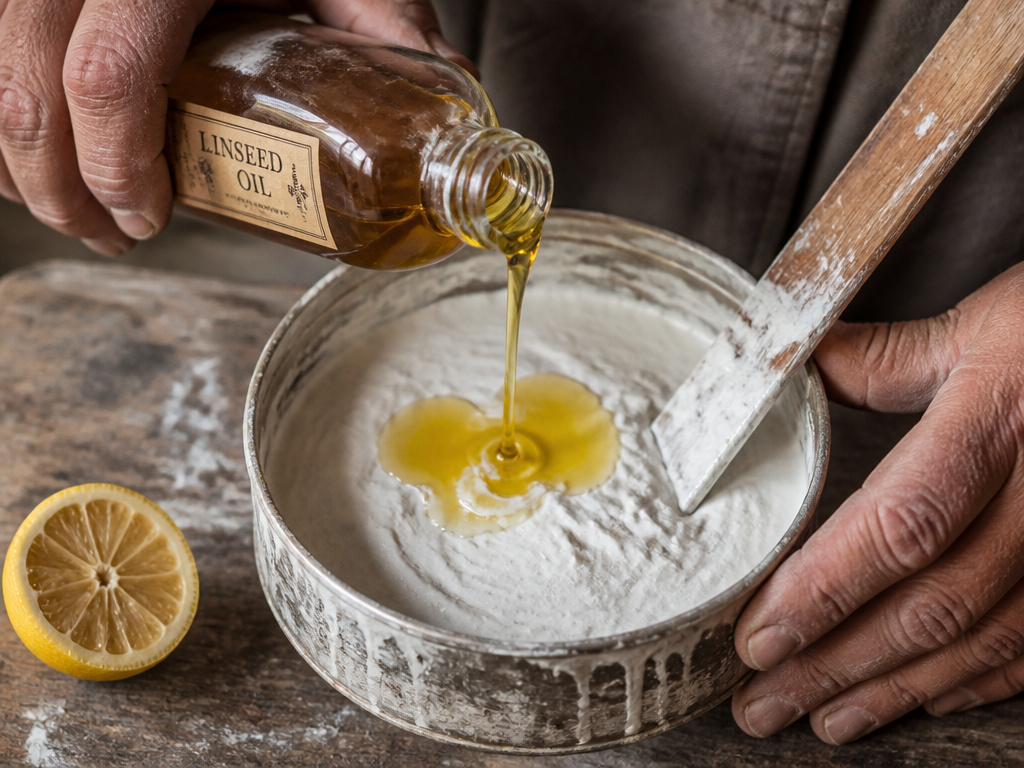
Linseed oil gets sold as the old-timer’s secret. The research is more mixed than the folklore, and the sources here genuinely disagree.
Here is the split, stated plainly. Babergh notes that linseed oil was commonly used historically as an additive. NSW allows an egg-cupful of raw linseed oil if desired, then adds that it may be better to use additives only in the final coats, if at all. SPAB goes furthest the other way: additional binders such as tallow and raw linseed oil reduce breathability, and tallow may support mould growth without a biocide.
The experimental work lands in the middle. MDPI 2022 found water repellence increased more or less linearly with linseed-oil dose, but none of the tested mixes achieved hydrophobic properties. So water repellence increases with linseed-oil dose, but none of the tested mixes achieved hydrophobic properties.
If you want to make limewash from putty, start plain. NSW’s method covers a few trowelfuls of putty with about 75mm of water, works it to a smooth paste, then dilutes to a thin cream at roughly 15-20% lime.
Limewash vs Mineral Paint vs Clay Paint: Which Wins Where
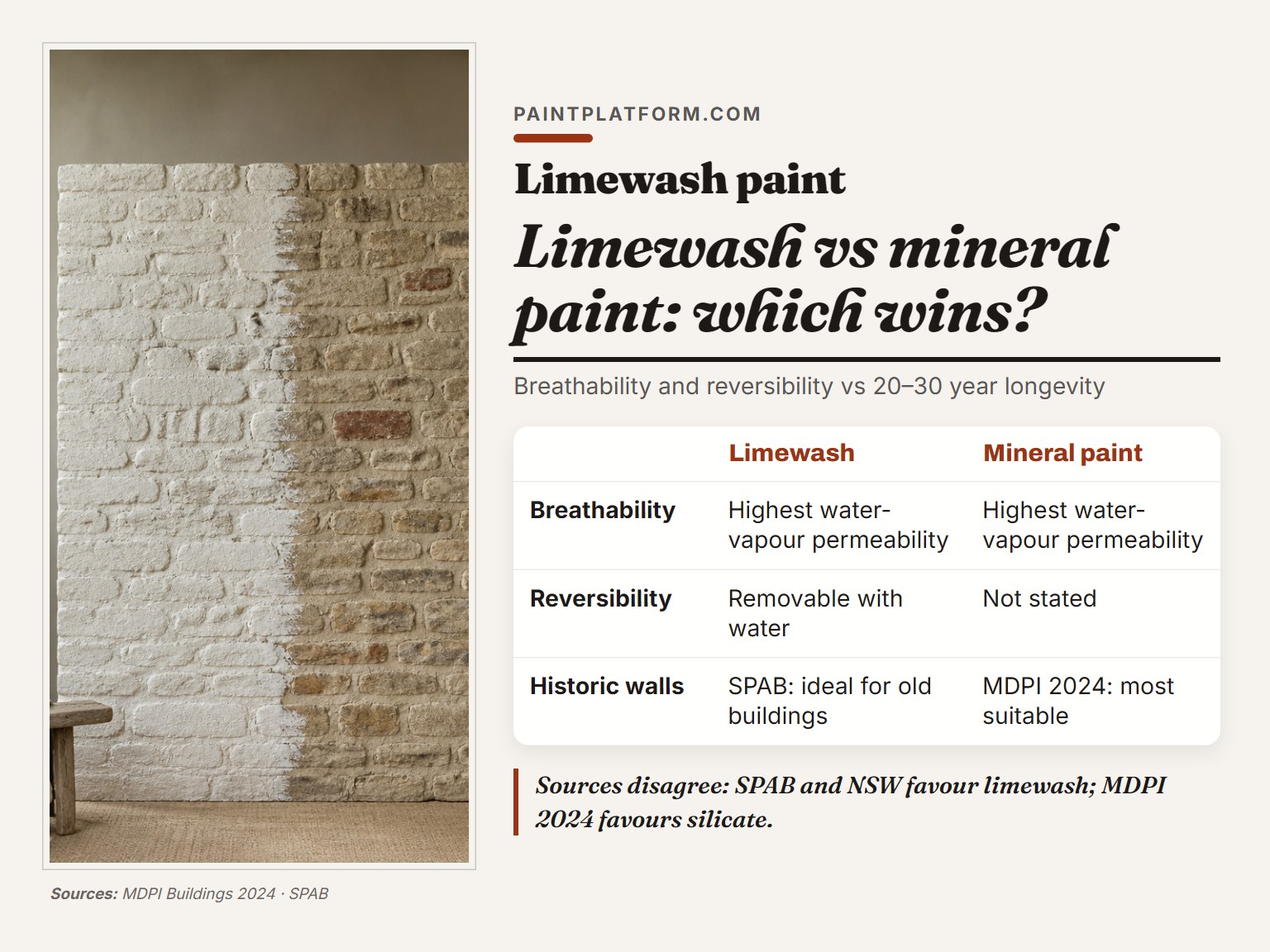
Three coatings do three different jobs, and picking the wrong one costs you a season of weekends.
Limewash wins on breathability, reversibility, and old walls. SPAB calls it the ideal choice for old buildings, and the sacrificial-coating mechanism backs that up.
Mineral paint wins on longevity. Keim claims 20 to 30 years of satisfactory performance on previously unpainted surfaces before redecoration, and the MDPI 2024 study concluded that silicate-based paints may be the most suitable option for conserving historic facades. Keim is a manufacturer making a manufacturer’s claim, so weigh it accordingly, but the independent study points the same direction.
Limewash vs Mineral Paint
If the wall is historic and you want a longer-lasting coating, mineral paint is the stronger mineral paint pros and cons case. If the wall needs to keep drying and you want the option to strip it back with water, limewash is the better fit.
Note the tension: SPAB and NSW both favour limewash, while the peer-reviewed facade study favours silicate. Both positions are defensible. They are optimising for different things.
Limewash vs Clay Paint
Limewash is harder, more alkaline, and better suited to masonry than to a plasterboard partition.
If you are coating limewash for interior walls rather than an exterior, the alkalinity still helps, but the wear pattern changes fast in hallways.
How to Tell Real Limewash From an Acrylic Impostor
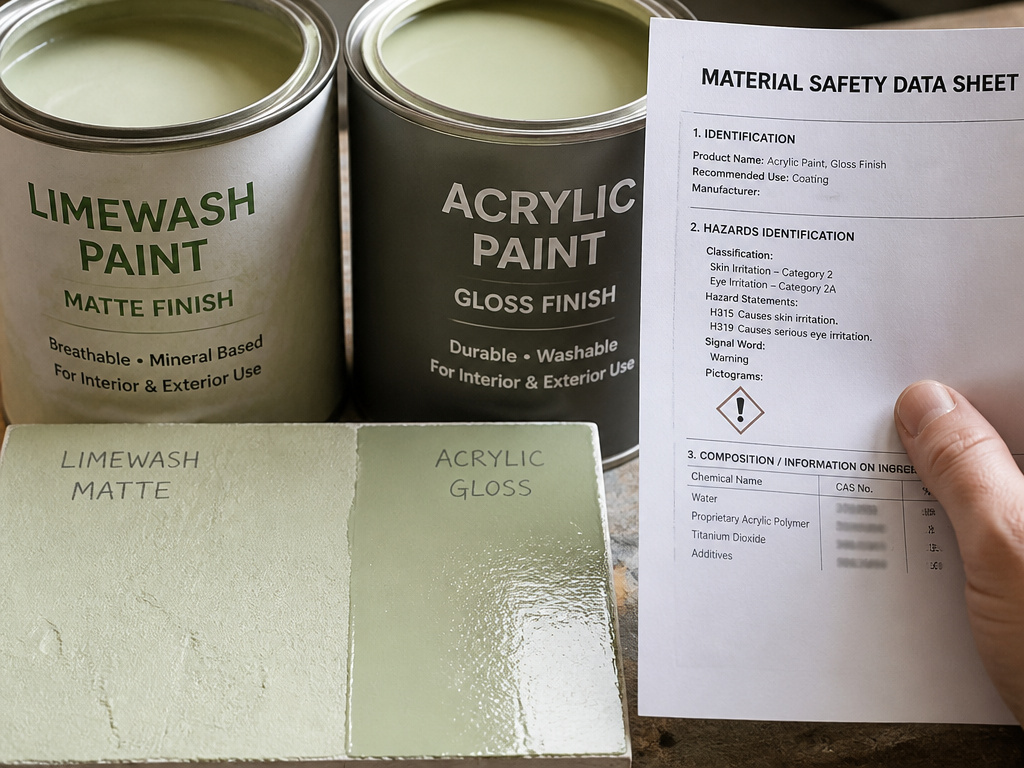
If the tin says “improved version”, put it down. NSW is explicit that this phrase usually signals modern binders.
Many commercial products sold as limewash are acrylic-based. They get marketed as vapour permeable, but NSW states they do not transmit moisture and salts and may create an impermeable, damaging coat. That is the exact failure mode limewash exists to avoid.
Five checks, in order of usefulness:
- Read the material safety data sheet. NSW points to MSDS documents as the place binders are disclosed. Manufacturers have to supply them.
- Watch for the word “improved”. NSW says an ‘improved version’ claim usually signals modern binders.
- Look at how it wears. Limewash acts as a sacrificial coating, destroyed more rapidly than the material below it.
Where this goes sideways: Buying a commercial product with modern binders without checking the MSDS first. NSW’s fallback is to look for one with a minimum proportion of acrylic resin or another organic polymer, but you can only do that if you read the sheet.
Applying It Without Wrecking It
Before you start: Quicklime is highly caustic and combines violently with water, creating intense heat and spitting that will burn. Wear waterproof clothing, a cloth over the neck and mouth, gloves, barrier cream, and safety glasses. Keep an eye bath of clean lukewarm water within reach, and if limewash gets in an eye, rinse continuously for 20 minutes and get medical help.
The method itself is short. The drying time is what people underestimate.
- Dampen the surface. SPAB says each coat should be allowed to dry and the surface dampened before the next coat.
- Apply thin and work it in with a large, rough-textured brush. A visibly thick layer crazes and cracks as it dries.
- Let each coat dry fully, then dampen again before the next. Rushing this is how you get a dusty film that rubs off on clothes.
- Build to three or four coats on a first application. SPAB’s figure is at least three or four, and NPS says three or more.
- Add pigment to the last coat or two only. SPAB and NSW agree on this, and it saves you mixing large volumes of a colour you may not love.
For a room-by-room walkthrough, how to limewash interior walls covers the indoor version, where drying times stretch and ventilation matters more.
One practical warning on colour: matching coloured limewash batches is difficult, so SPAB advises making enough to complete a single coat in one go. Buy short and you will see the seam.
Frequently Asked Questions
Is limewash paint safe to use indoors?
Yes, with ventilation and normal precautions. The finished coat is inert calcium carbonate. The wet product is caustic, so gloves and eye protection matter during application. NSW recommends an eye bath on hand and a 20-minute rinse if splashes reach the eyes.
Does limewash stop mould?
It helps rather than stops it. SPAB notes the alkalinity deters wood-boring beetles and helps sterilise walls, and Babergh describes limewash as slightly antiseptic. Trapped moisture is the real cause of mould, which is why sealing a wall makes the problem worse.
Can you paint over limewash with normal paint?
You can, but you lose the breathability that made limewash worth using. Babergh warns that masonry paint over a mineral finish is unlikely to be acceptable because masonry paint is impermeable and traps moisture. Going the other direction, limewash does not bond well to masonry paint either.
How many coats of limewash do you need on a first application?
At least three or four, according to SPAB, with each coat allowed to dry and the wall dampened before the next. The National Park Service recommends three or more for an initial limewashing. Successive recoats need fewer layers.
Does limewash work on modern brick?
Usually not. SPAB lists hard brick and flint as unsuitable because they are impervious, so the coating cannot grip or dry properly. Modern dense brick behaves much like hard brick in this respect.
Before You Go
Here is the trigger that should stop you before you buy anything. If your wall is sandstone that has never been limewashed, or flint, or hard brick, close the tab and go do something else with your weekend. SPAB is direct about all three, and no amount of careful application fixes a substrate the coating cannot bond to.
For everyone else, the honest summary of limewash paint pros and cons is this: it is the most breathable option on an old wall, it is the easiest to undo, and it will ask you to come back sooner than you would like. Budget for a recoat schedule somewhere between annual and five-yearly depending on exposure, and you will not be surprised.
One concession worth stating. The MDPI 2024 facade study argues that silicate-based paints may be the most suitable choice for historic facades, and that is a real challenge to the limewash-first position that SPAB and NSW both hold. If longevity outranks reversibility for your building, mineral paint deserves a serious look.
For a shade-by-shade starting point, the limewash paint brands worth comparing are mostly the traditional putty-based ones, and it helps to know the limewash vs whitewash distinction before you order a colour you cannot return.
Test a patch first. Always a patch.
