
Paint Sheen Guide for Every Room: What Goes Where
This post contains affiliate links. As an Amazon Associate, we earn from qualifying purchases.
A paint sheen guide for every room starts with a contested rule: Sherwin-Williams says lower sheen hides wall flaws and higher sheen cleans easier, while Farrow & Ball says higher sheen no longer means tougher. Matte suits bedrooms and ceilings, eggshell or satin covers hallways and family rooms, semi-gloss handles kitchens, baths, and trim. Gloss belongs on doors and cabinets, not on a wall with dents in it.
Those gloss numbers on the back of a paint card come from a meter reading light off a dried film at two fixed angles. A finish measuring 30 at 60 degrees behaves nothing like one measuring 8. Same word on the label, different animal underneath.
What follows is the measurement system first, then the room-by-room calls, then the part most paint sheen guide for every room charts skip: how to test a sheen on your own wall before you commit to a gallon.
Key Takeaways
- Gloss is read at 60 degrees and sheen at 85 degrees, so two numbers describe one finish and they don’t move together.
- The durability ladder is contested. Farrow & Ball says higher sheen no longer means tougher; Sherwin-Williams and Consumer Reports still rank semi-gloss at the top.
- Cleaning a matte wall can permanently polish it. Benjamin Moore calls this burnishing, and it turns a stain into a shiny patch.
- Test on a sample board taped to the wall, not on a paper chip. Sheen shows at an angle, never head-on.
What Do the Gloss Numbers Actually Mean?
Two angles do all the work in any paint sheen guide for every room. Gloss is read at 60 degrees and sheen at 85 degrees, both on a 0 to 100 scale where 0 is chalk and 100 is a mirror.
Gloss is measured at a 60-degree angle and sheen at an 85-degree angle, on a scale of 0 to 100 where 0 is no reflection and 100 is mirror-like. The Master Painters Institute assigns Gloss Levels 1 through 7, each with separate 60-degree and 85-degree thresholds. Both numbers come from the same test method, ASTM D 523.
Sherwin-Williams publishes both angles in its sheen and gloss guide and points out that some products carry a gloss value, a sheen value, or both. That one detail explains most of the confusion in the aisle.
Here are the MPI levels as written into a real specification document.
| MPI Level | Name | 60° gloss | 85° sheen |
|---|---|---|---|
| Level 1 | Traditional matte / flat | Max 5 units | Max 10 units |
| Level 2 | High-side-sheen flat / velvet | Max 10 units | 10-35 units |
| Level 3 | Traditional eggshell | 10-25 units | 10-35 units |
| Level 4 | Satin | 20-35 units | Min 35 units |
| Level 5 | Traditional semi-gloss | 35-70 units | Not specified |
| Level 6 | Traditional gloss | 70-85 units | Not specified |
Level 7 (high gloss) sits above 85 units at 60 degrees.
Now the part that trips people up. The same document defines flat and eggshell twice, and the two definitions don’t match.
Under ASTM D 16, flat is anything below 15 measured at 85 degrees, and eggshell is 20 to 35 at 60 degrees. Under MPI, flat is capped at 5 units at 60 degrees and 10 at 85, while eggshell runs 10 to 25 at 60 degrees. A paint reading within both bands qualifies as eggshell under both. One reading above the MPI cap qualifies under ASTM and fails MPI.
The UH master spec Section 099123 is the document that puts ASTM D 16, ASTM D 523, and the MPI levels side by side, which is why the mismatch is visible at all. Most retail labels pick one system and stay quiet about the other.
What that means when you’re standing in the aisle:
- A sheen name is a range, not a number. “Eggshell” from two brands can sit far apart.
- Ask which angle the number refers to. A 60-degree figure and an 85-degree figure are not comparable.
- Ignore the name and read the product data sheet if the exact figure matters for a whole-house job.
For a wider look at how these categories stack up across brands, the guide to paint finishes covers the naming chaos in more detail.
Why the Durability Ladder Is Falling Apart
The claim that higher sheen means a tougher wall gets repeated so often it sounds like physics. Farrow & Ball now says it stopped being true.
Their position is direct: it used to be the case that higher sheen meant a more durable finish, and that’s no longer the case. Their Dead Flat is the most matte finish they make and they call it impressively durable. Their Flat Eggshell is described as just as durable as Modern Eggshell with half the sheen.
Sherwin-Williams half-agrees, and the half-disagreement is the interesting part. Their guide states that higher gloss and sheen are generally easier to clean, then immediately carves out Emerald and Duration Home, which they say offer exceptional washability, durability and stain resistance at all sheen levels.
Consumer Reports lands on the older rule. Their testing ranks semi-gloss as the toughest against wear and tear and the best at resisting stains, with flat and matte at the bottom, while Farrow & Ball says higher sheen no longer predicts durability.
| Source | Position on sheen and durability | What it means for you |
|---|---|---|
| Farrow & Ball | Higher sheen no longer predicts durability; Flat Eggshell matches Modern Eggshell at half the sheen | Ask about the specific product, not the category |
| Sherwin-Williams | Higher sheen generally cleans easier, except Emerald and Duration Home at every level | The rule breaks inside single product lines |
| Consumer Reports | Semi-gloss toughest, flat and matte least stain resistant | Traffic level still drives the decision |
| Benjamin Moore | Stains are harder to remove from low-sheen paint, and scrubbing can burnish it | Low sheen fails by polishing, not by staining |
Choose the product before the sheen. A matte from a washable line will outlast a satin from a cheap one, and the front of the can tells you more than the word on the back.
Sherwin-Williams says the same thing in their own guide: pick the product for the job first, then decide which sheen you want among the ones that product line offers. That’s the only order that survives contact with a real shelf.
Three questions settle it faster than any chart:
- What actually touches this wall? Hands, food spray, a dog, or nothing at all.
- How washable is this specific product at this specific sheen? Check the data sheet, not the category.
- Would a shinier wall look wrong here? If yes, that answer outranks durability.
The trade-off between the two ends of the scale is covered in more depth in the comparison of low sheen vs high sheen.
Matte Hides Every Flaw, Then Punishes You for Cleaning It
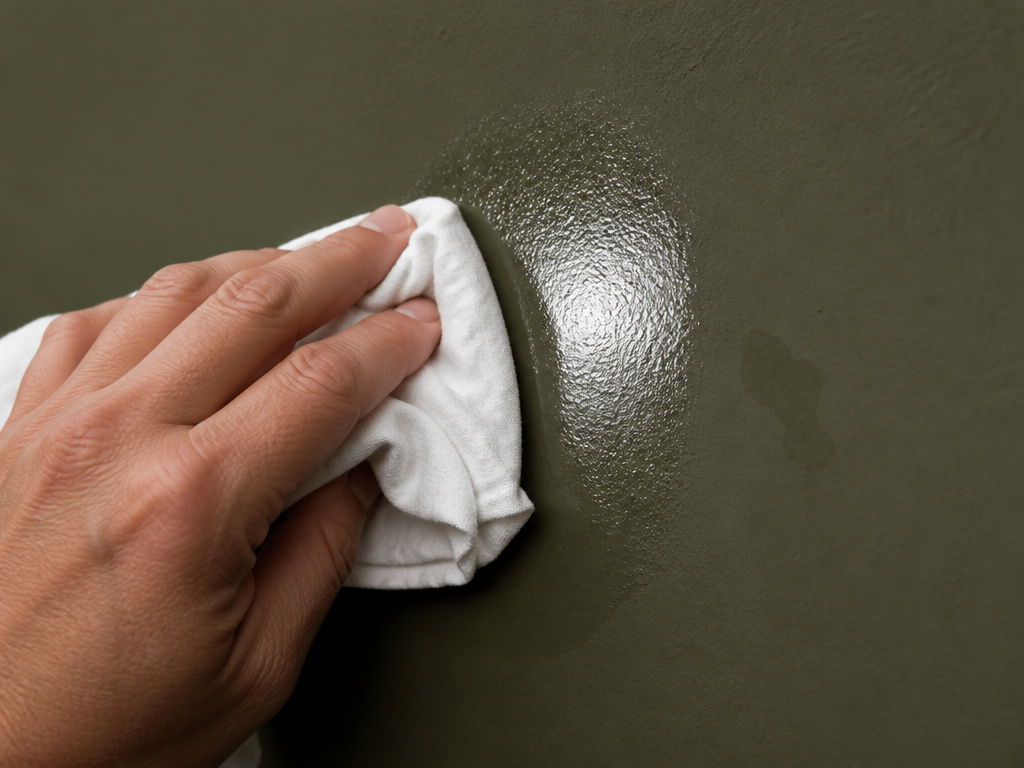
Sherwin-Williams and Consumer Reports say matte is the most forgiving finish on a bad wall, while Benjamin Moore warns that low-sheen paint is harder to clean and can burnish.
Benjamin Moore spells out the failure mode: stains are harder to remove from low-sheen paint, and constant rubbing or cleaning can result in burnishing. Burnishing is the film polishing itself under friction. The spot you scrubbed ends up catching the light differently from the wall around it, so the stain you removed leaves a bright patch behind.
Consumer Reports puts flat and matte at the bottom of the stain-resistance ranking for the same reason. Both hide imperfections well, and both are the least resistant to stains of any finish they test.
Where the sources split is on how far matte can travel. Taubmans rates their Flat at a 0-1% sheen level and calls it ideal for ceilings only, with Matt at 2-4% reserved for low-traffic interior walls. Sherwin-Williams sends matte and flat to adult bedrooms, areas that won’t get roughed up by kids, and uneven or textured walls.
Benjamin Moore goes further in the other direction. They position Regal Select Interior Matte (N548) as withstanding frequent washing even in busier areas like hallways and family rooms, and Waterborne Ceiling Paint (N508) as their flattest product for ceilings and very low-traffic areas.
Where this goes sideways: Scrubbing a matte wall with a damp cloth and pressure. The stain lifts, then the film polishes, and within a few passes you have a permanent sheen patch that no touch-up will match.
If you want matte in a busy room, the honest answer is to buy a washable matte rather than a standard one. Sherwin-Williams Emerald and Duration Home both come in a matte finish they describe as washing clean like gloss or semi-gloss. That’s the version of matte worth putting in a hallway.
More on picking finishes for rooms that get used hard is in the guide to high traffic areas.
Eggshell vs Satin: Which One Belongs on Your Walls?
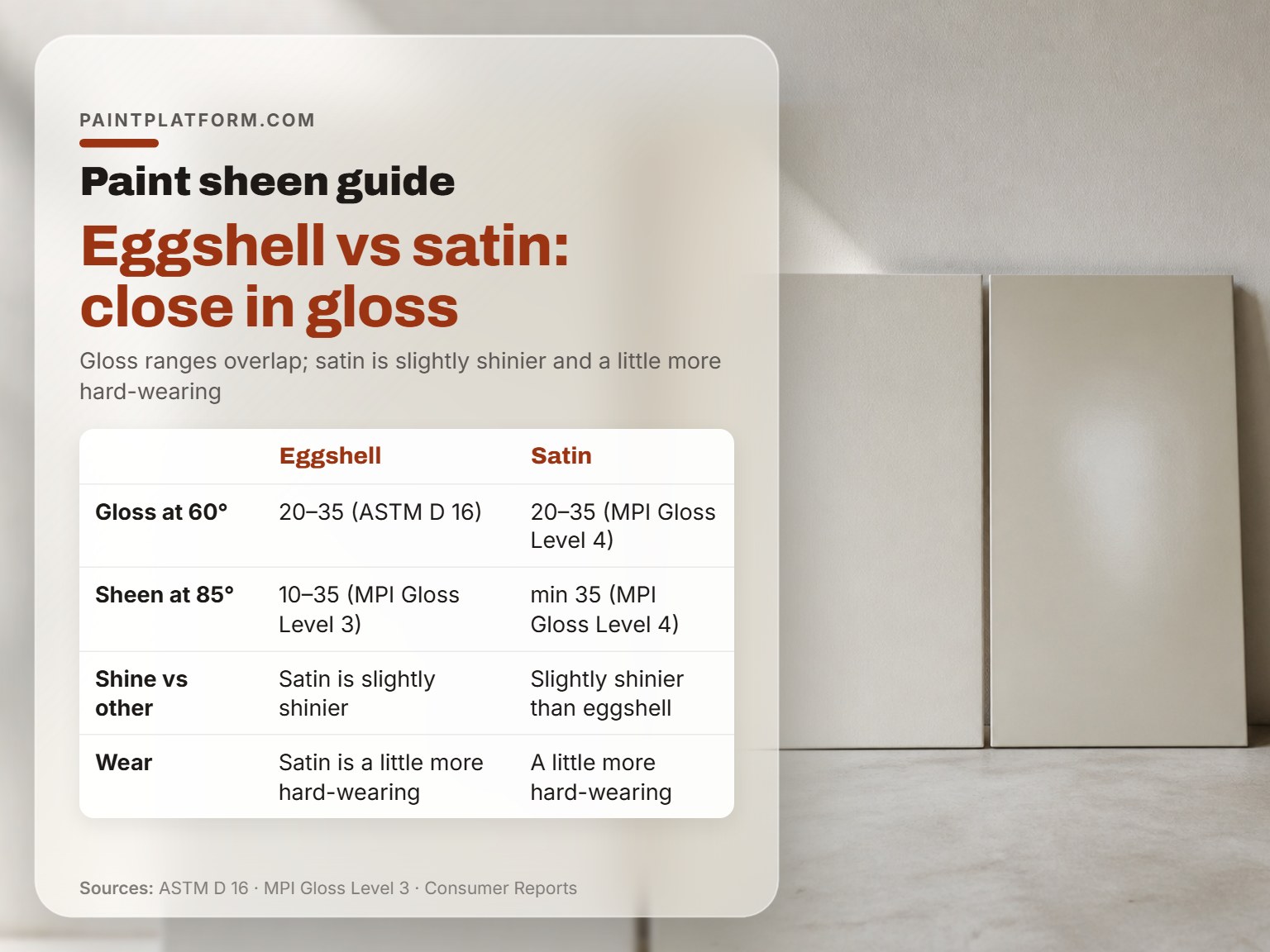
The gap between them is smaller than the names suggest, and the industry can’t agree on where the line sits.
What Eggshell Actually Measures
ASTM D 16 defines eggshell as a low-sheen finish between 20 and 35 at 60 degrees. MPI Gloss Level 3 defines traditional eggshell as 10 to 25 at 60 degrees with 10 to 35 at 85 degrees. Overlapping bands, not identical ones.
That matters less than it sounds, because most people pick by feel. Benjamin Moore describes eggshell as easy to clean and nearly shine-free, suited to most areas of a home including family rooms and hallways, and calls it infinitely more durable than flat or matte.
Where Satin Wins
Consumer Reports is blunt about the ranking: satin is slightly shinier than eggshell, both are easier to clean than flat or matte, and satin is a little more hard-wearing. They place satin in family rooms, living rooms, bedrooms, hallways, kitchens, dining areas, children’s bedrooms, and bathrooms.
Benjamin Moore agrees on direction and disagrees on margin. They say satin delivers a higher gloss than eggshell with better stain resistance and durability than lower sheens including eggshell, and place it on windows, shutters, trim, and interior doors.
One warning applies to both. Consumer Reports notes that eggshell and satin tend to accentuate surface imperfections, so the walls need to be prepped smooth first. That’s the cost of stepping up from matte.
I’ve stopped treating eggshell as the safe middle. On a wall with any texture or patching, satin amplifies every ridge, and matte forgives it. Pick the wall’s condition first, then the sheen name.
The head-to-head is broken down further in eggshell vs satin, and the next step up is covered in satin vs semi-gloss.
Steam, Grease, and Two Rooms That Need Different Answers
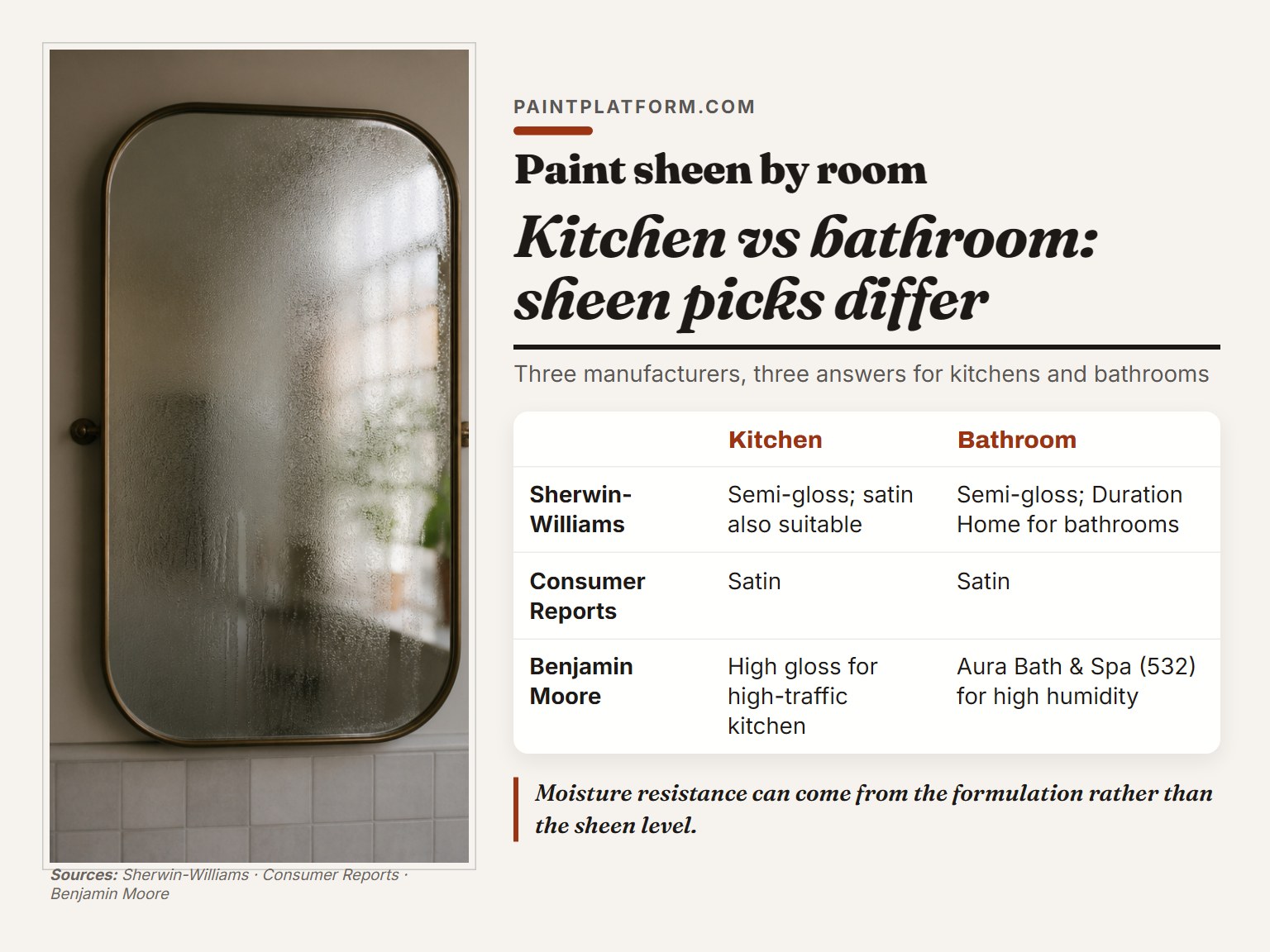
A bathroom mirror fogs quickly after a hot shower. A kitchen backsplash collects a thin grease film you notice with your fingertips before your eyes ever pick it up.
Kitchens
Sherwin-Williams recommends semi-gloss for kitchens and also lists satin as suitable. Consumer Reports places satin in kitchens among many other rooms. Benjamin Moore goes the other way entirely, saying high gloss is easy to clean, stain-resistant, and suited to doors, trim, and even a high-traffic kitchen.
Three manufacturers, three answers. The common thread is that all of them want a film that wipes, not one that absorbs.
Bathrooms
Sherwin-Williams recommends semi-gloss. Consumer Reports recommends satin. Benjamin Moore sidesteps the sheen question by pointing at a product: Aura Bath & Spa (532), built for durability, color retention and mildew resistance in high-humidity environments, and available in matte.
That last point is the useful one. Moisture resistance can come from the formulation rather than the sheen level, which is why a matte bathroom paint can work where a generic matte would fail.
The practical read:
- Kitchen with heavy cooking: satin or semi-gloss, or a washable matte if the walls are imperfect.
- Bathroom with a working fan: matte in a humidity-rated product, or satin if the fan is weak.
- Powder room: matte is fine. Nobody showers in there.
- Rental-grade flip: semi-gloss, because it wipes and hides nothing.
Room-specific picks are covered in more detail for kitchen walls and bathroom walls.
Trim, Doors, and Ceilings Want Opposite Finishes
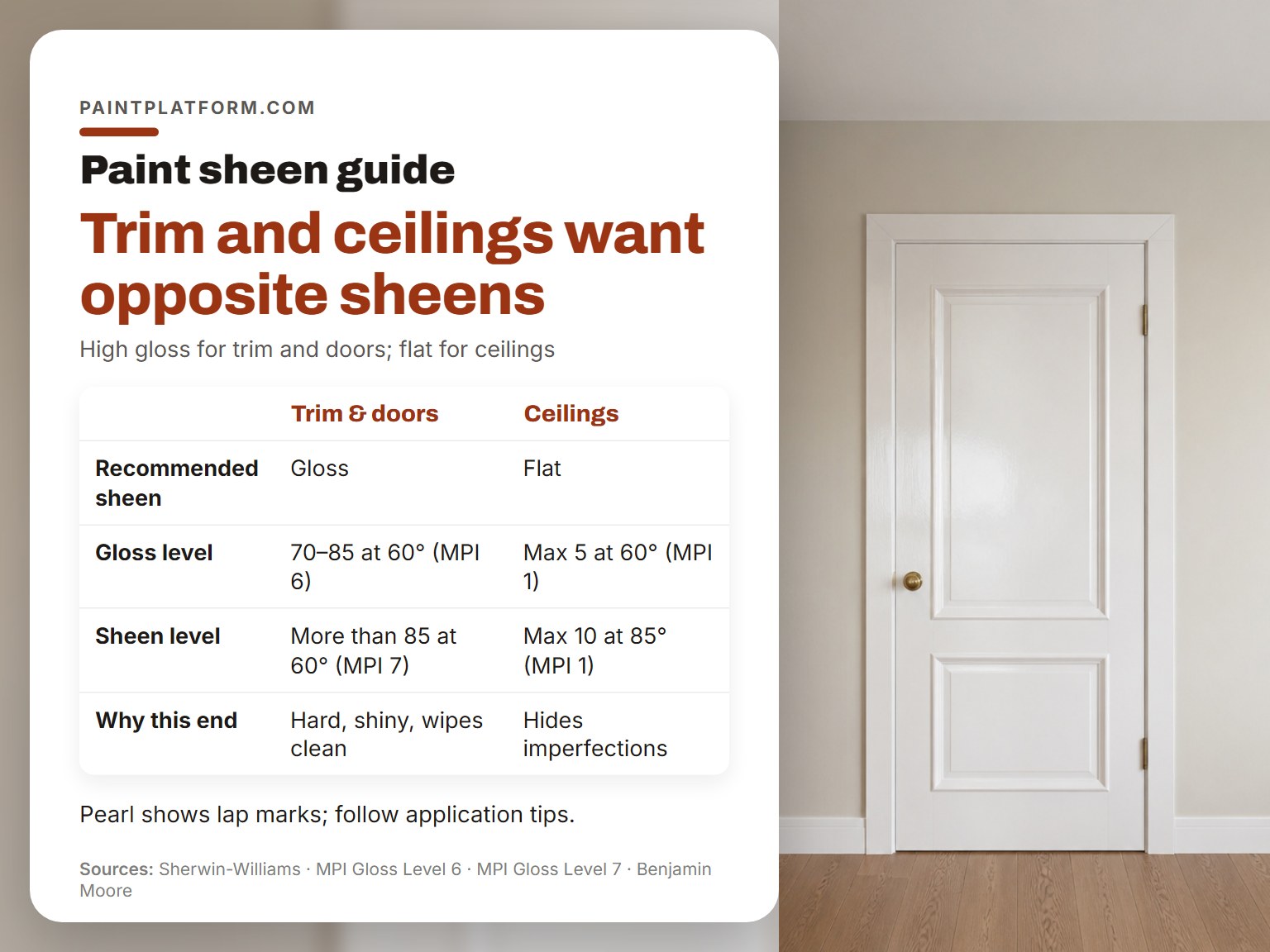
The two ends of the sheen scale live in the same room, and both of them are correct.
Trim takes the high end. Sherwin-Williams recommends gloss for wood trim, cabinets and doors, describing it as the most light-reflective finish with an extremely hard, shiny surface that often just wipes clean. Benjamin Moore puts Advance High Gloss (N794) on doors, trim, and high-traffic kitchens. Taubmans rates their Gloss at an 80% sheen level for doors, trims, and high-wear areas.
Ceilings take the low end. Taubmans rates their Flat at 0-1% and calls it ideal for ceilings only, specifically because durability and frequent cleaning aren’t a priority up there. Benjamin Moore’s Waterborne Ceiling Paint (N508) is their flattest product, chosen for masking imperfections.
Easy to miss: Pearl and soft-gloss finishes show lap marks. Benjamin Moore flags this directly, warning that pearl sheen is more susceptible to showing lap marks and other painting flaws, and telling painters to follow the manufacturer’s application tips carefully.
That warning is worth more than the sheen chart. A pearl finish on a large wall is a technique test, and if you’re rolling in sections you’ll see every overlap.
Trim and door guidance lives in the trim and doors breakdown, and the ceiling question is covered under ceilings.
Test the Sheen on a Board, Not a Chip
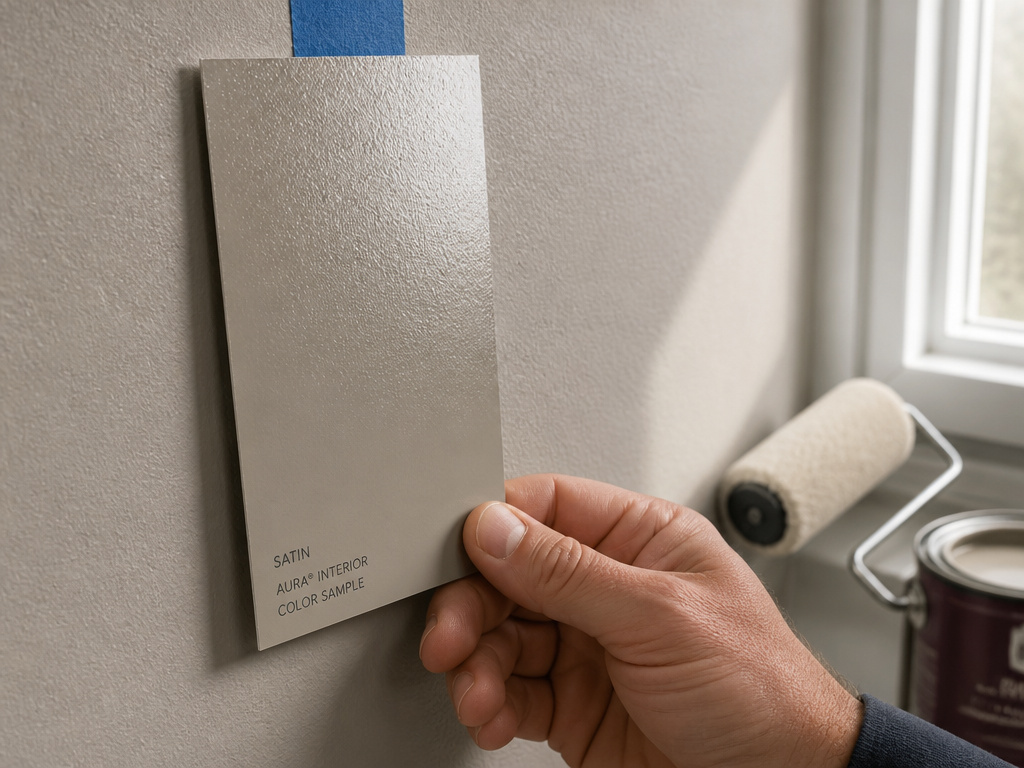
A sheen decision made from a small paper chip is a guess dressed up as a choice.
I picked satin off a small chip once. On the chip it looked soft and pretty. On a full wall with a window directly across from it, it turned into a mirror for every roller mark. Now I paint a sample board, tape it to the wall, and walk past it in the morning and again in the evening before I commit.
Before you start: Solvent and waterborne paints both release VOCs while curing, and Consumer Reports notes that some products carry Greengard Gold certification for lower emissions. Ventilate the room, keep the door open, and remove rags and waste from the storage area daily. Store any open containers tightly covered at 45 °F or above.
Here’s the sequence that actually settles it:
- Paint a sample board with the exact product and sheen you’re considering, same roller nap you’ll use on the wall.
- Let it cure fully. Wet paint reads darker and glossier than dry paint, and that gap fools almost everyone.
- Tape it flat against the wall in the room you’re painting, not in the garage.
- Walk past it at an angle, several times, at different times of day. Sheen shows up in glancing light, never head-on.
- Check it against the window wall. If the board sits opposite a bright window, you’ll see the roller texture the way you’ll actually live with it.
The University of Houston spec takes this seriously enough to require a benchmark sample for every coating type and substrate, with wall samples on at least 100 square feet, applied after permanent lighting is switched on. That’s the institutional version of taping a board to the wall.
Field conditions matter as much as the sheen. The same spec forbids application when substrate and ambient air fall outside 50-95 °F, when relative humidity exceeds 85%, when ambient temperature is less than 5 °F above the dew point, or onto damp and wet surfaces. Paint applied outside those limits can dry to a different sheen than the sample you approved.
If you’re still narrowing down which product goes on the board in the first place, the walkthrough on choosing interior paint covers the order of decisions.
Frequently Asked Questions
Is eggshell or satin better for a hallway?
Consumer Reports places both in hallways, with satin slightly more hard-wearing. Benjamin Moore puts eggshell in family rooms and hallways and describes satin as having better stain resistance than eggshell. On a hallway with imperfect walls, eggshell hides more; on one that gets bumped and wiped constantly, satin holds up longer.
Does higher sheen really mean easier cleaning?
Not reliably. Sherwin-Williams says higher gloss and sheen are generally easier to clean, then names Emerald and Duration Home as exceptions at every sheen level. Farrow & Ball states outright that higher sheen no longer predicts durability. Check the specific product’s data sheet rather than trusting the category.
Can I use matte paint in a bathroom?
Yes, if the product is formulated for it. Benjamin Moore’s Aura Bath & Spa (532) is a matte finish designed for high-humidity environments with mildew resistance. A standard matte in a steamy bathroom is a different bet, and Consumer Reports ranks flat and matte as the least stain resistant finishes they test.
What sheen goes on ceilings?
Taubmans rates their Flat at a 0-1% sheen level and specifies it for ceilings only, while Sherwin-Williams recommends matte and flat for adult bedrooms and uneven walls, and Benjamin Moore’s Waterborne Ceiling Paint (N508) is their flattest product. Ceilings don’t get wiped, so hiding imperfections and reducing glare matter more than washability.
Why did my paint dry a different sheen than the sample?
Application conditions are the usual cause. The UH specification prohibits painting outside 50-95 °F, above 85% relative humidity, or less than 5 °F above the dew point, and film formation changes when those limits are pushed. Wet paint also reads darker and glossier than the cured film, which is why a sample board needs to dry fully before you judge it.
The Bottom Line
Here’s the threshold that decides most rooms: if the wall has visible texture, patching, or a window directly across from it, drop one sheen level lower than you planned. Sheen amplifies whatever the surface already is, and no product line fixes a wall that catches light badly.
The concession is real, though. If you’re painting a hallway in a house with kids and a dog, the lower-sheen instinct costs you. That’s the one place I’d take satin over matte every time, and I’d rather repaint a shiny patch than scrub a burnished one.
One thing to do this week: buy a quart, paint a sample board, tape it to the wall, and look at it tomorrow morning. That single board will tell you more than any chart, including this one.
