
Water-Based vs Oil-Based Primer: Which Should You Buy?
This post contains affiliate links. As an Amazon Associate, we earn from qualifying purchases.
With water-based vs oil-based primer, the split is simple: water-based dries tack-free in as little as 30 minutes per Journeyman HQ (Kitchen Remodel Bellevue WA says 1 to 2 hours) and suits new drywall, while oil-based needs about 24 hours per most sources (Kilz’s listing says 4 hours) and blocks water stains, tannin bleed, and knots that latex can’t hold. Get the match right and the topcoat stays put.
The 24-hour gap between those two numbers is the whole reason this choice gets agonized over. Alkyd primer cures by oxidation, so it keeps hardening long after the surface feels dry to the touch. Water-based primer is finished when the water has evaporated. That difference decides your schedule, your topcoat, and whether the stain comes back.
What follows is the practical version: which primer goes on which surface, how the dry times really stack up, and the one spot where the common advice contradicts itself.
Key Takeaways
- Water-based primer goes tack-free in as little as 30 minutes and takes a topcoat within an hour in low humidity per Journeyman HQ, though Kitchen Remodel Bellevue WA lists water-based bonding primer at 1 to 2 hours. That makes it the pick for new drywall and previously painted walls.
- Oil-based primer needs about 24 hours before sanding or topcoating according to House Digest, Journeyman HQ, and Kitchen Remodel Bellevue WA, though Kilz’s own listing states 4 hours for Kilz Original; it’s the reliable choice for water stains, tannin bleed, and exterior wood.
- Shellac-based primer dries in roughly 45 minutes and blocks knots, marker, and smoke that water-based primer cannot hold back.
- Scuff and wipe glossy surfaces before priming, or the finish scrapes off with a fingernail.
- Test the topcoat rule on a hidden spot, because published advice on water-based paint over oil primer flatly disagrees.
Water-Based vs Oil-Based Primer: What Each One Actually Does
New drywall drinks paint unevenly, and that’s the job water-based primer was built for. The resins sit on the surface instead of soaking in deep, which keeps the finish coat from flashing or blotching across the wall.
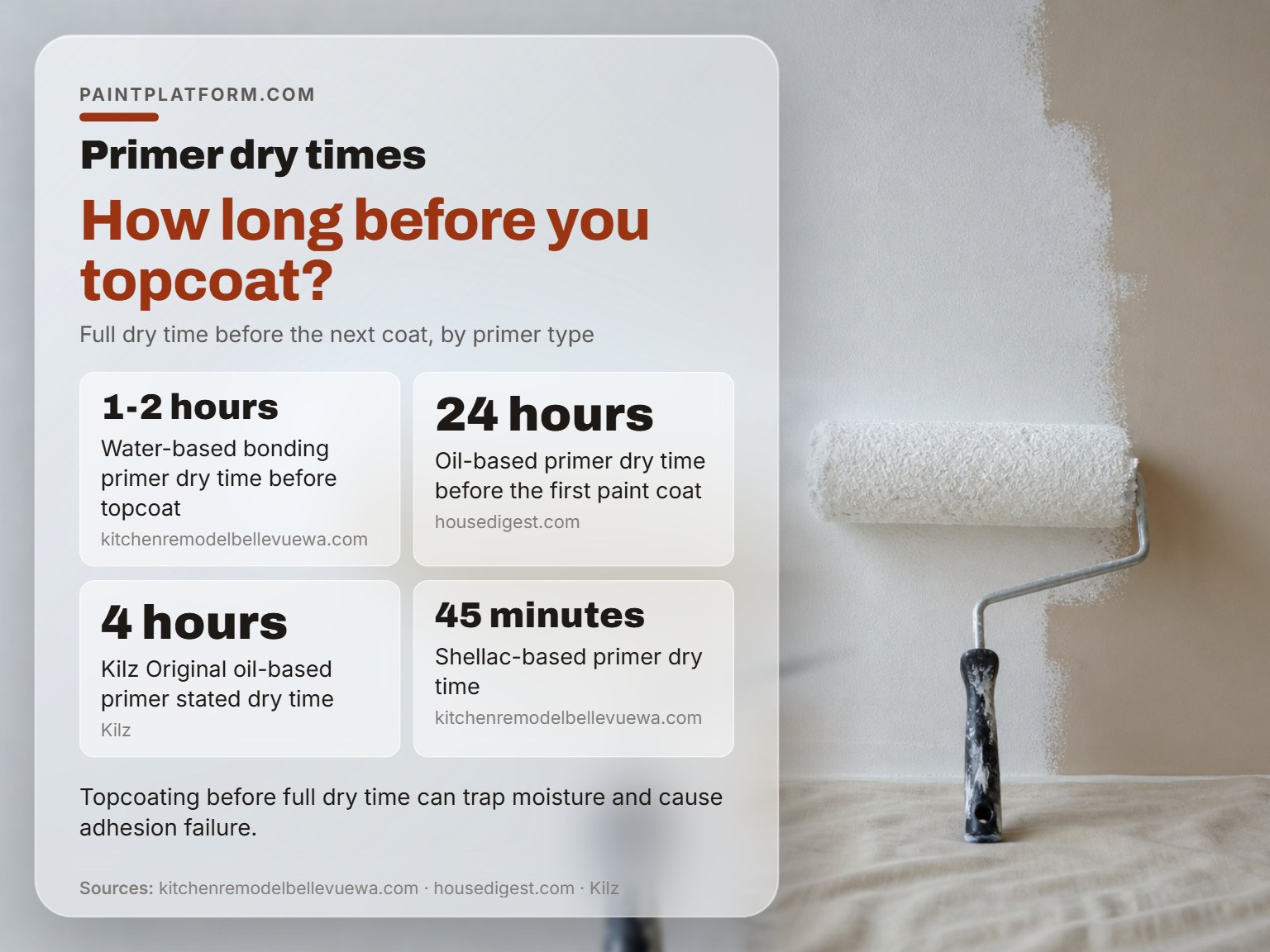
Water-based primers cure by water evaporation and reach a tack-free film in roughly 30 minutes, while a water-based bonding primer runs 1 to 2 hours. Alkyd primers cure by oxidation and need about 24 hours before sanding or topcoating. Shellac-based formulas dry in about 45 minutes and block tannin, knots, and smoke residue that latex cannot hold back.
Water-Based: Fast, Low-Odor, Porous Surfaces Only
Latex primer, which is what the trade calls most water-based formulas, dries by evaporation. That’s why it goes tack-free in as little as 30 minutes and why it cleans up with water.
It’s also the right call on new drywall. House Digest and Impact Wizards point the same direction: water-based primer seals joint compound and controls texture so paint lays evenly.
Where it struggles is anything non-porous. Journeyman HQ notes that water-based primers bead up and fail to bite on glossy enamel, old oil-based finishes, or metal unless you sand first.
Oil-Based: Slow, Strong, Stain-Proof
Alkyd primer builds a chemical barrier. Journeyman HQ calls it the only reliable choice for stubborn stains water-based products can’t handle, and Kitchen Remodel Bellevue WA rates its stain block as excellent, against moderate for water-based bonding primer.
Oil-based primer also penetrates exterior wood fibers and creates a mechanical bond that resists expansion and contraction from sun and humidity, per Journeyman HQ.
| Primer Type | Typical Dry Time | Stain Block | Best For |
|---|---|---|---|
| Water-based bonding | 1 to 2 hours | Moderate | Most cabinets, new drywall, previously painted walls |
| Shellac-based | 45 minutes | Excellent | Knots, marker, smoke, tannin on oak and cherry |
| Oil-based | 24 hours | Excellent | Water stains, raw wood, exterior wood |
| Acrylic urethane | 1 to 2 hours | Good | High-end refinishing, glossy surfaces |
Those are the manufacturer-side numbers. Your actual schedule shifts with humidity, film thickness, and how much air moves through the room.
How Long Does Each Primer Take to Dry?
Thirty minutes is the number the water-based camp quotes for tack-free, and it holds in low humidity. Journeyman HQ puts a wet-on-dry topcoat within an hour under those conditions.
Other sources are more conservative. Kitchen Remodel Bellevue WA lists water-based bonding primer at 1 to 2 hours, and puts KILZ Adhesion at roughly 30 minutes to dry with a 1-hour recoat. Varathane’s water-based wood primer carries a 30-minute recoat window. Shellac-based primer lands at 45 minutes.
Two honest readings exist. The 4-hour figure may describe a recoat window on a thin coat, and the 24-hour figure a full cure before sanding. Fair warning: I follow the label on the can in my hand, because that’s the only version the maker stands behind for that batch. The oil-based paint pros and cons tradeoff is mostly this: you buy stain blocking with drying time.
If a primer’s dry time and its recoat time disagree on the label, trust the longer number before you sand. Sanding a half-cured alkyd film gums up the paper and leaves a gummy edge that telegraphs through the topcoat.
Where Water-Based Primer Fails, and the One-Can Fix
Tannin bleed is the one that gets people. Cedar, redwood, and mahogany carry natural oils that react with the water in latex primer, pulling brown or red color to the surface and staining white paint almost instantly, per Journeyman HQ.
The failure list is short and predictable:
- Glossy enamel and old oil finishes. Water-based primer beads instead of biting, and the topcoat peels in sheets later.
- Metal. Same story without a heavy sanding pass first.
- Tannin-rich wood. Cedar, redwood, mahogany. The color comes up through the film.
- Anything with a visible stain. Water-based rarely matches oil for blocking, and the mark returns.
If you’re priming bare or previously coated boards rather than drywall, a dedicated wood primer decision comes before the paint decision, and tannin is the reason.
The fix is one extra can, not a different project. Zinsser B-I-N Shellac-Based Primer bonds to nearly any surface and blocks tannin on oak and cherry better than any water-based alternative, according to Kitchen Remodel Bellevue WA. Tools Radar calls the same product the gold-standard sealer.
I keep a can of the BIN type around for exactly this.
Cleanup takes denatured alcohol, and I ruined a cheap throwaway brush by leaving it sitting too long. Now I buy a cheap throwaway brush and don’t feel bad about it.
Common mistake: Rolling basic latex over a visible water stain. Two coats of regular paint can look fine at first, then the ring creeps back through the film and you’re priming the whole ceiling again.
Stuck on Glossy Cabinets? Scuff First, Then Choose
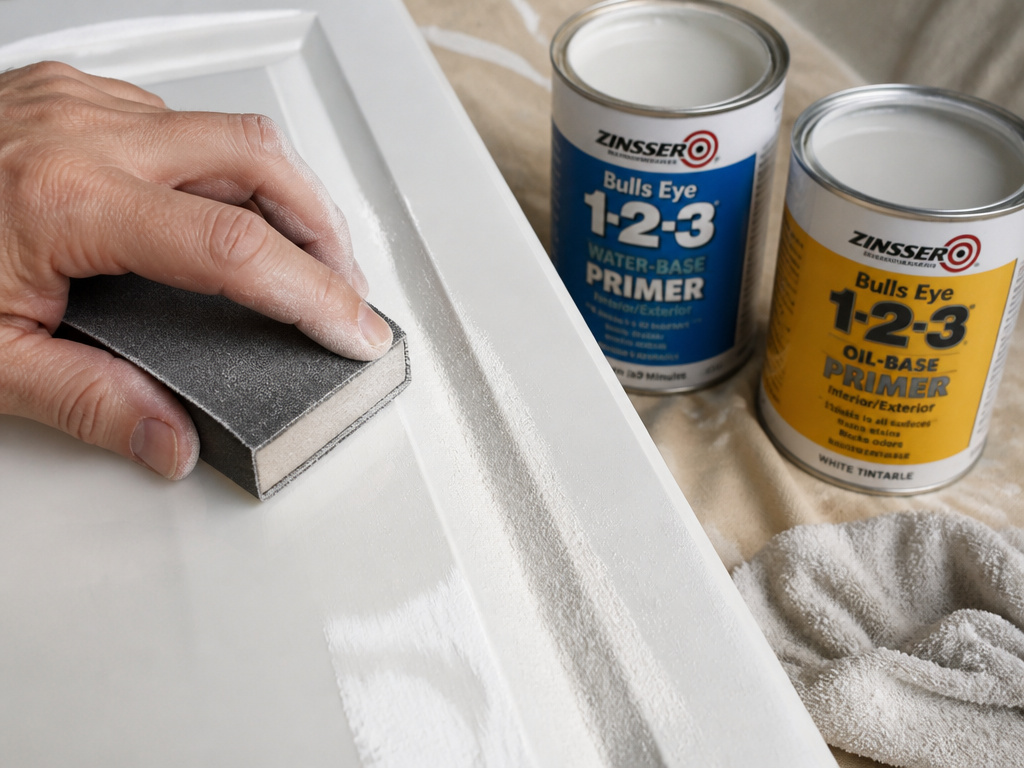
You scuff a cabinet door, wipe it, prime it, topcoat it, and a week later the paint scrapes off with your thumbnail.
Here’s where the advice genuinely splits. Kitchen Remodel Bellevue WA calls oil-based primer the superior option for adhesion on finished or glossy surfaces. Journeyman HQ says water-based primers bead up on gloss and recommends a bonding primer, which is often water-based, for laminate and gloss. Impact Wizards lands in the same place: bonding primer plus a scuff sand.
Why Oil-Based Gets Called “Superior” on Gloss
Oil-based primer does bite into a chalky or aged gloss film. The catch is yellowing. Kitchen Remodel Bellevue WA notes that alkyd primer can yellow over time, especially under a white topcoat. On white cabinets that’s a slow-motion problem rather than an immediate one.
The Bonding Primer Route
Bonding primers are formulated for surfaces that reject ordinary latex. INSL-X Stix Waterborne Bonding Primer is the pick Kitchen Remodel Bellevue WA names for slick and laminate surfaces.
Picking a primer for walls is the same decision at a bigger scale. Match the chemistry to the surface, then let prep do the rest.
- Scuff the gloss until the sheen goes flat.
- Wipe the dust off with a damp cloth and let it dry.
- Prime a thin, even coat and let it hit full dry time.
- Scratch-test a hidden spot before you commit to the whole run.
Skipping the wipe is the one that bit me.
The “No Water-Based Topcoat Over Oil Primer” Rule Is Half Right
Impact Wizards adds the useful detail. Incompatible layers resist bonding and peel once humidity, temperature shifts, or expansion stress them, and the example given is oil over latex rather than latex over oil.
So the two camps are describing different failures. A water-based topcoat over a fully cured alkyd primer is normal practice in one set of sources and forbidden in another. The acrylic side of that argument has its own discussion under water-based primer before acrylic paint, and it’s worth checking against your own test patch before you commit a whole wall.
Where this goes sideways: Topcoating before the primer hits full dry time. A partially wet film traps moisture under the paint and the bond fails once the room heats up. Full dry time runs 1 to 2 hours for water-based and 24 hours for oil-based per House Digest, Journeyman HQ, and Kitchen Remodel Bellevue WA, though Kilz’s listing states 4 hours for Kilz Original.
Which Primer Fixes Water Stains, Knots, and Smoke Odor?
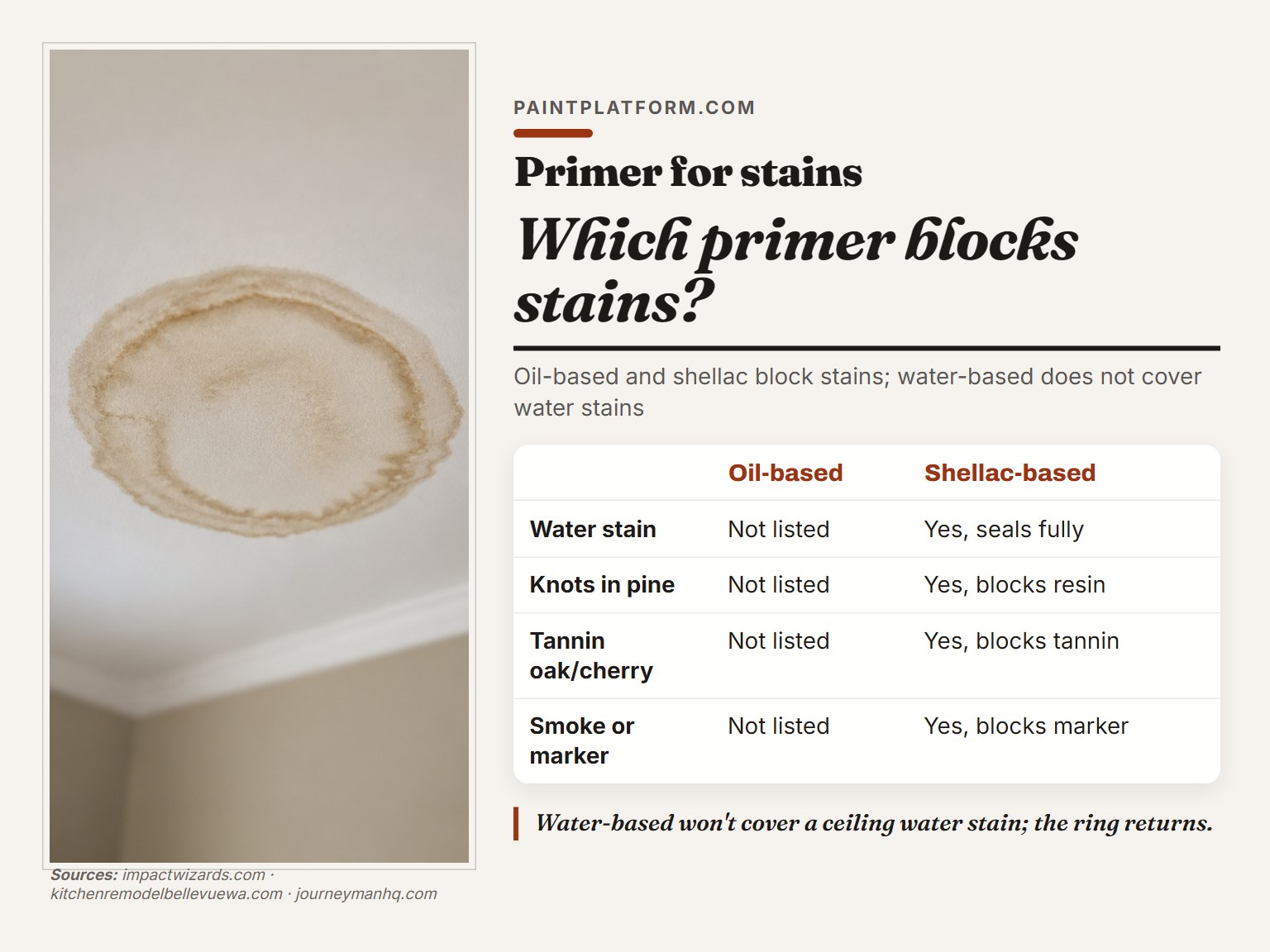
A brown ring on the ceiling, a knot bleeding through white trim, a smoke ghost above where the woodstove used to be. Three different problems that want three different cans.
I painted straight over a brown ceiling-edge water stain with two coats of regular latex once. The ring came back. The same spot took one coat of an oil-based stain-blocker, Kilz Original, and it stayed gone.
Now I outline every stain with a pencil before I prime. That’s how I can tell at a glance whether the mark is creeping back. Mine crept through before I started doing it, which was humbling.
Before you start: Oil-based primer gives off strong fumes, so open windows and run an exhaust or floor fan before you crack the can. Mineral spirits for cleanup are flammable and rough on skin, so keep them away from pilot lights and wear gloves. Shellac-based primer needs denatured alcohol, which is just as flammable and dries your hands out fast.
- Fix the source first. A stain fed by an active leak comes back through any primer, so repair the leak and let the substrate dry before you open a can.
- Outline the stain with a pencil. Without the outline you can’t tell whether the mark is creeping back, and you find out the expensive way after the topcoat.
- Prime with an oil-based stain-blocker. Kilz Original is the one I reach for; Kilz’s own guidance calls for thinning it 5% with mineral spirits for flow on trim while keeping full coverage over the stain.
- Wait the full dry time.
- Topcoat, then check your outline. If the mark is still inside the pencil line after the first coat, you needed the shellac-based product instead.
| Problem | Primer to Use | Why It Works |
|---|---|---|
| Water stain on a ceiling | Oil-based or shellac | Water-based won’t cover it; the ring returns |
| Knots in pine | Shellac-based | Blocks resin and tannin migration |
| Tannin bleed on oak or cherry | Shellac-based | Bonds to any surface, blocks tannin |
| Glossy factory finish | Water-based bonding | No sanding needed, dries in 30 minutes |
| New drywall | Water-based | Seals joint compound, prevents flashing |
| Smoke or marker | Shellac-based | Seals pigment and odor |
Knots and smoke want shellac. Impact Wizards recommends a shellac-based or specialized knot-sealing primer for resin and tannin migration, and Journeyman HQ names shellac as the problem-solver for pine knots and permanent marker. A stain blocking primer is the category to shop in when the mark is the whole reason you’re priming.
One practical note on cleanup. Oil-based primer needs mineral spirits and a brush that won’t shed, so brushes for oil-based primer matter more than they do with latex. Natural bristle holds the alkyd without matting.
Frequently Asked Questions
Can I use water-based primer over oil-based paint?
Sometimes, and the prep decides it. Water-based primer beads up on a glossy oil finish unless you sand it dull first, per Journeyman HQ. Scuff, wipe, and run a small test patch before you commit to the wall.
Is oil-based primer always better for stains?
No. It’s the better blocker for water stains and tannin, and Kitchen Remodel Bellevue WA rates both oil-based and shellac-based as excellent. Shellac gets the edge on knots, marker, and smoke, and it dries in about 45 minutes rather than 24 hours.
Do kitchen cabinets need a special primer?
Glossy and laminate cabinets do. INSL-X Stix Waterborne Bonding Primer is the pick Kitchen Remodel Bellevue WA names for slick surfaces, and KILZ Adhesion is the no-sand option. For most cabinet materials in good condition, a water-based bonding primer is the starting point.
How long before I can paint over primer?
Low humidity allows a water-based primer to take a topcoat within an hour.
Can I skip primer if the paint says it has primer in it?
On a clean, previously painted wall in decent shape, sometimes. On bare wood, new drywall, or anything with a visible stain, no. A paint-and-primer combo is still a latex product, and water-based stain blocking rates moderate against excellent for oil and shellac.
What’s the difference between a bonding primer and a stain-blocking primer?
Bonding primer is built for adhesion on slick surfaces like laminate and factory finishes. Stain-blocking primer is built to seal pigment, tannin, and odor so they can’t migrate up through the topcoat. Some products do a bit of both, but the ratings differ.
The Bottom Line
One rule covers most of this: if you can see the problem through the paint, you need oil or shellac. Water stains, knots, tannin, marker, smoke. Water-based primer handles the clean surfaces, the new drywall, and the previously painted wall that just needs a fresh color.
The water-based vs oil-based primer question stops being abstract once you’re standing in front of a stained ceiling with a pencil in your hand.
The one place I’d tell you to slow down is topcoat compatibility. House Digest says no water-based paint over oil primer; Journeyman HQ treats it as routine. Prime a scrap of the same material, topcoat it, and check adhesion after a couple of days. That test settles it for your actual surfaces instead of someone else’s.
So here’s the quick version for today. Find the worst stain in your house, outline it in pencil, and hit it with an oil or shellac product. One small can, one throwaway brush. If the outline is still clean after the topcoat cures, you picked right.
