
Paint Roller Frame Types Explained: Cages, Cores, and Fit
This post contains affiliate links. As an Amazon Associate, we earn from qualifying purchases.
Paint roller frame types break into three families: cage frames in standard, mini, and wide widths; adjustable frames that span 12 to 18 inches; and fixed industrial frames built for heavy covers. The frame you need depends on the cover’s core diameter first, then its width, then whether you plan to add a pole.
Core diameter is the thread that trips up more frame purchases than width ever does. A 9-inch Purdy frame with a 1-1/2 inch core will not take a Pro-Extra cover, even though both are labeled 9-inch and both sit on the same shelf. Paint roller frame types explained by core size make this mismatch clear.
What follows walks the three families, the core and wire specs that separate them, and the two compatibility joins that decide whether a frame and pole actually work together.
Key Takeaways
- Match core diameter first. A standard 9-inch frame runs a 1-1/2 inch core; a Pro-Extra 9-inch frame runs 1-3/4 inch and takes Pro-Extra covers only.
- Wire count is a tier marker, not a universal spec. Wooster calls 5+ wires the quality floor and builds pro frames with 6; Gordon Brush treats 5-wire as heavy duty and 4-wire as economical; Purdy publishes no wire count at all.
- Adjustable frames span 12 to 18 inches. McMaster’s 5161N11 locks with flip levers; Wooster’s adjustable Pro frame adjusts in 6-inch increments.
- A pole is a second compatibility join. Hyde warns that a frame-side Acme thread does not prove the pole will fit, so hand-thread and rock-test before loading paint, while McMaster-Carr and Purdy treat a 3/4 inch Acme hole or universal tip as the attachment standard.
- Wide frames pay off on big walls. Purdy rates 14-inch covers up to 55% more productive than 9-inch, measured against average completion time.
What Are the Main Paint Roller Frame Types?
Three frame families cover nearly every job, and the cage family alone splits into standard, mini, and wide sizes. Each one solves a different reach or cover-size problem, and the labels overlap enough that width alone tells you very little.
A cage frame consists of two end caps joined by a set of wires, with the roller cover sliding over the cage. The end caps act as bearings, and the wire count plus shank diameter determine how the frame carries a loaded cover under pressure against a wall.
Most paint roller frames you’ll find on a shelf are cage frames, with paint roller frame types explained by the cage family. The differences live in the core, the wire count, and the handle, and those three numbers are what separate a frame that lasts from one that wobbles by the second room.
| Frame Family | Typical Widths | Core Diameter | Best For |
|---|---|---|---|
| Standard cage | 9 in | 1-1/2 in | Walls and ceilings |
| Pro-Extra cage | 9 in | 1-3/4 in | Pro-Extra covers only |
| Adjustable | 12-18 in | 1-1/2 in | Mixed-width jobs |
| Mini | 4-1/2 or 6-1/2 in | Mini core | Trim and tight corners |
| Wide fixed | 18 in | 2-1/4 in | Large flat runs |
Standard and Pro-Extra Frames
Purdy’s standard 9-inch frame runs a 1-1/2 inch core and takes every 9-inch cover except the Pro-Extra line. The Pro-Extra frame runs a 1-3/4 inch core and takes Pro-Extra covers only. Purdy’s frames release a cover by tapping the frame against the edge of a utility sink or a trash can so the cover slides off, while Wooster uses a fast-action impact release.
That tap release is the small mercy of the design. A cover that fights you off the frame is usually a cover that wasn’t seated right to begin with.
Mini Frames and Their Locked Covers
Mini frames are cover-locked more often than people expect. Purdy’s Wire Mini frames come in 14-inch and 24-inch lengths and should be used only with Wire Mini rollers. The Jumbo Mini frames come in 12-inch and 22-inch lengths for 4-1/2 inch and 6-1/2 inch covers.
Wooster’s mini cage frames take both 4-1/2 and 6-1/2 inch mini rollers, which is the exception rather than the rule. Push the cover completely over the retaining spring. If it isn’t fully seated, the roller will slip off the frame mid-pass.
Adjustable and Wide Frames
McMaster-Carr’s adjustable frame (part 5161N11) holds 12, 14, and 18 inch covers on a 1-1/2 inch core, in aluminum and plastic. Flip the levers up to move the arms, flip them down to lock. Wooster’s adjustable Pro frame covers the same 12 to 18 inch span, adjusts in 6-inch increments, and locks tool-free.
For fixed wide work, McMaster’s 18-inch frame runs a 2-1/4 inch core. That’s a different core than the 9-inch frame in the same catalog, which is the whole point of checking before you buy.
Core Diameter Is Where Most Frame Purchases Go Wrong
A 1-1/2 inch core and a 1-3/4 inch core look identical on the shelf and fit nothing alike. Purdy publishes the difference plainly: the standard 9-inch frame is 1-1/2 inch, the Pro-Extra 9-inch frame is 1-3/4 inch, and the two lines don’t cross.
McMaster-Carr’s catalog shows the same drift at the wide end. Its 4, 7, and 9 inch frames all use a 1-1/2 inch core. Its 18-inch frame jumps to 2-1/4 inch.
Wooster’s Big Ted goes further: a 2-1/4 inch jumbo core on a 9-inch cover, which means a standard 9-inch frame from another brand won’t hold it.
So core diameter is not a footnote. It’s the first number to check, before width, before wire count, before anything about the handle. Buying a frame for the cover you already own is like buying a pan for a lid you found in a drawer. The fit is the whole thing.
The second number, once paint roller frame types explained by core size are settled, is the cover’s nap, and that’s a surface decision rather than a frame decision. Roughly 3/8 inch nap suits smooth walls, and 1/2 inch or more suits light texture. Get the nap wrong and no frame can save the finish. The paint roller covers you pick do more for the final look than the frame ever will.
Where the Frame Specs Disagree, and Why It Matters
Purdy publishes no wire count at all, which is the first clue that wire count is not a settled spec. The other three manufacturers each draw the line somewhere different.
| Spec | Wooster | Gordon Brush | Purdy |
|---|---|---|---|
| Wire count | 5+ for quality; 6 on pro frames | 5-wire heavy duty; 4-wire economy | Not published |
| Shank diameter | 5/16 in chrome (pro) | 5/16 in industrial; 1/4 in economy | Not published |
| 9-inch core | 2-1/4 in jumbo (Big Ted) | Not published | 1-1/2 in standard; 1-3/4 in Pro-Extra |
ACE Tools lands with Wooster and Gordon on wire count: five supports, versus four on cheaper frames, and the supports are embedded in the end caps rather than brazed on.
None of these is wrong. They’re tier markers. A 4-wire birdcage is economical and not heavy duty, per Gordon Brush. A 5-wire industrial frame is the heavy-duty standard. A 6-wire Wooster pro frame sits above both. If a spec sheet doesn’t tell you the wire count, treat the frame as economy until proven otherwise.
How Do You Match a Frame to a Cover?
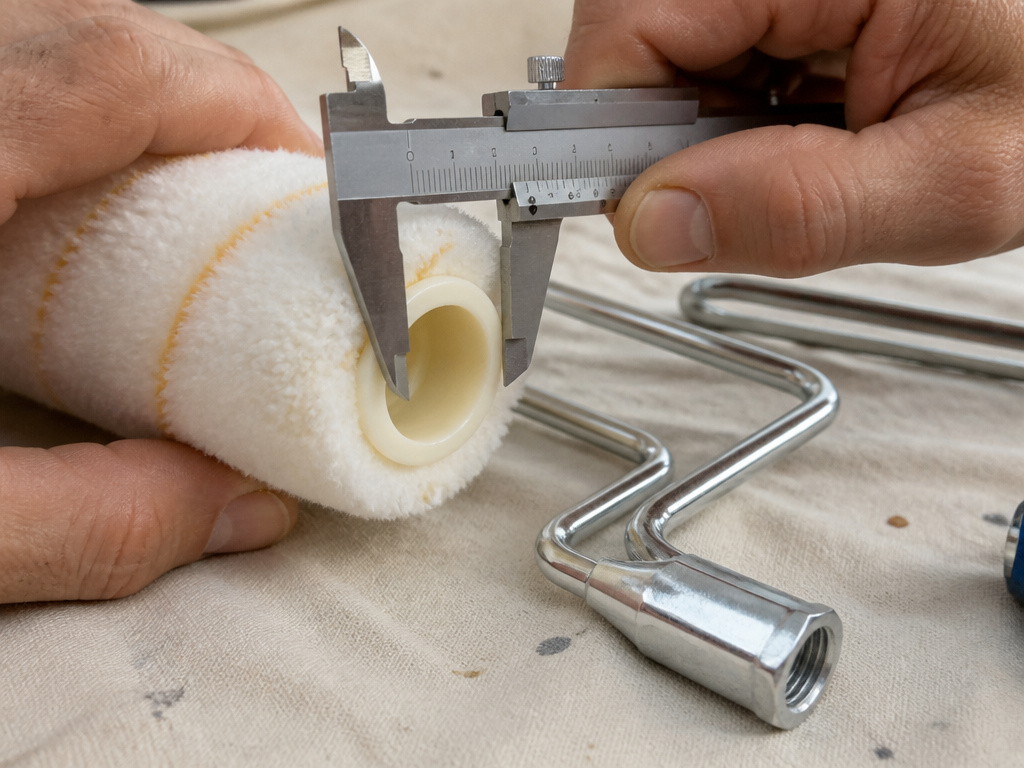
Match the core, then the width, then the pole. In that order. Hyde’s job guide is blunt about why: a nominal cover width does not establish core identity, frame fit, loading clearance, or suitability for the finish.
Before you start: A loaded frame on a pole is heavy and it is overhead. Hand-thread the pole and rock the joint before you load paint; a joint that wobbles dry will unscrew under a full cover. Keep the drop cloth under the work area, not just at the wall base.
Here’s the five-input check, in the order Hyde lays it out.
- Name the surface, its condition, and the coating. If the coating maker’s applicator spec doesn’t permit a roller, stop there. No frame repairs that mismatch.
- Measure the usable surface band, including clearance to approach and withdraw without striking adjacent work. Skipping this is how people buy an 18-inch frame for a 14-inch gap.
- Identify the exact cover by core, nap, and width. Width, pile, and family don’t close the join on their own.
- Find the maker’s explicit frame-fit bridge. It has to name or unambiguously specify the cover system and the frame interface.
- Decide whether a pole is needed. If yes, that’s a second compatibility join, with its own inspection.
That’s Hyde’s whole decision, though renovationrange says you choose by the cover’s width and core diameter and then by extension-pole attachment.
Mini, Standard, and Wide: Picking by Job Size
The garage wall went faster with a 3/8 inch nap roller on smooth fiber cement than brushing would have. I back-brushed only the edges and the grooves where the roller skipped. The rest was roll, load, roll. My only real mess was me, the drop cloth, and one very confused sandal.
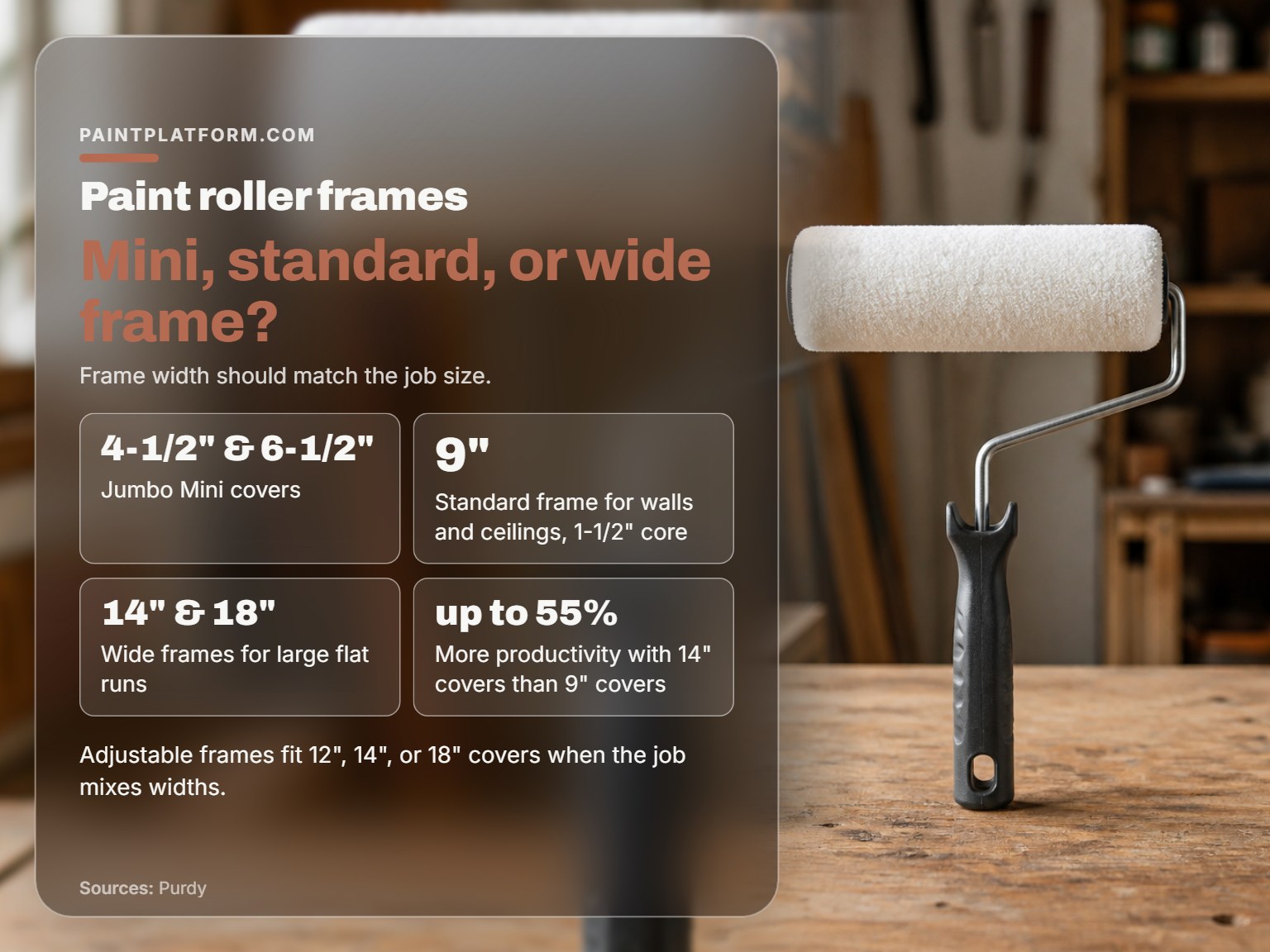
That job ran a standard 9-inch frame with a 1-1/2 inch core. A mini frame would have been slower on the field, and a wide frame would have been overkill for the wall height. Here’s the split I use now.
- Mini frames for trim, cabinet fronts, and anything narrower than a door. Purdy’s Jumbo Mini takes 4-1/2 and 6-1/2 inch covers.
- Standard 9-inch frames for walls and ceilings on most residential work. The 1-1/2 inch core is the default.
- Wide frames (14 or 18 inch) for large flat runs and ceilings where reach matters more than control. Purdy rates 14-inch covers up to 55% more productive than 9-inch, measured against average completion time.
- Adjustable frames when the job mixes widths. One frame, three cover sizes, fewer trips to the truck.
The mini vs full-size roller call comes down to field size. If you’re painting one bedroom, a standard 9-inch frame does most of the work and a mini handles the trim. If you’re painting a whole exterior, the 14-inch frame earns its keep on the field and the mini still handles the edges.
What about the types of paint rollers themselves? Nap and material decide the finish, and the frame just has to hold them. A mini roller on a full wall is a slow way to make a fast job. Use it for trim and corners, not the field.
Extension Poles and Threaded Handles: The Second Compatibility Join
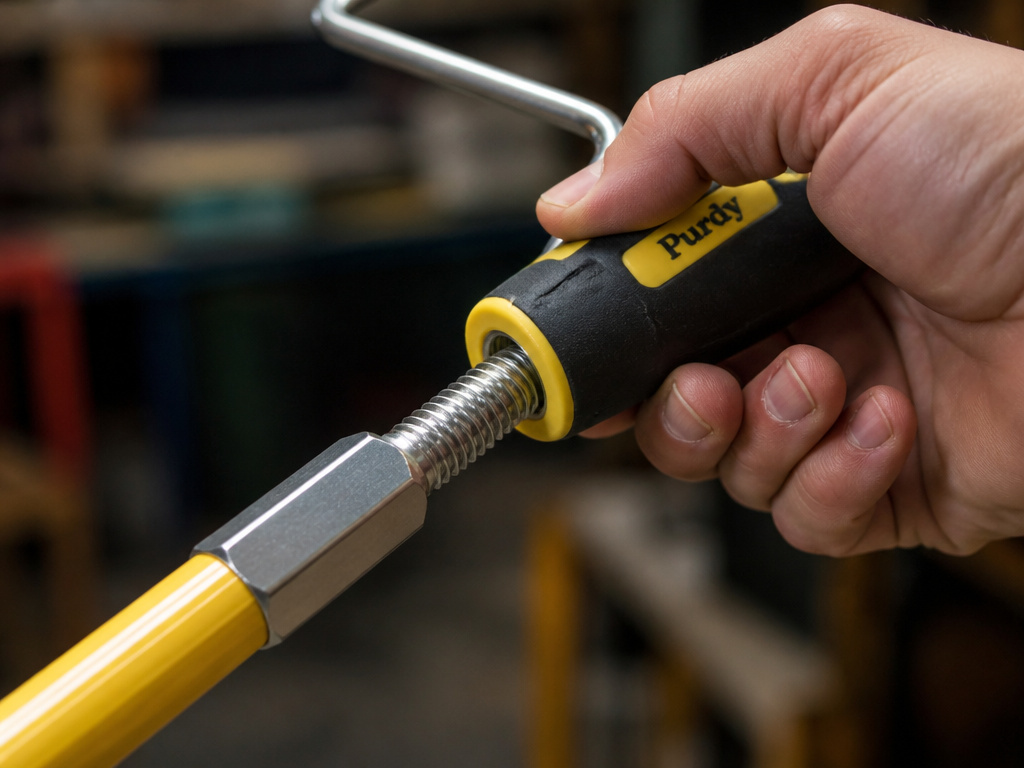
A 3/4 inch Acme thread is the US standard for paint roller handles and extension poles: 3/4 inch diameter, 5 threads per inch, Acme form. McMaster-Carr lists every one of its frames with that threaded hole. Wooster’s Sherlock frames take standard threaded poles.
The thread is loose-tolerance, though, and that’s where the join fails. Hyde’s guide is direct: a frame-side Acme claim alone does not prove the pair. Both sides have to establish the connection standard, and the exact instructions have to establish engagement and inspection.
If a pole wobbles when you rock it by hand, it will unscrew when you roll. Test the joint dry, before the frame has paint on it.
The extension poles that hold up share a few traits. Purdy’s Power Lock poles adjust and lock at any length, with a universal tip to attach to most roller frames. Wooster’s poles use a fiberglass outer with a rigid hex aluminum inner to reduce torsion, plus a quick-lever release. Wooster’s multi-position tool holder adds 160 degrees of adjustability and locks in 9 positions.
The Frame Upgrades That Actually Pay Off
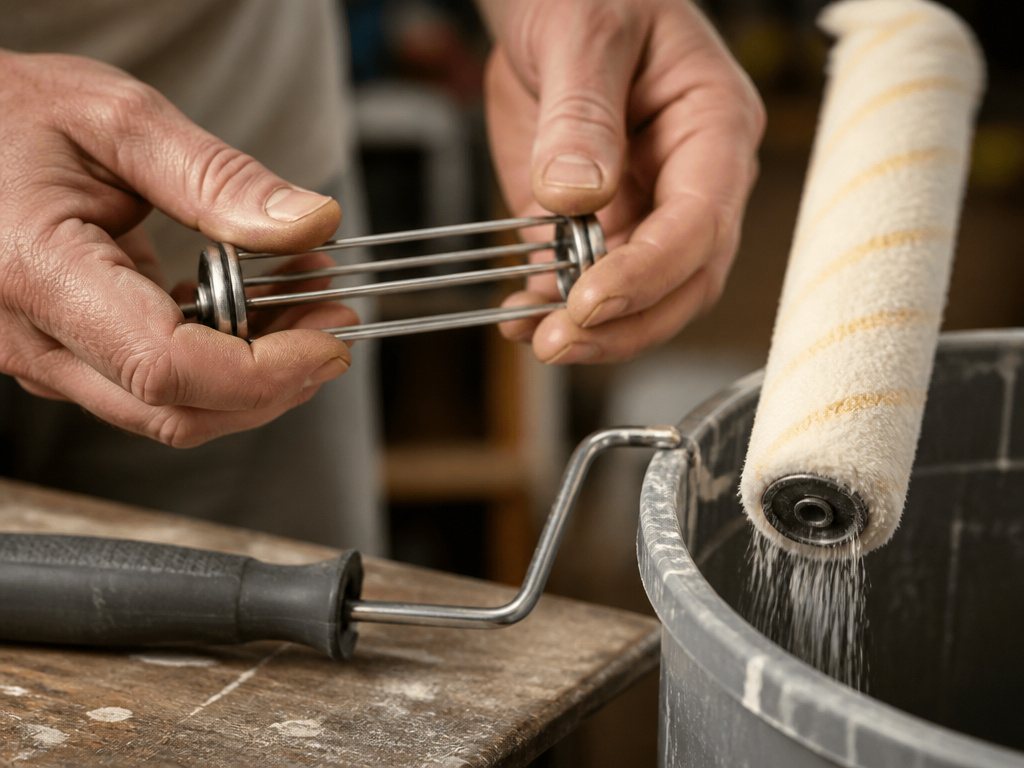
Spend your frame money on the cage, not the handle. A cheap frame with a sturdy cage and smooth-spinning bearings is a better bet than a fancy handle bolted to a wobbly birdcage.
A worthwhile upgrade is a frame that releases the cover cleanly. Purdy’s Revolution frames knock the cover off on the side of a trash can. Wooster’s mini cage uses a fast-action impact release. Either one beats fighting a cover off with your fingers while the paint dries.
What most people get wrong: Buying a premium cover for a frame that wobbles. The cover can’t fix a cage that drags, and a dragging cage skids instead of rolling. Spin the empty cage before you load it. It should turn smoothly and without catching.
Common mistake: Using a cover with fuzz that sheds into wet paint. No frame upgrade fixes that. The fibers land in the finish and dry there, and you’ll see them in the sheen.
Here’s the short list I’d check on any frame before buying.
- A cage that spins clean. Spin the empty cage. It should turn smoothly and without catching.
- A release that doesn’t fight you. Purdy Revolution and Wooster mini cages both knock the cover off.
- Gripping tabs or a retaining spring. McMaster frames use gripping tabs; Wooster mini cages use a retaining spring.
- A handle you can actually grip. ACE’s industrial frame molds the handle directly onto the frame with a threaded inner core.
When you’re done, clean paint rollers separate from the frame, and the frame itself needs only a wipe. The best paint rollers in your kit deserve the same care as the frame.
Frequently Asked Questions
What is the difference between a 9-inch and a 14-inch roller frame?
9-inch frame holds a 9-inch cover on a 1-1/2 inch core. A 14-inch frame holds a 14-inch cover and covers more wall per pass. Purdy rates 14-inch covers up to 55% more productive than 9-inch, measured against average completion time. The trade-off is weight and control near corners.
Can I use any 9-inch cover on a 9-inch frame?
No. Purdy’s standard 9-inch frame takes every 9-inch cover except Pro-Extra. The Pro-Extra 9-inch frame takes Pro-Extra covers only, because its core is 1-3/4 inch instead of 1-1/2 inch. Match the core, not just the width.
Do I need a different frame for a mini roller?
Usually yes. Purdy’s Wire Mini frames take Wire Mini rollers only, and its Jumbo Mini frames take 4-1/2 and 6-1/2 inch covers. Wooster’s mini cage frames are the exception and take both 4-1/2 and 6-1/2 inch mini rollers.
How do I know if my frame will fit my extension pole?
Hand-thread the pole and rock the joint before you load paint. If it wobbles, skips, or unscrews when you roll back and forth, that pair won’t work. A frame-side Acme thread alone doesn’t prove the pole will fit, per Hyde’s guide.
What wire count should I look for in a roller frame?
Wooster calls 5 or more wires the quality floor and builds pro frames with 6. Gordon Brush treats 5-wire as heavy duty and 4-wire as economical. ACE Tools uses five supports versus four on cheaper frames. Purdy publishes no wire count at all.
How do I release a roller cover without getting paint everywhere?
Tap the frame against the edge of a utility sink or a trash can and the cover slides off, per Purdy. Wooster uses a fast-action impact release. Remove the cover right after painting, before the paint starts to set.
The Bottom Line
One rule matters most: if the cover’s core doesn’t match the frame’s core, stop. Width, wire count, and handle shape are all secondary to that one number.
Then buy a 9-inch frame with a cage that spins clean, and put the money into a better cover. The frame just has to hold the cover straight.
This week, spin the empty cage on every frame you own. Any that drags gets quarantined, and any frame with a visibly bent or cracked part gets replaced rather than repaired. That’s the whole test.
