
Oil Painting Mediums Explained: What Each One Does
This post contains affiliate links. As an Amazon Associate, we earn from qualifying purchases.
Oil painting mediums explained in one line: they change how paint flows, how fast it dries, and how the finished film looks. Liquin Original is touch dry in one to six days depending on film thickness, while Langridge Painting Medium sets to a tack in 20 to 30 minutes for wet-in-wet work.
Every medium is a trade between three things: how long the paint stays open, how much it levels out, and how glossy the film ends up. Push one and the other two move with it.
That’s why the bottle you bought for better flow also changed your drying time, and why the fast one you added to a glaze made the layer underneath feel wrong, which is the oil painting mediums explained problem in miniature.
What follows runs in the order that actually matters: drying numbers first, because they set your whole schedule, then the three families, then the two places where the manufacturers contradict each other outright.
Key Takeaways
- Liquin Original is touch dry in one to six days, and that range comes from film thickness rather than from the product.
- Langridge Painting Medium sets to a tack in 20 to 30 minutes, which is why it suits wet-in-wet work and not fast finishing.
- NIST CS98-42 caps cobalt drier at 0.1% of the oil weight, and most modern mediums don’t publish their figure at all.
- The varnish wait doesn’t agree across sources: Winsor & Newton says six to twelve months, Gamblin says Gamvar can go on once the thickest paint is firm.
What a Medium Actually Changes in the Paint
A medium sits between your pigment and the surface, and it moves three things at once: flow, drying rate, and the look of the dried film.
A painting medium is a blend of binder, solvent, and sometimes resin or wax, added to tube colour to change handling. Tube paint already carries binder from the milling stage, so extra medium shifts the oil-to-pigment ratio of the layer and alters how that layer dries and bonds to what sits beneath it.
I found the ceiling on this the hard way. I loaded a fat stand-oil medium into an underpainting well past half the mix, and the paint went slick and glassy under the brush. Every mark I’d laid down flattened out overnight into a smooth sheet that looked like enamel rather than paint. Langridge states the exact threshold on its own product page: above 50% medium, the film shows an enamel finish with little or no physically raised brushmarks. Now I keep medium under a quarter of the mix until the top layers.
There’s an old rulebook for all of this, and almost nobody reads it. The NIST artists’ oil paints report, Commercial Standard CS98-42, was adopted in February 1940 and took effect for new production in May 1942.
It says vehicles shall be pure drying oils, linseed and/or poppy only. It caps cobalt drier at 0.1 percent of the oil weight and manganese at 0.2 percent, calculated as metal.
Langridge lists cobalt drier as an ingredient with no percentage disclosed. That gap between the standard and the shelf is the whole story of this topic.
I keep a scrap panel beside the palette for exactly this reason. Paint reads darker wet than it does when it dries, so I brush a stripe of the mix onto the scrap, let it set, and compare before committing to a large area. Try it on a scrap first.
How Fast Does Each Medium Dry?
One to six days is the range Winsor & Newton gives for Liquin Original, and the spread comes from film thickness rather than from the medium itself.
| Medium | Touch dry | What that means in practice |
|---|---|---|
| Liquin Original | 1 to 6 days | Range depends on how thick the film is |
| Galkyd Lite | 1 to 2 days | Fastest of the Gamblin family |
| Galkyd, Galkyd Gel, Neo Megilp | 3 to 4 days | Moderate, more working time |
| Galkyd Slow Dry | 4 to 6 days | Longest open time in that family |
| Langridge Painting Medium | 20 to 30 minutes to tack | Sets to a grab, still wet beneath |
| Chroma Odourless Classic Medium | About 5 days | Modified stand oil, flexible film |
Gamblin tested its numbers a specific way: 2 parts medium to 5 parts Titanium White, applied at 1/50 inch on coated paper, dried at 70°F until touch dry. That’s a method you can repeat, not a marketing line.
Pigment can override the whole table. Winsor & Newton puts Prussian Blue, Raw Sienna, the umbers, and Underpainting White at around two days, the ultramarines at around five, and the cadmiums, ivory black, titanium white, and alizarin crimson past five days, with alizarin listed at more than eight.
Alizarin crimson is the one that catches people out. oil paint drying time goes deeper on the pigment side.
Langridge Painting Medium is a pale amber liquid with a gum turpentine smell, and it tacks up in 20 to 30 minutes in a way you can feel through the brush. The surface grabs the next stroke instead of sliding.
Oil Painting Mediums Explained: Oils, Alkyds, and Gels
Liquin Original is an alkyd, and that single word explains most of how it behaves on the palette.
Oil-based mediums
Linseed, poppy, safflower, stand oil, and the blends built from them. Canson notes that purified linseed produces the finest, most transparent and brilliant paint, and that it retards drying, while boiled linseed accelerates it.
Poppy seed oil has the consistency of butter, dries slowly, and is the traditional choice for alla prima work where you want the brushstrokes to stay raised.
Winsor & Newton Safflower Oil slows drying, adds gloss and transparency, and has a low tendency to yellow. It’s also the base for a homemade medium: start at 50/50 safflower oil and solvent and adjust from there.
Alkyd mediums
Synthetic, fast, and already carrying driers. MITRA warns that most commercial alkyd paints and mediums contain driers, so artists should be cautious about adding more, since additives that speed drying promote cross-linking and can produce a more brittle film.
If you’re crossing over from water-based paint, acrylic mediums run on completely different chemistry. MITRA is blunt: oil paints aren’t compatible when mixed with most water-based mediums, including watercolour, gouache, and acrylic dispersion.
Gel and wax mediums
Gels hold texture. Chroma says Smooth Gel and Texture Gel should be mixed 1:1 with paint whenever you’re building thick impasto you plan to overpaint.
Without a gel, Chroma says thick impasto can take years to dry through. It stays like a soft-centred chocolate that shifts under the surface and loses the sharp definition of the application. That’s the most useful image in any of these guides.
Fat Over Lean: Where the Sources Genuinely Disagree
Chroma Archival Oils claims the fat over lean rule is built in, then warns in the same guide against fast layers over slow ones.
| Source | What it says about layering |
|---|---|
| Chroma Archival Oils | Rule is built in; fast mediums combine any way |
| Chroma, same guide | Do not use fast layers on top of slow ones |
| Langridge | Its fat medium shouldn’t sit under unmediated oil colour |
| NIST CS98-42 | Vehicle is linseed and/or poppy, nothing else |
The practical read: the fat over lean rule in oil painting still holds as a default, and a manufacturer claiming to have engineered it away is making a claim about its own resin system, not about paint in general.
Langridge is the honest one here. It states plainly that its medium has high oil content, is a fat medium, and shouldn’t be used for underpainting if oil colour with no added medium is going on top.
If you can’t say which layer is fattier, you’ve already lost track. Write the order on the back of the panel before the first stroke.
That single habit prevents most of the cracking people blame on their paint.
Which Medium Should You Actually Buy First?
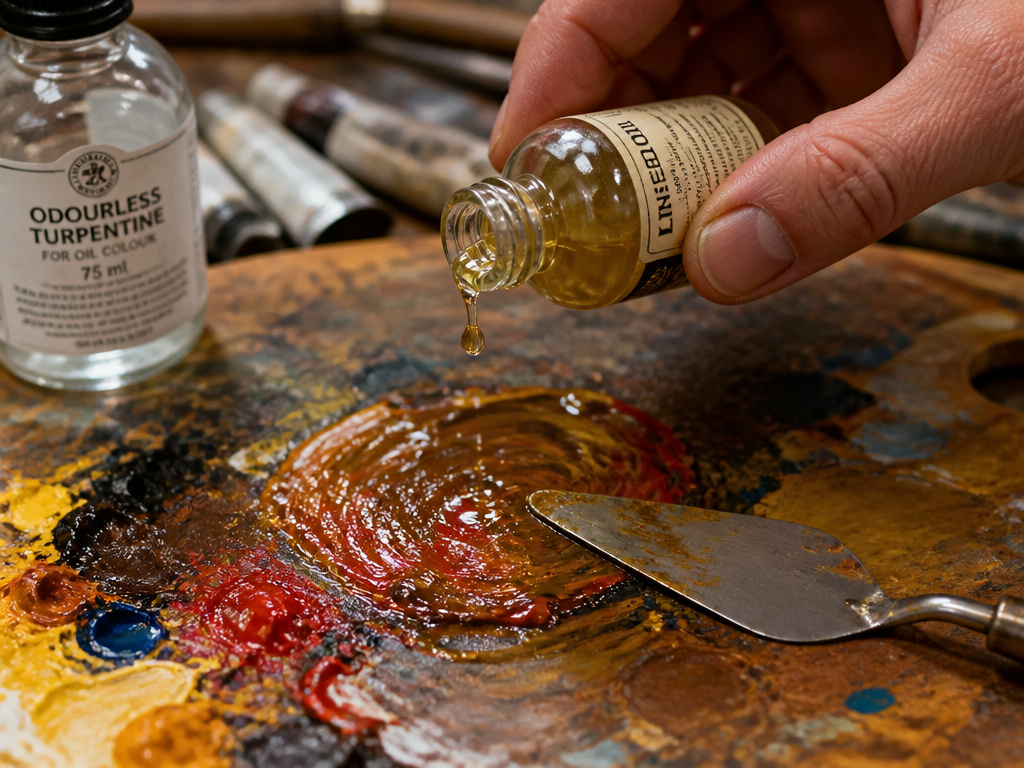
Buy one fast medium and one slow one, plus a solvent you can stand the smell of. That’s the whole kit.
- Liquin Original for the fast layers, because it’s touch dry in one to six days and stays non-yellowing.
- Gamsol if you’re thinning Galkyd, since Gamblin recommends only Gamsol for its Galkyd mediums, Cold Wax, Gamvar, and Ground.
- Langridge Painting Medium if you want wet-in-wet control, because it tacks in 20 to 30 minutes and grabs the next stroke.
- Chroma Archival Odourless Classic Medium for slow, flexible glazing at around five days.
I’d skip the four-bottle medium sampler. Two mediums and one solvent will teach you more in a month than eight bottles you’re scared to open.
If solvent fumes are what’s stopping you, water-mixable oils are the underrated option. They thin with water, and Holbein Duo Aqua is the one I reach for. That’s my preference, not a conservation recommendation.
Solvents and Thinning: The Part That Bites Beginners
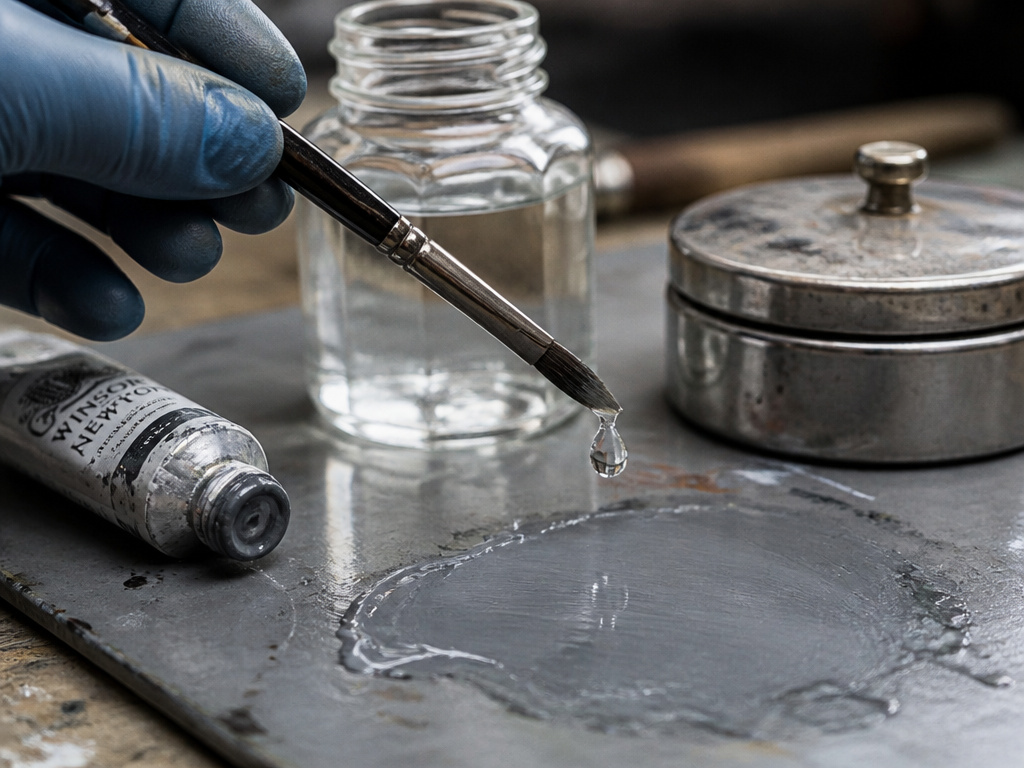
You dip the brush, the paint slides out like silk, and twenty minutes later you’ve got a thin grey puddle with a hard edge where the colour used to be.
That’s over-thinned paint. Winsor & Newton says solvents should only be used sparingly for thinning colour, so as not to affect the integrity of the paint.
Before you start: Solvent fumes are the real hazard here, not the paint. Chroma notes that oil paint itself has no toxic smell and that traditional mediums and solvents create the fumes associated with oil painting, so ventilate the room and keep the jar lidded between dips. Gamblin describes Gamsol as not absorbed through healthy skin, but that’s a claim about Gamsol, not about turpentine. Gloves on for the rest.
- Wipe the brush, then dip. Loading a wet brush straight into the jar carries pigment into your clean solvent and you’ll be replacing it inside a week.
- Add solvent a drop at a time. Winsor & Newton’s Artists’ Painting Medium takes solvent to go leaner and oil to go fatter, and the same logic applies to any mix you build yourself.
- Stop before the paint turns watery. Over-thinned colour loses binder and dries chalky, which is the same underbinding Langridge describes when oil sinks into a poorly primed canvas and leaves pigment liable to crack or flake.
Sansodor is the one I keep on the desk, because it’s the least hazardous solvent Winsor & Newton makes and you can open it in a small room without the whole house knowing.
Sinking-in is the other half of this. MITRA’s fix is simple: add a touch of medium to your paints and use less solvent. thin oil paint covers the ratios properly.
Varnishing Wait Times: Three Answers, One Decision
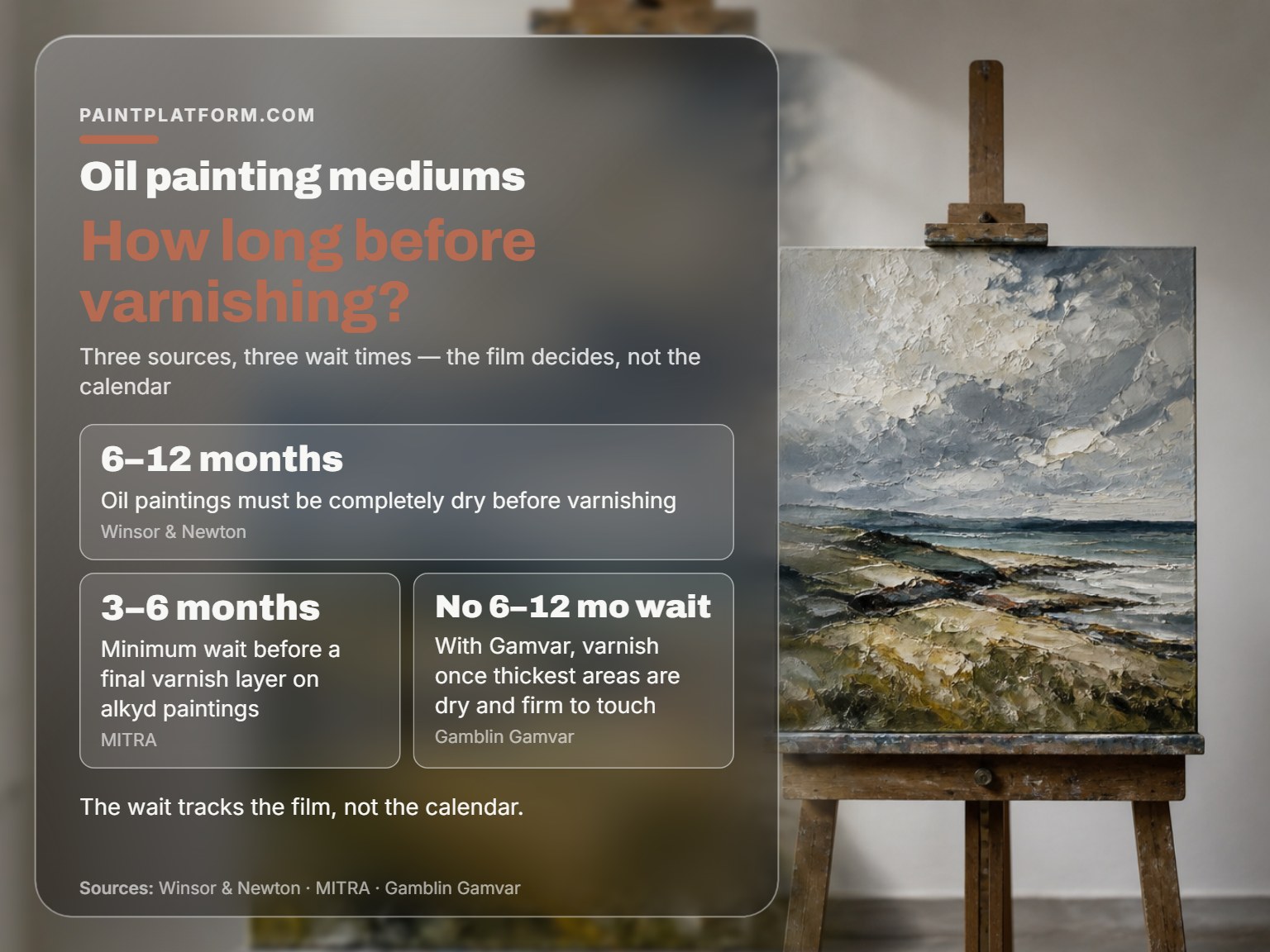
Six to twelve months is Winsor & Newton’s figure. Gamblin says most paintings don’t need that wait with Gamvar.
- Winsor & Newton: oil paintings must be completely dry before varnishing, which takes six to twelve months depending on paint thickness.
- MITRA: allow alkyd paintings at least three to six months before a final varnish layer.
- Gamblin: with Gamvar, apply once the thickest areas are thoroughly dry and firm to the touch.
Three positions, one takeaway. The wait tracks the film, not the calendar.
Where this goes sideways: Oiling out a matte patch instead of varnishing it. MITRA says to apply varnish locally to even the sheen, wait until dry, then varnish the whole surface. Langridge points out that oiling out is non-removable and doesn’t replace a varnish at all.
Gamblin is firm on the other side of this: mediums should not be used as a varnish or final coat, and picture varnishes should be colourless and removable.
A glaze layer should contain at least 10% oil colour, per Gamblin, and glazing technique depends on that ratio more than on which medium you pick.
Frequently Asked Questions
What’s the difference between a medium and a solvent?
Medium adds binder and changes how the paint handles and dries. A solvent thins the paint and evaporates away. Winsor & Newton treats them as separate jobs, and warns that solvents should only be used sparingly so the paint’s integrity holds.
Can I mix acrylic medium into oil paint?
No. MITRA states plainly that oil paints aren’t compatible when mixed with most water-based mediums, including watercolour, gouache, and acrylic dispersion. They can theoretically be layered, but the resulting stratigraphy can suffer over time.
How much medium should I actually add?
Winsor & Newton says mediums should be used moderately, since binders are already included in the milling process. Langridge’s own threshold is instructive: above 50% medium, the film goes enamel-smooth and loses raised brushmarks. For impasto gels, Chroma specifies 1:1 with paint.
Does medium make oil paint dry faster?
Only some of them. Liquin Original is touch dry in one to six days, and Galkyd Lite in one to two. Winsor & Newton Safflower Oil and Artists’ Painting Medium slow drying instead. Check which direction your bottle goes before you build a schedule around it.
Why did my paint dry dull and matte?
That’s sinking-in, where oil leaves the film and soaks into the support. MITRA’s fix is to add a touch of medium and use less solvent. If a finished area still looks matte, MITRA recommends varnish locally rather than oil.
Do I need a medium at all?
Not always. Winsor & Newton notes that binders are already in the tube, so a medium is a modifier rather than a requirement. Where it earns its place is when you need more open time, more flow, or more transparency than the paint gives you straight.
The Bottom Line
Here’s the trigger I’d give you: if you can’t name the medium and the rough ratio you used on a layer, don’t put another layer on top of it. Stop and write it down. That’s the moment most film failures get locked in.
None of this matters much if you’re painting small panels and finishing in one sitting. The layering problems show up when you build up over weeks, and that’s when the drier caps, the fat-over-lean order, and the varnish wait start doing real work.
And if you only ever buy one medium, make it an alkyd. It solves the problem beginners actually have, which is waiting.
