
Metal Paint Types Explained: How to Choose
This post contains affiliate links. As an Amazon Associate, we earn from qualifying purchases.
Metal paint types explained in one line: alkyds, epoxies, polyurethanes, acrylics, and zinc-rich primers each solve a different problem, and picking the wrong family is why paint peels. Alkyds handle general steel, epoxies block moisture, polyurethanes hold color outdoors, and zinc-rich primers sacrifice themselves to protect the steel underneath.
That peeling has a paper trail, and the metal paint types explained question comes down to how long they last. The coatings industry grades systems by how long they last before first maintenance, and ISO 12944 splits that into ranges rather than promises: low runs 2 to 5 years, medium 5 to 15, high more than 15.
What follows is the five families, the primer decision sitting underneath all of them, and the prep step that decides whether any of it holds.
Key Takeaways
- Match the family to the service, not the color chip. An alkyd on a dock and an epoxy on a sunlit railing both fail, just at different speeds.
- Alkyds quit in standing water. USACE System A is explicitly not intended for damp environments, surfaces that constantly sweat, or immersion.
- Epoxy chalks in sunlight and needs a topcoat if you care about color or gloss, per ISO 12944-5.
- Aromatic polyurethane is not a topcoat. Only aliphatic hardeners hold exterior gloss.
- Zinc-rich primers need moisture to cure, and too much of it blisters. Ethyl silicate zinc is the fussiest product on the shelf.
The 3 Jobs a Metal Coating Can Do
The Bureau of Reclamation sorts every protective coating into three families, and that sorting is more useful than any brand comparison you’ll read. Once you know which job a product is doing, the metal paint types explained question stops mattering.
Barrier coatings slow the passage of water, oxygen, and chloride ions without reacting with the steel. Inhibitive coatings release pigments that interfere with the corrosion reaction at the surface. Galvanic coatings, including zinc-rich primers and galvanizing itself, corrode in place of the steel until the sacrificial metal is used up.
Here’s the short version of each:
- Barrier. Epoxy and polyurethane are the workhorses. They slow permeation, but no barrier is completely impermeable, and corrosive agents get through eventually.
- Inhibitive. Zinc phosphate is a mildly inhibitive pigment widely used in modern primer formulations. It interferes with the corrosion reaction rather than blocking it.
- Galvanic. Zinc-rich primers are the most commonly used anodic-metal primers. The zinc corrodes in preference to the steel until it’s exhausted.
Most consumer products blend two of these. A “rust-inhibiting enamel” is usually a barrier resin with an inhibitive pigment stirred in, and it’s doing neither job especially well.
The Bureau of Reclamation protective coatings guide is worth skimming if you want the long version. It’s written for dam gates, but the chemistry doesn’t care what you’re painting.
| Family | How it protects | Where it wins | Where it fails |
|---|---|---|---|
| Alkyd | Barrier, dries by solvent loss | Gates, railings, dry shelter | Standing water, damp air, sunlight |
| Epoxy | Barrier, high chemical resistance | Immersion, tanks, buried steel | Sunlight, unless topcoated |
| Polyurethane | UV-stable barrier topcoat | Exterior color and gloss | Aromatic types chalk; not for immersion |
| Acrylic | Fast-dry barrier | Water-borne DTM in mild climates | C5 and CX environments |
| Zinc-rich | Galvanic, sacrificial | Primer over blast-cleaned steel | Poor prep, wrong humidity, thick films |
Alkyds: The Cheap Default That Quits in the Damp
Alkyd enamel quits the moment the steel stays wet. USACE System A states plainly that alkyds are not intended for humid or damp environments and should not be applied to surfaces that constantly sweat or sit in water. It also chalks and oxidizes in sunlight.
For a porch railing under a roof, that’s fine. For a boat trailer, it’s a waste of a Saturday.
The prep requirement is real too. System A calls for Commercial Blast or Brush-off Blast cleaning, which is a lot of work for a paint that’s going to chalk in three summers.
Rust-Oleum Stops Rust Protective Enamel is the alkyd most people actually buy, and it does what an alkyd does: lays down a hard, glossy film that shrugs off scuffs and handprints. Keep it out of ponding water and out of full sun and it earns its place. If you’re weighing options for a specific project, this rundown of the paint for metal covers where the alkyd line stops being the right call.
Common mistake: Recoating an alkyd over a damp surface to “build it up.” Trapped moisture drives out through the fresh film as it cures and lifts it into blisters within a single season.
Why Does Epoxy Chalk in Sunlight?
Sunlight breaks epoxy down, and the chalky film it leaves behind is the coating failing in slow motion. ISO 12944-5 §6.2.4 puts it bluntly: “Most epoxy coatings chalk when exposed to sunlight. If colour or gloss retention is required, a topcoat should be applied.
You can see it before you can explain it. Rub a thumb across a weathered epoxy panel and it comes away with a white smear, like chalk dust off a blackboard.
So epoxy is a primer and intermediate coat in atmospheric service. That’s the ISO position, and it’s the one that matters for anything the sun hits.
USACE takes a different line for a different situation. System C specifies straight epoxy polyamide for immersion and high-humidity service, where UV is absent and chemical resistance is the whole point. Both positions are correct once you name the service environment. A tank interior and a handrail are not the same job.
There’s a second thing epoxy doesn’t do. Unlike zinc-rich primers, epoxy protects steel by forming a barrier, and no barrier is completely impermeable. Water, chloride ions, and oxygen permeate through it over time. Thicker films buy you years, not forever.
If you’re going that route, the practical comparison of epoxy paint for metal is worth ten minutes before you buy a gallon.
Where this goes sideways: Using a straight epoxy as the finish coat on anything that faces the sky. It goes chalky and dull within a couple of seasons, and recoating means sanding a film that’s harder than the topcoat you’re putting on it.
Polyurethane Topcoats: Aliphatic or Nothing
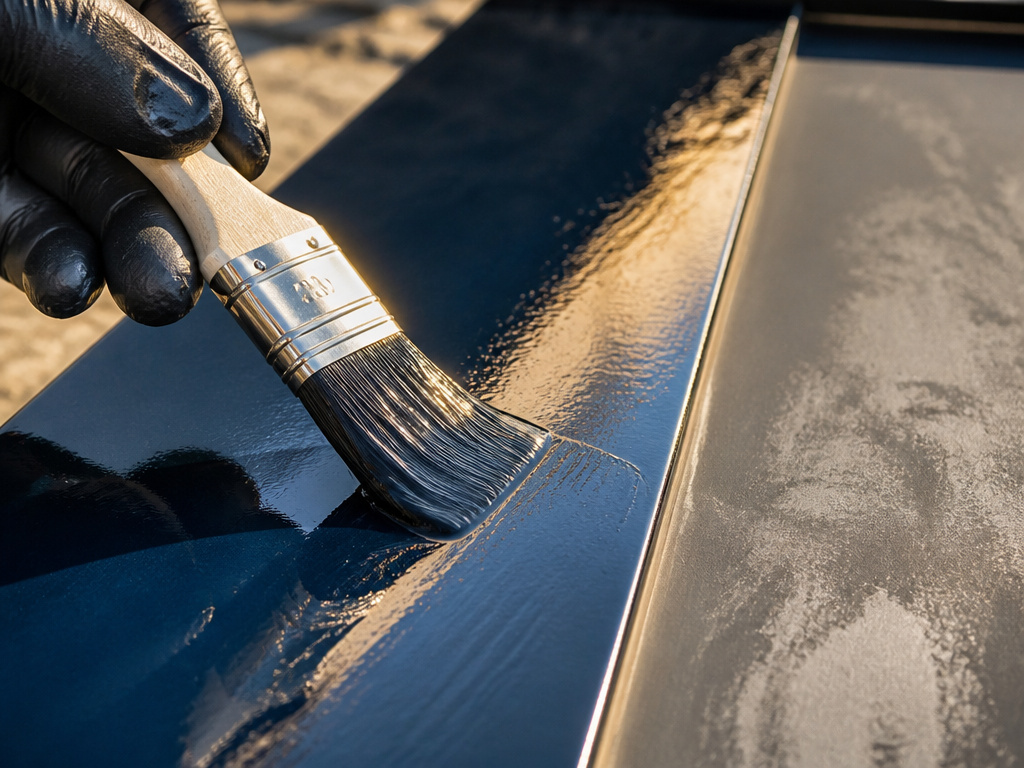
Fifteen times. That’s the color and gloss retention gap USACE measured between its acrylic polyurethane topcoat system and the alkyd, urethane, and straight-epoxy systems it compared it against. System D pairs an acrylic polyurethane topcoat over an epoxy polyamide primer, and it wins that comparison by a wide margin.
The catch is in the name of the service. System D is explicitly not recommended for immersed metals. The best-looking system on the list is disqualified the moment the steel goes underwater.
Hardener chemistry decides the rest. ISO 12944-5 §6.2.5 says aromatic polyurethane types are not recommended for topcoats because they tend to chalk, and aliphatic isocyanate hardeners are required for exterior gloss and color retention.
The IMIA paper takes a broader view, describing two-pack polyurethanes as used almost exclusively as topcoats for UV resistance, gloss, and durability, without splitting aromatic from aliphatic. Read both and the practical rule is the same: if the label doesn’t say aliphatic, don’t put it where the sun lands.
Two-pack polyurethane also cures by an irreversible chemical reaction. It dries like a single-pack paint and then keeps reacting for hours afterward. I sealed a dresser with wax once and it felt dry in an hour but stayed tacky for a full day. Cure and dry are different clocks, and paint is no different.
For anything outside, the exterior metal paint breakdown covers which topcoat pairs with which primer.
I’ve stopped recommending cheap two-pack polyurethane for anything but a topcoat. It’s a brilliant finish coat and a mediocre everything else, and people buy it expecting one product to do three jobs.
Zinc-Rich Primers and the Humidity Trap
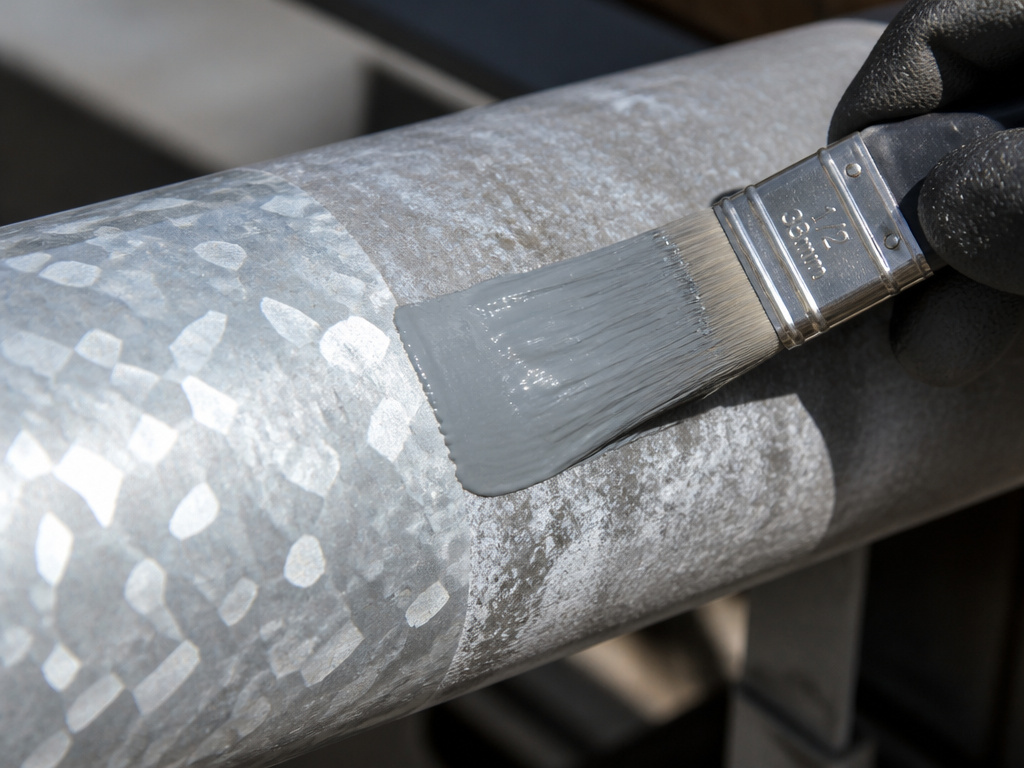
A galvanized handrail comes out of the dip bright and shiny. Two years later it’s a dull matte gray, and that’s the exact point at which paint finally has something to grip.
The Bureau of Reclamation explains why. Bare galvanizing in atmospheric service forms a protective layer between 1 and 2 years after galvanizing, and that layer impedes further corrosion. The service life of atmospheric galvanized metalwork has been known to exceed 50 years.
Before that layer forms, you’re dealing with zinc oxide and zinc hydroxide. Both are water soluble, not very dense, and they adhere loosely. Paint does not adhere well to them, and painting over them will probably result in premature coating failure. The first and second phase zinc reactions may keep going for 1 to 2 years after galvanizing, depending on local environment.
Ethyl silicate zinc primers have their own rules. They cure by reacting with atmospheric moisture, so the lower the relative humidity, the slower the curing. Exceed the nominal dry film thickness limit and the film cracks. Exceed the humidity limit and you get bubbles and pinholes. Once the liquid and zinc powder are mixed, pot life is limited and running out.
Three failure modes from one product, and all three come from the same variable: moisture.
If you’re priming bare steel rather than galvanized, the metal primer guide walks through which chemistry matches which substrate. And if rust is already in the picture, the rust paint for metal options are a different decision entirely.
Which Primer Goes Under Which Topcoat?
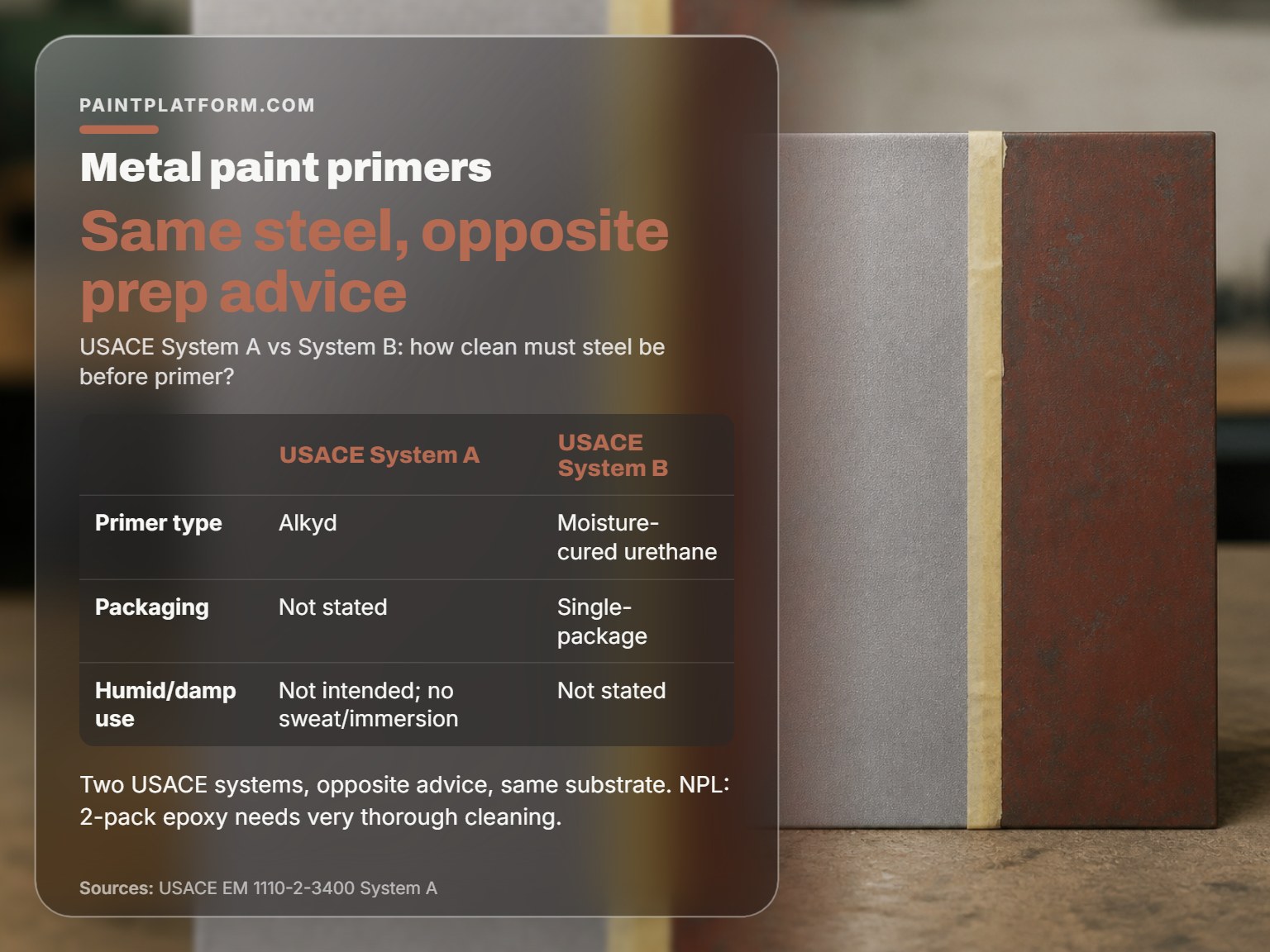
Three primers cover almost every home metal job: zinc-rich, two-pack epoxy, and wash primer. The disagreement is about how clean the steel has to be before any of them go on.
USACE System A requires Commercial Blast or Brush-off Blast for alkyd. System B, a single-package moisture-cured urethane, explicitly permits application over poorly prepared surfaces, particularly where proper preparation is difficult or impractical. Two USACE systems, opposite advice, same substrate.
The National Physical Laboratory lands closer to System A for epoxies. Two-pack epoxy primers rely on high adhesion and chemical resistance, and that adhesion is only obtained on a very thoroughly cleaned surface.
Prep isn’t a formality, either. One of the most common reasons for adhesion failure is painting over a contaminated substrate. Soluble salts left on the surface promote osmotic blistering, where moisture passes through the semipermeable coating and collects between film and steel.
I skipped a fine sanding pass on a slick drawer front before stenciling it once. The pattern scratched off with a fingernail inside a week. Metal behaves the same way: if the surface won’t take a scratch, it won’t hold paint.
Wash primer is the specialist option. Basic zinc chromate vinyl butyral wash primers provide excellent adhesion to carbon steel, stainless, zinc, aluminum, galvanized steel, and even glass, and they’re preferred where salt water or salt spray exposure occurs. Mix them, use them within 8 hours, and discard whatever’s left, because adhesion declines substantially even though the liquid looks unchanged.
The direct-to-metal paint question sits on top of all this. The waterborne direct-to-metal coatings report from the American Coatings Association is candid about the limits: DTM coatings perform well in C1 to C3 environments but have a long way to go to reach C5 or CX.
Easy to miss: The ACA notes DTM coatings often start as a single coat of about 50 microns, while traditional anticorrosive protection uses at least two layers. A one-coat claim and a two-coat reality can both be true depending on which product you picked up.
How Long Should a Metal Paint Job Actually Last?
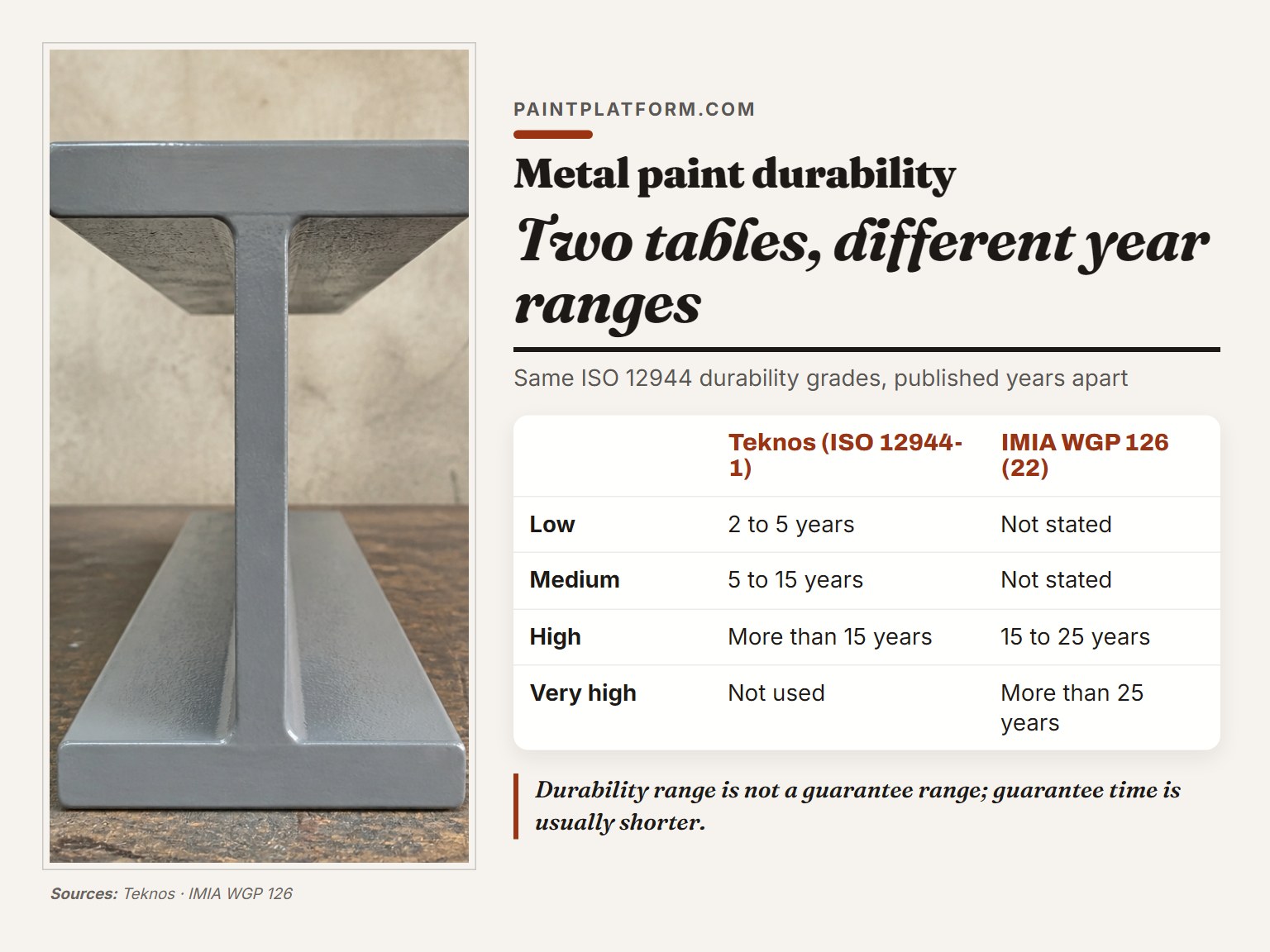
Durability ranges are not guarantees, and the two documents that publish them don’t even agree on the numbers.
| Grade | Teknos, citing ISO 12944-1 | IMIA WGP 126 (22) |
|---|---|---|
| Low | 2 to 5 years | Under 7 years |
| Medium | 5 to 15 years | 7 to 15 years |
| High | More than 15 years | 15 to 25 years |
| Very high | Not used | More than 25 years |
Neither table is wrong. They’re different readings of the same standard, published years apart, and the gap between them is a useful reminder that “15-year coating” is a category label, not a promise.
Teknos is explicit about this: the durability range is not a guarantee range, guarantee time is usually shorter than the durability range, and there are no rules linking the two.
What actually extends life is film thickness. The NPL guide states it plainly: generally, the thicker the coating, the longer the life, and undercoats exist to build that thickness across several coats. Laminar pigments such as micaceous iron oxide reduce or delay moisture penetration in humid atmospheres and improve tensile strength.
For a C5 high-durability system, the IMIA paper lists a zinc-rich epoxy primer at 60 µm, epoxy intermediate at 120 µm, and polyurethane topcoat at 80 µm, for 260 µm total. Those numbers are why industrial work looks so slow and thick compared to a rattle can.
If you’re working from a spray can, the spray paint for metal comparison is a different set of trade-offs, mostly around how many thin passes it takes to reach a film that’s actually there.
Thin coats, more of them, is the rule that survives every chemistry on this page. One heavy pass feels efficient and fails early.
The Prep Steps That Decide Everything
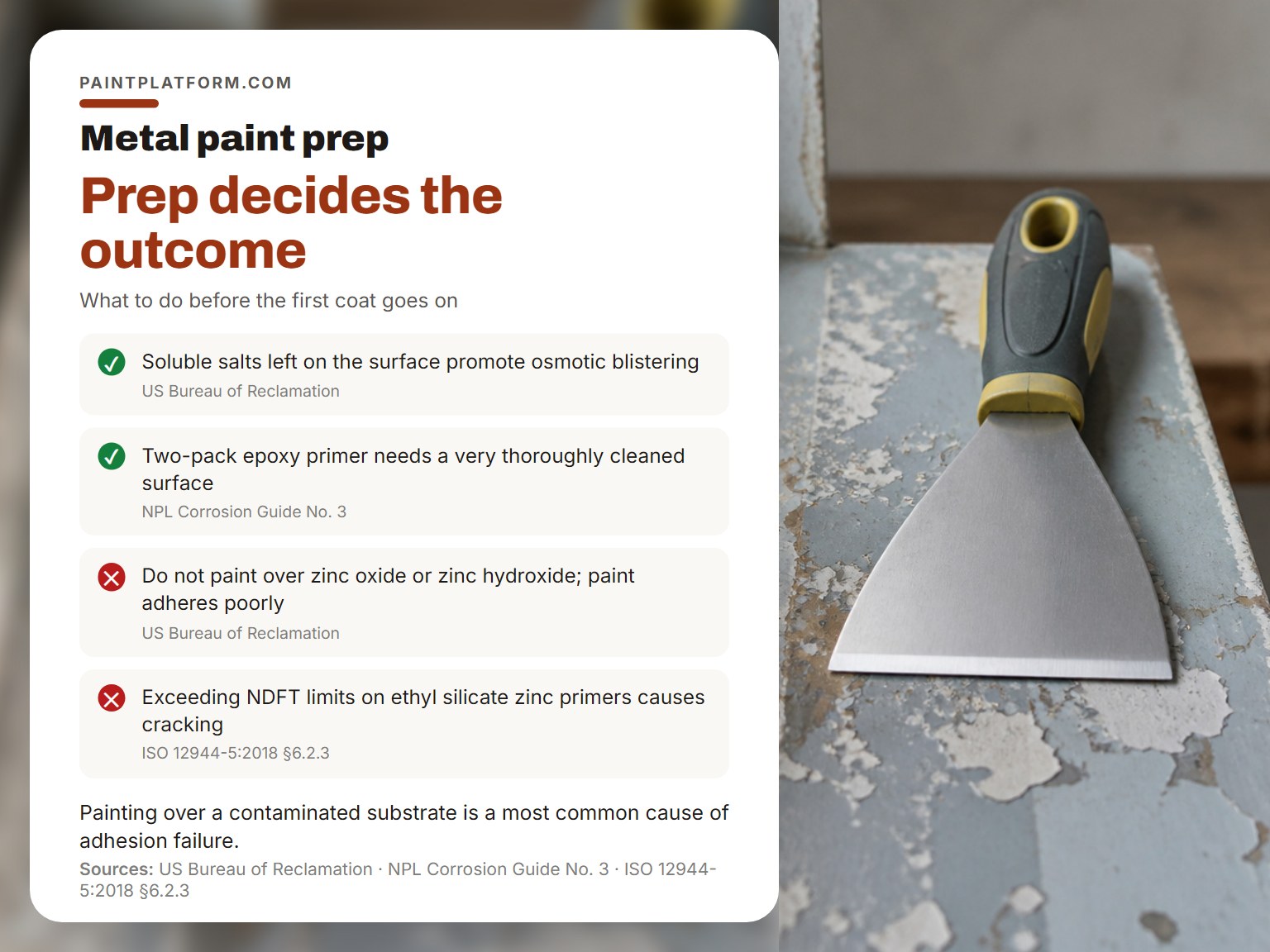
Prep decides the outcome, and it decides it before the first coat goes on.
Before you start: Solvent-borne coatings and wash primers release VOCs, and hot-applied bitumens give off volatile phenol compounds during heating that are considered carcinogenic and skin irritants. Wear protective clothing and an appropriate respirator, and work somewhere with real airflow. Abrasive blasting generates dust; eye and respiratory protection are not optional.
- Degrease before you touch anything abrasive. Soluble salts and oils left on the surface promote osmotic blistering, and blasting drives contamination into the profile instead of removing it.
- Remove loose rust and flaking paint mechanically. A wire brush and twenty minutes does more for adhesion than any additive in the can.
- Sand or blast to the profile the product calls for. An alkyd wants Commercial Blast or Brush-off Blast. A two-pack epoxy wants a very thoroughly cleaned surface. A moisture-cured urethane will tolerate less, and that tolerance is the exception, not the rule.
- Wipe down and let it flash off. Solvent left in a pit or seam flashes out through the curing film and leaves a pinhole.
- Prime within the recoat window printed on the can. Miss it and the primer has to be abraded before the topcoat will bond.
- Build thin coats to the stated film thickness. Thicker films crack, particularly on zinc-rich primers, where exceeding the nominal dry film thickness limit is a known failure mode.
The AISC painting and surface preparation FAQ is the structural steel industry’s own answer sheet if you want the surface prep standards spelled out, and the older metal painting process document archive covers the process side.
On the mechanical removal step, I keep a sharp carbide scraper within arm’s reach of every paint job now. One cleared a flaking window sill in about fifteen minutes, which is faster than I ever managed with a gooey stripper and a plastic putty knife. Keep the edge sharp or it just gouges. Pull it toward you rather than dragging it sideways across the work, because I learned that by leaving chatter marks all over a door frame that I then had to sand out anyway.
Skip the paint-plus-rust-converter combo as a permanent fix. It buys you a season on light surface rust and does nothing on scale. Remove the rust, then coat it.
Frequently Asked Questions
Can you paint directly over galvanized metal?
Not in the first year or two. Bare galvanizing forms a protective layer between 1 and 2 years after the dip, and before that layer exists you’re painting over zinc oxide and zinc hydroxide, which are water soluble and adhere loosely. A zinc chromate vinyl butyral wash primer is the standard bridge for galvanized, aluminum, and other difficult metals.
Is epoxy a good topcoat for outdoor metal?
Only with a topcoat over it. ISO 12944-5 §6.2.4 notes that most epoxy coatings chalk when exposed to sunlight, and recommends a topcoat where color or gloss retention matters. USACE still specifies straight epoxy polyamide for immersion and high-humidity service, where UV never reaches the film.
Why did my polyurethane topcoat go dull in a year?
Check the hardener type. Aromatic polyurethane types are not recommended for topcoats because they tend to chalk, and aliphatic isocyanate hardeners are required for exterior gloss and color retention. A product labeled simply “polyurethane” without a hardener designation is a gamble outdoors.
Can I skip the primer if the paint says direct-to-metal?
Sometimes, with caveats. The American Coatings Association reports that DTM coatings perform well in C1 to C3 environments but have a long way to go to reach C5 or CX, and that traditional anticorrosive protection uses at least two layers, a primer and a topcoat. A single-coat DTM is a mild-environment product.
What does NDFT mean on a paint can?
Nominal dry film thickness, expressed in micrometres. It’s the thickness the cured film is designed to reach, and it’s the number that governs everything from cracking on zinc-rich primers to how many coats an undercoat schedule needs.
How long should exterior metal paint last before repainting?
The published ranges disagree. Teknos, citing ISO 12944-1, puts low durability at 2 to 5 years, medium at 5 to 15, and high at more than 15. IMIA WGP 126 (22) grades low as under 7 years, medium 7 to 15, high 15 to 25, and very high above 25. Neither is a guarantee period.
The Bottom Line
One rule sits above every chemistry on this page: if the steel stays wet for hours at a time, skip every alkyd on the shelf. Standing water, constant condensation, immersion, a spot that never dries out after rain. That’s epoxy territory or zinc-rich territory, and the alkyd will chalk and lift while you’re still congratulating yourself on the finish.
Everything else is a decision about sunlight and film thickness. Sun hits it, you need an aliphatic polyurethane topcoat. Sun doesn’t, and epoxy can be the finish. Film thickness decides how many years you get, and no product on the shelf substitutes for it.
Start with the prep, not the can. Degrease, scrape, sand, and then read the label with clean hands. The product you choose matters less than the twenty minutes you spent before opening it.
