
How to Paint Stucco Without Cracking: Step-by-Step
This post contains affiliate links. As an Amazon Associate, we earn from qualifying purchases.
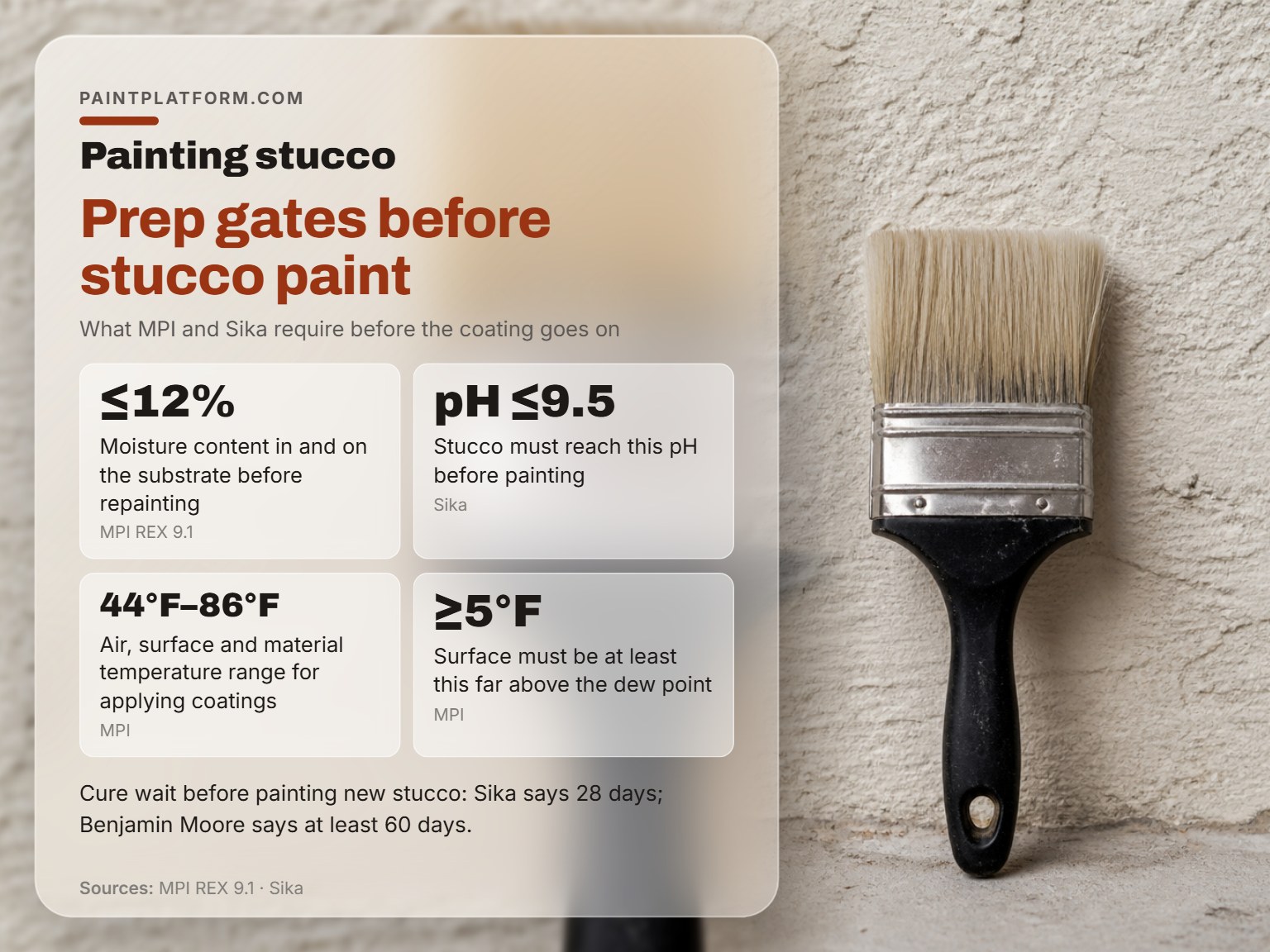
To paint stucco without cracking, coat only when air, surface, and material temperatures sit between 44°F and 86°F, the surface is at least 5°F above the dew point, and substrate moisture is 12% or less. Fresh stucco also needs a full cure and a pH of 9.5 or lower before any coating goes on.
Each of those thresholds maps to a specific failure. Below 44°F the coating never forms a continuous film. Above 86°F, or on a wall in direct sun, it skins over before it can level, and that’s where lap marks and hairline cracks begin.
What follows is the order that keeps you inside those windows: the prep that has to happen first, the crack repairs that need curing time before paint, and the coatings that bridge a hairline instead of hiding it.
Key Takeaways
- Stay inside 44°F to 86°F for air, surface, and material temperature, with the wall at least 5°F above dew point.
- Get substrate moisture to 12% or less before any coating, per MPI REX 9.1.
- Test pH before you buy paint. Sika puts full cure at about 28 days; Benjamin Moore says wait at least 60.
- Build thin, measured passes. Excessive film thickness is a named cause of blistering, efflorescence, and delamination.
- Caulk hairline cracks and let the caulk cure completely, or they telegraph back through the new coat in one winter.
What Temperature and Humidity Window Actually Prevents Cracking
Three conditions have to line up before a coating touches the wall: temperature, dew point, and moisture in the substrate.
Stucco coatings require air, surface, and material temperatures between 44°F and 86°F (7°C to 30°C). Surface temperature must stay at least 5°F (3°C) above dew point, and relative humidity is monitored per ASTM D3276 within a 40 to 80 percent range. Coating a hot, cold, or sun-exposed wall drives rapid drying, producing cracking, lap marks, and uneven sheen.
That dew point rule is the how to paint stucco without cracking question people skip. If the surface is only 3°F above the dew point, you’re inside the 5°F margin and you need to wait. Water is condensing on the wall while your coating is trying to cure.
The 40 to 80 percent humidity band is wider than it sounds. High humidity slows drying and raises the risk of alkali attack or efflorescence, especially on newer stucco that’s still holding moisture. Low humidity brings the opposite problem: the film skins before it levels.
| Condition | Target | What happens outside it |
|---|---|---|
| Air, surface, material temp | 44°F to 86°F (7°C to 30°C) | Rapid dry, lap marks, cracking |
| Surface vs. Dew point | At least 5°F (3°C) above | Condensation during application and cure |
| Relative humidity | 40% to 80% RH | Slow cure, alkali attack, efflorescence |
| Substrate moisture | 12% or less | Trapped moisture, blistering, peeling |
| Stucco pH | 9.5 or lower | Paint degradation, premature failure |
Direct sun is its own trap. A south-facing wall in early afternoon reads far hotter at the surface than the air temperature your weather app is showing, and MPI specifically flags sun-exposed surfaces as a cause of rapid drying. Early morning and late afternoon are your working windows on those walls.
How Long Should New Stucco Cure Before You Paint It?
Sika and Benjamin Moore give you two different answers to that question, and both are defensible.
Sika’s bulletin sets a measured gate: stucco must reach a pH of 9.5 or less, and full cure normally occurs 28 days after application. Benjamin Moore’s contractor guide sets a time gate instead: wait at least 60 days on new stucco.
Those numbers aren’t in conflict so much as measuring different things. Portland cement products start out extremely alkaline, and Sika notes those levels normally drop during the first month after installation. A pH test tells you what the wall is actually doing. A calendar tells you what it usually does.
If you can test, test. Sika points out that a pH tester is available at paint and lab supply stores. If you can’t test, note that Benjamin Moore says wait at least 60 days on new stucco, while Sika gates on a measured pH of 9.5 or less with full cure normally at 28 days.
Worth knowing before you start: Alkali resistance isn’t optional on stucco. Sika states that most acrylic and elastomeric coatings are already alkaline-resistant, but most other paints are not resistant to a highly alkaline condition. An alkali-resistant primer goes over the wall before anything else.
That’s the whole reason a cheap leftover can of interior paint is the wrong move here. It’ll look fine for a season and then let go.
Hairline, Credit-Card, or Quarter-Inch: Which Cracks Need What
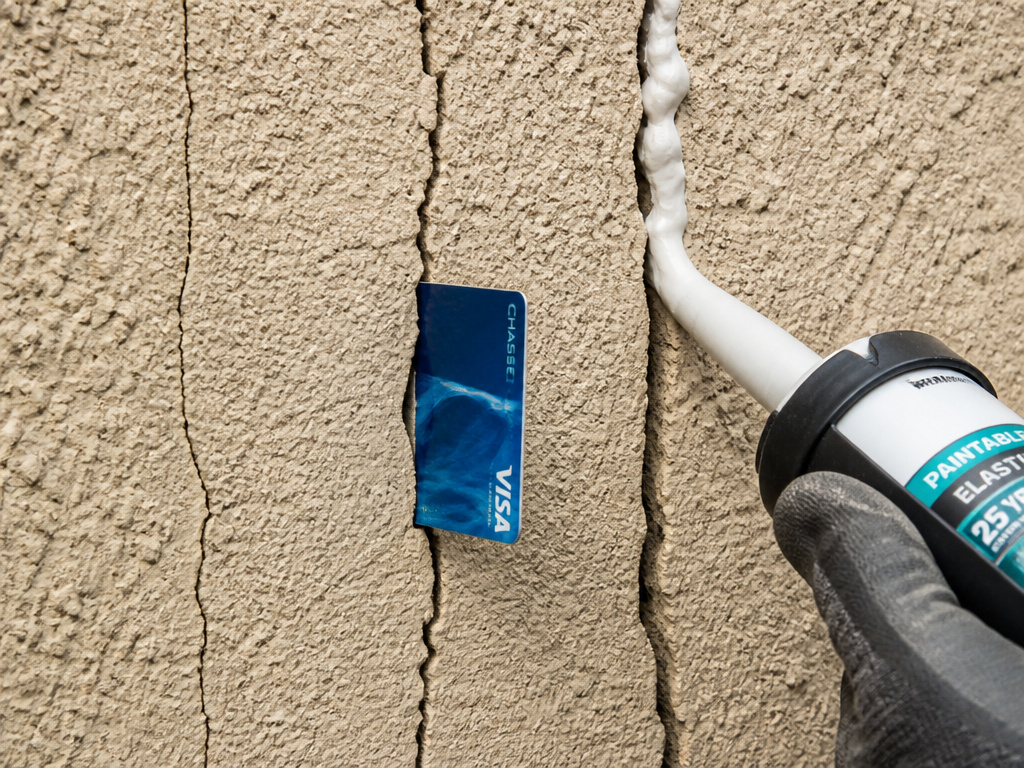
I painted straight over the hairline cracks on my first stucco wall. They were thin enough that the roller seemed to swallow them, so I told myself they were cosmetic. By the end of that winter every one had opened back up through the new coat, and each crack had a faint ridge you could catch a fingernail on.
What changed: anything under about 1/4 inch now gets a paintable elastomeric caulk worked into it and feathered, then left to cure completely before the first coat. Wider cracks get patch compound first. Boring, but the cracks stay closed.
The standards don’t fully agree on where that line sits, and it’s worth knowing which rule you’re following.
| Source | Threshold | What it calls for |
|---|---|---|
| MPI REX 9.1 | Cracks and holes under 1/4 inch | Exterior caulking compound, feathered, cured fully |
| MPI REX 9.1 | Cracks at or above 1/4 inch | Filling compound matched to surrounding texture |
| Benjamin Moore | Credit card fits in the crack | Open it up, prime, and patch it |
| Benjamin Moore | Minor hairline cracking | Acrylic caulk made for stucco repair |
The credit-card test is the more conservative of the two. If a card slides in, Benjamin Moore says open the crack up rather than bridge it, because a crack that wide is moving.
MPI’s rule on caulk is condition-based rather than calendar-based: the caulk “shall be allowed to cure completely,” with no fixed interval given. Benjamin Moore puts 7 to 10 days between repairing larger cracks and painting over them. When a standard and a manufacturer disagree on timing, note that Benjamin Moore puts 7 to 10 days between repairing larger cracks and painting, while MPI REX 9.1 requires the caulk to cure completely with no fixed interval.
Matching Patch Texture Without Making It Worse
A flat patch on a textured wall reads as a scar no matter how well you paint it. I’ve tried a stiff brush, a crumpled paper bag, and a damp sponge on the same repair. The sponge won by a mile, and the paper bag was a mess I won’t be repeating.
Dab, don’t drag. Dragging pulls the patch compound smooth and flattens the texture you’re trying to rebuild.
Common mistake: Painting too soon after a patch or a caulk bead. Paint over uncured material and you trap solvent underneath it; the repair fails from the inside out, usually within the first season.
Here’s the part that catches people: the crack is often a symptom, not the problem. MPI’s DSD-4 rating covers areas where the damage can’t be fixed with surface prep and paint at all. Those need repair or replacement, and repainting is only a temporary cosmetic fix.
The Prep Sequence That Decides Whether the Paint Holds
Prep eats the afternoon. It also decides whether the coating is still on the wall in five years.
Fair warning: this is the stage that feels like it isn’t doing anything. (I’ve skipped it before, so no judgment.)
MPI REX 9.1 is blunt about what has to come off: dirt, dust, efflorescence, loose paint, and powdery residue, on a surface that’s dry. Oil and grease come off with detergent cleaning (MPI RSP-13) followed by a clean water rinse, with solvent cleaning (MPI RSP-2) as the alternative on concentrated spots. Mildew gets MPI RSP-9. Rust stains get oxalic acid (MPI RSP-12).
Before you start: A pressure washer held close will drive water into cracks and shear soft stucco, so keep the nozzle moving and back off on old patches. Oxalic acid and mildew treatments need gloves and eye protection, and neither belongs on a ladder you’re sharing with a wet wall.
- Brush the wall down dry first. A soft-bristle vinyl brush loosens dirt before water turns it into a slurry that dries right back into the texture.
- Wash, then rinse. Pressure washing (MPI RSP-5) is the fastest route on a full wall; hand cleaning (MPI RSP-1) covers small areas. Skip the rinse and detergent residue stays put, and the primer won’t bond there.
- Strip the chalky bloom. Efflorescence gets removed, then flushed with clean water and re-tested. Coat over it and you’re painting a layer that’s already trying to leave the wall.
- Treat mildew with MPI RSP-9, not a splash of bleach. Mildew under a fresh film keeps working, and you’ll find the same pattern in the same corner next spring.
- Pull rust stains with oxalic acid (MPI RSP-12) before priming. A stain left in place keeps reading through the new coat.
- Dry to 12% moisture or less. MPI REX 9.1 sets that as the gate, and it’s the step that separates a coating that lasts from one that blisters.
- Mask and protect. Tape off windows and doors, and sheet over plants and shrubs before a sprayer comes out.
If you want the longer version of that sequence, the rundown on how to prepare exterior walls for painting covers the same ground with more detail on rinse technique. And if the wall already has coating failure rather than bare stucco, the guide to repair cracked paint on exterior walls is the right starting point.
You can feel the difference between a clean wall and a chalky one. Wipe a palm across a dusty patch and it comes away with a fine white smear that won’t brush off. That’s the layer the primer has to grab through, and it won’t.
Which Paint Actually Bridges Hairline Cracks?
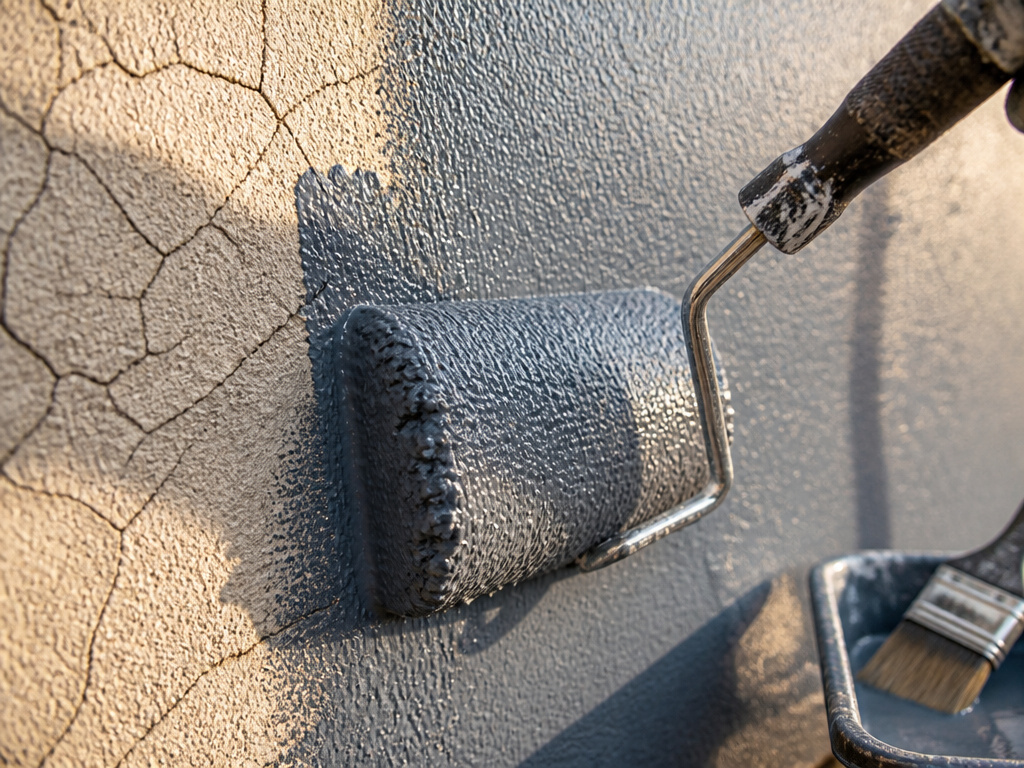
Two coating families do most of the work on stucco: acrylic and elastomeric.
Alkali resistance is the entry ticket. Sika points out that most acrylic and elastomeric coatings already qualify, which is why the paint aisle at a real coatings store looks different from the one at a big-box store. Most other paint types aren’t built for a highly alkaline surface.
For the primer coat, Benjamin Moore recommends its Ultra Spec Masonry Int/Ext 100% Acrylic Sealer. For the topcoat, stay inside the acrylic exterior family, since most acrylic and elastomeric coatings are already alkaline-resistant. The brand matters less than the chemistry.
Acrylic vs. Elastomeric: Which One Wins Where
Elastomeric wins over hairline cracking and on walls that move. Acrylic wins on sound, fully cured stucco where color retention and a flatter finish matter more than flexibility.
If you’re repainting a wall with a network of fine cracks, go elastomeric. If the wall is sound and you just want a clean recoat, a straight acrylic exterior is easier to work and holds color better. That comparison is worth reading in full before you commit, and the elastomeric paint trade-offs are laid out properly rather than sold.
A few application rules apply to either family:
- Don’t thin the paint with water. Sika is explicit that it hurts adhesion and can cause spotty de-lamination.
- Plan on 30 to 50 percent more paint than a flat wall of the same size, per Benjamin Moore, because texture eats coverage.
- Match roller nap to your texture using the surface rating on the packaging.
- Back roll or back brush after spraying while the coat is still wet.
That last point is where a lot of sprayed jobs go wrong. Spray-and-go leaves the peaks of the texture under-coated, and there’s a residential stucco best practices PDF that documents how often application technique, rather than product choice, drives the final result.
Two coats, applied the same way, with the first dry before the second goes on. Most people reach for a flat sheen on stucco because it masks imperfections, and that’s the right instinct.
How to Paint Stucco Without Cracking When the Weather Won’t Cooperate
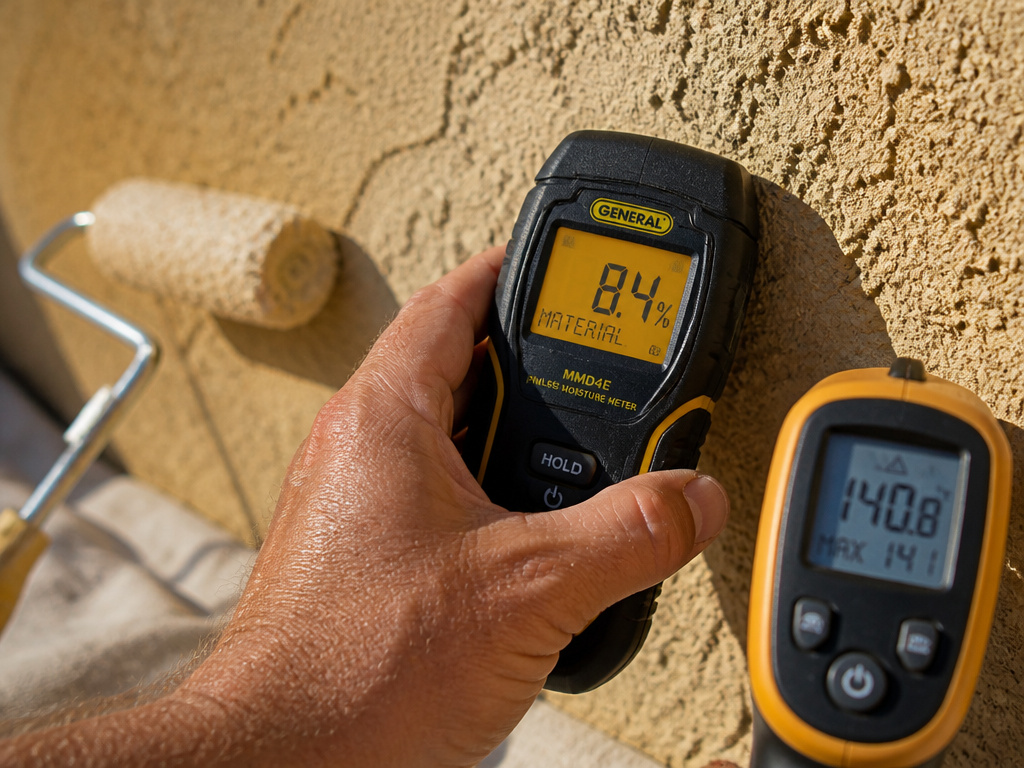
A perfect product applied at the wrong hour still fails the how to paint stucco without cracking test.
Direct sun is the most common culprit. MPI notes that coating a hot or sun-exposed surface causes rapid drying, and rapid drying is what produces cracking, lap marks, and uneven sheen. Touch a south wall at two in the afternoon and it’ll feel noticeably warmer than the air, which tells you the surface is running ahead of your coating’s open time.
Wind does the same thing from a different direction. Strong air currents accelerate evaporation and scatter overspray, so the film never levels.
Coastal and fog-prone sites are their own category. MPI advises delaying the coating until the surface is fully dry and stable, because on those walls the 40 to 80 percent humidity window is often unreachable and the dew point margin becomes the only rule that matters.
Where this goes sideways: Chasing a weather window by laying on a heavy coat to “get it done.” MPI builds film thickness through controlled, measured passes for a reason, and excessive film thickness is a named cause of blistering, efflorescence, cracking, and premature delamination. Thin coats, more of them.
Think of it like seasoning a soup. You add a little, taste, and add again. Dumping the whole jar in at the end is how you ruin a pot you can’t fix.
The rule of thumb: If the wall is hotter than your hand, colder than the air, or wetter than 12 percent, you’re not painting today. Come back when all three settle.
Working on a wall with deep texture also changes how much paint you’ll move per pass, and the notes on textured exterior walls are worth a look before you start loading a roller. If you’re still deciding what goes in the bucket, the breakdown of types of masonry paint sorts the formulations by what they’re actually built to do.
Frequently Asked Questions
Can you paint stucco in direct sunlight?
No. MPI specifically flags hot and sun-exposed surfaces as a cause of rapid drying, which produces cracking, lap marks, and uneven sheen. Work the shaded side first or wait for early morning and late afternoon, when the surface temperature is closer to the air temperature.
How long after pressure washing can you paint stucco?
Until it’s dry, not until a timer goes off. MPI REX 9.1 requires substrate moisture at 12% or less before repainting, and Benjamin Moore says to make sure the stucco is completely dry after washing. On a cool, humid day that can take considerably longer than a sunny one.
Do you have to prime stucco before painting?
Yes, with an alkali-resistant primer. Sika notes that an alkaline-resistant primer should go over alkaline surfaces to prevent paint degradation, and inadequate or no primer is one of the three named causes of premature failure.
Why did my stucco paint crack within a year?
The usual answer is that it went on too early or too thick. Sika describes blistering, flaking, and peeling with a soft underlying finish as the result of premature paint application that stopped the stucco from curing, and MPI names excessive film thickness as a cause of cracking.
Can you paint stucco in cold weather?
Not below 44°F. MPI’s window is 44°F to 86°F for air, surface, and material temperature, and the surface also has to sit at least 5°F above the dew point. Cold surfaces push you toward condensation and a film that never forms properly.
Does it matter whether I have EIFS or traditional stucco?
It changes how you approach the job. Benjamin Moore describes EIFS as typically softer than traditional stucco and better at holding color, while traditional hard-coat stucco is more durable but more prone to color change. Knock on the wall: hollow suggests EIFS, solid suggests traditional.
The Bottom Line
One trigger decides most of this: if you can’t get the wall to 12% moisture or less and at least 5°F above the dew point, stop and pick another week. Everything else here depends on that.
Here’s the concession. If you’re in a coastal or fog-prone climate, the humidity window MPI describes is often simply unavailable, and no amount of scheduling fixes it. On those walls you’re waiting for a stable stretch, not a stable afternoon, and the job may slide by weeks.
So start with a simple check instead of a paint purchase. Fill a spray bottle with plain water, mist a square foot of wall in the morning, and watch how long it takes to go from dark to uniform. If it’s still dark at lunch, the wall is holding moisture and you’ve just saved yourself a season of rework.
One small step at a time beats one heavy coat every time.
