
How to Paint Door Frames and Casings: Step-by-Step
This post contains affiliate links. As an Amazon Associate, we earn from qualifying purchases.
To paint door frames and casings, remove the door and lay it flat, sand with 220- to 400-grit, wipe with mineral spirits, and apply two thin coats of exterior acrylic latex. Weatherstrip comes out first.
The how to paint door frames and casings question matters more than any brush you own. A door standing in its frame pulls paint downhill the moment you load the brush, and every run along the top rail is a run you sand back tomorrow. Pull the door, tag the hinge edge, and the whole problem disappears.
What follows: the temperature window, the prep steps that decide whether the finish holds, the paint and primer choices that actually match the substrate, and the warranty deadlines that catch people who wait too long.
Key Takeaways
- Pull the door and lay it flat on padded sawhorses; runs along the edges drop to near zero.
- Wipe with mineral spirits and wait for the odor to disappear before the first coat, or the paint can fish-eye.
- Never paint the weatherstrip. Pull it, bag it, and re-insert it in the same kerf once the door is dry.
- Mind the warranty clock: 45 days for Masonite, 6 months for Therma-Tru doors, 30 days for PVC lite frames, 2 weeks for bare wood.
- Two thin coats beat one heavy coat, because a heavy coat skins over on top while the bottom stays wet and sags.
Why the Door Comes Off the Hinges First
I pulled a bedroom door off its hinges last spring, laid it across two padded sawhorses, and watched the runs along the top rail stop happening. Before that I was fixing drips on hanging doors about every second time. Gravity was doing the damage, and gravity was the thing I could remove.
Horizontal painting on padded sawhorses gives the coating the least chance to run. Doors and frames may also be painted vertically, which works for touch-up work. Remove the door from the frame when access allows, tag the hinge edge with tape, and protect the painted surface from damage during handling and storage.
Tag the hinge edge with a strip of painter’s tape and write the room on it. I once rehung a bedroom door in the bathroom opening and it rubbed for a week. (I learned that one the hard way.) Now every door gets a number before it comes off.
Special-Lite recommends painting doors and frames horizontally on sawhorses whenever possible, because it gives the paint the least chance to run. Masonite says horizontal is recommended but vertical is acceptable. MMI DOOR leaves the choice open. All three agree the door can come off; two of them prefer it.
The full painting order for a room runs ceiling, trim, doors, walls last, because it’s easier to cut a wall to trim than the other way around. I did it backwards on my first room and spent an entire afternoon touching up.
What Temperature Range Actually Works for Painting Door Frames?
Worth knowing before you start: Below 55 F most exterior paints may not coalesce properly, and the film can stay soft. It may look dry but still peel off under a fingernail later.
| Condition | What the manuals say | What to do |
|---|---|---|
| Minimum air temp | 55 F (Special-Lite); 50 F (Masonite) | Follow the paint manufacturer; Special-Lite says 55 F, Masonite says 50 F |
| Direct sunlight | Avoid (Special-Lite) | Paint in shade |
| High humidity | Extends dry time (Masonite) | Skip the day |
| Maximum temp | 90 F (Masonite) | Work early morning |
Special-Lite also says to avoid direct sunlight and very warm, humid conditions. Masonite notes that high humidity and low temperatures extend drying time. A coat that felt dry by lunch in July can still feel tacky at 4pm in October.
Why does the temperature matter so much? Paint cures by coalescing, and cold temperatures can prevent the polymer particles from merging into a continuous film. The paint decides, not your schedule.
The Prep Steps That Decide Whether the Finish Holds
Prep is where the how to paint door frames and casings job is won or lost, and it takes longer than the paint.
Before you start: Mineral spirits and oil-based paints are flammable and give off fumes; work with ventilation and keep rags in a sealed metal can. If the existing paint might be pre-1978, do not sand it. Test it first and call the EPA hotline at 1-800-424-LEAD.
Sanding is the first fork in the road. MMI DOOR says to scuff with #400 grit sandpaper or a green Scotchbrite pad. Masonite says to sand steel doors with 220-grit.
Sanding Grits by Substrate
The solvent choice is the second fork, and the manuals actually contradict each other here.
| Substrate | Sand with | Wipe with | Source |
|---|---|---|---|
| Smooth fiberglass (Special-Lite) | Not specified | IPA or MEK | Special-Lite |
| Fiberglass (MMI) | #400 or Scotchbrite | Mineral spirits | MMI DOOR |
| Steel (Masonite) | 220-grit | Mineral spirits | Masonite |
| Fiberglass (Masonite) | Not specified | Mineral spirits | Masonite |
Special-Lite recommends mild detergent, isopropyl alcohol, or MEK and warns against hydrocarbon solvents on its fiberglass. Mineral spirits is a hydrocarbon. MMI and Masonite both instruct mineral spirits. If you’re working on a Special-Lite door, follow Special-Lite. On anything else, mineral spirits is the common call.
Masonite’s instruction is to wait until there’s no residual odor. Use your nose as the test.
Before any paint goes on, the casing-to-wall joint gets caulking trim, and the caulk needs to be paintable. MMI DOOR lists elastomeric or polyurethane caulk. Silicone is not paintable and will leave a bald spot where the paint refuses to stick.
Brush marks come from loading too much paint at once, not from the brush itself. Thin coats and a light hand fix most of it. Get this wrong and the topcoat pays for it. Every time.
Which Paint and Primer to Use on Door Frames and Casings
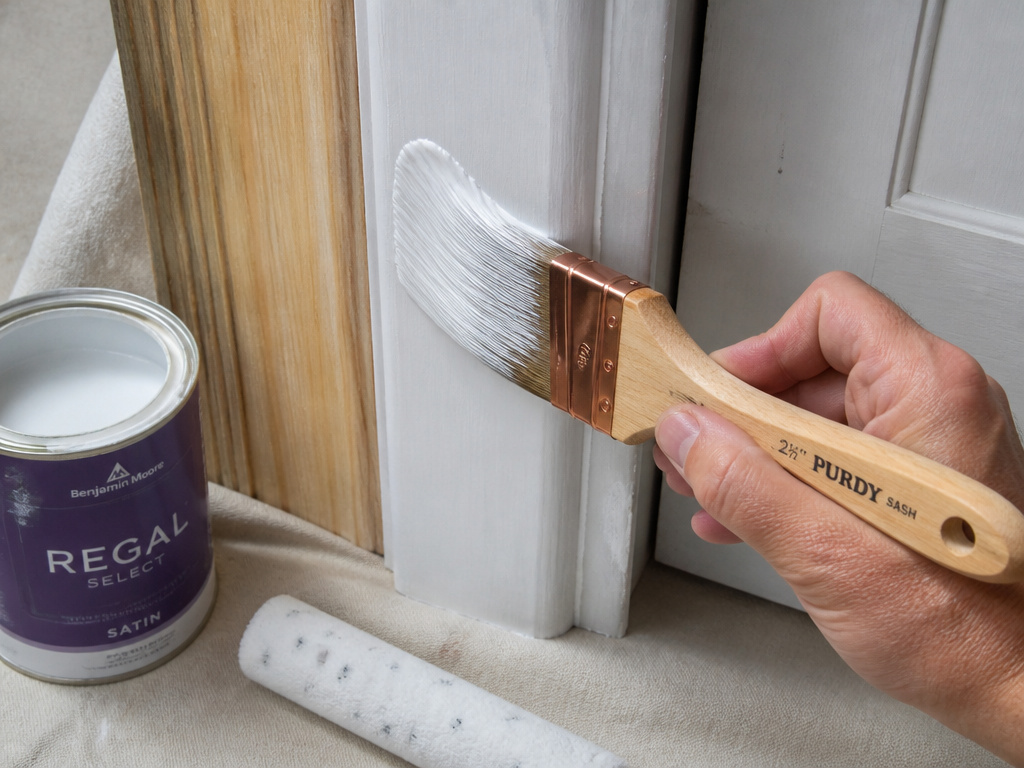
Special-Lite’s factory finish is acrylic urethane industrial paint, satin standard and gloss optional. MMI DOOR calls for exterior acrylic latex. Therma-Tru says acrylic latex house paint. Masonite allows oil-based or 100% acrylic latex.
The four manuals do not agree on chemistry, and the substrate is why.
- Special-Lite: acrylic urethane industrial paint is the factory finish; most common exterior grade paint works for repaint.
- MMI DOOR: exterior acrylic latex.
- Therma-Tru: acrylic latex house paint; exterior-grade for outside surfaces.
- Masonite: oil-based or 100% acrylic latex; no oil-based paint on wood frames or brickmould; lacquer not recommended.
For a door frame that gets touched a lot, choose a paint that levels out well with a brush and holds up to daily abuse. The best paint for trim and doors depends on the substrate, not the color.
The best brush for trim is a 2-1/2 inch angled sash brush, natural bristle for oil and synthetic for latex. Masonite specifies exactly the natural-versus-synthetic split. Special-Lite calls for high-quality fine natural bristle brushes and short-nap roller covers of 1/2 inch or less.
Prime if the surface is bare, patched, or previously stained.
Priming is where the manuals split again. Special-Lite recommends priming even on factory-primed doors, and requires it after body filler. Valspar says to prime fresh or previously stained wood. MMI DOOR doesn’t specify a priming step at all.
Wait until the surface feels dry to the touch, not just looks dry.
Special-Lite ships a Touch Up Kit with every painted order. Additional kits and 2-part acrylic urethane paint come from Rollie Williams Paint Spot.
How to Paint Door Frames and Casings Without Lap Marks
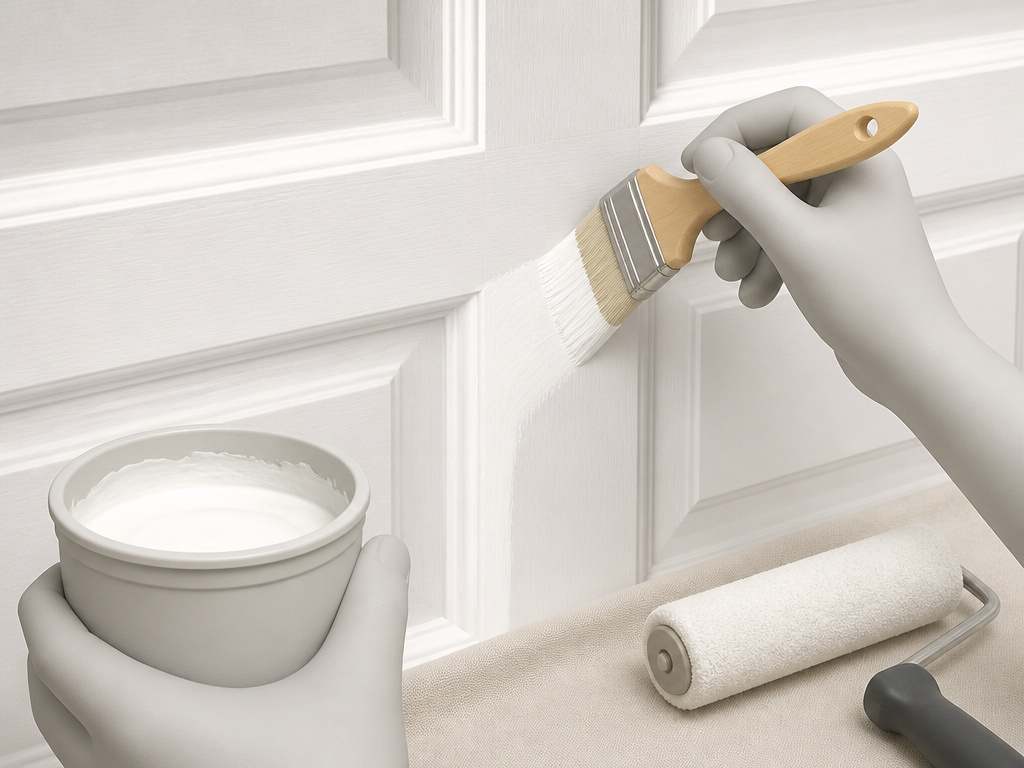
Three orders, three sources: Valspar says panels first, then a 6-inch roller on the outer edges; Hallman/Lindsay says panels, then horizontal sections, then vertical sections; Masonite says panels and sticking, then vertical center mullion, then horizontal rails, then vertical stiles, then outside edges.
Valspar says panels first with a brush, then a 6-inch roller on the outer edges. Hallman/Lindsay says panels, then horizontal sections, then vertical sections. Masonite says panels and sticking, then vertical center mullion, then horizontal rails, then vertical stiles, then outside edges.
The Order in Practice
The compromise that works on every door I’ve painted:
- Panels and sticking first. Skip this and the brush drags over a tacky rail into the recess, and you get a line of pulled paint at every panel edge.
- Vertical center mullion next. Skip it and you’re cutting in around wet rails, which is how lap marks start.
- Horizontal rails after that. Skip the sequence and the brush crosses a half-dry panel edge, which leaves a visible seam.
- Vertical stiles next. Skip them and the stiles carry brush marks dragged down from the rails.
- Edges and outside faces last. Skip them entirely and the door won’t seal, which voids the warranty on some brands.
Easy to miss: A door painted with dark colors or with a storm door attached can hit surface temperatures hot enough to burn a hand in direct summer sun. Masonite calls this out directly. The heat softens the film and the paint blisters off the bottom rail first.
If the brush glides, you’ve loaded too much paint and the coat will sag.
My order for a whole room is ceiling, trim, doors, then walls last. It’s easier to tape off or cut a wall to trim than the other way around.
How Do You Handle the Edges, Weatherstrip, and Hardware?
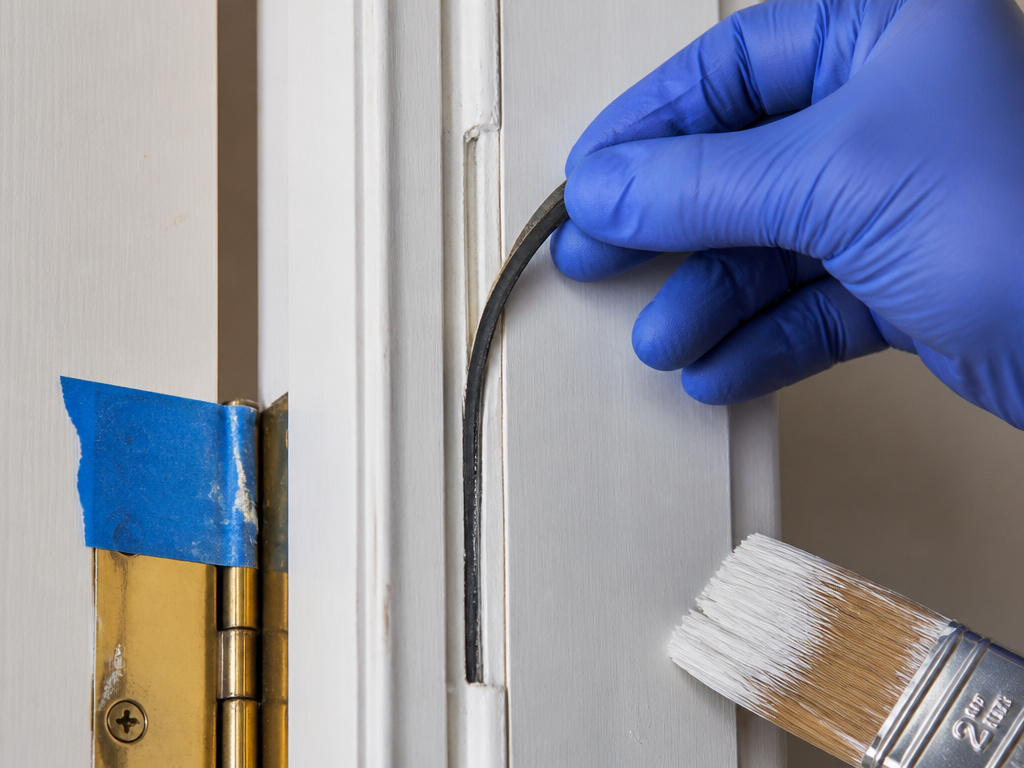
The edges are where most paint jobs fail, and they’re the part nobody photographs.
Weatherstrip is the first thing to pull. MMI DOOR says to remove or mask all hardware and weatherstrip before painting. Therma-Tru says to remove it before painting and re-insert it after the door is completely dry. Masonite says don’t paint it and don’t close the door until the paint is dry, but doesn’t mandate removal.
Pull it. Paint can bridge the kerf and glue the weatherstrip in place, and by the next cold snap the door may leak air around the edges.
What Each Source Says About Edges
The edge-painting rule splits between two sources:
- Valspar: if the door swings out, paint the hinged edge; if it swings in, paint the lock-side edge.
- Hallman/Lindsay: if the door opens into the room being painted, use the same color on the latch edge as the rest of the door; if it opens into the next room, don’t paint the hinged edge.
Valspar says if the door swings out, paint the hinged edge; if it swings in, paint the lock-side edge. Hallman/Lindsay says if the door opens into the room being painted, use the same color on the latch edge as the rest of the door; if it opens into the next room, don’t paint the hinged edge.
Tape the hinges, not the door. A strip of painter’s tape over each hinge leaf saves scraping later, and you don’t have to worry about paint bridging the knuckle.
Masonite adds one more edge case: outswing doors and doors with adjustable surface-mounted sweeps need the sweep removed and the bottom rail painted. Therma-Tru says all six sides of the door and composite components must be finished, and outswing doors need the bottom inspected and maintained as regularly as any other surface.
The same edge logic applies to window frames and sills, where Hallman/Lindsay notes windows need repainting more often than doors because of condensation and temperature swings.
The Warranty Deadline Most People Miss
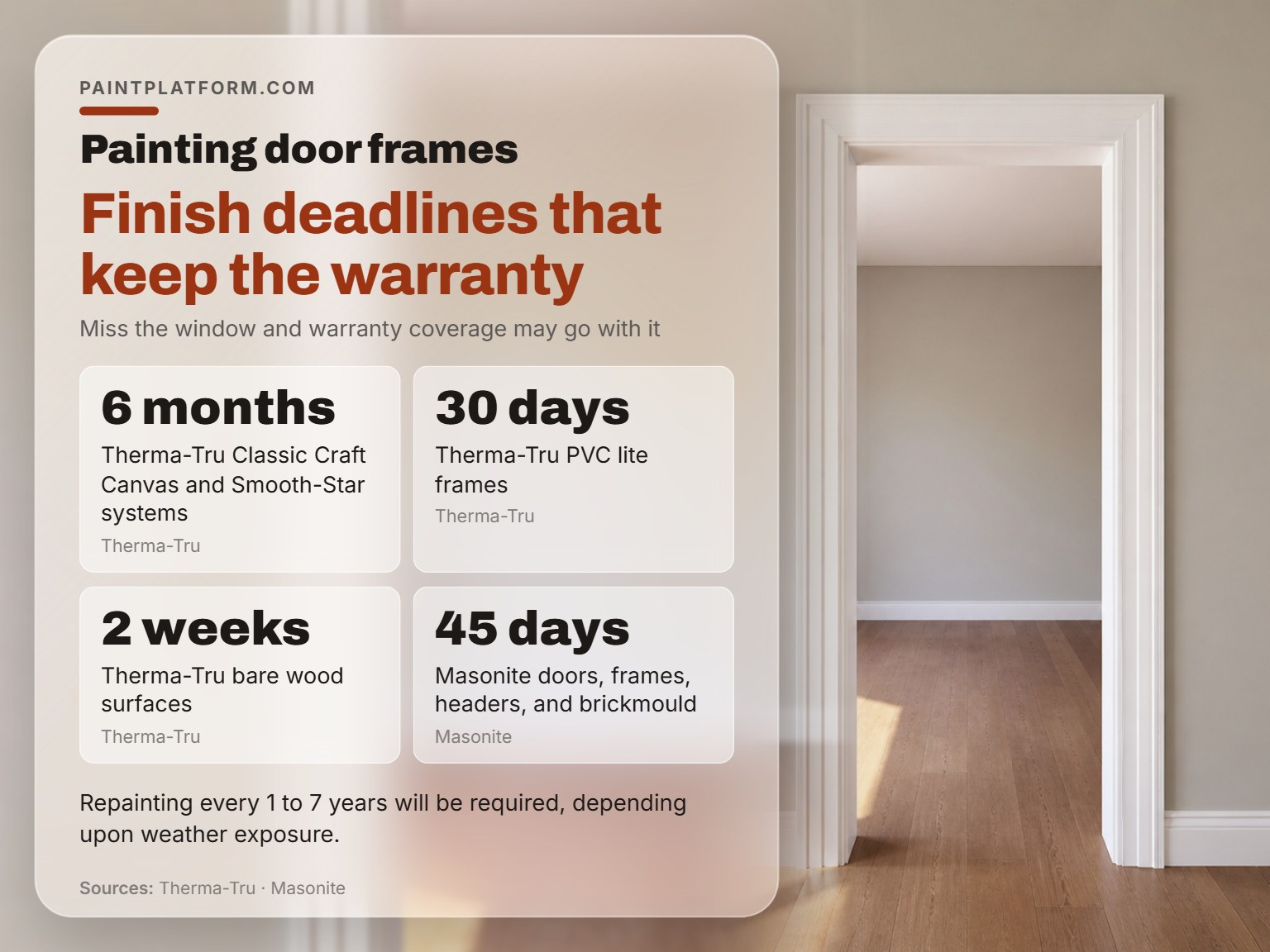
Therma-Tru gives you six months to finish a Classic Craft Canvas or Smooth-Star door system. PVC lite frames get 30 days. Bare wood surfaces get two weeks. Masonite gives you 45 days for the door, frame, header, and brickmould.
- Therma-Tru Classic Craft Canvas and Smooth-Star systems: finish within 6 months of installation.
- Therma-Tru PVC lite frames: finish within 30 days.
- Therma-Tru bare wood surfaces: finish within 2 weeks of installation or weather exposure.
- Masonite doors, frames, headers, and brickmould: finish within 45 days.
Miss the window and the warranty coverage may go with it.
Repaint cycles run longer. Masonite says repainting every 1 to 7 years will be required, depending on weather exposure. Therma-Tru says to maintain or replace sealants and finishes as soon as any deterioration is evident, and for semi-gloss, glossy paint, or clear coats, that means when the surface becomes dull or rough. Doors in severe climates need more frequent maintenance.
Figure out how much paint before you open a can. MMI DOOR estimates approximately 1 quart of high-quality exterior grade acrylic latex paint.
Frequently Asked Questions
Do I have to remove the door to paint it?
No. MMI DOOR says the door can be removed or left in the frame for final finishing. Masonite recommends removing it. Special-Lite recommends horizontal painting on sawhorses when possible. If you can get the door off, do it. If you can’t, paint it hanging.
What grit sandpaper should I use on a fiberglass door?
MMI DOOR says #400 grit or a green Scotchbrite pad. Special-Lite says 400-grit for the final pass and 220-grit for damage repair. Masonite doesn’t specify a grit for fiberglass, only for steel (220-grit).
Can I paint over the weatherstrip?
No. MMI DOOR, Therma-Tru, and Mason
