
How to Paint a Brick Chimney: Step-by-Step
This post contains affiliate links. As an Amazon Associate, we earn from qualifying purchases.
To paint a brick chimney, clean it thoroughly, wait at least 24 hours after cleaning (or at least 30 days for new or repaired masonry to cure and dry), prime with an alkaline-resistant primer, and use a breathable masonry coating. But check the moisture path first. BIA TN6 warns that any coating trapping water behind it can damage the brick.
Chimneys take weather differently than walls. A chimney sticks up above the roofline and catches rain, wind, and freeze-thaw on all four faces, so the moisture path a coating has to respect is longer than the one on a sheltered wall. BIA’s guidance notes that masonry doesn’t dry uniformly across a building, which makes the 24-hour wait a floor, not a guarantee. This is why how to paint a brick chimney differs from coating a sheltered wall.
The rest of this walks the decision in order: whether painting is even the right call, what the sources disagree on, the prep and product choices that actually hold up, and the cases where you should walk away.
Key Takeaways
- Fix flashing and weeps first. BIA TN6 2024 warns that treating deteriorating brick without addressing water entry may cause further problems.
- Wait at least 30 days on new or repaired masonry before any coating, and at least 24 hours after cleaning.
- Acrylic latex is vapor semi-permeable, not fully breathable. BIA notes most manufacturers don’t publish permeance data for it.
- Limewash and mineral paint are vapor-permeability-preserving options. Limewash lasts five to 10 years or more; mineral paint warranties run 15 years or more.
- Once painted, it’s committed. BIA states many treatments are irreversible and paint is very difficult to remove without damage.
Why a Brick Chimney Is a Different Job From a Wall
Chimneys sit above the roofline and take weather on all four faces, which is a harder exposure than a wall under an eave. That difference matters for how to paint a brick chimney because the whole reason masonry coatings fail is trapped water, and a chimney has more surface area for water to find.
Exterior brick intended for coating should conform to Grade SW per ASTM C62, C216, C652 and C1088, or Grade MW where permitted. Brick is set in chemically basic mortar, so an alkaline-resistant primer or masonry-designated paint is specified. Acrylic latex is typically identified as vapor semi-permeable rather than fully vapor permeable, and most manufacturers do not provide permeance information.
Water on bare brick doesn’t bead and sit there. It darkens the surface in a slow bloom and disappears into the pores, which is how you can tell the brick is still holding moisture even when it looks dry to the touch.
That absorption is the whole problem. A wall under an eave sheds most rain before it ever touches the brick. A chimney catches it on every face, and the top of the stack is the part that freezes first. BIA TN6 2024 is blunt about the risk: treatments can further compromise the brickwork if they trap moisture in the wall.
What the Sources Disagree On Before You Buy a Can
Two federal and industry sources give different minimum temperatures for the same job. BIA TN6 2024, citing ASTM D6237, puts the minimum air, material, and surface temperature at 40 °F. The NBS Letter Circular 747 sets the low limit at 45 °F for the 4 to 9 hours after application.
That’s not the only place the guidance splits. Here’s the short version of where the sources disagree:
| Question | Position A | Position B |
|---|---|---|
| Minimum temperature | BIA TN6 2024: 40 °F per ASTM D6237 | NBS LC 747: 45 °F for 4-9 hours after |
| Old paint before recoating | NBS LC 747: wire brush, old paint need not be removed | NPS Brief 1: remove built-up layers for adhesion |
| Damp masonry | BIA TN6 2024: cure and dry before treatment | NBS LC 747: damp OK, wet not OK |
| Coating choice | BIA TN6 2024: limewash or mineral paint | Angi (anecdotal): vapor-permeable sealant from CSIA list |
The old-paint question is the one that trips people up most. NBS LC 747 says a wire brush is enough and old paint that survives the brushing can stay. NPS Preservation Brief 1 says built-up layers may need to come off entirely so the new coat has something sound to grab. BIA TN6 2024 lands closer to NPS for mineral paint specifically, since that product only bonds to clean, unsealed brick.
On damp masonry, BIA and NBS are describing different products. BIA is talking about treatments that cure on the surface and need a dry substrate. NBS is talking about resin emulsion paint, which can go on damp walls but not wet ones. If you’re using a modern masonry coating, follow the BIA line and let the brick dry; NBS LC 747, by contrast, allows resin emulsion paint on damp walls but not wet ones.
The Step-by-Step Process, With the Waiting Built In
Here is the order of operations, and the waiting between steps is the part that actually decides whether the coating holds.
Before you start: A chimney means a ladder, a roof, and often a flue. Fall protection and a second person on the ground are not optional. If the chimney crown or flashing is cracked, stop and fix that first. BIA TN6 2024 warns that coating over a water-entry problem traps moisture and can make the damage worse.
- Wash the brick and let it dry. Scrub with a stiff brush and a non-ionic detergent (NPS Brief 1), rinse with low pressure, and wait at least 24 hours before any coating (BIA TN6 2024). Skipping the wait traps surface water under the primer and the first coat can blister.
- Fix flashing, weeps, and sealant joints. BIA TN6 2024 states that treating deteriorating brick without addressing water entry may cause further problems. Skipping this step means the coating seals in the problem instead of sealing out the weather.
- Patch mortar and caulk gaps larger than 1/16 inch. Angi’s guide (anecdotal) recommends caulk for gaps over 1/16 inch and 24 to 36 hours of dry time for patchwork. Skipping the patch leaves a gap that water can find.
- Prime with an alkaline-resistant masonry primer. BIA TN6 2024 specifies an alkaline-resistant primer or masonry-designated paint because brick is set in chemically basic mortar. Skipping the primer leaves the alkaline mortar in contact with the topcoat.
- Apply two coats, 24 hours apart, in the right weather. NBS LC 747 requires two coats with not less than 24 hours between them and a first coat slightly moistened before the second. BIA TN6 2024 sets the minimum at 40 °F and 5 °F above the dew point. Painting outside those windows risks the film not curing properly.
- Keep it dry for the full cure. NBS LC 747 notes cement-water paints need damp curing starting 6 to 12 hours after application and for 2 days after the final coat. Angi’s anecdotal guide says sealant needs at least 24 hours of completely dry weather. Rain in that window can compromise the cure.
Southington Painting’s guide (anecdotal) recommends a thick-nap roller for brick faces to push the coating into the pores.
Brick is tricky because many treatments are irreversible and paint is very difficult to remove without damage. Stripping it later is very difficult, so I test a hidden corner before I decide.
Which Coating Actually Belongs on a Chimney
BIA TN6 2024 discusses limewash and mineral paint as vapor-permeability-preserving options, and identifies acrylic latex as vapor semi-permeable rather than fully vapor permeable. That ranking holds for how to paint a brick chimney too, and the reason is the same: a chimney has more masonry surface exposed to weather than a wall does, so the penalty for trapping moisture is bigger.
| Coating | Permeance | Lifespan | Reversible? |
|---|---|---|---|
| Limewash | Preserves vapor permeability | 5-10 years or more | Water-removable in first few days |
| Mineral paint | Preserves vapor permeability | 15-year warranty, 30+ years on some projects | Needs clean, unsealed substrate |
| Acrylic latex | Vapor semi-permeable | Repaint every 3-5 years (1972 BIA) | Difficult, can damage brick |
| Vapor-permeable sealant | Breathable per CSIA list | Not specified in sources | Not specified |
If you’re still choosing a product, the masonry paint decision tree covers the same trade-offs in more depth, and the best exterior brick paint roundup is the place to start once you’ve picked a category.
Limewash: The Most Forgiving Option
Limewash is the one I’d start with if you’ve never worked with limewash before. BIA TN6 2024 notes that some limewashes can be removed with water within the first few days of application, which means a bad call is fixable in a way that most coatings are not. The trade-off is lifespan: five to 10 years or more, depending on environment and number of coats.
Mineral Paint: The Longest-Lasting Option
Mineral paint is the long-game choice. BIA TN6 2024 reports warranties of 15 years or more and projects where recoating wasn’t needed for 30 years or more. The catch is substrate: mineral paint needs clean, unsealed brick so the pore structure is accessible. For mineral paint, BIA TN6 2024 requires existing coatings to come off first, while NBS LC 747 says old paint that survives wire brushing need not be removed.
Acrylic Latex: The One Most People Buy
Acrylic latex is the product most people reach for, and budget options exist. Acrylic latex is vapor semi-permeable, not fully breathable, and BIA TN6 2024 notes most manufacturers don’t publish permeance data for it. They work. They just trap more moisture than limewash or mineral paint, which matters more on a chimney than on a wall.
If the chimney is interior and you’re weighing a coating, the best paint for fireplace brick guidance applies, because the substrate is the same masonry and the reversibility warning is the same.
The Prep Work Nobody Wants to Do
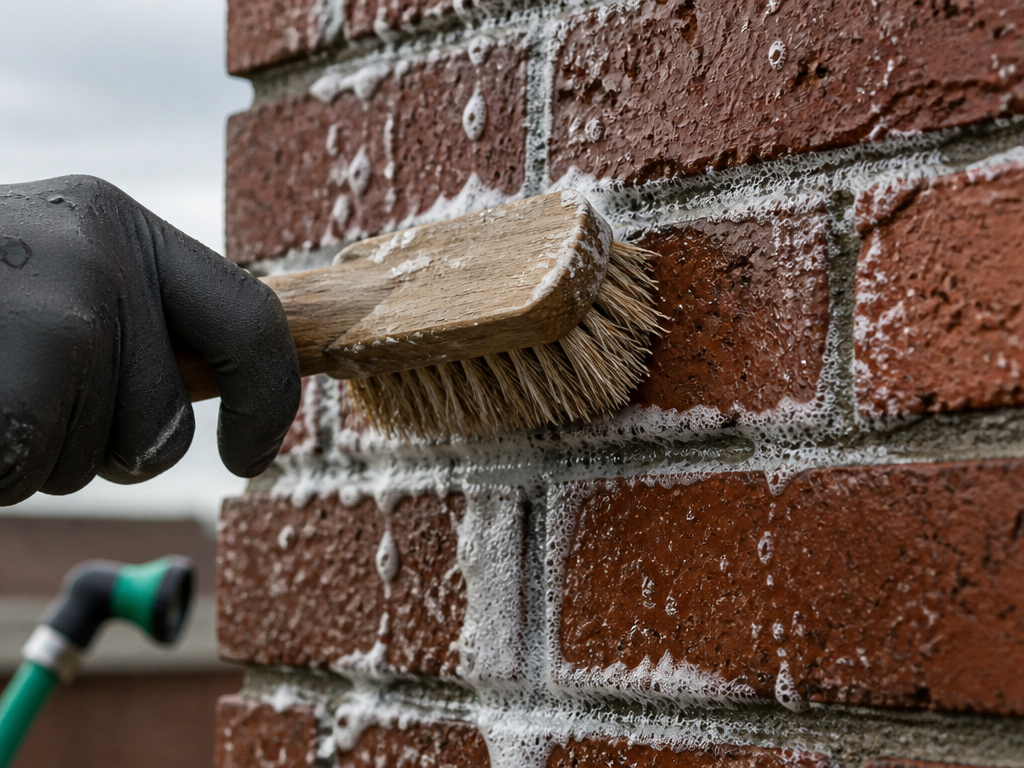
Prep decides whether the coating holds. The coating is the part people photograph.
- Wash with a stiff brush and non-ionic detergent. NPS Preservation Brief 1 recommends a low-pressure water wash with non-ionic detergent and a natural or synthetic bristle brush for biological growth.
- Rinse and wait at least 24 hours. BIA TN6 2024 requires the wait after cleaning before any treatment.
- Scrub off chalky residue. The same test works on brick: if the surface chalks, the coating won’t bond until it’s washed off.
- Neutralize after any stripper or acid cleaner. BIA TN6 2024 strongly recommends this because mineral paint is acid-sensitive.
On a brick chimney, I scrub with a stiff brush, rinse well, and let it dry at least 24 hours before a masonry primer. Brick drinks water like it’s training for something. The masonry primer needs to go on after that dry window, not before it.
For the full exterior sequence, the exterior brick painting walkthrough covers the same prep on walls, which is where most people practice before they climb a ladder.
When You Should Not Paint at All
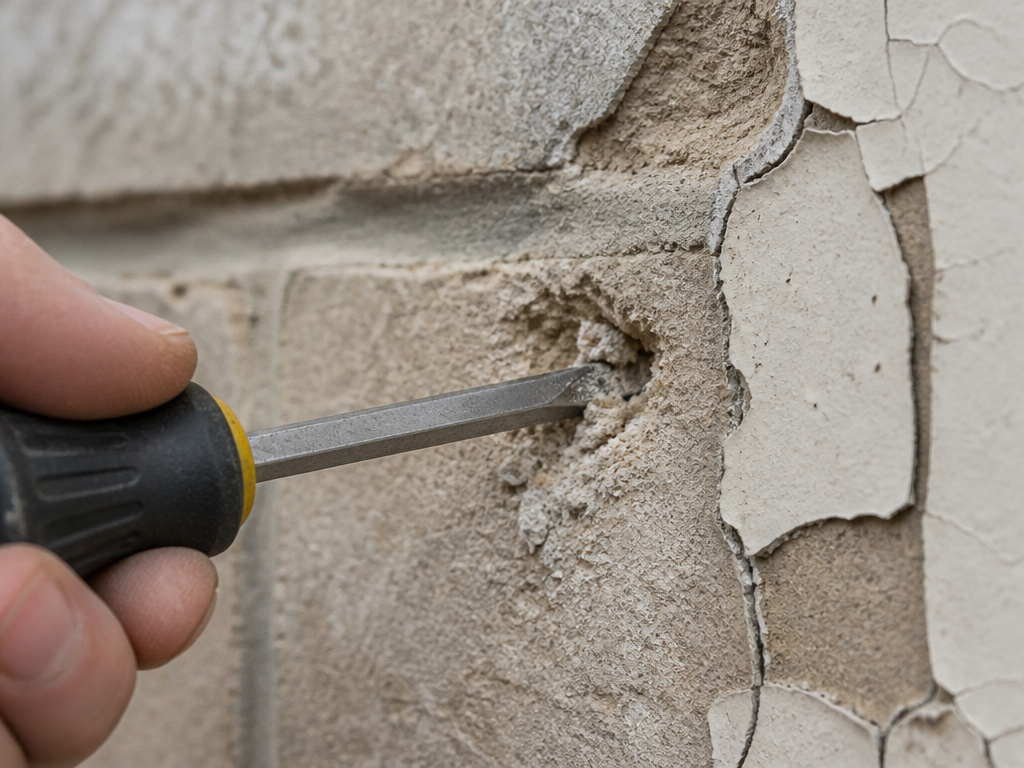
Sometimes the right answer is to leave the brick alone. BIA TN6 2024 states that many treatments are irreversible and that paint can be very difficult to remove from brick masonry without causing damage.
Where this goes sideways: Painting a chimney that already has a failed crown, cracked flashing, or a spalling face. BIA TN6 2024 warns that treating deteriorating brick without first fixing flashing, weeps, or sealant joints may cause further problems. The coating seals the symptom in and the freeze-thaw damage accelerates.
Never coat a chimney in the 24 hours after a rain. BIA TN6 2024 requires at least 24 hours of dry time after cleaning before treatment, and NBS LC 747 warns that paint applied to wet masonry traps water behind the film. The failure shows up as blistering in the first freeze-thaw cycle.
Paint on brick soaks into the pores, so don’t expect it to come off clean.
The NPS Preservation Brief 1 adds a constraint BIA doesn’t address: a brand new appearance may be inappropriate for an older building, and if the paint has been on the chimney for a long time, retention may be more historically appropriate than removal. That’s a preservation call, not a technical one, and it’s worth asking before you commit.
Frequently Asked Questions
Can you paint a brick chimney?
Yes, but the question is whether you should. BIA TN6 2024 warns that any coating that traps moisture in the brick can damage it, and a chimney takes more weather than a wall. If the flashing, crown, and joints are sound, a breathable coating like limewash or mineral paint is the safer path.
What is the best paint for a brick chimney?
BIA TN6 2024 treats limewash and mineral paint as the two coatings that preserve vapor permeability. Acrylic latex is vapor semi-permeable, and BIA notes most manufacturers don’t publish permeance data for it. A vapor-permeable sealant from the CSIA approved-products list is the anecdotal alternative from Angi’s guide.
How long should brick cure before painting?
BIA TN6 2024 requires at least 30 days of cure and dry time for new or repaired masonry before any treatment. After cleaning, wait at least 24 hours. A chimney with a fresh crown or repointed joints needs the full 30-day window.
What temperature is too cold to paint brick?
BIA TN6 2024, citing ASTM D6237, sets the minimum air, material, and surface temperature at 40 °F and requires the surface to be at least 5 °F above the dew point. NBS Letter Circular 747 is stricter: no exposure below 45 °F within 4 to 9 hours after application.
Does painting a brick chimney cause damage?
It can. BIA TN6 2024 states that treatments can compromise brickwork if they trap moisture, and that many treatments are irreversible. The damage can show up as spalling and freeze-thaw breakdown.
Can I remove paint from a brick chimney later?
BIA TN6 2024 states that paint can be very difficult to remove from brick masonry without causing damage. Limewash is the exception: BIA notes some limewashes can be removed with water within the first few days of application.
The Bottom Line
Here is the threshold I would use: if the chimney has never been painted and the flashing, crown, and joints are sound, leave it bare. Bare brick sheds water on its own, and BIA TN6 2024 notes treatments can compromise brickwork if they trap moisture.
If you’ve already decided to coat, the first step this week is a test patch on a hidden face. Limewash is the most forgiving option because BIA notes it can be removed with water in the first few days. Live with the patch before you commit the whole stack.
One concession: none of this applies to an interior brick chimney. Southington Painting’s guide (anecdotal) notes that interior brick is protected from moisture and is therefore paintable, though the step is still not reversible. The exterior is the hard call.
