
How to Clean Bathroom Walls: Surface by Surface
This post contains affiliate links. As an Amazon Associate, we earn from qualifying purchases.
To clean bathroom walls, match the method to the surface: warm water with a drop of dish soap and a soft cloth handles painted drywall, acrylic panels and PVCu, while natural stone needs a low-pH dish detergent and no chemical cleaners at all. Rinse every time, then let the wall dry completely.
That surface split is where the real work sits, because the same bottle can be a mild cleaner on one panel and a warranty-voiding solvent on another. Wetwall lists a diluted bleach solution among its recommended cleaners. Re-Bath puts bleach on its do-not-use list in the same breath as drain cleaner.
What follows is the routine for how to clean bathroom walls that works on nearly every surface, then the four points where the manufacturers genuinely disagree: bleach, abrasives, pressure washing and sealing. The last section is the one I care about most, because it decides whether your paint stays on.
Key Takeaways
- Weekly is the floor. Altro’s cleaning guide calls a weekly programme the minimum recommended, and asks for scuff removal more often than that, with daily given as the example.
- Rinse, then dry. Re-Bath and Wetwall both say to rinse after every clean. Residue is what dulls a finish and what makes fresh paint bead.
- Bleach is a brand decision, not a universal rule. Wetwall permits a diluted solution; Re-Bath bans bleach outright.
- No abrasive pads on most surfaces. Re-Bath, Wetwall and Altro ban abrasive pads, and Wetwall states that use of banned agents voids the warranty, though a research brief notes a blue Scotch-Brite pad is approved for Shaw shower walls.
- Natural stone is the exception to nearly everything here: seal it, and skip chemical cleaners entirely.
What Are Your Bathroom Walls Actually Made Of?
Five surfaces show up behind a bathroom sink, and each one tolerates a different short list of cleaners. Identify yours before you fill a bucket.
Pressure cleaning is permitted on Altro PVCu wall panels only with the nozzle held at least 600mm from the surface, and the water temperature must not exceed 60 degrees Celsius. Re-Bath and Wetwall authorize no pressure cleaning at all, specifying hand application of non-abrasive soap and water followed by a thorough rinse.
| Surface | What it tolerates | What it forbids |
|---|---|---|
| Painted drywall | Warm water, dish soap, soft cloth | Scrubbing, soaking, harsh chemicals |
| Acrylic panel (Wetwall) | Warm soapy water, non-abrasive cleaners | Scotch-Brite, thinners, MEK |
| PVCu sheet (Altro) | Soft cloth, alkaline cleaner, weekly wash | Abrasive pads, wire wool, water above 60 degrees |
| Solid surface (DuraBath) | Non-abrasive soap and water, thorough rinse | Bleach, vinegar, abrasives, gloss restorers |
| Natural stone | Low-pH dish detergent, soft cloth | Any chemical cleaner |
Painted drywall is what most homes actually have, and it’s the fussiest about water. Soap and water on a soft cloth is fine. A soaked sponge that sends water running down the wall is the bigger risk.
Acrylic and PVCu panels are the forgiving ones. Wetwall’s care sheet says warm soapy water and a sponge cover regular maintenance, and Altro’s guide asks for a weekly wash as a minimum. Both ban the same short list: gritty cleaners, Scotch-Brite pads, and strong solvents such as thinners or MEK (methyl ethyl ketone, an industrial solvent).
Solid-surface surrounds sit in the middle. Re-Bath approves non-abrasive soap and water for its DuraBath wall surrounds, provided you follow the label dilution and rinse afterward.
Natural stone is the outlier. Re-Bath’s own instruction for DuraBath Natural Stone is to skip chemical cleaners entirely and use a low-pH dishwashing detergent with a soft cloth.
How to Tell Them Apart Without a Spec Sheet
Three checks settle it in under a minute:
- Look for grout lines. Wetwall panels have none, which is one reason sealing is never required on them.
- Check the internal corners. Panel systems show a trim piece or a caulk bead. Tiled and painted walls don’t.
- Look for a repeating pattern. Printed panels repeat across the run. Stone doesn’t.
If you still can’t tell, start with the gentlest method and work up. A weak cleaner that needs a second pass beats a strong one that etches.
The Weekly Wash That Works on Almost Every Surface
Dust, wash, rinse, dry. The order carries more weight than the bottle when you compare a how to clean bathroom walls routine, and the whole job is quick.
Before you start: Never mix two cleaning chemicals in one bucket; Altro’s guide says not to combine them, and the label dilution is the only tested ratio you have. Read the safety data sheet before you open a new product, because that’s where the required gloves and eye protection are listed. If a cleaner reaches your eyes or skin, rinse immediately with plenty of water and get medical advice.
- Dust the walls dry, top to bottom. A dry microfiber cloth takes off the loose dust before it turns into mud. Skip this and the wash step becomes pushing gray paste around the room.
- Mix warm water with a small amount of mild soap. Follow the dilution on the label, which Re-Bath flags as very important for its approved cleaners. Go stronger and you’ll spend longer rinsing the residue off.
- Work from the top down. Gravity carries the dirty water into the section you haven’t reached yet, so the last pass lands at the bottom where the grime collects.
- Use a soft cloth or sponge, never a pad. Altro’s instruction is a soft cloth only. Re-Bath asks for a sponge, microfiber cloth or non-scratch pad. Ignore it and you trade a clean wall for a dull one.
- Rinse with clean water before the wall dries. Wetwall says to rinse immediately with all cleaners, and Re-Bath says rinse thoroughly after each cleaning. Soap film left to dry turns into a haze you’ll chase for a long time.
- Dry the wall completely. A dry cloth or an open window does it. Paint over a wall that’s still damp and you’ll be back here sooner than you’d like.
- Deal with scuffs as they appear. Altro’s guide asks for scuff and heavy-soil removal more often than the maintenance schedule, giving daily as the example. A scuff left for a while needs more pressure, and pressure is what burnishes a finish.
Dilute to the label, not to your mood. A cleaner you can smell from the doorway is strong enough to leave a film, and film is what makes the next coat of paint crawl.
Altro calls a weekly cleaning programme the minimum recommended, then adds that heavy traffic and strict hygiene areas need more. A bathroom shared by several people is heavy traffic. A guest bathroom isn’t.
If your walls are painted rather than panelled, the sequence for cleaning painted wall surfaces runs slightly differently, mostly because you can’t rinse as hard.
The Sealant Line Is a Separate Job
The bead of sealant where the wall meets the tub is not the same material as the panel above it. Altro’s guide asks for neutral cleaners only on sanitary sealant, because stronger products turn it yellow and no amount of scrubbing brings the color back.
Wipe the panel with whatever its care document approves. Then switch cloths and do the sealant with a neutral cleaner.
Four Manufacturers, Four Answers on the Same Bottle of Bleach
Four manufacturers, four answers, one bottle of household bleach. Wetwall lists a diluted bleach solution among its recommended cleaners. Re-Bath puts bleach on the do-not-use list alongside drain cleaner and hair dye. The American Cleaning Institute recommends liquid household bleach for mildew. Altro’s guide doesn’t mention bleach at all.
| Source | Position on bleach | Applies to |
|---|---|---|
| Wetwall (Wilsonart) | Diluted bleach solution is a recommended cleaner | Wall panel system |
| Re-Bath | Bleach is on the do-not-use list | DuraBath wall surrounds |
| American Cleaning Institute | Liquid household bleach for mildew | General bathroom surfaces |
| Altro | No bleach guidance; neutral cleaners on sealant | PVCu panels |
Each position describes a different material. A dilution that’s fine on a Wetwall panel can still be the wrong call on a solid-surface surround, and the only way to know which you own is the care document for that product.
Bleach also announces itself. You can smell it from the hallway for the rest of the afternoon, which is a reminder that the window should be open.
The American Cleaning Institute adds one caveat that holds whatever your walls are made of: keep bleach away from rust stains. It intensifies the color instead of lifting it, so a dedicated rust remover is the right tool there.
Abrasives: The One Rule Everyone Agrees On
Most care documents I read ban abrasive pads, though a research brief notes a blue Scotch-Brite pad is approved for Shaw shower walls. Re-Bath lists abrasive pads, steel wool and Teflon pads. Wetwall bans Scotch-Brite pads and states that use of those agents voids the warranty. Altro says no abrasive cleaners, pads or wire wool.
I keep a Scotch-Brite pad under the sink out of pure habit. On a bathroom wall it’s the wrong tool, and on a Wetwall panel it’s a warranty claim waiting to happen.
Pressure washing is the sharpest split of the four. Altro permits a hot-water lance at a minimum 600mm standoff and a maximum of 60 degrees Celsius, which is about two feet and well under boiling. Re-Bath and Wetwall authorize none at all.
Sealing depends entirely on the material. Re-Bath says DuraBath Natural Stone needs sealing on installation, that basic sealers can need resealing every year in high-traffic areas, and that its StoneWalled Sealer lasts 10 years with a warranty against staining. Wetwall says the opposite for its panels: no grout lines, non-porous, sealing never required.
Worth knowing before you start: A banned cleaner on a Wetwall panel dulls the surface and voids the warranty. The care document says so directly, so one enthusiastic afternoon can cost you the coverage.
How Do You Clean Bathroom Walls Without Damaging the Finish?
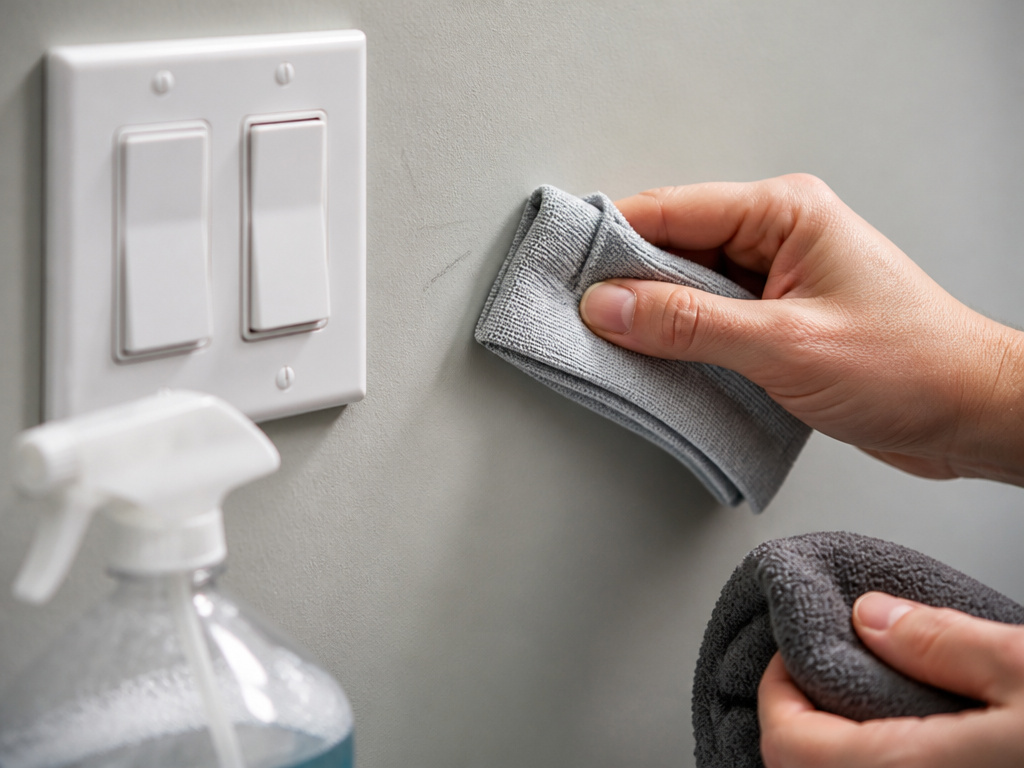
Pressure ruins more bathroom walls than chemistry does. The wrong cleaner just underperforms. The wrong scrub takes the sheen off and leaves a mark that rinsing won’t touch.
I found that out on a flat hallway wall. There was a scuff near the light switch, so I wet a rag and scrubbed it with my whole arm behind it. What I got was a palm-sized shiny patch that caught the light worse than the scuff ever had.
Flat paint has a matte surface that polishes under friction. Rub hard enough and you change the sheen in that spot, and nothing you rinse with puts it back.
The fix is boring. Dab, wipe lightly, and give it a few passes. If the mark is still there, stop and touch up the paint.
Most scuffs on a bathroom wall are paint transfer rather than dirt, which is why a damp sponge with warm water and a drop of dish soap lifts them with a light pass. The ones that survive are a job for removing scuff marks rather than more muscle.
I keep two cloths going, one wet and one dry, and the dry one does more for a streak-free finish than anything I’ve bought. Wipe, rinse, then buff the wall dry before the water sits. It costs little time and saves a second wash.
The tools matter less than the pressure. Three of them cover every surface in the room:
- Microfiber cloth for the general wash and the dry buff.
- Non-scratch pad for anything stuck on, used flat rather than edge-on.
- Soft nylon brush for slip-resistant floor texture and the tight corner where the wall meets the tray.
Finish decides which products you can use, too. Re-Bath warns against restore-gloss products on matte wall surrounds, and the reason is obvious once you’ve seen it: a matte surface is matte because it doesn’t reflect, so a gloss restorer leaves a shiny patch in the middle of a flat field.
Mildew, Mold, and the Stain Bleach Makes Worse
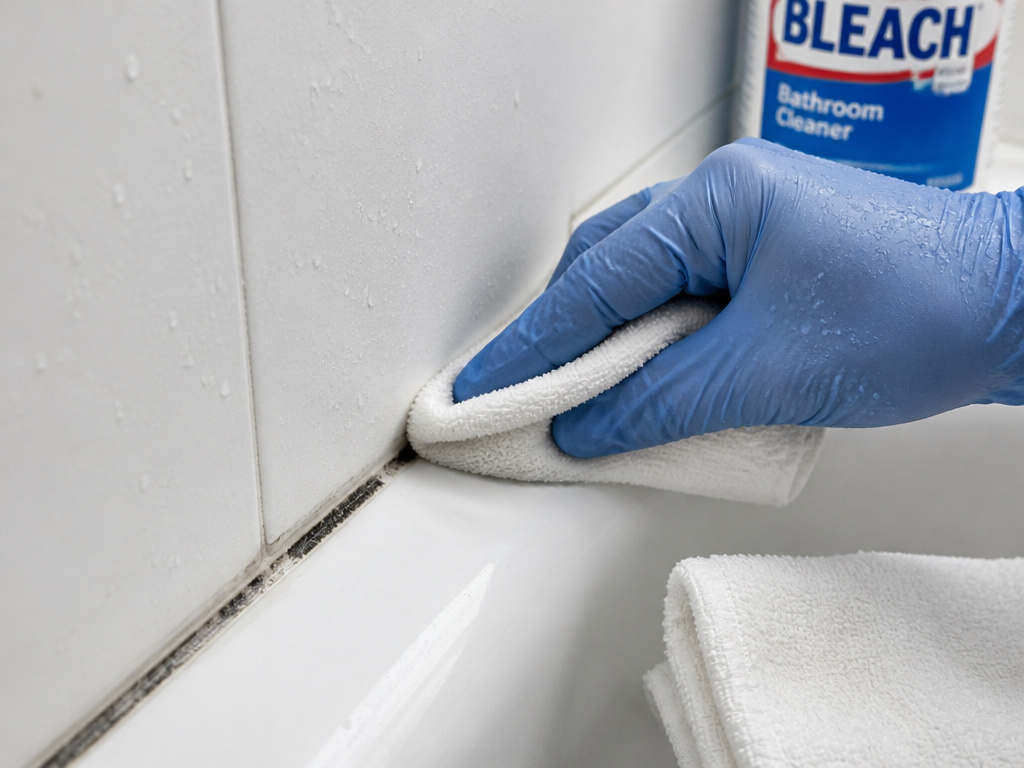
Mildew shows up first in the seam where the wall meets the tub, a thin dark line that comes back no matter how hard you scrub.
For mildew sitting on a hard panel, the bathroom cleaning tips resource from the American Cleaning Institute recommends liquid household bleach or a cleaner that contains bleach. That advice sits awkwardly beside Re-Bath’s blanket ban, and the material is what settles it. Bleach on a Wetwall panel is on the approved list. Bleach on a DuraBath surround is not.
Where mildew keeps returning through the paint rather than sitting on top of it, cleaning won’t fix it. That’s mildew on painted walls territory, and it usually means moisture is getting in from behind the coating.
Keeping it away is a ventilation job more than a cleaning job. Mold prevention comes down to moving damp air out of the room before it settles on the coolest surface.
Easy to miss: The sealant line and the wall panel are two different materials. Clean the panel with the product its maker approves, then wipe the sealant with a neutral cleaner on a separate cloth.
Before You Paint: The Wash Step That Decides Everything
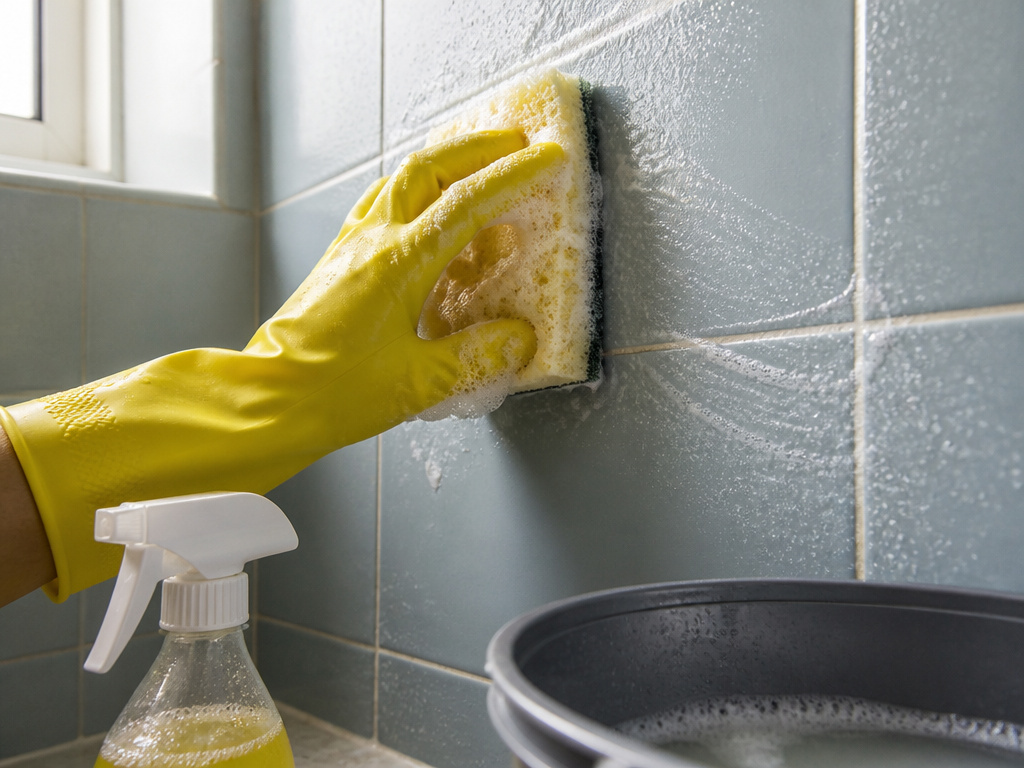
Paint fails on a dirty wall in the most visible way possible: it lets go in sheets.
I painted a kitchen wall near the stove once without washing it first. The paint had beaded up and peeled away in sheets, and I stood there with a scraper feeling like an idiot. I washed the same wall with warm water and a squirt of dish soap, rinsed it, let it dry properly, and repainted. That coat stuck fine.
Soap and water has done more for my adhesion problems than sanding ever has. The catch is the rinse. I left soap film on a hallway wall once and got fisheyes across the whole coat, which is the trade word for little craters where the paint pulls away from itself.
Dry is the other half. A wall that’s still damp from cleaning traps moisture under the paint, and that’s a problem you meet later rather than sooner.
Why Satin Beat Semi-Gloss in My Bathroom
Semi-gloss is the standard advice for a bathroom, on the grounds of moisture. Nobody mentioned that semi-gloss shows every drywall seam and every bad patch under the vanity light. I redid that room in satin and it looked much cleaner without any extra work.
What I’ve landed on is the flattest finish that still wipes clean, going shinier only in the small zone that actually gets splashed. Behind the stove, satin. Around a shower, whatever the paint’s data sheet says it can take.
If you’re repainting anyway, washable paint buys a lot of forgiveness in a wet room, and the sheen question is worth settling before the first coat rather than after. Painting bathroom walls also has its own rules about primer and ventilation that don’t apply anywhere else in the house.
The Short Tool List, and What I’d Leave in the Cupboard
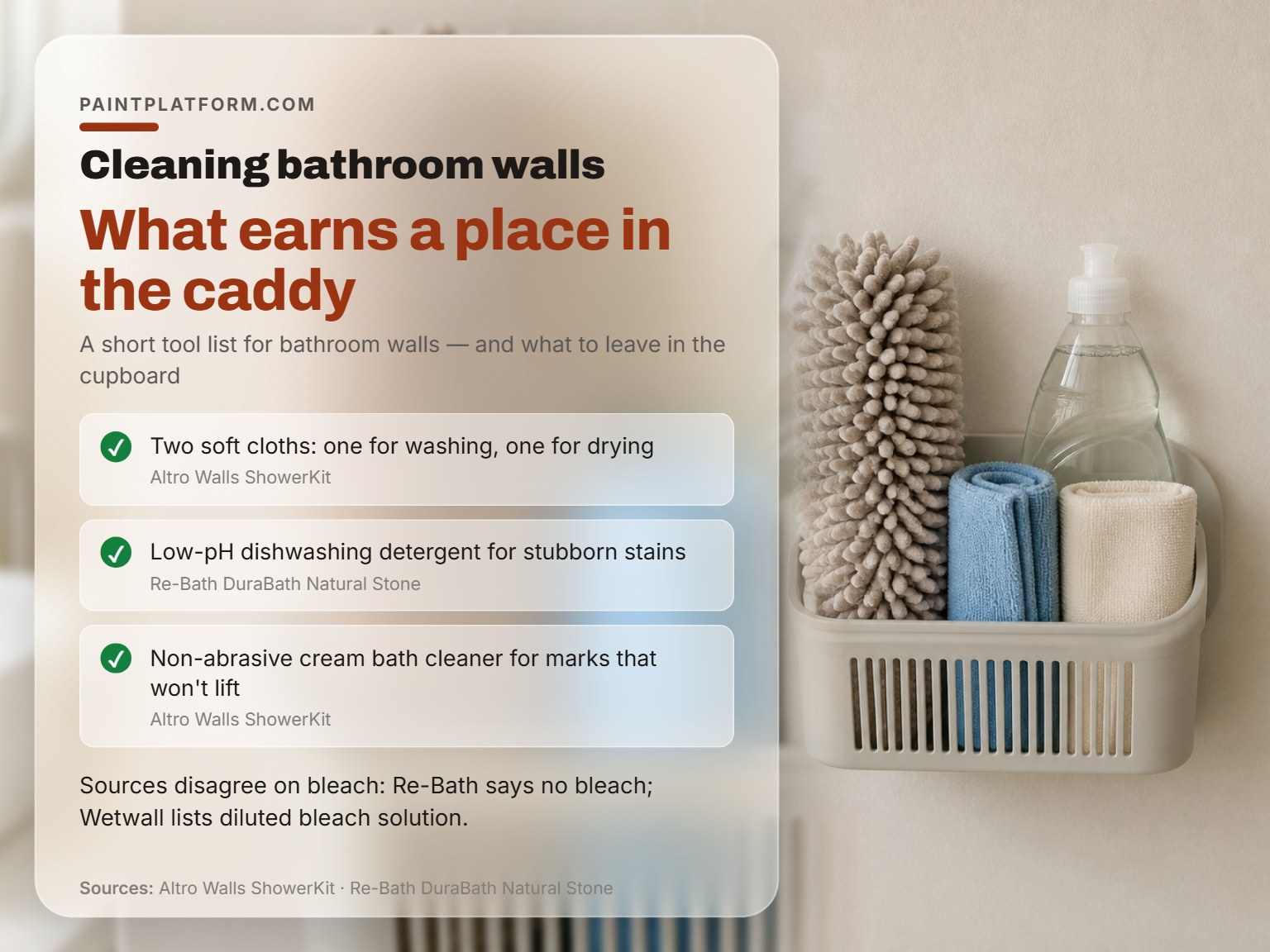
A handful of things earn a place in the caddy. The rest can stay under the sink.
- A dry microfiber duster. The most underrated item in the whole routine. It lifts dust before it becomes mud, and it does more than any bottle on the shelf.
- Two soft cloths, one for washing and one for drying. Re-Bath specifies a sponge, microfiber cloth or non-scratch pad. Altro says soft cloth only.
- A mild dish detergent. Re-Bath names straight Palmolive for stubborn stains on slip-resistant bottoms, and a low-pH dishwashing detergent for natural stone.
- A non-abrasive cream bath cleaner for marks that won’t lift. Altro’s guide recommends exactly that for stubborn stains.
- The product your surface actually approves. Wetwall permits common non-abrasive household cleaners. Re-Bath specifies non-abrasive soap and water. On Altro PVCu, heavy soiling calls for AltroClean 44 or an equivalent alkaline cleaner.
What I’d leave in the cupboard:
- Heavy chemical cleaners. Most of what lands on a bathroom wall is soap scum, dust and the occasional splash. A mild detergent handles all three.
- Bleach, unless the care document for your specific product allows it.
- Abrasive pads of any kind, including the green one I keep buying out of habit.
- Gloss restorers, if your surround is matte.
Bathroom walls don’t need a degreaser. Grease on kitchen walls is a separate job with its own rules.
If your wall is painted rather than panelled, the shortlist of best cleaners for painted walls is narrower than the supermarket shelf suggests.
Frequently Asked Questions
Can you use vinegar to clean bathroom walls?
Re-Bath puts vinegar on its do-not-use list for DuraBath wall surrounds, right next to bleach and drain cleaner. None of the other care documents I checked address vinegar at all, so there’s no manufacturer backing for it on panels. Stick to the cleaner your product’s care sheet names.
How often should bathroom walls be cleaned?
Altro’s guide calls a weekly programme the minimum recommended, with more frequent cleaning in heavy-traffic or high-hygiene areas. Scuffs and heavy soiling get removed more often than the maintenance schedule, and the guide gives daily as its example.
Is bleach safe on bathroom wall panels?
It depends entirely on the panel. Wetwall lists a diluted bleach solution among its recommended cleaners. Re-Bath bans bleach on DuraBath wall surrounds. The American Cleaning Institute recommends liquid household bleach for mildew on general bathroom surfaces. Check your own product’s document before you pour.
Do bathroom wall panels need sealing?
Wetwall panels have no grout lines and are non-porous, so sealing is never required. Re-Bath’s DuraBath Natural Stone is the opposite case: it needs sealing on installation, and basic sealers can need resealing every year in high-traffic areas. Its StoneWalled Sealer is rated at 10 years with a warranty against staining.
Can you pressure wash bathroom walls?
Only Altro permits it, and only with the nozzle at least 600mm from the surface and water no hotter than 60 degrees Celsius. Re-Bath and Wetwall authorize no pressure cleaning at all, specifying hand application of non-abrasive soap and water instead.
What’s the safest thing to clean painted bathroom walls with?
Warm water with a drop of mild dish soap, applied with a soft cloth or sponge, then rinsed with clean water and dried completely. Keep the pressure light, because a hard scrub on a flat finish polishes the surface and leaves a shiny patch that nothing rinses out.
The Bottom Line
All of this assumes you know what your wall is made of, and plenty of people don’t. So the first job this week isn’t cleaning. It’s finding the care document for your panel, or the paint can for your wall, and reading the do-not-use list before you buy anything.
The rule I actually use is a pass count. A few light passes with warm soapy water, then stop. A mark that survives a few light passes is paint transfer or damage, and neither one improves with more scrubbing. That’s how to clean bathroom walls without losing the finish you’re trying to protect.
If paint is the next step, I’d take a washed, rinsed, bone-dry wall with a cheap primer over a spotless wall with the expensive stuff on top of soap film. The wash is the part that decides.
Try the cleaner on a scrap of trim first, somewhere nobody will see. Then do the wall.
