
How to Choose Paint for Bathrooms: Sheen and Cure Time
This post contains affiliate links. As an Amazon Associate, we earn from qualifying purchases.
Choose paint for bathrooms by matching three things: a finish that resists staining, a formula rated for humidity, and a cure window you can leave alone. Consumer Reports points to satin or semi-gloss for cleanability, while Benjamin Moore sells a matte bathroom coating built for the same wet room.
That cure window is where these jobs fail first. Water hits a film that hasn’t hardened all the way through, and even a moisture-resistant paint softens and runs instead of holding. Knowing how to choose paint for bathrooms starts with understanding this curing process, and our guide to the best bathroom paint covers the formulas built for it.
What follows covers the four decisions that actually change the outcome: sheen, primer, cure time, and the failure mode almost nobody warns you about. Two credible sources disagree on the first three, and you’ll see both positions rather than one smoothed-over answer.
Key Takeaways
- Satin or semi-gloss is Consumer Reports’ recommendation for stain resistance and easier cleaning.
- Skip primer only on sound, previously painted walls with no stains, patches, or smoke damage, per Consumer Reports, though Benjamin Moore still recommends two coats for full performance.
- Give it at least overnight before the shower runs, per Consumer Reports, or a minimum of 24 hours per Benjamin Moore, and longer in a cool, humid room.
- Wash off old surfactant leaching first. Heavy cases need Fresh Start 046 before the topcoat.
- Two thin coats are recommended by Benjamin Moore, even with a self-priming product, while Consumer Reports finds one self-priming coat enough on a sound wall.
Which Sheen Actually Survives a Bathroom?
The two most credible sources on this disagree about the finish, and neither one is being careless.
Consumer Reports recommends satin or semi-gloss for bathroom walls, citing better stain resistance and easier cleaning. Benjamin Moore markets the opposite sheen for the same room: Aura Bath & Spa Matte 532, a matte coating with a 3 to 4.5 gloss reading at 85 degrees, built for high-humidity environments. Both positions appear in the manufacturers’ own published material.
Consumer Reports gives the reason plainly: satin and semi-gloss finishes are “more stain-resistant and easier to clean.” That’s a cleanability argument, and it holds up in a room where soap scum lands on the wall behind the tub.
Benjamin Moore’s counter is a product argument. Aura Bath & Spa Matte 532 is sold specifically for bathrooms and saunas, and its data sheet lists wallboard, plaster, masonry, wood, and primed or previously painted metal as acceptable substrates. A 3 to 4.5 gloss reading at 85 degrees puts it firmly in matte territory.
So which one? If wiping the wall matters most to you, satin, and our rundown of bathroom paint finishes lays out the trade-offs. If you want the flat, quiet look and you accept the trade that comes with a lower sheen, the matte bathroom product exists for exactly that, and our bathroom wall sheen guide walks through the choice.
Stand in the doorway with the light behind you and a semi-gloss wall catches a bright line along the top edge, right where steam pools and dries, which is the how to choose paint for bathrooms question in miniature. A matte wall in the same spot looks flat and calm. Same room, different mood, and you’re the one who has to live with it.
The paint finishes question gets easier once you accept that sheen and durability are two separate dials. If you’re stuck between the two, the satin vs semi-gloss comparison is the one that actually matters in a wet room.
Common mistake: Judging sheen from a 2-inch paper chip. A full wall in a steamy room reads a full step glossier than the chip, and the finish you picked at the counter looks like a different product by the second shower.
Do You Need Primer When Painting a Bathroom?
Primer is the decision where the advice splits along one line: what’s already on the wall.
Consumer Reports tested it. On walls in generally good condition, with no stains, patches, or smoke damage, and previously painted with a similar paint, their finding is that one coat of self-priming paint is plenty. Skip the primer and save yourself the step.
Benjamin Moore’s data sheet calls Aura self-priming on most properly prepared surfaces, then recommends two coats anyway for full color development and optimized performance. On bare substrates it wants two coats. Previously painted surfaces can finish with one or two.
| Wall condition | Consumer Reports | Benjamin Moore TDS |
|---|---|---|
| Sound, previously painted, no stains | Skip primer; one self-priming coat | Self-priming; two coats recommended |
| Bare drywall, plaster, masonry | Not addressed | Two coats; new plaster cures 30 days |
| Water, smoke, or grease stained | Not addressed | Special-purpose primer required |
| Heavy surfactant leaching | Not addressed | Fresh Start 046 before topcoat |
Neither position is wrong. Consumer Reports is describing a best case, and the best case is narrower than most people assume when they read “skip the primer” and stop.
I’ve watched people save twenty minutes on primer and lose a weekend fixing it. If the wall has a stain you can see from the doorway, the shortcut doesn’t apply to you.
Anything water stained, smoke damaged, grease stained, or very slick needs a special-purpose primer per the data sheet. Certain deep custom colors may need a Deep Base Primer tinted to a special prescription formula, which quietly kills the one-coat plan too. A bathroom primer is cheap insurance against all of it.
How Long Before the Shower Can Run Again?
Consumer Reports says let the paint dry overnight, while Benjamin Moore prints a minimum of 24 hours before returning the surface to full service.
Consumer Reports says let the paint dry overnight before using the shower, because splashed water can soften and run the film. Benjamin Moore’s data sheet asks for a minimum of 24 hours before returning the surface to full service, and notes the paint can be washed after two weeks. Recoat time is 1 hour at 77 °F and 50% RH.
Fair warning: high humidity and cool temperatures stretch all three of those numbers, so how to choose paint for bathrooms includes reading the room, not just the can. The data sheet says so directly. A steamy bathroom in a cold house is the worst case for this, and it’s also the most common one.
Your hand will tell you before the clock does. Run a palm across a wall in a cool room and the film feels cool and faintly tacky long after it looks dry to the eye.
Easy to miss: The 24-hour clock starts when the last coat goes on, not when you finish cutting in. Two coats an hour apart push full service out by an extra hour, and a cool room pushes it further still.
The VOC Question Has No Single Number
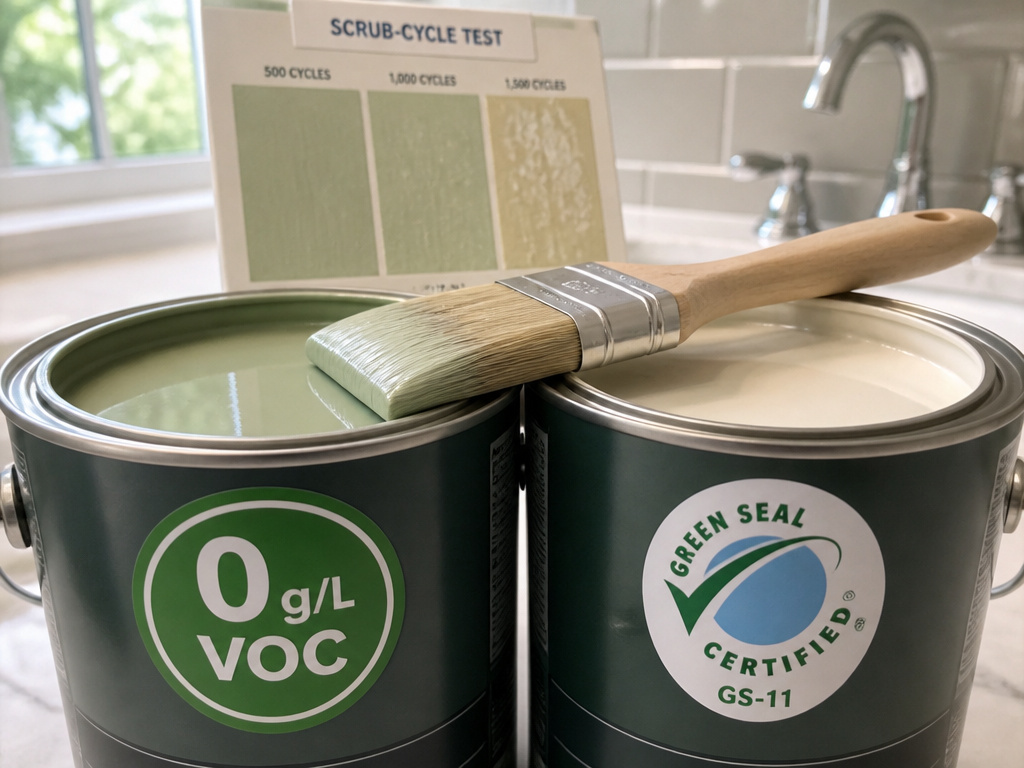
Green Seal GS-11 sets test thresholds for scrub cycles, washability, and hiding power, and it does not hand you one VOC figure to shop by.
That surprised me. The standard covers interior wall and ceiling coatings, primers, stains, finishes, and sealers, and it excludes recycled latex paint, aerosol products, and anti-graffiti coatings. What it actually specifies is performance: 400 scrub cycles before failure under ASTM D2486, washability of flat at 5 or better and non-flat at 7 or better under ASTM D4828, hiding power of at least 0.95 contrast ratio at 400 square feet per gallon, and adhesion of at least 50% wet/dry rating.
The Green Seal GS-11 paint standard is a durability document as much as an environmental one. That’s worth knowing before you treat a certification logo as a VOC number.
The EPA greener paints guide frames the choice broadly too. It points buyers toward salvaged or excess paint that vendors can remix into almost any color, alternative paints like lime, milk protein, clay, and earth-based pigments, and manufacturer take-back programs. No single ceiling there either.
Then there’s the product itself. Aura Bath & Spa Matte 532 sits at 0 g/L VOC, which is as low as the number goes. If a low-VOC bathroom coating is the goal, that’s the benchmark to compare against, and most acrylic latex paint in the mid range won’t hit zero.
What Actually Kills a Bathroom Paint Job
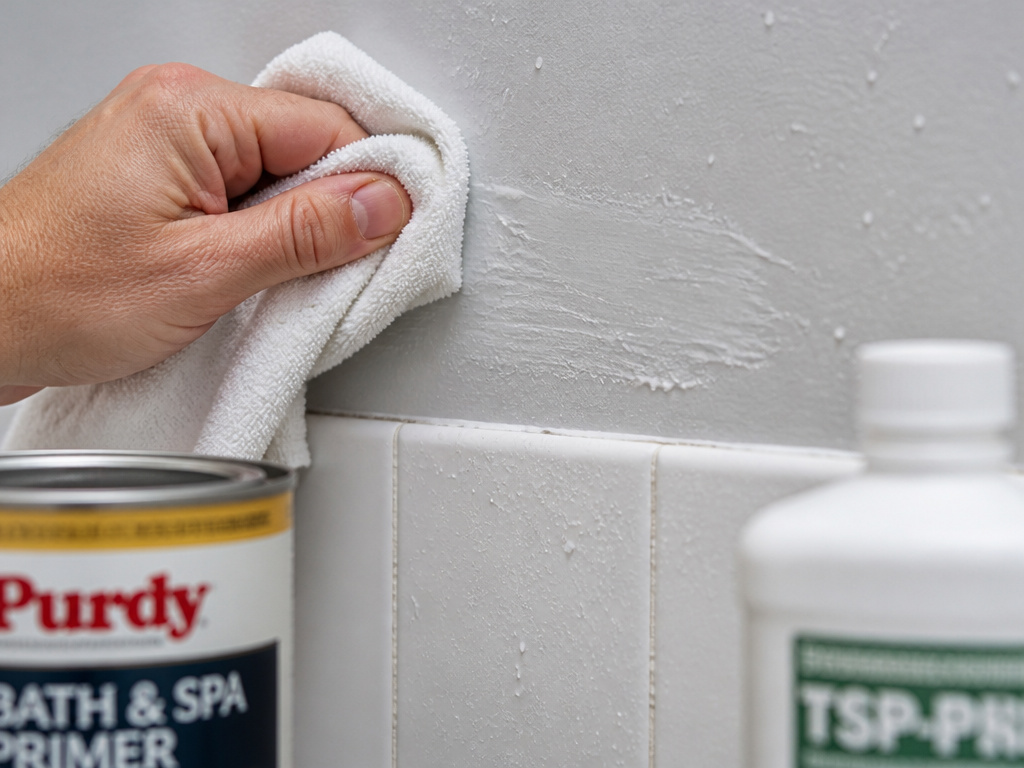
You paint the wall above the shower, it looks perfect for a month, then a shiny streak appears near the ceiling line and won’t wash off.
That’s surfactant leaching, and Benjamin Moore’s own data sheet names it as a common problem in areas where moisture concentrates on walls, specifically bathrooms and showers. The water-soluble components of the paint migrate to the surface and dry there.
What Leaching Looks Like on the Wall
It reads as a faint glossy smear, almost like dried soap that ran down and stopped. From across the room it looks like a lighting artifact. Up close with a rag, it smears instead of lifting.
When Washing Isn’t Enough
Leaching stains on existing coatings must be removed before painting. The data sheet’s instruction is to wash the surface thoroughly, remove any surfactants sitting on the substrate, and let it dry. Skip that and the new coat goes on over the problem.
Heavy leaching areas need more than washing. Those get primed with Fresh Start High-Hiding All Purpose Primer (046) before the topcoat.
Signs you need to wash before you paint, not after:
- A chalky or slick feel on a wall that looks clean
- Old streaks near the shower head or the ceiling line
- Any surface that beads water instead of absorbing a drop
- Soap residue you can feel with a dry fingertip
A mildew-resistant paint helps with the biology side of a wet room. It won’t fix a leaching problem, because leaching is chemistry, not mold.
The 6-Step Prep That Decides the Outcome
Prep decides this job. The paint is the easy part.
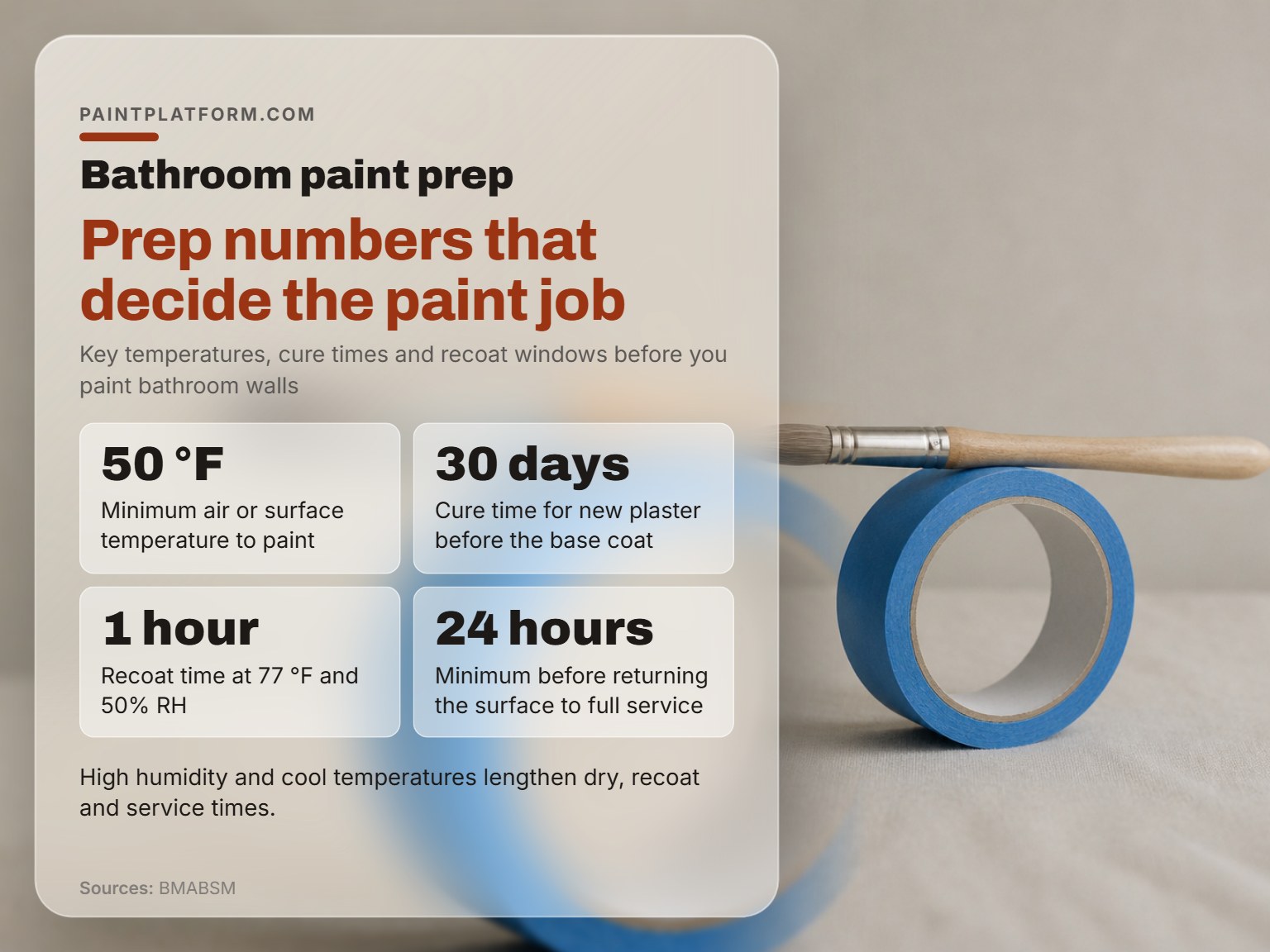
Before you start: Scraping or sanding old paint can release lead dust, which is toxic and especially dangerous to children and pregnant women. Wear a NIOSH approved respirator and clean up with a HEPA vacuum and a wet mop. Never sand a plaster surface; knife off protrusions instead. Keep the room above 50 °F, since the coating shouldn’t go on below that.
- Clear and tape the edges. Use painter’s tape and a sash brush with a tapered tip. Skip the tapered tip and you’ll fight the cut line around the toilet base for an hour.
- Wash the walls with a degreaser. Surfaces must be clean, dry, and free of dirt, dust, grease, oil, soap, wax, scaling paint, and mildew. Paint over soap film and the coat releases in sheets later.
- Scrape and feather any peeling paint. Sand the edges smooth with the surrounding surface and dull glossy areas. Skip it and the new film bridges a loose edge that fails within a season.
- Kill and remove mildew. Painting over it traps the stain and the growth keeps spreading underneath.
- Prime the problem areas. Stained, slick, or heavily leached spots get a special-purpose primer. Bare plaster needs 30 days of cure first, and cured plaster should be hard with a slight sheen and a maximum pH of 10.
- Recoat within the window. Recoat time is 1 hour at 77 °F and 50% RH. Wait far past that without sanding and the second coat can fail to bond.
The full sequence for how to paint bathroom walls is longer than this, but those six steps carry most of the risk.
Picking a Product Without Overpaying
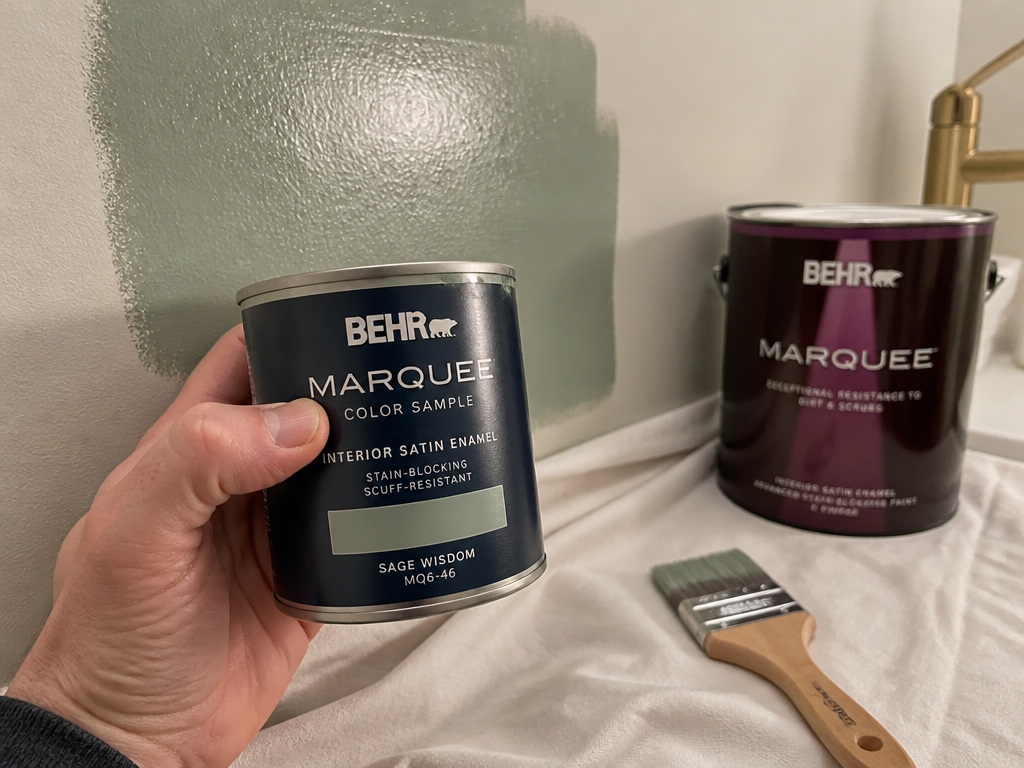
The product decision is smaller than the internet makes it.
I spent a whole season convinced the answer lived in the can. I bought the expensive stuff, prepped like a monk, and the walls came out looking about the same as the ones I’d done with a mid-range gallon. What actually moved my results was patience between coats, not the price on the lid.
The Premium Option
Benjamin Moore Aura Bath & Spa Matte 532 is the real thing for a humid room. Zero VOC, a matte finish built for bathrooms and saunas, spread rate of 350 to 400 square feet per gallon, and a recoat window of 1 hour. If you want the flat look and you’re willing to pay for a purpose-built coating, this is the one to beat.
The Mid-Range Habit
For a normal bathroom, a mid-range gallon does the job. For a normal bathroom, a mid-range gallon does the job, and I’d rather spend the difference on a roller and a second coat than on a premium lid.
That’s a preference, not a test result. Consumer Reports tests paint for coverage and stain resistance and publishes ratings, and their data is the place to check before you commit to a brand.
Buy a quart sample first. Paint a small test patch on the wall behind the door, let it cure, and look at it under bathroom light before you buy gallons. Sample quarts are the most underrated purchase in this whole process.
Frequently Asked Questions
Can I use matte paint in a bathroom?
Yes, if it’s a bathroom-specific matte like Benjamin Moore Aura Bath & Spa Matte 532, which is sold for bathrooms and saunas. Consumer Reports still recommends satin or semi-gloss for stain resistance and easier cleaning. The trade is look versus wipeability.
Do I really need primer in a bathroom?
On sound, previously painted walls with no stains, patches, or smoke damage, Consumer Reports found one coat of self-priming paint is enough. Water-stained, smoke-damaged, grease-stained, or slick surfaces need a special-purpose primer, and heavy surfactant leaching needs Fresh Start 046.
How long until I can shower after painting?
Consumer Reports says let it dry overnight. Benjamin Moore’s data sheet asks for a minimum of 24 hours before returning the surface to full service. High humidity and cool temperatures extend that, so a steamy room in a cold house needs more time, not less.
Why does my bathroom paint look streaky and shiny?
That’s likely surfactant leaching, which Benjamin Moore names as a common problem where moisture concentrates on walls like bathrooms and showers. Old leaching stains have to be washed off before repainting, and heavy areas need a primer before the topcoat.
How often should bathroom paint be refreshed?
Interior designer Cara Newhart recommends every five to seven years, depending on where you live and how often the bathroom is used. Freshening it keeps moisture from building up over time.
The Bottom Line
Here’s the threshold that decides most of this: if your bathroom wall has any stain you can see, any chalky feel, or any streak near the shower, the one-coat shortcut is off the table. Wash it, prime it, then paint. Below that threshold, one self-priming coat on a sound wall is genuinely enough, and Consumer Reports tested it.
The concession is real though. Everything above assumes a room that stays above 50 °F while it cures. In a cold house in February, the 24-hour window stretches, and rushing it undoes the prep you just did.
Try this today: grab a quart sample, paint a small test patch behind the door, and leave it alone until tomorrow. Look at it under the bathroom light before you spend anything on gallons. Start smaller than you think.
