
How Long Does Paint Take to Cure? A Realistic Timeline
This post contains affiliate links. As an Amazon Associate, we earn from qualifying purchases.
How long does paint take to cure depends on the coating: latex paint cures in 14 to 30 days by coalescence, oil-based paint reaches initial cure in 7 to 10 days and keeps hardening, and a two-pack product like HiChem 2-Pack Colour is fully cured in about 7 days. Dry to touch arrives in hours. Cure takes days.
The gap between those two clocks is where the trouble lives. A film that feels hard at hour two still holds solvent, and it keeps fusing for weeks afterward. Stack it, tape it, or scrub it too early and you find out the hard way.
What follows is the dry, recoat, and cure timeline for the main paint families, the conditions that stretch those numbers, and the places where the manufacturers and the standards body contradict each other outright.
Key Takeaways
- Dry to touch is not the finish line. Latex feels dry in one to two hours and takes a second coat in two to four.
- One aluminum paint cures in 10 days at 50°F and 3 days at 110°F.
- The fingernail scratch proves nothing. Dulux states plainly that a fingernail is not a reliable measure of hardness or cure.
- Water-based paint stays soft until fully cured, regardless of manufacturer, brand, make, or model.
What Dry, Recoat, and Cure Actually Mean
Coalescence, oxidation, and chemical crosslinking are the three mechanisms behind every cure-time number printed on a can.
Coalescence is the mechanism behind water-based cure. As water and coalescent solvent leave the film, polymer particles pack together, deform, and fuse into a continuous membrane. Until that fusion finishes, the film stays soft and permeable, no matter how hard the surface feels to a fingertip. That distinction is why a two-day-old wall can look finished and still be fragile.
Drying is evaporation. Dunn-Edwards describes it as the stage where water and solvents leave the coating and the pigment and resin bind together. Curing is the chemistry that follows, and it runs on a completely different clock.
Latex cures by coalescence and dries from the surface downward, which is why it sets so fast. Oil-based paint cures by oxidation and dries from the inside out, which is why it stays soft under the surface long after the top feels firm.
Getting the drying vs curing split straight explains why a wall feels done long before it is.
Why the Standards Body and the Paint Companies Use Different Words
ASTM D1640/D1640M-14(2022) states that “dry or drying, cure or curing, and film formation are used interchangeably throughout this standard.” Dunn-Edwards and Dulux both treat them as separate stages on separate clocks.
That disagreement matters more than it looks. If the standard treats the words as synonyms, a datasheet listing one cure number is technically complete. If the manufacturers are right, that same datasheet is missing the number most people actually need.
I keep both definitions in my head and translate depending on who I’m talking to.
How Long Does Paint Take to Cure? The Timelines by Paint Type
Fourteen days is the short end of a latex cure. Thirty days is the long end, and both numbers come from the same technical bulletin.
| Coating | Dry to touch | Recoat | Full cure |
|---|---|---|---|
| Latex (Dunn-Edwards) | 1 to 2 hours | 2 to 4 hours | 14 to 30 days |
| Water-based (Dulux, 20-25°C / 50% RH) | Not given | Not given | 1 to 2 weeks |
| Oil-based (Dunn-Edwards) | 4 to 8 hours | 8 to 10 hours or overnight | 7 to 10 days initial, then keeps hardening |
| HiChem 2-Pack Colour (air dry) | 2 to 3 hours | Not given | About 7 days |
Read that table by column rather than by row. The dry column tells you when dust stops being a threat. The recoat column tells you when a second coat will bond properly.
Only the last column tells you when the film has finished becoming what it is going to be.
Latex, Oil, and Two-Pack: Three Different Curing Mechanisms
Latex coalesces, oil oxidizes, and a two-pack product crosslinks through a hardener reaction.
Dunn-Edwards notes that oil-based coatings reach dry-to-touch in four to eight hours, but that professional painters wait eight to ten hours or overnight before a second coat. The manufacturer’s own field guidance runs more conservative than its datasheet window.
HiChem 2-Pack Colour goes from dust free in 30 to 35 minutes to touch dry in two to three hours to hard dry in 24 hours, with full cure at roughly seven days. Bake it at a 40°C metal temperature and hard dry drops to 60 minutes.
If you want the fuller breakdown of how long paint takes to dry before it cures, that stage is measured in hours and it behaves very differently by chemistry.
Common mistake: Recoating inside the dry-to-touch window because the surface feels ready. The second pass drags the half-set film, and the lap marks show up as flat, dull streaks.
Getting the recoat time right is the single cheapest way to avoid that.
Why Does the Same Paint Cure in 3 Days at 110°F and 10 Days at 50°F?
A steel tank in August sun and the same tank in a cold shop get the same can of paint and cure three times apart. Rust-Oleum’s datasheet for Silver-Brite Aluminum Paint B59S00011 lays it out at 3.0 mils wet film and 50% relative humidity.
| Surface temperature | To touch | To recoat | To cure |
|---|---|---|---|
| 50°F | 4 hours | 28 hours | 10 days |
| 77°F | 2 to 4 hours | 24 hours | 8 days |
| 110°F | 30 minutes | 10 hours | 3 days |
Same product, same film thickness, different surface temperature. Cure went from ten days to three.
Other factors push the same way:
- Dark colors with heavy pigment loading dry and cure slower than light colors, per Dunn-Edwards.
- Higher gloss coatings take longer to fully cure than lower sheen ones.
- Thick films hold solvent longer, so a heavy coat outlasts a thin one.
- Poor air circulation in a closed room may prolong drying time; increased ventilation encourages solvent evaporation.
- Over-tinting past 3Y per litre may slow drying further, per Dulux.
Cold slows the chemistry and heat speeds it, but heat also skins the surface closed while the film underneath is still wet. Warm and dry beats hot and dry.
If you are working outside, the full picture on exterior painting conditions covers dew point and wind as well as temperature.
Where the Manufacturers and the Standards Body Disagree
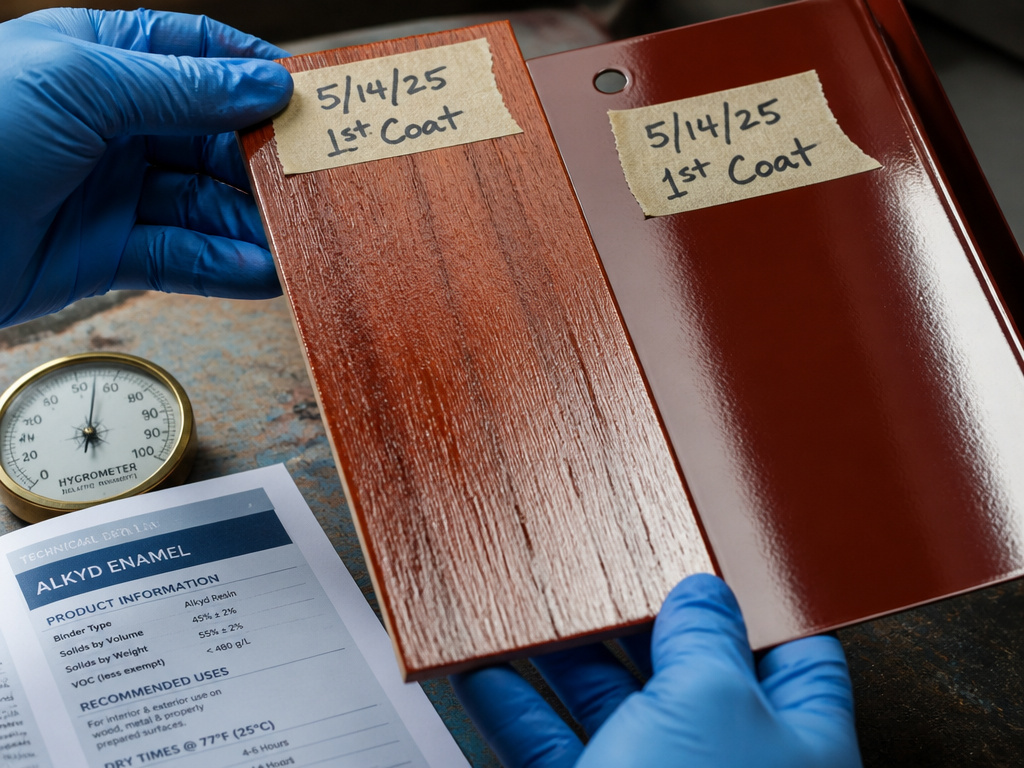
The datasheets do not agree with each other, and one of them contradicts the standard that is supposed to define the terms.
| Question | One position | The other position |
|---|---|---|
| Latex cure window | Dunn-Edwards: 14 to 30 days | Dulux: one to two weeks at 20-25°C and 50% RH |
| Are dry and cure the same thing? | ASTM D1640 uses the terms interchangeably | Dunn-Edwards and Dulux treat them as separate stages |
| Humidity and cure speed | Dunn-Edwards: high humidity slows drying | AkzoNobel Interfine 979: curing is faster at higher humidity, 40% to 85% RH |
| Datasheet values on bare wood | Datasheets publish general recoat intervals | ASTM Methods A, B and C cover smooth, non-absorbent substrates only |
The ASTM D1640 drying and curing standard is worth reading for the substrate limitation alone. It states that Methods A, B and C are limited to smooth, non-absorbent substrates and do not reflect absorption of the paint vehicle into the substrate.
That means every recoat number on a can was generated on a surface that does not drink.
Bare wood and fresh masonry drink. A 24-hour recoat interval measured on a metal panel is not a promise about your porch rail.
The humidity question splits the same way. ASTM is careful: some coatings speed up under elevated temperature and humidity, while others are adversely impacted by elevated humidity. Interfine 979 sits in the first camp within 40% to 85% RH. Dunn-Edwards puts latex in the second.
Then there is the accelerator ceiling. Tnemec sells No. 44-456 Urethane Accelerator for faster cure down to 35°F (2°C) and states it is not recommended above 75°F (24°C). ASTM notes that accelerators exist to aid drying in cooler temperatures and sets no warm-weather ceiling at all.
For a look at how long cure actually runs in a working shop, there is a peer-reviewed study on paint cure times from the automotive refinishing world, which is where the gap between “dry enough to handle” and “cured” stops being cosmetic.
I stopped trusting my own thumb on this years ago. A film can feel like glass and still be soft underneath, and the only honest check is time plus a scrap piece you do not care about. Paint a test board, write the date on the back, and handle it the way you plan to handle the real thing.
How to Tell Whether Paint Is Actually Cured
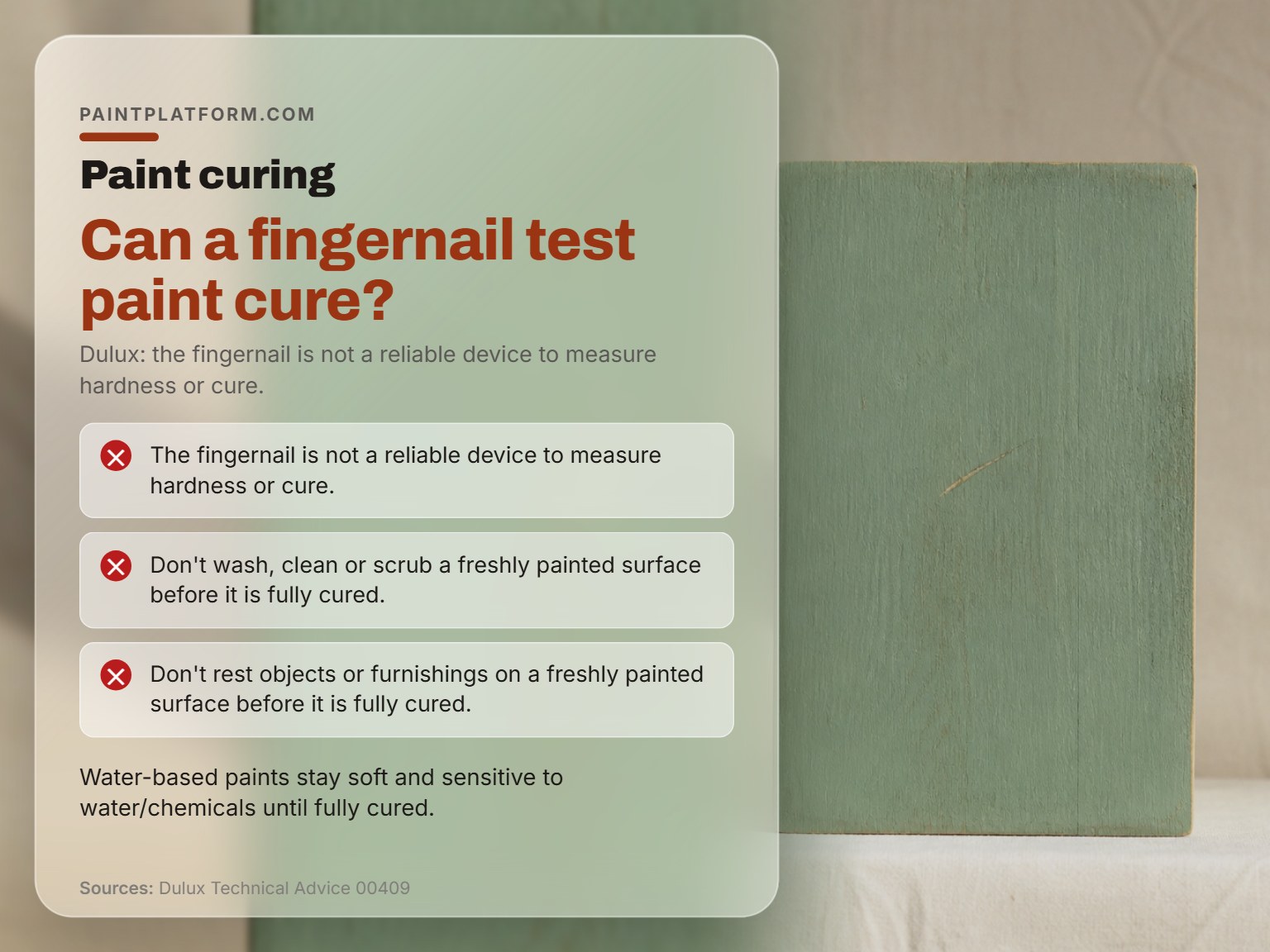
Can you trust the fingernail scratch everyone recommends?
Dulux answers that directly: the fingernail is not a reliable device to measure hardness or cure. A fingernail tells you only that the surface resisted one small, sharp point. Cure is a property of the whole film thickness.
The Fingernail Test Fails for a Reason
A scratch tests only the top of the film and nothing else. On a latex film curing by coalescence, the top can be fully fused while the layer against the substrate is still open.
Four checks that tell you more:
1. 2. 3.
- Test a scrap board first, never the finished surface.
Where this goes sideways: Scrubbing a spot to “check” it. Dulux warns against washing, cleaning, or scrubbing a freshly painted surface before it is fully cured, and the damage shows up as a dull patch that no amount of polishing brings back.
If a film is well past its window and still soft, the cause is usually one of four things. The reasons paint stays tacky are worth working through before you add another coat on top.
What Cure Time Means for Cabinets, Trim, and Anything You Touch
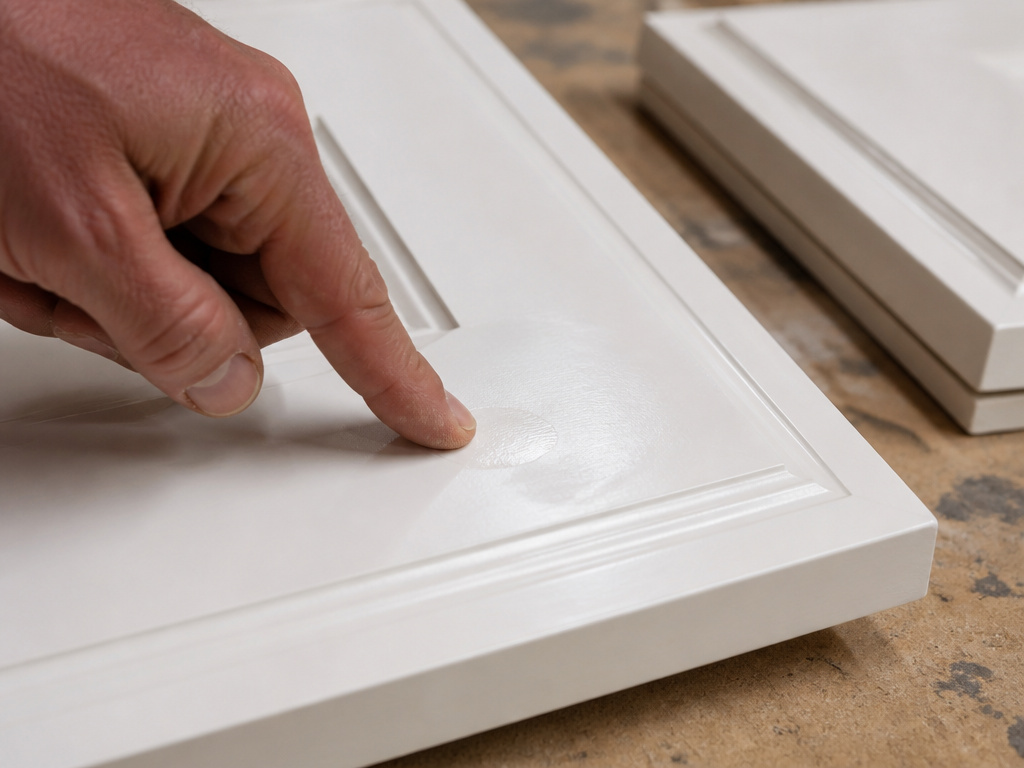
Cure time is a handling instruction. Treat it like one.
I have a stack of small panels in the studio that I painted, decided were dry, and stacked face to face. That was not a chemistry problem. It was an impatience problem.
Dulux lists the practical rules plainly: no washing or scrubbing before full cure, no objects or furnishings resting on the surface, and no contact with steam or condensation in a shower, kitchen, bathroom, or laundry.
That last rule matters for cabinets. A kitchen is a humidity machine, and a door closed early sits against a wet film. If you are working through how long before using painted cabinets, the answer tracks the cure window, not the dry window.
Before you start: Sanding old paint can release lead dust, and a NIOSH-approved respirator plus a HEPA vacuum and wet mop is the minimum for cleanup. Poor air circulation in a closed room may prolong drying time, so ventilation matters.
What to keep off a fresh film:
- No washing or scrubbing until the film is fully cured.
- No furniture, boxes, or objects resting on the surface.
- No steam, no condensation, no damp towel hanging against it.
Dulux’s statement is deliberately broad: water-based paints remain soft and sensitive to water and chemicals until fully cured, regardless of manufacturer, brand, make, or model. That covers the acrylics on your shelf as much as the paint on your wall.
Frequently Asked Questions
How long does paint take to cure before furniture goes back?
Dulux is direct about this: do not rest objects or furnishings on a freshly painted surface before it is fully cured. For latex, Dunn-Edwards puts full cure at 14 to 30 days. Move furniture back once the film is fully cured.
Does paint cure faster in hot weather?
Up to a point. Rust-Oleum’s Silver-Brite cures in 3 days at 110°F versus 10 days at 50°F. But Dunn-Edwards warns that higher temperatures can dry the surface first and leave a soft interior matrix, so heat buys speed at the cost of evenness.
Is paint cured when it stops smelling?
Not reliably. Dulux ties final hardening to the last traces of coalescent solvent leaving the film, so a fading smell is a rough signal at best.
Can a fan or a heater speed up the cure?
Air movement helps, since cure time varies with air movement as well as temperature and film thickness. Heat is riskier. Tnemec’s No. 44-456 accelerator is not recommended above 75°F (24°C), and pushing heat into a room to force a film dry is how you get a skin over a wet interior.
Why is my paint still tacky after a week?
The usual suspects are cool conditions, high humidity, thick films, over-tinting, and poor ventilation. Dulux sets hard limits at 10°C, 85% relative humidity, and within 3°C of the dew point, and a film applied outside those limits does not catch up on its own.
The Bottom Line
Here is the trigger I would hand anyone: if the room is below 10°C or the humidity is above 85%, put the brush down. Dulux sets both as hard limits, and patience does not rescue a film applied outside them.
Everything above assumes an architectural coating on a normal substrate. Bare wood and fresh masonry pull solvent out of a film at a rate no datasheet accounts for, and ASTM’s own methods exclude them by design. On those surfaces, add time instead of trusting the can.
And the unpopular one: the fingernail test is worse than no test at all. It hands you a confident answer that happens to be wrong, which is much harder to argue with than an honest “not yet.” Write the date on the wall behind the outlet plate and check it later instead.
