
Cordless Paint Sprayer Pros and Cons: Which Jobs Fit
This post contains affiliate links. As an Amazon Associate, we earn from qualifying purchases.
The cordless paint sprayer pros and cons start with maximum pressure, and that number splits the category in half. Graco hand-held models run 2000 psi (138 bar). The Worx WX020L tops out at 3 PSI (20 kPa). One drives thick latex through a small tip; the other runs a turbine and a wider nozzle for thin coats.
Pressure decides the job before you ever pull the trigger. A 2000 psi airless pump forces material through a tip orifice small enough to have its size stamped in the part number. A 3 PSI turbine pushes air past a wider nozzle and lets the material ride along in it. Same shelf, different machine.
What follows is the ledger the manuals actually support: the material limits that change model by model, the battery math, the temperature window, and the jobs where a sprayer genuinely beats a roller.
Key Takeaways
- Maximum pressure decides the job. Graco’s hand-held line lists 2000 psi (137 to 138 bar); the Worx WX020L lists 3 PSI (20 kPa). They are not interchangeable tools.
- Oil-based paint is a model question. The Graco ProShot 258865 and 258859 accept mineral spirit material above a 100°F (38°C) flash point. The TrueCoat Pro-X, Pro Compact A15, and TrueCoat 360 Connect are water-based only.
- One charge covers roughly 1 gallon of latex through a 515 tip on the TrueCoat Pro-X, and a dead battery reaches full in about 75 minutes.
- Freeze damage is permanent. The TrueCoat 360 Connect manual states pump damage will occur if fluid freezes inside the pump.
- Test on cardboard before the wall. Distance and speed are the two variables no manual can set for you.
What a Cordless Sprayer Actually Does That a Roller Can’t
A cordless airless sprayer is a pump, a battery, and a tip, and the tip does most of the deciding.
A cordless airless sprayer pressurizes paint inside a pump and forces it through a small tip orifice, where the pressure drop breaks the fluid into a fan pattern. Fan width is rated with the gun held 12 in. (30.5 cm) from the surface, and the tip’s last three digits encode both hole size and fan width.
That encoding matters more than any claim on the box. A 515 tip has a 0.015 in. (0.38 mm) hole. A 0.015 in. (0.38 mm) tip is included with the sprayer for most spraying applications.
Hole size controls flow rate, which is the amount of paint leaving the gun. Go bigger and you move material faster with less finish quality. Go smaller and the finish cleans up while the pass count climbs. That one choice changes the job more than the battery does.
Tips also wear. Graco states plainly that tips enlarge with use and with abrasive paint, and that worn tips should be replaced. A worn tip is why a sprayer that behaved last summer now leaves whiskers at the edge of the fan.
If you’re still working out which family you’re shopping in, the types of paint sprayers sort by how they move material rather than by brand.
Why Does the Pressure Rating Matter More Than the Battery?
Because the pressure rating tells you which machine you’re holding, and the battery only tells you how long you can hold it.
The gap here is enormous. The Worx WX020L lists a maximum pressure of 3 PSI (20 kPa). Graco’s hand-held airless manuals list 2000 psi across the ProShot, TrueCoat Pro-X, TrueCoat 360 Connect, and Pro Compact A15 lines, with the bar figure landing at 137 or 138 depending on the sheet. That gap decides what the tool can physically do.
At 3 PSI, a turbine moves air and the material rides along in the airstream. At 2000 psi, the pump forces material through a hole measured in hundredths of an inch and the pressure drop does the atomizing. Exterior latex needs the second method.
Match the pressure class to the material, not to the price tag. A 3 PSI turbine and a 2000 psi airless pump both say “cordless sprayer” on the box, and only one of them will move exterior latex.
So a low-pressure unit that spits and sputters on a fence isn’t broken. It’s being asked to do a job outside its class. The airless vs HVLP split is the first decision on this topic, not the last one.
Oil-Based Paint Is a Model-by-Model Question
Search results treat “cordless paint sprayer” as one category with one set of rules. The manuals split it model by model instead.
The Graco ProShot 258865 and 258859 are the exception in this set. They accept water-based and oil-based mineral spirit-type material, provided the flash point is above 100°F (38°C). The ProShot manual adds that oil-based material has to be sprayed outdoors or in a well-ventilated indoor area with a flow of fresh air.
Everything else in the Graco hand-held range is water-based only.
| Model | Paint it accepts | Manual limit |
|---|---|---|
| Graco ProShot 258865 / 258859 | Water-based and oil-based | Flash point above 100°F (38°C) |
| Graco TrueCoat Pro-X 258850 / 258851 | Water-based only | No flammable material |
| Graco TrueCoat 360 Connect 26D360 | Water-based only | No oil-based, no chlorine bleach |
| Graco Pro Compact A15 258861 | Water-based only | No flammable material |
| Graco EasyMax WP 258849 / 262605 | Water-based only | No flammable material |
Static shock is the other tell, and both manual families describe the same sequence. If you feel a shock, check that the flash point clears 100°F and that the label doesn’t say FLAMMABLE. If the shock continues, the material likely contains xylene, toluene, or naphtha, and the manual’s instruction is to switch material rather than push through.
Where this goes sideways: Buying a water-based-only model and then opening a can of oil-based enamel. The TrueCoat 360 Connect manual states outright that oil-based material is not compatible and cannot be used. You find out at the first clog, not at the shelf.
If you’re comparing models, the cordless paint sprayers that accept mineral spirit material are a much shorter list than the water-based-only group.
How Long Does One Battery Really Last?
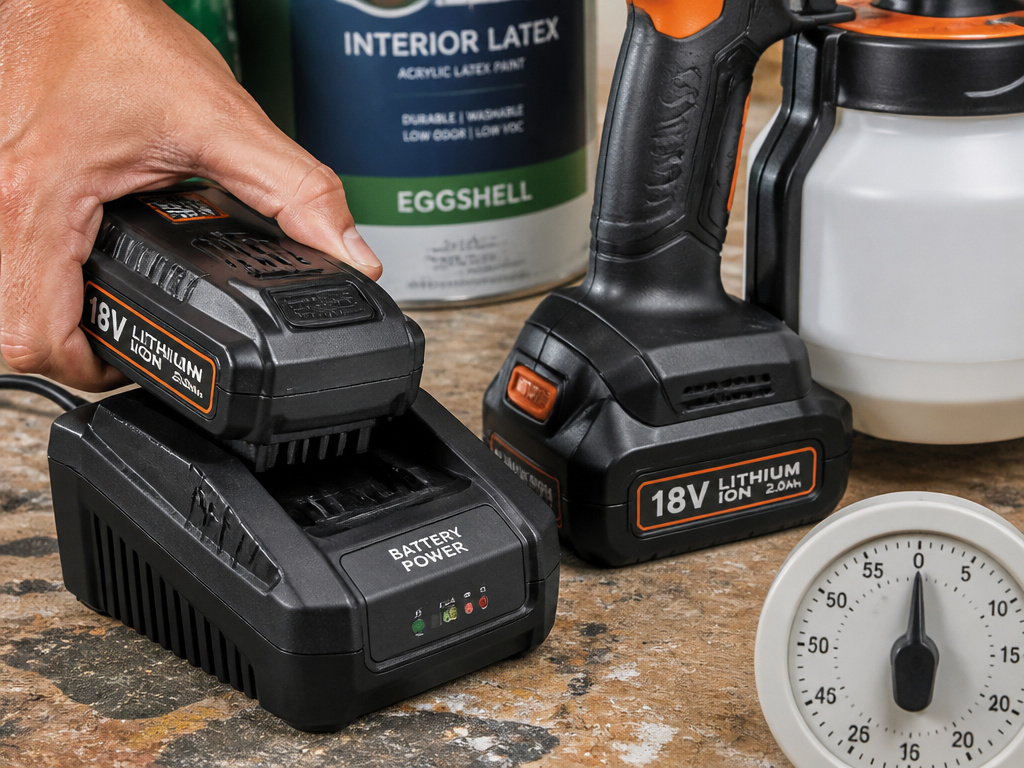
One fully charged battery sprays approximately 1 gallon of latex through a 515 tip, per the TrueCoat Pro-X manual. That’s the number to plan around.
The same manual gives the charge curve: a dead battery reaches 80% in roughly 45 minutes and full charge in about 75. Batteries ship at 50% charge and need a top-up before first use. Graco also asks for its own batteries in its own charger, and warns that a wet battery in the charger causes damage.
The storage rule is easy to miss. Graco does not recommend leaving the battery parked in the charger for longer than one week.
Common mistake: Treating the charger as a shelf. A week is the stated ceiling, and the battery is better off cool and dry than permanently docked.
What the Drill-Powered Model Changes
The TrueCoat 360 Connect 26D360 has no onboard battery at all. It runs off an 18V to 24V cordless drill or impact driver, which makes your drill part of the sprayer’s spec sheet.
- Duty cycle: 50%. Half the time on, half the time cooling.
- Weight: 2.5 lb (1.13 kg) for the sprayer itself, before the drill.
- Max tip orifice: 0.015 in. (0.38 mm), so the tip range is narrower than the battery models.
If runtime is the deciding factor for you, a battery life comparison across the model lines is more useful than a single gallons-per-charge figure.
What a Bad Spray Pattern Is Telling You
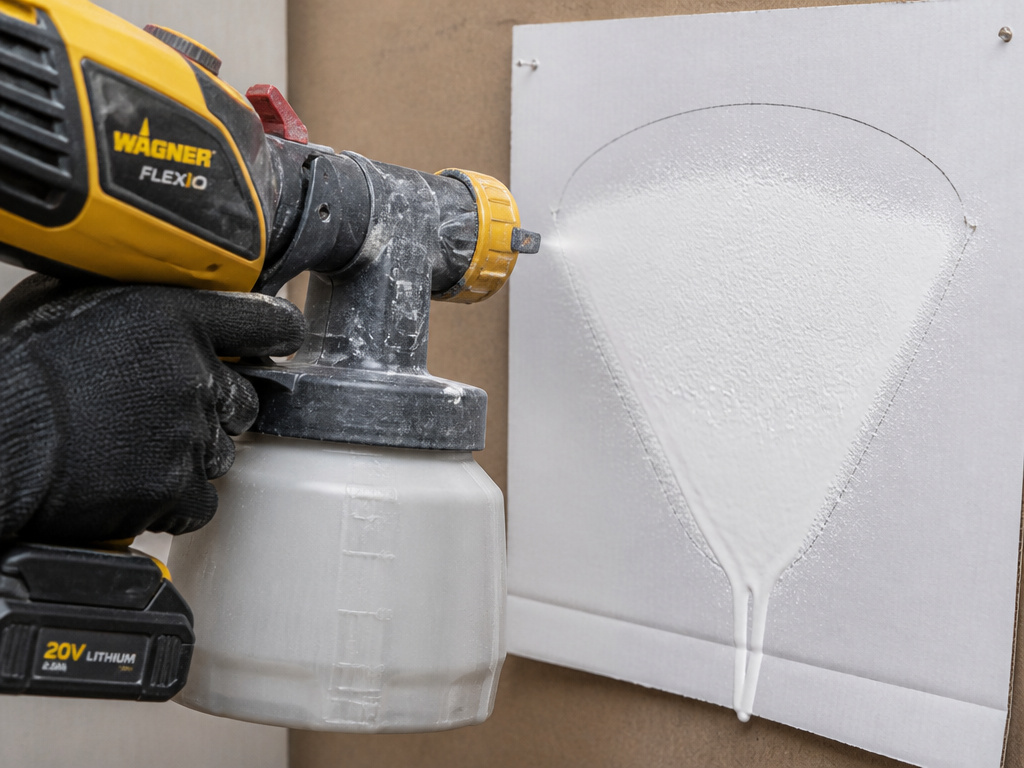
A spray pattern is a diagnostic readout, and it reads faster than any gauge.
Graco’s ProShot troubleshooting section maps symptoms to causes with unusual directness. Pulsating pattern: the Fine-Finish Optimizer is missing when spraying thin material. Tails on the fan: a worn tip. Drips: move the sprayer away from the surface to 10 in.
| What you see | Likely cause | Fix |
|---|---|---|
| Pattern pulses or surges | Optimizer missing on thin material | Install the Fine-Finish Optimizer |
| Tails at the fan edges | Worn or partly clogged tip | Replace the tip, clean the filter |
| Drips and runs | Too slow, too close, trigger held | Speed up, back off to 10 in. |
Where the Distance Numbers Disagree
Three manuals, three numbers, three different contexts. Worth knowing which book each came from.
Worx recommends positioning the WX020L six to eight inches from the spray surface. Graco rates tip fan width with the gun held 12 in. (30.5 cm) out, which is a rating condition rather than an instruction. And the ProShot manual’s fix for dripping is to move the sprayer away from the surface to 10 in.
Set yours by test instead of by argument.
Before you start: A hand-held airless sprayer builds 2000 psi (138 bar) internally, so remove the battery and run the pressure relief procedure before cleaning, servicing, or transporting it. Never point the gun at a person or animal, and keep hands away from the discharge. Solvent material needs outdoor or well-ventilated spraying, and the manual’s flash point floor is 100°F (38°C).
- Cut a square of cardboard and stand it against a wall. Skip this and your first real pass becomes the test, on a surface you have to live with.
-
Water shows the fan shape without burning material. 3.
-
Without a mark you’ll drift closer as the job wears on, which is exactly how a run starts.
The Cordless Paint Sprayer Pros and Cons the Manuals Actually List
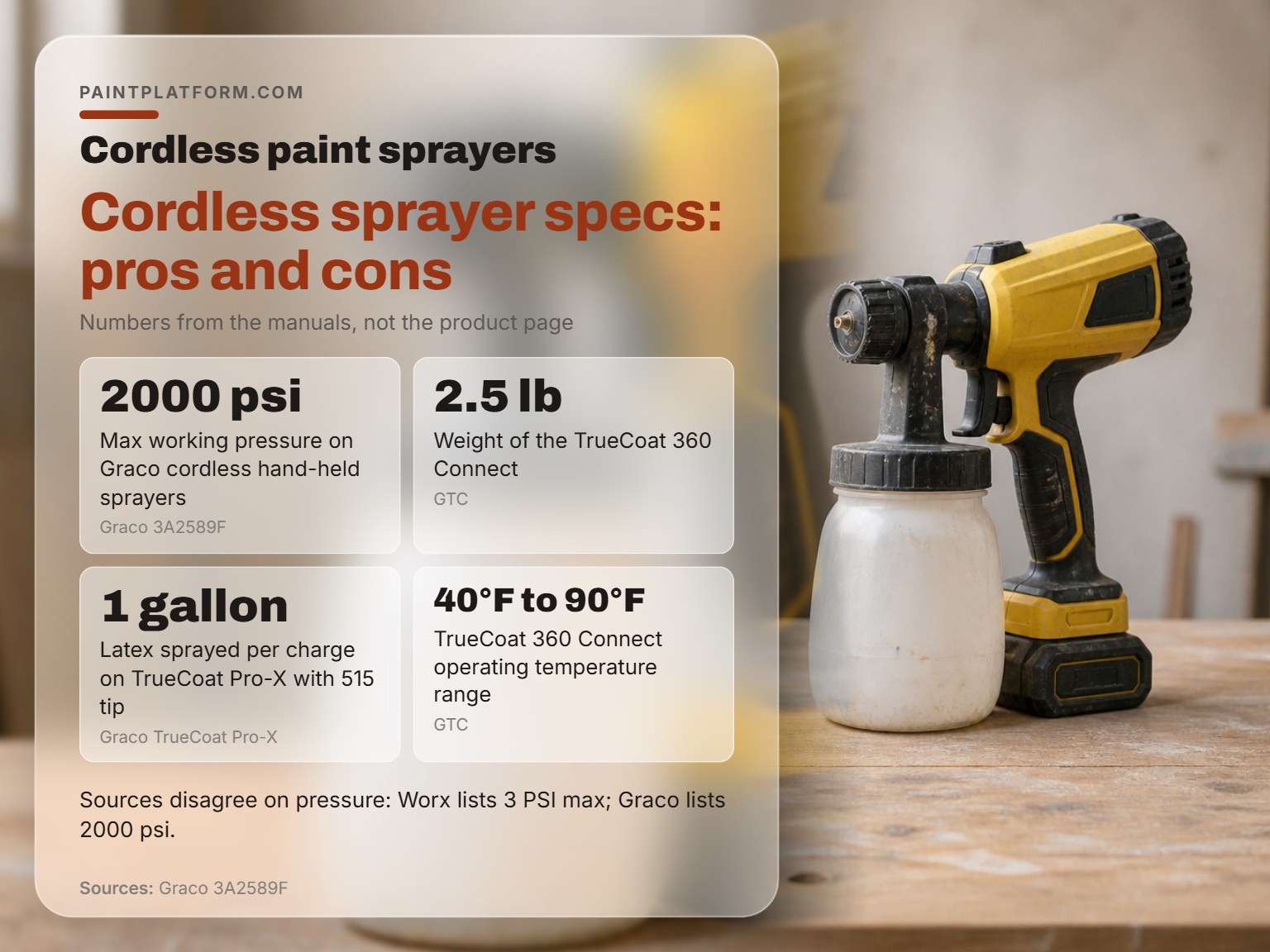
The ledger looks different when you read it off the spec sheets instead of the product page.
The Pros, Stated Plainly
- Full pressure without a cord. The TrueCoat 360 Connect weighs 2.5 lb (1.13 kg) and still lists 2000 psi (138 bar).
- Flow control at the tip. Hole size sets flow rate, so one sprayer covers primer through finish with a tip change.
- Roughly a gallon per charge on the TrueCoat Pro-X with a 515 tip and latex.
The Cons, Stated Plainly
- Material limits vary by model, and most of the Graco hand-held line is water-based only.
- The temperature window is narrow. The TrueCoat 360 Connect operates between 40°F and 90°F (4°C to 32°C) and stores between 32°F and 113°F (0°C to 45°C). Storage humidity is listed at 0% to 95%.
- Freeze damage is permanent. The manual’s wording is that pump damage will occur if fluid freezes in the pump.
- Battery housekeeping is real. Graco batteries in Graco chargers, nothing wet in the charger, one week maximum on the dock.
- Viscosity drifts at both temperature ends, which the manual notes can affect sprayer performance.
Prep is the cost that never makes it onto a spec sheet. That’s the part I’d weigh hardest, because it’s the one part a better tool can’t speed up.
If you’re weighing form factor, portable paint sprayers trade cup size against hand fatigue, and how to choose a paint sprayer walks the same trade-offs in more detail.
Which Jobs Actually Justify Pulling It Out
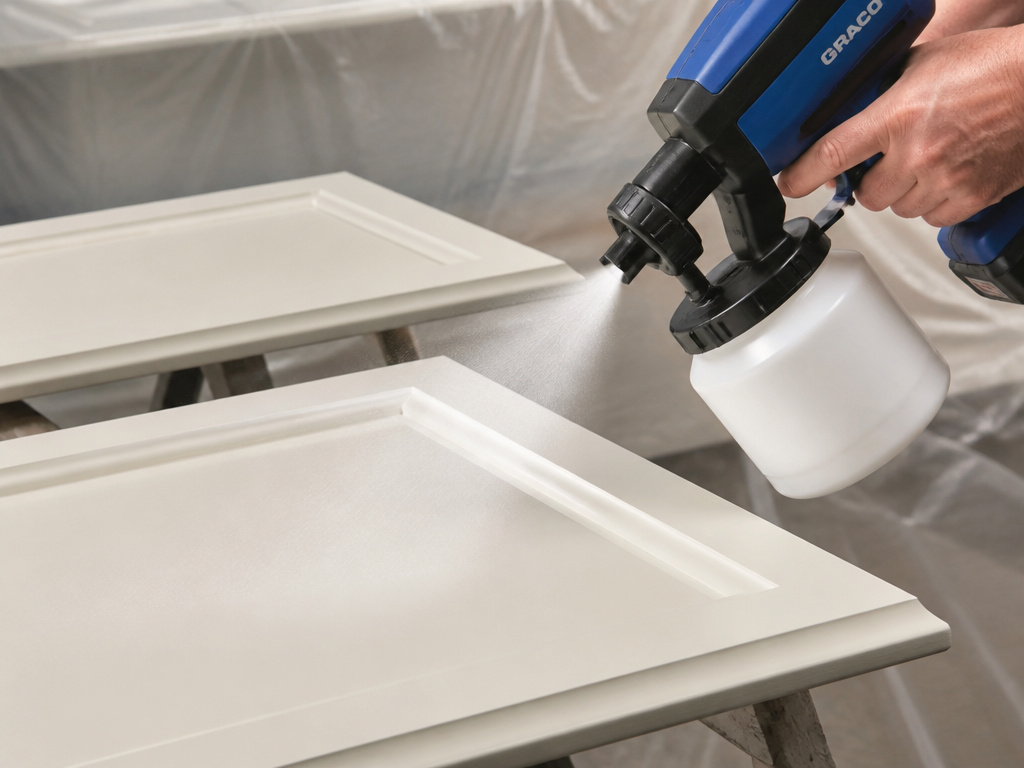
Three jobs repay the setup: a fence run, a set of cabinet doors and drawer fronts, and a large empty room with the trim already masked.
Cabinet work is the clearest case. Doors and drawer fronts come off, lay flat, and take a finish coat without a single brush mark, which is why cordless sprayers for cabinets are worth considering.
Where It Loses to a Roller
Skip the sprayer for a single small room. By the time you’ve masked the trim, the ceiling line, and the floor, a roller is already finished and cleaned up.
Two limits worth respecting, both with consequences you can see:
- Don’t spray exterior latex below 40°F (4°C). That’s the TrueCoat 360 Connect’s operating floor, and the manual warns that paint viscosity shifts at both temperature extremes.
- Don’t leave material sitting in the pump over a freeze. The manual states pump damage will occur if fluid freezes inside it.
If you’re brand new to spraying, start with the sprayers for beginners end of the range and a cardboard panel.
Frequently Asked Questions
Is a cordless paint sprayer worth it for one room?
Usually not. Masking, moving furniture, then flushing the pump and cleaning the tip typically runs longer than rolling a single room. It pays off on a run of cabinet doors, a fence, or a large empty space where a roller would need a ladder.
Can you use oil-based paint in a cordless sprayer?
Only in specific models. The Graco ProShot 258865 and 258859 accept oil-based mineral spirit-type material with a flash point above 100°F (38°C). Most of the Graco hand-held line, including the TrueCoat Pro-X and the TrueCoat 360 Connect, is water-based only. Check your exact model’s manual before opening the can.
How long does a cordless paint sprayer battery last?
The TrueCoat Pro-X manual states that one fully charged battery sprays approximately 1 gallon when using a 515 tip with latex paint. A dead battery reaches 80% in about 45 minutes and full charge in about 75.
Do you have to thin paint for a cordless sprayer?
Not usually on airless models, which are built to push thick latex at 2000 psi. Thinning matters more on low-pressure units, where material has to flow through a wider nozzle.
Can you spray indoors with a cordless sprayer?
Yes, with water-based material and airflow. The manuals require oil-based material to be sprayed outdoors or in a well-ventilated indoor area with a flow of fresh air, so a closed bedroom is out for solvent paint.
What happens if paint freezes inside the sprayer?
The TrueCoat 360 Connect manual states that pump damage will occur if fluid freezes in the pump. That’s permanent damage rather than a temporary slowdown, so purge the pump with water before cold storage. The same manual warns that plastic parts can be damaged by impact in low temperatures.
The Bottom Line
One fully charged battery on the TrueCoat Pro-X covers roughly 1 gallon with a 515 tip, so a small touch-up means you spent setup time to save spraying time.
The week the box arrives, cut a square of cardboard and test your spray distance. Whichever distance gives you a flat fan with clean edges is your number, and you’ll know it before the first wall.
One caveat that changes the whole calculation: if you’re spraying oil-based enamel, most of this doesn’t apply. The TrueCoat Pro-X, the TrueCoat 360 Connect, and the Pro Compact A15 are water-based only. The ProShot is the model in this set built for mineral spirit material, and it still caps you at a flash point above 100°F (38°C).
So the cordless paint sprayer pros and cons come down to whether the job is big enough to earn the setup. When it is, nothing else covers a fence that fast. When it isn’t, the roller was already finished.
