
Chalkboard Paint Guide: Cure Times and Recoat Windows
This post contains affiliate links. As an Amazon Associate, we earn from qualifying purchases.
A chalkboard paint guide worth reading starts with the number the can buries: cure time. Benjamin Moore CHK-3078 and Rust-Oleum SPC-18 both say 3 days before chalk. Porter’s Paints says 48 hours. APAS AP-S0070 says allow 7 days. Pick the longest window your brand allows and the board lasts.
That spread matters because the failure is quiet. Chalk pressed into a film that hasn’t finished curing pushes pigment into the soft coat, and the first erasing pulls up a grey ghost that never comes back. A board painted Friday and written on Sunday looks fine until you try to clean it.
What follows is the unglamorous part of chalkboard paint done properly: three cure numbers, two recoat windows, one temperature floor, and the prep sequence that decides whether any of it bonds. I’ll also show you where the certification standard openly admits it has no standard behind it.
Key Takeaways
- Cure 3 days on Benjamin Moore CHK-3078, Rust-Oleum SPC-18, and Propan Raya C-009/APCT, and a minimum of 3 days on Benjamin Moore ben 308, before any chalk touches the film.
- Porter’s Paints states 48 hours while APAS AP-S0070 asks for 7 days, so the published spread runs from 2 days to a full week.
- Stay above 10 C (50 F) through application and drying on Resene, Benjamin Moore and Porter’s jobs, though Propan Raya sets its minimum at 15 C; Resene prohibits the job outright if the temperature will drop below 10 C overnight.
- Condition the board with chalk dust before the first real writing, and repeat the step after every damp wipe.
- Skip liquid chalk on a true chalkboard coating. Resene sends those users to a separate write-on product entirely.
A Chalkboard Paint Guide to Cure Times, Brand by Brand
Three days is the most common answer in the published data sheets, and it is not the only one.
Chalkboard coatings cure by evaporation and coalescence rather than by simple drying. The film reaches a handleable state long before the resin has fully knit, which is why APAS AP-S0070 permits handling at 12 hours but asks for 7 days of curing before chalk is applied. Early chalk loading embeds pigment in a soft film.
Here is how the six sheets I keep bookmarked actually line up.
| Product | Cure before chalk | Notes |
|---|---|---|
| Benjamin Moore CHK-3078 and ben 308 | 3 days | ben 308 states a minimum |
| Rust-Oleum Specialty SPC-18 | 3 days | Condition before first use |
| Propan Raya C-009/APCT | 3 days | Condition before first use |
| Porter’s Paints | 48 hours | Shortest published window |
| APAS AP-S0070 | 7 days | Handleable at 12 hours |
| Resene FX D901C | 12 to 48 hours | Varies with film and drying |
Six data sheets, six levels of caution, and the chalkboard paint brands rarely print this number on the front of the can. I keep all six bookmarked and the spread still surprises me.
Which figure should you follow? The longest one you can stand. Cure is not a deadline you beat. It’s a window where the film is still soft enough to accept pigment permanently.
A board that gets chalked before its cure time is up will look perfect at first. Then the ghosting starts, and no amount of erasing fixes it.
Recoat Windows Run From 2 Hours to 4 Hours, and the Label Wins
Resene FX Chalkboard Paint D901C lists a 2 hour recoat. Benjamin Moore CHK-3078 lists 4 hours.
The rest of the field sits between them:
- Resene FX D901C: 2 hours.
- Porter’s Paints: minimum 2 hours between coats.
- Propan Raya C-009/APCT: 2 to 4 hours at 30 C, once the film is already dry.
- Omega APCO: 2 to 4 hours.
- Benjamin Moore CHK-3078 and ben 308: 4 hours.
- Rust-Oleum SPC-18: apply the chalkboard coat 2 hours after the primer.
Two hours sounds generous until you understand what recoating early actually does. A second waterborne coat laid onto a film that is still open re-emulsifies the first. The two layers then dry as one soft skin instead of two hard ones, and the whole system fails as a unit.
Common mistake: Recoating at the touch-dry point. Touch dry is 30 minutes on Porter’s and Omega, but the film underneath is still open. A second coat laid on that early dries as one soft layer that scuffs white under a thumbnail.
A short nap roller or a chalkboard paint brush works here. The nap matters more than the brand, and over-rolling a large panel leaves lap marks that show up in glancing light.
Why Chalkboard Paint Has to Be Flat, and How a Sheen Chip Fooled Me
I picked satin off a tiny chip once.
On a full wall with a window across from it, that same finish turned into a mirror for every roller mark I’d left behind. Chalkboard paint avoids that trap by design, and now I understand why the flatness is not a stylistic choice.
I won’t judge a chalkboard finish from a fan deck chip, and I won’t judge it from a small square either. Tape a sample board to the wall, look at it in the morning and again at dusk, then commit. (I learned that one the expensive way on a large wall.)
Most chalkboard paint for walls is built to land at a very low sheen, and that low sheen is doing real work. APAS AP-S0070 caps specular gloss at 5 units at 60 degrees for a certified product. Resene D901C measures 5 percent, plus or minus 1 percent, at the same angle.
Different measurement geometry, different numbers. Comparing those figures directly to the APAS limit is apples to oranges, and I’d rather say so than pretend the sheets agree.
What Temperature and Humidity Will Ruin the Coat?
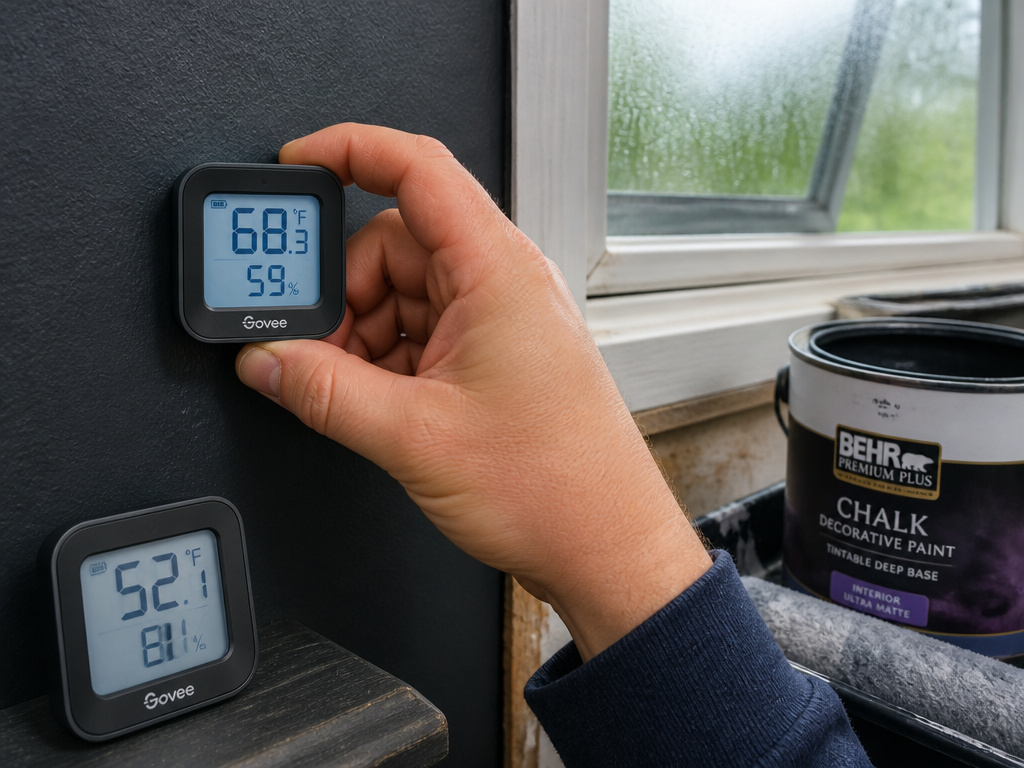
Ten degrees Celsius is the floor on most of the data sheets, though Propan Raya sets its minimum at 15 C. The ceilings are where they part ways.
| Product | Minimum temp | Maximum | Other limits |
|---|---|---|---|
| Resene FX D901C | 10 C | Not stated | No application if temp drops below 10 C while drying |
| Benjamin Moore CHK-3078 | 50 F (10 C) | 90 F surface | Storage 40 to 90 F |
| Porter’s Paints | 10 C | 30 C | Two-coat system |
| Propan Raya C-009/APCT | 15 C | 50 C | 80 percent RH maximum |
Porter’s and Propan Raya both impose upper limits that Resene and Benjamin Moore simply don’t mention. That’s a real gap in the published guidance, not a disagreement about physics.
I won’t start a chalkboard job below 10 C on most products, or below 15 C on Propan Raya, full stop. Not with a heater running, not with a fast-dry additive, not on a sunny afternoon that’s forecast to drop overnight.
Cold Rooms and the 10 C Floor
Resene’s wording is the strictest of the six. It prohibits application below 10 C or when the temperature is liable to drop below 10 C during the drying period. That second clause catches more people than the first.
A garage that hits 14 C at 2pm and 6 C at midnight fails the test even though you painted in the afternoon. The film stops coalescing, and it never recovers.
Ventilation belongs in the same conversation. Resene requires good airflow throughout drying and curing, and notes that poor ventilation may inhibit curing. A sealed room with the windows shut is a slow-motion failure.
Which Chalk Belongs on a Chalkboard Wall?
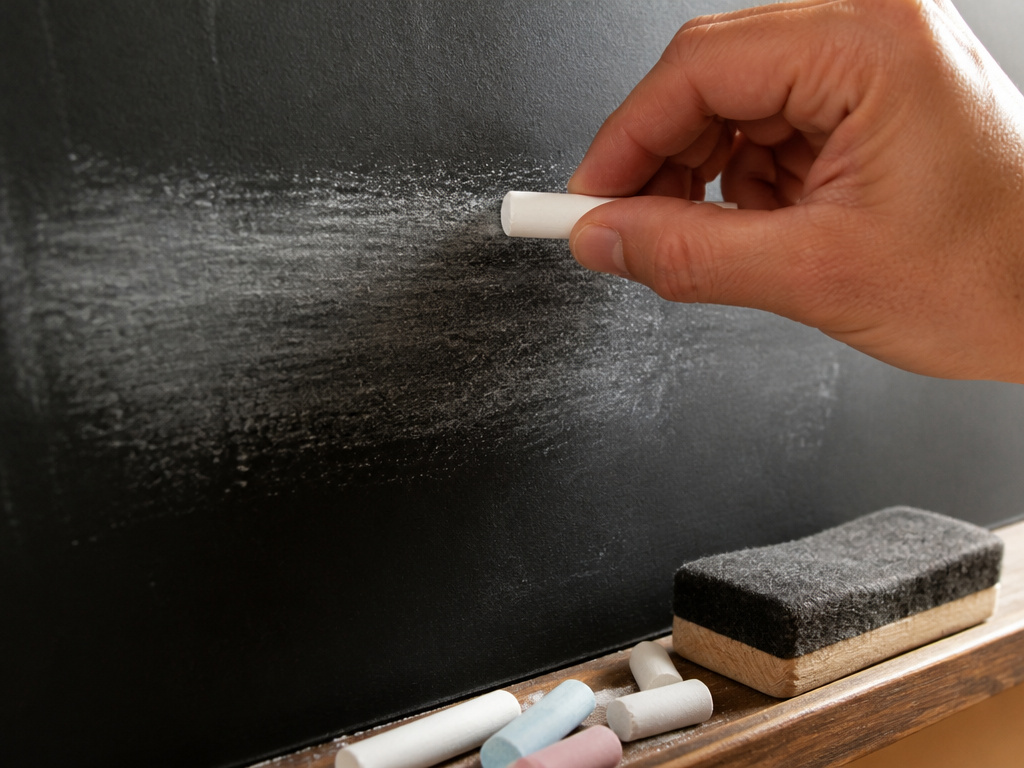
Two of the six data sheets rule out liquid chalk entirely.
Resene D901C specifies high quality blackboard chalk, removed with a duster or soft cloth, and directs anyone who wants liquid chalk to a Resene FX Write-on Wall Paint system instead. That’s a different product with different chemistry, not a different technique.
Benjamin Moore takes a softer line but lands in the same place. Both CHK-3078 and ben 308 recommend traditional, non-liquid chalk in lighter colors, and warn that additives in some chalk varieties leave residue behind when erased.
Traditional Chalk, Liquid Chalk, and the Residue Problem
Plain white chalk is the safest bet, and the data sheets say why. Dark or heavily pigmented chalk leaves more residue per stroke, and residue is exactly what a chalkboard film struggles to release.
If you want a marker-style surface, liquid chalk markers need a base coat built for them. Putting them on a standard chalkboard coating is how people end up with a permanently stained board.
Chalk dust is the cheapest sealer there is. Rub the side of a stick across the whole board, erase it, and the film is conditioned. Skip that step and the first real line you write will stay visible forever.
Conditioning is not optional folklore. Rust-Oleum, Benjamin Moore, and Propan Raya all describe the same step: coat the surface with chalk, erase it, and repeat after any cleaning.
The Prep Steps That Decide Whether the Film Bonds
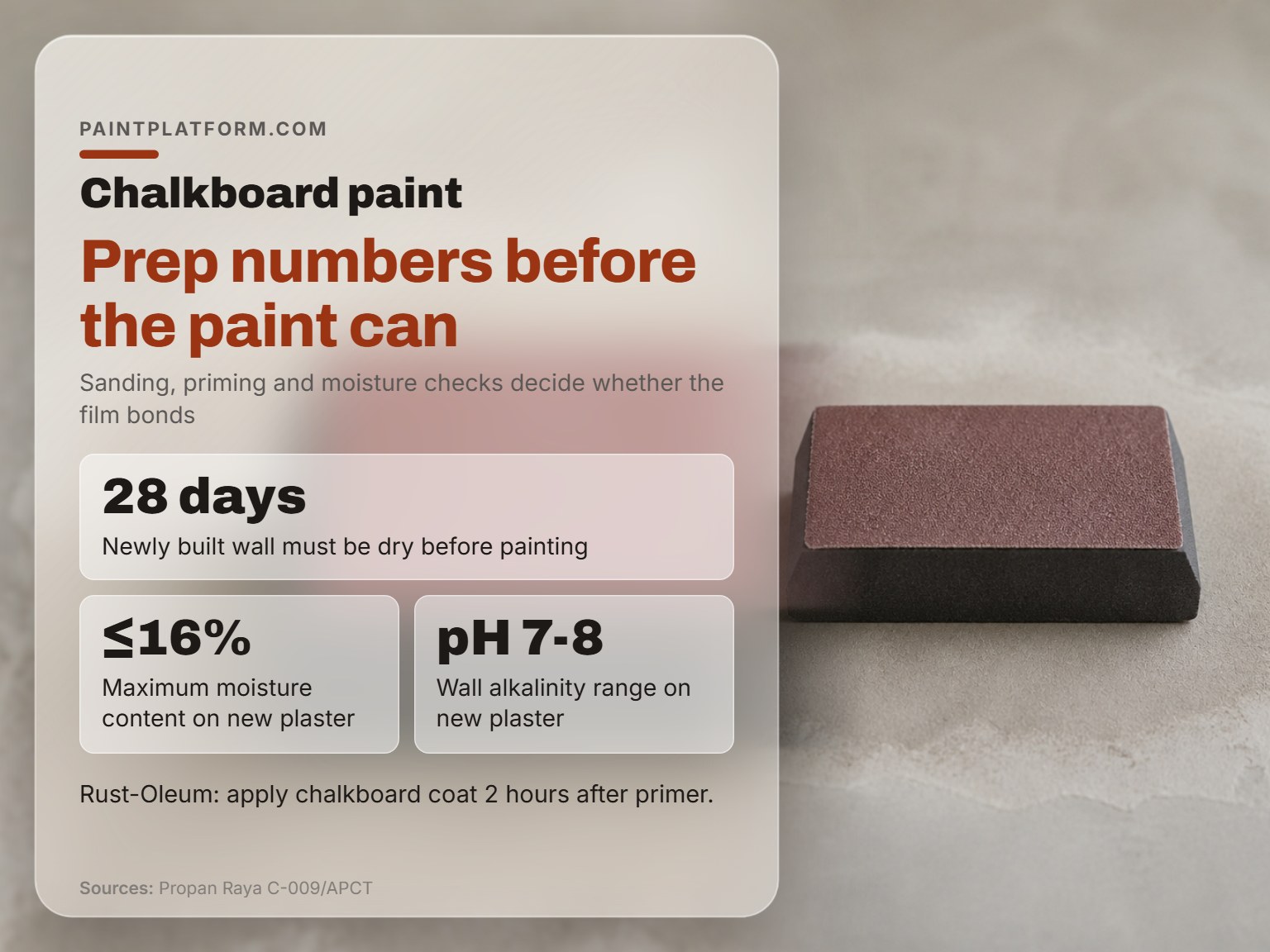
Three things happen before the paint comes out of the can: sanding, priming, and a moisture check.
Before you start: Sanding or scraping old paint can release lead dust, which is toxic and especially dangerous to children and pregnant women. Wear a NIOSH-approved respirator and clean up with a HEPA vacuum and a wet mop, not a dry brush. Keep good airflow through the whole job, and if paint contacts your eyes, flush with running water for at least 15 minutes.
- Sand to a flat, dull surface. Omega APCO specifies 180-grit on all surfaces to knock back the previous film. Skipping it leaves a glossy layer the new coat can’t grip, and the chalkboard lifts in sheets.
- Fill and spot prime every defect. Nail holes, cracks, and patched areas get filler, then primer. Unprimed patches draw binder out of the topcoat and dry to a different sheen, which shows up as a dull halo under raking light.
- Check moisture and alkalinity on new plaster. Propan Raya requires a newly built wall to be dry after 28 days, with moisture content at or below 16 percent and wall alkalinity at pH 7 to 8. Painting a damp wall traps that moisture under a sealed film, and it blisters from the inside out.
- Prime, then wait the stated interval. Rust-Oleum wants the chalkboard coat applied 2 hours after primer. Omega calls for light sanding between coats with 220-grit, then two finish coats.
- Apply two finish coats. Resene specifies two topcoats. Porter’s specifies two coats. Propan Raya asks for 2 to 3 coats at 30 microns dry film thickness each, with a recommended total of 60 to 120 microns.
If you want magnets to hold, magnetic chalkboard paint systems put a magnetite-bearing primer under the chalk coat. The chalk layer on top stays thin so the magnetic pull reaches through.
Fresh Plaster Is a Different Job
Porter’s is the only sheet in this set that spells out a full plaster sequence, and it takes days rather than hours. One coat of Mineral Silicate Primer, touch dry in 20 minutes, then 2 hours of dry time. Then one coat of Limeproof Undercoat Sealer, touch dry in 2 hours, with 6 hours of dry time before the topcoat goes near it.
Easy to miss: Wiping the finished board down too early. Rust-Oleum says wait 7 days after painting before a damp cloth touches it, and Benjamin Moore ben 308 says painted surfaces can be washed after two weeks. A damp wipe too early drags chalk into an uncured film and leaves a permanent smear.
Where the Standard Admits It Has No Standard
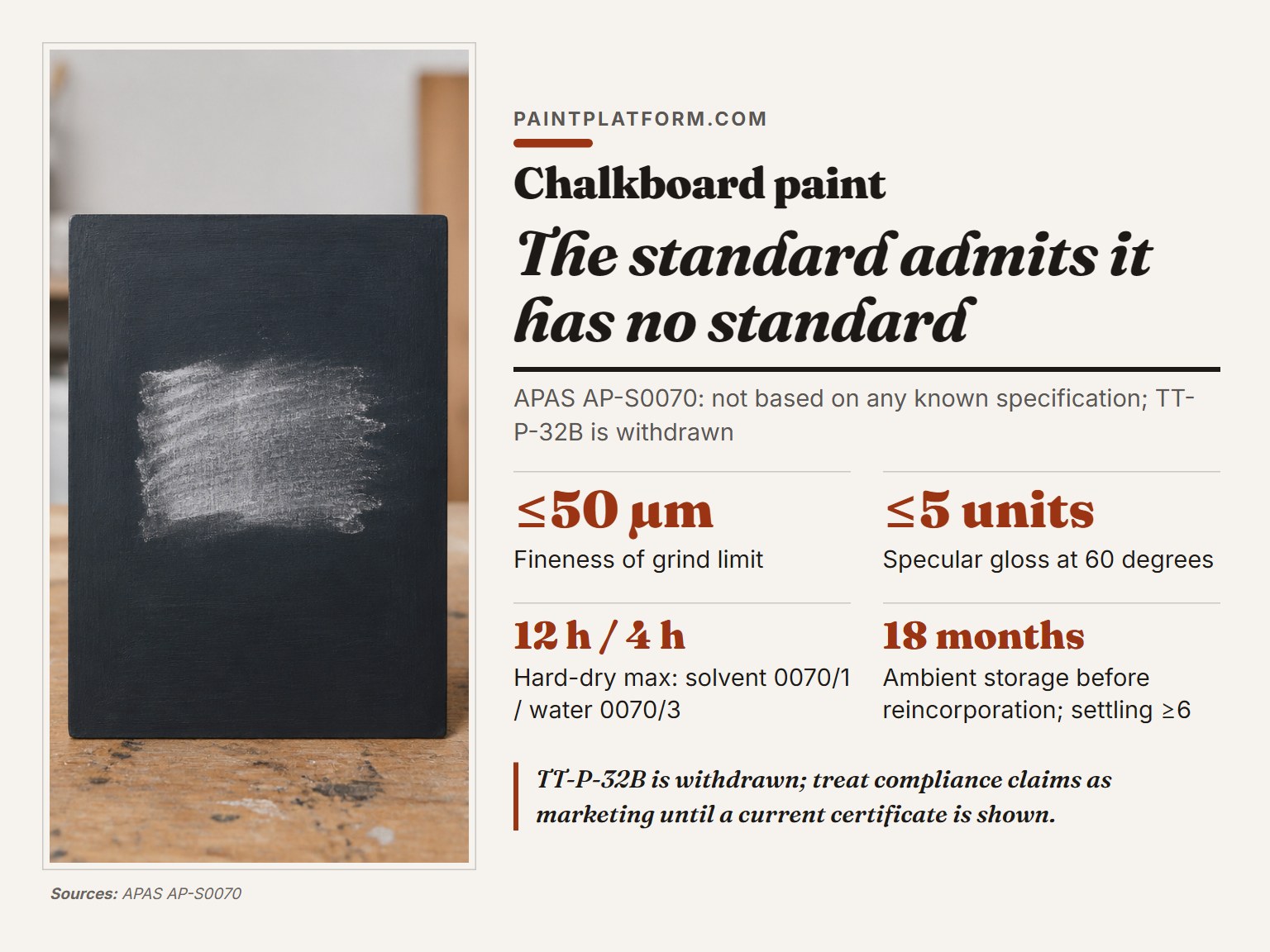
APAS AP-S0070 states plainly that it is not based on any known specification or standard.
That sentence is worth sitting with, because it undercuts a lot of confident marketing. The specification notes that US Government Specification TT-P-32B is now withdrawn. Any product claiming TT-P-32B compliance is making an unverifiable claim.
What APAS does give you is measurable. Fineness of grind at or below 50 microns. Specular gloss at or below 5 units at 60 degrees. A wet marking-and-removal rating of at least 4 and a dry rating of at least 3. A product that must reincorporate after 18 months of ambient storage, with a settling rating no lower than 6.
It also splits products into two sub-classes with different hard-dry limits: solvent-based 0070/1 at 12 hours maximum, water-based 0070/3 at 4 hours maximum.
Treat any TT-P-32B claim as marketing until someone shows you a current certificate. The standard it points to no longer exists.
If your real goal is a surface you wipe clean with a marker rather than a duster, dry erase paint is the different chemistry you actually want. Chalkboard coatings are built to release dust, not solvent ink.
Frequently Asked Questions
How long should chalkboard paint dry before the first writing?
Follow the longest figure your brand publishes. Benjamin Moore CHK-3078, ben 308, Rust-Oleum SPC-18, and Propan Raya C-009/APCT all say 3 days. Porter’s Paints says 48 hours. APAS AP-S0070 asks for 7 days of curing, even though the film is handleable at 12 hours.
Can I use liquid chalk markers on chalkboard paint?
Resene explicitly says no and points those users to a separate write-on wall paint system. Benjamin Moore recommends traditional non-liquid chalk in lighter colors because additives in some chalks leave residue. If markers are the plan, choose a coating formulated for them.
Does chalkboard paint need a primer?
It depends on the substrate. Rust-Oleum wants the chalkboard coat applied 2 hours after primer. Previously painted surfaces in good condition often take the topcoat directly, per Benjamin Moore.
Why does my chalkboard look blotchy after erasing?
Usually an uncured film or a skipped conditioning step. Chalk pressed into a soft coat embeds pigment that erasing can’t lift. Rub chalk over the whole surface and erase it before first use, and repeat that step after every damp cleaning.
Can I wash a chalkboard with soap and water?
Wait first. Rust-Oleum says 7 days after painting before a damp cloth, and Benjamin Moore ben 308 says two weeks before washing. Omega APCO warns against scouring pads, abrasive brushes, pressure washing, and solvents, all of which damage the film.
Is chalkboard paint the same as dry erase paint?
No. Chalkboard coatings are formulated to release dry chalk dust from a matte film. Dry erase coatings need a non-porous surface that releases solvent ink cleanly. The two products use different chemistry and are not interchangeable.
The Bottom Line
Here’s the trigger that settles it: if your room can’t hold 10 C (50 F) for the entire drying window on most products, or 15 C on Propan Raya, don’t open the can. Resene’s wording is the strictest of the six sheets, and I’d follow it even on a Benjamin Moore job, because a coat that dips below the floor overnight never fully knits.
Your first move this week is small. Paint a sample board, tape it to the wall, and look at it in the morning and again at dusk before you commit a whole wall to it. That habit saved me on a large panel once already.
One concession worth stating plainly: none of this helps if you want a marker board. Different product, different chemistry, different cure schedule. A chalkboard paint guide can only take you as far as chalk.
Start small and stay curious.
