
5 Best Waterproof Paint For Basement Walls in 2026
This post contains affiliate links. As an Amazon Associate, we earn from qualifying purchases.
The Zinsser WaterTite General Purpose Waterproofing Paint is the best overall choice for basement walls. It resists up to 10 PSI of water pressure and uses a low-odor, water-based formula that applies to wet or dry masonry. For those who prioritize mold and mildew defense, the Zinsser WaterTite LX Ultra offers a long-term guarantee, while the Rust-Oleum Watertite handles higher water pressure for dry walls.
A damp basement wall isn’t just an eyesore, it can lead to musty smells, flaking paint, and potential structural issues. The right waterproof paint needs to bond with porous masonry, resist hydrostatic pressure from groundwater, and hold up in a humid environment without peeling.
We evaluated these five paints based on manufacturer specifications, expert round-ups, and patterns in owner feedback to find the most reliable options for sealing and protecting basement walls. This guide breaks down the key differences in pressure resistance, coverage, and application to help you choose with confidence.
Top 5 Waterproof Paints For Basement Walls in the Market
Certain content that appears on this site comes from Amazon. This content is provided "as is" and is subject to change or removal at any time.
The Best Waterproof Paints For Basement Walls, Reviewed
Zinsser WaterTite General Purpose Waterproofing Paint

What We Like
- Resists up to 10 PSI water pressure
- Covers 250 sq ft per gallon
- Low odor water-based formula
- Applies to wet or dry masonry
Trade-offs
- Non-gritty texture offers less slip resistance
- Coverage depends on surface porosity and method
A 10 PSI water pressure rating means this paint can stop active seepage in a damp basement, not just hide stains. That kind of real waterproofing performance is rare in a water-based formula that stays low odor and easy to clean up. It applies directly to wet or dry masonry with a brush or roller, so you don’t have to wait for a perfectly dry wall before starting. For anyone finishing a cellar or foundation wall that gets occasional moisture, this delivers the core job without fuss.
The trade-off is coverage: one gallon covers up to 250 square feet depending on porosity and application method, which is a standard amount for this type of paint. The bright white non-gritty finish applies easily to wet or dry masonry with a brush or roller, so you get a clean look without extra effort. For straightforward waterproofing with minimal odor and easy handling, this is the one to reach for.
Product photos
Zinsser WaterTite LX Ultra Waterproofing Paint

What We Like
- 20-year waterproof guarantee
- 10-year mold and mildew proof guarantee
- Covers up to 375 sq. ft.
- Bright white, non-gritty finish
Trade-offs
- At 36 pounds, heavy to carry and handle
- Requires primer on previously painted surfaces.
A 20-year waterproof guarantee and a separate 10-year mold and mildew proof guarantee make this paint a long-term investment for basement walls. It covers up to 375 square feet per gallon, so a single coat can handle a good-sized room, and the bright white, non-gritty finish applies smoothly with a brush, roller, or sprayer. This is the pick for anyone who wants maximum resistance against moisture and mold without having to repaint every few years.
At 36 pounds per gallon, this is a heavy can to lug up and down basement stairs. If you are working on a small patch or a tight space, the LANCO Dry-Coat is lighter and easier to maneuver. But for full basement walls where long-term protection matters most, the Zinsser WaterTite LX Ultra gives you two guarantees that back up its performance.
Rust-Oleum Watertite Latex Waterproofing Paint

What We Like
- Resists up to 20 lb water pressure
- Ultra low odor for indoor use
- Easy soap-and-water cleanup
- Smooth, bright white finish
Trade-offs
- Applies only to dry walls
- No exterior or high-moisture surface mention
With a water pressure resistance rating of up to 20 pounds, this paint is guaranteed to stop water and resists significant hydrostatic force. The ultra low odor and soap-and-water cleanup make it practical for interior basement work where ventilation is limited. It also carries a 15-year waterproof guarantee and a separate 5-year mold and mildew protection promise, giving long-term confidence for a finished living space.
It requires a dry surface before application, so you cannot simply brush it onto a weeping wall and expect adhesion. If your basement has active leaks that need stopping before painting, addressing the source of moisture first is essential. But for walls that are already dry or have been pre-treated, the Rust-Oleum Watertite offers strong pressure resistance for sealing against groundwater.
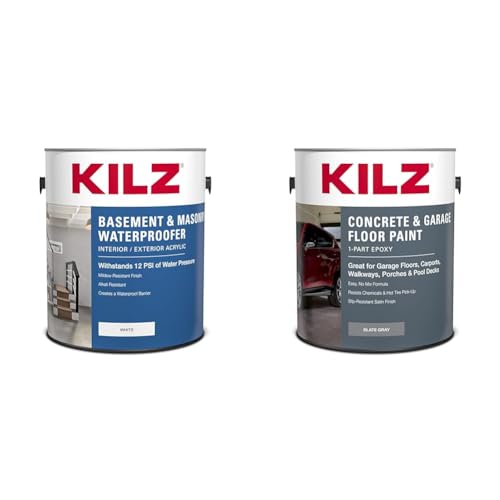
KILZ Basement & Masonry Waterproofing Paint
What We Like
- Resists oil, gasoline, and chemical stains
- Satin finish applies smoothly on horizontal surfaces
- Works on cinder block, stucco, brick, and more
Trade-offs
- Floor paint is only for horizontal surfaces
- Floor paint dries to touch in 2 hours, requires 4 hours before recoating
The basement paint is designed for interior and exterior walls, retaining walls, cinder block, stucco, and brick, while the floor paint targets concrete garages, basements, driveways, and porches.
The floor paint applies smoothly and evenly to horizontal surfaces, so it is not meant for walls or vertical masonry. For a wall-only job, Zinsser WaterTite LX Ultra provides a mold- and mildew-resistant finish for interior masonry, but that product does not include a floor coating. If your project involves both surfaces and you prefer using one brand, these two KILZ paints let you coordinate your purchase without a separate shopping trip.
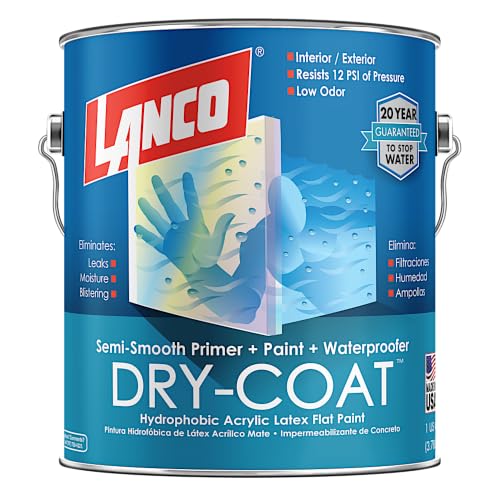
LANCO Dry-Coat Waterproofing Paint
What We Like
- Resists up to 12 PSI hydrostatic pressure
- Acts as primer, paint, and sealant
- UV- and chalk-resistant
- No heavy metals or lead
Trade-offs
- Only 1 gallon size limits large coverage per can
- Semi-smooth finish won't hide rough masonry
With a hydrostatic pressure resistance of 12 PSI, this paint handles serious water force from the outside in, ideal for basement walls that face persistent groundwater pressure. Its triple-duty formula works as primer, textured paint, and sealant, cutting down on the number of coats and products you need. That makes it a strong fit for anyone dealing with wet below-grade walls where stopping seepage is the top priority.
The semi-smooth finish won’t hide rough or pitted masonry the way a heavier texture can, so prep work matters more. Compared to the Zinsser WaterTite General Purpose, which stops 10 PSI, the LANCO offers a higher pressure ceiling for tougher conditions. If your basement sees only dampness rather than active water intrusion, the extra resistance may be more than you need.
Product photos
How We Evaluated Waterproof Paints For Basement Walls
Our evaluation focused on manufacturer data, expert recommendations from painting and home maintenance sources, and common themes found in thousands of owner experiences. We compared published specifications and verified claims against real-world reports.
The three criteria that mattered most were hydrostatic pressure resistance, application flexibility, and long-term durability. Hydrostatic pressure resistance determines whether the paint can stop water from pushing through the wall. Application flexibility includes whether the paint can go on damp surfaces and what prep work is required. Long-term durability is measured by coverage guarantees and resistance to mold, mildew, and peeling.
We also weighed practical factors like odor level, ease of cleanup, and whether the paint can double as a primer or sealant. A research-led approach means we can’t replicate every basement condition, but it does let us identify the products with the strongest engineering and the most consistent owner satisfaction.
What To Look For In Waterproof Paints For Basement Walls
Choosing the right paint starts with understanding your wall’s specific moisture problem. Not all waterproof paints are created equal, and the wrong choice can lead to peeling and wasted effort.
Look for a paint rated for the hydrostatic pressure your basement experiences. Check whether it can be applied to damp walls or requires a fully dry surface. Consider coverage per gallon, odor level, and whether it includes a primer for better adhesion.
Hydrostatic Pressure Resistance
This is the most critical spec. Hydrostatic pressure is the force of groundwater pushing against your foundation walls. A paint rated for 10 PSI or higher is suitable for most basements with moderate dampness, while paints rated for 20 PSI handle more severe conditions. If your walls are actively leaking or show signs of heavy water damage, you may need a more extensive waterproofing system before painting.
Surface Preparation and Application
Some paints can be applied directly to damp or even wet masonry, which is a major advantage if your walls never fully dry out. Others require the surface to be completely dry, which can mean waiting days or using dehumidifiers. Check whether the paint needs a separate primer, especially on previously painted or sealed surfaces, and whether it can be applied with a brush, roller, or sprayer.
Coverage and Finish
Coverage rates vary depending on the porosity of the wall. A smooth, non-gritty finish is easier to clean and looks more refined, but it offers less slip resistance if you plan to use the space for storage or as a workshop. A bright white finish helps brighten a dark basement, while tintable formulas let you add color.
- Verify the paint’s warranty or guarantee period for waterproofing and mold resistance.
- Check if the formula is low-odor or zero-VOC for use in occupied or finished basements.
- Confirm whether the paint is suitable for both interior and exterior masonry if you plan to use it on foundation walls.
- Look for a paint that can also serve as a primer and sealant to reduce the number of coats needed.
A good rule: the more severe your moisture problem, the more you should prioritize PSI rating over coverage or finish.
Waterproof Paints For Basement Walls Compared
The table below compares the key specifications and best-use scenarios for each paint, helping you match the right product to your basement’s specific needs.
| Product | Water Pressure Resistance | Formula Type | Finish |
|---|---|---|---|
| Zinsser WaterTite General Purpose Waterproofing Paint | 10 PSI | Water-based, low odor | Bright white, non-gritty |
| Zinsser WaterTite LX Ultra Waterproofing Paint | N/A | N/A | Bright white, non-gritty |
| Rust-Oleum Watertite Latex Waterproofing Paint | Up to 20 lb | Latex, water-based | Smooth, bright white, non-gritty |
| KILZ Basement & Masonry Waterproofing Paint | N/A | Water-based, single component | Satin |
| LANCO Dry-Coat Waterproofing Paint | 12 PSI | N/A | Semi-Smooth |
Frequently Asked Questions
Can waterproof paint stop active leaks in basement walls?
No single paint can stop an active, flowing leak. Waterproof paints are designed to resist hydrostatic pressure from damp walls. If water is actively seeping or gushing through cracks, you need to address the source before painting. That means fixing grading issues, gutter problems, or foundation cracks.
How long does waterproof paint last on basement walls?
With proper surface preparation, a quality waterproof paint can last five to ten years or more. Some products, like the Zinsser WaterTite LX Ultra, offer a 20-year waterproof guarantee, though actual longevity depends on the severity of moisture exposure and whether the paint is applied correctly.
Do I need to prime basement walls before using waterproof paint?
It depends on the product. Some waterproof paints, like the LANCO Dry-Coat, act as a primer, paint, and sealant in one coat. Others, such as the Zinsser WaterTite LX Ultra, recommend priming previously painted surfaces for best adhesion. Always check the manufacturer’s instructions for your specific wall condition.
Can I paint waterproof paint over existing paint on basement walls?
Yes, but only if the existing paint is sound and well-adhered. Loose, peeling, or chalky paint must be scraped or power-washed away first. On previously painted surfaces, a bonding primer is often recommended to ensure the waterproof paint adheres properly and forms an effective moisture barrier.
What is the difference between waterproof paint and water-resistant paint?
Waterproof paint is formulated to block hydrostatic pressure and prevent water from penetrating the wall, making it suitable for below-grade basement walls. Water-resistant paint, on the other hand, can repel splashes or condensation but will fail under sustained water pressure. Always choose a product explicitly labeled as waterproof for basement applications.
The Bottom Line
For the vast majority of homeowners, the Zinsser WaterTite General Purpose Waterproofing Paint is the best overall choice. It balances strong hydrostatic pressure resistance with a low-odor, water-based formula that can be applied to damp walls, saving you the headache of waiting for a dry surface. This is the paint to reach for when you want reliable waterproofing without a complicated process.
If your main concern is long-term mold and mildew prevention in a large basement, the Zinsser WaterTite LX Ultra is worth the extra investment, backed by a 10-year mold and mildew proof guarantee. For those on a tighter budget or painting both walls and floors, the KILZ Basement & Masonry Waterproofing Paint offers solid performance and stain resistance for horizontal surfaces.
The single most important factor in your decision is matching the paint’s PSI rating to the moisture pressure your basement actually faces. Choose a paint rated higher than you think you need, and always follow the surface preparation steps carefully. A well-chosen waterproof paint can transform a damp, musty basement into a dry, usable space.
