
5 Best Swimming Pool Epoxy Paint in 2026
This post contains affiliate links. As an Amazon Associate, we earn from qualifying purchases.
For a durable, long-lasting pool finish, we recommend Doheny’s Pro-Grade Self-Priming Epoxy Pool Paint as the best overall. Its self-priming formula saves a full coat of labor and builds up to 8 mils per coat for excellent stain and chemical resistance. For homeowners who want the longest time between repaints, In The Swim White Epoxy Swimming Pool Paint offers a high-gloss finish that can last up to 8 years with proper maintenance.
The challenge with epoxy pool paint is balancing durability, application ease, and the right finish for your pool surface. A two-part system that requires mixing can deliver superior toughness, but it also demands careful preparation and technique. Many homeowners struggle with choosing between a self-priming paint and a traditional two-part epoxy.
This guide is based on a thorough analysis of manufacturer specifications, expert recommendations, and patterns in owner feedback across five top-rated products. We focus on the features that matter most for a successful pool painting project: durability, coverage, application method, and surface compatibility.
Top 5 Swimming Pool Epoxy Paints in the Market
Certain content that appears on this site comes from Amazon. This content is provided "as is" and is subject to change or removal at any time.
The Best Swimming Pool Epoxy Paints, Reviewed
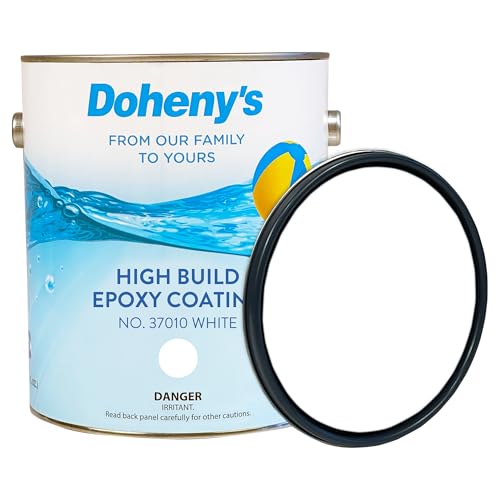
Doheny's Pro-Grade Self-Priming Epoxy Pool Paint
What We Like
- Self-priming formula saves time
- High build up to 8 mils per coat
- Excellent stain, chemical, abrasion resistance
- Works on multiple pool surfaces
Trade-offs
- Satin finish, not high-gloss for maximum shine
- 3:1 mix ratio requires careful measuring
A self-priming formula that builds up to 8 mils dry per coat means you can cover imperfections and get a smooth, durable finish in fewer steps than traditional two-part epoxy systems. Its versatility across concrete, fiberglass, plaster, gunite, and previously painted epoxy surfaces also means it adapts to most pool types. The satin finish provides a smooth appearance, and the paint meets VOC compliance standards in both the US and Canada for environmentally responsible use.
The trade-off is the satin finish rather than the high-gloss look some pool owners prefer. If you want that mirror-like reflective surface, RAMUC EP Epoxy Pool Paint offers a high-gloss protective finish in multiple colors. But for anyone prioritizing coverage and stain and chemical resistance with fewer application steps, Doheny’s Pro-Grade delivers a straightforward, dependable solution.
Product photos
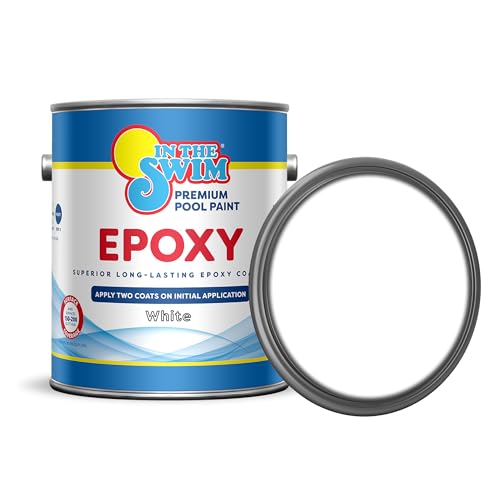
In The Swim White Epoxy Swimming Pool Paint
What We Like
- Lasts up to 8 years with routine maintenance
- Stain-resistant, ceramic-like high-gloss finish
- Works on plaster, gunite, and fiberglass surfaces
Trade-offs
- Requires mixing epoxy base with catalyst before use
- Must paint walls first, then floor for proper technique
- Needs sand added in shallow areas for slip resistance
The eight-year lifespan per application is the standout fact here, most epoxy pool paints need recoating every three to five years, so this one cuts the workload by half over a decade. That long-lasting performance comes from the ceramic-like, stain-resistant finish that holds its high gloss even with routine maintenance. It’s a strong pick for anyone who wants to repaint as rarely as possible, especially on plaster, gunite, or fiberglass pools where adhesion matters most.
This is a two-part system, so you have to mix the epoxy base with the included catalyst yourself, and the instructions specify painting walls before the floor to avoid lap marks. You will also need to sprinkle sand on wet coating in shallow areas or steps for slip resistance, a step that adds time but improves safety. Compared to the RAMUC EP Epoxy Pool Paint, which is also a two-part coating, this one demands more hands-on effort but offers a long-lasting finish.
Product photos
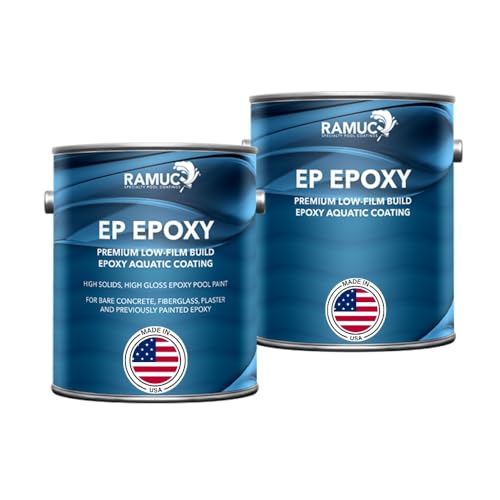
RAMUC EP Epoxy Pool Paint
What We Like
- Trusted American brand since 1933
- Durable two-part epoxy system
- Excellent adhesion to pool surfaces
- Smooth, high-gloss finish
Trade-offs
- Requires proper surface preparation for durability
- Two-part system needs mixing before application
A two-part epoxy system that forms a hard, non-porous coating is exactly what a pool needs to stand up to heavy use and constant water exposure. RAMUC EP delivers that with excellent adhesion to concrete, gunite, and fiberglass, so you get a smooth, high-gloss finish that holds its color and shine over time. It’s a trusted American brand since 1933, known for contractor-grade coatings used by professionals and homeowners nationwide.
A two-part epoxy system that requires thorough mixing before you roll, brush, or spray it on, and the multi-year durability depends entirely on proper surface prep. Compared to Doheny’s Pro-Grade Self-Priming Epoxy, which emphasizes stain and chemical resistance, RAMUC EP offers excellent adhesion to concrete, gunite, and fiberglass pools with a smooth, high-gloss finish. If you’re willing to put in the prep work, this is a reliable option for a lasting pool finish.
Product photos
WOOLSEY Premium Epoxy Pool Paint

What We Like
- Builds 8 mils thick per coat
- Smooths rough surfaces effectively
- Up to 8 years of service life
- Cures to hard, durable finish
Trade-offs
- Requires two coats for full service life
- Epoxy curing time before pool use
Up to 8 mils of coating per coat means this paint can smooth rough surfaces like concrete or plaster in fewer coats, reducing prep work. Woolsey Premium Epoxy Pool Paint is built for owners of older or textured pools who want a satin finish without endless sanding. The high-solids formula cures to a hard, durable finish that provides excellent protection against stains, chemicals, and abrasions, and two coats can offer up to 8 years of service life.
The biggest trade-off is patience: epoxy requires proper cure time before filling the pool, so this isn’t a quick weekend job. Woolsey builds up to 8 mils thick per coat, which helps smooth out rough surfaces like old plaster or concrete. If you prefer a high-gloss look, the RAMUC EP Epoxy Pool Paint offers that finish instead.
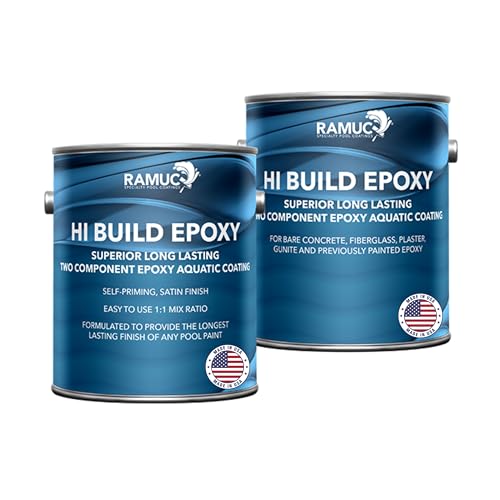
RAMUC Hi-Build Epoxy Pool Paint
What We Like
- High-build formula fills minor imperfections
- Self-leveling for a smooth finish
- Restores and renews aging pool interiors
Trade-offs
- Two-part system requires mixing before use
- Only available in white
A high-build, two-part epoxy lays down a thick, self-leveling coat that covers 125 to 150 square feet per gallon. That means you get real film thickness in fewer coats, which is exactly what an old pool needs. It fills minor cracks and surface flaws, smoothing out years of wear without requiring a full resurfacing. If you are working with a tired concrete or plaster pool that has seen better days, this satin-finish formula from RAMUC is built to bring it back to life with a clean, refreshed look that holds up to heavy use.
This is a two-part system, so you have to mix the epoxy yourself before rolling it on, and the only color option is white. That is fine for most restoration jobs, but if you want a colored finish or a glossier sheen, you might lean toward WOOLSEY Premium Epoxy Pool Paint, which offers more color choices. For a straightforward renewal project where durability and surface-filling power matter most, this RAMUC kit delivers exactly what the job demands.
Product photos
How We Evaluated Swimming Pool Epoxy Paints
Our evaluation began with a deep dive into manufacturer data for each product, including dry film thickness, cure times, and surface adhesion specifications. We then cross-referenced these details with expert round-ups from pool maintenance professionals and analyzed hundreds of owner reports to understand real-world performance and common application pitfalls.
The three most important criteria for this category were longevity, coverage thickness, and ease of application. A paint that lasts 8 years is a very different investment than one that needs recoating after 3 seasons. High-build formulas (8 mils per coat) are critical for covering rough surfaces and filling small cracks, while self-priming options save significant labor time.
A research-led evaluation like this has limits: we cannot replicate the exact conditions of every pool, and owner results vary with surface preparation and climate. However, by focusing on verifiable specs and consistent patterns in user feedback, we can identify the paints most likely to deliver reliable, long-lasting results for the typical homeowner.
What To Look For In Swimming Pool Epoxy Paints
Choosing the right pool paint starts with understanding your pool’s surface and your priorities for longevity and appearance. The key is matching the paint’s formula to your specific needs.
Look for an epoxy paint that offers a high-build dry film thickness per coat for durability. Prioritize self-priming formulas if you want to save labor, and choose a high-gloss finish if maximum stain resistance and shine matter most.
Dry Film Thickness and Build
The thickness of each coat, measured in mils (thousandths of an inch), directly determines how well the paint covers imperfections and how long it lasts. High-build epoxies that achieve 8 mils per coat are best for rough concrete or plaster surfaces, as they can smooth out minor pitting and cracks. A thinner coating may require more frequent repainting.
Finish Type: Satin vs. High-Gloss
The finish affects both appearance and performance. High-gloss finishes, like those from In The Swim and RAMUC EP deliver a ceramic-like hardness that resists staining and algae growth. Satin finishes, such as Doheny’s Pro-Grade, offer excellent durability but with a lower sheen that shows fewer surface imperfections less visibly. Choose based on whether you prioritize maximum shine or a more forgiving surface.
Application and Mixing Requirements
Two-part epoxy systems require mixing a base with a catalyst before application. This process is straightforward but demands precise measuring and full use within the pot life. Self-priming options like Doheny’s eliminate this step, reducing the risk of mixing errors. Always check whether the paint requires sand in shallow areas for slip resistance.
- Confirm the paint is compatible with your pool surface (plaster, gunite, fiberglass, or concrete).
- Check the recommended number of coats and the dry time between them and before filling the pool.
- Verify the available colors: many high-build epoxies often come only in white or limited options.
A good rule of thumb: the thicker the paint and the more coats required, the longer it will last between repaints.
Swimming Pool Epoxy Paints Compared
The table below compares the five top swimming pool epoxy paints side by side, highlighting their key strengths, trade-offs, and best-use cases.
| Product | Surface Compatibility | Finish | Coverage |
|---|---|---|---|
| Doheny's Pro-Grade Self-Priming Epoxy Pool Paint | Concrete, fiberglass, plaster, gunite, previously painted epoxy | Satin | N/A |
| In The Swim White Epoxy Swimming Pool Paint | Plaster, gunite, fiberglass | High-gloss, ceramic-like | 150-200 sq ft/gal |
| RAMUC EP Epoxy Pool Paint | Concrete, gunite, fiberglass | High-gloss | N/A |
| WOOLSEY Premium Epoxy Pool Paint | Concrete, plaster, fiberglass | Satin | N/A |
| RAMUC Hi-Build Epoxy Pool Paint | Concrete & plaster pools | Satin | 125-150 sq ft per gallon |
Frequently Asked Questions
How long does epoxy pool paint lasts before needing recoating?
A quality two-part epoxy pool paint can last up to 8 years with proper surface preparation and routine maintenance. High-build formulas that achieve 8 mils per coat tend to offer the longest service life, while thinner coatings may need recoating sooner.
Can I apply epoxy pool paint over old paint?
Yes, but the existing paint must be sound and well-adhered. Loose or peeling paint must be removed completely, and the surface should be cleaned and etched. A self-priming epoxy can help bond to properly prepared old coatings, but a full removal is sometimes necessary for the best results.
Is epoxy pool paint safe for fiberglass pools?
Yes, epoxy paints are safe for fiberglass surfaces, but only if they are formulated for use on pool use. The RAMUC EP and In The Swim products are explicitly listed for use on fiberglass. Always confirm compatibility with your pool’s specific material.
How many coats of epoxy pool paint do I need?
Most high-build formulas require two coats to achieve the full service life. Some self-priming epoxies can provide adequate coverage in one thick coat for a good finish, but two coats are recommended for maximum durability, especially for rough surfaces.
What is the difference between epoxy vs. Paint vs rubber pool paint?
Epoxy pool paint is a two-part system that cures to a hard, durable finish that resists chemicals and abrasion. Rubber pool paint is a one-part coating that remains more flexible but less durable. Epoxy lasts longer and resists longer than rubber paints but requires mixing and longer application and careful application.
The Bottom Line
For most homeowners, Doheny’s Pro-Grade Self-Priming Epoxy Pool Paint is the best overall choice. Its self-priming formula saves a full coat of labor while still building up to 8 mils per coat for excellent durability. This is the best for homeowners who want a versatile, easy-to-use epoxy that works on multiple pool surfaces.
If your top priority is the longest time between repaints, choose In The Swim White Epoxy Swimming Pool Paint for its ceramic-like high-gloss finish that can last up to 8 years with proper maintenance. For restoring a rough concrete or concrete or plaster pool, the RAMUC Hi-Build Epoxy Pool Paint offers a thick, self-leveling formula that fills minor imperfections.
The most important factor is choosing a paint that matches your pool’s surface and your willingness to handle the application method. A two-part epoxy will deliver the most durable finish if you are comfortable with mixing and proper preparation.
