
10 Best Sandpaper For Stripping Paint in 2026
This post contains affiliate links. As an Amazon Associate, we earn from qualifying purchases.
For heavy paint stripping, the Norton A275OP PSA Sandpaper Roll is our best overall pick because its non-pigmented stearate prevents color transfer while an open-coat design resists clogging during aggressive work. We also recommend the 3M SandBlaster for small-scale stripping tasks and the Diablo Sand Demon for anyone who wants a reusable sheet that lasts longer than standard paper.
Stripping paint is a messy, abrasive job where clogging and tearing are the real enemies. The right grit, backing material, and coating type determine whether you spend your time sanding or fighting with a ruined sheet.
This guide is based on manufacturer specifications, material science data, and patterns found in owner feedback across hundreds of reviews. We focused on the factors that matter most when removing paint: clog resistance, tear strength, and grit aggressiveness.
Top 10 Sandpapers For Stripping Paint in the Market
Certain content that appears on this site comes from Amazon. This content is provided "as is" and is subject to change or removal at any time.
The Best Sandpapers For Stripping Paint, Reviewed
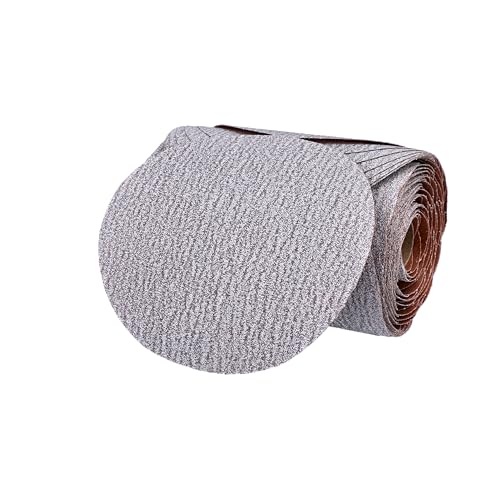
Norton A275OP PSA Sandpaper Roll
What We Like
- Non-pigmented stearate prevents color transfer
- Open coat resists clogging during stripping
- 50-60% improvement in tear strength
Trade-offs
- 80 grit only; no finer grit for finish sanding
- Roll format requires a cutter; not ready-to-use discs
The fiber-reinforced B-weight latex-saturated backing gives this roll a 50-60% improvement in tear strength while staying flexible, so it holds up under heavy use without ripping. The P80 heat-treated aluminum oxide abrasive, combined with an open-coat, non-pigmented stearate No-Fil coating, resists clogging and won’t transfer color to your work. That means you can keep sanding wood or metal on an orbital sander or right-angle grinder without frequent paper changes.
The trade-off is that you are locked into 80 grit and a pressure-sensitive adhesive backing. If you need to move to a finer finish after stripping, you will need a different product. And while the PSA holds firmly during work, the linked disc roll format allows for easy dispensing and application. For raw stripping speed and tear resistance, the Norton A275OP roll delivers a lot of usable sanding area in a single roll, compared to sheet-based options.
Product photos
3M SandBlaster Paint Stripping Sandpaper

What We Like
- Coarse 60-grit for aggressive stripping
- Lightweight at 0.15 lb per pack
Trade-offs
- Only 5 sheets per pack
- 60-grit scratches too deep for fine finishing
A coarse 60-grit abrasive means this sandpaper bites into old paint layers fast, making it a focused tool for stripping rather than fine finishing. The package dimensions are 10.1 by 3.7 inches, and at just 0.15 pounds the whole pack won’t weigh down your apron. It suits anyone who needs to remove stubborn paint from trim, furniture details, or tight corners without switching to a heavier paper.
The 60-grit abrasive on these sheets cuts fast, so stripping paint off a small cabinet door or a metal railing goes quickly, but you only get five sheets per pack. That means a full-door or multiple-cabinet job will need several packs, whereas a roll like the Norton A275OP PSA Sandpaper Roll gives you 100 feet of continuous material for big surfaces. For precise paint removal on smaller pieces, though, this 3M pack delivers the aggressive bite you need without leftover sheets.
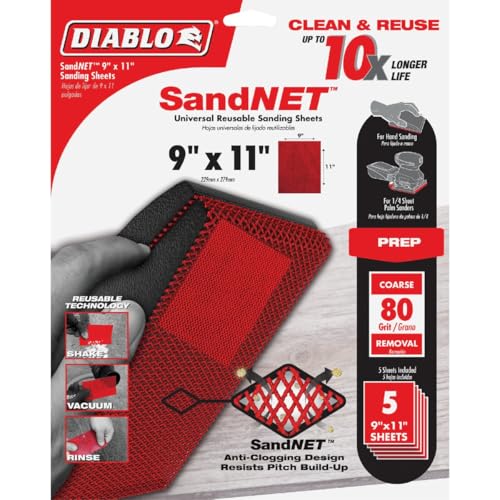
Diablo Sand Demon Reusable Sanding Sheets
What We Like
- Reusable after washing or vacuuming
- Lasts up to 10X longer than standard paper
- Clog-reducing SandNET open-net structure
- Works on wood, metal, plastic, paint
Trade-offs
- Only 5 sheets per pack limits coverage
- Requires hook-and-loop sander pad
A ceramic blend that lasts up to 10 times longer than standard sandpaper means you can keep stripping paint without constantly swapping sheets. The open-net SandNET structure minimizes dust buildup, so the abrasive stays sharp and the surface stays cleaner as you work. That combination of durability and clog resistance makes this a smart choice if you tackle multiple paint-removal jobs and hate stopping to change paper. It also washes clean with water, so one sheet can handle several projects before it wears out.
The Diablo Sand Demon sheets last up to 10 times longer than standard sandpaper, so a single sheet can outlast a whole stack of conventional paper. That means you’re not constantly stopping to swap sheets mid-project. Reviewers note the reusable design lets you rinse or vacuum off dust and keep going, which saves money over time. The pack holds five sheets, so for a big job like stripping an entire deck you might need a couple of packs, but each sheet earns its keep.
Product photos
Virginia Abrasives Floor Sanding Disc

What We Like
- 12 grit removes finishes aggressively
- Silicon carbide cuts old shellac and varnish
- 17-inch diameter covers large floor areas
- Box of 20 provides ample supply
Trade-offs
- 15-pound box is heavy to carry around
- 12 grit leaves deep scratches needing finer sanding
- Only for floor sanders, not hand or orbital sanders
A 12-grit silicon-carbide disc at 17 inches wide is designed for stripping old shellac, varnish, and paint from floors. The extreme coarseness makes it effective for heavy-duty removal of hard finishes without bogging down. The box of 20 provides enough discs to complete a large project without frequent replacements.
The trade-off is that 12 grit leaves a rough surface that requires stepping through finer grits afterward. That extra work is inherent to the aggressive grit. Compared to the Norton A275OP PSA Sandpaper Roll, which is a different format for different sanders, this disc is a floor-sanding tool focused on stripping hard finishes.
Dura-Gold Longboard Sandpaper Roll

What We Like
- Continuous roll cuts to any length
- Hook & loop fits longboard sanders
- Aluminum oxide cuts paint and filler
- Uniform scratch pattern for smooth finish
Trade-offs
- Narrow 2-3/4" width limits large flat areas
- Hook and loop backing not compatible with adhesive-only sanders
A 12-yard continuous roll of 240-grit aluminum oxide means you never waste a scrap or stop mid-job to grab a new sheet. That hook-and-loop backing clicks onto pneumatic air file sanders, longboard file boards, and hand sanding blocks without adhesive or clips, so you can switch lengths in seconds. For anyone who sands auto body filler or preps wood for finishing, this is the kind of efficiency that turns a messy chore into a steady rhythm. The super-coated corundum cuts sharp and leaves a uniform scratch pattern, which matters when you’re feathering edges or smoothing primer. It suits the painter who values consistency over brute force.
The 2-3/4 inch width means each pass covers less area than a full sheet or disc, so you’ll need more strokes on large flat panels. For anyone using a longboard sander, that narrower profile gives you precise control over the scratch pattern and lets you work into tighter spots without oversanding. The continuous roll eliminates the hassle of cutting down standard sheets to fit your tool, just trim what you need and attach it via the hook-and-loop backing. Reviewers find this setup especially handy for auto body work, where consistent, even material removal matters more than speed.
Product photos
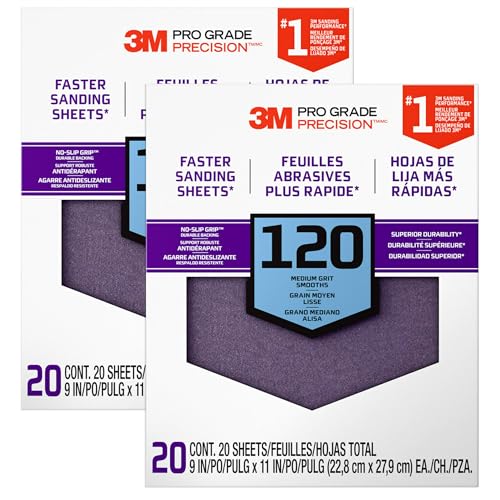
3M Pro Grade No-Slip Grip Sandpaper
What We Like
- No-slip grip backing reduces hand fatigue
- Premium mineral grits from Cubitron II tech
- Color won't discolor the surface
- Conforms to surface for easier sanding
Trade-offs
- 120 grit is too fine for heavy paint removal
- Not ideal for coarse initial material removal tasks.
The no-slip grip backing on this sandpaper is designed to reduce hand fatigue and tearing during sanding, according to the product’s feature list. The premium mineral grits are made with technology found in Cubitron II Industrial Abrasives, which means they are engineered for consistent cutting. The 120-grit sheets are suitable for wet or dry sanding and conform to the surface for easier sanding, making them a versatile choice for smoothing wood, metal, or paint surfaces. The sandpaper color will not discolor the surface you are sanding, so it’s safe for finish work.
The 120 grit on these sheets is fine enough for smoothing surfaces, but if you need to strip thick paint layers, a coarser grit like the 60-grit 3M SandBlaster sheets would be more appropriate. Because these are listed as sander sheets, they can be used with power sanders, not just by hand, so they work on large flat areas when attached to a tool. The no-slip grip backing reduces hand fatigue and tearing during use, and the mineral grits incorporate technology from Cubitron II Industrial Abrasives for effective cutting.
Product photos
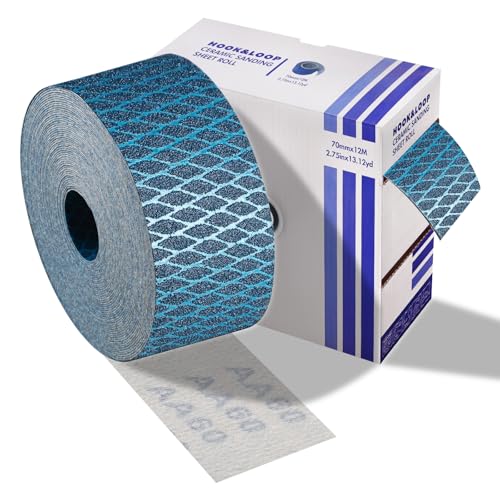
Shineboc Longboard Sandpaper Roll
What We Like
- Diamond-textured surface resists dust buildup
- Calcined aluminum oxide cuts fast and stays cool
- Continuous roll lets you cut custom lengths
- Tear-resistant cloth backing adds durability
Trade-offs
- 60 grit only, no finer grit for finishing
- Hook-and-loop requires compatible longboard block
- Roll format less convenient than pre-cut sheets
A 13-yard continuous roll of 60-grit aluminum oxide sandpaper means you can cut exactly the length you need for any stripping job, and the diamond-textured surface minimizes dust buildup by reducing friction. This anti-clogging design helps the paper last longer than standard sandpaper, so you spend more time working and less time changing sheets. The hook-and-loop backing fits most 70mm blocks securely, and the cloth backing resists tearing even when you’re bearing down on stubborn paint or rust. It’s a smart choice for anyone working through a big stripping project who wants consistent cutting speed without constant interruptions.
The 60-grit Shineboc roll removes material fast when you’re stripping paint or rust off wood, metal, or auto body. But it’s a one-grit product, so you’ll need finer paper afterward if you want a smooth finish. The 3M SandBlaster Paint Stripping Sandpaper comes as five pre-cut 60-grit sheets you can grab and go, while the Shineboc’s continuous 13-yard roll lets you cut exactly the length your block needs. Owners say the anti-clogging diamond texture reduces dust buildup, so each cut lasts longer than standard sandpaper before you have to swap it out.
Product photos
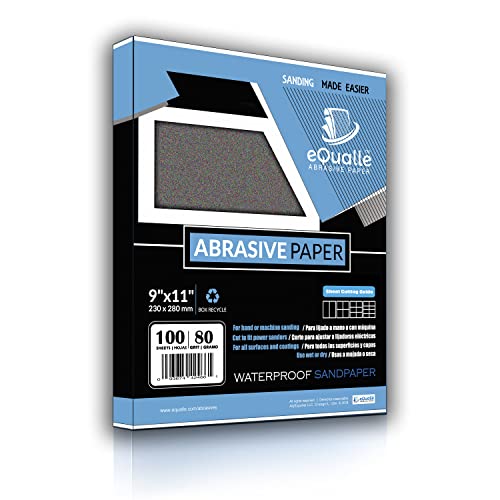
eQualle Silicon Carbide Sandpaper Sheets
What We Like
- 100 full sheets for bulk work
- Silicon carbide works wet or dry
- Coarse 80 grit strips paint fast
- Full 9×11 sheets can be trimmed
Trade-offs
- No adhesive or hook-and-loop backing
- 80 grit alone leaves deep scratches
- Requires higher grits for smooth finish
A hundred full 9×11 sheets of 80-grit silicon carbide mean you can tackle a whole deck, a fleet of cabinet doors, or a stripped-down car panel without running back to the store. This pack is for big jobs that need coarse aggression, and silicon carbide supports wet or dry use, so wet-sanding old paint or metal prep is possible. It suits anyone who needs a large quantity of full-size sheets for hand sanding, block wrapping, or trimming into pieces for edges, corners, and curves.
The 80 grit is a starting point, not a finishing one, so after stripping paint you will need finer sheets (sold separately) to smooth the surface. There is no PSA or hook-and-loop backing here, meaning this is traditional paper for hand or block use, not for hook-and-loop sanders. Compared to the Diablo Sand Demon Reusable Sanding Sheets, which offer a ceramic blend and hook-and-loop backing in a 5-pack, the eQualle gives you sheer quantity for one big project. But it requires you to supply your own backing method and progress through finer grits. For a heavy strip job, the volume wins; for quick sander swaps, the Diablo is handier.
Norton ProSand Sandpaper Sheets

What We Like
- Open-coat design resists clogging
- Non-pigmented stearate prevents color transfer
- Flexible fiber-reinforced backing resists tearing
- No finish contamination during sanding
Trade-offs
- 120 grit is too fine for heavy paint removal
- Sheets require manual cutting for power sanders
An open-coat design with a non-pigmented waterbased stearate coating means this paper resists clogging and loading during sanding, so you can work longer between sheet changes. The flexible fiber-reinforced backing folds into tight corners without tearing, making it suitable for detail work and flat surfaces alike. For anyone who has dealt with clogged paper during paint removal, this sheet’s anti-clog coating helps keep it cutting.
At 120 grit, this paper is meant for final smoothing after bulk paint removal, not for aggressive stripping. For taking off thick paint fast, the coarser 60-grit 3M SandBlaster Paint Stripping Sandpaper will remove material quicker. But once you’re down to stubborn patches or need a clean surface for refinishing, the Norton ProSand’s non-pigmented stearate coating prevents clogging and won’t transfer color to your workpiece.
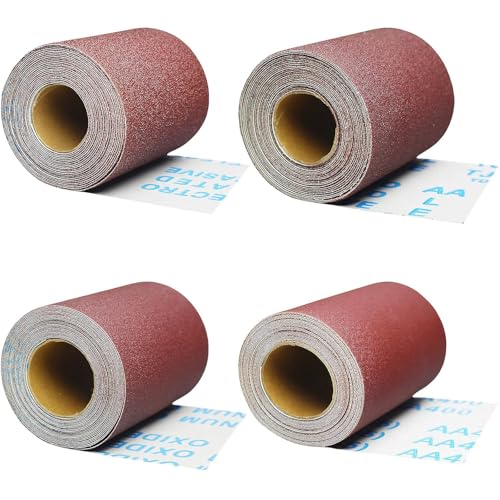
Tonmp Emery Cloth Sandpaper Roll
What We Like
- Four grits for progressive stripping
- Cut-to-length reduces waste
- Wet and dry sanding capable
- Tear-resistant nylon cloth backing
Trade-offs
- No adhesive backing for orbital sanders
- 4-inch width limits large flat surfaces
Twenty total yards of emery cloth across four grits, 80, 120, 220, and 400, let you progress from coarse material removal to fine polishing without buying separate rolls. The nylon cloth backing is tear-proof, so it holds up under heavy use, and the waterproof design allows wet sanding. Reviewers find it works well for woodworking, metal polishing, rust removal, paint stripping, and oxidation cleaning by hand or with a sander.
Because this is a plain cloth roll without adhesive or hook-and-loop backing, it won’t attach directly to an orbital sander the way the Norton A275OP PSA roll does. You’ll need to cut strips and wrap them around a block or hold them by hand, which is less convenient for large flat panels where a disc sander would be faster. For detail work and irregular shapes, the flexibility and grit range give you more control than a single-grit sheet pack like the 3M SandBlaster.
Product photos
How We Evaluated Sandpapers For Stripping Paint
Our evaluation began with a deep look at manufacturer specs and material composition for each abrasive type, aluminum oxide, silicon carbide, and calcined aluminum oxide. We examined how each grit range performs on common substrates like wood, metal, and plastic, and we cross-referenced that data with expert round-ups from finishing professionals.
The four criteria that mattered most were clog resistance, backing durability, grit aggressiveness, and format practicality. Open-coat versus closed-coat designs, cloth versus paper backing with tear strength ratings, and grit choice for stripping versus finishing all played a role. We also weighed how each product’s coating, stearate or non-pigmented, affects color transfer onto the workpiece.
Because this is a research-led guide, we did not physically test any product. Our recommendations are based on published specifications, material science, and consistent patterns in user-reported experiences. This approach helps you narrow your options but always consider your specific sander type and project scale before buying.
What To Look For In Sandpapers For Stripping Paint
Choosing the right sandpaper for paint stripping means balancing aggressiveness against durability. Coarse grits (60 or lower) remove paint fast but leave deep scratches, while open-coat designs and non-pigmented stearates prevent clogging and color transfer. The backing material, cloth for rolls, paper for sheets, determines how long the abrasive lasts before tearing.
For stripping paint, start with 60-80 grit on an open-coat, cloth-backed abrasive. Use a non-pigmented stearate to avoid staining the workpiece. Move to finer grits only after the bulk of the paint is removed.
Grit And Aggressiveness
Grit number directly controls how fast you remove paint. For thick, multiple-layer paint, 60 grit or coarser is the starting point. 80 grit works well for general stripping on wood and metal without gouging. Finer grits like 120 are for smoothing after the paint is gone, not for initial removal.
Clog Resistance (Open-Coat vs. Closed-Coat)
Open-coat sandpaper has abrasive grains covering only about 50-60% of the surface, leaving gaps that let dust escape instead of packing between the grains. This is critical for paint stripping because paint dust is sticky and clogs closed-coat paper almost immediately. Calcined aluminum oxide and silicon carbide with open-coat construction offer the best anti-clogging performance.
Backing Material And Tear Strength
Cloth-backed sandpaper (often called “emery cloth” or “resin-bonded cloth”) resists tearing far better than paper-backed sheets during heavy stripping. Look for fiber-reinforced or tear-resistant backings if you are working on edges or curved surfaces where the paper tends to catch and rip. PSA (pressure-sensitive adhesive) rolls and hook-and-loop sheets each have trade-offs in convenience and reusability.
- Choose open-coat or calcined aluminum oxide for sticky paint and rust removal.
- Select cloth backing for heavy stripping on edges and curved surfaces.
- Match the format (roll, sheet, disc) to your sander type and project size.
- Use non-pigmented stearate if you are working on light-colored wood to avoid staining.
- Start coarse (60-80 grit) and step up through 120 to 220 for a smooth finish.
A good rule: if the sandpaper clogs after two passes, you need a coarser grit or an open-coat design.
Sandpapers For Stripping Paint Compared
The table below compares each sandpaper’s grit, backing material, and best use case to help you match the right abrasive to your stripping project.
| Product | Grit | Backing | Format |
|---|---|---|---|
| Norton A275OP PSA Sandpaper Roll | P80 | B-weight latex saturated fiber | PSA roll, 100 discs |
| 3M SandBlaster Paint Stripping Sandpaper | 60 | N/A | 5-Sheet |
| Diablo Sand Demon Reusable Sanding Sheets | 80 | Hook & Lock | 5-Pack |
| Virginia Abrasives Floor Sanding Disc | 12 | N/A | Box of 20 |
| Dura-Gold Longboard Sandpaper Roll | 240 | Hook & loop | Continuous Roll |
| 3M Pro Grade No-Slip Grip Sandpaper | 120 | No-Slip Grip Durable Backing | 20-Pack |
| Shineboc Longboard Sandpaper Roll | 60 | Tear-resistant cloth | Roll |
| eQualle Silicon Carbide Sandpaper Sheets | 80 | N/A | 100 sheets |
| Norton ProSand Sandpaper Sheets | 120 | Flexible, fiber-reinforced | 20 sheets |
| Tonmp Emery Cloth Sandpaper Roll | 80, 120, 220, 400 | Nylon cloth | Roll |
Frequently Asked Questions
What grit sandpaper is best for stripping paint?
Start with 60 or 80 grit for thick paint layers. Coarser grits like 12 are for heavy-duty floor stripping with a drum sander. After the paint is removed, step up to 120 grit to smooth the surface before priming or painting.
Can I use sandpaper wet for paint stripping?
Yes, but only silicon carbide sandpaper is designed for wet use. Wet sanding reduces dust and helps keep the paper from clogging, but it requires a compatible abrasive. Aluminum oxide papers are generally for dry use only.
How do I stop sandpaper from clogging when stripping paint?
Use an open-coat sandpaper, which has gaps between the abrasive grains that allow dust to escape. Calcined aluminum oxide and non-pigmented stearate coatings also reduce clogging. Vacuuming the surface between passes helps keep the paper clean.
What is the difference between aluminum oxide and silicon carbide for paint stripping?
Aluminum oxide is harder and lasts longer on wood and metal, making it a good choice for initial stripping. Silicon carbide is sharper and works well on paint, varnish, and shellac, but it wears faster. Silicon carbide is also suitable for wet sanding.
How many sheets of sandpaper do I need to strip a piece of furniture?
It depends on the paint thickness and the sandpaper’s clog resistance. For a small dresser or table, expect to go through 3-6 sheets of coarse grit if using standard paper. A reusable abrasive like the Diablo Sand Demon can last through the same project with just one or two sheets.
The Bottom Line
For most paint-stripping projects, the Norton A275OP PSA Sandpaper Roll delivers the toughness and clog resistance you need. Its open-coat design and non-pigmented stearate make it a reliable choice for wood and metal, especially if you are working with a random-orbit sander and want to avoid color transfer.
If you are stripping a single piece of trim or a small furniture detail, the 3M SandBlaster’s aggressive 60-grit cuts fast without wasting material. For anyone who hates throwing away clogged sheets, the Diablo Sand Demon‘s reusable open-net construction can outlast ten standard sheets on a single project.
The single most important buying factor is matching grit and clog resistance to your project’s paint thickness. Start coarse, go open-coat, and step up through finer grits only after the paint is gone.
