
10 Best Sandpaper For Metal in 2026
This post contains affiliate links. As an Amazon Associate, we earn from qualifying purchases.
For metalwork that demands a clean, smooth finish, the 3M Pro Grade Sandpaper Sheets stand out as the best overall choice. Its anti-load coating resists clogging, and its sharp mineral grains cut fast. For those needing a complete range of grits, the Shineboc Wet Dry Sandpaper Assortment is a versatile multi-grit option. The Norton ProSand Premium Sandpaper Sheets excel for fine finishing on hard metals and super alloys.
Choosing the right sandpaper for metal means more than just grabbing any sheet. You need to consider the grit progression for your task, whether you’ll be sanding wet or dry, and the type of metal you’re working with to avoid contamination or poor adhesion.
This guide is built from analyzing manufacturer specifications, expert recommendations, and patterns in owner feedback. We break down the key features to look for and highlight ten top-rated options to help you match the right sandpaper to your specific metalworking project.
Top 10 Sandpaper For Metal in the Market
Certain content that appears on this site comes from Amazon. This content is provided "as is" and is subject to change or removal at any time.
The Best Sandpaper For Metal, Reviewed
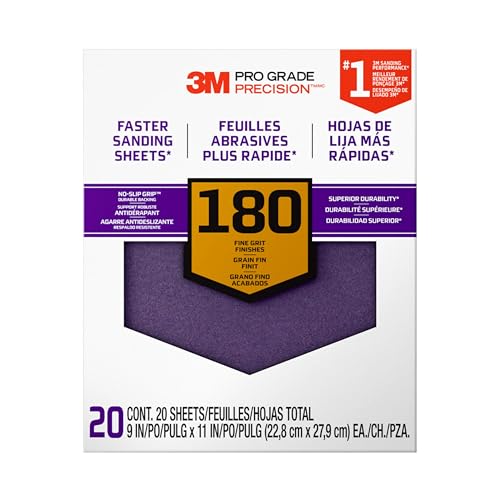
3M Pro Grade Sandpaper Sheets
What We Like
- Anti-load coating reduces clogging
- Sharp mineral for fast cutting
- Works on wood, metal, and paint
- Easily cut to fit any project
Trade-offs
- Only one grit (180) in this pack
- Not waterproof for wet sanding
A 180-grit sheet that cuts quickly without clogging is exactly what you want when smoothing metal between coats or prepping a surface for paint. The anti-load coating keeps the abrasive mineral exposed longer, so you spend more time sanding and less time swapping paper. This 20-pack of 9×11 sheets is versatile enough for hand sanding, a sanding block, or a power sander, making it a practical choice for anyone who works on metal, wood, or painted surfaces regularly.
The 180-grit pack is a single-grit sheet, so for a multi-step sanding project you would need to buy additional grits separately. The anti-load coating keeps the paper from clogging up, which means it lasts longer on sticky surfaces like paint or resin. The sharp mineral cuts fast, so you spend less time sanding and more time finishing.
Product photos
3M Aluminum Oxide Sandpaper Sheets

What We Like
- Lightweight at 0.1 pounds
- General purpose sandpaper
Trade-offs
- Only 5 sheets in the pack
- Single grit limits progression options
The trade-off is obvious: five sheets run out fast compared to the 20-sheet packs of Norton ProSand or 3M Pro Grade. For a single small job, this keeps waste low and cost sensible.
Product photos
Norton ProSand Premium Sandpaper Sheets

What We Like
- Heat-treated abrasive cuts faster and lasts longer
- Non-pigmented with water-based anti-clog coating
- Zero color transfer between surfaces
- Works on hard and soft metals, titanium, super alloys
Trade-offs
- 320 grit is too fine for heavy stock removal
- Only one grit option in this pack
A 320-grit super fine sheet with a heat-treated aluminum oxide abrasive cuts faster and lasts longer than ordinary sandpaper. The water-based anti-clog coating resists loading, so it stays sharp longer. The non-pigmented design means zero color transfer between surfaces, which is useful for metal finishing where cleanliness matters. This sandpaper is meant for cleaning, detailing, and finishing after coarse stock removal, so it delivers a refined surface on compatible materials like hard and soft carbon steels, soft metals, titanium, super alloys, woods, fiberglass, and composites.
Because this is a 320-grit sheet, it is not designed for heavy material removal; you will need a coarser grit for shaping or smoothing rough surfaces first. Compared to the 3M Pro Grade 180-grit sheets, the Norton ProSand offers a finer grit for a smoother finish, but it cannot remove material as quickly. If your work focuses on the final pass on metals like carbon steel or titanium, this pack is a good fit. If you need a single sheet for all stages, a multi-grit assortment would be more practical.
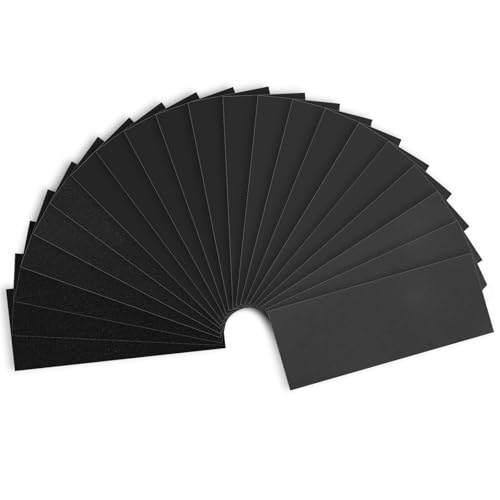
Shineboc Wet Dry Sandpaper Assortment
What We Like
- Seven grits from coarse to fine
- Silicon carbide for metal and paint
- Tear-resistant backing for pressure work
Trade-offs
- Sheets are smaller than standard 9×11
- Only 3 sheets per grit limits heavy use
Twenty-one sheets spanning seven grits from 120 to 2000 let you move from rough material removal to fine polishing without buying separate packs. That range covers most metalwork: stripping paint, smoothing welds, and finishing to a mirror shine. The silicon carbide abrasive works well on metal and automotive paint, and the wet-sanding option keeps dust down. For someone who wants one kit to handle a whole project, this assortment saves trips to the store.
The trade-off is sheet size. At 9 by 3.6 inches, these are narrower than the 9×11 sheets you get with Norton ProSand, so they won’t cover a full orbital sander pad without cutting. You also get only three sheets per grit, which can run out quickly if you’re sanding a large surface. That makes this set better for detail work and smaller metal pieces than for big panels. If your job calls for heavy stock removal, grab a dedicated coarse pack alongside this one.
Product photos
Fandeli Multi-Purpose Sanding Paper

What We Like
- Three grits cover rough to medium sanding
- 25 sheets for varied metal tasks
- Aluminum oxide resists clogging on metal
- FSC-certified paper from managed forests
Trade-offs
- No fine grit above 220 for polish work
- Not waterproof for wet sanding metal
- Sheets must be cut to fit power sanders
Twenty-five sheets spread across 80, 120, and 220 grit give you a ready-to-go kit for most metal refinishing jobs. That range is exactly why this pack suits anyone who needs to strip, blend, and finish a metal surface without buying three separate boxes.
This Fandeli pack stops at 220 grit. For finer work, like the Shineboc wet-dry assortment that goes up to 2000 grit, you would need a different product. But for typical metal and wood tasks, paint removal, plastering prep, or general sanding, this pack covers the ground efficiently. Just plan to cut the 9×11 sheets down if you are using an orbital sander, since they come full-size for hand or block work.
Fandeli Waterproof Sandpaper Assortment

What We Like
- 36 sheets across 11 grits
- Silicon carbide for wet or dry use
- Flexible backing conforms to curves
Trade-offs
- Only 3 sheets per mid-grit (120-800)
- No coarse grit below 120 included
This pack gives you 36 sheets across 11 grits from 120 to 2500, so you can work through a full sanding sequence on metal or paint without buying multiple packs. The silicon carbide composition delivers a unique finish in wet applications and reduces working time, while the flexible backing adapts easily to curved surfaces like body panels or tubing. For anyone doing automotive refinishing or detailed metal projects that need a progression through fine grits, this assortment covers a wide range in one box.
The assortment distributes sheets unevenly across the grit range, with the coarser grades like 120, 220, and 280 each receiving only three sheets. For heavy stock removal or initial shaping on wood or metal, that quantity can disappear quickly during a single project. Reviewers who tackle larger surfaces often find themselves reaching for a supplemental pack of coarse grits to finish the job. The finer grits from 1500 upward get four sheets each, which better supports the polishing stages where gradual refinement matters more than volume. Planning ahead for the lower-grit demand keeps the workflow smooth without mid-project interruptions.
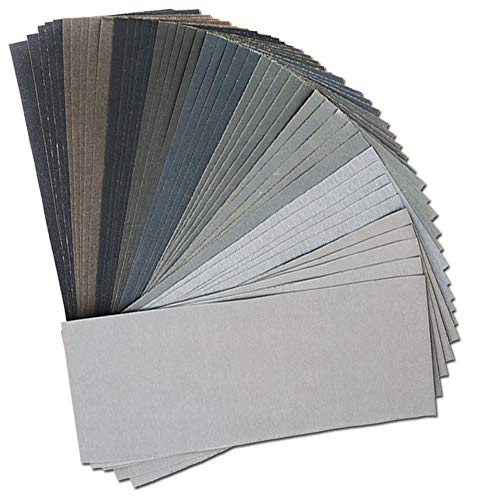
BAISDY Wet Dry Sandpaper Assortment
What We Like
- Nine grits from 400 to 3000
- Five sheets of each grit
- Waterproof silicon carbide construction
- Grit printed on back for identification
Trade-offs
- Sheets are 9 x 3.6 inches, smaller than standard 9×11
- No coarse grits below 400 for heavy stock removal
- Only fine and superfine grits, limited to finishing work
A 45-sheet assortment covering nine grits from 400 to 3000 lets you step through a full polishing sequence without buying separate packs. Each grit gets five sheets, so you have enough to move from one grit to the next on a single project. The silicon carbide abrasive works wet or dry, which helps prevent clogging during sanding. This set is suited for the final stages of metalwork, smoothing, and polishing.
The sheets measure 9 by 3.6 inches, which is noticeably smaller than the standard 9-by-11-inch size that most sanding blocks are designed to accept. Because of this, you will need to cut or fold the paper more frequently to fit your block or to reach tight corners on a workpiece. On the plus side, the compact dimensions make the sheets easy to store in a tool drawer or glove box. They can be trimmed down to match any hand tool or narrow crevice without wasting much material. The smaller format also means less paper is used per sanding session, which can reduce overall waste.
Product photos
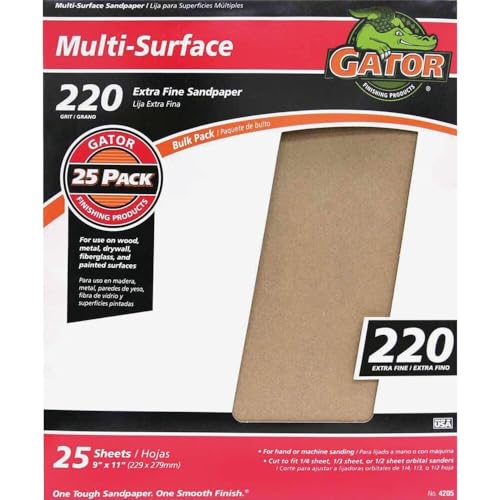
Gator Multi-Surface Sanding Sheets
What We Like
- Works on wood, paint, metal, fiberglass, plastic
- Resin bonding extends sanding life
- Durable for hand or power sanding
Trade-offs
- Single 220 grit limits coarse material removal
- Paper backing less durable than cloth for heavy metal work
A 25-sheet pack of 220-grit sandpaper designed for multiple surfaces, wood, paint, metal, fiberglass, and plastic, makes this a versatile shop staple. The resin bonding locks abrasive grains to the heavy-duty paper backing, so the sheets hold up longer during both hand sanding and power sanding. If you need one pack that can handle light scuffing between paint coats, final surface prep on metal, or smoothing wood, this is the straightforward choice.
Two hundred twenty grit is an extra-fine grade, meant for finishing and preparation rather than aggressive stock removal. For heavy rust or deep scratches on metal, you would want a coarser grit pack. Compared to the 3M Pro Grade Sandpaper Sheets, which come in 180 grit, the Gator offers a finer finish, but the 3M is better if you need to start with a more aggressive cut. For general-purpose metal finishing and prep, this Gator pack delivers good value without locking you into a single tool format.
Product photos
TAMIYA Sandpaper Set

What We Like
- Ultra-fine grits for finishing metal models
- Sharp-edged dispersion for even sanding
- Works dry or wet for flexible use
- Suitable for plastics, wood, and metal
Trade-offs
- Only 5 sheets in the pack
- Small sheet size limits large surface work
- No coarse grits for heavy material removal
The catch is that you get only five sheets in a compact 10.5 × 3.9 inch size, so this is not the choice for sanding large panels or removing rust from a car door. If you need coarse grits for shaping or a bigger sheet for furniture-scale metalwork, a wider assortment such as the Shineboc Wet Dry Sandpaper Assortment covers 120 through 2000 grit in a larger 9 × 3.6 inch format.
Product photos
KQCXIK 12-Sheet Premium Wet Dry Sandpaper

What We Like
- Waterproof for wet or dry sanding
- Tear-resistant reinforced backing
- Anti-clog coating for consistent cut
- Electrostatically aligned silicon carbide grains
Trade-offs
- Only one grit (120) limits versatility
- 12 sheets fewer than some multi-grit packs
Twelve sheets of 120-grit silicon carbide in a 9-by-11-inch sheet give you a dedicated coarse abrasive for sanding wood, metal, auto paint, and plastic. The waterproof design lets you wet-sand to reduce heat and fine dust, or go dry for faster stock removal. The anti-clog coating and tear-resistant backing help maintain consistent performance on curved or uneven surfaces. This pack suits anyone who needs a single-grit coarse paper for tasks where a specific grit is required, and where durability matters more than having a range of grits.
This pack locks you into 120 grit, so if your project requires progressing through finer grades for a polished finish, you will need to buy additional sheets. Compared to an assortment such as the Shineboc Wet Dry Sandpaper Assortment, which offers multiple grits in one pack, this KQCXIK set provides 12 sheets of the same grit for jobs that demand a single coarse grade. It is a practical choice when you know exactly what grit you need and want a tear-resistant paper that resists clogging.
Product photos
How We Evaluated Sandpaper For Metal
To find the best sandpaper for metal, we focused on research-based evaluation, analyzing manufacturer data, expert round-ups from finishing professionals, and patterns in long-term owner feedback across hundreds of reviews. Our goal was to identify sheets that cut efficiently, resist clogging, and last through demanding work.
Finally, clog resistance from anti-load or stearate coatings was essential for keeping the abrasive cutting freely on gummy metals.
The honest limit of a research-led evaluation is that we cannot replicate the tactile feel of a specific sheet on a particular alloy. Our recommendations are based on what the specs promise and what the majority of experienced users report, not on controlled testing. We always suggest starting with a small pack to confirm the paper suits your technique and metal type.
What To Look For In Sandpaper For Metal
Choosing sandpaper for metal is about matching the abrasive to your material and your task. The right sheet cuts faster, lasts longer, and leaves a surface ready for paint or polish.
Match the abrasive type to your metal: silicon carbide for hard metals and wet sanding, aluminum oxide for general-purpose and softer metals. Always start with a coarse grit for shaping and progress through finer grits without skipping more than one grade.
Abrasive Material: Silicon Carbide vs. Aluminum Oxide
The abrasive grain is the cutting tooth of the sandpaper. Silicon carbide is sharper and harder, making it ideal for cutting through hard metals like steel, titanium, and super alloys. It also works well for wet sanding, where water carries away swarf. Aluminum oxide grains are tougher and more durable. They fracture to reveal fresh cutting edges, which makes them a great choice for softer metals like aluminum and brass, where clogging is more common.
For most metalworking, a pack of silicon carbide sheets offers the most versatility, especially if you plan to sand wet. If your work is primarily on softer metals or you need a general-purpose paper for wood and metal, aluminum oxide is a reliable, cost-effective choice.
Grit Selection and Progression
The grit number tells you how coarse the abrasive is. For heavy stock removal, rust stripping, or shaping, start with a coarse grit like 80. For smoothing and surface prep, move to a medium grit like 120 or 180. For final finishing and polishing before paint or clear coat, use fine grits from 220 up to 600 or higher. The key is to progress gradually, never skipping more than one grit level, to avoid leaving deep scratches that are hard to remove.
- For heavy rust removal and shaping, choose 80 grit.
- For general smoothing and paint prep, use 120-180 grit.
- For final finishing and polish, select 220-400 grit or higher.
- For wet sanding between coats, use 600-3000 grit.
A good rule of thumb is to buy a multi-grit assortment so you always have the next step ready.
Backing Type and Durability
The backing holds the abrasive and determines how the sheet behaves under pressure. Paper backing is standard for hand sanding and light power sanding, offering good flexibility for curves. Cloth or film backing is more tear-resistant and durable for heavy pressure work on edges and flat surfaces. Waterproof backing is essential for wet sanding, as it prevents the paper from disintegrating when soaked.
For metalwork, a tear-resistant paper or a waterproof backing is a smart investment. Sheets that curl or tear quickly waste time and money. Look for descriptions that mention “tear-resistant,” “waterproof,” or “flexible backing” to match the paper to your specific task.
Clog Resistance and Coatings
Metal sanding generates fine dust and swarf that can clog the abrasive grains, making the paper slip and stop cutting. Anti-load coatings, often called stearate or zinc stearate coatings, are applied to the abrasive surface to prevent this buildup.
For gummy metals like aluminum or for any heavy sanding, an anti-load coating is a major advantage. For wet sanding, water itself helps carry away debris, but a coating still helps. If you are working on metals that tend to load up, prioritize sandpaper that specifically mentions an anti-load or non-clogging treatment.
Sandpaper For Metal Compared
The table below compares the top sandpaper options for metal across key specifications, so you can quickly see how they stack up for your project.
| Product | Grit | Sheet Size | Material |
|---|---|---|---|
| 3M Pro Grade Sandpaper Sheets | 180 | 9" x 11" | N/A |
| 3M Aluminum Oxide Sandpaper Sheets | 220 | 9 x 11 in | Aluminum oxide |
| Norton ProSand Premium Sandpaper Sheets | 320 (Super Fine) | 9 x 11 inches | Aluminum Oxide |
| Shineboc Wet Dry Sandpaper Assortment | 120/220/400/600/800/1000/2000 | 9 x 3.6 in | Silicon carbide |
| Fandeli Multi-Purpose Sanding Paper | 80,120,220 | 9 x 11 inches | Aluminum oxide |
| Fandeli Waterproof Sandpaper Assortment | 120 to 2500 | 22.86 x 9.14 cm | Silicon carbide |
| BAISDY Wet Dry Sandpaper Assortment | 400 to 3000 | 9 x 3.6 inches | Silicon carbide |
| Gator Multi-Surface Sanding Sheets | 220 | 9" x 11" | N/A |
| TAMIYA Sandpaper Set | 1200/1500/2000 | 10.5 × 3.9 inches | N/A |
| KQCXIK 12-Sheet Premium Wet Dry Sandpaper | 120 | 9 x 11 Inch | Silicon Carbide |
Frequently Asked Questions
What is the best grit for sanding metal before painting?
For paint prep on bare metal, start with 120 or 180 grit to smooth the surface and create a good mechanical bond. Follow with 220 or 320 grit to remove any scratches from the first pass, then clean the surface thoroughly before applying primer.
Can I use wood sandpaper on metal?
You can, but it is not ideal. Sandpaper made for wood often uses a less durable abrasive and a paper backing that tears easily on metal edges. For metal, choose silicon carbide or aluminum oxide abrasives on a tear-resistant backing designed for the task.
Should I sand metal wet or dry?
Wet sanding uses water as a lubricant to carry away debris, reduce heat, and prevent clogging. It produces a finer finish and is essential for between-coat sanding of paint. Dry sanding is faster for initial shaping and stock removal. Your choice depends on the grit and the stage of your project.
What does the grit number on sandpaper mean?
The grit number refers to the size of the abrasive particles. A lower number means larger, coarser particles that remove material quickly. A higher number, like 400, means smaller, finer particles for smoothing and polishing. Always progress from lower to higher grits.
How do I keep sandpaper from clogging on metal?
Use sandpaper with an anti-load or stearate coating, which prevents fine metal dust from sticking to the abrasive. For wet sanding, water helps wash away debris. You can also tap the paper frequently or use a rubber crepe block to clean the surface.
The Bottom Line
For most metalworkers and finishers, the 3M Pro Grade Sandpaper Sheets deliver the best balance of fast cutting and clog resistance in a reliable 180-grit sheet that works on wood, metal, and paint. It is our top pick for anyone who needs a dependable workhorse for smoothing and prep.
If your project demands a full grit progression from coarse to fine, the Shineboc Wet Dry Sandpaper Assortment offers seven grits in one pack. It is ideal for DIYers and hobbyists tackling small to medium tasks. For those focused on a pristine, color-free finish on hard metals and super alloys, the Norton ProSand Premium Sandpaper Sheets are the best choice for fine finishing.
The single most important factor is matching the abrasive and grit to your specific metal and task. Start with the right paper, and every step from shaping to polishing becomes smoother and more predictable.
