
10 Best Sanders To Remove Paint in 2026
This post contains affiliate links. As an Amazon Associate, we earn from qualifying purchases.
The Skil 5″ Random Orbital Sander is our Best Overall pick for removing paint. It combines effective variable-speed control with a cyclonic dust box that keeps work areas clean and a low-vibration design that reduces fatigue. For large-scale stripping, the DEWALT 20V MAX Belt Sander offers fast material removal and cordless mobility. Budget-focused DIYers should consider the DEKOPRO Random Orbital Sander, which comes with a full set of sandpapers.
Removing old paint is one of the most physically demanding prep jobs in any refinishing project. The right sander saves hours of elbow grease, but choosing wrong means endless clogged paper, clouds of toxic dust, or a finish full of swirl marks. What matters most is matching the sander’s motion, power, and dust management to the surface you’re stripping.
This guide is based on a close study of manufacturer specifications, expert round-ups, and patterns in owner feedback across hundreds of paint-stripping projects. We compare orbital, belt, and multi-mode sanders so you can pick the one that fits your work style and surface size.
Top 10 Sanders To Remove Paint in the Market
Certain content that appears on this site comes from Amazon. This content is provided "as is" and is subject to change or removal at any time.
The Best Sanders To Remove Paint, Reviewed
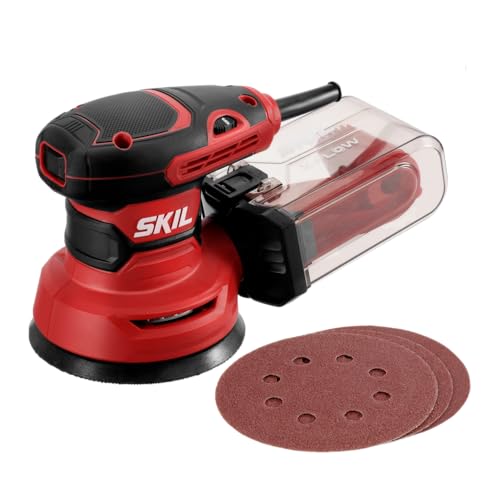
Skil 5" Random Orbital Sander
What We Like
- Variable speed control for different materials
- Cyclonic dust box keeps dust contained
- Low-vibration design with soft rubber grip
- Compact size for tight spaces
Trade-offs
- Corded design limits mobility vs cordless models
- Corded only, not for cordless job sites.
A 2.8-amp motor spinning at 13,000 orbits per minute gives this sander the muscle to strip paint efficiently without bogging down. The variable speed control lets you dial back for delicate surfaces or crank it up for heavy material removal. The cyclonic dust box pulls debris into an easy-to-empty container so you spend less time cleaning and more time working. Its compact body and soft rubber grip keep vibration low, making it a comfortable companion for longer stripping sessions on furniture, trim, or flat panels.
A 2.8 amp motor spinning at 13,000 orbits per minute gives this sander steady power for consistent material removal across a range of jobs. The variable speed control lets you dial in the right pace for different surfaces, while the cyclonic dust box uses centrifugal force to keep the transparent container easy to empty. Because it’s corded, you stay near an outlet, but you never lose power mid-stroke as a battery pack might.
DEWALT 20V MAX Belt Sander

What We Like
- 16.7% more sanding area than Milwaukee
- Up to 22% more power vs corded
- Quick-release tool-free belt changes
- Overmolded auxiliary handle for two-hand grip
Trade-offs
- Tool only: battery and charger sold separately
- Dust collection system requires separate Airlock kit
A 16.7% larger sanding surface than the Milwaukee 2832-20 means this belt sander lets you strip paint from big panels and floors faster, with fewer passes. The brushless motor delivers corded-level power, and the 25-speed trigger gives you fine control over how aggressive you go. For large paint-removal jobs on decks, doors, or furniture, this is the cordless option that keeps up with the work without dragging a cord behind you.
Compared to the corded Makita 9403, which weighs 13.0 pounds, this DEWALT trades raw belt width (3 x 18 vs. 4 x 24) for cordless freedom and a lighter feel in hand.
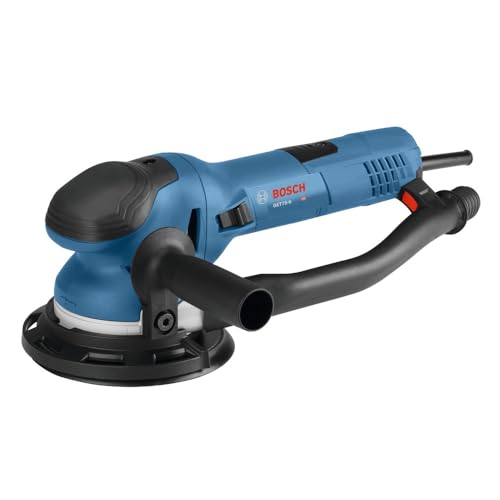
Bosch GET75-6N Orbital Sander
What We Like
- Turbo mode for 3x stock removal
- Dual-mode random and eccentric orbit
- Variable speed motor for control
- Multi-hole pad accepts wide abrasive selection
Trade-offs
- Requires external vacuum for dust collection
- Hoses and adapter sold separately
- Heavier than many palm sanders at 5.7 lb
The turbo-driven eccentric orbit mode removes material at up to five times the rate of standard random orbit sanding, so you can strip away layers fast on wood floors or furniture. The variable speed dial ranges from 290 to 640 RPM, letting you slow down for fine finishing once the rough work is done. This machine handles both aggressive stock removal and final smoothing in fewer passes.
The trade-off is that dust collection depends on hooking up a shop vacuum, there is no built-in canister or bag, and the hoses are sold separately. That extra setup step is worth it for the speed advantage, especially compared to a lighter palm sander like the Bosch ROS20VSC, which would take many more passes on heavy paint. At 5.7 pounds, you will feel the weight after an hour of overhead work, but on a flat surface the added mass helps keep the disc flat and the removal steady.
DEWALT 20V MAX Orbital Sander

What We Like
- Brushless motor for runtime and efficiency
- Variable speed from 8,000 to 12,000 OPM
- Low-profile head for tight access
- Dust-sealed switch protects against debris
Trade-offs
- Battery and charger sold separately
- No onboard dust collection without optional collector
At just 2.5 pounds, this cordless orbital sander lets you work overhead or on vertical surfaces without your arm tiring out before the job is done. Its brushless motor delivers the runtime and efficiency needed for extended sanding sessions, and the variable-speed dial (8,000-12,000 OPM) lets you dial down for delicate finishes or crank up for aggressive material removal. The low-profile height allows you to get close to the work surface for precise sanding, making it a natural fit for detail work.
The biggest thing to know up front is that this sander is sold as a bare tool. You’ll need a DEWALT 20V MAX battery and charger to run it, something to factor in if you’re not already invested in the system. For dust control, it comes with a one-handed locking dust bag, and the dust port is designed to fit directly to DEWALT’s DWV010 or DWV012 dust collectors (sold separately). Best for the mobile refinisher or job-site painter who values cordless convenience and precise speed control.
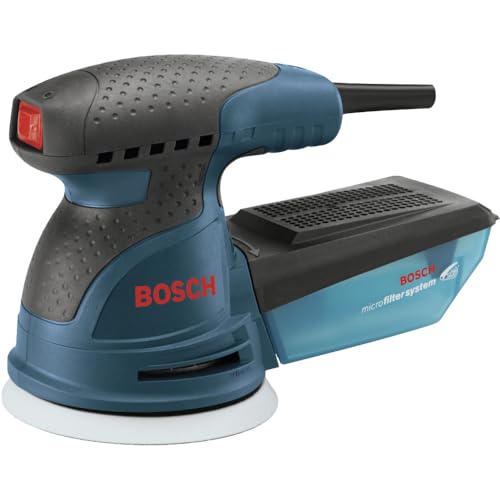
Bosch ROS20VSC Palm Sander
What We Like
- ½-micron microfilter dust canister
- Pad dampening system eliminates swirl marks
- Variable speed 7,500-12,000 OPM
- Includes carrying bag and vacuum adapter
Trade-offs
- Corded design limits mobility
- 3.5 pounds is heavier than some palm sanders
- Dust canister needs emptying frequently on large jobs
A ½-micron microfilter dust canister means this sander traps particles nearly invisible to the eye, keeping your work area noticeably cleaner than standard dust bags. That matters when you’re stripping paint indoors or in a shared space where fine dust lingers for hours. The variable-speed dial lets you dial down to 7,500 OPM for delicate finishes or crank up to 12,000 OPM for aggressive paint removal. The pad dampening system helps prevent those frustrating swirl marks on both flat panels and curved surfaces. It’s a thoughtful choice for anyone who prioritizes a tidy workspace without sacrificing control.
The Bosch ROS20VSC is a corded sander, so you’ll need to stay within reach of an outlet, which can be limiting on large decks or remote job sites. It weighs 3.5 pounds, slightly more than some palm sanders, but that extra heft helps keep it steady on flat surfaces. For dust control, its microfilter system traps particles as small as half a micron, so the work area stays noticeably cleaner than with standard dust bags.
DEKOPRO 5" Random Orbital Sander

What We Like
- 6 variable speeds for paint removal control
- 16 included sandpapers cover coarse to fine grits
- Detachable dust bag reduces cleanup time
- Ergonomic rubber grip with low-vibration design
Trade-offs
- Corded design limits mobility around large projects
- At 3.6 lb, heavier than some cordless palm sanders
A 2.5A motor that spins up to 14,000 RPM means this sander can handle paint removal without stalling. The six variable speeds let you adjust aggressiveness for stripping versus smoothing, and the included sandpaper assortment covers coarse through fine grits. For anyone tackling a paint-stripping project on a budget, this is a straightforward, capable tool that doesn’t cut corners on the essentials.
You’re tethered to an outlet with this sander, which matters less in a workshop than when sanding a fence or a porch. It also weighs 3.6 pounds, a bit more than the cordless DEWALT 20V MAX Orbital Sander, so extended overhead work might tire your arm faster. But for the price-conscious DIYer who wants reliable power and ready-to-use accessories, the DEKOPRO delivers what you need without the premium cost.
Product photos
PioneerWorks 6" Orbital Sander

What We Like
- Brushless motor for consistent torque under load
- 5mm orbit strips paint fast without swirl marks
- 6-inch pad covers 28.3 sq. in. per pass
- Variable speed dial for paint removal to finishing
Trade-offs
- Corded design limits mobility away from outlets
- At 4.8 lbs, heavier than smaller 5-inch sanders
A 6-inch pad covering 28.3 square inches per pass means you strip paint off large flat surfaces noticeably faster than with a typical 5-inch sander. The 5mm orbit diameter delivers aggressive material removal for taking off old paint layers, while the random orbital motion leaves a swirl-free surface ready for primer or a fresh coat. This PioneerWorks is built for anyone tackling big projects like kitchen cabinets, tabletops, or siding where speed and coverage matter more than maneuverability in tight corners.
Weight and corded operation are the main compromises here. At 4.8 pounds, it’s heavier than a compact 5-inch sander like the Bosch ROS20VSC, so overhead work or long sessions on vertical surfaces will fatigue your arm faster. But if your priority is raw paint-stripping speed on broad panels, the larger pad and brushless motor make this the right tool for the job.
Product photos
Festool RO 150 FEQ-Plus Sander

What We Like
- ROTEX rotary motion for fast material removal
- Eccentric motion for scratch-free surfaces
- FastFix tool-less pad changes
- Sands up to the edge with Festool Protector
Trade-offs
- At 11.5 pounds, heavy for extended overhead use
- Corded operation limits mobility in large workshops.
A 6-inch pad paired with ROTEX rotary motion means this sander can strip paint aggressively when you need speed, then switch to random orbital mode for a finish-ready surface without changing tools. The eccentric motion delivers the scratch-free results professionals expect, while the FastFix system lets you swap pads in seconds. It suits anyone who needs one machine to handle both heavy paint removal and fine finishing on a job site.
Product photos
Festool RO 90 DX Multi-Mode Sander

What We Like
- Switches pad shapes without tools
- Gear-driven aggressive mode strips stubborn paint
- Polishing mode for final shine
- Random orbital mode for smooth finish
Trade-offs
- At 8.9 lb, heavier than most palm sanders
- Small 3.5-inch pad covers less area per pass
A gear-driven aggressive sanding mode sets this sander apart for paint removal, letting you chew through thick layers of old finish faster than a standard random orbital can manage. That same tool switches to a random orbital pattern for a smooth, swirl-free surface, and even has a polishing mode to bring back a brilliant shine. The ability to swap from a round pad to a delta-shaped pad in seconds without tools adds versatility for different tasks.
Product photos
Makita 9403 4×24 Belt Sander

What We Like
- 84dB noise level for operator comfort
- Labyrinth seals protect motor from dust
- Sands flush to wall on nose and side
- Large front grip for comfortable control
Trade-offs
- At 13 pounds, tiring for overhead work
- Corded design limits mobility away from outlets
A 4-inch wide belt running at 1,640 feet per minute means this sander strips paint fast, eating through layers without bogging down. The labyrinth construction seals the motor and bearings against dust, so the tool lasts longer even on dirty paint-removal jobs. This is the sander for anyone who needs raw, consistent power for large flat surfaces like deck boards, siding, or tabletops, and who values a quieter work session at 84 dB.
Operating at just 84 decibels, this sander stays quiet enough for comfortable all-day use without hearing fatigue. The 4-inch-wide belt moves at 1,640 feet per minute, so material comes off quickly on doors, framing, or old paint. A labyrinth construction seals the motor and bearings against dust and debris, which extends the tool’s working life even in gritty conditions. The large front grip is positioned to reduce hand strain during long sessions, and the design lets you sand flush to a wall using either the nose or the side of the sander.
Product photos
How We Evaluated Sanders To Remove Paint
We built this guide by analyzing manufacturer documentation, expert recommendations from the painting and refinishing industry, and broad patterns in owner-reported experiences. This is a research-led evaluation, not a hands-on test. We focused on what makes a sander effective at removing paint rather than just smoothing bare wood.
The four criteria that mattered most were material removal rate, dust collection effectiveness, control features for paint versus finish work, and ergonomics for extended use. Paint stripping is aggressive work that generates heavy debris, so a sander that clogs quickly or sprays dust everywhere fails at its primary job.
We also weighed versatility. Many sanders can strip paint, but the best ones also let you dial down for fine finishing without switching tools. We looked for variable speed, multiple orbit modes, and pad options that give you control over the cut.
What To Look For In Sanders To Remove Paint
Choosing a sander for paint removal starts with understanding that paint is softer than wood but sticks harder. You need a tool that cuts fast without loading up the abrasive, collects the mess, and lets you work for hours without fatigue.
The best sander for removing paint combines aggressive orbit or belt action with effective dust collection and variable speed control. Match the pad size to your project surface and choose between corded power or cordless freedom based on your workspace.
Sander Type: Orbital, Belt, or Multi-Mode
Random orbital sanders are the most versatile choice for paint removal on flat and curved surfaces. Their dual-action motion prevents swirl marks and works well from coarse grits for stripping to fine grits for finishing. Belt sanders remove material fastest on large, flat areas like floors and tabletops but can gouge wood if you linger. Multi-mode sanders like those from Festool switch between aggressive rotary motion for stripping and random orbit for finishing, making them ideal for professionals who need one tool for the whole job.
Dust Collection
Paint dust, especially from lead-based paints, is hazardous to breathe. The most effective dust systems use a cyclonic separator or a HEPA-rated vacuum attachment to capture fine particles before they reach the air. Onboard dust bags are convenient but fill quickly during heavy stripping. Look for sanders with a vacuum port or a microfilter canister that traps particles down to ½ micron.
Power Source and Variable Speed
Corded sanders deliver consistent power for aggressive stripping without battery anxiety. They are the standard for heavy paint removal. Cordless models offer mobility but require a large-capacity battery to sustain the high draw of belt or orbital sanding. Variable speed is essential: lower speeds prevent melting paint from gumming up the paper on soft materials, while higher speeds cut fast through multiple layers of old paint.
- Check the orbit diameter for orbital sanders: 5mm or larger removes paint faster than 3mm finishing orbits.
- Confirm the belt size and change mechanism on belt sanders; tool-less changes save time on big jobs.
- Look for a pad dampening system if you need a swirl-free finish after stripping.
- Verify that dust ports accept standard 1-1/4 inch or 1-1/2 inch vacuum hoses.
A sander that feels good in your hands for ten minutes will feel heavy after two hours. Prioritize grip comfort and weight distribution for your typical project size.
Sanders To Remove Paint Compared
The table below compares the key specs and trade-offs of our top picks for removing paint, from the best overall orbital sander to the most aggressive belt models.
| Product | Motor Power | Speed | Weight |
|---|---|---|---|
| Skil 5" Random Orbital Sander | 2.8 amp | 13,000 OPM | 3.4 pounds |
| DEWALT 20V MAX Belt Sander | N/A | Variable, 25-speed dial | 1.0 lb |
| Bosch GET75-6N Orbital Sander | 7.5 amp | 3300-7300 OPM | 5.7 pounds |
| DEWALT 20V MAX Orbital Sander | Brushless | 8,000-12,000 OPM | 2.5 pounds |
| Bosch ROS20VSC Palm Sander | 2.5 amp | 7,500-12,000 OPM | 3.5 pounds |
| DEKOPRO 5" Random Orbital Sander | 2.5A | 14,000 RPM | 3.6 lb |
| PioneerWorks 6" Orbital Sander | 350W brushless AC | 4,000-10,000 RPM | 4.8 lbs |
| Festool RO 150 FEQ-Plus Sander | N/A | N/A | 11.5 pounds |
| Festool RO 90 DX Multi-Mode Sander | N/A | N/A | 8.9 pounds |
| Makita 9403 4×24 Belt Sander | N/A | 1,640 ft./min. | 13.0 lbs |
Frequently Asked Questions
What type of sander is best for removing paint?
A random orbital sander with a 5mm or larger orbit is the most versatile choice for removing paint from flat and contoured surfaces. It cuts fast without leaving swirl marks and works well with a wide range of grits. For large, flat areas like floors or siding, a belt sander removes paint much faster.
Can I use a sander to remove paint from metal?
Yes, but you need a sander with variable speed control set to a lower RPM to avoid overheating the metal. Use a sanding pad or abrasive designed for metal, and always wear eye protection. A random orbital sander with a fine grit works well for removing paint from automotive panels.
How do I keep sandpaper from clogging when removing paint?
Use a coarse grit and change paper frequently as it loads up. A dust collection system or vacuum attachment helps keep the abrasive surface clear. Some sanders with cyclonic dust separation reduce clogging by pulling debris away from the paper before it builds up.
Is a belt sander or orbital sander better for stripping paint?
A belt sander removes paint faster on large, flat surfaces but requires a steady hand to avoid gouging. An orbital sander is safer for curved or vertical surfaces and leaves a finish that needs less hand sanding. Choose a belt sander for speed on floors and tabletops; choose an orbital sander for furniture and trim.
Do I need a HEPA vacuum for paint removal?
A HEPA-rated vacuum is strongly recommended when removing paint indoors, especially if the paint may contain lead. Standard dust bags and shop vacs recirculate fine particles. A vacuum with a HEPA filter captures hazardous dust and keeps the air safer.
The Bottom Line
The Skil 5″ Random Orbital Sander is our Best Overall pick for most paint-removal projects. Its variable speed control lets you dial in the right aggressiveness for different paints and surfaces, while the cyclonic dust box and low-vibration grip keep you comfortable and clean through the work. It is the sander we recommend for DIYers stripping furniture, trim, or small flat surfaces.
If you are tackling a whole deck, a floor, or extensive siding, the DEWALT 20V MAX Belt Sander will remove paint many times faster than any orbital. For professionals who need one tool to strip and finish, the Festool RO 150 FEQ-Plus Multi-Mode Sander delivers the fastest material removal in a single sander body. Budget buyers can start with the DEKOPRO Random Orbital Sander and its included sandpapers.
The single most important factor in choosing a sander for paint removal is matching the tool’s aggressiveness to your surface. A belt sander on a delicate veneer is a disaster; an orbital sander on a thickly painted floor is a waste of time. Know what you are stripping, and pick the sander that fits the job.
