
9 Best Primers For Spray Paint in 2026
This post contains affiliate links. As an Amazon Associate, we earn from qualifying purchases.
For most DIY projects, the Rust-Oleum Stops Rust Filler & Sandable Spray Primer is the best overall pick because it fills minor imperfections, sands to a flat finish, and prevents rust. For bare metal that needs etching, the Rust-Oleum Self Etching Primer Spray is a top choice, while the Zinsser Bulls Eye 1-2-3 Plus Spray Primer is ideal for blocking tough stains.
The real challenge with primers is matching the right chemical properties to your specific surface material. A primer that bonds perfectly to plastic may not etch into bare steel, and a stain-blocking formula is wasted on clean, new wood. This guide cuts through the confusion by comparing nine specialized primers based on their surface compatibility, adhesion technology, and drying characteristics, helping you choose the one that matches your project’s demands.
Top 9 Primers For Spray Paint in the Market

Certain content that appears on this site comes from Amazon. This content is provided "as is" and is subject to change or removal at any time.
The Best Primers For Spray Paint, Reviewed
Rust-Oleum Stops Rust Filler & Sandable Spray Primer

What We Like
- Fills minor surface imperfections
- Sands smooth for a flat finish
- Rust-preventive base coat for vehicles
- Fast dry allows quick recoating
Trade-offs
- Oil-based formula requires solvent cleanup
- Coverage limited to 10 sq ft per can
A 10-minute dry-to-touch time means you can move from priming to sanding or topcoating in a single afternoon, which is exactly what you want when prepping a car panel or a piece of furniture. This Rust-Oleum filler primer does double duty: it hides light scratches and grain roughness while laying down a rust-resistant oil-based base that adheres well to wood, metal, and fiberglass. That combination of versatility and speed makes it a reliable all-around primer for projects where you don’t want to wait long between coats.
This primer covers up to 10 square feet per can. For a full car body or a long fence you’ll need multiple cans, but for smaller repairs, automotive touch-ups, or hobby projects where filling and sanding are key, the filler and sandable formula and fast recoat schedule make it a practical choice.
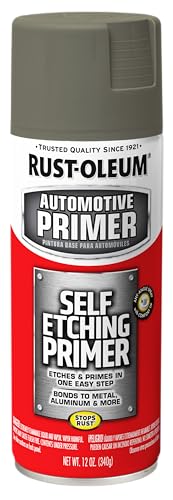
Rust-Oleum Self Etching Primer Spray
What We Like
- Etches and primes bare metal in one step
- Stops Rust formula prevents corrosion
- Dries to touch in 10 minutes
- Sprays upside down with any-angle technology
Trade-offs
- Oil-based formula requires solvent cleanup
- Limited to 12 sq ft coverage per can
A 30-minute recoat time means you can move from primer to topcoat in under an hour, which keeps a metal project rolling without long drying delays. This self-etching primer chemically bonds to bare metal, aluminum, and fiberglass while its Stops Rust formula locks out corrosion from the start. It suits anyone working on automotive panels, trailer frames, or raw steel parts who wants maximum adhesion without a separate etching step.
The trade-off is that this primer is oil-based, so cleanup requires solvent rather than soap and water. The Rust-Oleum Filler & Sandable Spray Primer fills minor scratches and sands smooth. This self-etching primer is designed for bare metal, aluminum, and fiberglass surfaces where maximum adhesion and rust prevention are the priorities. Pick this for bare metal that needs a tenacious grip; reach for the filler primer when you’re smoothing out old paint or small dings.
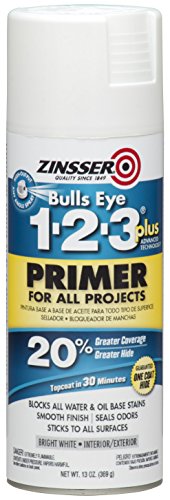
Zinsser Bulls Eye 1-2-3 Plus Spray Primer
What We Like
- Stain-blocking with one coat
- Bonds to glossy surfaces without sanding
- Accepts oil or latex topcoats
- Dries in 30 minutes
Trade-offs
- Oil-based formula requires solvent cleanup
- Only available in white finish
An oil-based formula that seals stains in a single coat and sticks to glossy surfaces without sanding sets this primer apart. For anyone tackling water stains, smoke marks, or old varnish, that stain-blocking ability means fewer coats and less frustration. It dries to the touch in 30 minutes, so you can move fast on a weekend project, and it works indoors or out on materials from drywall to metal. This is the pick when hiding imperfections matters more than covering a large area fast.
Coverage is the trade-off: at 12 square feet per can, you will need more cans for larger jobs. And because it is oil-based, you will need mineral spirits for cleanup rather than soap and water. If your project is small and stain-blocking is the priority, this primer earns its place. For large bare-metal panels or jobs where filling scratches matters most, one of the filler primers may suit you better.
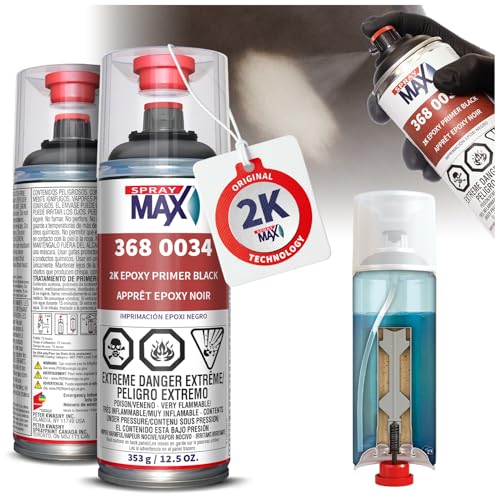
SprayMax 2K Epoxy Primer
What We Like
- Professional-grade 2K epoxy bonding strength
- Corrosion-resistant on steel and aluminum
- Fast 15-minute dust-dry time
- Variable nozzle for precise spray control
Trade-offs
- 2K system requires activation before spraying
- Heavier at 0.9 lb than some aerosol primers
A 2K epoxy formula that activates inside the can means this primer delivers the same chemical-curing bond professional shops get from mixing two-part paint, but without needing a spray gun or compressor. It dries to the touch in 15 minutes and sands smooth within hours, so you can move through a restoration or repair job quickly. For anyone priming bare metal on a car, motorcycle, or steel fabrication, the corrosion resistance and adhesion on aluminum and galvanized surfaces make it a serious step up from standard aerosol primers.
Activation is a one-way process: once you press the button on the bottom to mix the hardener, you have a limited working window before the can sets. So you need to plan your coats carefully. The Rust-Oleum Self Etching Primer works straight out of the can for quick jobs on lightly prepped metal. This SprayMax demands more attention but rewards you with a tougher, more durable foundation. It suits the builder who wants professional-grade results and is willing to follow the extra step.
U-POL Raptor Acid Etch Primer 1K Aerosol
What We Like
- Phosphoric acid ester for strong adhesion
- Etches and primes bare metal in one step
- Anti-corrosive barrier prevents rust
- No sanding required before topcoat
Trade-offs
- Only formulated for bare metal surfaces
- Requires direct topcoat for full protection
A phosphoric acid ester formula lets this primer bite into galvanized steel and aluminum without the extra step of mechanical sanding. That one-step etch-and-prime action saves time on bare metal panels and rub-throughs, creating a foundation that resists rust even in harsh conditions. For anyone working on automotive metal or galvanized structures, this aerosol delivers the adhesion that standard primers struggle to achieve on those slick, non-porous surfaces.
Specialization is the trade-off: this primer is built for bare metal, so it won’t help on plastic, wood, or previously painted surfaces. If your project is all metal, the flat fan nozzle lays down even coverage and you can topcoat immediately. For mixed-material jobs, a multi-surface primer like Rust-Oleum Self Etching Primer covers more ground but lacks the dedicated phosphoric acid bite that makes the Raptor so effective on galvanized steel.
Product photos
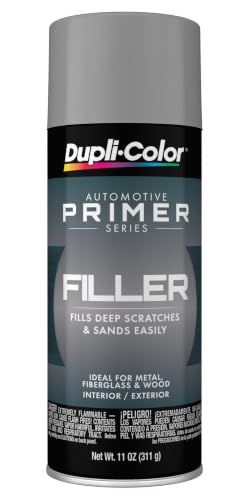
Dupli-Color Multi-Purpose Filler Primer
What We Like
- Fills deep scratches and minor imperfections
- High build formula for thick coverage
- Easy sanding for a smooth surface
- Improves top coat adhesion
Trade-offs
- At 0.9 lb, heavier than some competitors
- Requires sanding before top coat application
A high build formula means this primer can fill deep scratches and minor imperfections in a single pass, saving you from multiple layers of sanding and priming. That makes it a strong choice for anyone restoring an old car panel or repairing a heavily scratched surface where hiding flaws matters most. The easy sanding properties let you knock down the primer quickly to a smooth base, so your top coat grabs evenly and stays put.
Weight is the trade-off: at 0.9 pounds, this can feels slightly heavier than the Rust-Oleum Stops Rust Filler & Sandable Primer, which is 0.7 pounds. That extra mass comes from the thicker formula, but it also means you’ll work a little harder to hold the can steady during long sessions. If you’re fixing a small part or a single panel, it’s a fair exchange for the filling power; for a full car, you might prefer a lighter can for less fatigue.
Product photos
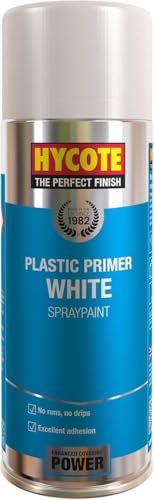
Hycote White Plastic Primer Spray Paint
What We Like
- Designed specifically for plastic surfaces
- Fast drying for quick project turnaround
- Works with acrylic, cellulosic, alkyd, polyurethane
Trade-offs
- Only 13.5 oz can covers less area than larger cans
- Requires a top coat for best results
This primer is designed specifically for plastic surfaces, including PVC, vinyl, and resin, so it skips the guesswork when you are painting bumpers, trim, or other plastic parts. The formula promotes maximum adhesion without needing a separate pretreatment, so you can move straight from cleaning to priming.
The Rust-Oleum Self Etching Primer handles bare metal directly, while the Hycote stays in its lane. That single-minded purpose makes it the better pick when you know your surface is plastic, but it is not a do-everything can.
Product photos
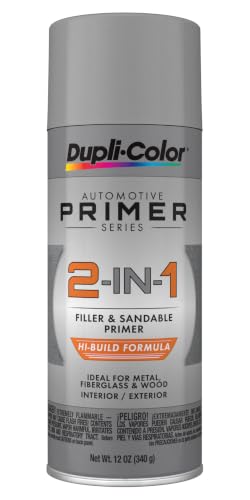
Dupli-Color Hi-Build Filler & Sandable Primer
What We Like
- Hi-build formula fills scratches
- Works on metal, fiberglass, wood
- Suitable for interior and exterior use
Trade-offs
- No interior or exterior use listed for plastic surfaces.
- Heavier than the Rust-Oleum Stops Rust spray primer at 1.0 pounds.
A 12-ounce hi-build formula means this primer lays down a thick, sandable layer that fills light scratches and surface imperfections in a single coat. That makes it a natural fit for anyone prepping metal, fiberglass, or wood for a refinishing job where hiding minor damage matters more than speed. It handles both interior and exterior work, so you can use it on a car panel or a piece of furniture without switching products. For a project with visible scratches or uneven grain, this is the primer that saves you from multiple rounds of filler and sanding.
The 12-ounce can holds less material than some competitors’ larger cans. For a full hood or a set of cabinets you might need two cans where one of the Rust-Oleum Stops Rust Filler & Sandable Spray Primer could cover the same area. But for spot repairs where filling power matters more than can size, the hi-build thickness delivers exactly what its name promises.
Product photos
Krylon COLORmaxx Paint & Primer Spray

What We Like
- Works on metal, wood, plastic, fabric, glass
- Fast drying for quick project turnover
- Rust protection and fade resistance included
- Sprays upside down for hard-to-reach spots
Trade-offs
- Not a dedicated etching primer for bare metal
- No chemical etch for raw, unpainted metal surfaces
With a surface list that covers metal, wood, plastic, wicker, fabric, and glass, Krylon COLORmaxx Paint & Primer Spray is one of the most versatile primers in this guide. It dries fast, so you can move from priming to painting in the same afternoon. The big-button tip sprays in any direction, even upside down, which makes those awkward angles on furniture or garden pieces much easier. The built-in rust protection and fade resistance mean it pulls double duty as both a primer and a protective layer, ideal for indoor and outdoor projects alike.
This is a general-purpose primer, not a specialized etching primer for bare metal like Rust-Oleum Self Etching Primer Spray. If you are priming raw, unpainted metal that needs maximum adhesion, the Krylon may require extra surface prep. But for the vast majority of mixed-material projects, wood, plastic, wicker, glass, this one saves you from buying multiple primers.
How We Evaluated Primers For Spray Paint
Our evaluation is a research-based analysis of manufacturer specifications, product data sheets, and patterns found in expert round-ups and owner feedback. We focused on the chemical adhesion mechanism each primer uses, etching, epoxy bonding, or mechanical filling, because that determines which surfaces it will stick to. We also examined dry times, recoat windows, and the need for sanding, as these factors directly affect project workflow.
The four criteria that mattered most were surface compatibility, adhesion technology, rust and corrosion protection, and ease of use. Surface compatibility means which materials the primer is formulated for. Adhesion technology covers etching versus epoxy versus filler. Ease of use includes dry time, cleanup requirements, and spray pattern control. We prioritized primers that offer clear, specific surface recommendations over those that claim broad “multi-surface” compatibility without the chemistry to back it up.
A research-led approach has limits: we cannot replicate the exact conditions of a garage, workshop, or outdoor project. Our recommendations are based on documented performance claims and reported owner experiences, not firsthand testing. We aim to give you the information to make an informed choice based on your specific surface and project requirements.
What To Look For In Primers For Spray Paint
Choosing the right primer starts with understanding your surface and the finish you want. A primer is not one-size-fits-all; the wrong chemistry can lead to peeling, poor adhesion, or rust bloom.
Match the primer’s adhesion chemistry to your surface: etching primers for bare metal, epoxy for high-strength bonding, filler primers for damaged surfaces, and stain-blocking primers for problem areas.
Surface Compatibility
The most critical factor is whether the primer is designed for your specific material. Dedicated etching primers contain phosphoric acid that bites into bare metal for maximum adhesion, while epoxy primers form a chemical bond with steel and aluminum. Plastic primers are formulated to flex with the substrate and prevent cracking. Multi-surface primers offer convenience but are not intended for raw, unpainted metal.
Adhesion Technology
Understanding how a primer adheres to a surface helps you predict its performance. Etching primers use acid to microscopically roughen metal, creating a mechanical and chemical bond. Epoxy primers (like the SprayMax 2K) require a catalyst to cure, producing a hard, corrosion-resistant layer. Filler primers build a thick film that can be sanded flat, but they rely on the surface being clean and slightly rough. Stain-blocking primers seal porous surfaces and contain pigments that prevent bleed-through.
Drying Time and Recoat Window
Fast-drying primers (10-30 minutes to touch) allow for quicker project turnaround, but you must check the recoat window, the time within which you can apply the next coat without sanding. Some oil-based primers require longer drying before sanding. Solvent cleanup is a trade-off for the superior adhesion and rust protection of oil-based formulas; if water-based cleanup is a priority, look for primers labeled as such.
- Confirm the primer is formulated for your surface (metal, plastic, wood, or fiberglass).
- Check if the primer requires a topcoat for full protection or if it can be left as a base.
- Verify the dry time and recoat window to plan your project schedule.
- Consider the can size and coverage area to ensure you have enough for the job.
One rule of thumb: if you are priming bare metal, use an etching or epoxy primer; for everything else, start with a dedicated multi-surface or filler primer.
Primers For Spray Paint Compared
The table below compares the nine primers across the key criteria that matter most for a successful paint job: surface compatibility, adhesion technology, and dry time.
| Product | Surface Compatibility | Drying Time | Formula Type |
|---|---|---|---|
| Rust-Oleum Stops Rust Filler & Sandable Spray Primer | Wood, metal, fiberglass | 10 minutes to touch/recoat | Oil-based |
| Rust-Oleum Self Etching Primer Spray | Bare metal, aluminum, fiberglass | 10 minutes to touch | Oil-based |
| Zinsser Bulls Eye 1-2-3 Plus Spray Primer | Drywall, concrete, wood, masonry, metal, glossy | 30 minutes | Oil-based |
| SprayMax 2K Epoxy Primer | Metal, Aluminum, Steel | Dust-dry in 15 min | 2K Epoxy |
| U-POL Raptor Acid Etch Primer 1K Aerosol | Galvanized steel, aluminum, bare metals | N/A | Phosphoric acid ester |
| Dupli-Color Multi-Purpose Filler Primer | N/A | N/A | High build |
| Hycote White Plastic Primer Spray Paint | All plastic surfaces, PVC, vinyl, resin | Fast drying | N/A |
| Dupli-Color Hi-Build Filler & Sandable Primer | Metal, Fiberglass & Wood | N/A | Hi-Build |
| Krylon COLORmaxx Paint & Primer Spray | Metal, wood, plastic, wicker, fabric, glass | Fast drying | N/A |
Frequently Asked Questions
What is the best primer for spray paint on bare metal?
For bare metal, an etching primer is the best choice because it contains acid that chemically bonds to the surface. The Rust-Oleum Self Etching Primer Spray is designed to etch and prime in one step, providing corrosion resistance for steel, aluminum, and fiberglass.
Can I use a multi-surface primer on plastic?
Some multi-surface primers, like the Krylon COLORmaxx Paint & Primer Spray, work on plastic, but a dedicated plastic primer is often better. The Hycote White Plastic Primer Spray Paint is formulated specifically for plastic surfaces, offering flexibility and adhesion that general primers do not provide.
How long should I wait before applying topcoat over primer?
Drying times vary by product. Many fast-drying primers are ready for topcoat in 10 to 30 minutes, while others may require up to an hour or more. Always check the manufacturer’s recoat window on the can to ensure proper adhesion and avoid sanding between coats.
Do I need to sand before using a filler primer?
Filler primers are designed to fill scratches and imperfections, but they still require the surface to be clean and free of loose material. Light sanding is recommended to create a mechanical key for the primer to grip, though some formulas, like the U-POL Raptor Acid Etch Primer, require no sanding before topcoat.
What is the difference between a 1K and 2K primer?
A 1K primer is a single-component aerosol that is ready to spray directly from the can. A 2K primer, like the SprayMax 2K Epoxy Primer, requires activation by mixing a hardener before use, which creates a stronger, more durable chemical bond. 2K primers are typically used for professional-grade applications where maximum adhesion and corrosion resistance are needed.
The Bottom Line
For the vast majority of DIY projects, the Rust-Oleum Stops Rust Filler & Sandable Spray Primer delivers the best balance of filling ability, sandability, and rust prevention. It is our top recommendation for auto enthusiasts and home users who need a fast-drying, versatile primer that works on multiple surfaces and leaves a smooth foundation for paint.
If your project involves bare metal that needs chemical etching, the Rust-Oleum Self Etching Primer Spray is the right pick. For those dealing with water stains, smoke damage, or glossy surfaces that resist paint, the Zinsser Bulls Eye 1-2-3 Plus Spray Primer offers exceptional stain-blocking performance. For professional-grade bonding on steel or aluminum, the SprayMax 2K Epoxy Primer is worth the extra effort.
The single most important buying factor is surface compatibility. Choosing a primer formulated for your specific material, whether it is bare metal, plastic, wood, or fiberglass, is the difference between a paint job that lasts for years and one that peels within weeks.
