
10 Best Primers For Fiberglass in 2026
This post contains affiliate links. As an Amazon Associate, we earn from qualifying purchases.
For fiberglass projects, the Rust-Oleum Automotive Sandable Primer Spray is our best overall pick because it dries to the touch in just 10 minutes and can be wet or dry sanded for a smooth finish. The Rust-Oleum Stops Rust Automotive Primer Spray is our best versatile choice, and the TotalBoat TotalProtect Marine Barrier Coat Epoxy Primer leads for marine blister prevention.
Working with fiberglass presents unique challenges: its smooth, non-porous surface can lead to adhesion problems, and any imperfections in the substrate will telegraph through the final paint job. A dedicated primer bridges the gap between the fiberglass and your topcoat, providing a uniform surface for paint to grip.
This guide is based on a thorough analysis of manufacturer specifications, expert recommendations, and patterns in owner feedback. We evaluated each primer on adhesion, sandability, coverage, and application method to help you choose the right one for your specific project.
Top 10 Primers For Fiberglass in the Market

Certain content that appears on this site comes from Amazon. This content is provided "as is" and is subject to change or removal at any time.
The Best Primers For Fiberglass, Reviewed
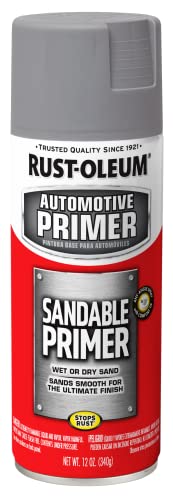
Rust-Oleum Automotive Sandable Primer Spray
What We Like
- Wet and dry sandable for smooth finish
- Stops Rust formula protects against corrosion
- Dries to touch in 10 minutes
- Works on wood, metal, and fiberglass
Trade-offs
- Oil-based formula requires solvent for cleanup
- 12 oz can covers only 15 sq ft
A dry-to-touch time of 10 minutes means you can recoat quickly, which is a real advantage when prepping surfaces for paint. The Stops Rust formula provides a rust-resistant base coat that matters on metal components, and the flat sandable finish creates the smooth surface topcoats need to adhere well. This primer works on wood, metal, and fiberglass surfaces, making it a fast foundation for automotive or general repair work.
The oil-based formula needs mineral spirits or similar solvent for cleanup. That makes it less convenient than water-based options like the NADAMOO All Surface Epoxy Primer Spray if you prefer quick soap-and-water cleanup. Coverage is also limited to 15 square feet per can, so a larger project like a full vehicle panel will require multiple cans. For smaller jobs like a patch repair on metal or fiberglass, the speed and rust protection make this a practical choice.
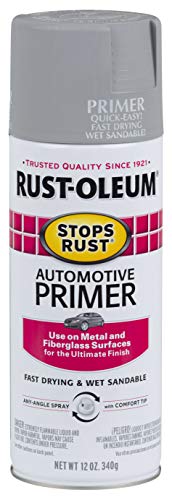
Rust-Oleum Stops Rust Automotive Primer Spray
What We Like
- Works on wood, metal, and fiberglass
- Rust-resistant oil-based formula
- Fast drying and recoat in 15 minutes
- Wet sandable for smooth finish
Trade-offs
- Oil-based formula requires solvent cleanup
- 12 oz can covers only 12 sq. ft.
A 12-ounce can that covers up to 12 square feet and dries to handle in 15 minutes means you can apply a coat and be ready for the next step quickly. This Rust-Oleum spray is formulated for wood, metal, and fiberglass surfaces, so it fits neatly into a mixed-material project like an old boat or car body with both metal and fiberglass parts. The Stops Rust formula provides a rust-resistant base coat for outdoor use, and the Comfort Tip lets you spray from any angle, which helps reach awkward corners without flipping the can.
Oil-based primer needs mineral spirits or paint thinner for cleanup, so it is less convenient than water-based options if you are working indoors without good ventilation. For a versatile one-can solution that handles fiberglass, metal, and wood with fast drying and rust resistance, this primer is a practical choice for mixed-material projects.
TotalBoat TotalProtect Marine Barrier Coat Epoxy Primer
What We Like
- Prevents fiberglass blisters and metal corrosion
- High-build two-part epoxy barrier coat
- Fast drying, flexible and durable
Trade-offs
- Two-part epoxy requires mixing before use
- Needs thinner for spray application
With 225 square feet of coverage per gallon at 7 mils wet, this two-part epoxy primer lays down a thick, protective barrier that seals out moisture and stops gelcoat blisters before they start. Designed for both above and below the waterline, it bonds directly to fiberglass and underwater metals, making it a go-to for anyone restoring a hull or prepping a boat for bottom paint. The fast-drying formula creates a flexible, durable epoxy barrier coat.
The TotalBoat TotalProtect Marine Barrier Coat Epoxy Primer is a two-part epoxy system that prevents fiberglass blisters and metal corrosion. It is a serious choice for boat owners who want a durable, marine-grade foundation. You have to mix the two parts yourself, and if you plan to spray it, you will need the dedicated thinner. That extra step is worth it for the level of blister prevention it provides, especially compared to a simpler single-part primer like the Rust-Oleum Automotive Sandable Primer Spray, which is not designed for the same marine environment. This primer is for the owner who is willing to spend a little more time on prep.
TotalBoat Marine Topside Boat Paint Primer

What We Like
- Covers completely in one coat
- Dries fast, sands in 60-90 minutes
- Works on fiberglass, wood, gelcoat
- Chromate-free and lead-free
Trade-offs
- Needs thinning for spray application
- Cannot apply thicker than recommended or cure fails
A one-part primer that covers completely in a single thin coat means less time sanding between layers and a faster path to your topside finish. It is designed for use above the waterline on fiberglass, wood, or gelcoat and delivers a sandable surface in 60 to 90 minutes at 65°F. The high-solids formula seals well without building up too thick, which is exactly what you need before laying down a polyurethane or enamel topcoat.
This is a topside-only primer, so it won’t help with blister prevention below the waterline like a two-part epoxy would. If you are spraying, you will need to thin it with xylene, adding an extra step compared to a rattle-can option like Rust-Oleum Automotive Sandable Primer Spray. But for a clean, fast topside job on the deck or cabin, this primer delivers the smooth foundation that makes the finish paint needs.
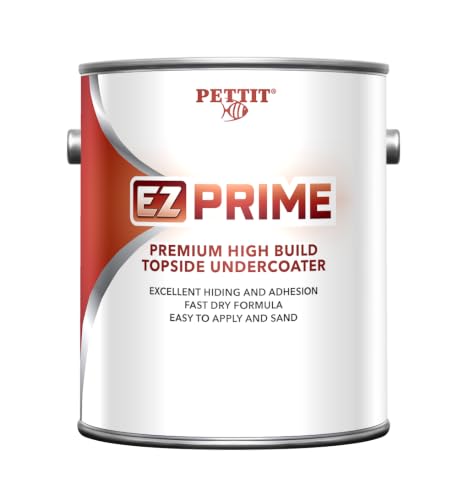
Pettit EZ Prime High Build Topside Undercoater
What We Like
- Fills cracks, checks, and pits
- Fast drying for quick sanding
- One-coat coverage saves labor
Trade-offs
- Designed for topside, not below waterline
- Requires sanding for best finish
A high-solids formula that fills cracks, checks, and surface irregularities in a single coat means you spend less time layering primer and more time moving toward the topcoat. Its fast-drying nature sands easily, so you can knock down imperfections quickly and keep your project rolling. That combination of filling power and speed makes it a natural fit for anyone refinishing a topside surface where appearance matters.
This is a quart-sized can, which covers a modest area. If you are working on a large hull, you may need multiple quarts or a different format. Compared to the Rust-Oleum Automotive Sandable Primer Spray, which comes in a 12-ounce aerosol can, the Pettit offers a larger volume of primer per container, but the Rust-Oleum is easier to apply in tight spots without a spray gun. For a dedicated topside refinish where you want to hide weathering and create a uniform base, this primer delivers exactly what the name promises.
Product photos
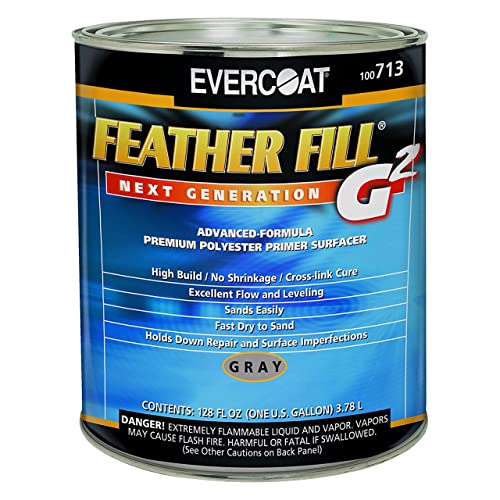
Evercoat Feather Fill G2 Polyester Primer Surfacer
What We Like
- Shrink-resistant formula
- Fast dry-to-sand time
- Smooth spraying application
- Works on fiberglass and rigid plastics
Trade-offs
- At 12 pounds, heavy for handheld use
- Requires 180-320 grit sanding steps
A full 128 fluid ounces of polyester primer surfacer means you can cover multiple fiberglass panels or a whole boat hull without running out mid-project. This Evercoat formula is designed to spray smoothly and sand quickly, with a shrink-resistant formula that bonds to fiberglass, rigid plastics, and more. It provides a flat foundation for any paint system.
At 12 pounds, this gallon weighs fifteen times as much as a Rust-Oleum Automotive Sandable Primer Spray can, so it’s a container you’ll want to set on a bench rather than carry around. The trade-off buys you a high-build polyester primer that sands quickly with 180, 220, or 320 grit paper, which saves time on larger fiberglass panels. For someone prepping a boat or auto body, that fast dry-to-sand cycle matters more than a few extra pounds.
Ideal for painters and body shop professionals who need a high-build polyester primer surfacer for fiberglass or rigid plastics who need a fast-drying, shrink-resistant foundation. Not ideal for small touch-ups or lightweight handheld work where a 12-pound container is inconvenient.
Fiberglass Supply Depot Duratec Grey Surface Primer

What We Like
- Eliminates pinholes and surface defects
- Builds up to 40 mil wet-on-wet
- Adheres to epoxies and fiberglass
- Polishes to a high-gloss finish
Trade-offs
- Requires careful application to avoid runs at 40 mil build
- Air-cure still needs proper ventilation and drying time
With an air-cure technology that works even in thin coats, you can move through your project without waiting days between layers. The primer builds up to 40 mil wet-on-wet, which is useful for composite plugs, master molds, and high-density foams where a pinhole-free, porosity-free surface is critical. It polishes to a high-gloss finish ready for mold making or as a base for topcoats, making it a strong pick for anyone building production-grade fiberglass parts.
This product is designed for composite plugs and master molds, not for quick touch-ups or small repairs where a spray can is more practical. For smaller jobs, the Rust-Oleum Automotive Sandable Primer Spray offers a different form factor. But for serious mold and plug work where surface perfection matters most, this Duratec primer provides the high-build and porosity-free surface that spray cans cannot match.
Product photos
Evercoat Slick Sand Polyester Primer Surfacer

What We Like
- Fills rough surfaces in one coat
- Works on fiberglass, metal, aluminum
- Sands easily with 180-220 grit
- Convenient foundation for any paint system
Trade-offs
- At 11.5 lb, heavy for a single gallon
- Heavy at 11.5 pounds per gallon
A full 128 ounces of polyester primer surfacer means you can cover large fiberglass panels or multiple repair areas without running out mid-project. This stuff is formulated to fill rough and uneven surfaces in a single coat, which saves serious time when you’re prepping a boat hull, an RV sidewall, or a custom fiberglass part for paint. The bond is strong on fiberglass, metal, and aluminum, and it sands cleanly with 180 or 220 grit on an orbital sander, so you can get a smooth foundation fast. It’s the kind of product that makes sense if you want to move through the primer stage quickly and get to topcoat.
Weighing 11.5 pounds per gallon, this primer surfacer is noticeably heavier than spray-can alternatives like Rust-Oleum’s 0.8-pound Sandable Primer Spray. That mass means you’ll need a spray gun or roller to apply it, it’s not a rattle-can product. The payoff is a single coat that fills rough and uneven surfaces on metal, aluminum, fiberglass, and wood. Owners who have used it report that the weight translates to a high-build layer that reduces the number of coats needed, saving time on larger jobs. Just be prepared to set up proper spraying equipment before starting.
Product photos
NADAMOO All Surface Epoxy Primer Spray

What We Like
- Bonds to glass, porcelain, and fiberglass
- Resists corrosion and chemical damage
- Thick formula covers imperfections and dark colors
- Works indoors and outdoors
Trade-offs
- Coverage only 10-12 sq. ft per can
- Requires clean, grease-free surface before application
A single can of NADAMOO All Surface Epoxy Primer Spray covers about 10-12 square feet with two light coats. That is enough for smaller projects like a fiberglass chair, a plastic trim piece, or a metal patio table. The modified epoxy resin formula is designed to seal and create a smoother, more even finish, ensuring superior adhesion between the top coat and the substrate. The thick consistency covers imperfections and neutralizes dark colors underneath, which means fewer coats of your final paint and a truer, more vibrant finish. For anyone working on mixed-material repairs or refinishing odd items around the house, this spray primer offers exceptional adhesion without needing a separate mixing step.
The NADAMOO primer uses modified epoxy resins to resist corrosion and chemical damage, so it holds up well on indoor furniture, outdoor wood trim, or metal patio furniture that sees moderate use. One can covers about 10-12 square feet with two light coats, which is enough for small surfaces or targeted repairs. For a large project, you’ll need multiple cans, but the adhesion is reliable on materials like metal, wood, plastic, porcelain, glass, drywall, fiberglass, and concrete.
Product photos
EverBond Multipurpose RV Roof Primer

What We Like
- 30% more bonding strength claimed
- Covers over 200 square feet
- Works on fiberglass, wood, metal, concrete
- Designed for RV and camper roofs
Trade-offs
- Heavy at 8.6 pounds for a gallon
- Not for spray application or small touch-ups
A gallon that covers over 200 square feet and promises up to 30% more bonding strength makes this a serious option for anyone recoating an RV roof. It sticks to fiberglass, EPDM rubber, wood, concrete, and metal, so you can use it on the whole roof surface without switching products. That versatility and the extra grip matter most when you’re laying down a roof coating that has to hold up through sun, rain, and highway vibration.
Weight and focus are the main considerations here. At 8.6 pounds per gallon, it’s not something you want to carry up a ladder in one hand. And while it’s built for RV roofs, it covers EPDM rubber, wood, fiberglass, concrete, and metal, so you can use it on the whole roof surface without switching products. If your project is a full RV roof recoat, the EverBond delivers the coverage and adhesion you need in one can.
Product photos
How We Evaluated Primers For Fiberglass
Our evaluation began with a deep dive into manufacturer data sheets and technical documentation for each primer. We focused on chemical composition, recommended surface preparation, and compatibility with common topcoats. We also studied expert round-ups from professional painters and marine restorers to understand which products perform best in real-world conditions.
The four criteria that mattered most were adhesion to fiberglass, sandability after curing, coverage area per can or gallon, and the product’s intended use case (automotive, marine, or general DIY). A primer that sticks well but requires excessive sanding or multiple coats loses points for efficiency. Similarly, a high-build filler might be ideal for boat hulls but overkill for a small repair on an RV.
It’s important to note that this is a research-led evaluation, not a hands-on test. We cannot speak to the feel of a spray pattern or the exact ease of sanding a particular formula.
What To Look For In Primers For Fiberglass
Choosing the right primer for fiberglass means understanding the specific demands of your project. The key factors are adhesion, sandability, build quality, and application method.
The best fiberglass primer sticks tenaciously to the smooth surface, sands easily to a uniform finish, and provides the right amount of fill for your project’s imperfections.
Adhesion and Compatibility
Fiberglass is a non-porous, often gel-coated surface that resists mechanical bonding. Look for primers explicitly labeled for fiberglass or composite materials. Two-part epoxy primers offer the strongest chemical bond and are ideal for marine applications where moisture resistance is critical. Polyester primer surfacers, like the Evercoat Feather Fill G2, are formulated to bond with fiberglass and rigid plastics, making them a top choice for body shops.
Sandability and Build
The ability to sand a primer to a smooth, level surface is essential for a professional-looking paint job. “Wet sandable” primers allow you to use water as a lubricant, reducing clogging on sandpaper and producing an ultra-smooth finish. High-build primers, such as the Pettit EZ Prime, are designed to fill minor scratches, pinholes, and surface imperfections in a single coat, saving significant labor time. Check the manufacturer’s recommended grit range for sanding (e.g., 180-320 grit).
Coverage and Application Method
Consider the scale of your project. Spray cans offer convenience and fast drying for small repairs and touch-ups, but they cover a limited area, typically 10-15 square feet per can. For larger surfaces like a boat hull or RV roof, a quart or gallon of brushable or sprayable primer is far more economical. The EverBond Multipurpose RV Roof Primer covers over 200 square feet per gallon, making it ideal for large, continuous surfaces.
- For small repairs and touch-ups, choose a spray can for ease of use.
- For large areas like boat hulls or RV roofs, buy a quart or gallon to save money.
- For marine use below the waterline, a two-part epoxy barrier coat is essential.
- For bodywork and high-fill applications, a polyester primer surfacer is the right tool.
- Always check the product’s compatibility with your specific type of fiberglass and topcoat.
A common rule of thumb: if you can see the fiberglass weave or feel surface imperfections, you need a high-build primer.
Primers For Fiberglass Compared
The table below compares the ten primers on key specifications, helping you quickly identify the best option for your fiberglass project.
| Product | Surface Compatibility | Coverage | Finish |
|---|---|---|---|
| Rust-Oleum Automotive Sandable Primer Spray | Wood, metal, fiberglass | Up to 15 sq ft | Flat, sandable |
| Rust-Oleum Stops Rust Automotive Primer Spray | Wood, metal, fiberglass | Up to 12 sq. ft. | Flat Light Gray |
| TotalBoat TotalProtect Marine Barrier Coat Epoxy Primer | Fiberglass, metal | 225 sq. ft./gal at 7 mils wet | White or Gray |
| TotalBoat Marine Topside Boat Paint Primer | Fiberglass and wood | N/A | White and gray |
| Pettit EZ Prime High Build Topside Undercoater | Fiberglass, Wood, Metal | One-Coat Coverage | N/A |
| Evercoat Feather Fill G2 Polyester Primer Surfacer | Fiberglass, rigid plastics, SMC | N/A | Gray |
| Fiberglass Supply Depot Duratec Grey Surface Primer | fiberglass, wood, MDF, brick, concrete | N/A | High-gloss polishable |
| Evercoat Slick Sand Polyester Primer Surfacer | metal, aluminum, fiberglass | N/A | N/A |
| NADAMOO All Surface Epoxy Primer Spray | Metal, wood, plastic, porcelain, glass, fiberglass, drywall, concrete | 10-12 sq. ft (2 light coats) | Matte gray |
| EverBond Multipurpose RV Roof Primer | EPDM, wood, fiberglass, concrete, metal | 200+ sq ft per gallon | N/A |
Frequently Asked Questions
What is the best primer for fiberglass?
The Rust-Oleum Automotive Sandable Primer Spray is our best overall pick for its fast drying time, sandability, and corrosion protection. For marine use, the TotalBoat TotalProtect Marine Barrier Coat Epoxy Primer is the top choice for blister prevention.
Can I use regular spray paint as a primer on fiberglass?
It is not recommended. Regular spray paint lacks the adhesion promoters and chemical formulation needed to bond with smooth, non-porous fiberglass. A dedicated fiberglass primer ensures your topcoat adheres properly and lasts longer.
Do I need to sand fiberglass before priming?
Yes, sanding is almost always required. Lightly sand the fiberglass surface with 180-320 grit sandpaper to create a mechanical “tooth” for the primer to grip. Clean the surface thoroughly of all dust and contaminants before applying primer.
What is the difference between epoxy primer and polyester primer for fiberglass?
Epoxy primers offer superior chemical and moisture resistance, making them ideal for marine and below-waterline applications. Polyester primer surfacers are high-build fillers that sand easily and are excellent for bodywork and cosmetic repairs on fiberglass.
How long should I wait before sanding fiberglass primer?
Drying times vary by product. Many fast-drying primers can be sanded in 60-90 minutes, while two-part epoxies may require several hours or overnight. Always follow the manufacturer’s recommended recoat and sanding times for the best results.
The Bottom Line
For most DIYers and hobbyists, the Rust-Oleum Automotive Sandable Primer Spray offers the best balance of speed, performance, and value. It dries quickly, sands beautifully, and provides reliable adhesion for small to medium fiberglass repairs. If you are working on a boat or need maximum moisture resistance, invest in the TotalBoat TotalProtect Marine Barrier Coat Epoxy Primer for its superior protection.
Budget-conscious shoppers or those with large fiberglass surfaces should look to the EverBond Multipurpose RV Roof Primer for its exceptional coverage per gallon. Professionals needing a high-build filler will find the Evercoat Feather Fill G2 Polyester Primer Surfacer indispensable for eliminating surface defects quickly.
The single most important factor in a successful fiberglass paint job is proper surface preparation. No primer can compensate for a poorly cleaned or inadequately sanded surface. Take the time to prep correctly, and your chosen primer will do its job flawlessly.
