
8 Best Paper For Fine Art Prints in 2026
This post contains affiliate links. As an Amazon Associate, we earn from qualifying purchases.
For fine art prints that truly represent your work, the Hahnemühle Platinum Rag Fine Art Paper is our best overall pick. It combines 100% cotton archival quality with a smooth surface that captures fine detail and bright contrast. For a textured, traditional feel, the Canson Infinity Arches BFK Rives Paper is our best textured matte choice, while the Canson Infinity Rag Photographique Paper offers an ultra smooth surface for photographers.
Choosing the right paper for fine art prints means balancing surface texture, weight, and archival properties. A paper that looks beautiful in the package may not hold ink the way you expect, and a surface that suits a vibrant photograph might wash out a delicate pencil drawing.
This guide is based on manufacturer specifications, expert round-ups, and patterns we found in owner feedback. We organized eight top papers by their strengths to help you match the right sheet to your medium and printing goals.
Top 8 Fine Art Papers For Inkjet Prints in the Market
Certain content that appears on this site comes from Amazon. This content is provided "as is" and is subject to change or removal at any time.
The Best Fine Art Papers For Inkjet Prints, Reviewed
Hahnemühle Platinum Rag Fine Art Paper

What We Like
- 100% cotton for archival quality
- Smooth subtle texture suits fine detail
- Natural bright white enhances print contrast
- Acid and alkaline buffering free
Trade-offs
- Single-sided only for inkjet printing
- 300 gsm is midweight, not the heaviest available
A 300 gsm, 100% cotton sheet with a smooth, subtle texture gives fine art prints a natural bright white base that makes colors and blacks stand out without looking harsh. The paper is acid and alkaline buffering free, which helps prevent yellowing and degradation over time. For artists who want a reliable surface that handles fine detail and crisp edges, this delivers exactly that balance of feel and permanence.
The trade-off is that its smooth surface, while excellent for sharp inkjet reproduction, won’t give you the toothy, textured handfeel that some painters and printmakers prefer for expressive, heavy-layered work. Compared to Canson Infinity Arches BFK Rives, which offers a soft textured pure white matte finish at 310 gsm, the Hahnemühle leans cleaner and more refined. Choose this when your priority is archival stability and a pristine, bright canvas for photographic or digital fine art prints.
Canson Infinity Arches BFK Rives Paper

What We Like
- 100% cotton for archival quality
- Soft textured matte surface
- Acid-free for long-lasting prints
- 310 gsm heavy weight
Trade-offs
- 8.5×11 size limits larger print formats
A 310 gsm, 100% cotton paper gives this sheet a sturdy, substantial feel that holds ink beautifully without curling or buckling. The soft textured matte surface is the real draw here, it catches light gently and gives fine art prints a tactile, painterly quality that smooth papers can’t match. This is the paper to reach for when you want your work to feel like a true art print, not just a digital output. It suits artists who prize surface character and archival longevity over razor-sharp detail reproduction.
The soft textured surface gives prints a painterly feel, but it’s not designed for applications that demand razor-sharp line work. If your work relies on ultra-fine detail, a smoother paper like the Hahnemühle Platinum Rag may be a better fit. For artists who value surface character and a traditional aesthetic, this paper delivers a gallery-worthy result in the standard 8.5×11 format.
Canson Infinity Rag Photographique Paper

What We Like
- 100% cotton rag for archival prints
- Ultra smooth surface for fine detail
- No optical brighteners for stable white
- Museum-grade acid free construction
Trade-offs
- 11 x 17 inch size limits large format work
- Heavier than many fine art papers at 2.8 pounds per box
A 310 gsm 100% cotton rag paper with an ultra smooth surface and zero optical brighteners means your fine art prints will hold sharp detail and stay true to their white base for decades. This is the paper for photographers and digital artists who want a flawless, almost photographic finish without the risk of yellowing over time. The museum-grade, acid free construction backs up that archival promise, making it a natural fit for limited edition prints or gallery work where permanence matters as much as the image itself.
The ultra smooth surface delivers pinpoint clarity, which is exactly what photographers and digital artists want for sharp detail. For larger prints, the Moab Entrada Rag Bright 300 offers a similar cotton base in bigger sizes, while this paper stays at 11 x 17 inch sheets. Anyone chasing a clean, modern look will find this paper delivers exactly that.
Hahnemühle Museum Etching Paper

What We Like
- 100% rag for archival quality
- Subtle texture adds tactile depth
- Natural white for neutral tones
Trade-offs
- Letter size limits large-format prints
- Texture too subtle for highly detailed prints
A 100% rag fine art paper means your prints are built to last, with a natural white base that keeps colors true without the harshness of bright optical brighteners. The subtle surface texture gives each print a gentle, handcrafted feel, perfect for reproductions of drawings, etchings, or paintings where you want the paper itself to contribute to the mood. It suits artists who value archival integrity and a soft, non-glossy finish that feels like traditional printmaking paper.
The trade-off is that this paper’s letter-size sheets (8.5 x 11 inches) limit you to smaller prints. If you routinely work at 11 x 17 or larger, you’ll want to look at a bigger option like the Canson Infinity Arches BFK Rives. It’s a paper that rewards a deliberate, tactile approach to fine art printing.
Epson Velvet Fine Art Paper
What We Like
- 100% cotton rag for archivability
- Bright white surface for color reproduction
- Museum-quality acid-free base
- Enhanced 1440 dpi printing support
Trade-offs
- Only 20 sheets per pack, fewer than rivals
- Not double-sided, limiting print options
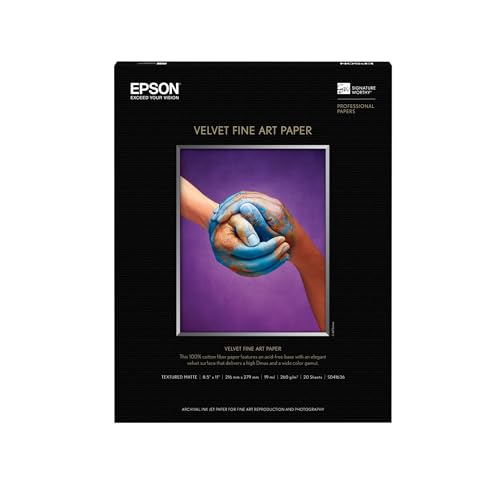
A bright white, 100% cotton rag surface supports excellent color reproduction for fine art prints. The museum-quality acid-free base helps preserve prints and photos over time, making it suitable for artists and photographers who want archival integrity. This paper is designed for those who value a bright white surface and archival quality.
If you frequently print larger or in higher volume, those alternatives give you more paper per purchase. But for smaller, gallery-ready prints where surface brightness and cotton rag purity matter most, this Epson paper delivers exactly what the label promises.
Product photos
Finestra Art Smooth Fine Art Paper
What We Like
- Double-sided for twice the prints
- 100% cotton archival surface
- Bright white for wide color gamut
- Works with all major inkjet brands
Trade-offs
- 5×7 size limits larger print projects
- Only 50 sheets in the pack
- Smooth surface not for textured looks
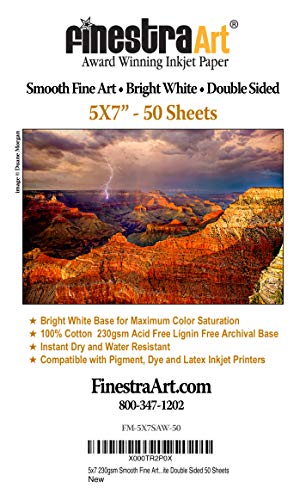
Fifty sheets of 100% cotton paper in a 5×7 size make this a compact option for fine art prints. The bright white surface is designed for maximum color gamut and color fidelity, and the double-sided design lets you use both sides. The paper is archival by ISO standards and acid and lignin free, which helps preserve your work. The smooth surface works with all major inkjet printers, so it is a practical choice for small-format printing.
At 5×7 inches, this paper is limited to postcard-sized prints, so it won’t work for gallery pieces or portfolio sheets. The smooth surface is a deliberate choice for crisp detail, but it lacks the texture some artists want for certain reproductions. Compared to larger sheets from other brands like Hahnemühle or Canson, this one is clearly for small-format projects where double-sided printing matters.
Product photos
Moab Entrada Rag Bright 300 Paper
What We Like
- 300 gsm heavyweight for durability
- 100% cotton archival quality
- Double-sided for versatile printing
- Bright white with D65 103 brightness
Trade-offs
- Smooth hotpress surface lacks texture for some styles
- Contains OBAs that some archivists avoid
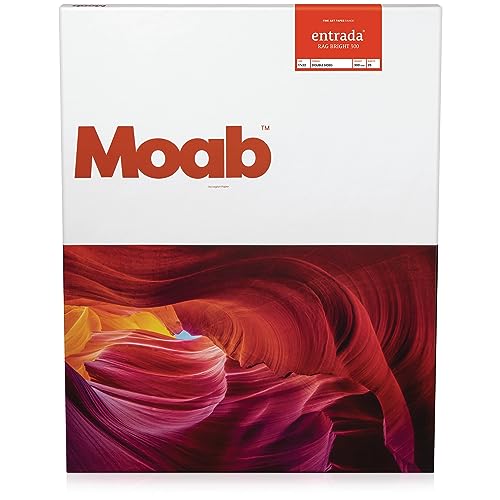
A 300 gsm weight and 100% cotton construction give this paper a sturdy, archival feel that holds up to handling and framing without curling. The double-sided design means you can print on both sides, making it efficient for portfolios or proofs where you want to maximize each sheet. Its smooth hotpress matte surface delivers crisp detail and sharp edges, ideal for photographic prints or digital art with fine lines. This paper suits artists who need a bright white base that makes colors pop and black-and-white prints look rich and contrasty, all while keeping a professional, non-reflective finish.
The trade-off here is that the smooth hotpress surface lacks the tooth or texture that some watercolor or charcoal-style prints benefit from. If you prefer a more tactile, papery feel, you might lean toward a textured option like Canson Infinity Arches BFK Rives. Also, the paper contains optical brightening agents (OBAs) to achieve its bright white look, which some users may want to note. For color accuracy and a clean, modern aesthetic in double-sided printing, this paper delivers where it counts.
Product photos
Breathing Color Optica One Fine Art Paper
What We Like
- 100% cotton fiber construction
- Bright white for black and white
- Archival certified over 100 years
- Compatible with Canon, HP, Epson
Trade-offs
- Only available in 8.5×11 inch size
- 25-sheet pack limits high-volume jobs
This 300 gsm paper with a 15.4 mil thickness feels substantial and holds up well under ink. The bright white 100% cotton surface is designed for black and white and color prints, giving you clean highlights and solid contrast. It meets Fine Art Trade Guild archival standards, so your prints can last beyond 100 years under proper care. The smooth matte finish keeps the focus on your image without added texture.
Product photos
How We Evaluated Fine Art Papers For Inkjet Prints
Our research began with the core specifications that define a fine art paper: fiber content (cotton rag versus alpha-cellulose), weight (gsm), surface finish (smooth, textured, or etched), and archival certifications like acid-free and OBA-free construction. We cross-referenced manufacturer data sheets with expert recommendations from the art-printing community to see which papers consistently earned consistent praise for print quality and durability.
The four criteria that mattered most were archival quality, surface texture compatibility, and sheet size availability. Archival quality ensures your prints resist yellowing and fading for decades, and we prioritized 100% cotton papers first. Surface texture determines how ink absorption and detail sharpness, which is why we separated papers with distinct finishes like hot press smooth and cold press textured. Sheet size directly affects what you can print, so we noted which papers limit you to letter sizes versus larger formats.
An evaluation based on research has honest limits. The recommendations reflect what the specifications and the collective feedback from experienced users suggest about each paper’s performance, not a hands-on comparison.
What To Look For In Fine Art Papers For Inkjet Prints
Choosing the right fine art paper is about matching the paper’s properties to your printer, your subject, and your display goals. The best paper for a high-contrast black-and-white photograph is not the same as the best paper for a watercolor reproduction.
Look for 100% cotton rag paper for archival longevity, a surface texture that suits your image detail, and a weight around 300 gsm for durability. Avoid papers with optical brighteners (OBAs) if you want the whitest stable print over time.
Paper Base: Cotton Rag vs. Alpha-Cellulose
Cotton rag paper is the gold standard for fine art prints. Made from cotton fibers, it is naturally acid-free and resists yellowing and degradation for generations. Most top-tier papers in this guide use 100% cotton. Alpha-cellulose papers are a more affordable alternative but do not offer the same archival longevity. For prints you intend to sell or display long-term, always choose cotton rag.
Surface Texture: Smooth vs. Textured
The surface of the paper dramatically affects how ink sits and how detail appears. Smooth or ultra-smooth surfaces (like hot press) produce sharp, crisp detail and are ideal for photographs, digital art, and fine line work. Textured surfaces (like cold press or etching) add a tactile, handmade feel that suits reproductions of traditional watercolor or pencil drawings. The trade-off is that texture can soften fine detail, so choose based on your image content.
Paper Weight (gsm) and Thickness
Weight is measured in grams per square meter (gsm). A weight around 300 gsm is considered a standard heavy fine art paper that feels substantial and resists buckling when wet with ink. Heavier papers above 300 gsm offer more rigidity but may be too thick for some printers feed mechanisms. Always check your printer specifications for the maximum paper weight it accepts.
- Verify your printer supports the paper weight and thickness.
- Check if the paper is single-sided or double-sided for your print run.
- Confirm the size fits your printer tray or requires manual feeding.
- Look for papers without optical brighteners if you want long-term white stability.
A good rule of thumb: for photographs and digital art, choose a smooth, bright white cotton rag paper around 300 gsm. For traditional media reproductions, choose a textured matte paper.
Fine Art Papers For Inkjet Prints Compared
The table below compares each paper key specifications side-by-side, including fiber content, weight, surface texture, and sheet count, so you can quickly narrow your choice.
| Product | Material | Surface | Sheets |
|---|---|---|---|
| Hahnemühle Platinum Rag Fine Art Paper | 100% cotton | Smooth, subtle textured | 25 Sheets |
| Canson Infinity Arches BFK Rives Paper | 100% cotton | Matte, soft textured | 25 Sheets |
| Canson Infinity Rag Photographique Paper | 100% cotton rag | Ultra smooth | 25 Sheets |
| Hahnemühle Museum Etching Paper | 100% rag | Subtle texture | N/A |
| Epson Velvet Fine Art Paper | 100% cotton rag | Bright white matte | 20 sheets |
| Finestra Art Smooth Fine Art Paper | 100% cotton | Double-sided, smooth | 50 sheets |
| Moab Entrada Rag Bright 300 Paper | 100% Cotton | Smooth (Hotpress) Matte | 25 Sheets |
| Breathing Color Optica One Fine Art Paper | 100% cotton fiber | Smooth matte | 25 sheets |
Frequently Asked Questions
What is the best paper for fine art prints?
The best paper for fine art prints is the Hahnemühle Platinum Rag Fine Art Paper, which combines 100% cotton archival quality with a smooth surface that captures fine detail and bright contrast. It is ideal for fine art photographers and digital artists who want crisp, long-lasting prints.
What is the difference between matte and glossy fine art paper?
Matte fine art paper has a non-reflective surface that absorbs ink, producing a soft, flat finish that is ideal for reproductions of paintings and drawings. Glossy paper has a reflective coating that produces sharper detail and more vibrant colors, but it can show fingerprints and is less common for traditional fine art.
Is 100% cotton paper necessary for archival prints?
Yes, 100% cotton rag paper is the industry standard for archival prints because it is naturally acid-free and resists yellowing and degradation over time. Papers made from alpha-cellulose or wood pulp are more affordable but will not last as long under display conditions.
What paper weight is best for fine art printing?
A weight of 300 gsm is the most common and versatile choice for fine art prints, offering a substantial feel and resistance to buckling. Heavier papers above 300 gsm are more rigid but require a printer that can handle the thickness.
Can I use regular photo paper for fine art prints?
Regular photo paper is not recommended for fine art prints because it lacks the archival properties, surface texture, and weight that give fine art prints their premium feel and longevity. Fine art papers are designed to resist fading and yellowing for decades, while standard photo papers may degrade within a few years.
The Bottom Line
For most artists and photographers, the Hahnemühle Platinum Rag Fine Art Paper is the best overall choice. Its 100% cotton construction and smooth, bright white surface deliver crisp detail and archival longevity that makes your prints gallery-ready. It is the paper to buy if you want a reliable, high-quality sheet for your best work.
If you prefer a textured, traditional feel for reproductions of watercolor or pencil work, the Canson Infinity Arches BFK Rives Paper is our best textured matte pick. For those who need an ultra smooth surface for razor-sharp photographs or digital art, the Canson Infinity Rag Photographique Paper offers a museum-grade finish. Budget-conscious artists or those making small test prints should consider the Finestra Art Smooth Fine Art Paper for its double-sided value.
The single most important factor in choosing a fine art paper is matching the surface texture to your image content. A smooth paper will make fine detail pop, while a textured paper adds a tactile quality that suits traditional media. Choose the surface that best serves your art.
