
10 Best Paint Sprayers For Trim And Doors in 2026
This post contains affiliate links. As an Amazon Associate, we earn from qualifying purchases.
For trim and doors, the Titan Tool FlexSpray Paint Sprayer is the best overall pick because it includes both a FlexFinish front end for large surfaces and a FineFinish tip for precise trim work. The Wagner Earlex 5700 HVLP Sprayer is best for fine finishing on furniture, while the VONFORN HVLP Paint Sprayer offers the most versatile nozzle kit for DIYers.
Painting trim and doors is a different challenge than painting walls. You need a sprayer that delivers a fine, controlled finish without overspray, and that can handle the tight corners and grooves found on baseboards, crown molding, and paneled doors.
This guide is based on research into manufacturer specifications, expert round-ups, and patterns in owner feedback. We’ve organized ten sprayers by their specific strengths to help you match the right tool to your project.
Top 10 Paint Sprayers For Trim And Doors in the Market
Certain content that appears on this site comes from Amazon. This content is provided "as is" and is subject to change or removal at any time.
The Best Paint Sprayers For Trim And Doors, Reviewed
Titan Tool FlexSpray Paint Sprayer

What We Like
- Two quick-change front ends for versatility
- FineFinish tip for precise trim work
- Lightweight at 4.3 pounds with shoulder straps
Trade-offs
- Larger footprint than compact HVLP sprayers
- Requires switching front ends between tasks
The dual front-end system is the single most decisive feature here: a twist of the Quick Change mechanism swaps between the high-production FlexFinish for walls and the precise FineFinish for trim and doors. That means one sprayer handles both broad surfaces and detailed finishing without buying a second tool. At 4.3 pounds with included shoulder straps, it is easy to carry around a job site, and Jetforce Technology lets it spray heavy coatings like latex and light coatings like lacquer. This is the sprayer for someone who wants one machine that handles both types of work.
You do have to switch front ends between jobs, which adds a small step compared to a dedicated trim sprayer like the HomeRight Super Finish Max that stays set for fine work. But the Titan covers large surfaces with the FlexFinish front end, and the FineFinish front end is designed for finishing cabinets, furniture or trim. For the DIYer or pro who paints both trim and walls with the same tool, the FlexSpray offers versatility across both tasks.
Product photos
Wagner Earlex 5700 HVLP Sprayer

What We Like
- Professional metal spray gun
- Flow control dial for fine tuning
- Quick-Lock container for fast color changes
- Sprays oil- and water-based materials
Trade-offs
- Stationary design limits portability
- 2.2 PSI turbine cannot spray unthinned latex
The 1.5mm stainless steel tip and needle are designed to produce an ultra-fine finish on woodworking projects like furniture, antiques, and family heirlooms. The flow control dial lets you adjust material output, and the 15-foot hose provides reach around a workpiece. It sprays a variety of materials including urethanes, varnishes, oils, stains, sealers, enamels, glazes, water-based lacquer, and thinned latex. The Quick-Lock container makes color changes and cleanup faster.
The Earlex 5700 is a stationary unit, meaning it sits on a bench or cart and isn’t meant to be carried around. If you need to spray a whole house interior or move constantly between rooms, a handheld like the Wagner FLEXiO 595 offers more mobility. And while the 2.2 PSI turbine handles thinned latex, it won’t push unthinned latex or heavy-bodied paints the way a higher-pressure airless sprayer would. For the dedicated finisher who prioritizes a flawless, fine finish on trim and doors over raw speed or portability, the Earlex 5700 delivers exactly that control and quality.
VONFORN HVLP Paint Sprayer
What We Like
- Four nozzle sizes for varied materials
- Three adjustable spray patterns
- Dust blowing joint for surface prep
- Tool-free assembly and easy cleaning
Trade-offs
- Handheld design limits fatigue on long door projects
- No weight listed, so fatigue on long jobs is unknown
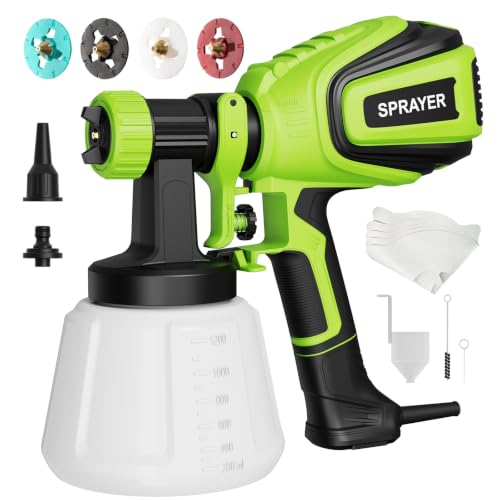
Four nozzle sizes from 1.0mm up to 3.0mm let you switch between thin stains for trim and thicker latex for doors without buying extra parts. That versatility, paired with three spray patterns and a dust-blowing joint for cleaning the surface before you start, makes this kit a strong fit for anyone tackling a mix of trim and door projects around the house. The tool-free assembly and included cleaning brush keep setup and teardown fast. You spend less time fiddling and more time painting.
The VONFORN HVLP Paint Sprayer includes four nozzle sizes from 1.0mm to 3.0mm, so you can switch between fine furniture finishing and heavier fence painting without buying extra tips. The Wagner Earlex 5700 is a stationary HVLP system for woodworking projects, meaning it stays on a table while you work; the VONFORN is handheld, so you carry the sprayer to each surface. That portability is handy for moving around a room, but you hold the unit for the whole job.
Product photos
HomeRight Super Finish Max Sprayer
What We Like
- Lightweight at 3.3 pounds
- Three brass tips included
- Three spray patterns for versatility
- Requires less thinning than Finish Max
Trade-offs
- Handheld design limits reach for large surfaces
- Requires more cleanup than cup-style sprayers
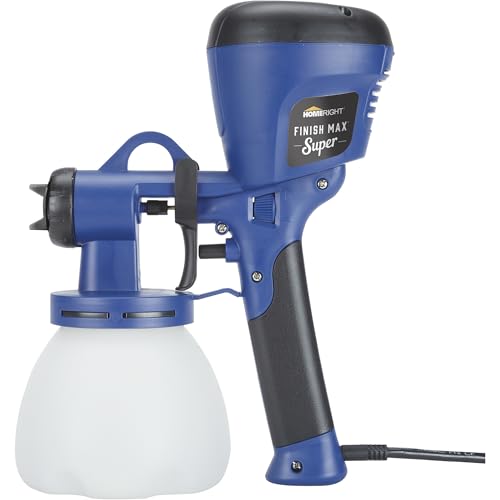
At just 3.3 pounds, this sprayer stays comfortable in your hand for extended trim and door work, where control matters more than raw speed. The three brass tips and three spray patterns let you switch between stains, sealers, and latex paint without stopping to swap parts. You can move from a door panel to a window casing with a quick adjustment. It suits DIYers who want a smooth finish on furniture, cabinets, and interior millwork without wrestling a heavy machine.
Its lightweight handheld design works best for smaller projects. For a whole house of trim or multiple doors in one day, a stationary system like the Earlex 5700 might save your arm. But if you value maneuverability and easy cleanup for weekend projects, this sprayer keeps the focus on the work, not the tool.
Wagner FLEXiO 595 Paint Sprayer
What We Like
- Two nozzles for large and fine work
- Sprays unthinned latex with iSpray nozzle
- 9 adjustable speed settings for control
- 10% lighter than prior FLEXiO models
Trade-offs
- Heavier than the ScotchBlue Easy Clean Sprayer
- Lacks a carrying case for storage and transport.
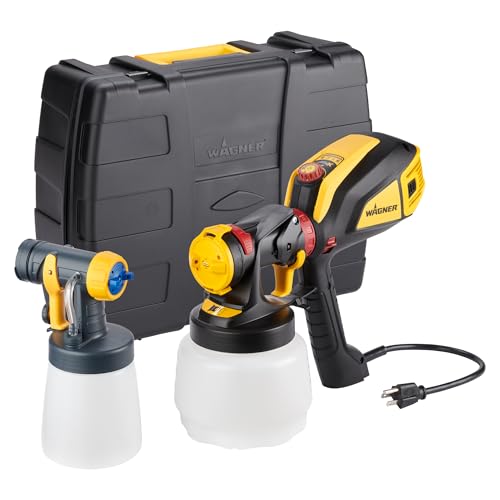
The two-nozzle system, a wide iSpray for big surfaces and a Detail Finish nozzle for precision, lets you switch from spraying an entire door to painting trim without changing tools. With nine speed settings and adjustable spray width, you can dial in the right flow for latex, stain, or enamel, and the X-Boost turbine handles unthinned paint through the iSpray nozzle. That makes it a strong fit for anyone tackling both large trim sections and detailed cabinet work in the same project.
The iSpray nozzle sprays unthinned latex, so you can tackle walls and siding straight from the can without thinning. The Detail Finish nozzle is included for smaller projects like cabinets and furniture. Compared to the HomeRight Super Finish Max, which uses three brass tips, the Wagner offers more speed on large surfaces but requires swapping nozzles when switching between broad and fine work.
ScotchBlue Easy Clean Paint Sprayer
What We Like
- 1-minute cleanup with no disassembly
- Disposable components for fast color swaps
- Integrated paint filtration, no pre-straining
- Sprays at any angle for grooves
Trade-offs
- Requires a separate 6-gallon air compressor
- Only works with water-based paints
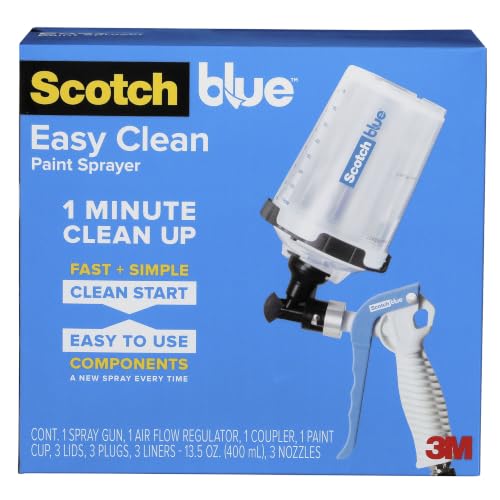
A one-minute cleanup that needs no spray gun disassembly is the headline here, and it delivers exactly what it promises. The ScotchBlue Easy Clean Paint Sprayer keeps paint out of the gun body, so you just twist off the disposable cup, liner, and nozzle, toss them, and you are done. That makes it a natural fit for weekend DIYers who want to spray a door or a set of cabinet fronts without spending half the afternoon scrubbing a spray tip. The integrated paint filtration also saves you the step of straining paint beforehand, and the ability to spray at any angle helps you reach into trim grooves and panel recesses without fighting gravity.
This is not a standalone tool. It requires a 6-gallon or larger air compressor, an air hose, a wrench, and thread tape, none of which come in the box. For someone who already owns a suitable compressor, the ScotchBlue is a light, fast-cleaning option that swaps colors in seconds. For someone who does not, the extra equipment cost and setup step may steer them toward an all-in-one sprayer.
Product photos
WORKPRO HVLP Paint Sprayer
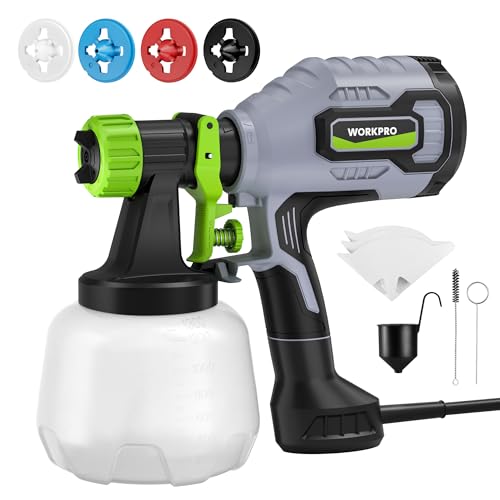
What We Like
- 44 fl oz container reduces refill stops
- 4 nozzle sizes for varied paint types
- Adjustable flow control for precision
- 600W motor for steady atomization
Trade-offs
- At 5.8 inches wide, less compact for tight spaces
- Requires immediate cleaning after each use
A 44 fl oz container means you can spray multiple door panels or a full set of trim without stopping to refill. That generous capacity, paired with a 600W motor and four nozzle sizes from 1.5mm to 2.6mm, gives you the flexibility to handle thin stains on cabinet doors and thicker latex on baseboards alike. The adjustable flow control lets you dial back the paint output for detailed work, then open it up for broader passes. This is a smart fit for anyone tackling a whole room’s worth of trim, doors, or cabinets in one session.
The 44 fl. oz. container holds enough paint for medium to large projects, so you can spray walls or fences without constant refills. That capacity comes with a trade-off: the sprayer measures about 5.8 inches on each side, which is bigger than a compact model like the Tilswall Shark 600. You will also need to clean it right after use, the instructions warn against leaving it uncleaned overnight to avoid clogs.
Product photos
Tilswall Shark 600 Paint Sprayer
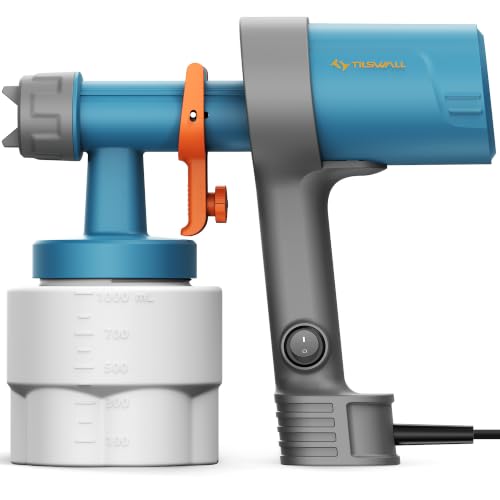
What We Like
- Ultra-light design reduces arm fatigue
- Fully assembled, no tools needed
- 3 nozzles and 3 spray patterns
- Easy to clean with included brush
Trade-offs
- Requires paint thinning for best results
- Must clean within 15 minutes after use
Three interchangeable nozzles, sized 1.3mm, 1.8mm, and 2.6mm, team up with a choice of horizontal, vertical, or circular spray patterns. That combination lets you switch from a fine finish on cabinet details to a wider fan for door panels without swapping tools. The adjustable flow rate goes from zero up to 1200 mL per minute, so you can feather the trigger for delicate touch-up work or open it up for broad coverage on a fence. Owners report that matching the nozzle to the paint viscosity, measured with the included cup, is key to avoiding drips and getting that smooth, even coat every time.
You must thin paint to the right viscosity using the included cup and clean the sprayer within 15 minutes after use to avoid clogs. Compared to the HomeRight Super Finish Max, which includes three brass tips, the Shark 600 relies on interchangeable nozzles and favors thinner paints for best results. For focused projects where a lightweight, easy-to-clean tool matters, this design delivers as advertised.
Fuji Spray Semi-PRO 2 HVLP System
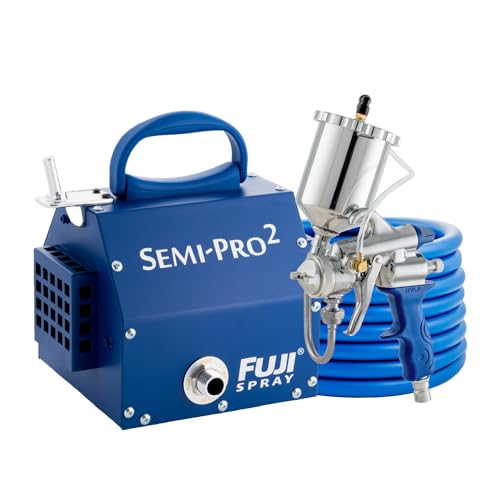
What We Like
- 1400W motor for consistent airflow
- Adjustable fan pattern control
- 25ft hose reduces overspray
- Metal turbine case with gun holder
Trade-offs
- At 25.2 lb, not for extended handheld use
- 400cc cup requires frequent refills on large jobs
- Stationary turbine limits mobility
The 1400W motor powers this HVLP system, and the 25-foot hose with an air control valve is designed to reduce overspray and bounce-back. The 1.3mm air cap and adjustable fan pattern let you change the spray width for different surfaces. This is a turbine system with a metal case and a gun holder, built for someone who sprays regularly and wants a reliable tool.
At 25.2 pounds, this is a system you set on the floor or a cart and work from the gun. That works well in a workshop or a room where you can stage the unit. If you need to move between floors or jobsites, a lighter system like the Wagner Earlex 5700 might be easier to carry. The 400cc gravity cup means more frequent refills on larger projects, though the gravity feed helps with thinner materials. For dedicated finishing where the setup stays put, this system delivers control and consistent airflow.
Titan Impact X 440 Airless Sprayer

What We Like
- Logix tip sensing adjusts pump speed automatically
- 1.2 HP brushless motor with 4-year warranty
- Sprays latex, stain, enamel, and lacquer
- Quick-change fluid section for on-site maintenance
Trade-offs
- At 30 lb, it's heavy for handheld use
- Built for 50-100 gallons per week, overkill for small DIY jobs
A 1.2 HP brushless motor and a 50-foot hose mean this sprayer is built to handle whole-house jobs without stopping to refill or reposition. The Logix tip sensing automatically adjusts pump speed when you swap tips, so you get full power for walls and fine control for trim without fiddling with dials. It sprays latex, stain, enamel, and lacquer straight from the box, making it a single-machine solution for pros who move between interior trim and exterior siding in the same week.
The Titan Impact X 440 weighs 30 pounds, so it’s built to stay put on a job site rather than be carried around for quick touch-ups. Designed for 50-100 gallons per week, this sprayer is aimed at contractors who need to cover large areas day after day. That heft means stability when you’re pulling a long hose across a room, and the output capacity keeps you moving without constant refills.
Product photos
How We Evaluated Paint Sprayers For Trim And Doors
Our evaluation focused on manufacturer specifications, expert round-ups, and patterns in owner feedback. We looked for sprayers that excel at the precision and control needed for trim and door work, not just general-purpose painting.
The three criteria that mattered most were spray tip and nozzle options for fine detail work, weight and ergonomics for extended use on doors and long runs of trim, and the type of paint the sprayer can handle without excessive thinning. For trim, a sprayer that can atomize paint finely enough for a smooth finish is essential.
Every evaluation has limits. Without using the products directly, subjective factors like spray pattern quality or ease of adjustment cannot be compared. The assessment relies on what owners consistently report and what the specifications indicate about each model’s intended use.
What To Look For In Paint Sprayers For Trim And Doors
Choosing the right sprayer for trim and doors means focusing on precision, portability, and paint compatibility. Here are the key buying criteria.
Look for a sprayer with a fine-finish tip or nozzle, a weight under 5 pounds for handheld models, and the ability to spray unthinned latex if you plan to use it for doors.
Spray Tip and Nozzle Size
For trim and doors, a smaller tip or nozzle size (typically 1.0mm to 1.8mm) produces a finer spray pattern that reduces overspray and delivers a smooth finish on narrow surfaces. Some sprayers come with multiple nozzle sizes so you can switch between thin stain and thick latex.
Weight and Ergonomics
Spraying a set of doors or a long hallway of trim can take an hour or more. A lightweight sprayer under 5 pounds reduces arm fatigue. Look for models with shoulder straps or padded handles for longer sessions. Stationary turbine systems trade portability for power.
Paint Compatibility and Thinning
Check whether the sprayer can handle unthinned latex, which is common for doors. HVLP sprayers with lower PSI often require thinning, while airless models spray directly from the can. If you switch between oil-based primer and water-based paint, look for quick-change containers.
- Measure your typical project size: a 44-ounce container reduces refills on multiple doors.
- Check if the sprayer includes a cleaning brush or disposable components for faster cleanup.
- Verify the hose length if using a turbine system, a longer hose lets you leave the motor in one spot.
- Consider whether you need a sprayer that works at any angle for door grooves and window frames.
A good rule: if you mostly paint trim and doors, prioritize a fine-finish tip and a lightweight body over raw power.
Paint Sprayers For Trim And Doors Compared
The table below compares the key specifications and best-use scenarios for each of the ten sprayers we evaluated for trim and doors.
| Product | Technology | Spray Patterns | Nozzle Sizes |
|---|---|---|---|
| Titan Tool FlexSpray Paint Sprayer | Jetforce Technology | N/A | FlexFinish & FineFinish |
| Wagner Earlex 5700 HVLP Sprayer | HVLP | Round, horizontal | 1.5mm stainless steel |
| VONFORN HVLP Paint Sprayer | HVLP | Horizontal, vertical, circular | 1.0, 1.5, 2.0, 3.0 mm |
| HomeRight Super Finish Max Sprayer | HVLP | 3 patterns | 3 brass tips |
| Wagner FLEXiO 595 Paint Sprayer | HVLP | N/A | iSpray + Detail Finish |
| ScotchBlue Easy Clean Paint Sprayer | N/A | N/A | 3 Nozzles |
| WORKPRO HVLP Paint Sprayer | HVLP | Horizontal, vertical, circular | 1.5, 1.8, 2.2, 2.6 mm |
| Tilswall Shark 600 Paint Sprayer | HVLP | horizontal, vertical, circular | 1.3mm / 1.8mm / 2.6mm |
| Fuji Spray Semi-PRO 2 HVLP System | HVLP | N/A | 1.3mm installed |
| Titan Impact X 440 Airless Sprayer | Airless | N/A | N/A |
Frequently Asked Questions
What type of paint sprayer is best for trim and doors?
An HVLP (high volume, low pressure) sprayer is typically best for trim and doors because it applies paint with less overspray and more control. Airless sprayers work well for large volumes but may produce a heavier coat. Look for a model with a fine-finish tip or nozzle.
Can I use a paint sprayer for both trim and doors?
Yes, many sprayers include interchangeable nozzles or tips that let you switch between a fine spray for trim and a wider pattern for doors. The Titan Tool FlexSpray is designed specifically for this dual use with its two quick-change front ends.
Do I need to thin paint for a trim sprayer?
It depends on the sprayer. HVLP sprayers with lower power often require thinning latex paint. Airless sprayers and some newer HVLP models like the Wagner FLEXiO 595 can spray unthinned latex. Always check the manufacturer’s recommendations.
How do I clean a paint sprayer after using it on trim?
Most sprayers require flushing the system with water or a cleaning solution. The ScotchBlue Easy Clean model cleans in about one minute with disposable components and no disassembly. Other models include a cleaning brush for the nozzle and cup.
What is the difference between a handheld and a stationary paint sprayer?
Handheld sprayers are lightweight and easy to move around a room, making them good for trim and doors. Stationary turbine systems like the Fuji Spray Semi-PRO 2 offer more consistent airflow and power but require you to move the hose and gun while the motor stays in one place.
The Bottom Line
For most DIYers and homeowners, the Titan Tool FlexSpray Paint Sprayer is the best overall choice because it handles both trim and doors with dedicated front ends. It’s light enough for extended use and versatile enough to grow with your projects.
If you focus on fine furniture and detailed woodwork, the Wagner Earlex 5700 HVLP Sprayer delivers a professional finish with its metal spray gun and flow control dial. Budget-conscious buyers should consider the HomeRight Super Finish Max for its lightweight design and included brass tips.
The most important factor is matching the sprayer to your typical paint material. If you spray unthinned latex regularly, choose an airless or high-power HVLP model. If you work mostly with stains and thinned paints, a standard HVLP sprayer will serve you well.
