
10 Best Paint Primers For Fiberglass in 2026
This post contains affiliate links. As an Amazon Associate, we earn from qualifying purchases.
For fiberglass, the right primer is the difference between a paint job that lasts and one that peels. Our pick for Best Overall is the TotalBoat TotalProtect Marine Barrier Coat Epoxy Primer because it prevents blisters, resists corrosion, and works above and below the waterline. If you are focused on stopping osmotic blistering, the Pettit Protect High Build Epoxy Primer is the specialist choice, while the TotalBoat Marine Topside Boat Paint Primer is ideal for fast-drying topside work.
The challenge with fiberglass is its smooth, non-porous surface, which makes adhesion difficult. Paint needs a mechanical grip, and the wrong primer can lead to delamination, especially in marine environments where moisture and UV are constant threats. You need a product formulated to bond with gelcoat and epoxy surfaces.
This guide is research-based, drawing on manufacturer specifications, expert advice on marine coatings, and patterns in owner feedback. We evaluated ten primers across key criteria to help you choose confidently for your specific project, whether it’s a full hull repaint or a small repair.
Top 10 Paint Primers For Fiberglass in the Market

Certain content that appears on this site comes from Amazon. This content is provided "as is" and is subject to change or removal at any time.
The Best Paint Primers For Fiberglass, Reviewed
TotalBoat TotalProtect Marine Barrier Coat Epoxy Primer

What We Like
- Prevents fiberglass blisters and metal corrosion
- High-build formula for above/below waterline
Trade-offs
- Requires dedicated thinner for cleanup
- Two-part system needs careful mixing
Because it’s a two-part system, you do need to mix the epoxy with its hardener and use the recommended TotalBoat Epoxy Primer Thinner 200 for cleanup or thinning. That’s an extra step compared to a one-part primer, but for a boat that needs serious blister prevention or corrosion protection, the barrier it creates is worth the effort. Owners who want a simpler option for small touch-ups might consider the Rust-Oleum Marine Wood & Fiberglass Primer, though that product is designed mainly to improve topcoat adhesion on wood and fiberglass, not to provide a heavy-duty barrier coat.
Pettit Protect High Build Epoxy Primer

What We Like
- Prevents osmotic blistering in fiberglass
- High-build formula needs fewer coats
- Corrosion protection for metal surfaces
- Professional-grade for new builds and repairs
Trade-offs
- Two-part system requires mixing before use
- Requires accurate measuring and thorough mixing before application.
A two-component epoxy that creates a thick moisture barrier, this primer is built to stop osmotic blistering before it starts. The high-solids formula lays down more film per coat than many barrier systems, so you spend less time applying and more time moving on to painting. It also protects steel, aluminum, and underwater metal gear from corrosion in freshwater and saltwater environments. For anyone restoring a fiberglass hull or prepping for bottom paint, this is the kind of heavy-duty foundation that gives you peace of mind below the waterline.
The two-part epoxy must be mixed before application, and at 15 pounds per gallon, the can demands a sturdy mixing station. For smaller touch-ups, a ready-to-use primer like Rust-Oleum Marine Wood & Fiberglass Primer comes in a quart size. But for full hull protection against osmotic blistering, this Pettit system creates a durable moisture barrier with outstanding water and chemical resistance.
Product photos
TotalBoat Marine Topside Boat Paint Primer

What We Like
- Ready to sand in 60-90 minutes
- Works on fiberglass, wood, and gelcoat
- Chromate-free and lead-free formula
Trade-offs
- Needs proper ventilation during application
- Cannot apply thicker than recommended or cure fails
- Requires thinning with xylene for spray use
A dry time of 60 to 90 minutes at 65°F means you can sand and recoat the same day, which matters when you are working on a boat that needs to get back in the water fast. This one-part primer seals fiberglass, wood, and gelcoat in one coat, with a second coat only if you need more build. It is a straightforward choice for anyone who wants a brush-and-roll process and a fast turnaround. That is especially true if you plan to top it with a polyurethane topside paint like TotalBoat Wet Edge.
If you lay this primer on too thick, it may not cure properly, and for spray use you must thin it with xylene in a well-ventilated area. For a different approach, the Pettit Protect High Build Epoxy Primer is listed among other primers, but its specific filling characteristics are not detailed here. For a fast-drying undercoat on a sound surface, this primer keeps your project moving without unnecessary delays.
Rust-Oleum Stops Rust Filler & Sandable Spray Primer
What We Like
- Fills minor surface imperfections
- Sands smooth for topcoat adhesion
- Dries to touch in 10 minutes
- Sprays from any angle
Trade-offs
- Limited to 10 sq ft per can
- Oil-based requires solvent cleanup
- Flat finish needs sanding before topcoat
A 10-minute dry time means you can recoat or sand that primer almost as fast as you can set down the can, which really speeds up a project. The filler formula goes on and sands smooth, hiding minor surface flaws without needing a separate filler product. The comfort tip works from any angle, so reaching awkward spots on a car panel or a boat hatch is straightforward. It works on wood, metal, and fiberglass, so you can use the same can across different materials.
The trade-off is that each can covers only 10 square feet, so a full fiberglass hull or a large automotive project will need several cans. The oil-based formula means you’ll need mineral spirits for cleanup rather than soap and water. Compared to the TotalBoat TotalProtect Marine Barrier Coat Epoxy Primer, which comes in a gallon and is designed for larger marine surfaces, this Rust-Oleum is better suited for smaller jobs like touch-ups, custom parts, or single panels where you don’t want to mix a two-part epoxy. It’s a fast, accessible option for the DIYer who values speed and simplicity over covering a whole boat in one go.
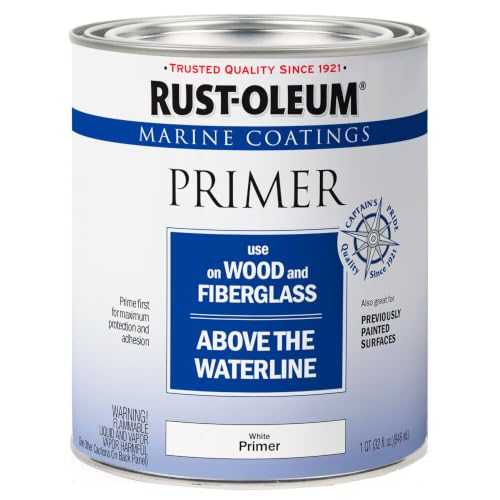
Rust-Oleum Marine Wood & Fiberglass Primer
What We Like
- Improves topcoat adhesion on fiberglass
- Dries to the touch in 1 hour
- Covers 100 sq ft per quart
- Sands easily for a smooth base
Trade-offs
- Limited to above-waterline use only
- Quart size covers only 100 sq ft
With a one-hour dry time and 100 sq ft of coverage per quart, this primer works fast on wood or fiberglass surfaces above the waterline. It improves topcoat adhesion, creating a base that helps finishing paint dry to an even gloss. That makes it a natural fit for boat owners who need a reliable primer for above-waterline areas where appearance matters and adhesion is critical.
This primer is strictly an above-waterline product, so it won’t help with blister prevention or corrosion below the waterline the way a two-part epoxy like TotalBoat TotalProtect would. If your project stays dry and you want a simple, sandable base coat that works with standard marine paints, this Rust-Oleum quart is a practical and affordable option.
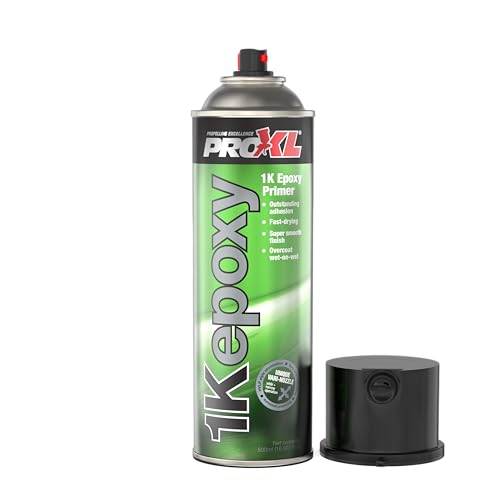
ProXL 1K Epoxy Primer Aerosol
What We Like
- High adhesion to fiberglass and plastics
- Fast-drying and sandable hard finish
- Vari-nozzle adjusts spray width easily
- Corrosion and moisture resistant formula
Trade-offs
- 1K epoxy lacks the durability of 2-part systems
- 500 ml can covers only small areas
The Vari-nozzle on this aerosol lets you dial the fan from a narrow 1-2 inch stream up to a wide 5-6 inch pattern, so you can precisely control coverage on curved fiberglass panels without wasting material. It bonds strongly to fiberglass, metal, and plastics, dries fast to a hard sandable finish, and seals against moisture and corrosion. That makes it a practical pick for small repairs, touch-ups, or projects where you want the adhesion of an epoxy primer without mixing two parts.
The 500 ml aerosol size makes this ideal for small repairs and touch-ups, not for covering a whole boat hull. It sprays easily with a controlled pattern and minimal overspray thanks to the Vari-nozzle, which adjusts from a 1-2 inch fan up to 5-6 inches. For quick, no-mix adhesion on metal, fiberglass, or plastic patches, this primer saves setup time over two-part systems.
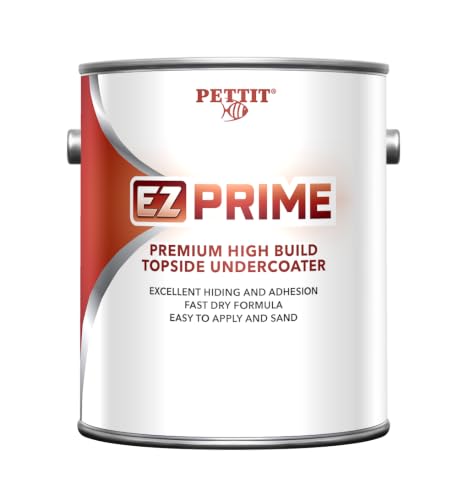
Pettit EZ Prime High Build Topside Undercoater
What We Like
- High-build formula fills cracks and pits
- Fast drying and easy to sand
- One-coat coverage reduces labor
- Works on fiberglass, wood, and metal
Trade-offs
- Designed only for marine topside enamels
- White color limits tinted topcoat options
A high-solids formula that fills cracks, checks, pits, and weathering in a single coat means you can skip multiple rounds of sanding and priming. This quart-sized undercoater is designed for boat owners who want a smooth topside finish with reduced prep time. Its fast-drying nature and easy sanding help speed up project completion. Best suited for fiberglass, wood, and properly prepared metal, it creates the ideal foundation for marine enamels like Pettit or Z-Spar.
If filling surface imperfections is your main goal, this high-build undercoater is designed to hide cracks, checks, pits, weathering, and irregularities, creating a smoother foundation for marine topcoat applications. Compared to the TotalBoat TotalProtect Marine Barrier Coat Epoxy Primer, which is a two-part system aimed at preventing fiberglass blisters, Pettit EZ Prime focuses on building up and smoothing the surface. It works best with marine topside enamels like Pettit, Z-Spar, and Shipendec, so if you plan to use a non-marine or epoxy-based topcoat, you would need a different primer.
Product photos
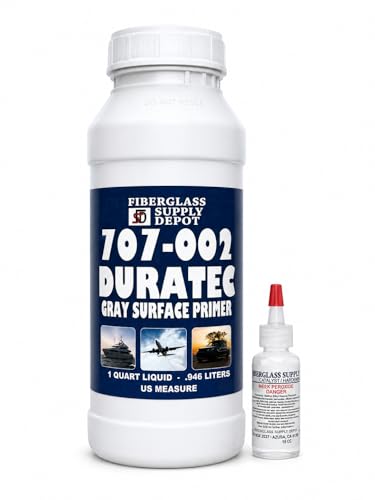
Fiberglass Supply Depot D707-002Q Paint Primers
What We Like
- Fills pinholes for porosity-free surface
- Builds up to 40 mil wet on wet
- Fast air-cure even in thin coats
- Polishes to high-gloss for mold making
Trade-offs
- Designed for composite plugs, not quick touch-ups
- Heat distortion at 200°F limits high-temp applications
A 40-mil wet-on-wet build means you can lay down a thick, even coat in a single session, saving hours of sanding and recoating on fiberglass plugs or master molds. The low-porosity formula is engineered to eliminate pinholes and defects, so you get a glass-smooth surface ready for mold making or topcoat application. This primer suits anyone building composite parts, patterns, or high-density foam projects who needs a fast-curing, high-build foundation that sands easily and polishes to a gloss.
A 200°F heat distortion rating means this primer handles epoxy and fiberglass work without softening under cure temperatures, so it’s reliable for composite plugs and mold surfaces. The title lists a 15cc hardener, which implies mixing is part of the process, but the real payoff is the low-porosity finish that blocks pinholes and defects. For builders chasing a flawless surface, that extra step is a fair exchange.
Product photos
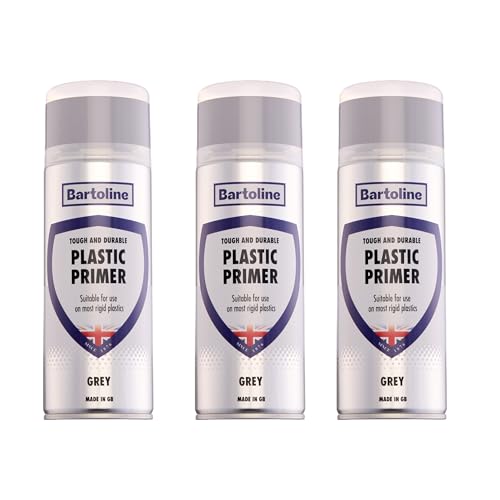
Bartoline Plastic Primer Spray Paint
What We Like
- Strong adhesion to rigid plastics and fiberglass
- Fast-drying aerosol for quick coverage
- Smooth, sandable finish for overcoating
- Works indoors and outdoors on various projects
Trade-offs
- Not designed for large surfaces like boat hulls
- Requires topcoat paint for final finish
Three 13.5 oz cans give you enough primer for multiple small to medium jobs without a trip back to the store. The formula bonds to fiberglass, PVC, vinyl, resin, and polypropylene, so it works on the rigid plastics that often need a dedicated primer. A fast-drying aerosol means you can apply a coat and move on quickly, and the smooth, sandable finish is ready for overcoating with topcoat paints. This primer is listed for use on automotive parts, garden items, and household DIY projects where adhesion on plastic and fiberglass is the main concern.
The three-pack of 13.5 oz aerosol cans is designed for smaller projects like plastic garden chairs or automotive parts, not for covering a full boat hull. Each can holds 400 ml of primer that bonds strongly to rigid plastics such as PVC, vinyl, resin, polypropylene, and fiberglass. The spray format dries quickly and leaves a smooth, sandable finish ready for topcoat paint, so you can skip mixing and cleanup.
Product photos
Evercoat Slick Sand Polyester Primer Surfacer

What We Like
- Fills rough surfaces in one coat
- Sands easily with 180-220 grit
- Works on fiberglass, metal, and wood
- Large 128-ounce can for big jobs
Trade-offs
- At 11.5 pounds, heavy for handheld sanding
- Requires orbital sander, not hand-sand friendly
- Polyester formula needs careful mixing and timing
A 128-ounce can means you can lay down a thick, fill-ready coat across a whole fiberglass hull or auto panel without running out halfway. This polyester surfacer is built for people who want to smooth out deep scratches, pinholes, and uneven surfaces in a single pass, as it is ideally suited for filling most rough and uneven surfaces in one coat. It is the right choice if you are doing serious bodywork on fiberglass, metal, or wood and you already own an orbital sander, because the recommended 180 to 220 grit sandpaper works fast on this primer. The large volume and high-build nature make it a shop-friendly workhorse for projects that need a flat, paintable foundation.
Weight and process are the main drawbacks here. At 11.5 pounds, this gallon can is heavy, and the polyester formula requires you to work quickly before it sets, this is not a grab-and-spray product like the Rust-Oleum Marine Wood & Fiberglass Primer. If you prefer a simpler, ready-to-use primer that you can brush on in small areas, the lighter Pettit EZ Prime High Build Topside Undercoater might be more convenient. But for anyone laying down a single thick coat that sands down to a smooth, professional finish, the Evercoat Slick Sand delivers the filling power and sandability that polyester surfacers are known for.
Product photos
How We Evaluated Paint Primers For Fiberglass
Our evaluation relied on technical specifications from manufacturers, guidance from marine coating experts, and common themes from owner reports. We focused on the chemical and physical properties that determine success on fiberglass surfaces.
The four criteria that mattered most were adhesion and substrate compatibility, build and filling capability, drying and sanding characteristics, and the intended application environment (above or below the waterline). A primer that bonds poorly to gelcoat will fail, while one that cannot fill pinholes or sand smoothly creates extra work.
A research-led evaluation like this cannot replicate real-world application conditions, but it can identify the primers with the strongest formulations and the most consistent user outcomes. We prioritized products with clear technical data and well-documented success in marine and automotive fiberglass work.
What To Look For In Paint Primers For Fiberglass
Choosing a primer for fiberglass comes down to matching the product’s chemistry and format to your specific job. A general rule is that epoxy primers offer the best protection and adhesion, while polyester surfacers fill faster but require more skill to apply.
Adhesion To Gelcoat And Epoxy
Fiberglass surfaces are slick. A primer must chemically or mechanically bond to the existing gelcoat or epoxy. Look for primers specifically labeled for fiberglass or marine use, as these contain resins formulated for low-porosity substrates. Two-part epoxy primers generally provide the strongest bond, while aerosol options like the ProXL 1K Epoxy Primer offer convenience for small repairs.
Build And Filling Capability
Many fiberglass surfaces have pinholes, cracks, or weave texture. High-build primers like the Evercoat Slick Sand Polyester Primer Surfacer can fill these imperfections in one coat, saving significant sanding time. The Pettit EZ Prime High Build Topside Undercoater is another option for filling small flaws on topside surfaces. If your surface is already smooth, a thinner primer will suffice.
Drying Time And Sandability
Time matters. A fast-drying primer like the TotalBoat Marine Topside Boat Paint Primer can be sanded in 60 to 90 minutes, keeping a project moving. Slower-curing epoxy primers offer better chemical resistance but require patience. A primer that sands easily with 180 to 220 grit paper reduces labor and prevents clogging.
Rule of thumb: For below-waterline durability, choose a two-part epoxy primer. For topside cosmetic work, a high-build polyester or fast-drying marine primer will save time.
- Check the recommended thinner and clean-up solvent before buying.
- Confirm the primer is compatible with your intended topcoat (e.g., polyurethane, enamel, or epoxy).
- For spray cans, verify the coverage area per can to ensure you have enough for your project.
- If working in a garage, ensure the product can be applied at lower temperatures or with proper ventilation.
- Always test adhesion on a small, inconspicuous area first.
Paint Primers For Fiberglass Compared
The table below compares the key features of each primer, including its best use, build type, and drying time, to help you narrow down your choice at a glance.
| Product | Type | Application | Surface/Substrate |
|---|---|---|---|
| TotalBoat TotalProtect Marine Barrier Coat Epoxy Primer | 2-part epoxy primer/barrier coat | Roller or spray | N/A |
| Pettit Protect High Build Epoxy Primer | 2-part epoxy | Brush, roll, or spray | N/A |
| TotalBoat Marine Topside Boat Paint Primer | One-part marine primer | Brush, roll, or spray | N/A |
| Rust-Oleum Stops Rust Filler & Sandable Spray Primer | Oil-based, rust preventive | N/A | Wood, metal, fiberglass |
| Rust-Oleum Marine Wood & Fiberglass Primer | N/A | N/A | Wood & fiberglass |
| ProXL 1K Epoxy Primer Aerosol | N/A | Aerosol with Vari-nozzle | Metal, Fibreglass, Plastics |
| Pettit EZ Prime High Build Topside Undercoater | N/A | N/A | Fiberglass, wood, metal, painted |
| Fiberglass Supply Depot D707-002Q Paint Primers | N/A | N/A | N/A |
| Bartoline Plastic Primer Spray Paint | N/A | N/A | PVC, vinyl, resin, polypropylene, fiberglass |
| Evercoat Slick Sand Polyester Primer Surfacer | Polyester Primer Surfacer | Orbital sander, 180-220 grit | Metal, aluminum, fiberglass, wood |
Frequently Asked Questions
Can I use regular auto primer on fiberglass?
You can, but it is not recommended for marine applications. Standard auto primers are not formulated to resist osmotic blistering or bond as aggressively to gelcoat. For boats, a dedicated marine or fiberglass primer like the TotalBoat TotalProtect or Pettit Protect offers much better long-term protection.
How do I prepare fiberglass before priming?
The surface must be clean, dry, and sanded. Use coarse grit paper to rough up the gelcoat, then wipe down with a solvent like acetone or dewaxer to remove any contaminants. For repairs, fill any deep gouges or cracks with an epoxy filler before priming.
What is the difference between epoxy and polyester primer for fiberglass?
Epoxy primers provide superior adhesion, moisture resistance, and blister prevention, making them ideal for below-waterline use. Polyester primers like the Evercoat Slick Sand are high-build and sand very easily, but they are more brittle and less moisture-resistant. Polyester is best for topside bodywork and filling.
How many coats of primer do I need on fiberglass?
It depends on the primer’s build. High-build primers like the Pettit EZ Prime or Evercoat Slick Sand can fill and level in one or two coats. Standard primers may require three or more coats to achieve a smooth, pinhole-free surface. Always follow the manufacturer’s recommended dry film thickness.
Can I spray fiberglass primer with a brush?
Yes, but it is not ideal for a smooth finish. Brushing works for small areas and high-build primers, but you will need to sand more aggressively to level the brush strokes. For large hulls, spraying with a gun or using an aerosol like the ProXL 1K Epoxy Primer gives a more uniform result.
The Bottom Line
The TotalBoat TotalProtect Marine Barrier Coat Epoxy Primer is the best overall choice for anyone serious about protecting a fiberglass hull from blisters and corrosion. It is a two-part system that requires careful mixing, but its high-build formula and dual above/below-waterline capability make it the most versatile and durable option in this guide.
If your priority is preventing osmotic blistering on a new build or major restoration, the Pettit Protect High Build Epoxy Primer is the specialist pick. For smaller projects, the Rust-Oleum Stops Rust Filler & Sandable Spray Primer offers an accessible aerosol solution that fills and primes quickly.
The single most important factor is matching the primer’s chemistry to your application environment. Choose epoxy for below-waterline durability and moisture resistance, and choose a fast-drying or high-build option for topside cosmetic work.
