
10 Best Paint For Metal Roofing in 2026
This post contains affiliate links. As an Amazon Associate, we earn from qualifying purchases.
For homeowners looking to protect and refresh a metal roof, the Ames Maximum Stretch Roof Coating stands out as the best overall pick thanks to its exceptional 650% elongation and 88% light reflectivity. It resists cracking and peeling while lowering cooling costs, making it ideal for low-slope metal roofs. For sunny climates, the Rust-Oleum 710 Elastomeric Roof Coating offers high solar reflectivity, while the Liquid Rubber Silicone Roof Coating provides top-tier UV stability.
The challenge with painting a metal roof is finding a coating that sticks through extreme temperature swings, resists rust, and stays flexible enough to move with the metal without cracking. Many standard paints fail within a season because they lack the elastomeric properties needed for this demanding surface.
This guide is research-based, drawing on manufacturer specifications, expert round-ups, and patterns in owner feedback to compare 10 top coatings. We break down what matters most, flexibility, reflectivity, adhesion, and durability, so you can choose with confidence.
Top 10 Paints For Metal Roofing in the Market
Certain content that appears on this site comes from Amazon. This content is provided "as is" and is subject to change or removal at any time.
The Best Paints For Metal Roofing, Reviewed
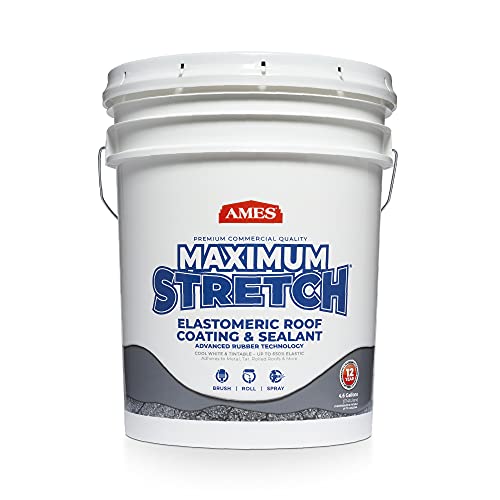
Ames Maximum Stretch Roof Coating
What We Like
- 650% elongation resists cracking and peeling
- 88% light reflectivity lowers cooling costs
- Adheres to metal, tar, and rolled roofs
- Non-toxic, low VOC, made in USA
Trade-offs
- At 53 pounds, heavy to lift onto a roof
- White only; tintable but not pre-colored
With 650% elongation, this coating stretches to six and a half times its original length before cracking, which helps it resist cracking and peeling as the roof moves. That flexibility, combined with 88% light reflectivity, reduces surface temperatures and can lower cooling costs. It adheres directly to metal, tar, and rolled roofing without needing a separate primer, and the low-VOC formula makes it safer to apply. For a low-slope roof, the 5-gallon pail provides enough material for a full job, though coverage will depend on the surface condition and application method.
The trade-off is weight: at 53 pounds per pail, hauling it up a ladder takes real effort. If your project is a large low-slope metal roof and you can manage the lifting, this coating offers the flexibility and heat reflection that smaller containers may not provide for a full roof. For smaller patches or lighter jobs, a gallon-sized product might be easier to handle.
Product photos
Rust-Oleum 710 Elastomeric Roof Coating

What We Like
- 80% solar reflectivity cuts cooling costs
- Waterproof seal sets in 6 hours
- Resists cracking down to -10°F
- 10-year warranty backs durability
Trade-offs
- Gallon 2-pack covers less area than 5-gallon options
- White color shows dirt more than aluminum finishes
This coating reflects 80% of solar heat, which can help lower cooling costs during hot weather, and it forms a waterproof seal within six hours. The 10-year warranty adds long-term protection against defects. It resists cracking down to -10°F, making it suitable for cold climates as well. For metal roofs in sunny areas, the reflectivity and quick waterproofing are practical benefits.
Coverage is a consideration: this product is sold as a two-pack of gallons, so for very large roofs you may need multiple sets. The white finish can show dirt more than some darker coatings, but the high reflectivity and warranty make it a strong option for smaller projects where energy savings are a priority.
Product photos
Liquid Rubber Silicone Roof Coating

What We Like
- UV-stable, won't degrade from sun
- Over 237% elongation prevents cracking
- No solvents or harmful odors
- Works on metal, concrete, and more
Trade-offs
- Requires primer for EPDM and TPO roofs
- Coverage is 1 gallon per 50 sq ft, so large roofs need many gallons
A silicone coating that stretches over 237% without cracking means it handles thermal expansion on metal roofs better than many alternatives. The UV-stable formula won’t break down from exposure, so a white reflective coat stays bright and keeps cooling benefits over time. The zero-solvent, ultra-low-VOC composition means you can apply it indoors or outdoors without a special breathing apparatus.
Owners of EPDM or TPO roofs should plan for an extra step. Unlike most other surfaces, those two materials require a separate primer before the Liquid Rubber Silicone Roof Coating can be applied. That adds a bit of time and expense to the project, since primer is not included. For metal, concrete, wood, or standard flat and low-slope roofs, no primer is needed at all. The coating goes directly onto the clean surface, saving effort and keeping the job straightforward. Just be sure to check your roof type before starting so you have everything on hand.
Rust-Oleum 510 Fibered Aluminum Roof Coating

What We Like
- 7 Year Warranty for long-term confidence
- Waterproof and rustproof protection built in
- Cool Roof Technology with 53% reflectivity
- Self primes over tight rust
Trade-offs
- Reflectivity lower than some silicone coatings
- Only sold as 2-pack gallon set
A 7 Year Warranty is rare for a roof coating, and it signals the kind of durability you want when protecting a metal roof from rust. The Rust-Oleum 510 Fibered Aluminum Roof Coating delivers waterproof and rustproof protection without needing a separate primer, you can brush or roll it directly over tight rust. Its Cool Roof Technology reflects 53% of the sun’s heat, which helps lower cooling costs on a hot metal roof. This is the coating to reach for when your top priority is stopping rust in its tracks and keeping it sealed for years.
The 7-year warranty on this Rust-Oleum roof coating means you get long-term protection for metal roofs, which is its main selling point. It self-primes over tight rust, so there’s no need for a separate primer step before application. With Cool Roof Technology offering 53% reflectivity, it can help lower energy costs by reflecting sunlight. For a metal roof where rust is the primary concern, this coating’s rustproofing and warranty make it a practical pick.
Product photos
Nationwide Coatings 17038 Paint

What We Like
- Ceramic heat-dissipating technology reduces energy costs
- 100+ mph windlift and wind-driven rain protection
- Class A fire rating per NFPA 101
- 9-color fan deck for curb appeal
Trade-offs
- Two coats required for full coverage
- Not suitable for flat or low-slope roofs
The ceramic microspheres in this coating help dissipate absorbed heat rather than letting it travel into the dwelling, which can keep the interior cooler in hot months and help reduce energy costs. The elastomeric membrane seals against wind-driven rain at over 100 mph and carries a Class A fire rating per NFPA 101. It suits homeowners who want energy savings and a fire-safe, durable finish on a sloped metal or tile roof, and the nine-color fan deck lets you match your home’s style without replacing the roof.
This product requires two coats and a clean, dry surface above 45°F, so it’s a weekend project rather than a quick touch-up. If your roof is sloped and you want a coating that reflects UV rays and dissipates heat, this product is formulated for that purpose.
Product photos
Liquid Rubber Color Roof Sealant

What We Like
- 900% elongation resists cracking
- Water-based, low-odor formula
- UV-stable and solar reflective
Trade-offs
- Requires multiple heavy coats
- Coverage is very thick per pail
Up to 900% elongation lets this coating flex with roof movement without cracking or peeling, which is critical for metal roofing that expands and contracts with temperature swings. That extreme flexibility, paired with a temperature range from -40°F to 150°F, makes it a strong choice for climates with freeze-thaw cycles or intense sun. The water-based, low-odor formula keeps application comfortable, and the UV-resistant, solar-reflective finish helps protect the roof from sun damage. For anyone wanting a membrane that moves with the roof rather than fighting it, this is the one to reach for.
Tenee RV Roof Coating

What We Like
- 1000%+ elongation handles roof expansion
- 88% solar reflectivity reduces heat absorption
- No primer needed on TPO surfaces
- Water-based, no-VOC formula
Trade-offs
- EPDM requires separate compatible primer
- Coverage only 50 sq. ft. per gallon
An 88% solar reflectivity rating means this coating actively bounces heat away from your RV roof, keeping the interior cooler and slowing UV damage. The 1000%+ elongation lets the membrane stretch as the roof expands and contracts with temperature changes, which helps prevent cracking. It works on TPO without primer, which simplifies the job for many owners, and the water-based formula means no harsh fumes during application.
Coverage is the main trade-off here. At 50 square feet per gallon, a larger motorhome will need multiple gallons. The coating is designed for broad roof areas; for vents, skylights, seams, joints, or larger cracks, you’ll need to first repair with compatible seam tape or self-leveling sealant. The Ames Maximum Stretch Roof Coating comes in a five-gallon pail, which may be more convenient for larger projects. If you own a camper or travel trailer and want a flexible, reflective layer that goes on easily, this fits the bill. For a full-size bus conversion, you’d want a higher-volume product.
Product photos
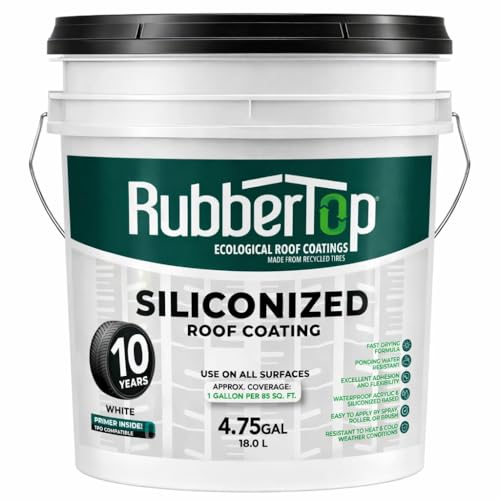
Rubbertop USA Siliconized Roof Coating
What We Like
- Lowers interior temperature up to 25%
- Waterproof acrylic & siliconized elastomeric formula
- Fast drying for flat and metal roofs
- Resistant to both heat and cold
Trade-offs
- 4.75 gallon pail is heavy for ladder work
- Requires primer on some surfaces for adhesion
A 25% reduction in interior temperature is the standout number here, directly addressing the biggest pain point of a metal roof in summer: the oven effect. Rubbertop USA’s siliconized acrylic formula combines the adhesion and breathability of acrylic with added weather resistance, making it a strong fit for DIYers who want a cooler home without switching to a full silicone system. It applies with spray, roller, or brush, so you can work at your own pace, and the fast-drying nature means you are not waiting days between coats.
Weight is the main consideration here. At 4.75 gallons, this pail is a haul up a ladder, especially compared to the 1-gallon cans of a product like Rust-Oleum 710 Elastomeric Roof Coating, which are easier to carry in batches. For homeowners who prioritize heat reflection and ease of application over ultimate longevity, this is a smart middle ground.
Product photos
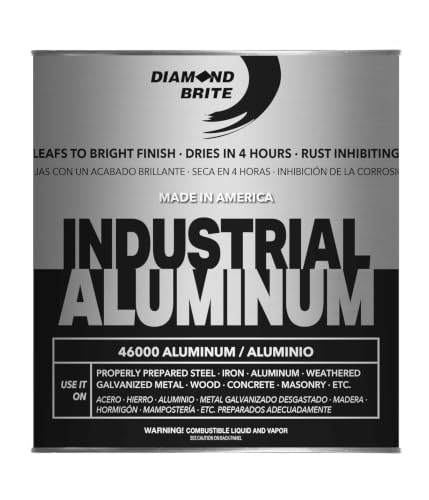
Diamond Brite Aluminum Paint
What We Like
- Works on hot surfaces
- Can be brushed, rolled, or sprayed
- Suitable for metal roofs and machinery
Trade-offs
- 1-gallon size covers less area than 5-gallon options
- At 10.0 lb, heavier than some small roof coatings
A gallon of aluminum paint that handles hot surfaces means you can coat a metal roof under the midday sun without worrying about flash drying or poor adhesion. Diamond Brite Aluminum Paint keeps things simple: brush it, roll it, or spray it onto properly prepared metal, and it bonds well enough for radiators and machinery, so a roof is well within its range. This is the pick for anyone who wants a straightforward, budget-friendly option for a smaller metal roof project without stepping up to a premium elastomeric or fibered coating.
Coverage is the main consideration here. At one gallon and 10.0 pounds, this paint covers less area than a five-gallon bucket like the Ames Maximum Stretch Roof Coating, so you might need multiple gallons for a larger roof. But if your job is a shed, a small barn, or a section of flashing, Diamond Brite gives you the heat tolerance and application flexibility of a dedicated metal paint without the extra cost or weight of a heavy-duty roof coating system.
Gardner AP-2085 Paint

What We Like
- Rust-inhibiting for metal surfaces
- Reflective coating lowers cooling costs
- Fibered for added durability
- Meets ASTM D2824 performance standards
Trade-offs
- At 42.1 lb, heavy to lift onto a roof
- Overkill for small shed or touch-up repairs
A 5-gallon pail of fibered aluminum coating means you can cover a substantial metal roof in one go, with the reflective pigment actively bouncing heat away to reduce cooling bills. The coating includes rust-inhibiting properties for metal surfaces, and the interlocking fibers help extend roof life while meeting ASTM D2824 performance requirements. This is a heavy-duty solution for corrosion prevention and energy savings, suitable for those coating large areas.
At 42.1 pounds, this 5-gallon pail is a serious load to haul up a ladder, so it’s best reserved for a full roof job rather than small patches. For lighter work, the Rust-Oleum 510 Fibered Aluminum Roof Coating comes in gallon containers that are easier to manage on a ladder. When you need to protect a metal roof from rust and reflect heat, this Gardner coating delivers the coverage and durability the specs promise.
Product photos
How We Evaluated Paints For Metal Roofing
Our evaluation relies on manufacturer specifications, expert round-ups, and patterns in owner feedback to identify the strongest options for metal roofing. We analyzed published performance data and common owner experiences to separate marketing claims from real-world value.
The four criteria that mattered most were elongation, solar reflectivity, adhesion to metal surfaces, and warranty coverage. Elongation measures flexibility to resist cracking as metal expands and contracts. Solar reflectivity shows how much heat the coating bounces away. Warranty coverage signals manufacturer confidence. We also weighed practical factors like coverage area per gallon and ease of application.
A research-led evaluation has limits: it cannot capture how a coating performs after years of weather exposure in your specific climate. We recommend cross-referencing these findings with local contractor input and checking the manufacturer’s surface preparation guidelines for your roof type.
What To Look For In Paints For Metal Roofing
Choosing the right coating for your metal roof means balancing flexibility, reflectivity, and durability against your roof’s slope and your climate. Here are the key factors to consider.
Focus on elongation percentage for crack resistance, solar reflectivity for energy savings, and the warranty length as a gauge of durability. Match the coating type to your roof’s slope and material.
Elongation and Flexibility
Metal roofs expand and contract with temperature changes. A coating with high elongation can stretch without cracking. Products like the Liquid Rubber Color Roof Sealant offer 900% elongation, while the Ames Maximum Stretch Roof Coating provides 650%. For extreme climates with wide temperature swings, prioritize coatings with high elongation to avoid premature failure.
Solar Reflectivity and Energy Efficiency
A coating’s solar reflectivity index tells you how much sunlight it bounces away from the roof. Higher reflectivity means lower interior temperatures and reduced cooling costs. The Ames Maximum Stretch Roof Coating achieves 88% reflectivity, while the Rust-Oleum 710 Elastomeric Roof Coating hits 80%. For hot, sunny regions, look for reflectivity above a high percentage.
Rust Protection and Adhesion
Metal roofs are prone to rust, especially at fasteners and seams. Some coatings, like the Rust-Oleum 510 Fibered Aluminum Roof Coating, are self-priming over tight rust and include rustproof protection. Others require a separate primer for adhesion to certain substrates. Check whether the coating is fibered or silicone-based, as these formulas tend to bond better to metal.
- Check the coverage rate per gallon to estimate how many pails you need.
- Verify if a primer is required for your specific roof material.
- Look at the dry time and temperature range for application.
- Confirm the coating is suitable for your roof’s slope (low-slope versus steep).
- Read the warranty terms to understand what’s covered.
A simple rule: the higher the elongation and reflectivity numbers, the more protection and energy savings you can expect, but you may pay more per gallon.
Paints For Metal Roofing Compared
The table below compares the key specs of each coating side by side, helping you quickly see which one fits your roof’s needs.
| Product | Container Size | Material | Elongation |
|---|---|---|---|
| Ames Maximum Stretch Roof Coating | 5 Gallon | Elastomeric, Acrylic, Rubberized | 650% |
| Rust-Oleum 710 Elastomeric Roof Coating | Gallon | N/A | N/A |
| Liquid Rubber Silicone Roof Coating | 1 Gallon | Silicone | Over 237% |
| Rust-Oleum 510 Fibered Aluminum Roof Coating | Gallon | N/A | N/A |
| Nationwide Coatings 17038 Paint | 1 Gallon | Elastomeric Ceramic | N/A |
| Liquid Rubber Color Roof Sealant | 5 Gallon | Elastomeric | Up to 900% |
| Tenee RV Roof Coating | 1 Gal | Liquid Rubber | 1000%+ |
| Rubbertop USA Siliconized Roof Coating | 4.75 Gallon Pail | Acrylic & Siliconized Elastomeric | N/A |
| Diamond Brite Aluminum Paint | 1 Gallon | N/A | N/A |
| Gardner AP-2085 Paint | 5 Gallons | Fibered aluminum coating | N/A |
Frequently Asked Questions
Can I paint over an existing coating on my metal roof?
Yes, but only if the existing coating is sound and clean. Power wash the surface to remove dirt and loose material. If the old coating is peeling or chalking, you may need to strip it or apply a bonding primer first.
How long does metal roof paint typically last?
Most high-quality elastomeric coatings last 5 to 10 years when applied correctly. The Rust-Oleum 710 Elastomeric Roof Coating comes with a 10-year warranty, while the Rust-Oleum 510 Fibered Aluminum Roof Coating offers a 7-year warranty. Proper surface preparation and application extend the lifespan.
What is the difference between aluminum paint and elastomeric coating?
Aluminum paint, like the Diamond Brite Aluminum Paint, provides a thin, reflective layer that resists heat and rust. Elastomeric coatings are thicker and flexible, stretching with the metal to prevent cracking. For large roofs with temperature swings, elastomeric coatings offer better long-term protection.
Do I need a primer before applying metal roof paint?
It depends on the coating and your roof’s material. Some coatings, such as the Rust-Oleum 510 Fibered Aluminum Roof Coating, are self-priming over tight rust. Others, like the Liquid Rubber Silicone Roof Coating, require a separate primer for EPDM and TPO roofs. Always read the manufacturer’s instructions.
Can I apply metal roof coating in cold weather?
Most coatings require temperatures above 50°F for proper curing. The Rust-Oleum 710 Elastomeric Roof Coating resists cracking down to -10°F after it cures, but application still needs mild conditions. Check the product label for the minimum application temperature.
The Bottom Line
The Ames Maximum Stretch Roof Coating is the best overall choice for most homeowners with low-slope metal roofs. Its 650% elongation and 88% reflectivity deliver both crack resistance and energy savings, backed by a low-VOC, non-toxic formula made in the USA. It’s heavy at 53 pounds, so plan for help getting it onto the roof.
If your roof is in a sunny climate and you want a 10-year warranty, the Rust-Oleum 710 Elastomeric Roof Coating is a strong alternative. For those on a budget tackling a small metal surface, the Diamond Brite Aluminum Paint offers a heat-tolerant, easy-to-apply option that won’t break the bank.
The single most important factor when buying paint for a metal roof is elongation, the coating’s ability to stretch without cracking. Prioritize this number above all else, and your roof will stay protected through every season.
